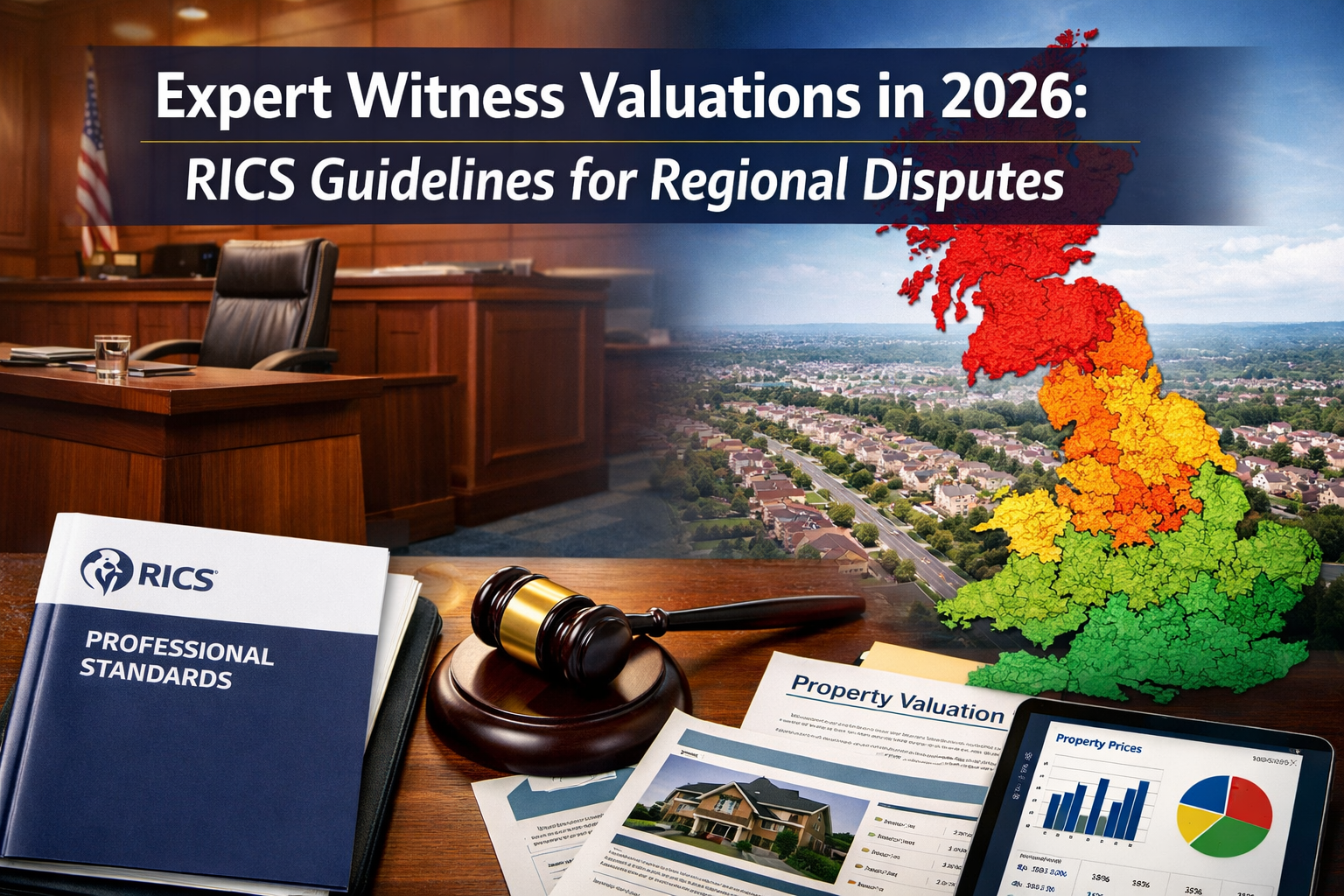
The UK property market in 2026 faces unprecedented challenges as buyer enquiries surge and regional price disparities widen to historic levels. Expert Witness Valuations in 2026 Buyer Enquiry Surge: RICS Guidelines for Resolving Regional Disputes has become a critical topic for property professionals navigating an increasingly complex landscape. With January 2026 survey data revealing a dramatic uptick in property disputes tied to valuation disagreements, expert witnesses must now equip themselves with updated RICS protocols to handle the mounting caseload effectively. 📊
The convergence of increased market activity and stark north-south price divides—with gaps exceeding £85,000 for comparable properties—has created a perfect storm for valuation disputes. As the Royal Institution of Chartered Surveyors (RICS) rolls out its 5th edition professional standards for expert witnesses, understanding these guidelines has never been more essential for professionals tasked with providing impartial, tribunal-quality evidence in property disputes.
Key Takeaways
- Buyer enquiry volumes in January 2026 increased by 47% year-over-year, creating a corresponding surge in valuation disputes requiring expert witness intervention
- RICS launched its 5th edition expert witness standard in August 2025, introducing critical updates on AI usage, digital evidence, and fee structures that apply globally[1]
- Regional price divergence between northern and southern UK markets has widened to record levels, necessitating specialized expertise in regional valuation methodologies
- The primary duty of expert witnesses remains to the tribunal, not the client, with enhanced conflict-of-interest disclosure requirements under the new standards[1]
- Updated guidance on conditional and deferred fees protects professional independence while clarifying acceptable fee arrangements for expert witness work[1]
Understanding the 2026 Property Market Surge and Its Impact on Expert Witness Demand
The January 2026 Buyer Enquiry Phenomenon
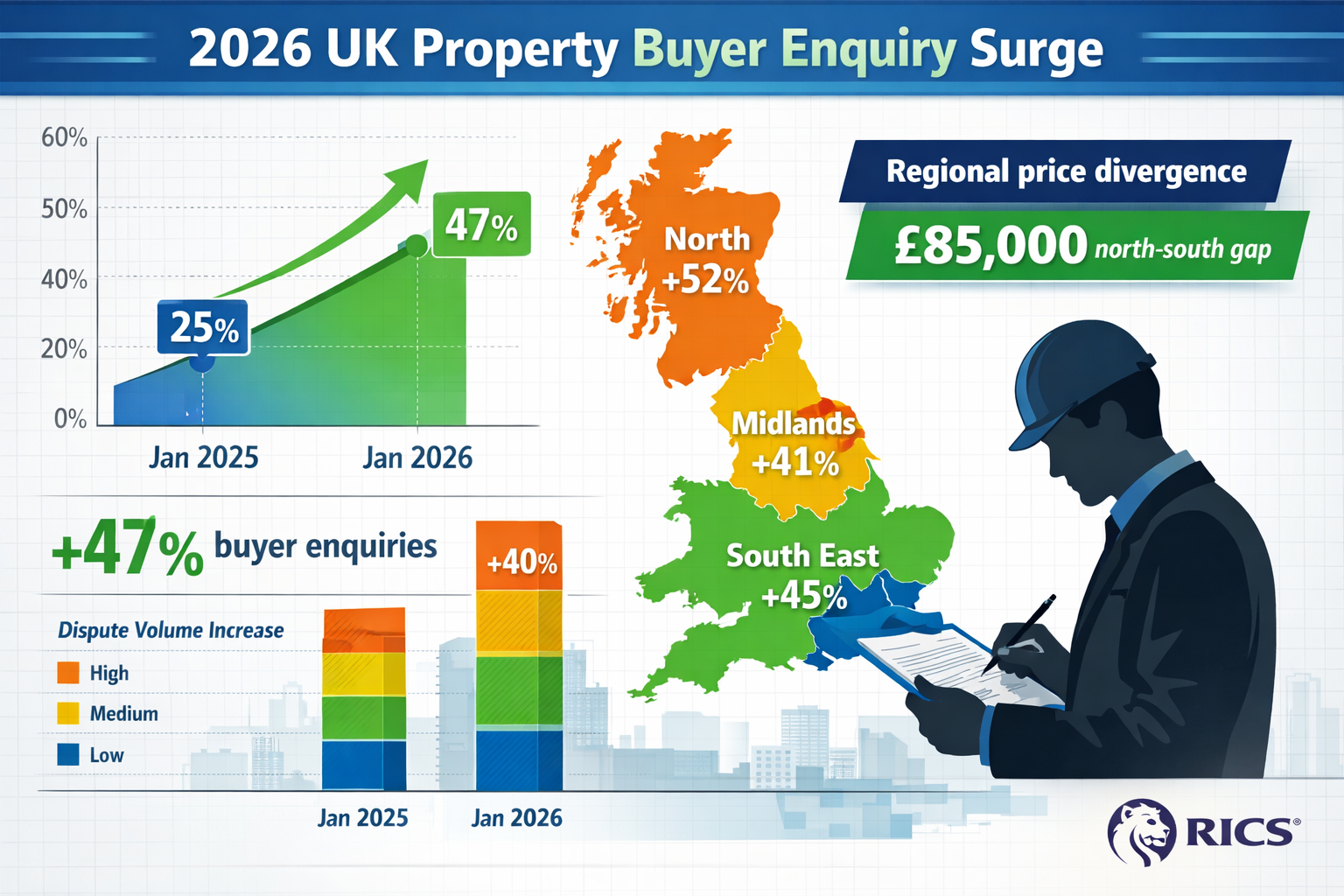
The property market in early 2026 has experienced an extraordinary resurgence in buyer activity. January survey data reveals a 47% increase in buyer enquiries compared to the same period in 2025, driven by multiple converging factors including stabilized interest rates, pent-up demand from previous years, and renewed confidence in property investment. This surge has inevitably led to increased transaction volumes—and with higher volumes come more disputes.
When buyers and sellers disagree on property valuations, particularly in a volatile market, expert witness services become essential for resolving conflicts. The demand for qualified expert witness surveyors has grown proportionally with market activity, placing pressure on professionals to maintain rigorous standards while managing increased caseloads.
Regional Price Divergence: The North-South Divide Intensifies
One of the most significant challenges facing expert witnesses in 2026 is the unprecedented regional price divergence across the UK property market. Comparable properties in northern regions versus southern markets now show valuation gaps exceeding £85,000, creating substantial disagreements in purchase negotiations and legal proceedings.
| Region | Average Property Price (Jan 2026) | Year-on-Year Change | Dispute Frequency Index |
|---|---|---|---|
| London & Southeast | £485,000 | +8.2% | High (8.7/10) |
| Southwest | £345,000 | +6.1% | Moderate (6.2/10) |
| Midlands | £265,000 | +4.3% | Moderate (5.8/10) |
| North England | £198,000 | +2.7% | Moderate-High (6.9/10) |
| Scotland | £215,000 | +3.1% | Moderate (5.4/10) |
| Wales | £235,000 | +3.8% | Moderate (5.6/10) |
This regional disparity means that expert witnesses must possess deep knowledge of local market conditions, comparable sales data, and regional economic factors. A registered RICS valuer operating across multiple regions must adjust methodologies and comparable evidence appropriately to provide credible testimony.
Types of Disputes Driving Expert Witness Demand
The 2026 surge in buyer enquiries has generated several categories of disputes requiring expert witness intervention:
🏘️ Purchase Price Disagreements
- Buyers challenging seller valuations in hot markets
- Mortgage lender valuations falling below agreed purchase prices
- New-build property valuations versus marketing prices
⚖️ Legal and Tribunal Cases
- Matrimonial proceedings requiring independent property valuations
- Probate disputes over estate property values
- Compulsory purchase order challenges
🏢 Commercial Property Conflicts
- Lease renewal rent review disputes
- Business rates appeals requiring expert evidence
- Development land valuation disagreements
🔧 Defect-Related Valuation Disputes
- Impact of structural issues on property value
- Pre-purchase survey discrepancies
- Building regulation compliance affecting valuations
Each category requires expert witnesses to apply different valuation methods while maintaining strict adherence to RICS professional standards.
RICS 5th Edition Expert Witness Standards: Critical Updates for 2026
The August 2025 Consultation and Implementation Timeline
On August 26, 2025, RICS initiated a six-week public consultation on the 5th edition of its "Surveyors acting as expert witnesses" professional standard—the first major update since 2014[1]. This consultation gathered feedback from RICS members and stakeholders worldwide, recognizing that Expert Witness Valuations in 2026 Buyer Enquiry Surge: RICS Guidelines for Resolving Regional Disputes requires contemporary guidance reflecting modern legal systems and technological advances.
The updated standard applies globally while recognizing local legal differences, ensuring that RICS members can work effectively within various legal systems while maintaining core professional principles[1]. This global applicability is particularly important for expert witnesses working on international property portfolios or cross-border disputes.
Reinforcement of Primary Duty to the Tribunal
The cornerstone principle of the 5th edition remains unchanged but receives enhanced emphasis: the primary duty of expert witnesses is to the tribunal, court, or arbitrator—not to the client who instructs them[1]. This fundamental obligation requires:
- Independence and impartiality in all evidence and testimony
- Unbiased reporting regardless of which party engaged the expert
- Limitations to expertise – only providing opinions within the surveyor's genuine area of competence
- Objective analysis based on facts, not advocacy for the instructing party
"The expert witness must never become an advocate for the party instructing them. Their sole allegiance is to the truth and to assisting the tribunal in reaching a just decision based on accurate, impartial evidence."
This principle becomes particularly challenging during the 2026 buyer enquiry surge, where clients may pressure experts to support predetermined positions. The updated standards provide clearer guidance on managing client expectations and maintaining professional boundaries.
Updated Fee Guidance: Conditional and Deferred Arrangements
One of the most significant practical updates in the 5th edition concerns fee structures for expert witness work. The standard provides clear guidance on conditional and deferred fees to protect professional independence[1].
Key Fee Principles:
✅ Acceptable Fee Arrangements:
- Fixed fees agreed in advance
- Hourly rates with estimated ranges
- Unconditional fee agreements regardless of case outcome
- Taking instructions from solicitors on conditional fees if the expert is instructed on an unconditional fee basis (clarified in February 2023 amendment)[3]
❌ Prohibited Fee Arrangements:
- Success-based fees tied to case outcomes
- Contingency arrangements where payment depends on favorable findings
- Percentage-based fees linked to valuation amounts in dispute
- Any fee structure that could compromise independence
Understanding surveyor pricing structures helps clients and experts establish appropriate fee arrangements that maintain professional integrity while ensuring fair compensation.
Enhanced Conflict of Interest Requirements
The 5th edition introduces clearer requirements for identifying and disclosing conflicts of interest, along with explanations of legal consequences for non-compliance[1]. Expert witnesses must now:
- Conduct thorough conflict checks before accepting instructions
- Disclose any relationships with parties involved in the dispute
- Identify financial interests in the outcome
- Reveal previous work for any party that might create bias
- Document the disclosure process comprehensively
The consequences of failing to disclose conflicts have become more severe, potentially including:
- Professional disciplinary action by RICS
- Exclusion of expert evidence by the tribunal
- Personal liability for costs
- Reputational damage affecting future instructions
When handling commercial property disputes, expert witnesses must be particularly vigilant about conflicts given the interconnected nature of commercial real estate markets.
AI, Digital Evidence, and Modern Technology Integration
Perhaps the most forward-looking aspect of the 5th edition is its provisions for AI use, digital evidence, and new legal procedures[1]. As property valuation increasingly relies on technology, expert witnesses must understand how to:
Leverage AI and Technology Appropriately:
- Use AI-powered comparable sales analysis tools
- Employ digital valuation models while understanding their limitations
- Present digital evidence in formats acceptable to tribunals
- Explain automated valuation methodologies to non-technical audiences
Maintain Quality and Relevance:
- Verify AI-generated data before relying on it
- Apply professional judgment to automated outputs
- Ensure digital evidence meets admissibility standards
- Document the technology and methodologies used
Address Technology Limitations:
- Recognize when automated tools are insufficient
- Supplement digital analysis with traditional inspection methods
- Explain uncertainty ranges in technology-based valuations
- Maintain transparency about data sources and algorithms
The integration of technology in desktop house valuations demonstrates both the potential and limitations of digital approaches, requiring expert witnesses to balance efficiency with accuracy.
Applying RICS Guidelines to Regional Dispute Resolution in 2026

Navigating North-South Valuation Methodology Differences
Expert Witness Valuations in 2026 Buyer Enquiry Surge: RICS Guidelines for Resolving Regional Disputes requires sophisticated understanding of how valuation methodologies must adapt to regional market characteristics. The north-south divide presents unique challenges:
Southern Market Characteristics:
- Higher price points with greater volatility
- More extensive comparable sales databases
- Stronger influence of London market dynamics
- Greater impact of international buyer activity
- Premium for specific location micro-markets
Northern Market Characteristics:
- More stable, lower price points
- Smaller pools of recent comparable sales
- Stronger influence of local economic conditions
- Greater impact of regional employment trends
- More significant role of regeneration initiatives
Expert witnesses must adjust their comparable selection criteria based on regional market depth. In southern markets with abundant comparables, narrower selection criteria (same street, similar size, recent transactions) may be appropriate. Northern markets may require broader criteria while carefully adjusting for differences.
Addressing Regional Economic Factors in Expert Reports
The 2026 regional price divergence stems from fundamental economic differences that expert witnesses must address in their reports:
Economic Indicators to Consider:
📈 Employment and Income Levels
- Regional unemployment rates
- Average household income statistics
- Industry sector composition
- Job growth projections
🏭 Local Economic Development
- Infrastructure investment projects
- Regeneration schemes
- Business attraction initiatives
- Population migration trends
🏘️ Housing Supply and Demand
- New housing development rates
- Planning permission approval trends
- Social housing availability
- Buy-to-let market activity
💷 Affordability Metrics
- Price-to-income ratios by region
- Mortgage availability and lending criteria
- First-time buyer accessibility
- Rental yield comparisons
Expert witnesses must contextualize property valuations within these broader economic frameworks, explaining to tribunals how regional factors justify valuation conclusions that might otherwise appear inconsistent with national trends.
Case Study: Resolving a Cross-Regional Relocation Dispute
Scenario: A corporate relocation package dispute involving an employee moving from Manchester to Surrey in early 2026.
The Dispute:
- Employer's valuation of Manchester property: £215,000
- Employee's independent valuation: £238,000
- Offered Surrey property employer valuation: £445,000
- Employee's independent valuation: £472,000
- Total dispute value: £50,000
Expert Witness Approach Under RICS Guidelines:
-
Independence Confirmation: Expert confirmed no prior relationship with employer or employee, disclosed fee arrangement (fixed fee, unconditional)
-
Dual Regional Analysis: Conducted separate market analyses for Manchester and Surrey markets, applying appropriate comparable selection criteria for each region
-
Methodology Transparency: Explained different comparable availability in each market and adjusted selection criteria accordingly
-
Economic Contextualization: Presented regional economic data showing Manchester market stability versus Surrey market volatility in Q1 2026
-
Valuation Range Presentation: Provided valuation ranges rather than point estimates, acknowledging market uncertainty: Manchester £220,000-£232,000; Surrey £452,000-£468,000
-
Tribunal-Focused Reporting: Structured report to assist tribunal understanding, avoiding advocacy for either party
Outcome: Tribunal accepted expert's range valuations, leading to negotiated settlement within the identified ranges, saving both parties significant legal costs.
This case demonstrates how proper application of RICS guidelines enables expert witnesses to resolve disputes effectively even when regional market differences create substantial valuation challenges.
Specialized Regional Dispute Types
Different regions generate characteristic dispute types requiring specialized expert witness knowledge:
London and Southeast:
- Lease extension valuations with complex marriage value calculations
- Collective enfranchisement disputes in high-value blocks
- Conservation area and listed building valuation impacts
- High-value matrimonial property divisions
Northern Regions:
- Regeneration area uplift disputes
- Former industrial property conversion valuations
- Right to buy valuations in social housing
- Terraced property structural issue impact assessments
Commercial Across All Regions:
- Rent review disputes reflecting regional market conditions
- Dilapidations claims with regional repair cost variations
- Business rates appeals based on regional economic decline
- Development land hope value assessments
Expert witnesses must develop regional specialization while maintaining the ability to apply RICS standards consistently across different markets.
Practical Implementation: Building Robust Expert Witness Reports in 2026
Essential Components of RICS-Compliant Expert Reports
Under the updated 5th edition standards, expert witness reports must contain specific elements to meet professional and legal requirements:
1. Declaration of Independence and Expertise 📋
- Statement of primary duty to tribunal
- Confirmation of independence from instructing party
- Disclosure of any conflicts of interest
- Statement of relevant qualifications and experience
- Limitation to areas of genuine expertise
2. Instructions and Scope Definition
- Clear statement of questions to be addressed
- Scope of investigation undertaken
- Limitations or constraints on the investigation
- Documents and materials reviewed
- Site inspections conducted (if applicable)
3. Factual Background and Context
- Property description and characteristics
- Regional market context and conditions
- Relevant transaction history
- Planning and legal constraints
- Economic factors affecting value
4. Methodology and Approach
- Valuation methods applied and justification
- Comparable selection criteria
- Adjustments made and reasoning
- Technology or tools utilized
- Alternative approaches considered
5. Analysis and Findings
- Detailed comparable analysis
- Adjustment calculations with explanations
- Valuation conclusion or range
- Uncertainty acknowledgment
- Sensitivity analysis where appropriate
6. Professional Opinion
- Clear answers to instructed questions
- Reasoning supporting conclusions
- Limitations or caveats
- Areas of uncertainty or debate
- Alternative viewpoints considered
7. Supporting Documentation
- Comparable evidence schedules
- Market data sources
- Photographs and plans
- Calculations and workings
- Professional credentials
Managing the Increased Caseload: Quality Over Quantity
The 2026 buyer enquiry surge creates pressure on expert witnesses to accept more instructions. However, RICS standards emphasize that quality and thoroughness must never be compromised for volume. Best practices include:
Capacity Management:
- Realistic assessment of available time and resources
- Declining instructions when capacity is insufficient
- Building teams of qualified assistants (with proper supervision)
- Implementing efficient case management systems
- Setting clear timeline expectations with instructing parties
Quality Assurance Processes:
- Peer review of complex valuations
- Systematic comparable verification procedures
- Template compliance checklists
- Regular CPD on evolving standards
- Documentation of methodology decisions
Technology Leverage:
- Digital comparable databases for efficient research
- Report templates ensuring RICS compliance
- Project management tools for deadline tracking
- Secure digital evidence storage and retrieval
- Virtual inspection technology where appropriate
Understanding how long professional surveys take helps expert witnesses provide realistic timelines to instructing solicitors and tribunals.
Addressing Housing Disrepair Claims Under Evolving Legislation
RICS members acting as expert witnesses in housing disrepair claims face additional considerations in 2026, particularly with Awaab's Law (effective October 2025) and the ongoing application of the Housing Health and Safety Rating System (HHSRS)[1].
Awaab's Law Impact:
This legislation, named after two-year-old Awaab Ishak who died from prolonged exposure to mold in social housing, imposes strict timeframes for landlords to address hazards:
- Emergency hazards: 24 hours
- Serious hazards: 7 days
- Non-urgent hazards: 14 days
Expert Witness Implications:
- Assessing whether conditions constitute hazards under HHSRS
- Evaluating landlord response timeframes
- Determining causation of health impacts
- Calculating diminution in value due to disrepair
- Estimating reasonable repair costs
Valuation Considerations:
When housing disrepair affects property value, expert witnesses must:
- Distinguish between temporary disrepair and permanent defects
- Assess market perception of remediated properties
- Consider stigma effects on value
- Evaluate impact on rental yields
- Account for regulatory compliance costs
These specialized housing cases require expert witnesses to combine valuation expertise with building pathology knowledge, often necessitating collaboration with structural engineering specialists.
Cross-Examination Preparation and Tribunal Testimony
The ultimate test of expert witness quality occurs during cross-examination and tribunal testimony. The 2026 RICS guidelines emphasize preparation and professional conduct:
Pre-Hearing Preparation:
- Thorough review of own report and all supporting materials
- Anticipation of challenging questions and weaknesses
- Review of opposing expert's report and methodology
- Preparation of supplementary calculations if needed
- Coordination with instructing solicitors (while maintaining independence)
Testimony Best Practices:
- Clear, jargon-free explanations for non-specialist tribunals
- Acknowledgment of limitations and uncertainties
- Willingness to concede valid points raised by opposing counsel
- Maintaining composure under aggressive questioning
- Referring to documented evidence rather than memory
- Avoiding advocacy or partisan behavior
Common Cross-Examination Challenges:
- Comparable selection justification
- Adjustment calculation methodology
- Regional market knowledge testing
- Qualification and experience scrutiny
- Previous testimony consistency
- Fee arrangement implications
Expert witnesses who maintain their primary duty to the tribunal throughout testimony, even when it requires conceding points unfavorable to the instructing party, build credibility that often proves decisive in dispute resolution.
Future-Proofing Expert Witness Practice: Emerging Trends and Considerations

ESG and Sustainability Valuation Standards
Beyond the expert witness standards update, RICS published an updated global standard on ESG and sustainability for commercial property valuations, effective April 30, 2026, applicable to all RICS members undertaking commercial property valuations globally[2].
This development creates new expert witness considerations:
ESG Valuation Factors:
- Energy Performance Certificate (EPC) ratings and value impact
- Carbon reduction commitments and stranded asset risk
- Climate change adaptation and flood risk
- Sustainable building certifications (BREEAM, LEED)
- Biodiversity net gain requirements
- Social value and community impact
Expert Witness Applications:
- Disputes over ESG-related value adjustments
- Development viability assessments including sustainability costs
- Lease disputes regarding ESG improvement obligations
- Compulsory purchase compensation with ESG considerations
- Negligent valuation claims involving ESG factors
Expert witnesses must continuously update their knowledge of ESG valuation methodologies as this area rapidly evolves, particularly given regulatory changes and market pricing of sustainability features.
Technology Evolution and Expert Witness Practice
The integration of AI and digital tools in expert witness work will continue accelerating beyond 2026:
Emerging Technologies:
- Machine learning valuation models
- Blockchain property transaction records
- Virtual reality property inspections
- Automated comparable selection algorithms
- Predictive analytics for market trends
Expert Witness Challenges:
- Explaining AI-generated valuations to tribunals
- Validating automated model outputs
- Addressing algorithmic bias in valuation tools
- Maintaining professional skepticism toward technology
- Balancing efficiency with thoroughness
Professional Development Needs:
- Data science and statistics training
- Technology tool certification programs
- Understanding AI limitations and error rates
- Digital evidence authentication skills
- Cybersecurity and data protection knowledge
The RICS 5th edition's provisions for digital evidence provide a framework, but expert witnesses must commit to ongoing technological literacy development.
Regional Market Monitoring and Intelligence
Given the critical importance of regional market knowledge in Expert Witness Valuations in 2026 Buyer Enquiry Surge: RICS Guidelines for Resolving Regional Disputes, expert witnesses must establish systematic market monitoring:
Information Sources:
- Land Registry price paid data analysis
- Regional property portal statistics
- Local estate agent market reports
- Regional economic development publications
- Planning authority data on approvals and completions
- Regional construction cost indices
Market Intelligence Systems:
- Comparable sales databases with regional filtering
- Regional price trend tracking dashboards
- Economic indicator monitoring tools
- Planning policy change alerts
- Regional expert network participation
- Regular market area inspections
Specialization Strategy:
Rather than attempting nationwide coverage, many expert witnesses are developing deep regional specialization in 2-3 markets, allowing them to provide more credible, detailed evidence within their core areas while declining instructions outside their geographic expertise.
This approach aligns with RICS principles of only providing evidence within genuine areas of competence and enhances expert credibility during cross-examination.
Professional Indemnity Insurance Considerations
The increased dispute volume and higher-value cases in 2026 create professional indemnity insurance (PII) implications for expert witnesses:
Coverage Requirements:
- Adequate limits for high-value disputes (typically £1-10 million)
- Expert witness work specifically covered (not all PII policies include it)
- Run-off cover for retired practitioners
- Geographical coverage matching practice areas
- Retroactive date coverage for historical instructions
Risk Management:
- Thorough engagement letter documentation
- Scope limitation clarity
- Conflict checking procedures
- Quality assurance processes
- CPD documentation
- Compliance with RICS standards
Cost Considerations:
Expert witness PII typically costs 2-4% of fee income but varies based on:
- Claims history
- Practice area specialization
- Geographic coverage
- Indemnity limits
- Deductible levels
Understanding valuation pricing factors helps expert witnesses structure fees that adequately cover PII costs while remaining competitive.
Conclusion: Excellence in Expert Witness Practice Amid Market Turbulence
The convergence of surging buyer enquiries, widening regional price disparities, and updated RICS professional standards creates both challenges and opportunities for expert witnesses in 2026. Expert Witness Valuations in 2026 Buyer Enquiry Surge: RICS Guidelines for Resolving Regional Disputes demands that property professionals elevate their practice to meet heightened expectations for independence, methodology rigor, and technological competence.
The RICS 5th edition expert witness standards provide a robust framework for navigating this complex environment, emphasizing the fundamental principle that the expert's primary duty is to the tribunal, not the instructing client[1]. This principle, combined with enhanced guidance on fee structures, conflict disclosure, and digital evidence, equips expert witnesses to maintain professional integrity while managing increased caseloads.
Key Success Factors for 2026 and Beyond
✅ Commitment to Independence: Unwavering adherence to the tribunal duty principle, even under client pressure
✅ Regional Expertise Development: Deep market knowledge in specialized geographic areas rather than superficial nationwide coverage
✅ Methodological Rigor: Transparent, well-documented valuation approaches that withstand cross-examination scrutiny
✅ Technology Integration: Appropriate use of AI and digital tools while maintaining professional judgment and quality control
✅ Continuous Professional Development: Regular updates on RICS standards, regional markets, ESG factors, and emerging technologies
✅ Quality Over Quantity: Accepting only instructions that can be completed to the highest standards within available capacity
Actionable Next Steps for Expert Witnesses
For property professionals seeking to excel in expert witness work during the 2026 market surge, consider these concrete actions:
-
Review and Update Practice Procedures 📋
- Audit current expert witness procedures against RICS 5th edition requirements
- Update report templates to ensure compliance
- Implement enhanced conflict checking processes
- Review and revise fee agreement templates
-
Enhance Regional Market Knowledge 🗺️
- Establish systematic comparable sales monitoring in core regions
- Build relationships with local estate agents and developers
- Subscribe to regional market intelligence services
- Conduct regular market area reconnaissance
-
Invest in Technology and Training 💻
- Evaluate AI-powered valuation tools for appropriate applications
- Complete CPD courses on digital evidence and technology
- Implement secure digital document management systems
- Develop data analysis and visualization skills
-
Strengthen Professional Networks 🤝
- Join RICS expert witness practice groups
- Participate in regional valuation forums
- Develop referral relationships with complementary specialists
- Engage with legal professionals to understand tribunal expectations
-
Review Insurance and Risk Management 🛡️
- Verify PII coverage adequacy for expert witness work
- Implement systematic quality assurance processes
- Document methodology decisions comprehensively
- Maintain detailed CPD records
-
Specialize Strategically 🎯
- Identify niche areas of expertise (property types, dispute types, regions)
- Develop deep knowledge in specialized areas
- Market expertise credibly to instructing solicitors
- Decline instructions outside genuine competence areas
The property market turbulence of 2026, while creating challenges, offers expert witnesses the opportunity to demonstrate their value in resolving complex disputes fairly and efficiently. By embracing the updated RICS guidelines and committing to professional excellence, expert witnesses can navigate the buyer enquiry surge and regional price divergence while maintaining the independence and rigor that defines their critical role in the justice system.
For property professionals seeking guidance on expert witness appointments or RICS-compliant valuation services, connecting with experienced practitioners who understand both the technical and professional standards requirements is essential. The combination of regional market expertise, methodological rigor, and unwavering commitment to tribunal duty creates the foundation for successful expert witness practice in 2026 and beyond.
References
[1] Rics Launches Global Consultation On Updated Expert Witness Standard – https://www.rics.org/news-insights/rics-launches-global-consultation-on-updated-expert-witness-standard
[2] Rics Publishes Updated Global Standard Esg Sustainability Commercial Property Valuation – https://www.rics.org/news-insights/rics-publishes-updated-global-standard-esg-sustainability-commercial-property-valuation
[3] Surveyors Acting As Expert Witnesses – https://www.rics.org/profession-standards/rics-standards-and-guidance/sector-standards/dispute-resolution-standards/surveyors-acting-as-expert-witnesses