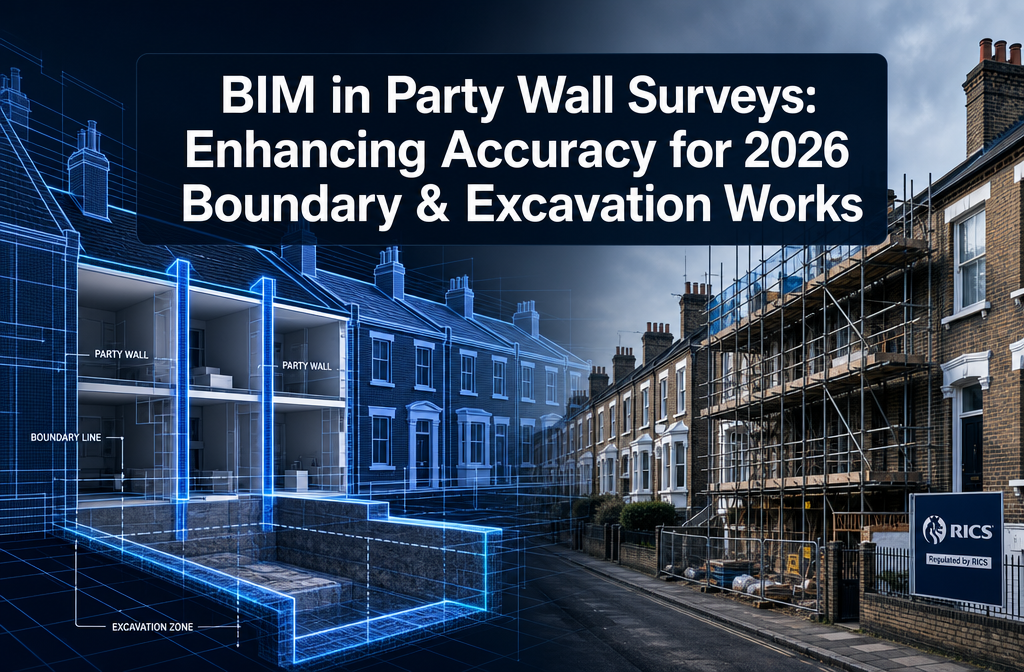
Nearly one in three new-build homes in the UK is handed over with significant defects — yet the majority of legal claims around poor workmanship fail not because the defects don't exist, but because the evidence supporting them is weak. That gap between a genuine grievance and a winning case is precisely where expert witness surveyors in construction defect claims earn their value. Understanding how to build a credible case around poor workmanship — from the first site visit through to cross-examination — is the difference between a settlement and a dismissed claim.
Key Takeaways
- 📋 Evidence quality beats qualifications: Courts increasingly judge expert surveyors on their methodology, not just their credentials. A structured, standards-referenced report outweighs a vague defects list every time.
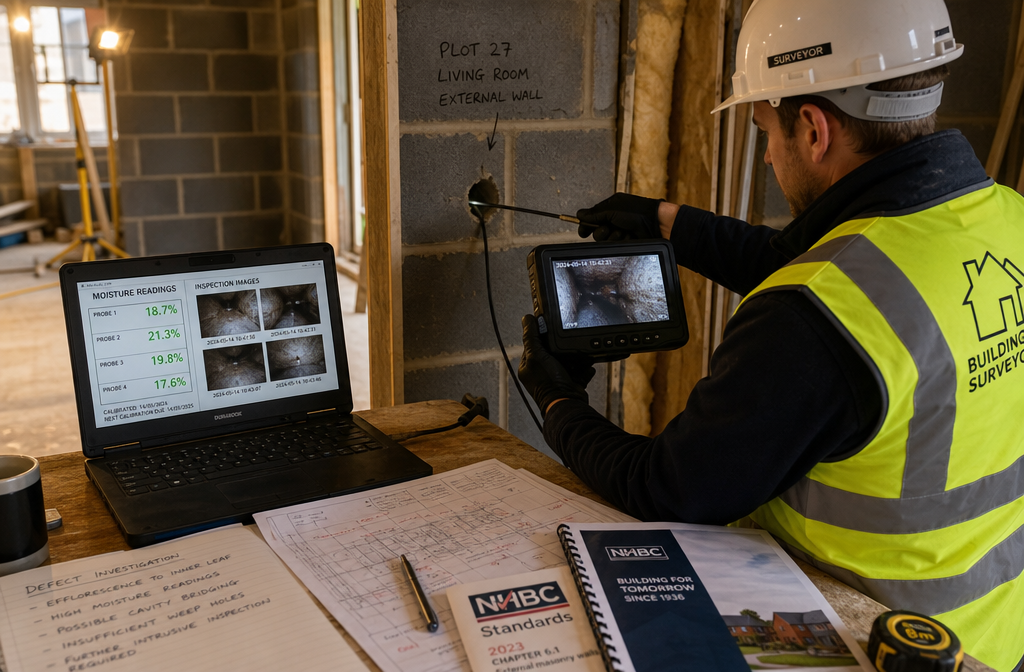
- 🔍 Intrusive investigation is now expected: Visual-only inspections are routinely criticised in judgments. Borescope tests, moisture readings, and sample openings are becoming standard practice.
- ⚖️ Independence is non-negotiable: Surveyors perceived as "hired guns" risk having their evidence dismissed, even when the defects are real.
- 📅 Early engagement is decisive: Once remedial works begin, pre-remediation records become the backbone of the claim. Engage an expert before work is covered up.
- 🏗️ Design vs. workmanship distinction matters: Correctly categorising each defect directly affects who is liable and what damages are recoverable.
What Makes an Expert Witness Surveyor Credible in Court?
The role of an expert witness surveyor is not simply to identify what has gone wrong. It is to explain why it went wrong, who is responsible, and how much it will cost to put right — in a way that a judge can follow and trust.
Recent 2026 guidance from construction litigation practitioners makes clear that poor workmanship claims increasingly succeed or fail on the "reasoned methodology" of the surveyor, not just their qualifications [7]. Courts now look for four specific things:
| What Courts Look For | What It Means in Practice |
|---|---|
| Explicit hypothesis | A clearly stated allegation: what defect is claimed and where |
| Structured inspection plan | A documented, repeatable method of investigation |
| Standards references | Specific clauses from NHBC, Building Regulations, BS 8102, BS 5250, etc. |
| Transparent reasoning | A logical path from observation → standard → breach → damage |
Unstructured "defects lists" that simply describe problems without analytical explanation are now commonly criticised in court judgments [7]. A surveyor who says "the brickwork is sub-standard" without citing the relevant workmanship tolerance or standard provides counsel with very little to work with.
The Part 35 Duty: Independence Above All
In England and Wales, expert witnesses are bound by CPR Part 35, which requires them to serve the court — not the instructing party. This means:
- Opinions must be genuinely held and honestly expressed
- Limitations in the evidence must be disclosed
- Alternative explanations (e.g., maintenance failure rather than workmanship defect) must be considered and addressed
Experts who over-state conclusions or ignore inconvenient counter-evidence risk being treated as "hired guns" by the court, with their evidence given little weight — even where genuine workmanship defects exist [6]. Credibility, once lost, is almost impossible to recover under cross-examination.
From Site Inspection to Expert Report: Building the Evidence Chain
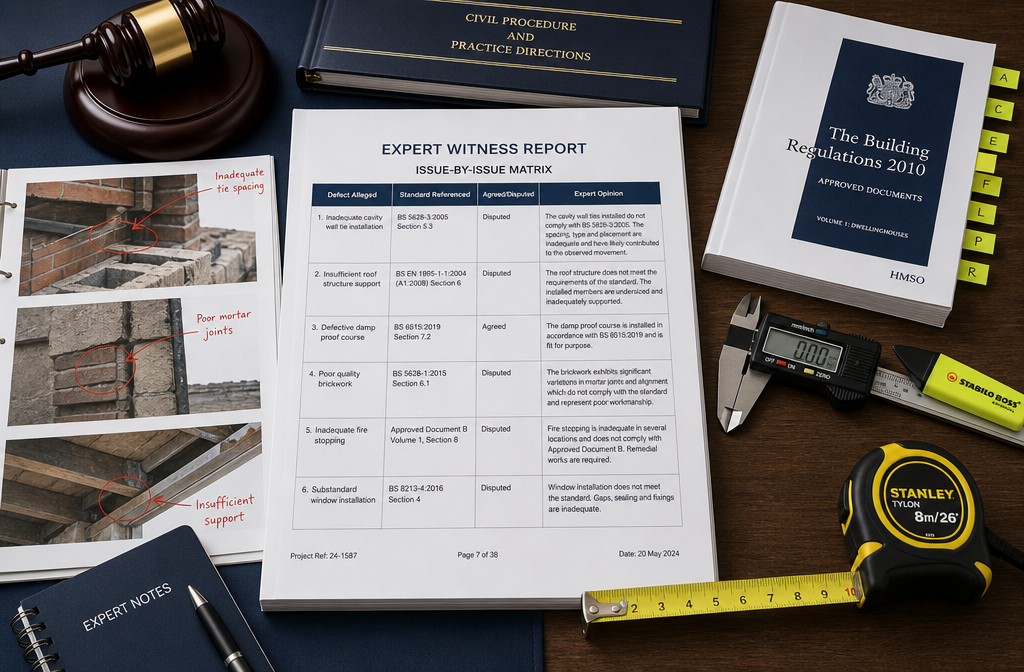
The journey from a client's complaint about poor workmanship to a persuasive expert report follows a clear sequence. Each step must be documented with the same rigour that will later be scrutinised in court.
Step 1: Early Evidence Preservation
The single most important action in any construction defect claim is engaging the expert before remedial works begin [6]. Once defective workmanship is covered up or replaced, the court must rely almost entirely on pre-remediation records. Instructing solicitors should secure:
- Original contract documents and drawings
- Method statements and site inspection records
- Photographic records taken during construction
- Any snagging lists or handover documentation
A specialist defect survey commissioned at this early stage creates a contemporaneous baseline that is extremely difficult to challenge later.
Step 2: Intrusive Investigation — Going Beyond the Visual
Courts have grown sharply critical of "drive-by" reports based on visual inspection alone [6]. For latent defects — those hidden within the building fabric — intrusive investigation is now expected, not optional. This includes:
- 🔬 Borescope inspections to examine cavity walls without destructive opening
- 💧 Calibrated moisture meter readings with time-stamped records
- 🧱 Sample openings and core tests to expose concealed workmanship
- 🌡️ Thermal imaging to identify cold bridging and insulation gaps
Particular attention should be paid to hidden damp, incomplete cavity barriers, and defective fire-stopping — areas identified in 2026 guidance as the highest-risk latent defects in new-build claims [6]. For complex structural issues, a drainage survey or solid floor slab survey may also form part of the investigative toolkit.
💬 "Courts are increasingly critical of 'drive-by' reports. Robust defect claims around workmanship now hinge on invasive testing and clear explanations of why intrusive methods were or were not used." — Manchester Surveyors, 2026 [6]
Step 3: Aligning Observations with Specific Standards
Every defect observation must be anchored to a verifiable benchmark. General assertions that work is "poor quality" or "not fit for purpose" carry little weight without a standard to measure against. Relevant benchmarks include:
- NHBC Standards (for new-build homes)
- BS 8102 (protection of below-ground structures from water)
- BS 5250 (management of moisture in buildings)
- Building Regulations — critically, the version in force at the time of construction, not the current edition [9]
- Manufacturer installation instructions (often overlooked but legally significant)
- Contract specification clauses (bespoke tolerances agreed between parties)
Aligning each observation with the specific clause that has been breached transforms a list of complaints into a structured legal argument.
Step 4: Distinguishing Design Defects from Workmanship Defects
One of the most significant developments in 2026 construction case law is the tightened expectation that expert surveyors clearly distinguish design defects from workmanship defects [9]. This matters enormously because:
- Workmanship defects = contractor failed to execute correctly
- Design defects = architect or engineer specified incorrectly
- Supervision failures = defective work was not caught during site inspections
Each category points to a different defendant and potentially different recoverable damages. Surveyors who clearly categorise each defect and trace it back to non-compliant execution, inadequate supervision, or flawed design give counsel a much stronger platform for apportioning liability [9].
For properties with unusual construction methods, a non-standard construction survey can be invaluable in separating inherent design limitations from genuine workmanship failures.
Step 5: Quantifying Repair Costs
A credible expert report does not stop at identifying defects — it must also quantify the cost of remediation in a way that is defensible under cross-examination. This means:
- Itemised schedules of works with unit rates
- Reference to current market pricing (e.g., BCIS or comparable tender evidence)
- Distinguishing between like-for-like repair and betterment
- Addressing whether phased or emergency works are required
Where fire safety or cladding issues are involved — a continuing litigation hotspot in 2026 [9] — cost quantification must also account for regulatory compliance requirements, which may significantly exceed the cost of simply reinstating the original (defective) specification.
Withstanding Cross-Examination: The Expert's Performance in Court
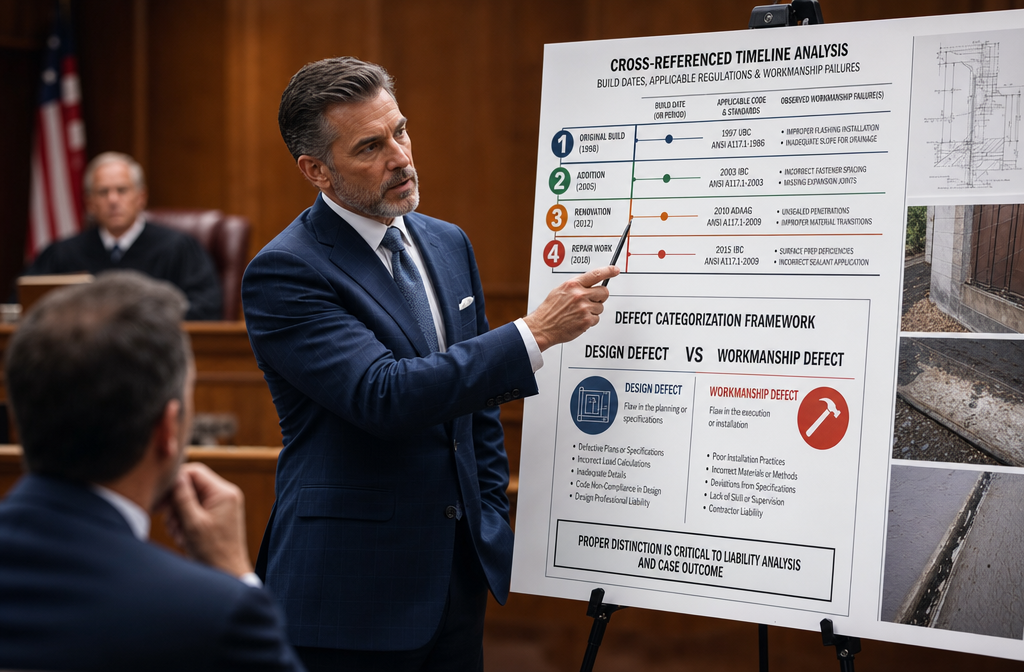
Producing a rigorous report is only half the battle. The expert must then defend their conclusions under cross-examination — often by a skilled barrister whose entire strategy is to undermine credibility, methodology, or independence.
Joint Expert Statements and Issue Matrices
Courts increasingly require both parties' experts to meet and produce a joint statement before trial [7]. This document identifies:
- Facts that are agreed between experts
- Issues that remain in dispute
- The specific technical basis for each disagreement (e.g., which clause of which standard applies)
This process forces surveyors to frame their evidence around verifiable benchmarks rather than generalised assertions [7]. An expert who cannot clearly articulate why their interpretation of a standard differs from the opposing expert's will struggle in the witness box.
Common Cross-Examination Challenges
| Challenge | Preparation Strategy |
|---|---|
| "You only did a visual inspection" | Document all intrusive tests; explain why each method was chosen |
| "This could be maintenance failure, not workmanship" | Address alternative causes explicitly in the report |
| "You're just an advocate for the claimant" | Demonstrate Part 35 compliance; show where you agreed with the other side |
| "Your cost figures are inflated" | Use independently verifiable pricing sources; show your workings |
| "The regulations you cited weren't in force at the time" | Build a cross-referenced timeline of build dates and applicable standards [9] |
Contemporaneous Records: The Expert's Best Defence
The most powerful protection against cross-examination is contemporaneous, methodical site records [6]. These include:
- Time-stamped photographs with location references
- Annotated plans showing where each measurement was taken
- Calibrated instrument records (moisture meters, thermal cameras)
- Signed and dated site notes made at the time of inspection
Records created after the fact — or reconstructed from memory — are significantly more vulnerable to challenge. The discipline of creating thorough contemporaneous documentation at the time of inspection pays dividends throughout the entire litigation process.
Maintaining Independence When Pressure Mounts
As a case progresses toward trial, instructing solicitors may (consciously or not) push for stronger conclusions or ask the expert to address only the most favourable evidence. The expert's duty is to resist this pressure. Disclosing limitations, acknowledging uncertainty, and conceding points where the opposing expert is correct are all signs of credibility — not weakness.
💬 "Experts perceived as 'hired guns' who over-state conclusions or ignore alternative causes risk their evidence being given little weight, even where workmanship defects genuinely exist." — Manchester Surveyors, 2026 [6]
Choosing the Right Expert Witness Surveyor for a Construction Defect Claim
Not every chartered surveyor is suited to the expert witness role. Law firms and claimants selecting an expert for expert witness surveyors in construction defect claims should vet candidates on the following criteria:
✅ Key Selection Criteria
- RICS membership and relevant specialist accreditation
- Hands-on site experience in the type of construction involved (residential, commercial, cladding, etc.)
- Prior testimony experience — courtroom familiarity matters [1]
- Publication history — articles, technical papers, or CPD presentations demonstrate depth of knowledge [3]
- Familiarity with CPR Part 35 and the litigation process
- Geographic coverage — the expert should be able to attend the site and court without logistical complications
Specialist directories in 2026 show a broadening pool of available construction defect surveyor experts, with profiles increasingly stressing hands-on experience and prior testimony as key credibility indicators [1][3]. Local expertise also matters: a surveyor familiar with regional construction practices, materials, and local authority requirements will often produce more targeted evidence.
For those in London and the South East, local chartered surveyors with specialist defect investigation experience can provide both the technical depth and geographic accessibility that litigation demands. Whether the property is in North London, Surrey, or Essex, local knowledge of construction practices strengthens the expert's evidence.
Cladding, Fire Safety, and the 2026 Litigation Landscape
Fire safety workmanship failures — missing cavity barriers, poorly installed fire-stopping, non-compliant cladding systems — remain one of the most active areas of construction defect litigation in 2026 [9]. These cases present particular challenges for expert witnesses:
- The applicable version of Building Regulations must be identified precisely (the version in force at the time of construction, not today's)
- Cross-referenced timelines linking build dates, regulatory requirements, and specific workmanship failures are now considered essential in credible expert reports [9]
- Material specifications must be checked against what was actually installed, not just what was specified
In these cases, the expert's ability to produce a clear, chronological narrative — showing when the building was constructed, what the regulations required at that time, and how the workmanship fell short — is often the decisive factor in establishing liability.
Conclusion: Actionable Steps for Building a Credible Workmanship Case
Expert witness surveyors in construction defect claims play a central role in determining whether a poor workmanship allegation becomes a successful legal outcome. The key is not simply identifying defects — it is building an evidence chain that is methodical, standards-referenced, independently verifiable, and capable of withstanding rigorous cross-examination.
Actionable Next Steps
- Engage an expert early — before any remedial works begin or evidence is disturbed
- Commission a specialist defect survey to create a contemporaneous baseline record
- Insist on intrusive investigation where latent defects are suspected
- Anchor every defect to a specific standard — NHBC, Building Regulations, BS codes, or contract specification
- Clearly categorise each defect as workmanship, design, or supervision failure
- Quantify remediation costs with independently verifiable pricing
- Vet your expert carefully — prior testimony, publication history, and Part 35 familiarity are non-negotiable
Whether the claim involves damp penetration, structural failures, fire safety breaches, or general poor workmanship, the strength of the expert surveyor's evidence will shape the outcome at every stage — from pre-action negotiations through to trial.
References
[1] Construction – https://www.law.com/expert-witness/directory/construction/
[3] Land Surveying – https://www.expertinstitute.com/expert-witness/land-surveying/
[6] Expert Witness Strategies For New Build Defect Disputes In 2026 Latent Risks And Evidence Prep – https://manchestersurveyors.com/expert-witness-strategies-for-new-build-defect-disputes-in-2026-latent-risks-and-evidence-prep/
[7] Mastering The Role Of Expert Witnesses In Construction Defect Litigation – https://www.finchhammer.com/post/mastering-the-role-of-expert-witnesses-in-construction-defect-litigation
[8] Construction Defects – https://www.lexvisio.com/expert-witnesses/construction-defects
[9] Legal Developments In Construction Law May 2026 – https://www.mayerbrown.com/en/insights/publications/2026/05/legal-developments-in-construction-law-may-2026