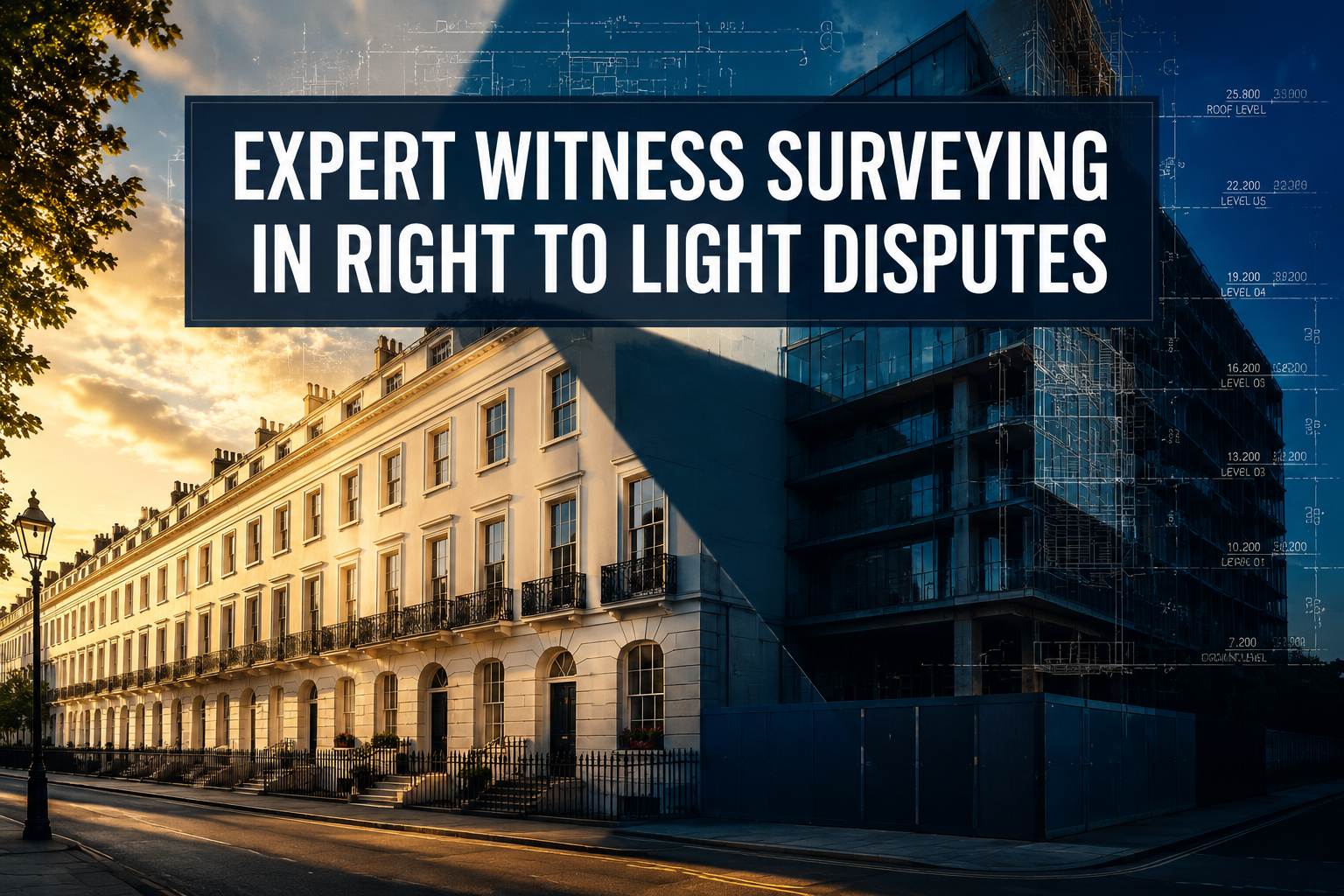

Fewer than one in ten property owners realise that a right to light can be acquired automatically after 20 years of uninterrupted enjoyment under the Prescription Act 1832 — without any formal registration or written agreement. When a neighbouring development then blocks that light, the resulting dispute can escalate into High Court litigation worth hundreds of thousands of pounds. Expert Witness Surveying in Right to Light Disputes: How Building Surveys and Valuations Feed Into Daylight Claims sits at the intersection of physical inspection, technical modelling, legal rights, and financial impact — and getting any one of those elements wrong can sink an otherwise valid case.
Key Takeaways
- A right to light claim requires three interlocking strands of expert evidence: physical building inspection, daylight and sunlight assessment, and property valuation.
- Expert witnesses must comply with Civil Procedure Rules Part 35 and RICS professional standards to ensure their reports are admissible and credible in court.
- The Waldram method remains the dominant technical tool for measuring light interference, but it faces increasing scrutiny and should be supplemented with modern 3D modelling.
- Evidential pitfalls — including incomplete site inspections, unsupported valuation assumptions, and poorly explained technical models — are the most common reasons expert reports are challenged.
- Early engagement of a qualified chartered surveyor can prevent disputes from reaching litigation and significantly reduce costs for all parties.
What a Right to Light Dispute Actually Involves
A right to light is a legal easement that entitles the owner or occupier of a building to receive natural light through defined apertures — typically windows — to a level sufficient for the comfortable use and enjoyment of the property. It is not a right to sunlight, nor a right to an unobstructed view. This distinction matters enormously when framing expert evidence.
The right arises in three principal ways: by express grant in a deed, by long use under the Prescription Act 1832 (20 years of uninterrupted enjoyment), or by implied grant on the sale of land. Once established, it is a property right that binds successors in title and can be enforced against anyone who substantially interferes with it.
When a new building or extension reduces the light entering an affected property, the claimant must prove two things: first, that a right to light exists; and second, that the interference is actionable — meaning the remaining light falls below the threshold for comfortable use. This is where Expert Witness Surveying in Right to Light Disputes: How Building Surveys and Valuations Feed Into Daylight Claims becomes indispensable. Neither element can be established without rigorous, independently verified technical evidence.
Remedies available to a successful claimant include:
| Remedy | Description |
|---|---|
| Injunction | Court order requiring demolition or modification of the offending structure |
| Damages in lieu | Financial compensation calculated on the basis of a notional release of the right |
| Negotiated release | Pre-litigation settlement, often the most cost-effective outcome |
The threat of an injunction — which can require a developer to demolish a completed building — makes early expert involvement critical. Courts have granted injunctions in high-profile cases even after construction is complete, as confirmed in Coventry v Lawrence [2014] UKSC 13.
The Physical Building Survey: Foundation of the Expert's Evidence
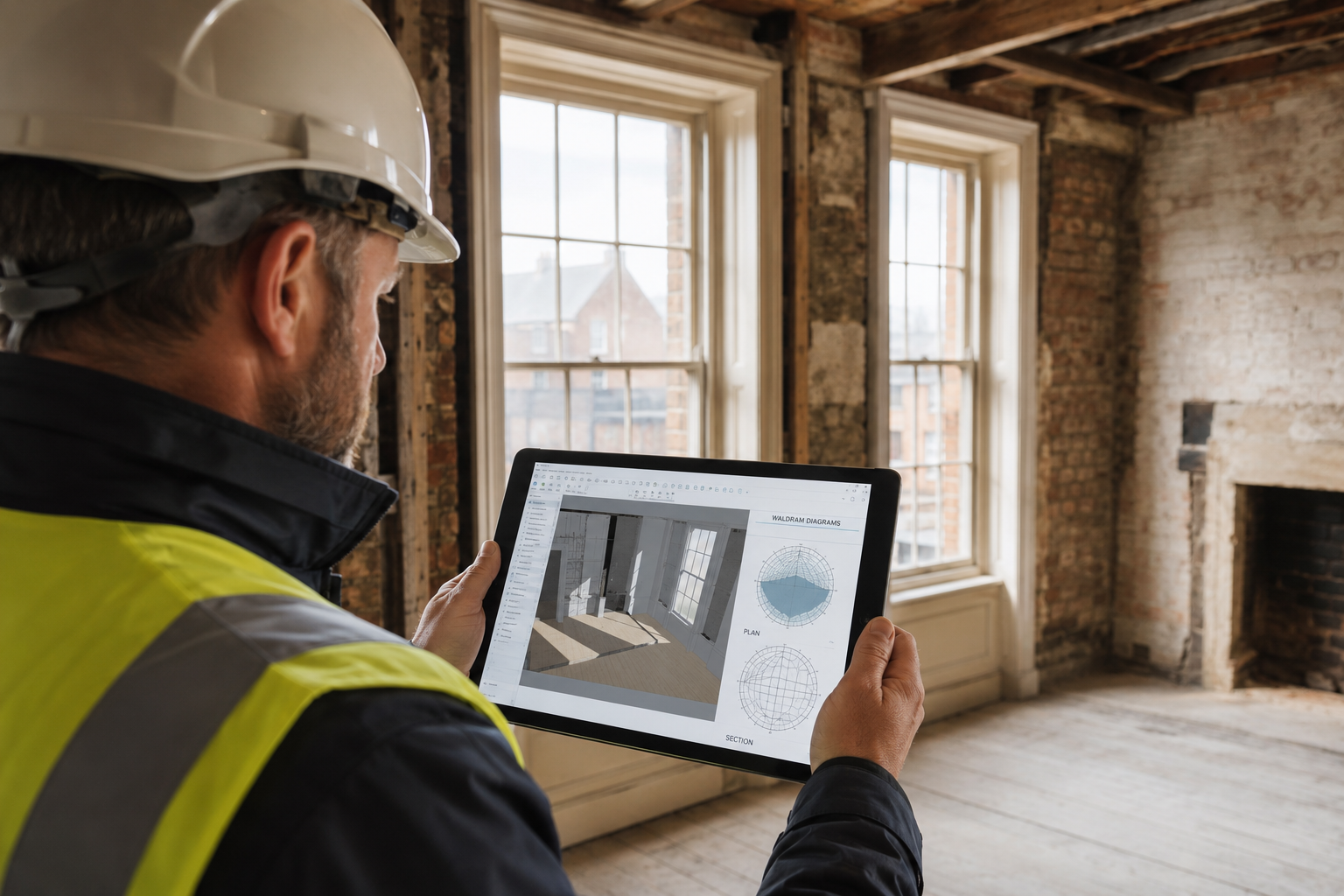
No credible expert report in a right to light claim can be produced from a desk. The physical building survey is the evidentiary foundation on which all technical modelling and valuation work depends. A comprehensive building survey must capture the precise dimensions, layout, and use of every room affected by the alleged interference.
What the Site Inspection Must Record
The surveyor's inspection should document:
- Window dimensions and positions: Height, width, cill level, and head height for every aperture claimed to receive the right to light.
- Room use and layout: A bedroom, kitchen, and office have different thresholds for adequate illumination. The use of the room at the time the right was acquired, and its current use, are both legally relevant.
- Existing obstructions: Any pre-existing structures, trees, or topographical features that already limit light to the affected apertures must be recorded. Failure to account for these is one of the most common evidential pitfalls.
- Neighbouring development details: Floor levels, eaves heights, and the precise position of the new structure relative to the affected windows.
For complex multi-storey disputes or where access is restricted, drone surveys can provide accurate dimensional data and photographic evidence that would be impossible to obtain from ground level alone. Modern surveying practices increasingly employ advanced 3D visualisation technology to enhance the precision of expert reports [3].
A schedule of condition report prepared before construction begins can also serve as a critical baseline document, recording the existing light environment and the state of the affected property at a defined point in time. This pre-construction record significantly strengthens the claimant's position if a dispute later arises.
Common Evidential Pitfalls in Site Inspection
- Failing to measure from the correct datum point (the centre of the window, not the wall face)
- Omitting rooms that are partially affected, which weakens the overall picture of interference
- Not recording the orientation of the building relative to the sun's path
- Ignoring seasonal variation in natural light levels
Measurement Standards and Technical Modelling in Daylight Claims
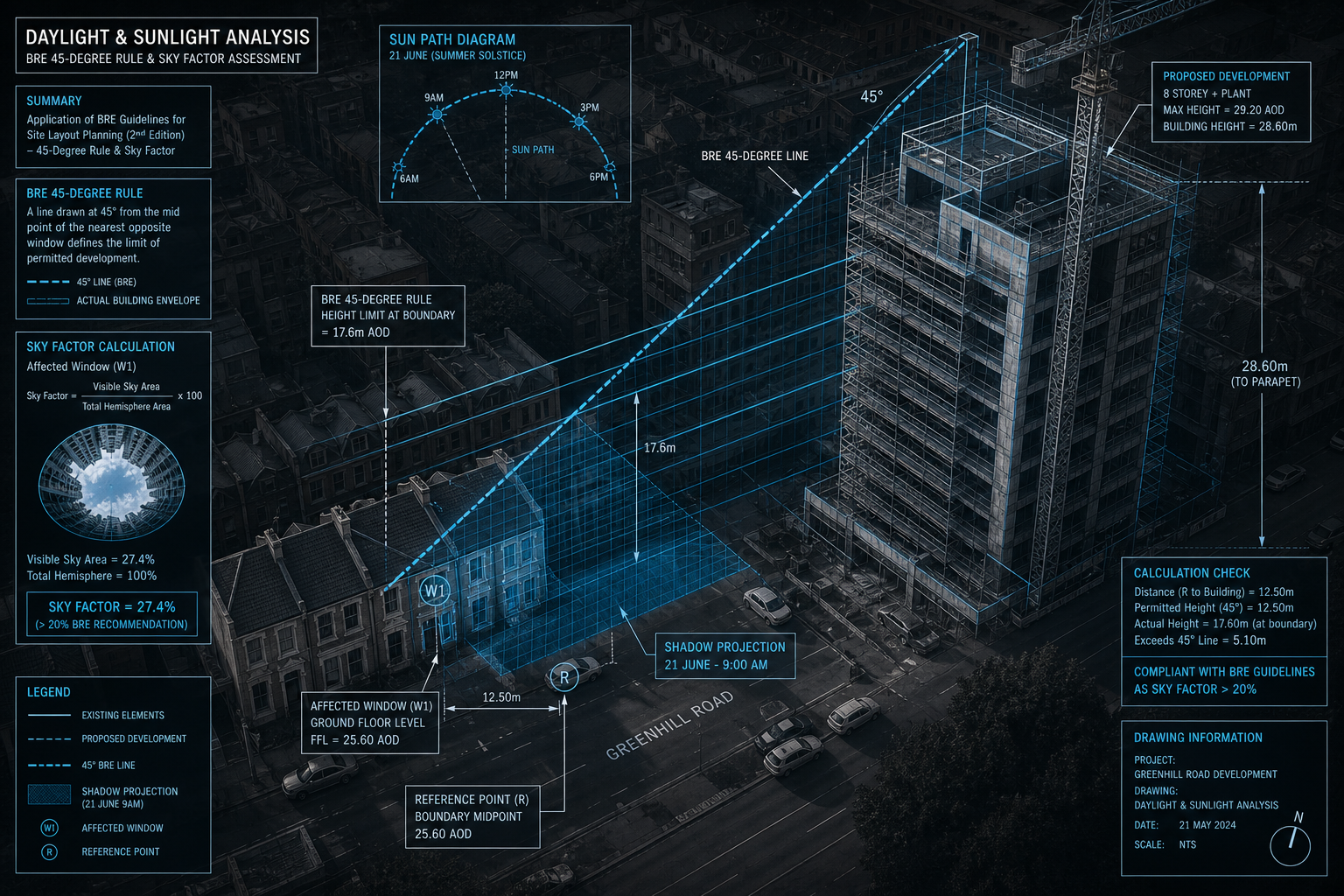
Once the physical survey data is gathered, the expert must apply recognised measurement standards to determine whether the interference is actionable. This is the most technically demanding phase of Expert Witness Surveying in Right to Light Disputes: How Building Surveys and Valuations Feed Into Daylight Claims, and the phase most likely to be challenged in court.
The Waldram Method and Its Limitations
The Waldram diagram method, developed by Percy Waldram in the early twentieth century, remains the most widely used tool for quantifying the loss of light to an affected room. It works by plotting the visible sky from a reference point within the room on a specially constructed diagram, then calculating the percentage of sky visible before and after the obstruction.
The traditional threshold for adequate light is 0.2% of the total sky hemisphere — roughly equivalent to one-fiftieth of the sky. Rooms that receive less than this across more than 50% of their working plane are generally considered to be inadequately lit for ordinary purposes [4].
However, the Waldram method has faced significant criticism for its applicability in modern contexts [4]. Key limitations include:
- It measures sky visibility, not actual illuminance, and does not account for direct sunlight or reflected light from surrounding surfaces.
- It was designed for residential use and may not translate accurately to commercial or mixed-use properties.
- It does not reflect contemporary expectations of natural light in energy-efficient buildings.
The surveying profession has debated these limitations extensively, and courts have begun to scrutinise Waldram-based evidence more carefully. Expert witnesses should supplement Waldram analysis with BRE (Building Research Establishment) guidelines on daylight and sunlight, including the Vertical Sky Component (VSC) and No-Sky Line (NSL) tests used in planning assessments. Specialist consultants conduct detailed assessments to analyse the impact of new developments on existing buildings' access to natural light, ensuring compliance with BRE guidelines [2].
3D Modelling and Visualisation
Modern expert reports increasingly incorporate 3D computer modelling to illustrate the before-and-after light environment in a way that a judge or arbitrator can readily understand. Software such as ESRI CityEngine or purpose-built right to light packages can generate:
- Animated shadow studies showing how light changes through the day and across seasons
- False-colour maps showing illuminance levels across affected room surfaces
- Comparative cross-sections showing the obstruction angle created by the new development
The critical rule for technical modelling is this: the model must be calibrated against the physical survey data. Any discrepancy between the model inputs and the measured dimensions of the building will be identified and exploited by the opposing expert. All assumptions must be stated explicitly in the report.
How Valuations Feed Into Daylight Claims
The financial dimension of a right to light dispute is often where the most significant disagreement between parties arises. Even where liability is established, the quantum of damages — or the price at which a claimant might agree to release the right — depends entirely on a credible property valuation.
The Valuation Framework
Damages in lieu of an injunction in right to light cases are typically assessed on a "negotiated release" basis: what sum would a willing seller and a willing buyer have agreed for the release of the right, in a hypothetical negotiation conducted before the development was built? This is sometimes called the Stokes v Cambridge approach, derived from the 1961 case that established the principle of splitting the developer's profit attributable to the infringement.
A registered RICS valuer must assess:
- The unencumbered value of the development: What is the completed development worth without the right to light constraint?
- The value of the development subject to the right: What would the development be worth if it had to be modified to avoid the infringement?
- The claimant's loss: The diminution in value of the affected property as a result of the reduced light.
The difference between (1) and (2) represents the "profit at stake" for the developer, and courts have typically awarded claimants between 33% and 50% of this figure as a negotiated release price. Understanding the factors that influence property valuation is therefore directly relevant to quantifying the financial remedy in a daylight claim.
For commercial properties, the valuation exercise is more complex. A commercial building survey may reveal that reduced natural light has a measurable impact on rental value, occupier demand, or the ability to let the property at all — all of which feed into the damages calculation. A RICS Red Book valuation provides the formal, court-ready framework for presenting these figures.
Valuation Pitfalls to Avoid
- Circular reasoning: Using the same comparables to establish both the unencumbered value and the diminution in value without adjustment.
- Ignoring planning risk: The developer's profit calculation must account for the possibility that planning permission might have been refused or modified.
- Overstating the claimant's loss: Courts are sceptical of valuation evidence that claims a disproportionate diminution in the affected property's value relative to the actual degree of light interference.
- Failing to update comparables: Market conditions change. Valuations based on stale comparable evidence will be challenged.
Expert Witness Obligations: CPR Part 35 and RICS Standards
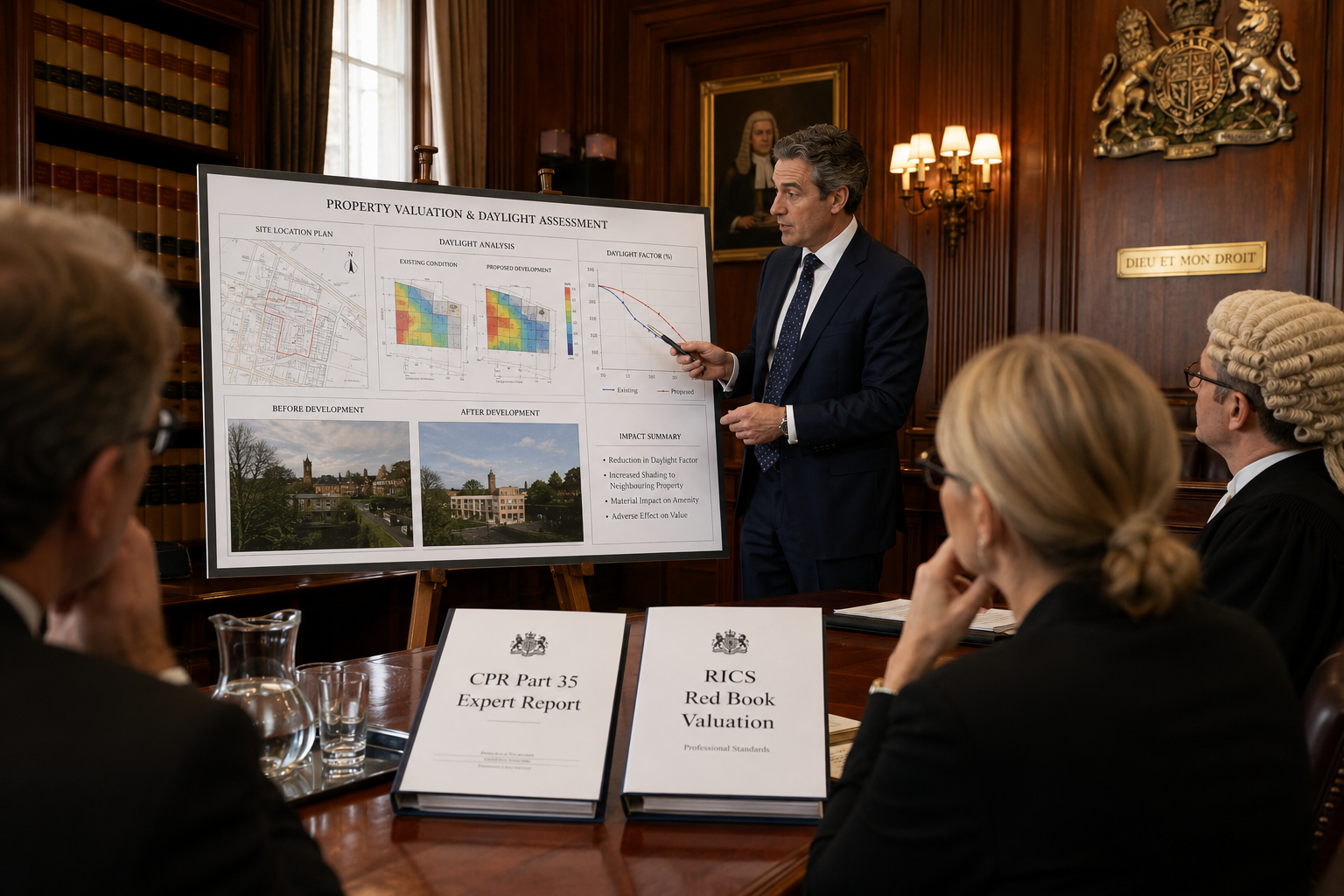
Expert Witness Surveying in Right to Light Disputes: How Building Surveys and Valuations Feed Into Daylight Claims carries specific legal obligations that distinguish expert evidence from ordinary factual evidence. An expert witness's primary duty is to the court, not to the party instructing them [1].
Under Civil Procedure Rules Part 35, expert reports must:
- State the substance of all material instructions received from the instructing party
- Confirm that the expert understands their duty to the court and has complied with it
- Identify any matters that fall outside the expert's expertise
- State where an opinion is provisional or qualified
Failure to comply with CPR Part 35 can result in the report being excluded from evidence entirely [3]. Courts have struck out expert evidence for breaches including failure to disclose instructions, advocacy masquerading as opinion, and selective presentation of technical data.
RICS members are additionally bound by the RICS Practice Statement on Surveyors Acting as Expert Witnesses, which requires impartiality, transparency, and adherence to professional standards [1]. The emphasis on impartiality is not merely procedural — it is the foundation of the expert's credibility. An expert who is perceived as a hired advocate will have their evidence discounted, regardless of its technical merit.
Practical steps to protect the integrity of expert evidence:
- Maintain a clear written record of all instructions and communications with the instructing solicitor
- Prepare a separate "working file" containing all calculations, model inputs, and raw survey data
- Seek a single joint expert appointment where possible to reduce costs and improve the prospects of settlement
- Engage in without-prejudice discussions with the opposing expert at the earliest opportunity
Firms specialising in right to light disputes provide a range of services — including boundary determination, party wall matters, building defect analysis, and valuation disputes — that address the full spectrum of property conflicts [1]. For disputes involving shared boundaries or structural works, understanding party wall dispute procedures can also be relevant, as construction works triggering a right to light claim often involve party wall notices simultaneously.
Explaining Technical Evidence to the Court
One of the most underappreciated skills in expert witness surveying is the ability to translate complex technical modelling into language that a judge — who is likely not a surveyor — can understand and rely upon.
Structuring the Expert Report for Clarity
A well-structured expert report in a right to light claim should follow a logical sequence:
- Executive summary: A plain-English summary of the expert's conclusions, written for a non-technical reader.
- Methodology: A clear explanation of the measurement standards applied, why they were chosen, and their limitations.
- Survey findings: Documented results of the physical inspection, supported by photographs, plans, and measured drawings.
- Technical analysis: The Waldram or BRE calculations, with all assumptions stated and justified.
- Valuation section: The financial impact assessment, with comparables and methodology explained.
- Conclusions: A clear statement of whether, in the expert's opinion, the right to light has been infringed and to what degree.
Surveying experts collaborate closely with legal teams to provide comprehensive support in litigation, offering both technical assessments and strategic advice [6]. This collaboration is most effective when the expert is engaged early — ideally before any pre-action correspondence is sent — so that the technical evidence can inform the legal strategy from the outset.
Visual Aids and Demonstrative Evidence
Courts have consistently welcomed well-prepared visual aids in technical property disputes. Annotated photographs, before-and-after light diagrams, and 3D model animations can all be used as demonstrative exhibits, provided they are accurately derived from the underlying survey data and clearly labelled.
The expert must be prepared to defend every element of their visual evidence under cross-examination. A diagram that cannot be explained in plain English, or that relies on assumptions the expert cannot justify from the physical survey, will undermine the entire report.
Conclusion
Right to light disputes demand a level of technical rigour, legal awareness, and communication skill that few areas of surveying practice can match. The expert witness role requires the seamless integration of physical building inspection, recognised measurement standards, and credible property valuation — all presented in a form that satisfies both CPR Part 35 and the scrutiny of opposing counsel.
Actionable next steps for parties involved in or anticipating a right to light dispute:
- Commission a physical building survey immediately: Do not wait for litigation. A comprehensive RICS building survey establishes the baseline evidence that all subsequent technical work depends upon.
- Engage a chartered surveyor with specific right to light experience: General building surveying expertise is not sufficient. The expert must understand Waldram methodology, BRE guidelines, and the legal framework for damages.
- Obtain a formal RICS valuation early: Understanding the financial exposure — for both claimant and developer — is essential for informed settlement negotiations.
- Consider pre-action expert discussions: Many right to light disputes settle without litigation when both parties have credible, well-prepared expert evidence. Early engagement reduces costs and uncertainty for everyone.
- Do not overlook party wall and planning dimensions: A development that triggers a right to light claim will often involve party wall procedures and planning conditions that interact with the daylight claim. A coordinated approach across all three disciplines produces the strongest outcome.
The cost of getting expert witness surveying wrong in a right to light dispute — whether through incomplete inspection, flawed modelling, or unsupported valuation — can far exceed the cost of doing it properly from the outset. In 2026, with urban densification driving more development close to existing properties than ever before, the demand for rigorous, court-ready daylight claims evidence will only continue to grow.
References
[1] expertwitnesssurveyors.co.uk – https://www.expertwitnesssurveyors.co.uk/?utm_source=openai
[2] righttolightsurveyors.co.uk – https://www.righttolightsurveyors.co.uk/?utm_source=openai
[3] expertwitnesssurveyor – https://expertwitnesssurveyor.com/?utm_source=openai
[4] Right To Light – https://en.wikipedia.org/wiki/Right_to_light?utm_source=openai
[5] Expert Witness – https://www.survtechsolutions.com/expert-witness?utm_source=openai
[6] cnettleman – https://cnettleman.net/?utm_source=openai