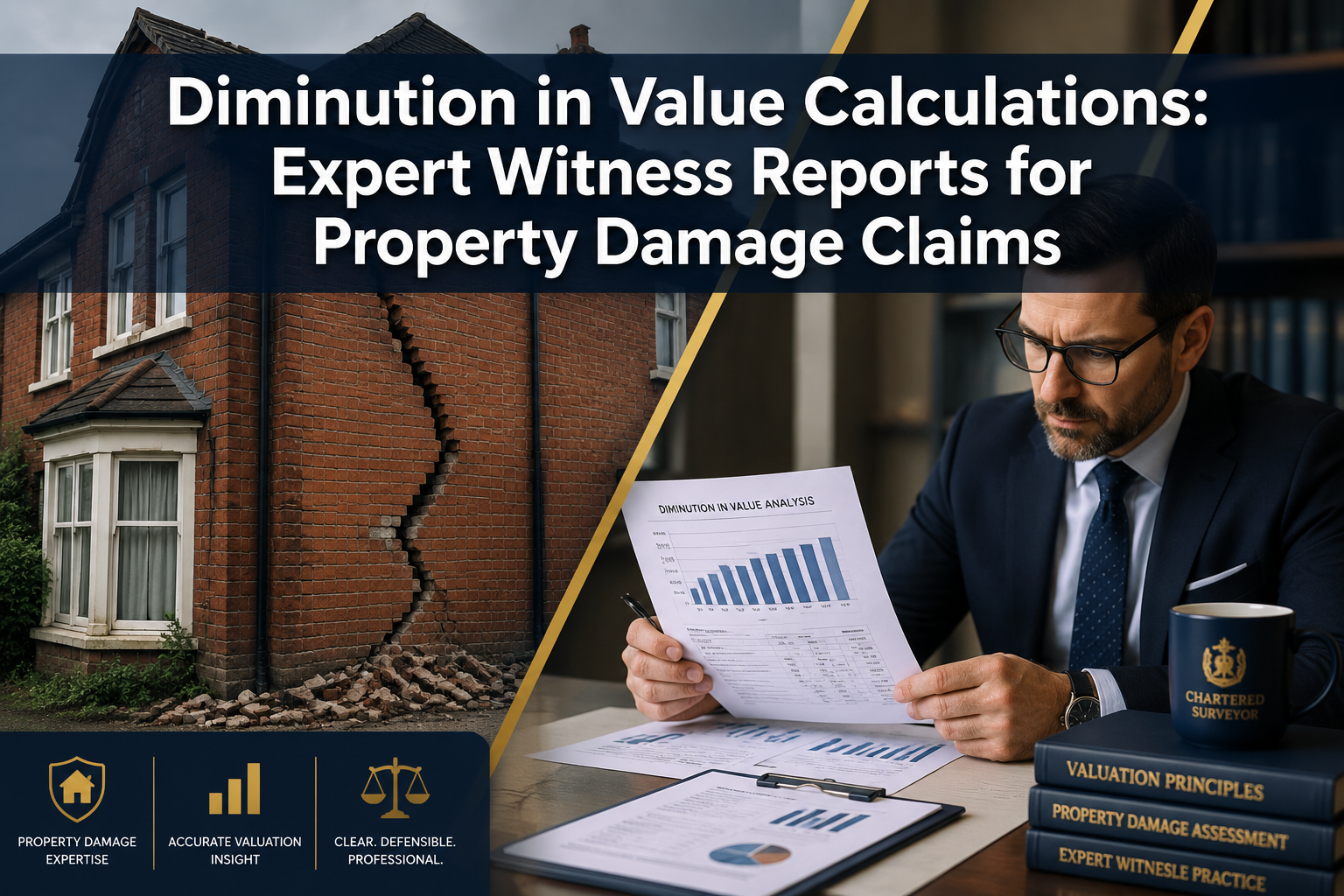
A property can be fully repaired and still be worth thousands of pounds less than it was before the damage occurred. That gap between the cost of reinstatement and the actual loss suffered by the owner is the core of diminution in value — and it is one of the most contested, misunderstood, and financially significant concepts in property damage disputes in 2026.
Diminution in Value Calculations: Expert Witness Reports for Property Damage Claims sits at the intersection of surveying, valuation science, and litigation. When a claimant argues that their property has lost market value despite repairs, they need more than a builder's invoice. They need a structured, court-ready expert witness report that applies recognised methodology, references comparable market evidence, and withstands cross-examination. This article explains exactly how those calculations work, what courts expect, and how to commission a report that holds up.
Key Takeaways
- Diminution in value is the measurable loss in a property's market value after damage, even when repairs have been completed.
- Expert witness reports must follow recognised methodologies — such as the paired sales analysis or the before-and-after valuation approach — and align with RICS guidance.
- Courts scrutinise the qualifications, independence, and methodology of expert witnesses; a poorly structured report can be rejected entirely.
- Factors including damage severity, repair quality, stigma, and local market conditions all influence the final diminution figure.
- Commissioning a qualified chartered surveyor with expert witness experience is essential for credible, admissible evidence.
What Is Diminution in Value and Why Does It Matter in Property Damage Claims
Diminution in value (sometimes called diminished value) refers to the reduction in a property's open market value caused by damage, contamination, or a defect — even after remedial works have been carried out [1]. It is distinct from the cost of repair. A property owner may spend £40,000 restoring flood-damaged floors, replastering walls, and replacing fixtures, yet find that buyers still discount their offer because of the property's history. That discount is the diminution.
In legal terms, the principle is straightforward: a claimant is entitled to be put back in the position they would have occupied had the damage not occurred. Where repair costs alone do not achieve that, the residual loss in value becomes a separate head of damages [1]. Courts in England and Wales have consistently recognised this principle, and the RICS Valuation — Global Standards (the "Red Book") provides the professional framework within which surveyors must operate when quantifying it.
The concept applies across a wide range of scenarios:
| Damage Type | Typical Diminution Trigger |
|---|---|
| Structural damage (subsidence, fire) | Stigma, buyer concern over recurrence |
| Flooding or water ingress | Insurance difficulties, perceived risk |
| Environmental contamination | Health concerns, regulatory restrictions |
| Neighbouring construction defects | Ongoing liability uncertainty |
| Party wall damage | Dispute history visible to future buyers |
Understanding valuation factors that influence market value is essential before attempting any diminution calculation, because the starting point — the undamaged value — must itself be established with precision.
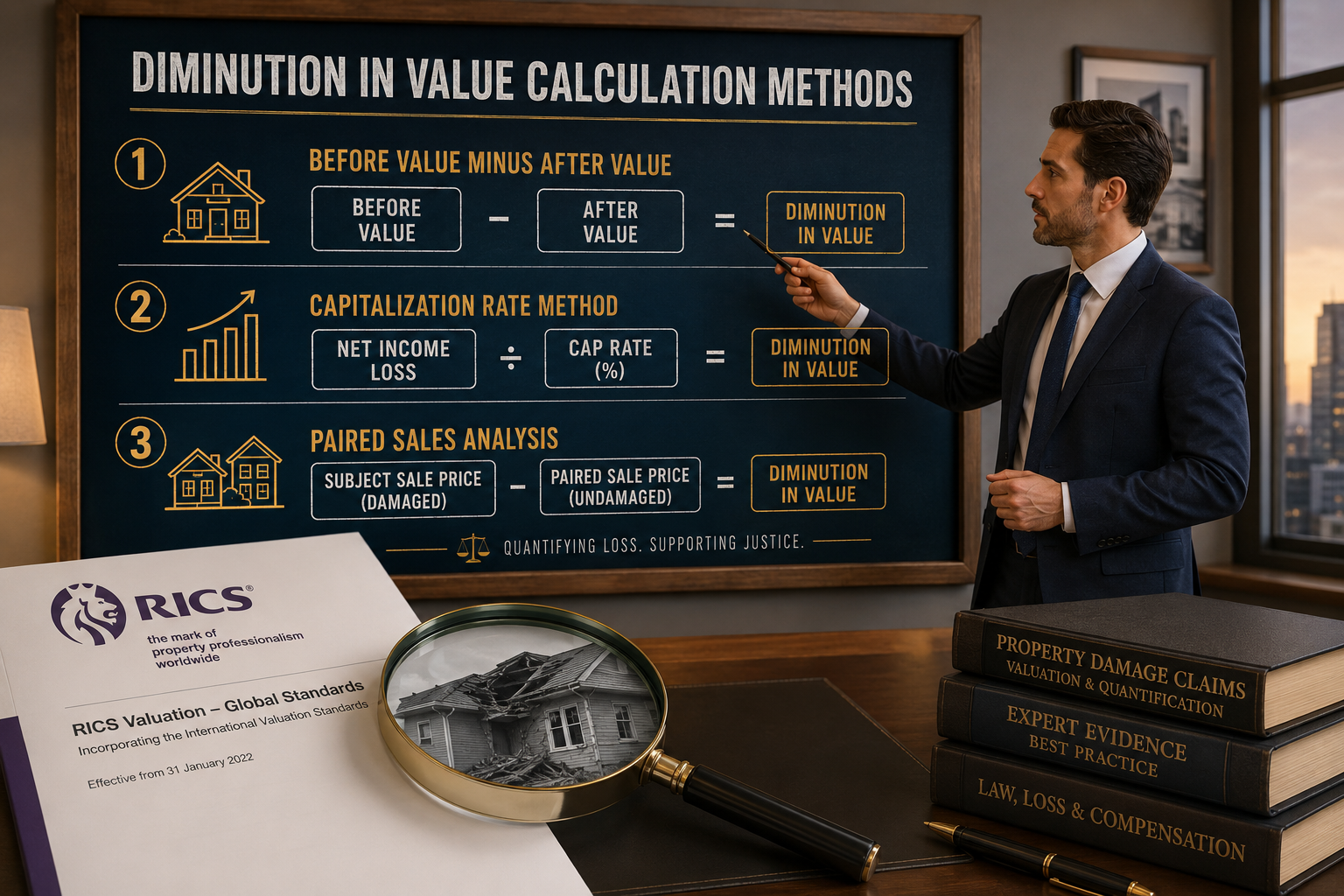
The Core Formulas Used in Diminution in Value Calculations: Expert Witness Reports for Property Damage Claims
No single formula applies universally. Expert witnesses draw on several recognised methodologies depending on the nature of the damage, the availability of market data, and the legal jurisdiction. The three most widely used approaches in UK property damage claims are set out below.
1. The Before-and-After Method
This is the most direct and widely accepted approach. The expert establishes:
- V(before): The open market value of the property immediately before the damage occurred
- V(after): The open market value of the property in its current (post-repair) state
- Diminution = V(before) – V(after)
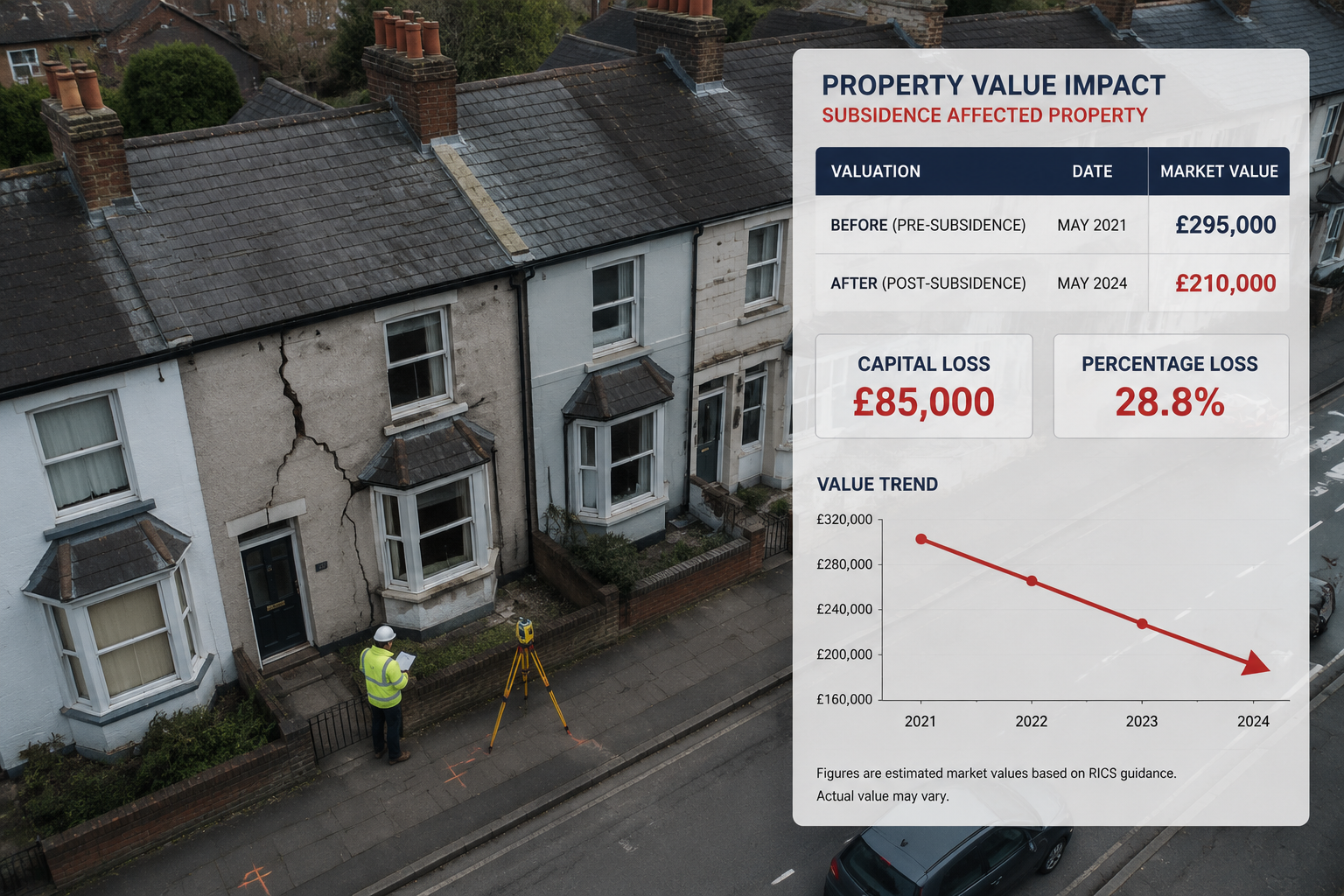
The challenge lies in evidencing both figures. V(before) typically relies on comparable sales data, the property's own transaction history, and market indices. V(after) requires the expert to assess how a hypothetical willing buyer in the open market would price the property given its damage history, the quality of repairs, and any residual risk.
2. Paired Sales Analysis
This method compares sales of damaged (or previously damaged) properties with sales of equivalent undamaged properties in the same market area over the same period. The percentage differential between the two groups represents the market-implied diminution.
Formula:
Diminution (%) = [(Undamaged Comparable Price – Damaged Property Price) / Undamaged Comparable Price] x 100
In the landmark US case Cook v. Rockwell International Corp., expert witness Wayne L. Hunsperger applied market research and regression analysis across a large dataset to estimate a $169 million loss for residential properties affected by environmental contamination [2]. While US case law does not bind English courts, the methodological rigour expected is directly comparable.
3. The Capitalisation of Rent Differential Method
Used primarily for investment or commercial properties, this approach calculates the reduction in achievable rent caused by the damage, then capitalises that income loss at an appropriate yield:
Diminution = (Undamaged Rent – Damaged Rent) / Capitalisation Rate
For example, if damage reduces achievable rent by £5,000 per annum and the market yield is 5%, the capitalised diminution is £100,000.
Each of these methods requires the expert to document their assumptions, cite their comparable evidence, and explain why the chosen methodology is appropriate for the specific claim. A Red Book valuation provides the formal RICS-compliant framework within which these figures must be presented.
What Courts Expect from Expert Witness Reports
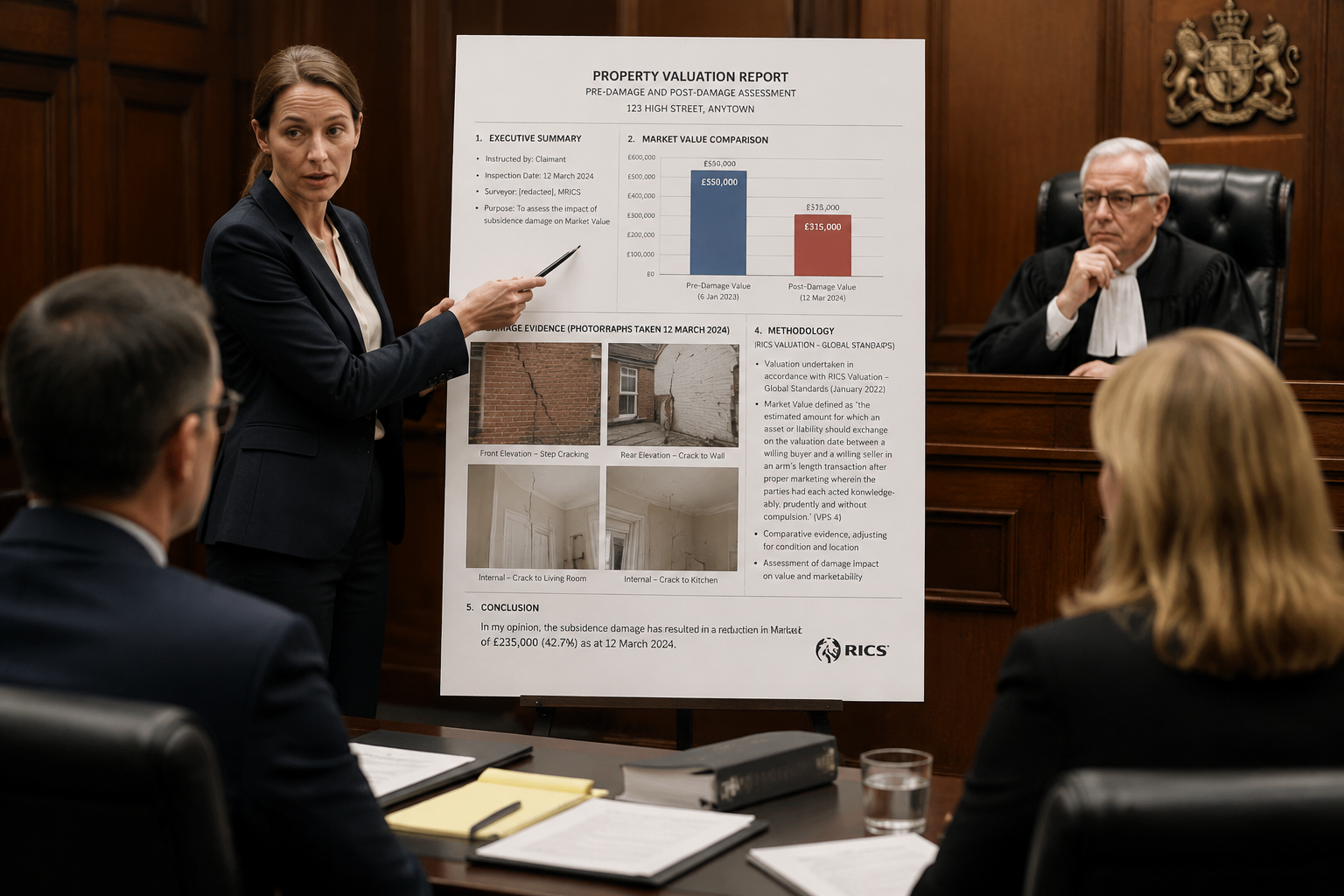
The admissibility and weight given to an expert witness report depends heavily on how it is structured and who prepares it. In England and Wales, Part 35 of the Civil Procedure Rules (CPR) governs expert evidence. The expert's overriding duty is to the court, not to the party instructing them.
Qualifications and Independence
Courts examine whether the expert has the relevant professional qualifications and practical experience. In Alexander v. Halliburton Energy Services, the court evaluated whether the expert's economic model was aligned with the applicable legal standards — a reminder that technical competence alone is insufficient if the methodology does not map to the legal test being applied [3].
For property diminution claims in England and Wales, the expert should ideally be:
- A Chartered Surveyor (MRICS or FRICS) with valuation experience
- Registered as a RICS Registered Valuer
- Experienced in expert witness work and familiar with CPR Part 35 duties
Engaging a surveyor who offers expert witness services with specific experience in property damage claims significantly reduces the risk of the report being challenged on procedural grounds.
Structure of a Compliant Report
A court-ready diminution in value report typically contains the following sections:
- Executive Summary — the key finding and the diminution figure
- Instructions and Scope — what the expert was asked to assess
- Property Description — physical details, tenure, location
- Damage Description — nature, extent, and cause of damage
- Repair Assessment — quality and completeness of remediation
- Valuation Methodology — which approach was used and why
- Market Evidence — comparable transactions cited and analysed
- Before and After Valuations — with full reasoning
- Conclusion — the diminution figure expressed as a sum and/or percentage
- Statement of Truth — as required by CPR Part 35
A schedule of condition report prepared before any damage occurs can be invaluable at this stage, providing a documented baseline against which post-damage conditions are measured.
The Stigma Factor
One of the most contested elements in any diminution report is stigma — the residual market discount that persists even after technically adequate repairs. Buyers and their mortgage lenders may still perceive risk, making the property harder to sell or finance. Courts have accepted stigma as a legitimate component of diminution, but the expert must quantify it with reference to market evidence rather than assertion [4].
Specialist litigation support firms have identified stigma arising from causes as varied as soil subsidence, access impairment, and construction defects — all of which require the same disciplined, evidence-based approach [6].
Key Factors That Influence the Diminution Figure
Several variables determine how large or small the diminution will be in any given case. Understanding these factors helps both claimants and their legal teams set realistic expectations.
Severity of original damage
Structural damage — such as that caused by subsidence, fire, or flooding — consistently produces larger diminution figures than cosmetic defects. A property that has suffered significant structural compromise may carry a market discount of 5% to 20% even after full repair [4]. For subsidence-related cases, a subsidence survey should form part of the evidence base.
Quality of repairs
Poor-quality remediation amplifies diminution. If a surveyor assesses that repairs were not carried out to the appropriate standard, the residual risk to a buyer is greater, and the discount widens. Conversely, high-quality repairs with full documentation and warranties can reduce the stigma element substantially.
Market conditions
High-demand markets with limited supply tend to absorb damage history more readily than slow markets where buyers have alternatives. However, in competitive markets, buyers may be more sensitive to any factor that creates uncertainty, particularly where mortgage lenders apply conservative criteria [4].
Insurance history and future insurability
A property that has made a flood or subsidence claim may face higher insurance premiums or restricted cover. This directly affects its market value and must be reflected in the diminution calculation.
Disclosure obligations
In England and Wales, sellers must disclose known material facts about a property. A damage history that must be disclosed to future buyers creates a permanent market disadvantage that the diminution figure must capture.
Tenure and leasehold considerations
Leasehold properties introduce additional complexity. Diminution may interact with lease extension rights, service charge disputes, or landlord obligations. Understanding lease extension valuation principles is relevant where the damage affects a leasehold asset.
RICS Guidelines and Professional Standards
The RICS Red Book (Valuation — Global Standards) and the accompanying UK National Supplement set the professional standards for all formal valuations, including those prepared for litigation. Key requirements include:
- Independence: The valuer must be independent of the parties and disclose any conflicts of interest.
- Basis of value: For diminution claims, the appropriate basis is typically Market Value — the estimated amount for which an asset should exchange on the valuation date between a willing buyer and a willing seller in an arm's length transaction.
- Comparable evidence: All comparables must be cited, analysed, and adjusted for differences in location, condition, size, and timing.
- Assumptions and special assumptions: Any departure from normal valuation assumptions must be clearly stated and justified.
RICS also publishes guidance on expert witness work through its professional standards, which align with the Civil Justice Council's Protocol for the Instruction of Experts. Surveyors preparing diminution reports must be familiar with both sets of requirements.
For complex structural damage cases, the valuation report should be read alongside technical engineering evidence. A residential structural engineering report can provide the technical foundation that the valuation expert then translates into market value impact.
Common Pitfalls in Diminution in Value Calculations: Expert Witness Reports for Property Damage Claims
Even experienced professionals make errors that undermine their reports. The most frequent pitfalls include:
- Conflating repair cost with diminution. These are separate heads of loss. A report that simply adopts the repair estimate as the diminution figure will not withstand scrutiny.
- Insufficient comparable evidence. Assertions about market discount without cited transactions are vulnerable to challenge. The more comparable sales data the expert can reference, the stronger the report.
- Failure to address the quality of repairs. An expert who does not inspect the repaired property and assess workmanship is missing a critical variable.
- Ignoring stigma. Omitting the stigma component understates the true loss, particularly in cases involving flooding, contamination, or structural failure.
- Advocacy bias. A report that reads as a partisan document rather than an independent assessment risks being given little weight by the court [3].
How to Commission an Expert Witness Report for a Property Damage Claim
When instructing an expert witness for a diminution in value claim, the following steps improve the quality and credibility of the resulting report:
- Instruct early. The expert should ideally inspect the property before repairs are completed, or at least before evidence of the damage is removed.
- Provide full documentation. Share all repair invoices, contractor reports, photographs, insurance correspondence, and any prior valuations.
- Define the scope clearly. The letter of instruction should specify the date of damage, the nature of the claim, and the legal test being applied.
- Ensure the expert understands their CPR duties. The expert must acknowledge their overriding duty to the court in the report itself.
- Request a draft for review. Legal representatives can check for factual errors (not conclusions) before the report is finalised.
Certified appraisers and chartered surveyors who prepare these reports must provide detailed analyses covering damage assessments, repair quality evaluations, and market value analyses both before and after the incident — all of which serve as critical evidence in legal proceedings [5].
For dilapidations-related diminution claims in commercial contexts, a schedule of dilapidations prepared alongside the valuation report provides a comprehensive evidential package.
Conclusion
Diminution in value is not a theoretical concept — it represents real financial loss that property owners suffer when damage permanently affects what a buyer will pay. Quantifying that loss requires structured methodology, robust market evidence, and a report that meets the exacting standards of both RICS and the Civil Procedure Rules.
Actionable next steps for claimants and legal professionals in 2026:
- Instruct a RICS Registered Valuer with expert witness experience as early as possible in the claims process — ideally before repairs are completed.
- Ensure a schedule of condition or pre-damage valuation is available to establish the baseline figure.
- Request that the expert applies the before-and-after method, paired sales analysis, or capitalisation approach — and explains in writing why the chosen methodology is appropriate.
- Do not accept a report that conflates repair costs with diminution in value; these are distinct heads of loss.
- Where structural damage is involved, commission a technical engineering report to support the valuation evidence.
A well-constructed expert witness report, grounded in RICS methodology and supported by credible comparable evidence, is the most powerful tool available in a property damage claim. The investment in getting it right at the outset is invariably less than the cost of challenging a poorly prepared report in court.
References
[1] Diminution In Value – https://www.irmi.com/articles/expert-commentary/diminution-in-value?utm_source=openai
[2] Real Estate Expert Witness Evaluates Property Damage Claims – https://www.expertinstitute.com/resources/case-studies/real-estate-expert-witness-evaluates-property-damage-claims/?utm_source=openai
[3] Valuation Expert Witness Estimates Damage To Property Values After Chemical Spill – https://www.expertinstitute.com/resources/case-studies/valuation-expert-witness-estimates-damage-to-property-values-after-chemical-spill/?utm_source=openai
[4] Diminished Value Appraisal What It Is And How To File – https://legalclarity.org/diminished-value-appraisal-what-it-is-and-how-to-file/?utm_source=openai
[5] Diminished Value – https://en.wikipedia.org/wiki/Diminished_value?utm_source=openai
[6] Value Diminution – https://www.irr.com/neworleans/services/litigation-support-and-expert-testimony/value-diminution?utm_source=openai
[7] Diminished Value Appraisal – https://www.certifiedautoappraisers.com/services/diminished-value-appraisal?utm_source=openai