
The UK retrofit sector stands at a critical crossroads in 2026. With a shocking 92% of recent installations requiring immediate remediation and the government's ambitious £15 billion Warm Homes Plan now underway, the spotlight has turned to one crucial profession: chartered surveyors. The recent Quality in Retrofit Summit has delivered clear, actionable insights that will reshape how building surveys support energy performance certificate (EPC) compliance and retrofit delivery. For property professionals, understanding these changes isn't optional—it's essential for protecting clients, maintaining professional standards, and capitalizing on the sector's transformation.
Building Surveys Post-Quality in Retrofit Summit: Actionable Insights for 2026 EPC and Retrofit Compliance represents more than just a policy discussion. It signals a fundamental shift in how the construction industry approaches energy efficiency upgrades, with surveyors positioned as independent quality gatekeepers rather than passive observers. The summit's findings reveal both the scale of current failures and the pathway forward through enhanced professional standards, comprehensive assessment methodologies, and technology-enabled monitoring.
Key Takeaways
- Quality crisis demands immediate action: 92% of ECO4 and GBIS installations have major issues requiring remediation, with 6% presenting immediate health and safety risks, creating urgent demand for independent professional oversight[2]
- RICS launches new retrofit accreditation: The Residential Retrofit Surveying AssocRICS pathway addresses critical competence gaps, already showing oversubscription as professionals seek formalized credentials beyond inadequate 3-5 day courses[2][3]
- Whole-house assessment becomes mandatory: Surveyors must transition from component-based evaluations to systems-based whole-house assessments supporting the £15 billion Warm Homes Plan's targeted interventions[1]
- Professional independence rebuilds trust: RICS positioning surveyors as impartial quality gatekeepers separate from commercial installation interests addresses retrofit's fundamental trust problem[3]
- Data-driven monitoring ensures outcomes: Robust post-installation monitoring and stock condition surveys become essential for validating performance and enabling rapid remediation when issues arise[2]
The Retrofit Quality Crisis: Understanding the Scale of the Problem
Shocking Statistics Reveal Systemic Failures
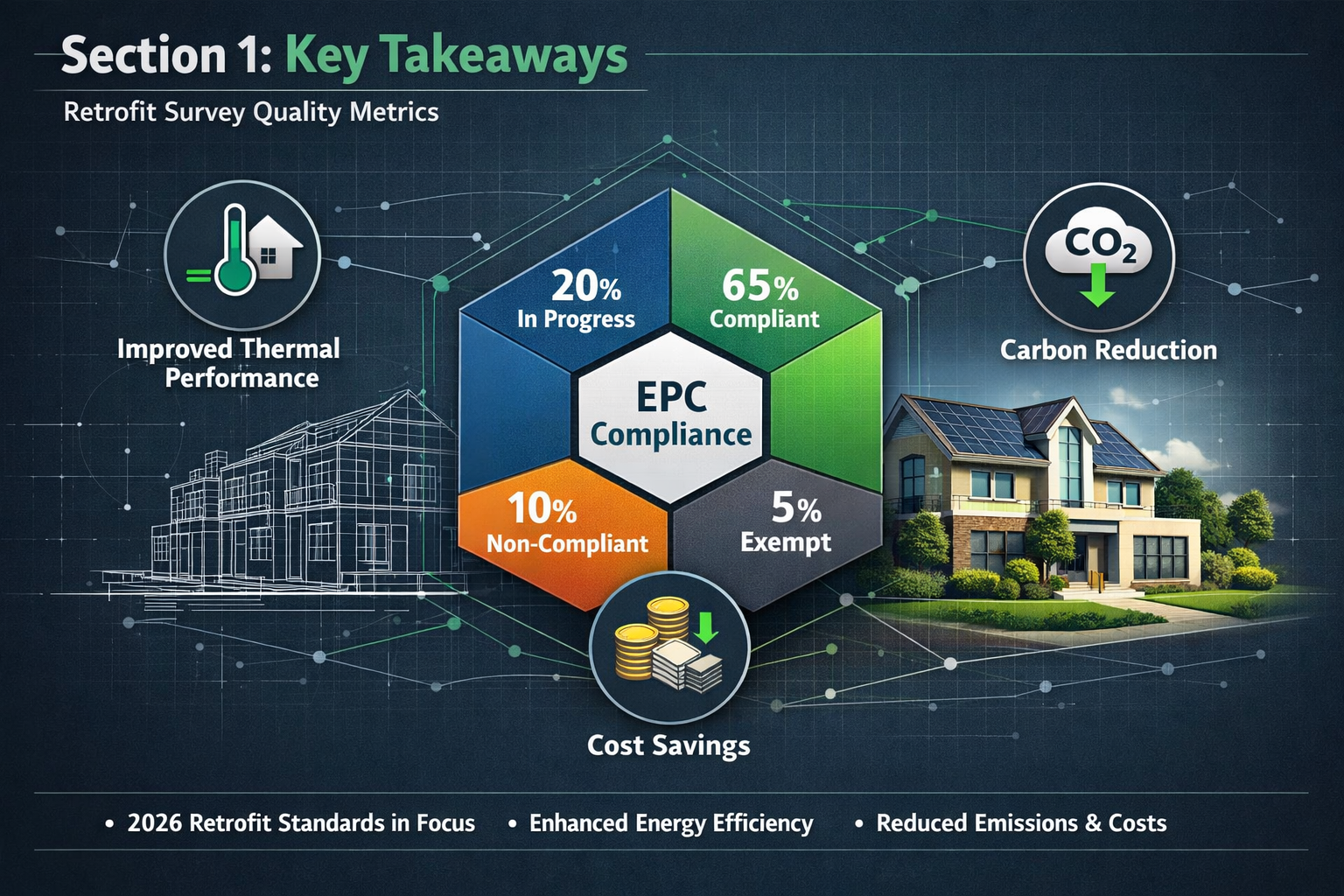
The National Audit Office's recent findings have sent shockwaves through the retrofit sector. 92% of installations carried out under ECO4 and the Great British Insulation Scheme (GBIS) have "major issues requiring immediate remediation," while a further 6% present "immediate health and safety risks."[2] These aren't minor defects or cosmetic concerns—they represent fundamental failures in installation quality, design appropriateness, and project oversight.
These statistics expose several critical weaknesses in the current system:
- Inadequate pre-installation assessments failing to identify property-specific risks
- Poor installation workmanship by insufficiently trained contractors
- Lack of independent quality verification throughout the retrofit process
- Absence of post-installation monitoring to validate performance outcomes
- Insufficient consumer protections when problems emerge
For chartered surveyors, these failures create both professional obligations and commercial opportunities. Property owners increasingly recognize that independent professional advice—delivered through comprehensive RICS building surveys—provides essential protection against costly retrofit failures.
Why Current Retrofit Assessments Fall Short
Summit panellist Kate Charrington from Projekt 3 identified a fundamental problem: the gap between residential surveyors and retrofit practitioners has grown dangerously wide.[2] Current training frameworks for Domestic Energy Assessors and Retrofit Assessors require only 3-5 day courses—a timeframe deemed wholly insufficient for the complexity of modern retrofit projects.
"Any professional sector brings independence. Our role is to make sure it is right from start to end." — RICS leadership on rebuilding retrofit trust[3]
This competence deficit manifests in several ways:
Limited understanding of building physics: Assessors may not fully grasp how interventions affect moisture movement, thermal bridging, and ventilation requirements.
Component-focused thinking: Traditional approaches evaluate individual measures (boiler replacement, window upgrades) without considering whole-house system interactions.
Insufficient risk identification: Failure to recognize property-specific vulnerabilities such as solid wall construction challenges, existing damp issues, or ventilation deficiencies.
Lack of post-installation validation: Minimal follow-up to ensure installed measures perform as designed and don't create unintended consequences.
The new RICS Residential Retrofit Surveying AssocRICS pathway directly addresses these gaps by establishing rigorous professional standards that go far beyond basic energy assessment training.[2][3]
The Trust Problem in Retrofit
Beyond technical failures, the retrofit sector faces what industry leaders call a "trust problem."[3] Homeowners lack confidence in professional guidance, and high-profile installation failures have severely damaged sector reputation. This trust deficit creates significant barriers to achieving the government's ambitious targets for home energy upgrades.
RICS is prioritizing transparency, robust standards, and continued professional development to normalize good practice rather than pursue marketing-driven narratives.[3] This approach positions chartered surveyors as trusted advisors who provide independent, evidence-based recommendations free from the commercial pressures that may compromise installer objectivity.
Building Surveys Post-Quality in Retrofit Summit: Key Recommendations for Enhanced Survey Practice
Whole-House Assessment Methodology
The summit emphasized a fundamental shift from component-based evaluations to systems-based whole-house assessments.[1] This approach recognizes that buildings function as integrated systems where individual interventions can have cascading effects throughout the property.
A comprehensive whole-house assessment includes:
| Assessment Component | Survey Focus Areas | Key Deliverables |
|---|---|---|
| Building Fabric Analysis | Wall construction types, insulation levels, thermal bridging, air tightness | Thermal performance baseline, upgrade opportunities |
| Moisture & Ventilation Strategy | Existing damp issues, ventilation adequacy, condensation risk | Moisture management plan, ventilation requirements |
| Heating System Evaluation | Current system efficiency, heat distribution, control strategies | Heating upgrade pathway, renewable technology suitability |
| Renewable Technology Suitability | Solar potential, heat pump viability, property constraints | Technology recommendations, installation feasibility |
| Occupant Needs Assessment | Household composition, health conditions, budget constraints | Tailored retrofit plan aligned with occupant requirements |
This methodology requires surveyors to develop expertise beyond traditional structural surveys, incorporating building physics, energy modeling, and occupant health considerations into their assessments.
Stock Condition Surveys for Social Housing Providers
RICS is developing a comprehensive Residential Stock Condition Survey Code of Practice designed for both RICS members and all social housing providers.[4] This code addresses legal and regulatory frameworks, survey design methodologies, and post-survey procedures to standardize quality across the sector.
Stock condition surveys serve multiple critical functions:
✅ Compliance verification: Ensuring properties meet Awaab's Law requirements for damp and mould management
✅ Investment planning: Identifying retrofit priorities across large property portfolios
✅ Performance monitoring: Tracking condition changes over time to validate intervention effectiveness
✅ Risk management: Identifying health and safety hazards requiring immediate attention
✅ Asset valuation: Supporting financial planning and investment decisions
Social housing providers managing thousands of properties need systematic approaches to identify which homes require urgent intervention and which can follow planned upgrade schedules. Professional stock condition surveys provide the data foundation for evidence-based decision-making.
Neighborhood-Level Retrofit Planning
The Warm Homes Plan's targeted support for low-income households requires surveyors to think beyond individual properties to neighborhood-level retrofit planning programmes.[1] This approach recognizes that concentrated interventions in specific areas can achieve economies of scale, reduce disruption, and build community engagement.
Neighborhood planning involves:
- Area-wide building stock analysis identifying common construction types and shared challenges
- Community engagement strategies building trust and encouraging participation
- Coordinated contractor deployment reducing mobilization costs and installation timescales
- Shared infrastructure planning for district heating networks or renewable energy systems
- Social value creation through local employment and skills development
This strategic approach requires surveyors to develop project management and stakeholder engagement capabilities alongside their technical expertise.
PAS 2035 Framework Compliance
While PAS 2035:2023 provides an excellent framework for embedding quality throughout retrofit projects, numerous sector practitioners are not following it.[2] Summit expert Ben Nixon from Bailey Garner highlighted this compliance gap as a critical barrier to quality outcomes.
PAS 2035 establishes a structured process including:
- Initial assessment by qualified Retrofit Assessor
- Retrofit design by competent Retrofit Designer
- Installation by certified contractors following approved specifications
- Quality assurance through independent inspection
- Post-installation evaluation validating performance outcomes
Chartered surveyors can support PAS 2035 compliance through multiple touchpoints:
- Conducting pre-retrofit specialist defect surveys identifying existing issues
- Providing independent quality assurance during installation
- Performing post-installation monitoring surveys validating outcomes
- Supporting dispute resolution when installations fail to meet standards
The gap between PAS 2035 requirements and actual practice creates significant professional liability risks for all parties involved in retrofit projects. Surveyors who understand and apply the framework position themselves as essential quality gatekeepers.
The £15 Billion Warm Homes Plan: Opportunities and Obligations for Surveyors
Understanding the Three-Pillar Approach
The UK Government's £15 billion Warm Homes Plan allocates funding over 5 years to upgrade 5 million homes through three distinct pillars:[2]
Pillar 1: Targeted Support for Low-Income Households 🏠
This pillar provides fully funded or heavily subsidized retrofits for households in fuel poverty or vulnerable situations. Surveyors play critical roles in:
- Identifying eligible properties through condition assessments
- Designing appropriate intervention packages within budget constraints
- Ensuring installations address health and safety priorities
- Validating outcomes through post-installation surveys
Pillar 2: Universal Offer for Investment-Ready Households 💷
This pillar offers subsidies and financing mechanisms for households able to contribute toward retrofit costs. Surveyor involvement includes:
- Providing independent pre-purchase advice on retrofit potential
- Conducting RICS home surveys incorporating energy efficiency assessments
- Advising on cost-effective upgrade pathways
- Supporting mortgage lenders with retrofit valuation guidance
Pillar 3: Stronger Protections for Renters 🛡️
This pillar strengthens minimum energy efficiency standards for rental properties and enhances enforcement. Surveyors support compliance through:
- Conducting EPC assessments and improvement recommendations
- Performing Awaab's Law compliance surveys for damp and mould
- Providing expert witness services in enforcement proceedings
- Supporting landlords with compliant upgrade planning
Awaab's Law Compliance and Surveyor Responsibilities
Awaab's Law represents landmark tenant protection legislation creating explicit surveyor responsibilities for managing damp and mould risks in rental properties.[1] Named after two-year-old Awaab Ishak, who died from prolonged exposure to mould in social housing, the law imposes strict timescales for addressing hazards and establishes clear accountability chains.
Surveyors now face expanded duties including:
- Hazard identification: Conducting thorough inspections identifying damp, mould, and condensation risks
- Causation analysis: Determining whether issues stem from building defects, installation failures, or occupant behavior
- Remediation specification: Recommending appropriate interventions addressing root causes
- Compliance verification: Confirming remedial works meet required standards and timescales
- Ongoing monitoring: Establishing surveillance protocols preventing recurrence
The law creates significant professional liability exposure for surveyors who fail to identify or properly address moisture-related hazards. Comprehensive damp surveys have evolved from optional specialist services to essential components of rental property assessments.
Commercial Property Retrofit Opportunities
While residential retrofit dominates policy discussions, the Warm Homes Plan's principles extend to commercial property portfolios facing similar energy efficiency mandates. Commercial building surveys incorporating retrofit assessments address:
- Minimum Energy Efficiency Standards (MEES) compliance for commercial lettings
- Corporate net-zero commitments requiring systematic property decarbonization
- Building performance optimization reducing operational costs
- Asset value protection as energy efficiency becomes critical to marketability
- Tenant attraction and retention through improved comfort and reduced energy costs
Commercial retrofit presents distinct challenges including complex building services, diverse occupancy patterns, and split incentive problems between landlords and tenants. Surveyors with commercial expertise can capture significant market opportunities as businesses face increasing pressure to decarbonize their property portfolios.
RICS Residential Retrofit Surveying AssocRICS Pathway: Professional Standards for 2026
Addressing the Competence Gap
The RICS Residential Retrofit Surveying AssocRICS pilot pathway launched in response to widespread recognition that existing retrofit assessor qualifications fall short of professional requirements.[2][3] The pathway has already demonstrated oversubscription, indicating significant industry demand for formalized professional credentials.
This accreditation addresses several critical competence gaps:
Technical Knowledge Depth: Moving beyond basic energy assessment to comprehensive understanding of building physics, moisture dynamics, ventilation strategies, and renewable technology integration.
Systems Thinking: Developing ability to evaluate whole-house interactions rather than isolated component performance.
Risk Assessment: Identifying property-specific vulnerabilities and designing interventions that avoid unintended consequences.
Quality Assurance: Understanding inspection protocols, performance validation, and remediation strategies when installations fail.
Professional Ethics: Maintaining independence from commercial pressures and prioritizing client interests over contractor convenience.
The pathway establishes retrofit surveying as a distinct professional specialization requiring dedicated training, examination, and continued professional development—not merely a weekend course add-on to existing qualifications.
Pathway Structure and Requirements
While full pathway details continue to evolve, the framework includes:
| Pathway Component | Requirements | Purpose |
|---|---|---|
| Foundation Knowledge | Building construction, building physics, energy systems, regulatory frameworks | Establish technical baseline competence |
| Specialist Retrofit Training | PAS 2035 framework, whole-house assessment, technology selection, quality assurance | Develop retrofit-specific expertise |
| Practical Experience | Supervised retrofit assessments, portfolio development, case study documentation | Demonstrate applied competence |
| Professional Assessment | Technical examination, portfolio review, professional interview | Validate readiness for independent practice |
| Continued Professional Development | Annual CPD requirements, emerging technology training, regulatory updates | Maintain currency and competence |
This structured approach contrasts sharply with the current situation where individuals can become Retrofit Assessors after brief training courses without demonstrated competence or ongoing professional development requirements.
Integration with Existing RICS Qualifications
The retrofit pathway complements existing RICS qualifications rather than replacing them. Chartered surveyors with residential or building surveying backgrounds can add retrofit specialization to their practice areas, while new entrants can pursue retrofit surveying as a primary career path.
Integration benefits include:
- Leveraging existing expertise: Building surveyors already possess strong foundation knowledge in construction pathology and defect analysis
- Cross-practice synergies: Retrofit assessments naturally complement Level 2 and Level 3 surveys, creating service bundling opportunities
- Professional credibility: RICS membership signals independence, competence, and ethical standards to consumers
- Quality assurance: RICS regulatory framework provides consumer protection through complaints processes and professional indemnity requirements
Surveyors pursuing retrofit accreditation position themselves at the intersection of traditional building surveying and the rapidly expanding energy efficiency sector.
Market Positioning and Commercial Opportunities
The retrofit surveying pathway creates distinct commercial advantages:
💼 Differentiation from unqualified competitors: RICS accreditation distinguishes professionals from individuals with minimal training
💼 Access to institutional clients: Social housing providers, local authorities, and large property portfolios increasingly require professionally qualified assessors
💼 Premium fee justification: Demonstrated competence and professional indemnity support higher fee levels than basic energy assessments
💼 Reduced professional liability: Systematic training and quality frameworks minimize risk of costly errors or omissions
💼 Future-proofed practice: Positioning for inevitable regulatory tightening and quality standard increases
Technology and Data: Enabling Quality Outcomes in Retrofit

The "Data is King" Principle
Richard Ellis from Peabody Trust emphasized at the summit that "data is king" in achieving quality retrofit outcomes.[2] Robust monitoring systems enable rapid identification and remediation when issues occur, while long-term performance tracking validates intervention effectiveness.
Effective data strategies include:
Pre-retrofit baseline establishment: Documenting existing conditions through thermal imaging, air tightness testing, moisture readings, and energy consumption analysis.
Installation quality verification: Photographic documentation, spot-check measurements, and compliance checklists confirming work meets specifications.
Post-installation performance validation: Comparing actual energy savings, comfort improvements, and air quality outcomes against predicted performance.
Longitudinal monitoring: Tracking property condition over months and years to identify degradation, maintenance needs, or emerging issues.
Portfolio-level analytics: Aggregating data across multiple properties to identify systemic issues, best practices, and investment priorities.
Surveyors who develop data collection and analysis capabilities position themselves as strategic advisors rather than one-time report providers. Monitoring surveys create ongoing client relationships and recurring revenue streams.
Thermal Imaging and Building Diagnostics
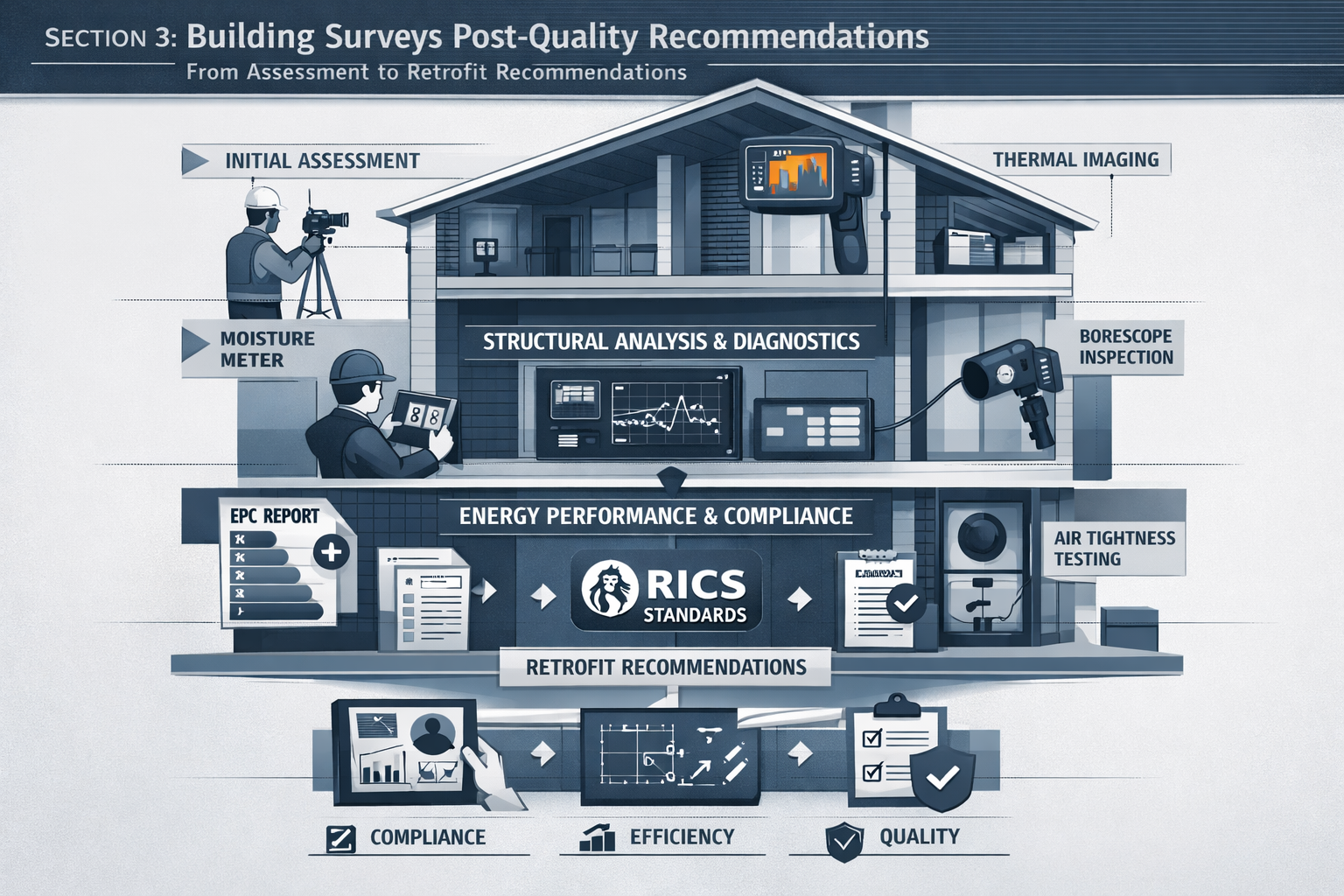
Advanced diagnostic technologies transform surveyor capabilities:
📷 Thermal imaging cameras reveal heat loss patterns, thermal bridging, insulation gaps, and moisture intrusion invisible to visual inspection.
📷 Blower door testing quantifies air leakage rates and identifies specific infiltration points requiring sealing.
📷 Moisture meters detect elevated moisture levels indicating damp problems or condensation risks.
📷 Indoor air quality monitors measure CO₂, volatile organic compounds, and particulate matter affecting occupant health.
📷 Energy monitoring systems track real-time consumption patterns validating retrofit performance.
These technologies enable evidence-based assessments replacing subjective judgments with objective measurements. The investment in diagnostic equipment quickly pays for itself through enhanced service quality, reduced liability exposure, and premium fee justification.
Digital Reporting and Client Communication
Modern retrofit surveying demands clear, accessible communication with diverse stakeholders including homeowners, landlords, contractors, and funders. Digital reporting platforms enable:
- Interactive 3D models helping clients visualize proposed interventions
- Cost-benefit analysis tools comparing upgrade options with payback calculations
- Photographic documentation providing visual evidence of conditions and defects
- Video walkthroughs explaining complex technical issues in accessible language
- Cloud-based access allowing stakeholders to review reports anywhere, anytime
- Integration with project management systems tracking recommendations through to completion
Surveyors who embrace digital tools enhance client experience while improving operational efficiency. The ability to deliver professional, accessible reports distinguishes quality practitioners from those producing dense technical documents that clients struggle to understand.
Practical Implementation: Actionable Steps for Surveyors in 2026
Immediate Actions for Existing Practitioners
Surveyors seeking to capitalize on retrofit opportunities should take these concrete steps:
1. Assess Current Competence Gaps 🎯
Honestly evaluate your understanding of building physics, retrofit technologies, and regulatory frameworks. Identify specific knowledge areas requiring development.
2. Pursue RICS Retrofit Accreditation 📚
Enroll in the AssocRICS pathway or equivalent professional development programs addressing identified gaps.
3. Invest in Diagnostic Equipment 🔧
Acquire thermal imaging cameras, moisture meters, and air quality testing equipment enabling evidence-based assessments.
4. Update Service Offerings 📋
Revise marketing materials and service descriptions to highlight retrofit expertise and whole-house assessment capabilities.
5. Develop Referral Networks 🤝
Build relationships with qualified retrofit contractors, energy consultants, and funding providers creating complete client solutions.
6. Implement Quality Management Systems ✅
Establish systematic processes ensuring consistent service delivery and documentation meeting professional standards.
7. Secure Appropriate Professional Indemnity Insurance 🛡️
Verify coverage adequately addresses retrofit-specific liability exposures and emerging regulatory requirements.
Building Retrofit Expertise Systematically
Developing genuine retrofit competence requires systematic learning:
Phase 1: Foundation Knowledge (Months 1-3)
- Complete PAS 2035 framework training
- Study building physics fundamentals
- Review current regulatory requirements
- Understand EPC methodology and limitations
Phase 2: Technical Specialization (Months 4-6)
- Deep dive into specific technologies (heat pumps, insulation systems, ventilation strategies)
- Learn moisture risk assessment and management
- Develop whole-house modeling capabilities
- Practice thermal imaging interpretation
Phase 3: Applied Experience (Months 7-12)
- Conduct supervised retrofit assessments
- Collaborate with experienced practitioners
- Build case study portfolio
- Develop client communication skills
Phase 4: Professional Accreditation (Months 13-18)
- Complete RICS pathway requirements
- Pass technical assessments
- Submit portfolio for review
- Achieve AssocRICS designation
This timeline reflects realistic professional development recognizing that retrofit surveying requires substantial expertise beyond basic building surveying qualifications.
Creating Client Value Propositions
Effective marketing communicates clear client benefits:
For Homeowners:
"Our independent retrofit assessments protect your investment by ensuring installations are appropriate for your property, properly specified, and correctly installed. We identify potential problems before they become expensive failures."
For Landlords:
"We help you navigate complex compliance requirements including Awaab's Law, MEES regulations, and EPC standards while maximizing property value and minimizing tenant complaints."
For Social Housing Providers:
"Our systematic stock condition surveys and neighborhood retrofit planning enable evidence-based investment decisions, regulatory compliance, and demonstrable tenant outcomes."
For Commercial Property Owners:
"We support your net-zero journey through comprehensive building assessments, technology feasibility studies, and ongoing performance monitoring ensuring retrofit investments deliver promised returns."
Tailored messaging addressing specific client pain points and objectives drives engagement more effectively than generic technical descriptions.
Navigating the Complex Standards Landscape
Simplifying Overlapping Requirements
The summit identified a critical need to simplify the complex system of standards, oversight, and protections for energy efficiency and microgeneration installations.[2] The Warm Homes Plan commits to reviewing this framework, with streamlined approaches expected by mid-2026.
Current complexity includes:
- PAS 2035:2023 for retrofit project delivery
- Building Regulations Part L for energy efficiency
- Microgeneration Certification Scheme (MCS) for renewable technology
- TrustMark framework for consumer protection
- Competent Person Schemes for self-certification
- Local authority building control requirements
- Awaab's Law for social housing damp and mould
- MEES regulations for rental property energy standards
Surveyors must navigate this landscape while avoiding overwhelming clients with regulatory detail. The key is translating complex requirements into clear, actionable guidance.
Staying Current with Regulatory Changes
The retrofit regulatory environment evolves rapidly. Effective strategies for maintaining currency include:
✓ Subscribe to RICS technical updates providing members with regulatory change notifications
✓ Join professional networks facilitating knowledge sharing among retrofit practitioners
✓ Attend industry conferences and summits like the Quality in Retrofit Summit providing early insight into emerging requirements
✓ Engage with trade publications covering retrofit sector developments
✓ Participate in consultation processes shaping future standards and regulations
✓ Allocate dedicated CPD time specifically for regulatory updates rather than relying on ad-hoc learning
Surveyors who position themselves as regulatory experts create additional client value by helping navigate compliance complexity.
Quality Assurance and Consumer Protection
The retrofit sector's quality crisis demands robust consumer protection mechanisms. Surveyors contribute through:
Independent verification: Providing impartial assessments separate from contractor commercial interests
Documentation standards: Creating comprehensive records enabling accountability and dispute resolution
Complaints processes: Supporting clients when installations fail to meet promised standards
Expert witness services: Providing expert witness testimony in legal proceedings addressing retrofit failures
Professional indemnity: Maintaining insurance protecting clients from surveyor errors or omissions
RICS membership signals to consumers that practitioners adhere to rigorous professional standards and face meaningful consequences for substandard work—a critical differentiator in a sector plagued by quality problems.
Case Studies: Retrofit Survey Excellence in Practice
Social Housing Stock Condition Programme
A large housing association managing 15,000 properties across the Southeast implemented a systematic stock condition survey programme to support Warm Homes Plan participation and Awaab's Law compliance.
Challenge: Limited existing data on property conditions, construction types, and retrofit suitability across a diverse portfolio including Victorian terraces, 1960s tower blocks, and modern low-rise developments.
Approach: Chartered surveyors conducted representative sample surveys (20% of stock) using standardized assessment protocols including:
- External and internal visual inspection
- Thermal imaging of building fabric
- Moisture readings in high-risk areas
- Ventilation adequacy assessment
- Existing insulation evaluation
- Heating system condition review
Outcomes:
- Identified 2,300 properties requiring urgent damp and mould remediation
- Developed neighborhood-level retrofit plans for 12 concentrated intervention areas
- Secured £8.5 million Warm Homes Plan funding for targeted upgrades
- Established baseline data enabling performance monitoring
- Achieved full Awaab's Law compliance across portfolio
Key Success Factor: Independent professional surveys provided credible evidence supporting funding applications and investment prioritization.
Private Landlord MEES Compliance
A property investor with 45 rental properties faced MEES enforcement action for multiple properties with EPC ratings below minimum standards.
Challenge: Unclear which interventions would achieve compliance cost-effectively while avoiding unintended consequences like condensation problems.
Approach: Chartered surveyor conducted whole-house assessments for each property including:
- Detailed construction analysis identifying wall types, existing insulation, and thermal bridging
- Moisture risk assessment evaluating condensation and damp vulnerabilities
- Heating system evaluation determining upgrade requirements
- Cost-benefit analysis comparing intervention options
- Phased implementation planning prioritizing worst-performing properties
Outcomes:
- Achieved MEES compliance for all properties within 18 months
- Average intervention cost 30% below initial contractor quotations through strategic specification
- Zero post-retrofit condensation or damp problems through proper moisture risk management
- Improved tenant satisfaction and reduced void periods
- Enhanced portfolio value through improved EPCs
Key Success Factor: Independent professional advice prevented inappropriate interventions while optimizing compliance pathways.
Owner-Occupier Retrofit Planning
A family in a 1930s semi-detached property sought to improve comfort, reduce energy bills, and achieve net-zero carbon heating.
Challenge: Conflicting advice from multiple contractors, uncertainty about technology suitability, and concerns about disruption and cost.
Approach: Chartered surveyor provided independent whole-house assessment including:
- Thermal imaging revealing significant heat loss through uninsulated cavity walls and solid floor
- Air tightness testing identifying infiltration around windows and service penetrations
- Heat pump feasibility study evaluating property suitability and system sizing
- Phased retrofit plan balancing budget constraints with performance objectives
- Contractor tender evaluation ensuring competitive pricing and quality specifications
Outcomes:
- Implemented cavity wall insulation, floor insulation, and air source heat pump over two phases
- Achieved 65% reduction in heating costs and improved comfort throughout property
- Secured £7,500 Warm Homes Plan grant reducing out-of-pocket costs
- Avoided condensation problems through proper ventilation specification
- Increased property value by approximately £25,000
Key Success Factor: Independent professional guidance enabled confident decision-making and protected against inappropriate contractor recommendations.
Future Outlook: The Evolution of Retrofit Surveying Beyond 2026
Emerging Technologies and Assessment Methods
The retrofit surveying profession will continue evolving as new technologies and methodologies emerge:
Artificial Intelligence and Machine Learning 🤖
AI-powered image analysis will enable automated defect detection from thermal imaging and photographs, while machine learning algorithms will predict retrofit performance based on property characteristics and historical data.
Digital Twins and Building Information Modeling 🏗️
Virtual property models will integrate survey data, energy modeling, and performance monitoring, enabling scenario testing before physical interventions.
Drone-Based Inspections 🚁
Unmanned aerial vehicles will facilitate roof and facade inspections reducing surveyor risk and improving documentation quality.
Continuous Monitoring Systems 📊
Internet-of-Things sensors will provide real-time data on temperature, humidity, air quality, and energy consumption, enabling proactive maintenance and performance optimization.
Augmented Reality Survey Tools 👓
AR headsets will overlay building information, thermal data, and historical records during site inspections, enhancing surveyor efficiency and accuracy.
Surveyors who embrace emerging technologies while maintaining professional judgment and independence will lead the profession's evolution.
Policy Developments on the Horizon
Several policy changes will shape retrofit surveying demand:
Tightening EPC Requirements: Minimum standards for rental properties will likely increase from current EPC E to EPC C by 2028-2030, creating substantial assessment demand.
Owner-Occupier Mandates: While currently voluntary, energy efficiency requirements may extend to owner-occupied properties during sale or major renovation.
Embodied Carbon Assessments: Retrofit specifications will increasingly consider whole-life carbon impacts, not just operational energy savings.
Performance Guarantees: Regulatory frameworks may require post-installation performance validation ensuring predicted savings materialize.
Circular Economy Integration: Retrofit assessments will evaluate material reuse, recycling potential, and waste minimization alongside energy performance.
Surveyors developing expertise in these emerging areas position themselves for long-term professional success.
Building the Retrofit Surveying Profession
The transformation from retrofit as a niche specialization to a core professional discipline requires:
Academic Integration: University programs incorporating retrofit surveying into building surveying and construction management curricula.
Research and Evidence Base: Systematic studies evaluating retrofit intervention effectiveness, failure modes, and best practices.
Professional Networks: Dedicated retrofit surveying communities facilitating knowledge sharing and collective learning.
Public Awareness: Consumer education highlighting the value of independent professional advice in retrofit decision-making.
Regulatory Recognition: Formal requirements for qualified surveyor involvement in retrofit projects receiving public funding or regulatory compliance.
The Quality in Retrofit Summit represents a critical milestone in this professional development journey, establishing clear standards and expectations for surveyor competence and conduct.
Conclusion: Seizing the Retrofit Opportunity with Professional Excellence
Building Surveys Post-Quality in Retrofit Summit: Actionable Insights for 2026 EPC and Retrofit Compliance delivers a clear message: the retrofit sector's quality crisis creates both urgent obligations and significant opportunities for chartered surveyors. The shocking failure rates in recent installations, combined with the £15 billion Warm Homes Plan's ambitious targets, demand professional oversight that only independent, competent surveyors can provide.
The path forward requires surveyors to:
✅ Develop genuine retrofit competence through the RICS AssocRICS pathway and systematic professional development
✅ Adopt whole-house assessment methodologies replacing component-focused approaches with systems-based thinking
✅ Embrace technology and data enabling evidence-based recommendations and performance validation
✅ Maintain professional independence positioning as trusted advisors separate from contractor commercial interests
✅ Navigate regulatory complexity translating overlapping requirements into clear client guidance
✅ Commit to quality outcomes through robust documentation, monitoring, and accountability
The retrofit transformation represents one of the most significant professional opportunities in surveying's recent history. The sector will upgrade millions of properties over the coming decade, creating sustained demand for competent professional services. Surveyors who position themselves now—through accreditation, capability development, and market positioning—will capture substantial market share while contributing to critical national objectives around energy security, carbon reduction, and housing quality.
The alternative—maintaining business as usual while the retrofit sector transforms around you—risks professional obsolescence as clients, regulators, and funders increasingly demand demonstrated competence and independent oversight.
Your Next Steps
Immediate Actions (This Week):
- Review the RICS Residential Retrofit Surveying AssocRICS pathway requirements
- Assess your current competence gaps in retrofit-related knowledge
- Identify one retrofit-related CPD activity to complete this month
Short-Term Actions (This Quarter):
- Enroll in PAS 2035 framework training
- Invest in thermal imaging equipment or arrange equipment rental for initial assessments
- Update your service offerings to include whole-house retrofit assessments
- Develop relationships with qualified retrofit contractors for referral partnerships
Long-Term Actions (This Year):
- Complete the RICS retrofit accreditation pathway
- Conduct at least 10 supervised retrofit assessments building practical experience
- Develop case studies demonstrating your retrofit expertise
- Position yourself as a local chartered surveyor specializing in retrofit quality assurance
The Quality in Retrofit Summit has provided the roadmap. The £15 billion Warm Homes Plan has created the market. The RICS accreditation pathway has established the professional framework. The only remaining question is whether you'll seize this transformative opportunity to build a future-focused surveying practice delivering genuine value to clients while advancing critical national objectives.
The retrofit revolution is here. Professional surveyors who lead with competence, independence, and commitment to quality will shape the sector's future while building thriving, sustainable practices. The time to act is now.
References
[1] Retrofit Leaders Meet Rics Hq Discuss Importance Transformative Projects – https://www.rics.org/news-insights/retrofit-leaders-meet-rics-hq-discuss-importance-transformative-projects
[2] Quality In Retrofit Summit 2026 – https://retrofitacademy.org/quality-in-retrofit-summit-2026/
[3] Sparks Of 2026 9 Rics And The Return Of Professional Trust In Retrofit – https://www.refurbandretrofit.com/sparks-of-2026-9-rics-and-the-return-of-professional-trust-in-retrofit/
[4] Consultation Launched Housing Stock Condition Survey Code Practice – https://www.rics.org/news-insights/consultation-launched-housing-stock-condition-survey-code-practice