The Northern England property market is experiencing an extraordinary renaissance in 2026, with house prices climbing and rental demand surging to unprecedented levels. As buyers rush to capitalize on better affordability compared to southern regions, the critical question emerges: are purchasers conducting thorough building surveys before committing to properties in these high-velocity markets? The answer could mean the difference between securing a sound investment and inheriting a catalogue of expensive structural defects.
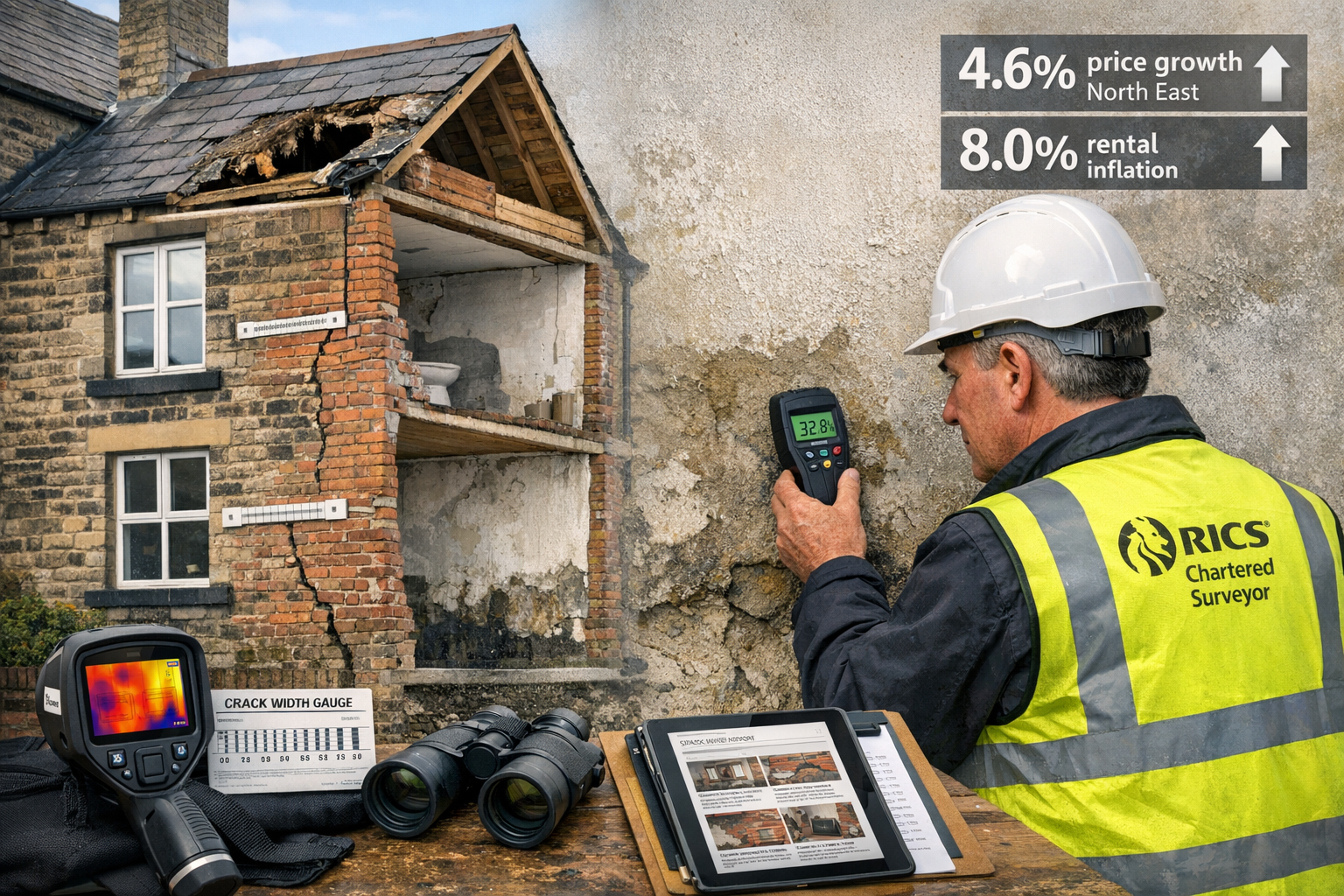
Building Surveys for Northern England Housing Boom: Spotting Defects in High-Demand Recovery Markets has become essential knowledge for anyone navigating property transactions across the North West, North East, Yorkshire, and Scotland. With the North East recording 4.6% house price inflation in the 12 months to December 2025 and rental costs soaring by 8.0% through January 2026—the highest of all English regions—the pressure to move quickly can overshadow due diligence[2]. However, experienced surveyors understand that rapid market growth often masks underlying structural issues that require expert identification.
Key Takeaways
- 🏠 Northern England markets are experiencing robust growth, with Wales, Scotland, and northern regions forecast to see 3-4% price increases through 2026, driven by superior affordability compared to southern markets[3][4]
- 🔍 Building surveys remain critical despite market momentum, as Victorian and Edwardian housing stock prevalent in northern cities often conceals structural defects including subsidence, damp penetration, and roof deterioration
- 📊 The North East leads rental inflation at 8.0% annually, creating investment opportunities that demand thorough property inspection before purchase[2]
- ⚠️ Common defects in northern properties include cavity wall tie failure, chimney stack deterioration, and foundation movement exacerbated by clay soil conditions and mining legacy
- 💡 Professional RICS building surveys provide essential protection in fast-moving markets, identifying defects that could cost tens of thousands in remediation work
Understanding the Northern England Housing Market Surge in 2026
Regional Price Performance and Market Dynamics
The northern property markets have emerged as the standout performers in 2026, reversing decades of southern dominance. Market analysis reveals that "positive momentum has carried over from last year, with demand and inflation remaining robust" across northern regions[1]. This transformation reflects fundamental shifts in affordability, remote working patterns, and regional economic development.
Regional Price Growth Comparison:
| Region | Annual Price Growth | Rental Inflation | Market Outlook |
|---|---|---|---|
| North East | 4.6% (Dec 2025) | 8.0% (Jan 2026) | Strong demand continues |
| North West | 3-4% forecast | 7.2% | Robust investment activity |
| Yorkshire | 3-4% forecast | 6.8% | Steady growth trajectory |
| Scotland | 3-4% forecast | 7.5% | Sustained buyer interest |
| London | 1-2% forecast | 5.1% | Slower growth comparatively |
The data demonstrates a clear affordability advantage driving northern market strength. While London properties remain priced beyond reach for many first-time buyers, cities like Manchester, Liverpool, Leeds, and Newcastle offer substantially better value propositions. This has triggered increased transaction volumes and competitive bidding situations that can pressure buyers to skip comprehensive building surveys.
The Risk-Opportunity Paradox
Strong market conditions create a paradoxical situation for property buyers. On one hand, rising prices and rental yields present genuine investment opportunities. On the other, the urgency to secure properties before prices climb further can lead to inadequate due diligence. This is where professional RICS building surveys become indispensable.
The northern housing stock presents unique challenges:
- Victorian and Edwardian terraces dominate urban landscapes, with construction dating from 1850-1920
- Stone construction prevalent in Yorkshire and parts of the North West requires specialist assessment
- Industrial heritage means many areas have mining legacy issues affecting foundations
- Climate factors including higher rainfall and exposure create specific deterioration patterns
- Conversion properties where former industrial buildings have been adapted for residential use
Each of these characteristics demands specialized surveying expertise to identify potential defects before they become expensive problems.
Building Surveys for Northern England Housing Boom: Essential Defect Categories
Structural Movement and Subsidence Issues
Subsidence and structural movement represent the most serious—and potentially expensive—defects that building surveys must identify. Northern England presents specific subsidence risk factors that differ from southern regions:
Primary Subsidence Causes in Northern Properties:
- Mining subsidence 🏭 – Historical coal mining activities across County Durham, Yorkshire, Lancashire, and Northumberland have left underground voids that can cause delayed settlement decades after mine closure
- Clay soil shrinkage – While less prevalent than in the South East, clay soils in parts of Cheshire, Lancashire, and South Yorkshire expand and contract with moisture changes
- Tree root activity – Mature trees near Victorian properties can extract moisture from soil, causing foundation movement
- Leaking drains – Deteriorated Victorian drainage systems wash away supporting soil beneath foundations
- Poor original construction – Shallow foundations common in 19th-century terraced housing provide inadequate support
Identifying Subsidence During Surveys:
Professional surveyors employ systematic approaches to detect structural movement:
- Crack pattern analysis – Diagonal cracks wider than 5mm, particularly around doors and windows, indicate potential subsidence
- External elevation inspection – Stepped cracking in brickwork following mortar joints suggests foundation settlement
- Level verification – Using laser levels or traditional spirit levels to detect floor slopes and ceiling drops
- Door and window operation – Sticking doors or gaps around frames indicate frame distortion from movement
- Monitoring evidence – Checking for existing crack monitoring strips or tell-tales from previous concerns
A comprehensive Level 3 RICS building survey provides the detailed structural analysis necessary to identify these issues before purchase. For properties where specific concerns exist, a specific defect report can provide focused investigation.
Damp Penetration and Moisture-Related Defects
Damp issues plague northern properties with particular severity due to regional climate patterns. Higher rainfall, prevailing westerly winds, and lower temperatures create ideal conditions for moisture penetration. Building surveys must distinguish between different damp types:
Types of Damp in Northern Properties:
- Rising damp 💧 – Groundwater rising through walls via capillary action, typically affecting ground floor walls up to 1 meter height
- Penetrating damp – Rainwater entering through defective pointing, cracked render, or failed flashings
- Condensation – Moisture from daily living condensing on cold surfaces, particularly in poorly ventilated properties
- Lateral damp – Moisture entering through solid walls during driving rain, common in exposed locations
Survey Detection Methods:
Modern building surveyors utilize multiple diagnostic tools:
- Electronic moisture meters – Providing instant readings of moisture content in walls, though requiring interpretation expertise
- Thermal imaging cameras – Revealing cold spots and moisture patterns invisible to naked eye inspection
- Visual indicators – Tide marks, salt efflorescence, peeling wallpaper, and musty odors
- Invasive investigation – Removing sections of plaster to examine wall construction and damp proof course condition
- External assessment – Checking ground levels, drainage, guttering, and pointing condition
The prevalence of solid wall construction in Victorian terraced housing means many northern properties lack cavity wall protection against moisture. Surveyors must assess whether properties have been retrofitted with cavity wall insulation, as improper installation can actually increase damp penetration by bridging the cavity gap.
Roof Structure and Covering Deterioration
Northern England's exposure to harsh weather conditions accelerates roof deterioration. Building surveys must thoroughly assess roof condition, despite the challenges of accessing these elevated structures safely.
Common Roof Defects in Northern Properties:
| Defect Type | Prevalence | Typical Cost to Remedy | Survey Detection Method |
|---|---|---|---|
| Slate slippage | Very High | £8,000-£15,000 | Binocular inspection, drone survey |
| Ridge tile failure | High | £2,000-£5,000 | Close visual inspection |
| Lead flashing deterioration | High | £3,000-£8,000 | Physical examination |
| Timber rot in roof structure | Moderate | £10,000-£25,000 | Loft inspection, moisture testing |
| Chimney stack deterioration | Very High | £4,000-£12,000 | Elevated inspection |
| Valley gutter failure | Moderate | £5,000-£10,000 | Internal staining evidence |
Modern surveying technology has revolutionized roof inspection capabilities. Drone surveys enable detailed photographic documentation of roof conditions without the safety risks and access limitations of traditional ladder inspection. High-resolution imagery can reveal:
- Individual missing or slipped slates
- Cracked or deteriorated ridge tiles
- Chimney stack pointing defects
- Lead flashing separation
- Moss accumulation indicating moisture retention
- Sagging roof lines suggesting structural issues
For properties in the competitive northern markets, drone surveys provide rapid, comprehensive roof assessment that doesn't delay transaction timelines while still delivering thorough defect identification.
Building Surveys for Northern England Housing Boom: Property-Type Specific Considerations
Victorian and Edwardian Terraced Housing
Terraced houses form the backbone of northern urban housing stock, with entire neighborhoods constructed during the industrial revolution to house factory workers. These properties present consistent defect patterns that experienced surveyors recognize:
Characteristic Terrace Defects:
🏘️ Shared party walls – Structural movement can affect multiple properties simultaneously, requiring assessment of neighboring properties' condition
🧱 Solid wall construction – No cavity means direct moisture transmission and poor thermal performance
🪟 Single-glazed sash windows – Original windows often deteriorated, with replacement quality varying dramatically
⬇️ Cellar dampness – Below-ground rooms typically suffer severe moisture issues requiring tanking or improved drainage
🔥 Chimney breast removal – Inappropriate removal of chimney breasts without adequate structural support causes serious defects
📐 Shallow foundations – Original construction often used minimal foundation depth, increasing subsidence risk
When conducting building surveys on terraced properties, particular attention must focus on:
- Roof valley junctions where terraces meet at angles, creating complex waterproofing challenges
- Shared chimney stacks serving multiple properties, with deterioration affecting neighbors
- Party wall condition and evidence of movement or separation between properties
- Rear extension additions often constructed to lower standards than original buildings
- Conversion quality where single dwellings have been divided into flats
A Level 2 Homebuyer Survey may suffice for well-maintained terraces in good condition, but the majority of Victorian terraced housing benefits from the comprehensive analysis provided by Level 3 surveys.
Stone-Built Properties in Yorkshire and the North West
Stone construction dominates in Yorkshire, parts of Lancashire, and Cumbria, presenting unique surveying challenges. Stone properties require specialist knowledge to assess properly:
Stone Property Defect Patterns:
- Pointing deterioration – Lime mortar pointing erodes over time, requiring careful repointing with appropriate materials
- Stone face spalling – Freeze-thaw cycles cause stone surface deterioration, particularly on exposed elevations
- Lintel failure – Stone lintels above openings can crack under load or due to wall movement
- Damp penetration – Solid stone walls transmit moisture readily, especially when pointing fails
- Inappropriate repairs – Modern cement pointing and renders trap moisture, accelerating stone decay
Surveyors assessing stone properties must understand traditional construction methods and appropriate repair techniques. Using cement-based materials on properties originally constructed with lime mortar creates moisture trapping that accelerates deterioration—a common defect found in properties that have undergone inappropriate renovation.
The current market boom means many stone properties are being purchased for renovation. Buyers must understand the true cost of appropriate restoration using heritage-compatible materials and techniques, which significantly exceeds standard renovation costs.
Converted Industrial Properties and New-Build Apartments
Northern cities have embraced industrial heritage conversion, transforming mills, warehouses, and factories into residential apartments. These conversions present distinct surveying considerations:
Conversion Property Survey Focus Areas:
- Original structure integrity – Assessing whether historic timber beams, cast iron columns, and brick walls remain sound
- Conversion quality standards – Evaluating whether developers used appropriate specifications for residential use
- Sound insulation – Checking whether adequate acoustic separation exists between units
- Fire safety compliance – Verifying fire doors, detection systems, and escape routes meet current regulations
- Building services – Assessing heating, ventilation, and electrical systems capacity and condition
- Lease terms and service charges – Understanding ongoing costs and management responsibilities
For apartment purchases, RICS commercial building surveys adapted for residential conversion contexts provide appropriate assessment depth. The surveyor must evaluate both individual unit condition and common areas including:
- Roof covering and structure
- External envelope maintenance
- Communal heating systems
- Lift installations
- Fire safety systems
- Structural frame condition
The rapid development pace in cities like Manchester and Leeds means some conversions have been completed to minimal standards. Thorough building surveys identify shortcuts that will generate expensive remediation costs through service charge contributions.
Advanced Survey Techniques for High-Demand Markets
Technology-Enhanced Defect Detection
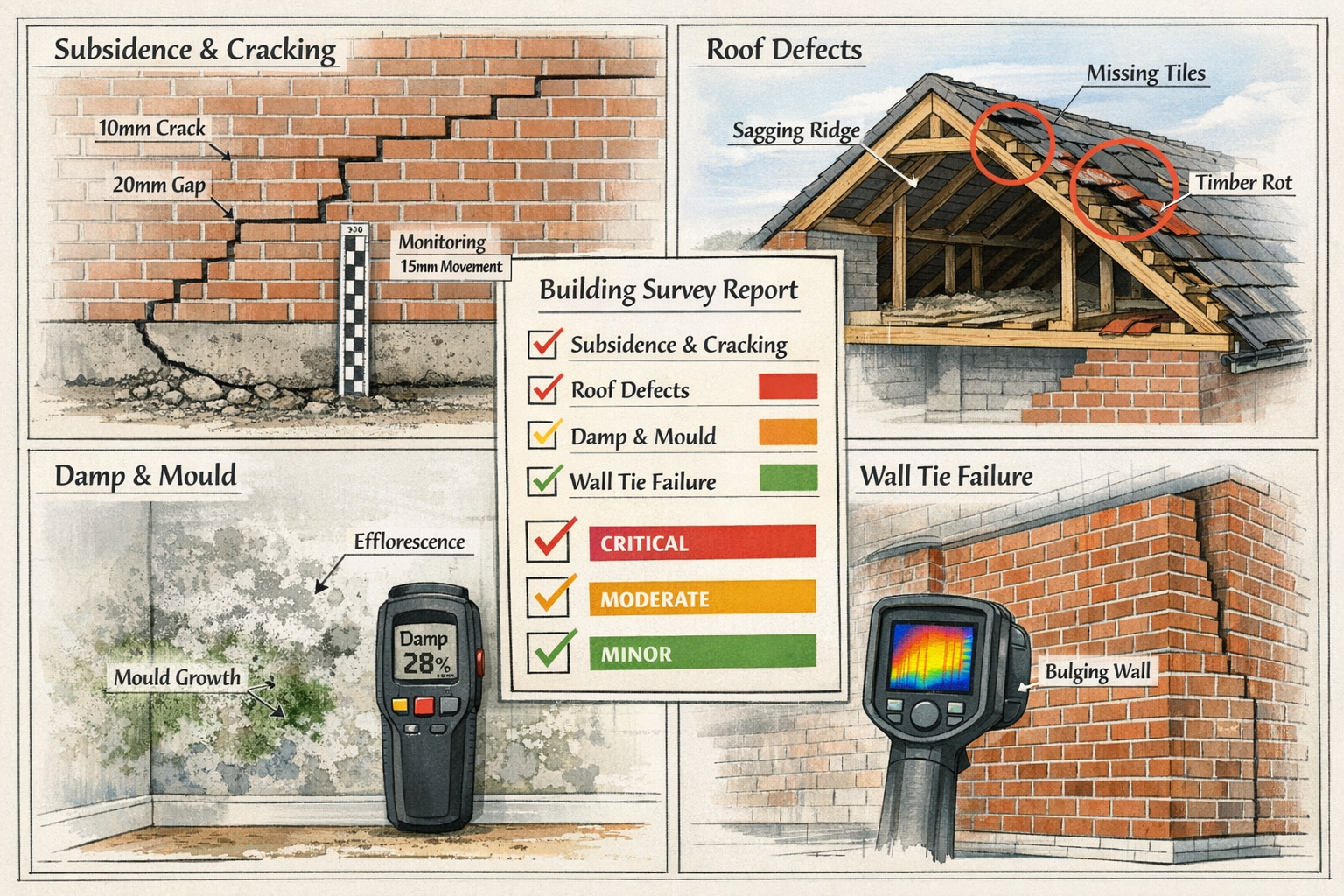
Modern building surveying has evolved beyond visual inspection and moisture meters. Advanced diagnostic technologies enable more accurate defect identification:
Thermal Imaging Applications:
Thermal cameras detect temperature variations that indicate:
- Insulation gaps showing as cold spots in thermal images
- Air leakage paths around windows, doors, and service penetrations
- Hidden moisture appearing as cooler areas due to evaporative cooling
- Heating system defects revealing radiator or underfloor heating failures
- Structural thermal bridging identifying cold bridges causing condensation risk
Drone Survey Advantages:
Unmanned aerial vehicles provide unprecedented roof access:
- Complete roof coverage documentation without scaffolding costs
- Chimney stack close-up inspection revealing pointing and flaunching defects
- Valley and gutter assessment from angles impossible with ladder access
- Photographic evidence providing detailed records for negotiation and future reference
- Safety improvements eliminating surveyor fall risks from elevated positions
Structural Movement Monitoring:
For properties with existing cracks or suspected movement:
- Crack width gauges providing precise measurement of crack dimensions
- Tell-tale monitors installed to track whether cracks are active or historic
- Level surveys using laser or optical levels to measure floor and ceiling slopes
- Photographic monitoring documenting crack patterns for comparison over time
These technologies complement traditional surveying expertise rather than replacing it. Interpretation requires experienced professional judgment to distinguish serious defects from cosmetic issues.
Prioritizing Defects in Competitive Markets
When Building Surveys for Northern England Housing Boom reveal multiple defects—as they frequently do with older housing stock—buyers need clear prioritization to make informed decisions:
Defect Severity Classification:
Category 1 – Critical Defects ⚠️
- Active structural movement requiring immediate investigation
- Serious roof defects causing water ingress
- Dangerous electrical installations
- Structural alterations without adequate support
- Severe damp affecting structural timber
Category 2 – Significant Defects 🔶
- Historic movement showing no current activity
- Roof covering nearing end of serviceable life
- Damp penetration requiring remediation
- Outdated heating systems requiring replacement
- Window replacement needed for performance
Category 3 – Minor Defects ⚪
- Cosmetic repairs to decoration
- Minor pointing repairs
- Gutter and downpipe maintenance
- Garden drainage improvements
- Minor joinery repairs
Professional building surveys should clearly categorize defects, provide cost estimates for remediation, and indicate urgency. This enables buyers to:
- Negotiate price reductions based on Category 1 and 2 defect costs
- Plan renovation budgets accurately including all identified work
- Make informed decisions about whether to proceed with purchase
- Prioritize post-purchase work addressing critical issues first
- Obtain specialist reports where structural engineers or damp specialists are needed
For complex defects requiring specialist assessment, surveyors may recommend residential structural engineering input to provide detailed analysis and remediation specifications.
Navigating Building Surveys in Fast-Moving Northern Markets
Timing Survey Commissioning Strategically
The competitive nature of northern property markets in 2026 creates timing challenges for building surveys. Properties often receive multiple offers within days of listing, yet comprehensive surveys require 1-2 weeks to arrange and complete.
Strategic Approaches:
Pre-Offer Survey Viewing 📋
- Arrange informal surveyor viewing before submitting offer
- Obtain preliminary assessment of major defects
- Submit offer with survey contingency clearly stated
- Proceed to full survey once offer accepted
Accelerated Survey Services ⚡
- Many surveyors offer expedited services for competitive situations
- Premium fees typically apply but prevent property loss
- Drone surveys can be completed within 48 hours
- Preliminary verbal reports available before written documentation
Survey Contingency Negotiation 🤝
- Include survey clause in offer terms
- Specify timeframe for survey completion (typically 10-14 days)
- Reserve right to renegotiate based on findings
- Clearly communicate survey importance to vendors and agents
Simultaneous Conveyancing ⚖️
- Instruct solicitors immediately upon offer acceptance
- Proceed with searches while survey is conducted
- Maintain transaction momentum while protecting interests
- Be prepared to exchange quickly if survey is satisfactory
Understanding Survey Types and Selecting Appropriately
RICS offers three standardized survey levels, each suited to different property types and buyer needs:
RICS Level 1 – Condition Report
- Basic visual inspection only
- Suitable for new-build or recently constructed properties
- Limited defect identification
- Rarely appropriate for northern Victorian/Edwardian stock
RICS Level 2 – HomeBuyer Report
- Standard inspection of visible elements
- Suitable for conventional properties in reasonable condition
- Identifies significant defects requiring attention
- Appropriate for well-maintained terraces and modern properties
RICS Level 3 – Building Survey
- Comprehensive inspection of all accessible areas
- Detailed defect analysis and remediation advice
- Suitable for older properties, unusual construction, or renovation projects
- Recommended for most northern housing stock
Given the age and construction characteristics of northern properties, Level 3 building surveys provide the most appropriate protection. The additional cost (typically £800-£1,500 depending on property size) represents excellent value when identifying defects that could cost tens of thousands to remedy.
For buyers uncertain which survey level suits their needs, consulting with local chartered surveyors familiar with regional property characteristics provides valuable guidance.
Interpreting Survey Reports and Taking Action
Building survey reports can be lengthy, technical documents. Understanding how to extract actionable information is essential:
Key Report Sections:
- Executive Summary – Overview of significant findings and recommendations
- Detailed Findings – Room-by-room defect description with photographs
- Defect Categorization – Classification by severity and urgency
- Cost Estimates – Approximate remediation costs for identified defects
- Recommendations – Suggested actions including specialist investigations
Post-Survey Actions:
When surveys reveal significant defects, buyers have several options:
Renegotiate Purchase Price 💰
- Request reduction reflecting remediation costs
- Provide survey report as evidence supporting reduction
- Consider vendor's market position and motivation
- Be prepared to compromise on final adjustment
Request Vendor Remediation 🔧
- Ask vendor to complete specific repairs before completion
- Obtain quotations and specifications for required work
- Include retention clauses if work cannot complete before exchange
- Verify work quality through reinspection
Proceed with Full Knowledge 📊
- Accept property with defects and plan post-purchase remediation
- Obtain detailed quotations for budgeting purposes
- Arrange specialist contractor appointments in advance
- Consider mortgage lender requirements for serious defects
Withdraw from Purchase 🚪
- Exercise survey contingency clause if defects are unacceptable
- Recover survey costs and move to alternative property
- Learn from findings to inform future property selection
- Avoid expensive mistake of purchasing unsuitable property
The robust northern market conditions mean vendors may resist price reductions, particularly if backup offers exist. However, comprehensive survey evidence provides strong negotiating leverage, as subsequent buyers will likely identify the same defects.
Regional Variations Across Northern England Markets
North East Specific Considerations
The North East market—encompassing Newcastle, Sunderland, Durham, and Middlesbrough—presents unique characteristics influencing building survey requirements:
Market Dynamics:
- Strongest price growth at 4.6% annually, though moderating from previous 7.5%[2]
- Highest rental inflation nationally at 8.0%, driving investor activity[2]
- Mining legacy affecting subsidence risk across County Durham and Northumberland
- Coastal exposure creating severe weathering on properties near the North Sea
- Stone and brick mix with regional variations in construction materials
Survey Focus Areas:
- Mining subsidence risk assessment, particularly in former coalfield areas
- Coastal weathering damage on exposed elevations
- Cavity wall tie corrosion in properties from 1920-1980 period
- Render deterioration on pebbledashed properties common in the region
- Flat roof defects on 1960s-1970s properties prevalent in some areas
North West Market Characteristics
The North West—including Manchester, Liverpool, Preston, and Chester—has experienced sustained growth driven by economic development and infrastructure investment:
Market Features:
- Strong investor demand for buy-to-let opportunities in city centers
- Conversion activity transforming industrial heritage buildings
- Terraced housing dominance in urban cores
- Stone construction in parts of Lancashire and Cheshire
- New-build apartment supply in Manchester and Liverpool centers
Survey Priorities:
- Conversion quality assessment in former industrial buildings
- Terraced property party wall condition and shared defects
- Basement and cellar dampness in Victorian housing
- New-build snagging issues in rapidly constructed apartment blocks
- Stone property pointing and damp penetration in Pennine areas
Yorkshire and Humber Region
Yorkshire's diverse property market spans from Leeds' urban terraces to rural stone cottages in the Dales:
Regional Characteristics:
- Stone construction predominance requiring specialist knowledge
- Mill conversion heritage particularly in Bradford and Huddersfield
- Varied topography creating drainage and exposure challenges
- Strong rental markets in Leeds, Sheffield, and York
- Rural property diversity including farmhouses and cottages
Survey Emphasis:
- Stone property assessment using appropriate techniques
- Drainage issues on sloping sites common in hilly areas
- Roof condition on exposed moorland properties
- Conversion quality in former textile mills
- Agricultural building conversions requiring change of use assessment
The Future of Building Surveys in Northern Markets

Market Outlook and Survey Demand
Forecasts for 2026 indicate continued strength in northern markets, with Wales, Scotland, and northern England expected to see 3-4% price growth supported by better affordability[3][4]. This sustained momentum suggests building survey demand will remain robust throughout the year.
Driving Factors:
- Affordability advantage over southern markets attracting first-time buyers
- Remote working flexibility enabling relocation from expensive regions
- Investment yields superior to southern buy-to-let opportunities
- Infrastructure development including HS2 and Northern Powerhouse initiatives
- Economic growth in regional cities creating employment opportunities
As markets remain competitive, the temptation to skip thorough building surveys may increase. However, the age and condition of northern housing stock makes this a particularly risky strategy. Properties that appear cosmetically acceptable often harbor serious defects requiring expensive remediation.
Evolving Survey Technology and Methodologies
Building surveying continues to evolve with technological advancement:
Emerging Technologies:
3D Laser Scanning 📐
- Creates precise digital models of properties
- Enables accurate measurement without physical access
- Documents existing conditions comprehensively
- Facilitates renovation planning and design
Artificial Intelligence Analysis 🤖
- AI systems trained to identify defect patterns in photographs
- Automated crack measurement and classification
- Predictive maintenance modeling based on property characteristics
- Enhanced report generation with comparative data
Moisture Mapping Systems 💧
- Advanced sensors creating detailed moisture distribution maps
- Non-invasive investigation of wall construction
- Identification of moisture sources and pathways
- Monitoring systems tracking remediation effectiveness
Building Information Modeling (BIM) 🏗️
- Digital twins of existing properties
- Integration of survey data with renovation planning
- Lifecycle maintenance planning and cost forecasting
- Enhanced communication between surveyors, buyers, and contractors
These technologies will enhance rather than replace traditional surveying expertise. The interpretation of findings and provision of practical advice remains fundamentally dependent on experienced professional judgment.
Conclusion: Protecting Investments in Northern England's Property Boom
The Northern England housing market presents genuine opportunities in 2026, with price growth, rental yields, and affordability combining to create attractive investment conditions. However, the region's predominantly Victorian and Edwardian housing stock demands thorough building survey assessment before purchase commitments.
Building Surveys for Northern England Housing Boom: Spotting Defects in High-Demand Recovery Markets represents essential due diligence that protects buyers from expensive mistakes. The competitive market environment creates pressure to move quickly, but skipping comprehensive surveys risks acquiring properties with serious structural defects, damp penetration, or roof deterioration that could cost tens of thousands to remedy.
Actionable Next Steps
For buyers navigating northern property markets in 2026:
✅ Commission appropriate survey levels – Select Level 3 building surveys for Victorian/Edwardian properties, Level 2 for modern well-maintained homes
✅ Engage RICS qualified surveyors – Ensure professionals hold appropriate qualifications and local market knowledge
✅ Include survey contingencies – Protect your position with clear survey clauses in offer terms
✅ Act on survey findings – Use reports to negotiate price reductions or vendor remediation of significant defects
✅ Obtain specialist input – Commission structural engineers or damp specialists where surveys identify serious concerns
✅ Plan renovation budgets – Use survey cost estimates to create realistic post-purchase expenditure plans
✅ Consider technology options – Utilize drone surveys and thermal imaging for enhanced defect detection
The northern property boom offers substantial opportunities, but only for buyers who conduct thorough due diligence. Professional building surveys provide the knowledge necessary to make informed decisions, negotiate effectively, and avoid properties with defects that undermine investment value.
In markets experiencing 4.6% price growth and 8.0% rental inflation[2], the cost of a comprehensive building survey represents a small investment that protects much larger financial commitments. As market forecasts predict continued strength through 2026[3][4], demand for quality surveying services will remain high.
Buyers who prioritize thorough building surveys position themselves to capitalize on northern market opportunities while avoiding the expensive pitfalls that trap those who rush purchases without adequate professional assessment. The combination of market knowledge, appropriate survey selection, and expert interpretation creates the foundation for successful property investment in Northern England's dynamic housing markets.
References
[1] Weekly Summary 6th February 2026 – https://builtplace.com/weekly-summary-6th-february-2026/
[2] February2026 – https://www.ons.gov.uk/economy/inflationandpriceindices/bulletins/privaterentandhousepricesuk/february2026
[3] House Prices Set For A Gentle Rise In 2026 What It Means For You – https://yesmortgageservices.co.uk/house-prices-set-for-a-gentle-rise-in-2026-what-it-means-for-you/
[4] Market Forecasts For 2026 Point To Stability Not A Surge – https://www.embracefs.co.uk/blog/market-forecasts-for-2026-point-to-stability-not-a-surge