Canterbury & Kent
Awaab’s Law 2026 Extensions: Building Surveyors’ Guide to Assessing Excess Cold, Fire, and Electrical Hazards in PRS Properties
Over 4.6 million households in England live in the private rented sector — and a significant proportion of those homes still contain hazards that can kill. The tragic death of two-year-old Awaab Ishak from prolonged mould exposure catalysed one of the most significant shifts in housing law in a generation. Now, with Awaab’s Law 2026 extensions bringing electrical hazards, fire risks, and excess cold firmly within the regulatory framework, building surveyors working in the private rented sector (PRS) face new professional obligations that demand updated inspection protocols and sharper hazard assessment skills.
This guide to Awaab’s Law 2026 Extensions: Building Surveyors’ Guide to Assessing Excess Cold, Fire, and Electrical Hazards in PRS Properties sets out exactly what surveyors need to know — from legal timescales to on-site assessment techniques — to keep landlords compliant and tenants safe.
Key Takeaways 📋
- Awaab’s Law originally targeted damp and mould in social housing, but 2026 extensions expand regulated hazards to include excess cold, fire risks, and electrical defects in PRS properties [2]
- Strict response timescales now apply — surveyors must understand these deadlines to advise landlords accurately
- HHSRS (Housing Health and Safety Rating System) remains the primary assessment framework, but surveyors must apply it with greater rigour under the new regime
- Detailed, evidenced reports are essential — vague findings will not satisfy enforcement requirements
- Proactive inspection before tenancy commencement is now a best-practice standard, not merely a recommendation
What Are the Awaab’s Law 2026 Extensions?
Awaab’s Law was introduced through the Social Housing (Regulation) Act 2023 and initially required social landlords to investigate and remedy damp and mould hazards within fixed timescales [2]. The 2026 extensions represent a critical broadening of that mandate — applying similar obligations to private rented sector landlords and expanding the list of regulated hazards beyond damp and mould.
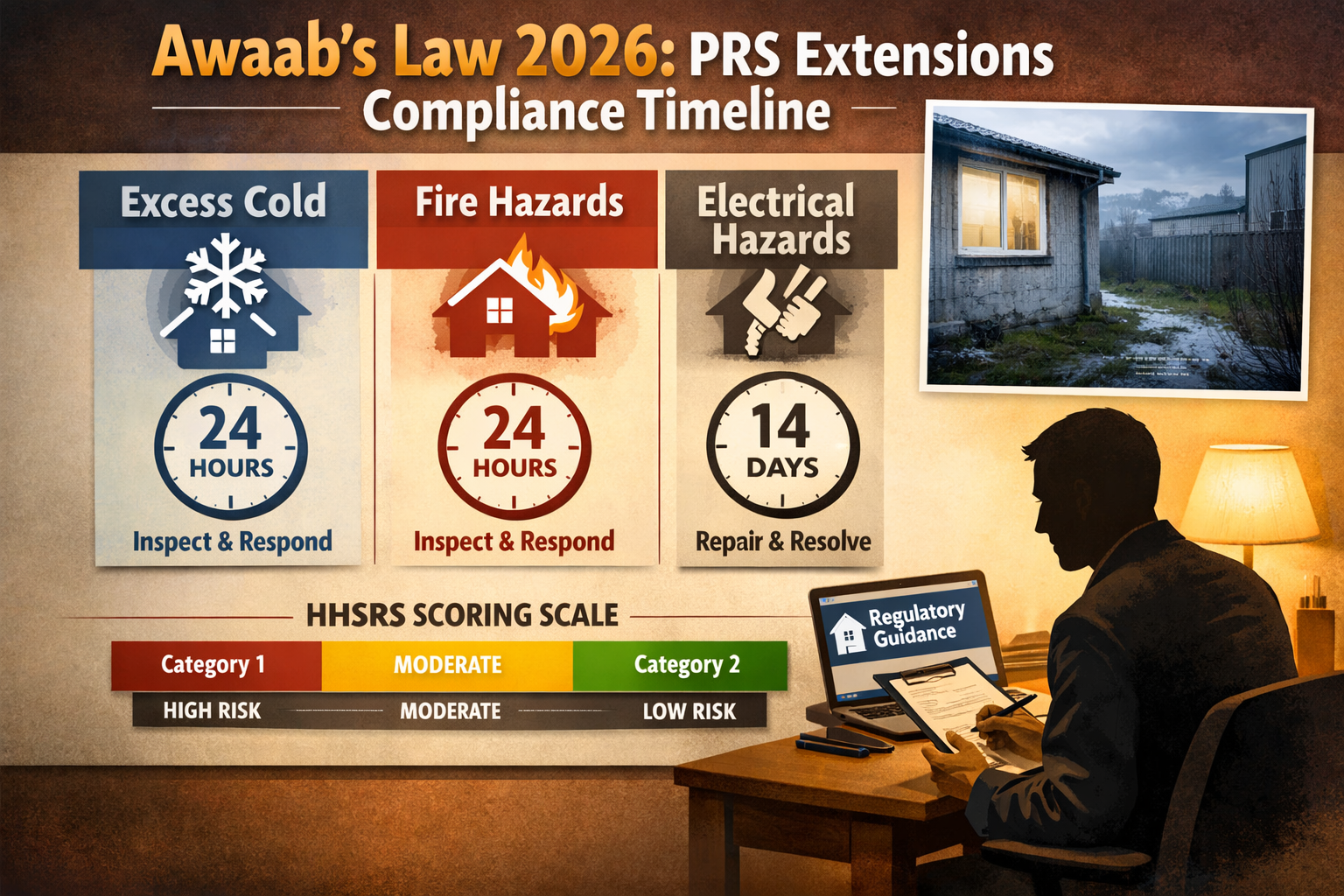
Under the extended framework, three additional hazard categories now attract mandatory response requirements:
| Hazard Category | HHSRS Classification | Key Risk |
|---|---|---|
| Excess Cold | Category 1 if below 18°C in living areas | Cardiovascular and respiratory illness |
| Fire Hazards | Category 1 where escape routes compromised | Death or serious injury |
| Electrical Hazards | Category 1 for exposed wiring, faulty circuits | Electrocution, fire |
💬 “Awaab’s Law mandates timescales for damp and mould remediation — and the 2026 policy framework makes clear that excess cold, fire, and electrical risks carry equivalent urgency.” [2]
The response timescales under the extended law are broadly:
- Emergency hazards (immediate risk to life): Investigation within 24 hours, repair commenced within 24 hours
- Urgent hazards (significant risk): Investigation within 14 days, repair within a reasonable period
- Non-urgent hazards: Written acknowledgement within 14 days, repair plan within 28 days
Surveyors advising PRS landlords must understand these timescales intimately — because a surveyor’s report will often form the evidential basis for determining which category applies.
Understanding the HHSRS Framework in the Context of 2026 Extensions
The Housing Health and Safety Rating System (HHSRS) has long been the statutory tool for assessing residential hazards in England and Wales. Under the Awaab’s Law 2026 extensions, its application in PRS properties takes on renewed legal weight.
HHSRS scores hazards using a formula that weighs:
- Likelihood of harm occurring
- Spread of outcomes (from minor injury to death)
- Vulnerability of the likely occupants
A Category 1 hazard (score above 1,000) triggers mandatory action by local authorities and, under the extended law, mandatory response timescales for landlords. A Category 2 hazard (score below 1,000) carries advisory weight but does not yet trigger the same strict timescales — though surveyors should flag these clearly.
For building surveyors, the practical implication is clear: every HHSRS assessment must now be thorough, documented, and defensible. Surveyors who produce vague or incomplete reports risk exposing their landlord clients to enforcement action — and themselves to professional liability claims.
Understanding the difference between a Level 2 and Level 3 survey is also relevant here: PRS compliance inspections often require the depth of investigation associated with a Level 3 building survey, particularly in older properties where multiple hazard categories may overlap.
Assessing Excess Cold Hazards: Surveyor Protocols
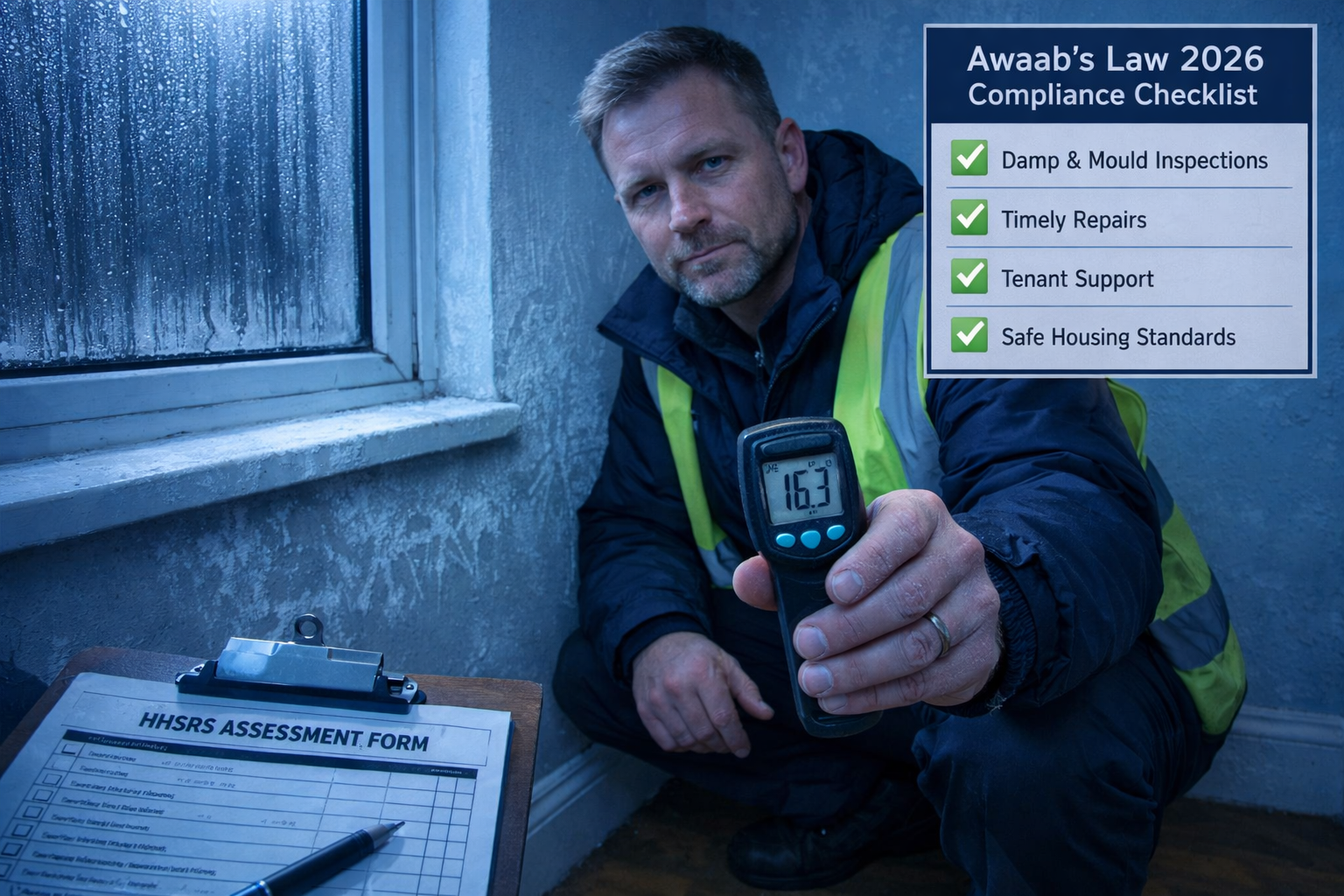
Excess cold is one of the most prevalent — and most underreported — hazards in PRS properties. The HHSRS defines excess cold as conditions where the living room temperature cannot be maintained at 21°C and bedroom temperatures cannot reach 18°C in cold weather.
On-Site Assessment Checklist ✅
When inspecting for excess cold under the Awaab’s Law 2026 extensions framework, surveyors should systematically evaluate:
🔥 Heating System
- Age, type, and condition of boiler or heat source
- Presence and functionality of thermostatic controls
- Evidence of recent servicing (Gas Safe certificates, service records)
- Adequacy of radiator coverage across all habitable rooms
🏠 Building Fabric
- Wall insulation (cavity wall, solid wall — use thermal imaging where possible)
- Loft insulation depth (minimum 270mm recommended)
- Window type and condition (single glazing is a significant cold risk indicator)
- Floor insulation, particularly in ground-floor properties — a solid floor slab survey can reveal heat loss pathways that are otherwise invisible
💨 Draught Proofing
- Door and window seals
- Letterbox and keyhole draught exclusion
- Chimney and flue draught management
📊 Thermal Imaging
Thermal imaging cameras are increasingly standard equipment for surveyors assessing excess cold. They identify cold bridging, missing insulation, and air infiltration points that visual inspection alone cannot detect. Surveyors should record thermal images as part of the evidential record.
💡 Pro tip: Always conduct excess cold assessments during or after a cold spell where possible. Assessments in summer months should be supplemented by SAP (Standard Assessment Procedure) calculations or equivalent modelling.
Assessing Fire Hazards: What the 2026 Extensions Require
Fire hazards in PRS properties span a wide spectrum — from missing smoke alarms to compromised escape routes and unsafe solid fuel appliances. The Awaab’s Law 2026 extensions place fire hazard assessment on an equal footing with excess cold and electrical risks.
Key Fire Hazard Categories
1. Means of Escape
- Are all escape routes clear and unobstructed?
- Do fire doors meet current standards (FD30 minimum in HMOs)?
- Are escape windows openable and of adequate dimensions?
2. Detection and Warning Systems
- Smoke alarms on every floor (mandatory since 2015 Smoke and Carbon Monoxide Alarm Regulations)
- Carbon monoxide alarms in rooms with solid fuel appliances
- Interlinked alarms in HMOs and larger properties
- Alarm testing records
3. Ignition Sources and Combustible Materials
- Condition of fixed electrical installations (see electrical section below)
- Proximity of combustible materials to heat sources
- Condition of gas appliances and flues
4. Structural Fire Resistance
- Integrity of fire-stopping in ceiling voids and wall penetrations
- Condition of fire-resistant plasterwork
- Evidence of previous fire damage or repair
For building surveys in older PRS properties — particularly Victorian and Edwardian terraces common across London and the South East — fire hazard assessment must account for original construction methods that provide minimal inherent fire resistance.
Fire Hazard Reporting Standards
Under the 2026 framework, fire hazard reports must specify:
- The exact nature of the defect
- The HHSRS category (1 or 2)
- Recommended remedial action with indicative timescales
- Whether the hazard triggers the 24-hour emergency response requirement
Assessing Electrical Hazards: A Surveyor’s Technical Guide
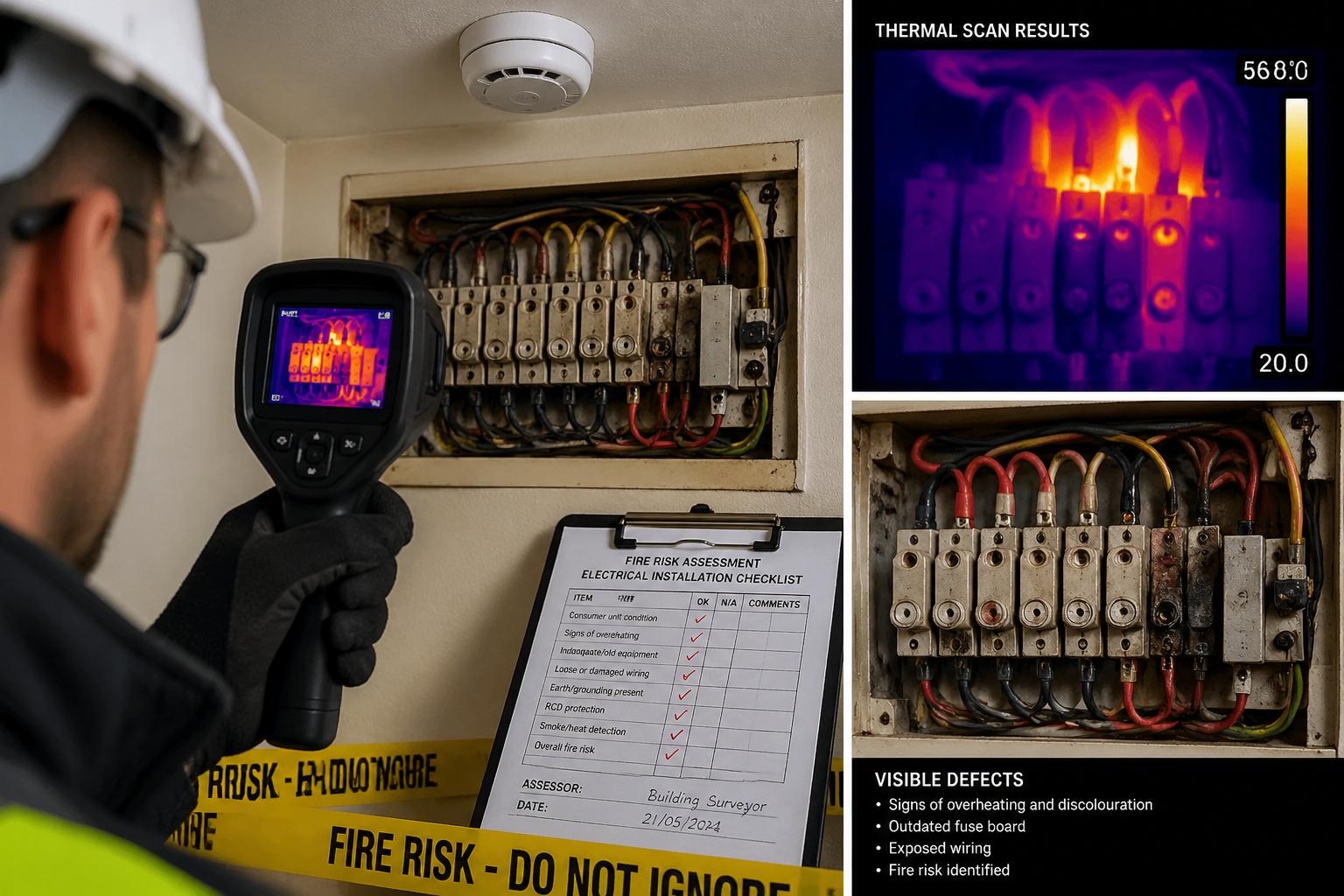
Electrical hazards are among the most technically demanding assessments for building surveyors — particularly because full electrical testing falls within the domain of NICEIC-registered electricians rather than surveyors. However, surveyors play a vital role in identifying visible electrical defects and flagging properties that require a full Electrical Installation Condition Report (EICR).
What Surveyors Can and Should Assess
Visual Inspection Scope:
| Element | What to Look For |
|---|---|
| Consumer unit | Age (pre-2016 plastic units may lack RCD protection), condition, labelling |
| Wiring | Visible rubber or cloth-insulated wiring (pre-1960s), overloaded sockets, DIY modifications |
| Sockets and switches | Cracked faceplates, scorch marks, loose fittings |
| Lighting | Exposed bulb holders, missing covers in bathrooms |
| Earthing and bonding | Visible bonding cables at gas and water entry points |
🚨 Immediate Red Flags (Category 1 Indicators):
- Exposed live conductors
- Evidence of arcing or scorching at any point
- Absence of RCD protection in a property with a wet room or kitchen
- Rubber-insulated wiring still in active use
- DIY wiring with non-standard connections
The EICR Requirement
Since 1 April 2021, all PRS landlords in England have been required to hold a valid EICR (maximum 5-year interval). Under the Awaab’s Law 2026 extensions, a surveyor identifying electrical hazards must:
- Record the defect with photographic evidence
- Assign an HHSRS hazard score
- Recommend an urgent EICR if one is not current or if visible defects suggest the installation is unsafe
- Advise the landlord of their response timescale obligations
Surveyors in London and the South East can access specialist RICS building surveys that integrate electrical hazard assessment within a broader property condition report — a particularly efficient approach for landlords managing multiple PRS properties.
Practical Inspection Protocols for Awaab’s Law 2026 Compliance
Before the Inspection
- Review tenancy history — has the property had complaints? Previous enforcement notices?
- Check EICR and Gas Safe certificate dates — are they current?
- Confirm access to all rooms, loft, and basement if applicable
- Prepare equipment: thermal imaging camera, hygrometer, thermometer, damp meter, torch, camera
During the Inspection
Adopt a room-by-room, system-by-system approach:
- External envelope first — assess insulation, glazing, roof condition (a roof survey may be warranted for older properties)
- Heating system — visual inspection, thermostat testing, boiler condition
- Electrical installation — consumer unit, visible wiring, sockets, earthing
- Fire safety — alarms, escape routes, fire doors, combustion appliances
- Damp and cold — thermal imaging, damp readings, ventilation assessment
Reporting Standards
A compliant Awaab’s Law 2026 report should include:
- Property details and inspection date
- Hazard schedule with HHSRS scores for each identified hazard
- Photographic evidence for every Category 1 hazard
- Recommended actions with priority ratings
- Timescale obligations cross-referenced to the extended law
- Limitations of inspection (e.g., areas not accessed, specialist tests recommended)
For surveyors new to PRS compliance work, understanding surveyor pricing and professional rates is also important — compliance inspections are more intensive than standard homebuyer surveys and should be priced accordingly.
Common Pitfalls Surveyors Must Avoid ⚠️
- Underscoring hazards — being overly conservative with HHSRS scores to avoid alarming landlord clients creates professional liability risk
- Failing to recommend specialist tests — surveyors who note “possible electrical concern” without recommending an EICR may be found negligent
- Ignoring cumulative hazard effects — a property with marginal excess cold AND inadequate fire detection AND aging wiring presents a compounded risk that should be reflected in the report
- Not documenting limitations — if a loft hatch is locked or a room is inaccessible, this must be explicitly stated
- Confusing social housing and PRS obligations — while the 2026 extensions align the regimes, some timescale and enforcement differences remain
Conclusion: Actionable Next Steps for Building Surveyors
The Awaab’s Law 2026 Extensions: Building Surveyors’ Guide to Assessing Excess Cold, Fire, and Electrical Hazards in PRS Properties represents both a challenge and an opportunity for the profession. Surveyors who adapt their protocols now will be well-positioned to serve a growing market of PRS landlords navigating complex compliance obligations.
Here are the immediate actions every building surveyor should take:
- ✅ Update inspection checklists to explicitly cover excess cold, fire, and electrical hazard categories under the 2026 framework
- ✅ Invest in thermal imaging equipment — it is no longer optional for PRS compliance work
- ✅ Refresh HHSRS scoring knowledge — consider CPD training specifically on the 2026 extensions
- ✅ Build relationships with NICEIC electricians and Gas Safe engineers — cross-referral is essential for complete compliance support
- ✅ Review your professional indemnity cover — the expanded liability landscape under the 2026 extensions warrants a conversation with your insurer [3]
- ✅ Standardise report templates to meet the evidential requirements of the extended law
For landlords and surveyors across London and the South East, working with local chartered surveyors who understand the specific housing stock and enforcement landscape in their area is the most effective way to achieve and maintain compliance.
The stakes are high — but so is the opportunity to protect tenants, support responsible landlords, and demonstrate the true value of professional surveying expertise.
References
[1] Understanding Topographic Survey Costs A Complete Pricing Guide – nottinghillsurveyors.com
[2] Damp And Mould Policy 2026 – slough.gov.uk
[3] Rpcannualinsurancereview2026 Compressed – hinshawlaw.com
Related services from Canterbury Surveyors
- RICS Homebuyer Surveys (Level 2)
- Building Surveys (Level 3)
- Structural engineers in Canterbury & Kent
Get a fixed-fee quote or call 0204 579 8270.