

{"cover":"Professional landscape format (1536×1024) hero image with bold text overlay: 'Renters' Rights Act: How New Tenant Protections Are Changing UK Valuations' in extra large 72pt white bold sans-serif font with dark semi-transparent overlay box, centered upper third. Background shows a row of traditional British terraced houses in warm afternoon light, a surveyor holding a clipboard in the foreground, subtle UK flag motif. Color scheme: deep navy blue, white, gold accents. High contrast, magazine cover aesthetic, editorial quality.","content":["Landscape format (1536×1024) editorial illustration showing a split scene: left side depicts a landlord reviewing a legal document marked 'Section 21 Abolished' at a desk with property deeds; right side shows a RICS-registered surveyor inspecting a residential property interior with a digital tablet displaying valuation figures. Warm interior lighting, professional attire, British period property details visible. Color palette: slate blue, cream, charcoal. Sharp focus, photorealistic editorial style.","Landscape format (1536×1024) infographic-style image showing a property valuation chart with downward adjustment arrows labeled '10-20% discount for sitting tenants', overlaid on a blurred background of a UK residential street. Foreground features a wooden desk with a printed Decent Homes Standard checklist, a tape measure, and a surveyor's report. Bold typography callouts highlight 'Periodic Tenancy', 'Repair Obligations', and 'Compliance Costs'. Color scheme: deep teal, white, amber highlights. Editorial, data-driven visual style.","Landscape format (1536×1024) scene showing a professional property condition survey in progress inside a British rental flat: a chartered surveyor photographs damp patches on a wall while a tenant observes. On a nearby table sits an open laptop showing a dilapidations report and a stack of legal notices. Natural daylight from sash windows, period cornicing visible. Color palette: muted grey, warm white, professional blue accents. Photorealistic, documentary editorial style."}

Fewer pieces of legislation in a generation have forced property professionals to rethink their core assumptions as rapidly as the Renters' Rights Act. With over 11 million private renters in England alone, the Act's reforms reach into every corner of the residential property market — from how surveyors calculate investment value to how landlords must now document and maintain their properties. Understanding how the Renters' Rights Act and new tenant protections are changing UK valuations and repair obligations is no longer optional for landlords, lenders, or surveyors: it is a professional necessity.
Key Takeaways
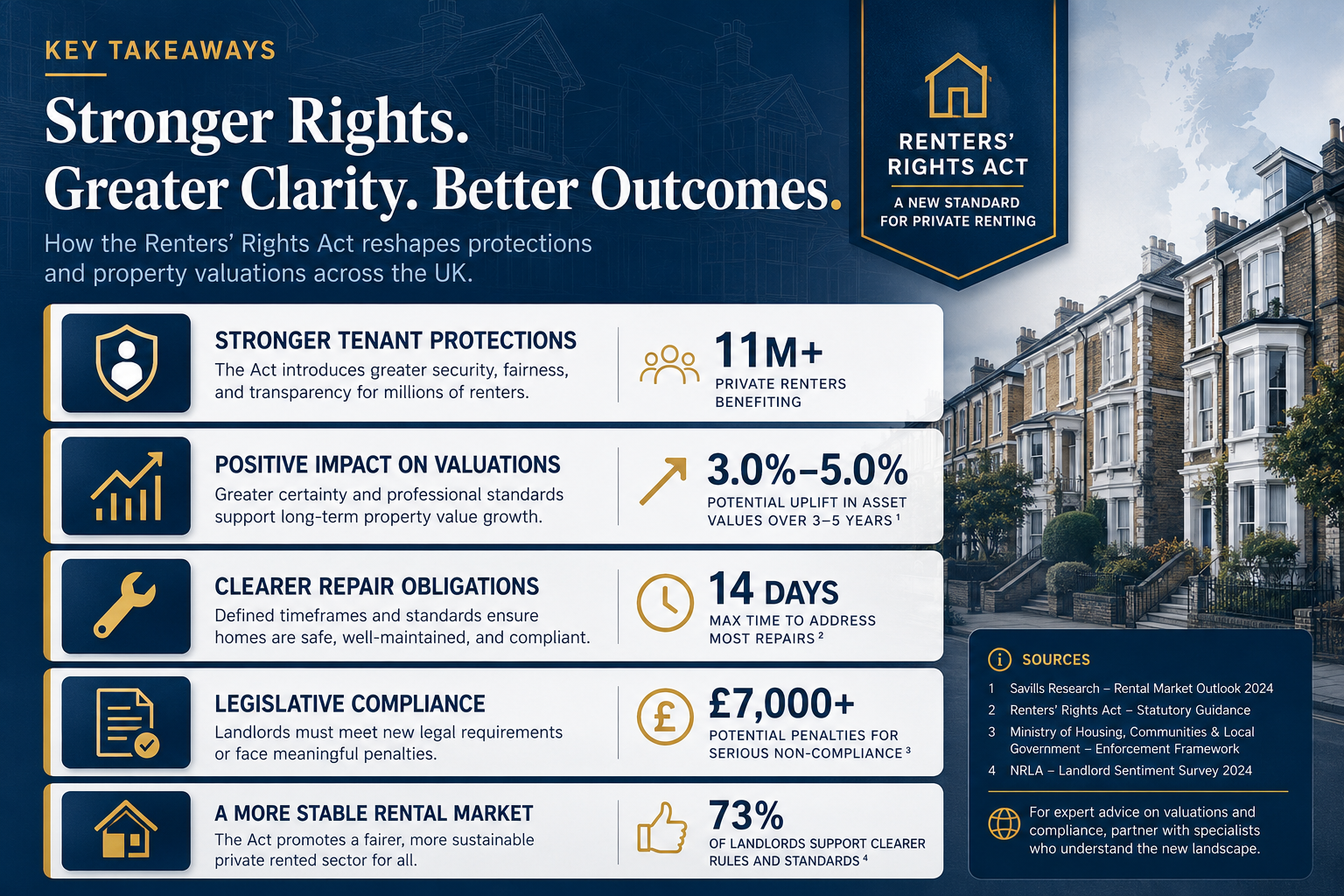
- The abolition of Section 21 'no-fault' evictions fundamentally alters vacant possession assumptions and may reduce investment valuations by 10-20% for properties with sitting tenants.
- All private rented properties must now meet the Decent Homes Standard, significantly raising repair and maintenance obligations for landlords.
- Rent increases are capped at once per year and must reflect market value, directly affecting rental income forecasts used in valuations.
- Condition surveys have become critical legal documents for deposit disputes, possession proceedings, and compliance evidence.
- Non-compliance fines range from £7,000 to £40,000, making professional property assessments a financial safeguard, not just good practice.
The Core Legislative Changes Landlords and Surveyors Must Understand
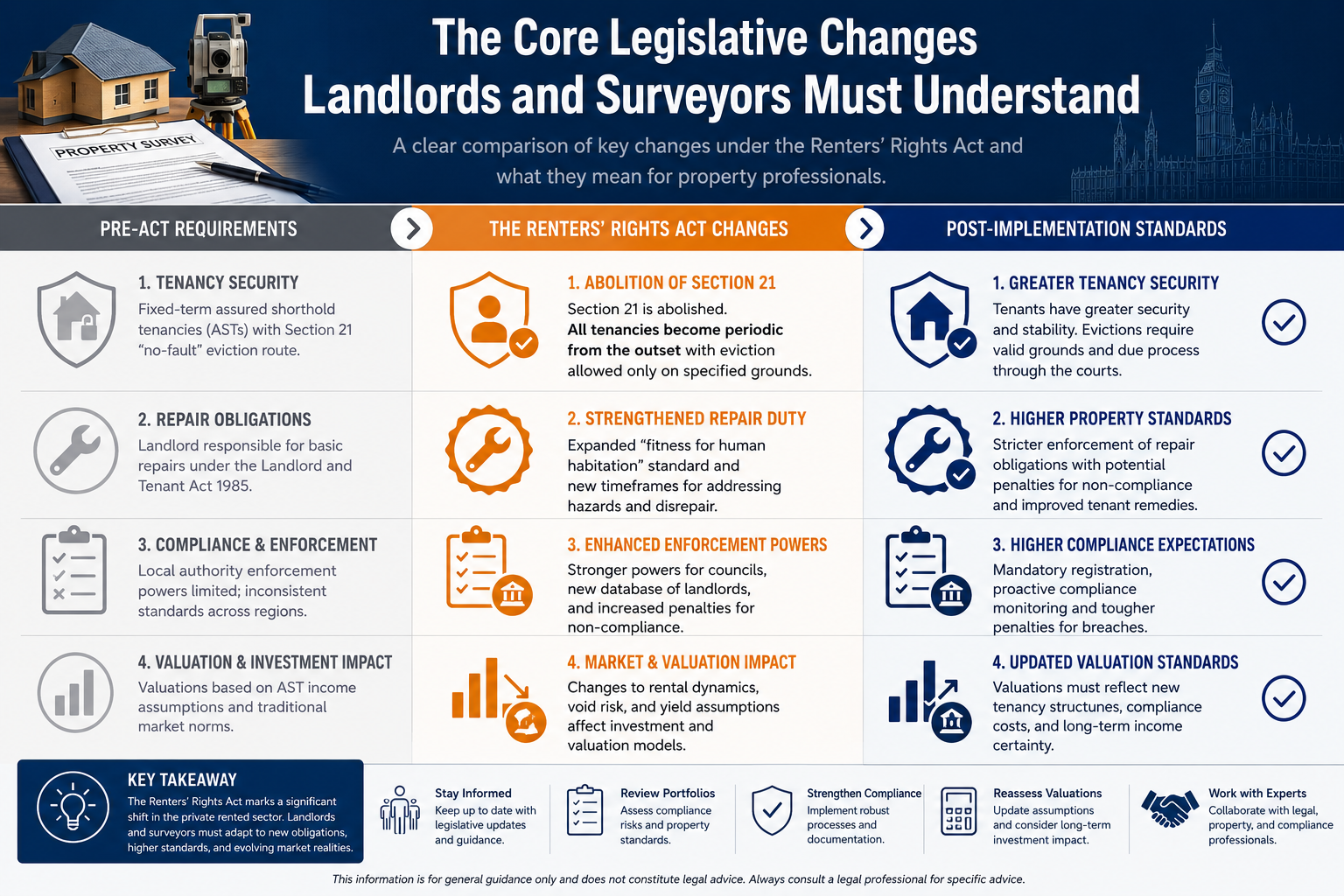
The Renters' Rights Act represents the most significant overhaul of the private rented sector in England for decades. To appreciate how the Renters' Rights Act and new tenant protections are changing UK valuations and repair obligations, it is essential to understand what the legislation actually does.
Abolition of Section 21 and the Shift to Periodic Tenancies
The headline reform is the abolition of Section 21 'no-fault' evictions. Landlords can no longer serve a notice to quit without providing a legally recognised reason. All possession claims must now proceed under Section 8 of the Housing Act 1988, relying on specific statutory grounds such as rent arrears, anti-social behaviour, the landlord's intention to sell, or the need for the property for a family member [1].
Alongside this, fixed-term assured shorthold tenancies have been replaced with periodic tenancies. Tenants may remain in a property indefinitely until they choose to leave, giving two months' notice [2]. This is a structural change, not a procedural one. The certainty of a fixed end date — which landlords and investors have historically relied upon for planning refurbishments, sales, or re-lettings — has been removed.
Revised Possession Grounds and Notice Periods
The Act amends and expands the grounds on which possession can be sought. Grounds now include property sale, redevelopment, landlord or family occupation, significant rent arrears, and persistent anti-social behaviour. Each ground carries its own notice period, and landlords must ensure strict procedural compliance before making any court application [3].
This procedural complexity has real cost implications. Legal fees, extended void periods during possession proceedings, and the risk of court delays all affect the net return on a rental investment.
Rent Increase Restrictions
Rent increases are now limited to once per year, and no increase is permitted within the first 12 months of a tenancy. Any increase must be in line with market value [1]. Tenants retain the right to challenge proposed increases through a tribunal, providing a meaningful brake on above-market rent growth.
For investors and valuers, this restriction directly affects the income capitalisation models used to assess investment value. Where a landlord previously had flexibility to reset rents at the end of each fixed term, that lever has been substantially reduced.
Strengthened Tenant Rights
The Act also restricts landlords from discriminating against tenants with children or those in receipt of housing benefit. Tenants now have a legal right to request permission to keep pets, and landlords must consider such requests reasonably [6]. These provisions affect how properties are managed and may influence insurance requirements and property condition over time.
How the Renters' Rights Act Is Directly Changing UK Valuations
The valuation implications of this legislation are substantial and are already prompting RICS-registered surveyors to revise their methodologies. Understanding how the Renters' Rights Act and new tenant protections are changing UK valuations and repair obligations requires a close look at the specific adjustments now required.
Vacant Possession Value vs. Tenanted Value
Historically, a significant premium attached to a property with vacant possession. A landlord or investor could acquire a property, serve a Section 21 notice, and regain possession within two to three months. That flexibility underpinned valuations for properties earmarked for refurbishment, sale, or owner-occupation.
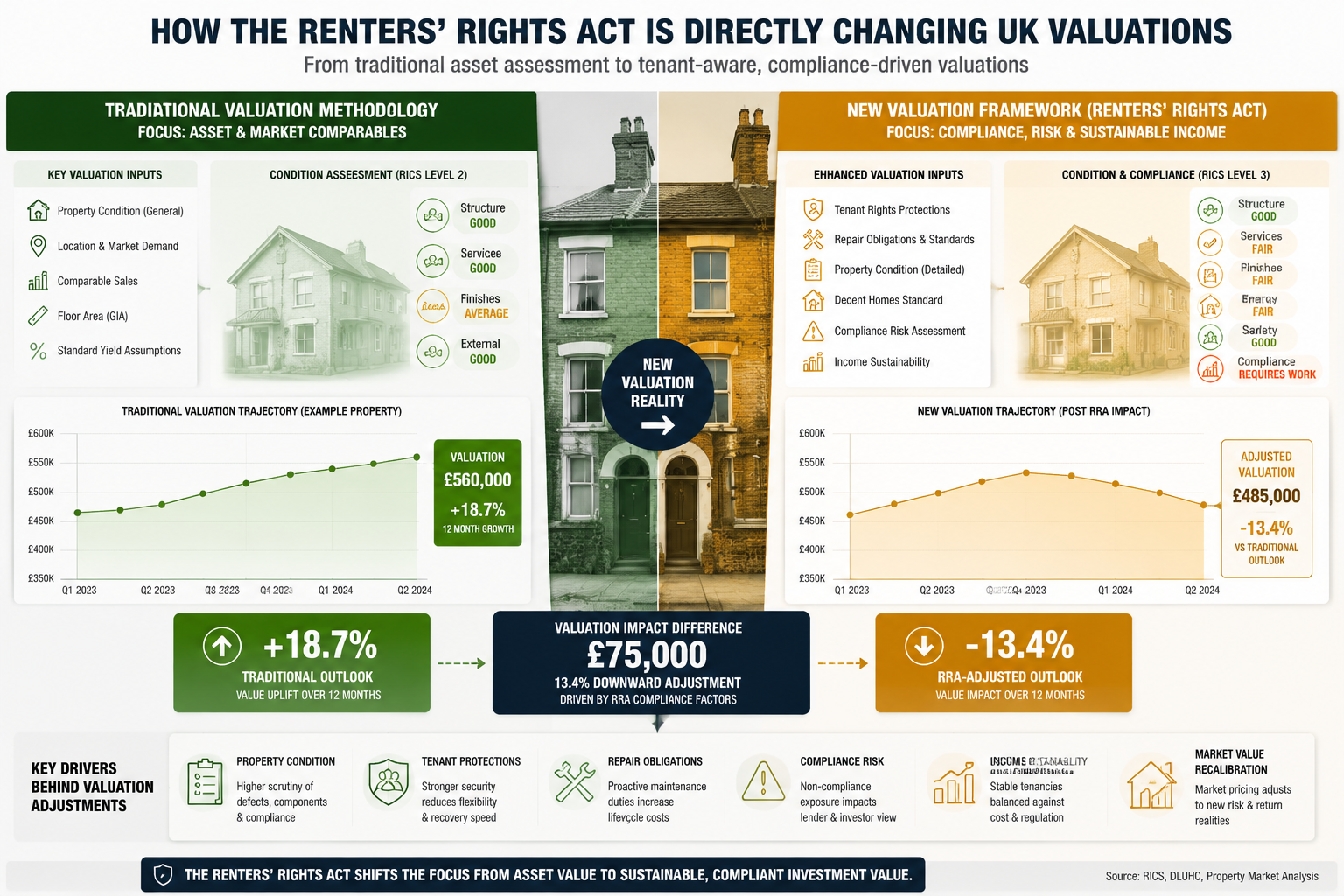
With Section 21 gone, the route to vacant possession is slower and less certain. Surveyors are now advised to consider applying discounts to properties with sitting tenants. Depending on the length of occupation, the tenant's circumstances, and the applicable possession grounds, discounts of 10-20% below vacant possession value may be appropriate [8]. This is not a minor adjustment — on a £400,000 property, a 15% discount represents £60,000.
For any formal assessment, working with registered RICS valuers who understand the new legislative framework is essential to ensure that valuations properly reflect current market conditions.
Investment Yield Assumptions
Buy-to-let and build-to-rent investors have traditionally modelled returns based on assumptions about void periods, rent growth, and the ease of asset disposal. All three of these assumptions are now under pressure:
| Factor | Pre-Act Assumption | Post-Act Reality |
|---|---|---|
| Void periods | Short, predictable | Potentially longer, court-dependent |
| Rent growth | Flexible, at each tenancy renewal | Capped at once per year, market-aligned |
| Asset disposal | Section 21 notice, then sale | Must use specific possession grounds |
| Tenant turnover | Controlled by fixed-term expiry | Tenant-led, open-ended |
These shifts mean that income-based valuations — which capitalise net rental income at an appropriate yield — must now factor in higher management costs, lower rent growth expectations, and extended void risk [3].
Red Book Valuations and Lender Security
Mortgage lenders are acutely aware of the new landscape. A Red Book valuation for a tenanted buy-to-let property must now account for the reduced flexibility in regaining possession and the compliance obligations imposed by the Decent Homes Standard. Lenders are expected to ensure that borrower landlords comply with the Act, since non-compliance could impair the value of the lender's security [6].
This has practical consequences for remortgaging, portfolio reviews, and any valuation carried out for lending purposes. Surveyors preparing RICS-compliant valuations must address these factors explicitly.
Capital Gains Tax and Disposal Valuations
For landlords planning to exit the market, the valuation at the point of disposal is equally affected. A property sold with a sitting tenant — which is now the default position for any occupied rental — will typically achieve less than one sold with vacant possession. Landlords seeking a capital gains tax valuation should ensure their surveyor applies an appropriate tenanted discount and documents the rationale clearly for HMRC purposes.
Repair Obligations, the Decent Homes Standard, and Condition Surveys
The extension of the Decent Homes Standard (DHS) to the private rented sector is the reform with the most direct impact on day-to-day repair obligations. Previously applicable only to social housing, the DHS now sets a binding floor for property condition across all private rentals in England [4].
What the Decent Homes Standard Requires
The DHS requires that all rented properties meet four core criteria:
- Freedom from Category 1 hazards under the Housing Health and Safety Rating System (HHSRS)
- A reasonable state of repair, meaning no significant disrepair to the structure, roof, or essential services
- Reasonably modern facilities, including kitchens and bathrooms that are not excessively outdated
- Effective thermal comfort, meaning adequate heating and insulation
For many older private rental properties — particularly Victorian and Edwardian terraces common across London and the South East — meeting these standards will require capital investment. Landlords who have deferred maintenance may face substantial remediation costs.
Compliance Costs and Rebuild Assessments
The extension of the DHS to private rentals is expected to drive higher rebuild costs as property standards rise. Landlords and insurers should reassess their valuations and insurance coverage accordingly [4]. A reinstatement cost valuation that fails to account for the higher specification now required under the DHS risks leaving a landlord underinsured in the event of a major loss.
Enforcement Powers and Fines
Local authorities have been given enhanced enforcement powers. Fines for non-compliance with the new standards range from £7,000 to £40,000 depending on the severity and persistence of the breach [5]. Repeat offenders can face higher penalties and, in serious cases, Rent Repayment Orders that require landlords to refund up to 12 months of rent.
These penalties make professional compliance assessments a financial priority. A building survey or dilapidations survey carried out before or during a tenancy can identify defects that would trigger enforcement action, allowing landlords to address them proactively.
The Critical Role of Condition Surveys
With the removal of Section 21, condition surveys have taken on a new legal significance. A detailed, timestamped survey at the start of a tenancy now serves multiple purposes [7]:
- Establishing a baseline for deposit deduction claims at the end of the tenancy
- Providing evidence in possession proceedings where property damage or breach of tenancy is alleged
- Demonstrating compliance with the Decent Homes Standard at the point of letting
- Supporting insurance claims by documenting the property's condition before occupation
A poorly documented tenancy start — or no survey at all — leaves landlords exposed in all four of these areas. Given that possession proceedings under Section 8 are now the only route to regaining a property, the quality of documentary evidence is more important than ever.
"With the removal of Section 21, the condition survey has moved from a best-practice recommendation to an essential legal safeguard for every landlord in the private rented sector."
For landlords managing properties across London and the South East, working with chartered surveyors in London who understand both the legislative requirements and local market conditions provides the most reliable foundation for compliance and valuation work.
Practical Implications for Different Stakeholders
For Landlords
- Commission a professional condition survey at the start of every tenancy and update it at each renewal or change of occupancy.
- Audit properties against the Decent Homes Standard before the next inspection cycle to avoid enforcement action.
- Review insurance coverage to ensure reinstatement values reflect the higher specification now required.
- Seek formal valuation advice before selling a tenanted property to understand the likely discount versus vacant possession value.
For Investors and Portfolio Holders
- Revisit income capitalisation models to reflect capped rent growth, extended void risk, and higher management costs.
- Reassess disposal strategies for underperforming assets, particularly where possession grounds are uncertain.
- Engage RICS-registered valuers for portfolio reviews to ensure that book values reflect the post-Act reality.
For Lenders
- Update lending criteria to require evidence of DHS compliance as a condition of mortgage advance.
- Ensure that valuations for buy-to-let lending explicitly address the tenanted discount and the implications of the new possession regime.
- Monitor borrower compliance with anti-discrimination provisions, as breaches could affect the enforceability of tenancy agreements and the value of the lender's security [6].
For Surveyors
- Apply explicit tenanted discounts in valuations where Section 21 is no longer available, with clear supporting rationale.
- Ensure condition surveys are sufficiently detailed to serve as legal evidence in tribunal and court proceedings.
- Advise clients on the interaction between the DHS, HHSRS hazard ratings, and reinstatement cost assessments.
Conclusion
The Renters' Rights Act has fundamentally altered the operating environment for everyone involved in the private rented sector. How the Renters' Rights Act and new tenant protections are changing UK valuations and repair obligations is a question that now demands a concrete, professional response — not a wait-and-see approach.
Actionable next steps for 2026:
- Landlords should commission a professional condition survey for every tenanted property and audit compliance with the Decent Homes Standard without delay.
- Investors should instruct a RICS-registered valuer to reassess portfolio values using methodologies that reflect the post-Act framework, including appropriate tenanted discounts.
- Lenders should update their valuation instructions to require explicit commentary on tenanted value, possession risk, and DHS compliance.
- Surveyors should ensure their valuation reports and condition surveys meet the evidential standards now required by the new possession and enforcement regime.
The legislation is in force. The professional and financial consequences of ignoring it are real and measurable. Acting now — with qualified, experienced surveyors — is the most effective way to protect the value of a rental property asset in the current market.
References
[1] Consideration Of Implications Of Renters Rights Act On Valuation – https://www.rics.org/news-insights/consideration-of-implications-of-renters-rights-act-on-valuation
[2] Guide To The Renters Rights Act – https://www.gov.uk/government/publications/guide-to-the-renters-rights-act/guide-to-the-renters-rights-act
[3] Renters Rights Act 2025 – https://nwlsolicitors.co.uk/insights/renters-rights-act-2025
[4] Renters Rights Act 2025 Rebuild Cost Impact – https://www.rebuildcostassessment.com/post/renters-rights-act-2025-rebuild-cost-impact
[5] Renters Rights Bill Impact On Landlords – https://www.xero.com/uk/guides/renters-rights-bill-impact-on-landlords/
[6] Renters Rights Act Lenders Landlords – https://ww3.rics.org/uk/en/journals/property-journal/renters-rights-act-lenders-landlords.html
[7] Renters Rights Act 2026 Implications For Condition Surveys Landlord Valuations And Dispute Evidence – https://www.canterburysurveyors.com/blog/renters-rights-act-2026-implications-for-condition-surveys-landlord-valuations-and-dispute-evidence/
[8] Valuing Rental Properties Under The Renters Rights Act 2026 Surveyor Adjustments For Section 21 Abolition – https://www.canterburysurveyors.com/blog/valuing-rental-properties-under-the-renters-rights-act-2026-surveyor-adjustments-for-section-21-abolition/