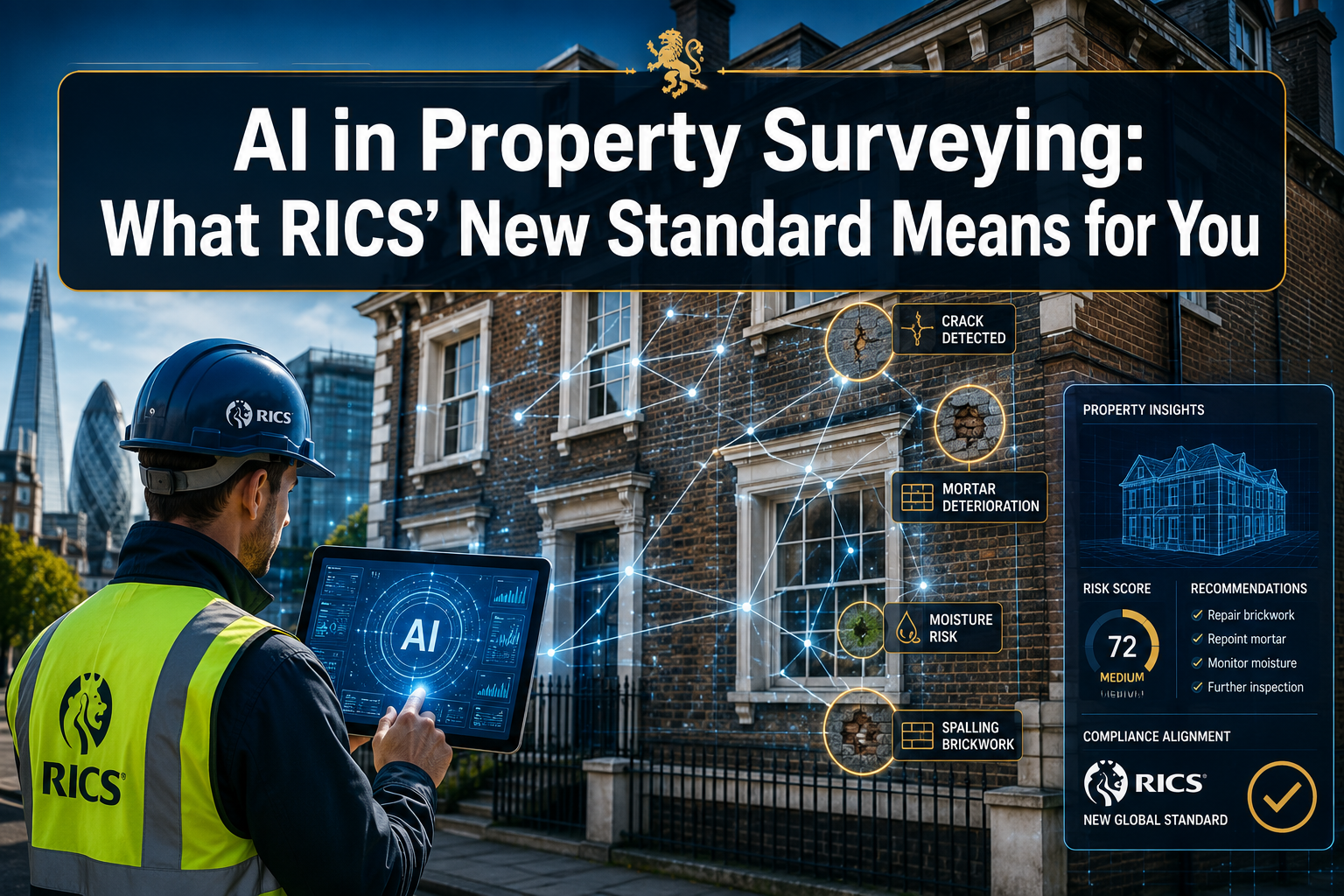

By March 2026, every RICS member and regulated firm worldwide faced a non-negotiable deadline: comply with the profession's first-ever global standard on artificial intelligence, or risk breaching their professional obligations. That standard — covering the responsible use of AI in property surveying: what RICS' new professional standard means for building surveys and valuations — represents the most significant shift in surveying practice governance in a generation.
The standard was published in September 2025 and became mandatory on 9 March 2026 [1][2]. It applies wherever AI has a material impact on surveying services, which explicitly includes valuations and building surveys [5]. For property owners, buyers, and the professionals who serve them, understanding what this standard demands — and what it protects — is now essential.
Key Takeaways
- RICS' first global AI standard became mandatory on 9 March 2026, applying to all members and regulated firms worldwide where AI materially affects surveying services [2].
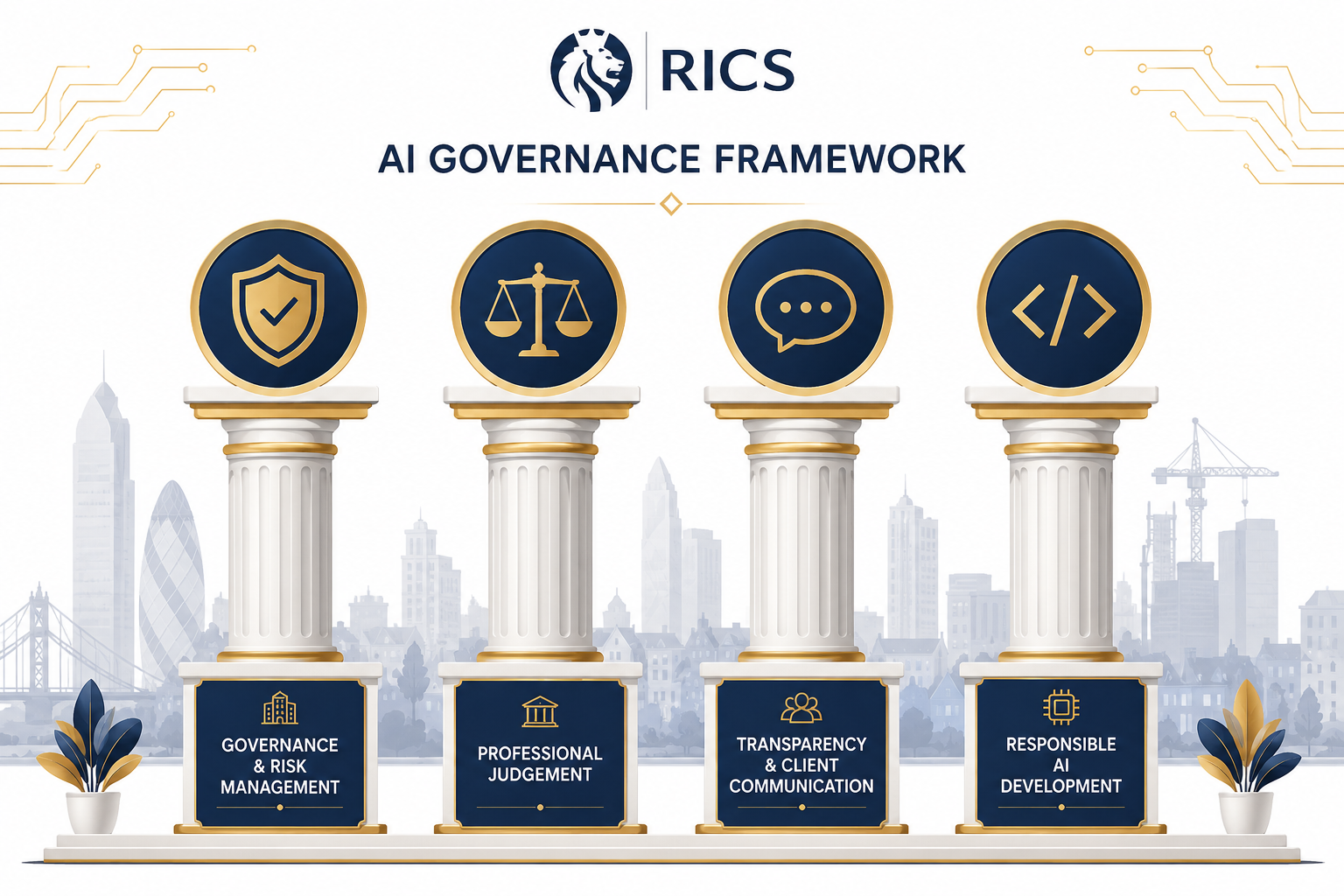
- The standard is built around four pillars: governance and risk management, professional judgement and oversight, transparency and client communication, and responsible AI development [1][3].
- Surveyors remain fully accountable for all professional outputs — AI tools are assistive, not a replacement for professional responsibility [5].
- A mandatory written assessment is required before using AI on any instruction where it could materially affect the outcome [5].
- Clients must be told when AI has been used in a material way, and surveyors must be able to explain and justify AI-assisted conclusions [2][5].
Why RICS Acted Now: The Scale of AI Adoption in Surveying
Artificial intelligence had already entered surveying practice well before any formal standard existed. Automated valuation models (AVMs), AI-powered defect detection software, drone-based image analysis, and large language model tools for report drafting were all in active use across the profession. A 2024 RICS survey of European members found that AI adoption was accelerating rapidly, with a significant proportion of firms already using or piloting AI tools for core tasks [4].
The absence of a governing framework created real risks. Without clear rules, individual surveyors were making inconsistent decisions about when AI outputs could be trusted, how those outputs should be disclosed to clients, and who bore responsibility when AI-assisted work contained errors. The responsible use of AI in property surveying became not just a technical question but a professional ethics question.
RICS responded by developing a standard that is both practical and principled. It does not ban AI. It does not mandate specific tools. Instead, it sets out the conditions under which AI can be used responsibly — and makes clear that those conditions are non-negotiable for members [1][5].
The Four Pillars of the RICS AI Standard
The standard is structured around four core requirement areas. Each one addresses a different dimension of responsible AI use in surveying practice [1][2][3].
1. Governance and Risk Management
Firms and individual surveyors must have documented processes for identifying, assessing, and managing the risks associated with AI tools. This includes understanding how a given AI system works, what data it was trained on, and where its outputs may be unreliable or biased [5].
For firms, this means establishing internal governance structures — policies, oversight roles, and audit trails — before deploying AI on client instructions. For sole practitioners, it means being able to demonstrate that a considered assessment was made before any AI tool was used in a material way.
2. Professional Judgement and Oversight
This is perhaps the most consequential pillar for day-to-day practice. The standard is explicit: AI must not replace professional judgement. Surveyors must have sufficient knowledge of the AI systems they use, including their limitations, known failure modes, and potential for bias [5][8].
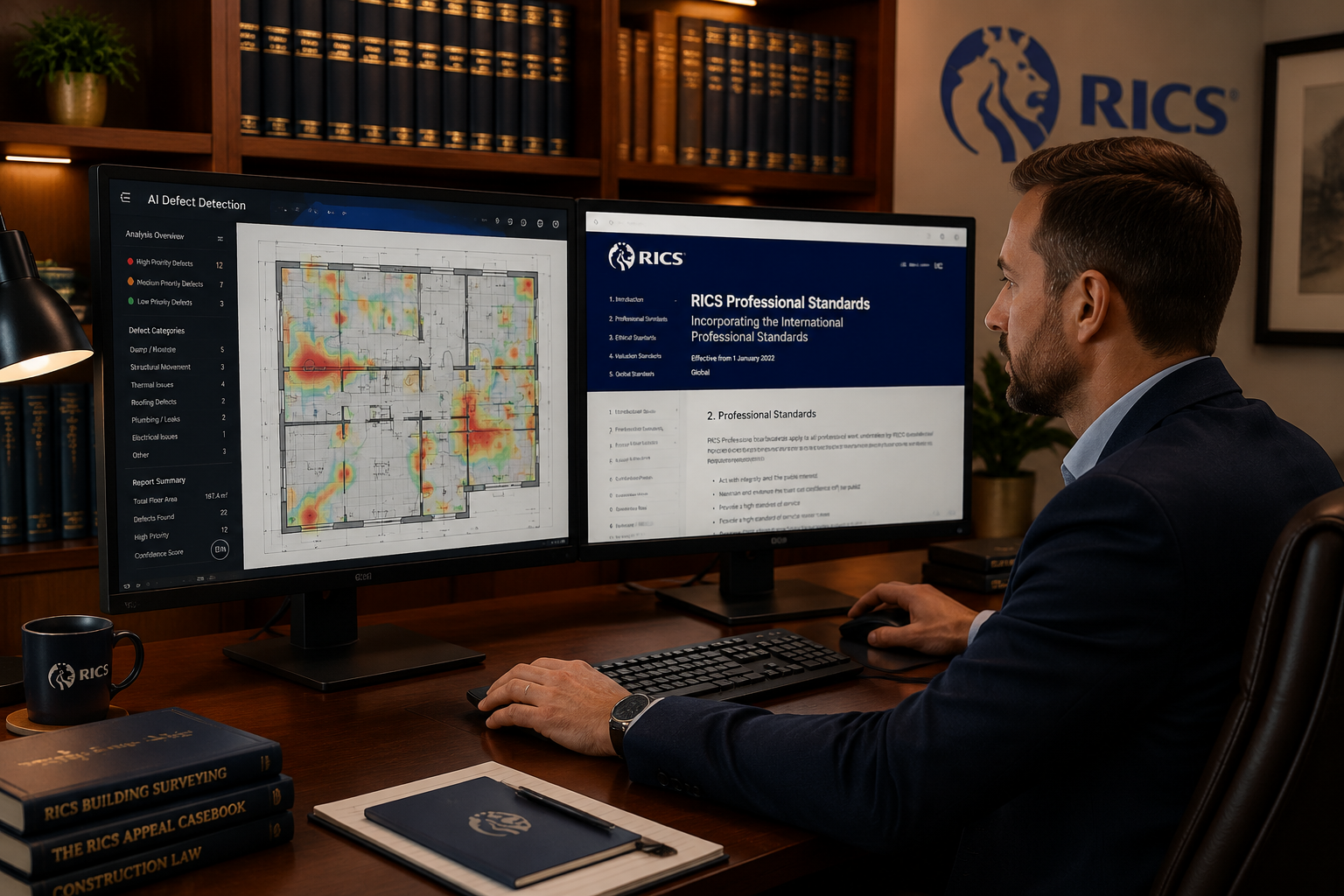
A RICS explainer on the standard emphasises that professional scepticism — a concept already embedded in the RICS Valuation Global Standards (Red Book) — must be applied when relying on AI for valuations [8]. An AI-generated output, whether from an AVM or a defect detection algorithm, cannot be accepted at face value. The decision that an output is reliable must be made and recorded by a named surveyor [5][8].
This has direct implications for RICS building surveys and commercial building surveys. If AI software flags a potential structural defect or moisture issue, the surveyor cannot simply report that finding without independently verifying it. The AI is a prompt for investigation, not a conclusion.
3. Transparency and Client Communication
Clients must be informed when AI has been used in a way that materially affects the delivery of their surveying service [2][5]. This obligation applies at the outset of an instruction and in the final report or advice.
The standard does not require surveyors to disclose every use of AI — spell-checkers and standard office software are not in scope. The threshold is materiality: if the AI tool influenced the professional output in a meaningful way, the client must know, and the surveyor must be able to explain how the tool was used and why its outputs were considered reliable.
"Surveyors remain fully accountable for their professional outputs. AI tools are assistive, not a substitute for professional responsibility." — RICS, 2025 [5]
This transparency obligation is particularly relevant in property valuations, where clients — whether individuals, lenders, or commercial investors — make significant financial decisions based on the surveyor's conclusions. If an AVM contributed to a valuation figure, that must be disclosed and the surveyor must justify why the AVM output was appropriate for that specific property and market context.
4. Responsible Development of AI Systems
The fourth pillar applies to firms that develop AI tools in-house, rather than simply adopting third-party products. Requirements here cover data governance, testing for bias, and ensuring that development processes align with professional and ethical standards [1][3][5].
For most surveying practices, this pillar will be less immediately relevant than the first three. However, as more firms build proprietary tools — custom AVMs, bespoke inspection checklists powered by machine learning, or automated report generation systems — this requirement will grow in significance.
What the Standard Means in Practice: Building Surveys and Valuations
Mandatory Written Assessment Before Using AI
One of the most operationally significant requirements in the standard is the mandatory written assessment. Before using AI on any instruction where it could materially affect the outcome, the surveyor must assess and document whether AI use is appropriate [5].
This assessment must consider:
- The nature and complexity of the property or transaction
- The reliability and limitations of the specific AI tool being used
- Whether the AI output can be adequately verified by the surveyor
- The potential impact on the client if the AI output is wrong
For a straightforward Level 2 HomeBuyer Survey on a standard post-war semi-detached property, an AI-assisted defect screening tool might be entirely appropriate — provided the surveyor has the knowledge to verify its outputs and documents that assessment. For a complex residential structural survey on a listed building with unusual construction, the same tool might not meet the reliability threshold, and the written assessment must reflect that.
Automated Valuation Models: Useful Tool, Not Final Word
AVMs have become widely used in mortgage lending and commercial property transactions. The RICS standard does not prohibit their use — but it does require that surveyors treat AVM outputs with the same professional scepticism applied to any other data source [8].
An AVM cannot account for the specific condition of a property, recent local market anomalies, or factors that do not appear in transactional data. When a surveyor uses an AVM as part of a valuation, the standard requires that they:
- Understand how the AVM was built and what data it uses
- Identify the circumstances in which the AVM is likely to be unreliable
- Apply independent judgement to determine whether the AVM output is appropriate for the specific instruction
- Record that assessment in the file
For commercial property valuations, where individual asset characteristics and lease structures can significantly affect value, the limitations of AVMs are especially pronounced. The standard reinforces that no AVM output can substitute for a qualified surveyor's analysis.
Defect Detection and Building Condition Surveys
AI-powered image analysis tools — capable of identifying cracks, damp patches, roof damage, and other defects from photographs — are increasingly available to building surveyors. These tools can improve efficiency and consistency, particularly for large-scale stock condition surveys covering many properties.
However, the RICS standard makes clear that AI defect detection outputs must be verified by the surveyor before being reported to the client. A flagged anomaly in an image is not a confirmed defect. The surveyor must exercise judgement about whether the AI's identification is accurate, whether further investigation is needed, and how the finding should be characterised in the report.
This is especially important for issues like damp surveys, where visual indicators can be misleading without physical investigation, or roof surveys, where drone imagery may not capture the full picture of structural integrity.
Comparing Surveyor Obligations Before and After the Standard
| Obligation | Before March 2026 | From March 2026 |
|---|---|---|
| Written AI assessment | No formal requirement | Mandatory where AI is material [5] |
| Client disclosure of AI use | No standard requirement | Required where AI is material [2] |
| Governance framework for AI | No formal requirement | Required for all regulated firms [1] |
| Accountability for AI outputs | Implied by general duty | Explicitly named surveyor must sign off [5] |
| Knowledge of AI limitations | No formal standard | Mandatory competence requirement [5] |
Implications for Clients: What to Expect from Your Surveyor
The RICS standard has practical implications for anyone commissioning a building survey or property valuation in 2026. Clients should expect:
- Greater transparency about the tools and methods used in their survey or valuation report
- A named professional who takes explicit responsibility for every conclusion, including those informed by AI
- Clearer explanations of how AI-assisted findings were verified before being reported
- Consistent standards regardless of which RICS-regulated firm they instruct, anywhere in the world
For clients choosing the right property survey, this is reassuring news. The standard means that AI can enhance the quality and thoroughness of surveying work — but the professional accountability that clients rely on remains firmly in place.
Clients who receive a report containing AI-assisted analysis are entitled to ask how that analysis was verified and what the surveyor's independent assessment concluded. Under the new standard, surveyors must be able to answer those questions clearly [2][5].

Challenges and Ongoing Debates Within the Profession
The introduction of the RICS AI standard has not been without discussion. Some practitioners have raised concerns about the practical burden of mandatory written assessments, particularly for high-volume residential survey work [10]. Others have questioned how "material impact" should be defined in practice — a threshold that will inevitably require case-by-case judgement.
There are also questions about competence. The standard requires surveyors to have sufficient knowledge of the AI tools they use, including their technical limitations. For many experienced practitioners, building that knowledge represents a genuine professional development challenge [7][9].
RICS has indicated that guidance materials, training resources, and APC (Assessment of Professional Competence) updates will support members in meeting the new requirements [7]. The standard is intended to evolve as AI technology and surveying practice develop, so further updates are anticipated.
The broader debate within the profession reflects a tension that exists across many industries: how to harness the genuine efficiency and analytical benefits of AI without allowing those benefits to erode the professional judgement and accountability that give surveying its value.
Conclusion: Accountability Remains the Foundation
The RICS standard on the responsible use of AI in property surveying — what RICS' new professional standard means for building surveys and valuations — does not represent a rejection of technology. It represents a clear-eyed acknowledgement that technology must serve professional standards, not replace them.
For surveyors, the practical steps are clear:
- Audit current AI use across all service lines to identify where the standard applies
- Develop or update internal governance policies covering AI tool selection, assessment, and oversight
- Build competence in the AI tools used, including their limitations and failure modes
- Implement client disclosure processes for all instructions where AI is used materially
- Document every material AI use with a named surveyor taking explicit responsibility for the output
For clients, the standard provides meaningful assurance: the surveyor signing your report remains personally accountable for every conclusion it contains, whether or not AI contributed to that conclusion.
The profession's embrace of AI, governed by a robust professional standard, has the potential to deliver better, more consistent, and more thorough surveys and valuations. The RICS standard ensures that as the tools evolve, the accountability does not erode.
References
[1] Rics Launches Landmark Global Standard On Responsible Use Of Ai In Surveying – https://www.rics.org/news-insights/rics-launches-landmark-global-standard-on-responsible-use-of-ai-in-surveying
[2] Rics First Ever Standard On Responsible Ai Use Now In Effect – https://www.rics.org/news-insights/rics-first-ever-standard-on-responsible-ai-use-now-in-effect
[3] Ai Responsible Use Standard – https://ww3.rics.org/uk/en/journals/construction-journal/ai-responsible-use-standard.html
[4] Ai In Europe Survey – https://www.rics.org/news-insights/ai-in-europe-survey
[5] Responsible Use Of Artificial Intelligence In Surveying Practice September 2025 – https://www.rics.org/content/dam/ricsglobal/documents/standards/Responsible-use-of-artificial-intelligence-in-surveying-practice_September-2025.pdf
[7] Rics Responsible Use Of Ai Explained For Apc Candidates – https://resources.apcguide.com/rics-responsible-use-of-ai-explained-for-apc-candidates/
[8] Watch – https://www.youtube.com/watch?v=PmaGA7HTZJs
[9] Propertyelite Rics Surveying Ai Activity 7401523133440237568 61cd – https://www.linkedin.com/posts/propertyelite_rics-surveying-ai-activity-7401523133440237568-61CD
[10] New Rics Standard On The Responsible Use Of Ai – https://www.reddit.com/r/buildingsurveying/comments/1s0nbag/new_rics_standard_on_the_responsible_use_of_ai/