
Nearly nine years after the Grenfell Tower fire killed 72 people, an estimated 231,000 flats in England remain formally trapped inside a remediation programme — properties that buyers, lenders, and valuers must navigate with extreme care. [5] Surveying cladding remediation in 2026 post-Grenfell: valuation impacts for buyers is no longer a niche concern; it is a mainstream due-diligence requirement that shapes mortgage approvals, sale prices, and long-term investment decisions across the UK's flat market.
Key Takeaways
- At least 4,310 residential buildings over 11m in England have been formally identified with unsafe cladding, affecting an estimated 231,000 flats as of 2026. [5]
- The UK government's May 2026 Grenfell Tower Inquiry progress report confirms that remediation of the highest-risk buildings targets completion by 2029, with wider works running into the 2030s.
- EWS1 forms, Building Safety Act 2022 obligations, and lender requirements remain critical checkpoints for any buyer of a flat in a multi-storey block.
- Cladding-affected properties can suffer value discounts of 10–30% or more, and some remain effectively unmortgageable without a satisfactory external wall assessment.
- Commissioning the right level of building survey before exchange is the single most important step a buyer can take to protect their financial position.
The Scale of the Cladding Crisis Entering 2026
The numbers are stark. Government data released in early 2026 identify 4,310 residential buildings over 11m in England as containing unsafe cladding, with an estimated 231,000 flats formally enrolled in a remediation programme. [5] Campaign groups and independent analysts suggest the broader universe of homes with some form of fire-safety or cladding-related issue could reach up to 1.5 million flats — a figure that includes buildings outside formal schemes but still facing impaired value and restricted mortgage lending. [5]
Public Accounts Committee evidence from February 2024 placed the number of residential buildings over 11m needing remediation at between 9,000 and 12,000, with an estimated total remediation cost of £12.6 billion to £22.4 billion. [8] That financial exposure is not abstract: it flows directly into how chartered surveyors and mortgage valuers price risk when advising buyers.
Why the Problem Persists in 2026
Three interconnected factors keep the cladding issue alive in the market:
- Remediation pace — Works on many blocks have been delayed by funding disputes, contractor availability, and the complexity of identifying all responsible parties under the Building Safety Act 2022.
- Assessment backlogs — External wall system assessments (EWS1 forms) are still required by most major lenders for flats in multi-storey blocks, and qualified fire engineers remain in short supply.
- Scope creep — Investigations frequently uncover secondary fire-safety defects beyond cladding itself, including missing cavity barriers, combustible balconies, and inadequate fire doors, each adding cost and time.
"The scale of the problem means a material proportion of blocks will still be in assessment or works phases during the late 2020s — a factor surveyors increasingly reflect via longer marketing periods, restricted demand, and risk discounts in valuation models." [8]
Regulatory and Funding Framework: What Has Changed
Building Safety Act 2022 and Developer Accountability
The Building Safety Act 2022 remains the cornerstone legislation. It created the Building Safety Regulator, established a new regime for higher-risk buildings (those over 18m or seven storeys), and introduced legal mechanisms to compel developers and building owners to fund remediation. Buyers need to understand whether a target property falls within the Act's scope, because this affects both the remediation funding route and the timeline for works.
The Building Safety Levy — October 2026
A significant new financial mechanism arrives on 1 October 2026: the Building Safety Levy. Confirmed by the government, the levy applies to most new residential developments requiring building control approval, including student accommodation, and is charged per square metre of new residential floor space. Affordable housing, NHS facilities, care homes, and schemes under 10 dwellings are among the exemptions. [11]
The government projects the levy will raise over £3 billion across 10 years, with receipts earmarked for remediating unsafe buildings, particularly cladding-affected stock. [11] For buyers of new-build flats, the levy adds a layer of development cost that may influence asking prices and residual land values — a factor that informed red book valuations will need to account for going forward.
Government Progress Report: Timelines Stretching to the 2030s
The UK government's May 2026 Grenfell Tower Inquiry progress report confirms that remediation of the highest-risk buildings is targeted for completion by 2029, while works on lower-risk or more complex buildings are expected to continue into the 2030s. The report emphasises continuing activity under the Building Safety Act 2022 and associated funding schemes. [14] For buyers purchasing today, this means the property they are buying may still be mid-remediation for several years — a reality that must be factored into any valuation.
How Cladding Status Affects Property Valuations
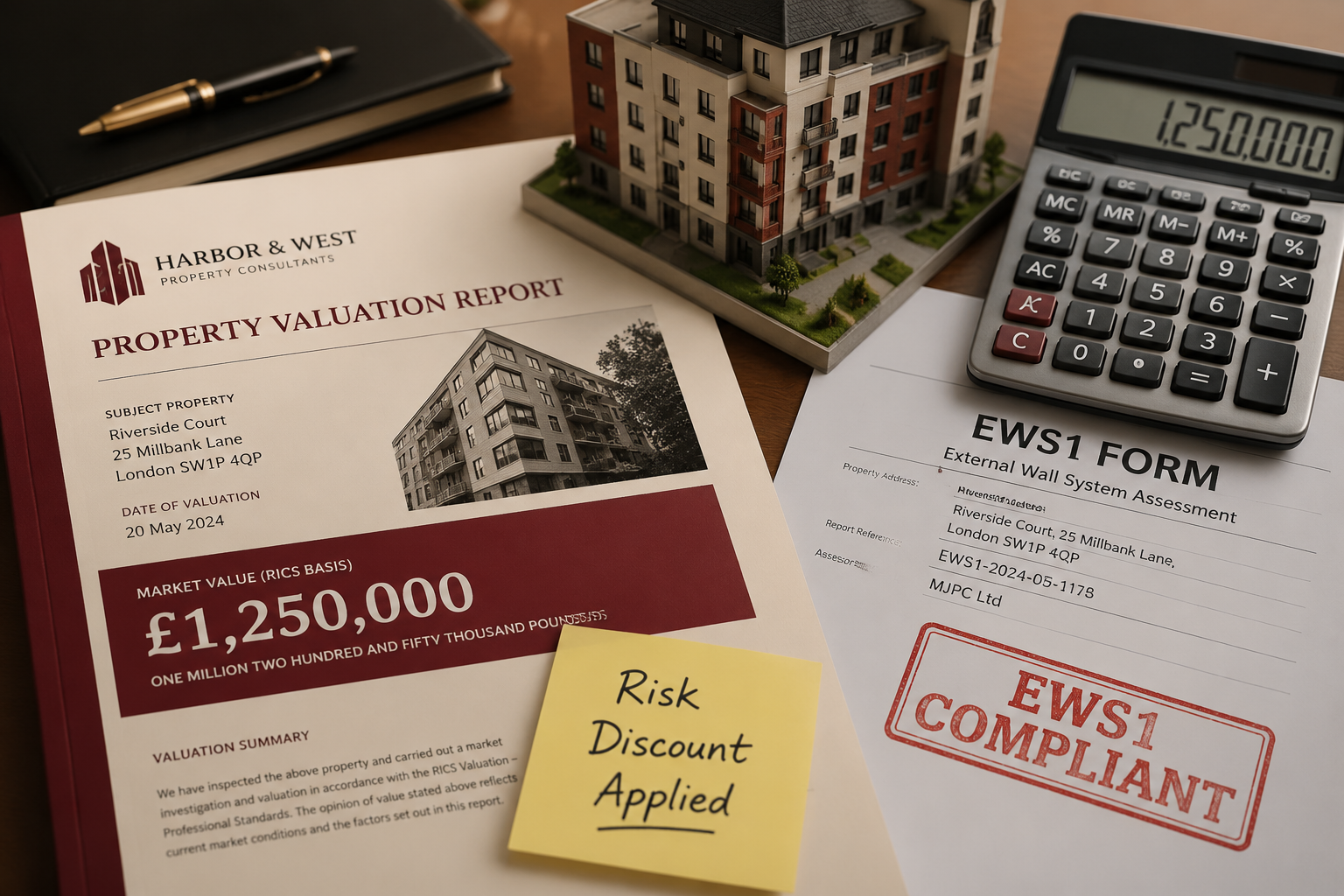
The EWS1 Form: Still Central in 2026
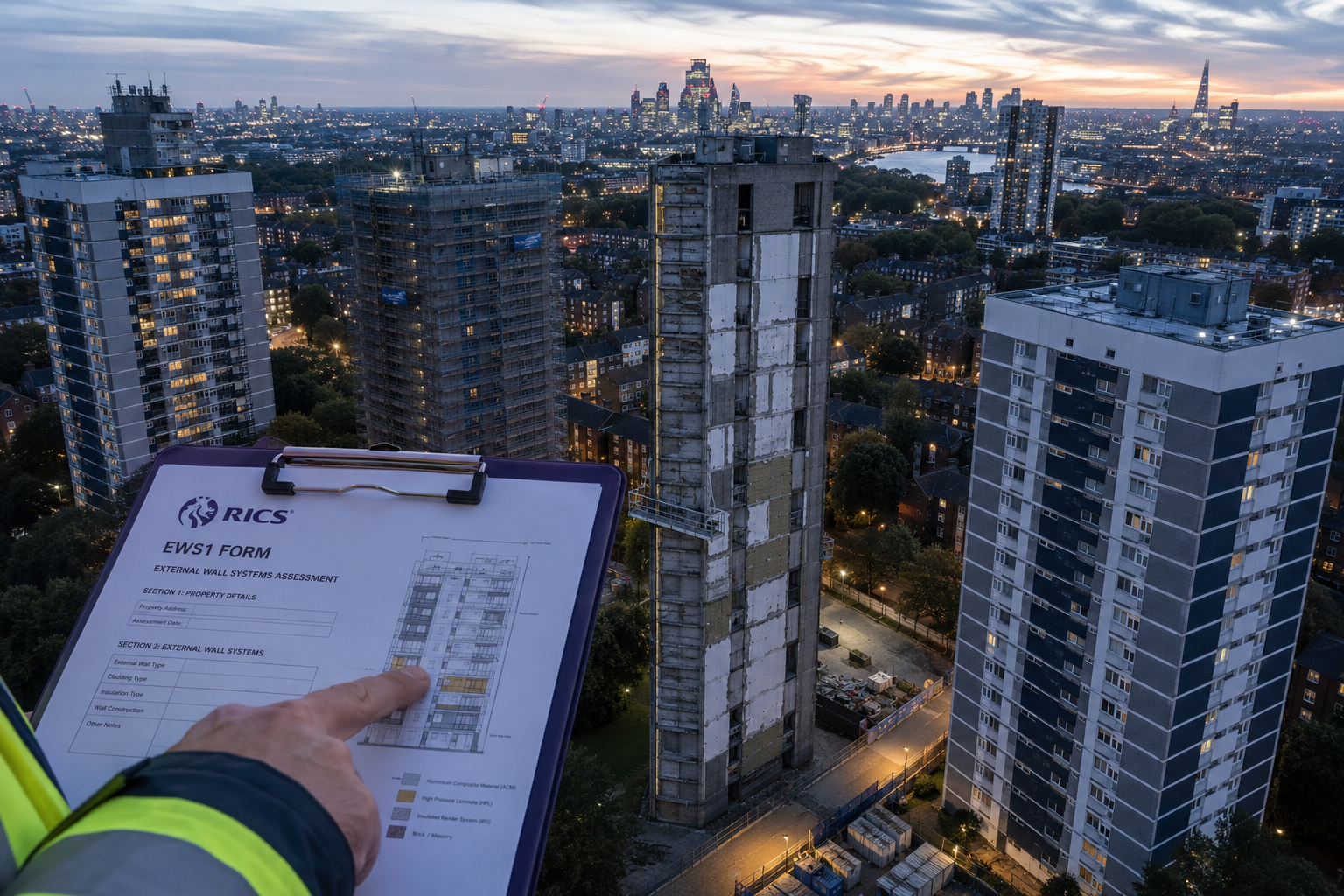
The External Wall System (EWS1) form — introduced by RICS, UK Finance, and the Building Societies Association in 2019 — remains the primary mechanism by which mortgage lenders assess fire-safety risk in multi-storey residential blocks. [1] A completed EWS1 form categorises a building's external wall system and signals whether remediation is needed before lending can proceed.
Key EWS1 categories buyers will encounter:
| EWS1 Rating | Meaning | Typical Lending Impact |
|---|---|---|
| A1 | No combustible materials present | Lenders generally proceed normally |
| A2 | Combustible materials present but low risk | Most lenders proceed; some caveats |
| B1 | Remediation not required | Lenders generally proceed |
| B2 | Remediation required | Most lenders decline or heavily restrict |
A B2 rating is effectively a red flag. Properties in buildings rated B2 are frequently unmortgageable until remediation is complete or a satisfactory remediation plan with funding confirmed is in place. [2] RICS has been actively developing guidance to support valuers navigating these scenarios. [10]
Quantifying the Value Discount
Surveying cladding remediation in 2026 post-Grenfell: valuation impacts for buyers requires an honest assessment of the numbers. Research and market evidence suggest cladding-affected properties can suffer:
- 10–20% discounts where a remediation plan is confirmed and funded but works have not yet started
- 20–30% or greater discounts where no remediation plan exists, the EWS1 is B2, or the responsible party is disputed
- Effective unmarketability in some cases, particularly where lenders will not lend and cash buyers demand very steep discounts to absorb the risk
These are not theoretical figures. RICS has acknowledged the significant impact on valuations and the difficulty valuers face when comparable evidence is thin in affected blocks. [3] Understanding the key factors that affect a property valuation is essential context for any buyer receiving a survey or valuation report on a flat in a multi-storey block.
Service Charge and Leaseholder Protections
The Building Safety Act 2022 introduced important protections for qualifying leaseholders, capping or eliminating their liability for certain remediation costs. However, these protections are not universal. Buyers must verify:
- Whether the building qualifies under the Act's leaseholder protection provisions
- Whether the developer or freeholder has accepted liability
- What costs, if any, may still fall to leaseholders via service charges for non-cladding fire-safety defects
Service charge liabilities for fire-safety works can run into tens of thousands of pounds per flat where protections do not apply. This is a material valuation factor that a lease extension valuation or purchase valuation must address explicitly.
What Buyers and Their Surveyors Must Check
Choosing the Right Survey Level
Not all surveys are equal when cladding is a concern. A standard Level 2 homebuyer report provides a visual inspection but is not designed to assess external wall systems in depth. For flats in multi-storey blocks built or clad between approximately 1980 and 2015, a more detailed inspection is strongly advisable.
Understanding the difference between a Level 2 and Level 3 survey is a practical starting point. A Level 3 building survey provides a more thorough assessment of construction and condition, though it still cannot replicate a specialist fire engineer's external wall assessment. For complex or high-risk buildings, buyers may need both a building survey and a separate fire-safety specialist report.
The RICS homebuyer survey remains a popular entry-level option for lower-risk properties, but buyers of flats in blocks with any cladding concern should discuss the appropriate scope with their surveyor before commissioning.
Specific Defect Reports for Cladding
Where a buyer has identified a specific concern — for example, the presence of ACM (aluminium composite material) panels, high-pressure laminate cladding, or timber rainscreen systems — a specific defect report focused on the external wall system can provide targeted professional opinion. This type of report is particularly useful when the EWS1 status is unknown or disputed.
Key Questions Every Buyer Should Ask
Before exchange of contracts on any flat in a multi-storey block, buyers should obtain clear written answers to the following:
- Is there a current, valid EWS1 form for the building? What is its rating?
- Is the building registered with the Building Safety Regulator (if over 18m/7 storeys)?
- Has a Principal Accountable Person been identified under the Building Safety Act?
- Is there a confirmed remediation plan, and is it funded by the developer, government scheme, or leaseholders?
- What are the current and projected service charges, including any building safety-related items?
- Does the building have a current Fire Risk Appraisal of External Walls (FRAEW)?
Solicitors should raise these enquiries formally, but surveyors play a critical role in flagging when answers are absent or inadequate.

Surveying Cladding Remediation in 2026 Post-Grenfell: Practical Guidance for Safe Purchases
RICS Guidance and Valuer Obligations
RICS has been at the forefront of developing professional standards for valuers and surveyors working on cladding-affected properties. The organisation's supplementary guidance on cladding for surveyors sets out how practitioners should approach external wall system risk in valuations and surveys, including the requirement to reflect market evidence of impaired value and restricted lending. [1] [3]
Valuers are now expected to:
- Identify whether a building falls within scope of the Building Safety Act
- Note the EWS1 status where available and flag its absence
- Apply appropriate risk-based adjustments to market value where fire-safety defects are present or suspected
- Advise clients clearly when a specialist fire-safety assessment is required before a reliable valuation can be given [10]
For buyers seeking a formal market valuation — whether for mortgage purposes, Help to Buy, or independent purchase advice — a Red Book valuation from a RICS-registered firm will incorporate these considerations within a structured, professionally accountable framework.
Non-Standard Construction and Cladding Overlap
Some of the most complex cases involve buildings that combine cladding concerns with non-standard construction methods — large panel systems, in-situ concrete frames, or steel-framed structures. These properties carry layered risk, and buyers should ensure their surveyor has experience with non-standard construction assessments as well as fire-safety awareness.
Drone Surveys for Inaccessible Elevations
Where external wall systems are at height and not accessible by standard inspection, drone surveys offer a practical means of obtaining close visual evidence of cladding condition, fixings, and any visible deterioration. While a drone survey does not replace a fire engineer's assessment, it can provide surveyors with valuable photographic evidence to inform their report and identify areas requiring specialist attention.
The Role of Stock Condition Surveys for Leaseholders and RTM Companies
For residents' management companies, right-to-manage organisations, and housing associations, a stock condition survey provides a systematic baseline of the building's condition, including external wall systems, fire doors, and compartmentation. This type of survey is increasingly being used as a precursor to commissioning a formal FRAEW, helping building owners prioritise expenditure and demonstrate due diligence to regulators and insurers.
Market Outlook: Recovery, Risk, and Residual Uncertainty
The UK flat market has shown selective recovery in areas where remediation is well advanced and EWS1 forms are in place. New cladding schemes have begun releasing some properties back into the mainstream sales market. [4] However, the recovery is uneven. Blocks where remediation is stalled, where developer liability is contested, or where secondary fire-safety defects have been discovered alongside cladding issues remain significantly impaired.
For buyers, the key market dynamics to understand in 2026 are:
- Lender appetite is improving but remains selective — most high-street lenders will now lend on B1-rated buildings, but B2 remains a near-universal barrier
- Insurance premiums remain elevated for buildings with unresolved fire-safety issues, adding to service charge costs and reducing net yields for investors
- Remediation timelines are long — even where works are confirmed and funded, completion may be two to five years away, meaning buyers absorb the disruption period
- Resale risk persists — a buyer purchasing today may face the same valuation challenges when they come to sell, unless remediation is complete by that point
Understanding how valuation factors interact — including condition, lease length, service charges, and building safety status — is essential for any buyer making a financially sound decision in this market.
Conclusion
Surveying cladding remediation in 2026 post-Grenfell: valuation impacts for buyers remains one of the most consequential due-diligence challenges in the UK residential property market. With 231,000 flats formally in remediation programmes, government timelines stretching toward the 2030s, and a new Building Safety Levy arriving in October 2026, the regulatory and financial landscape is still evolving. [5] [8]
Actionable next steps for buyers:
- Commission the right survey — for any flat in a multi-storey block, discuss whether a Level 3 building survey, a specific defect report, or a specialist external wall assessment is appropriate before exchange.
- Obtain and verify the EWS1 form — do not rely on the seller's assurances; request the original form and confirm the assessor's qualifications.
- Instruct a solicitor experienced in building safety — standard conveyancing enquiries may not capture all relevant risks under the Building Safety Act 2022.
- Get a formal RICS Red Book valuation — particularly where the building's cladding status is uncertain, a structured professional valuation protects both buyer and lender.
- Model the worst-case service charge scenario — ask the managing agent for a five-year service charge projection that includes building safety works.
- Seek specialist advice on leasehold protections — confirm whether leaseholder cost protections under the Building Safety Act apply to the specific building and flat.
The cladding crisis is not over. But buyers who approach the process with the right professional support — a qualified chartered surveyor, an experienced conveyancer, and a clear understanding of the regulatory framework — can make informed decisions and protect their financial interests in a market that is slowly, unevenly, finding its way back to normality.
References
[1] Cladding For Surveyors Supplementary Info Paper 1 – https://www.rics.org/content/dam/ricsglobal/documents/standards/cladding_for_surveyors_supplementary_info_paper_1.pdf
[2] Property Nightmares In Grenfells Wake – https://ww3.rics.org/uk/en/modus/built-environment/homes-and-communities/property-nightmares-in-grenfells-wake.html
[3] Rics Activity To Date Post Grenfell V41 Updated 03 Sep 2024 – https://www.rics.org/content/dam/ricsglobal/documents/reports/RICS-activity-to-date-post-Grenfell_v41_updated-03-Sep-2024.pdf
[4] New Cladding Scheme To Release Thousands Of Properties Into Sales Market – https://thenegotiator.co.uk/news/new-cladding-scheme-to-release-thousands-of-properties-into-sales-market/
[5] Cladding Scandal 2026 Update 231000 Unsellable Homes – https://www.propertysolvers.co.uk/youtube/cladding-scandal-2026-update-231000-unsellable-homes/
[8] Report – https://publications.parliament.uk/pa/cm5901/cmselect/cmpubacc/362/report.html
[10] Rics Developing Guidance To Support Valuers On Properties With Cladding – https://www.rics.org/news-insights/rics-developing-guidance-to-support-valuers-on-properties-with-cladding