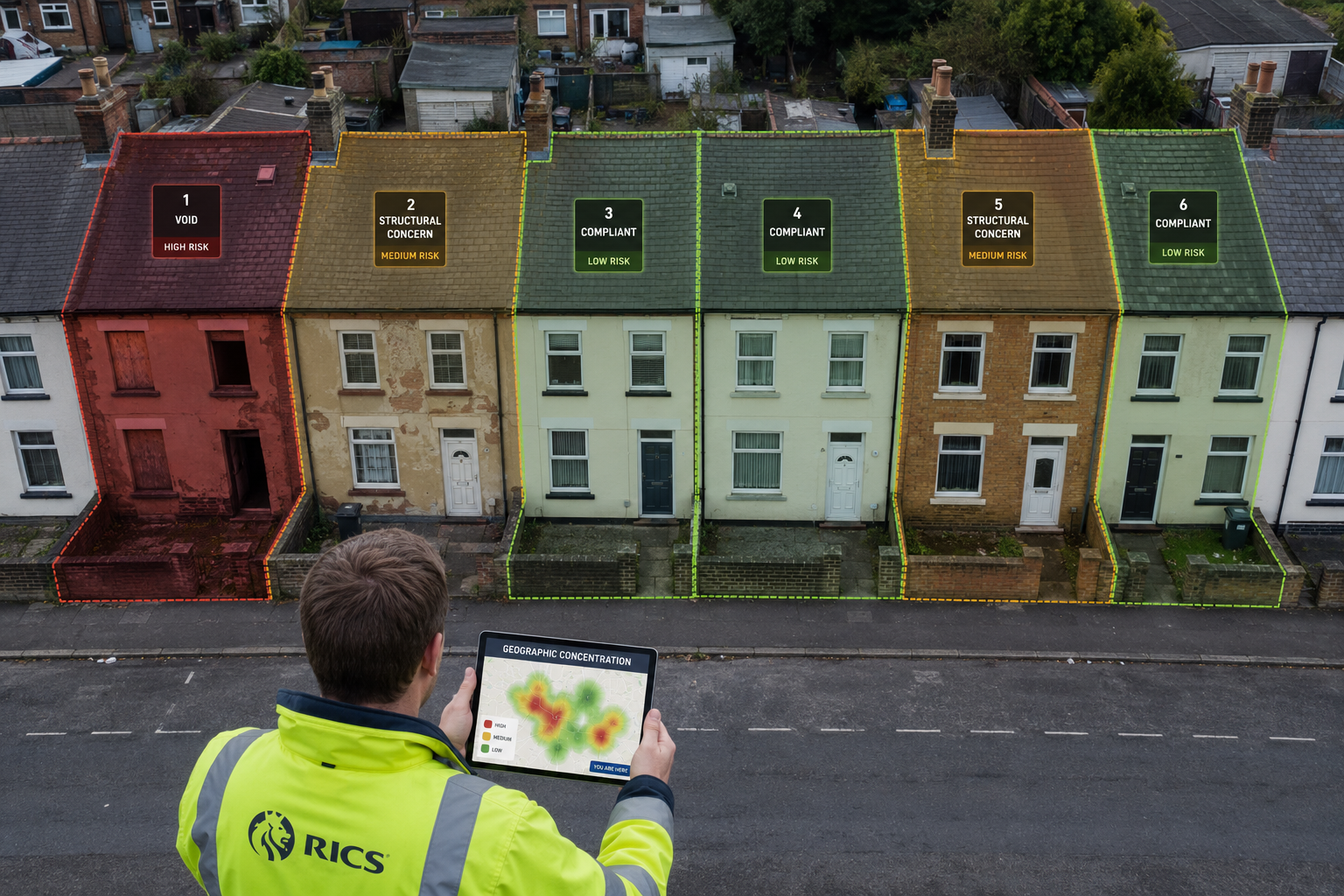
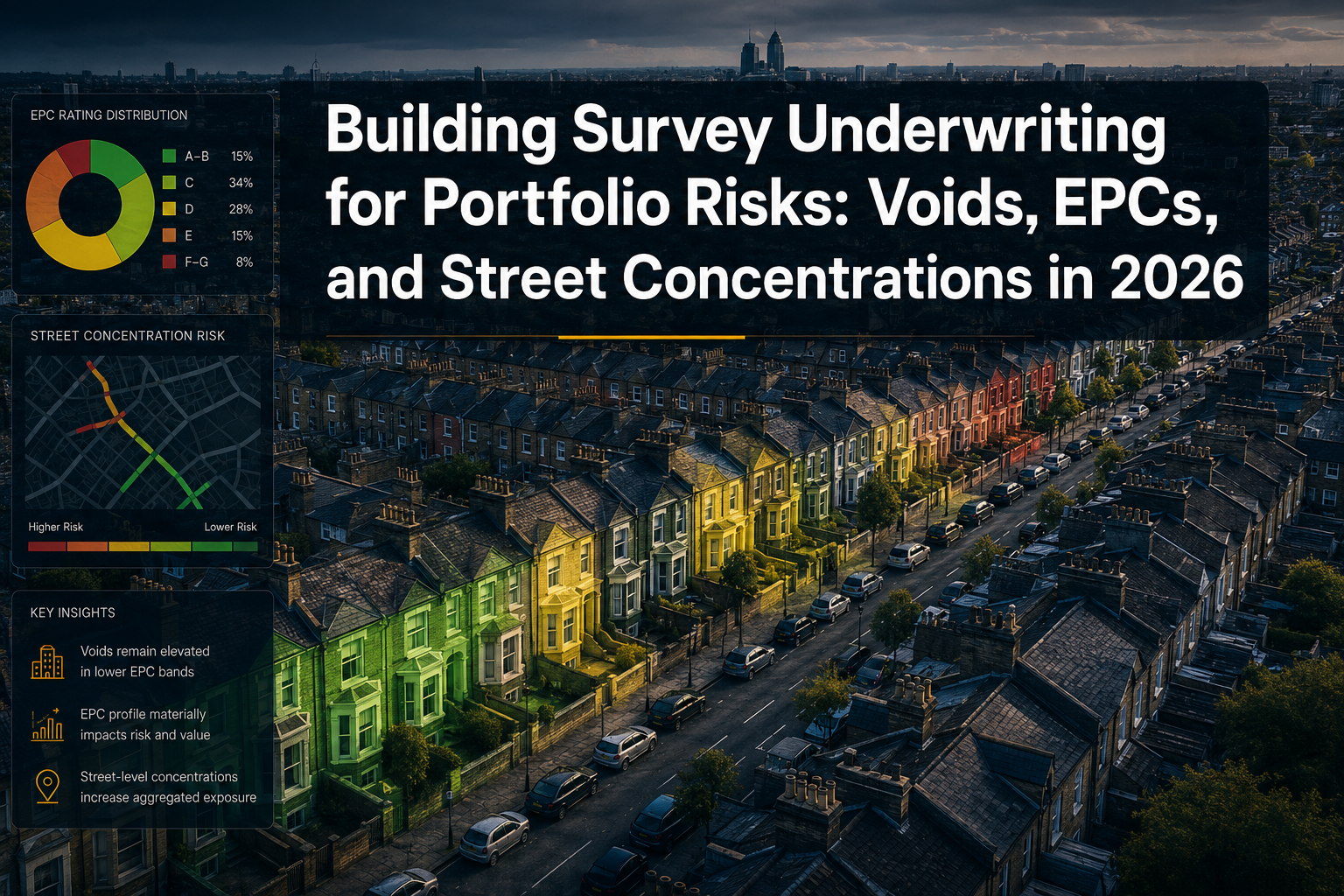
A single property investment firm with 180 assets discovered £1.02 million in EPC regulatory exposure sitting undetected in its back book — and resolved it within 48 hours once the data was properly centralised [8]. That figure is not unusual. Across the UK property market in 2026, underwriters, institutional landlords, and portfolio managers are confronting the same uncomfortable reality: the risks that erode returns most severely are rarely the dramatic ones. They are the slow-burn liabilities hiding in void units, outdated energy certificates, and clusters of similar properties on the same street. Building Survey Underwriting for Portfolio Risks: Voids, EPCs, and Street Concentrations in 2026 has moved from a niche technical discipline to a front-line commercial priority.

Key Takeaways
- Void properties carry compounding risks — structural deterioration, vandalism, arson, and insurance ineligibility — that escalate rapidly without weekly inspection protocols.
- Outdated EPC data is a material liability: the average domestic EPC in England and Wales is over seven years old, creating hidden MEES compliance gaps across portfolios [7].
- Street concentration risk amplifies individual asset problems into portfolio-wide losses when multiple units on the same street share the same construction defects or flood exposure.
- COPE data (Construction, Occupancy, Protection, Exposure) remains the foundational framework for accurate property underwriting, and its quality directly determines premium accuracy [9].
- Level 3 building surveys are the most effective tool for surfacing the specific defects — poor roof condition, non-standard construction, deteriorated wiring — that trigger underwriting exclusions or inflated premiums.
What Underwriters Actually Fear: The COPE Framework and Its Weak Points
Property underwriting has always rested on four pillars: Construction, Occupancy, Protection, and Exposure — collectively known as COPE data. When these data points are accurate, underwriters can price risk with confidence. When they are stale, incomplete, or simply wrong, the entire pricing model fails [9].
The problem in 2026 is that COPE data quality across large portfolios is frequently poor. Field verification programmes — like those conducted across more than 12,900 locations in all 50 US states — consistently find that address-level data held by insurers diverges significantly from physical reality [1]. Roof age, construction material, occupancy status, and proximity to fire hydrants are all routinely misrecorded. In a UK context, the same pattern holds: portfolios assembled through multiple acquisitions carry inherited data errors that no one has corrected.
The specific defects that make underwriters most nervous include:
- Roofs with less than five years of remaining life expectancy
- Aluminium wiring or knob-and-tube electrical systems in older stock
- Properties in poor overall condition with deferred maintenance
- Units that have been vacant for more than 30 consecutive days [4]
Each of these triggers either outright ineligibility for standard coverage or a significant loading on premiums. For a portfolio manager, discovering these conditions at renewal — rather than at acquisition — is an expensive lesson.
This is precisely where RICS Level 3 building surveys deliver their greatest value. A Level 3 survey provides the granular, condition-specific data that feeds directly into COPE assessments. It identifies roof life expectancy, flags non-standard construction, and documents electrical and structural deficiencies in a format that underwriters can act on. For institutional portfolios, commissioning Level 3 surveys at acquisition — rather than relying on desktop valuations — is increasingly standard practice [6].
"The risks that erode returns most severely are rarely the dramatic ones. They are the slow-burn liabilities hiding in void units, outdated energy certificates, and clusters of similar properties on the same street."
For commercial assets, the stakes are even higher. A RICS commercial building survey will examine mechanical and electrical systems, cladding, fire suppression, and occupancy classification — all of which feed directly into commercial property underwriting models. Skipping this step to save on survey fees routinely costs multiples of that saving when coverage gaps emerge.
The Void Problem: How Empty Units Become Portfolio Time Bombs
Vacancy is not a neutral condition. The moment a property becomes unoccupied, a cascade of risk factors activates simultaneously.
Chubb's analysis of vacant asset management identifies the core hazards clearly: water damage from undetected leaks, theft of copper and lead, vandalism, and — most severely — arson [3]. Standard property insurance policies typically contain vacancy clauses that reduce or eliminate coverage after 30 to 60 days of unoccupancy. A portfolio with even a modest void rate of 5–8% will almost certainly contain units that have crossed this threshold without the insurer being notified.
The compounding effect of voids on underwriting:
| Risk Factor | Occupied Property | Vacant Property |
|---|---|---|
| Water damage detection | Usually rapid | Often delayed weeks |
| Vandalism frequency | Low | High |
| Arson risk | Baseline | Significantly elevated |
| Insurance coverage | Standard | Often voided or restricted |
| Structural deterioration rate | Normal | Accelerated |
The structural dimension is equally serious. Pre-lease surveys routinely uncover movement-induced cracking, deteriorated roof coverings, and damp ingress in properties that have been vacant for extended periods. Repair costs in these cases frequently reach 15–30% of the property's value — a figure that transforms a seemingly attractive acquisition into a loss-making liability [5].
The recommended mitigation is straightforward but demanding: weekly physical inspections of all vacant units, documented maintenance checks, and immediate notification to insurers of any change in occupancy status [3]. For large portfolios, this requires a systematic tracking system rather than ad hoc management.
Structural surveys are particularly valuable for void properties that have been empty for more than six months. They provide the documented baseline that both insurers and future tenants require before coverage can be reinstated or a lease signed. Similarly, schedule of condition reports created at the point of vacancy provide defensible evidence of pre-vacancy condition, which is critical when disputes arise about deterioration responsibility.
For portfolios with high void concentrations in specific postcodes, drone surveys offer a cost-effective method of conducting rapid visual inspections of roof conditions across multiple adjacent properties without the time and cost of individual access arrangements.
EPC Compliance as an Underwriting Variable in 2026

The energy performance dimension of building survey underwriting for portfolio risks: voids, EPCs, and street concentrations in 2026 has become impossible to ignore. The Minimum Energy Efficiency Standards (MEES) framework, which requires rental properties to meet a minimum EPC rating, creates a direct regulatory liability for any portfolio holding sub-threshold assets.
The core problem is data currency. The average domestic EPC in England and Wales is more than seven years old [7]. For a portfolio assembled over a decade, this means that a significant proportion of EPC certificates pre-date major works, changes in assessment methodology, and updated regulatory thresholds. An EPC that showed a compliant E rating in 2018 may reflect a property that is now genuinely non-compliant — or, equally, one that has been improved but whose certificate has never been updated.
Why static EPC data creates material risk:
- Regulatory exposure: letting a sub-threshold property triggers civil penalties
- Financing risk: lenders increasingly require minimum EPC ratings for mortgage products
- Stranding risk: properties that cannot be economically upgraded to meet future thresholds lose capital value
- Insurance loading: some underwriters now factor EPC rating into premium calculations for certain property types
Building Atlas's transaction due diligence approach addresses this directly by generating address-level reports that assess current EPC status, estimated retrofit costs, and climate hazard flags projected to 2030 and 2050 horizons [2]. This kind of forward-looking analysis is becoming standard in institutional transaction due diligence, and it is increasingly expected by underwriters assessing long-term portfolio exposure.
The Better Buildings Partnership's guidance on EPC quality checks adds another layer of complexity: not all EPCs are accurate, and some have been produced using assumptions that do not reflect actual building fabric [10]. A poor-quality EPC can either overstate compliance (creating hidden regulatory risk) or understate it (creating unnecessary retrofit expenditure). Quality-checking EPCs against physical survey data is therefore not a bureaucratic exercise — it is a direct financial control.
For portfolio managers, the practical response involves three steps:
- Audit all EPCs for age, methodology, and consistency with known property characteristics
- Commission fresh assessments for any certificate more than five years old or produced under superseded methodology
- Model retrofit costs for all sub-threshold assets against projected regulatory timelines
The £1.02 million exposure identified by one property investment firm was not discovered through a regulatory audit — it was found by centralising and cross-referencing EPC data that had previously been held in disconnected spreadsheets [8]. The lesson is that data infrastructure precedes risk management.
Street Concentrations: The Portfolio Risk That Aggregate Models Miss
Individual asset analysis is necessary but insufficient for portfolio underwriting. The third major risk dimension in building survey underwriting for portfolio risks: voids, EPCs, and street concentrations in 2026 is geographic concentration — specifically, the clustering of multiple assets on the same street or within the same small postcode.
Street concentration risk operates through several mechanisms:
Shared construction defects. Victorian and Edwardian terraced streets were typically built by the same contractor using the same materials. If one property in a terrace has failing chimney stacks, inadequate damp-proof courses, or substandard roof timbers, the probability that adjacent properties share the same defects is high. A survey of one property provides meaningful intelligence about its neighbours.
Correlated flood and subsidence exposure. Properties on the same street share the same ground conditions, drainage infrastructure, and flood plain characteristics. A subsidence survey on one property in a street of clay-soil terraces should prompt a review of subsidence risk across all assets in that location.
Correlated void risk. When economic conditions in a specific area deteriorate — a major employer closes, a retail anchor leaves — void rates across an entire street can spike simultaneously. A portfolio with five properties on the same street faces correlated vacancy rather than independent vacancy, which is a fundamentally different risk profile.
Regulatory concentration. If a local authority designates a street for a selective licensing scheme or an Article 4 direction, every property in that street is affected simultaneously. Portfolio managers who have mapped their assets geographically can anticipate and respond to these regulatory changes; those who manage assets as a disconnected list cannot.
The institutional response to street concentration risk involves risk categorisation matrices that score assets not only on individual condition but on geographic clustering, shared exposure factors, and regulatory environment [6]. This approach, increasingly standard among professional landlords, requires the kind of granular survey data that only physical inspections can provide.
For portfolios with significant concentrations in specific locations, local chartered surveyors with deep knowledge of area-specific issues — local drainage problems, known ground conditions, area-wide construction types — provide substantially more useful intelligence than generalist desktop assessments.
Practical Protocols for Portfolio-Level Survey Underwriting
Translating the three risk dimensions — voids, EPCs, and street concentrations — into a workable survey programme requires a structured approach rather than reactive commissioning.
A tiered survey protocol for portfolio risk management:
- Tier 1 (Acquisition): Full Level 3 building survey for all assets above a defined value threshold or age threshold. Includes COPE data capture, EPC verification, and structural condition assessment.
- Tier 2 (Periodic review): Level 2 homebuyer-equivalent surveys for assets within five years of acquisition, focusing on condition changes and EPC currency.
- Tier 3 (Void activation): Immediate schedule of condition report at point of vacancy, followed by structural survey if vacancy extends beyond six months.
- Tier 4 (Street concentration trigger): When three or more assets in the same street show similar defect patterns, commission a comparative survey across the full concentration to identify shared risks.
Chain-of-custody discipline in data collection is as important as the surveys themselves. Field data that is not systematically recorded, version-controlled, and linked to insurance records provides little protection when a claim is disputed or a renewal is negotiated [1].
Dilapidation surveys at lease end provide a further layer of documentation that supports both insurance claims and tenant dispute resolution. For commercial portfolios, these surveys are essential for maintaining the condition data that underwriters rely on at renewal.
Conclusion
Building Survey Underwriting for Portfolio Risks: Voids, EPCs, and Street Concentrations in 2026 demands a more systematic and data-driven approach than most portfolio managers currently apply. The risks are not theoretical — they manifest as insurance coverage gaps, regulatory penalties, stranded assets, and correlated losses that aggregate models consistently underestimate.
Actionable next steps for portfolio managers and underwriters:
- Audit all COPE data across the portfolio against physical survey records, prioritising assets where data is more than three years old or was inherited through acquisition.
- Centralise all EPC certificates, flag any over five years old, and commission fresh assessments before the next regulatory compliance window.
- Map all assets geographically to identify street concentrations of three or more properties, then commission comparative surveys to assess shared defect and exposure risk.
- Implement a void tracking protocol with weekly inspection records and immediate insurer notification procedures.
- Commission Level 3 building surveys for any asset flagged as high-risk under the above criteria before the next insurance renewal cycle.
The firms that will manage portfolio risk most effectively in 2026 are those that treat survey data not as a transaction cost but as a strategic intelligence asset. The cost of a comprehensive survey programme is a fraction of the regulatory exposure, premium loading, or capital loss that inadequate data creates.
References
[1] 413solution – https://www.413solution.com/?utm_source=openai
[2] Stranding Risk Transaction Dd – https://www.buildingatlas.io/use-cases/stranding-risk-transaction-dd?utm_source=openai
[3] Safeguarding Vacant Assets A Blueprint For Portfolio Risk Management – https://www.chubb.com/us-en/businesses/resources/safeguarding-vacant-assets-a-blueprint-for-portfolio-risk-management.html?utm_source=openai
[4] Ineligible Risks – https://ptshelp.hoaic.com/index.cfm/underwriting-guidelines/texas-dwelling-fire/ineligible-risks?utm_source=openai
[5] Ultimate Pre Lease Surveys Guide – https://www.surveymerchant.com/blog/ultimate-pre-lease-surveys-guide?utm_source=openai
[6] Building Surveys For Institutional Buy To Let Portfolios Assessing Quality Standards When Professional Landlords Dominate 2026 Market – https://www.canterburysurveyors.com/blog/building-surveys-for-institutional-buy-to-let-portfolios-assessing-quality-standards-when-professional-landlords-dominate-2026-market/?utm_source=openai
[7] Why Static Epc Data Is A Material Back Book Risk – https://www.cotality.com/uk/resources/article/why-static-epc-data-is-a-material-back-book-risk?utm_source=openai
[8] Property Investors – https://homedata.co.uk/case-studies/property-investors?utm_source=openai
[9] Cope Data The Foundation Of Property Underwriting – https://skyscraperinsurance.com/cope-data-the-foundation-of-property-underwriting/?utm_source=openai
[10] Good Bad And Ugly How Reduce Mees Risk Through Epc Quality Checks – https://www.betterbuildingspartnership.co.uk/good-bad-and-ugly-how-reduce-mees-risk-through-epc-quality-checks?utm_source=openai