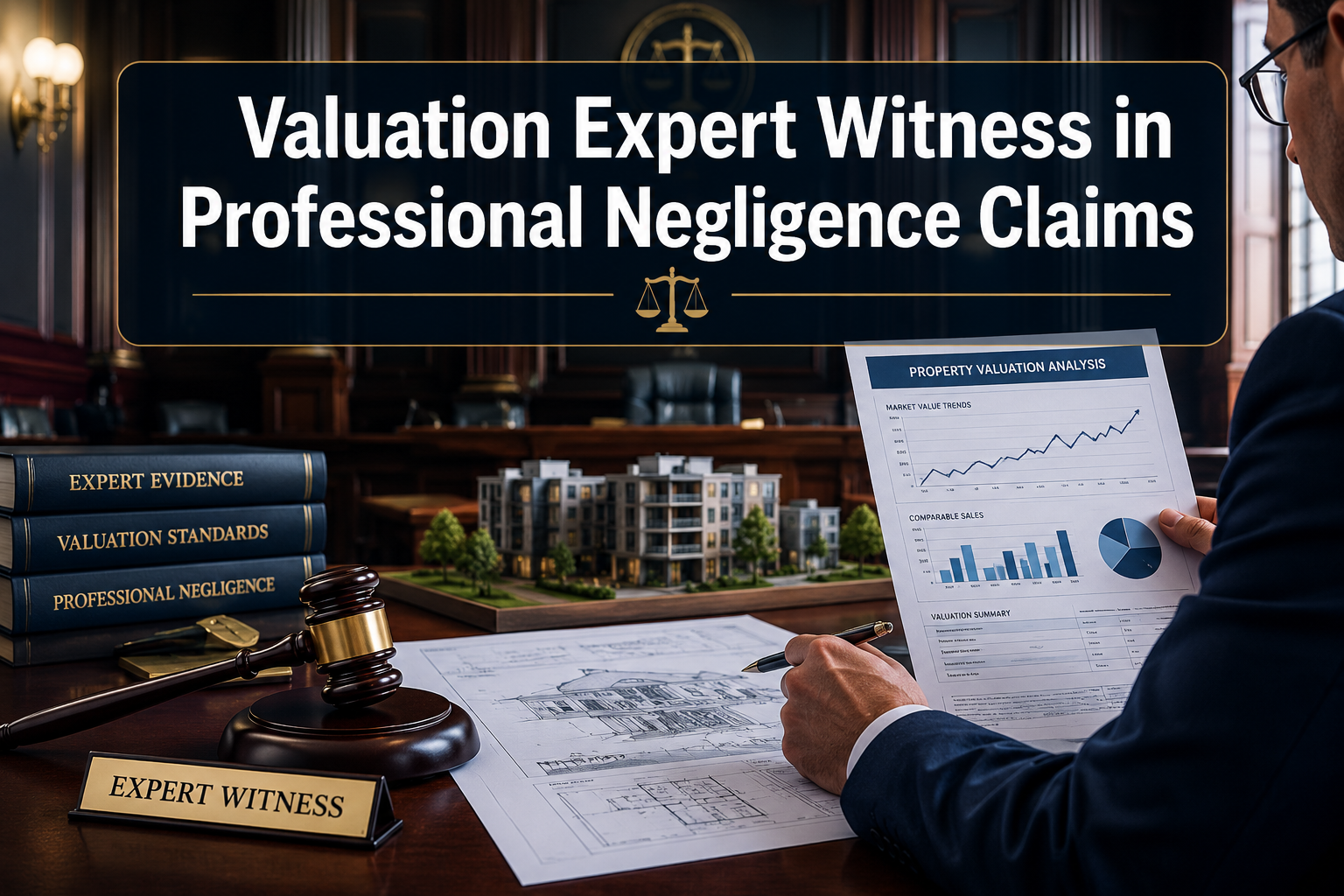

A single overvaluation can cost a lender millions, a homebuyer their life savings, and a surveyor their career. When these losses reach the courts, the outcome often hinges on one critical figure: the valuation expert witness. In professional negligence claims involving surveyors, the role of a qualified expert is not simply to offer an opinion — it is to reconstruct what a competent valuation should have looked like, quantify the financial damage caused by the original error, and present those findings in a form that withstands rigorous legal scrutiny. Understanding how valuation expert witnesses in professional negligence claims assess surveyor liability and market value impacts is essential for solicitors, claimants, defendants, and property professionals alike in 2026.
Key Takeaways
- Courts assess surveyor negligence against a permissible "bracket" of acceptable valuations, typically 5-15% depending on property type.
- Valuation expert witnesses must reconstruct the correct market value at the date of the original survey, not at the date of the claim.
- Scope creep — using a valuation beyond its intended purpose — is a leading cause of liability exposure for surveyors.
- Diminution in value (DIV) methodology is the primary tool for quantifying financial loss in surveyor negligence claims.
- Professional indemnity insurance (PII) for valuers is under significant strain, making defensible reporting more important than ever.
What Professional Negligence Means for Surveyors
Professional negligence occurs when a surveyor fails to exercise the standard of skill and care expected of a reasonably competent member of their profession, and that failure causes measurable financial loss. In valuation work, negligence typically manifests in one of three ways: an overvaluation that leads a lender or buyer to overpay, an undervaluation that causes a seller to accept less than fair market value, or a failure to identify material defects that would have affected the agreed price.
The legal test applied by English courts draws heavily on the principle established in Bolam v Friern Hospital Management Committee [1957] and its property-specific application. A valuer is not negligent simply because another professional would have reached a different figure. The question is whether the original valuation fell outside the range that a body of competent valuers, exercising reasonable skill and care, could have produced [9].
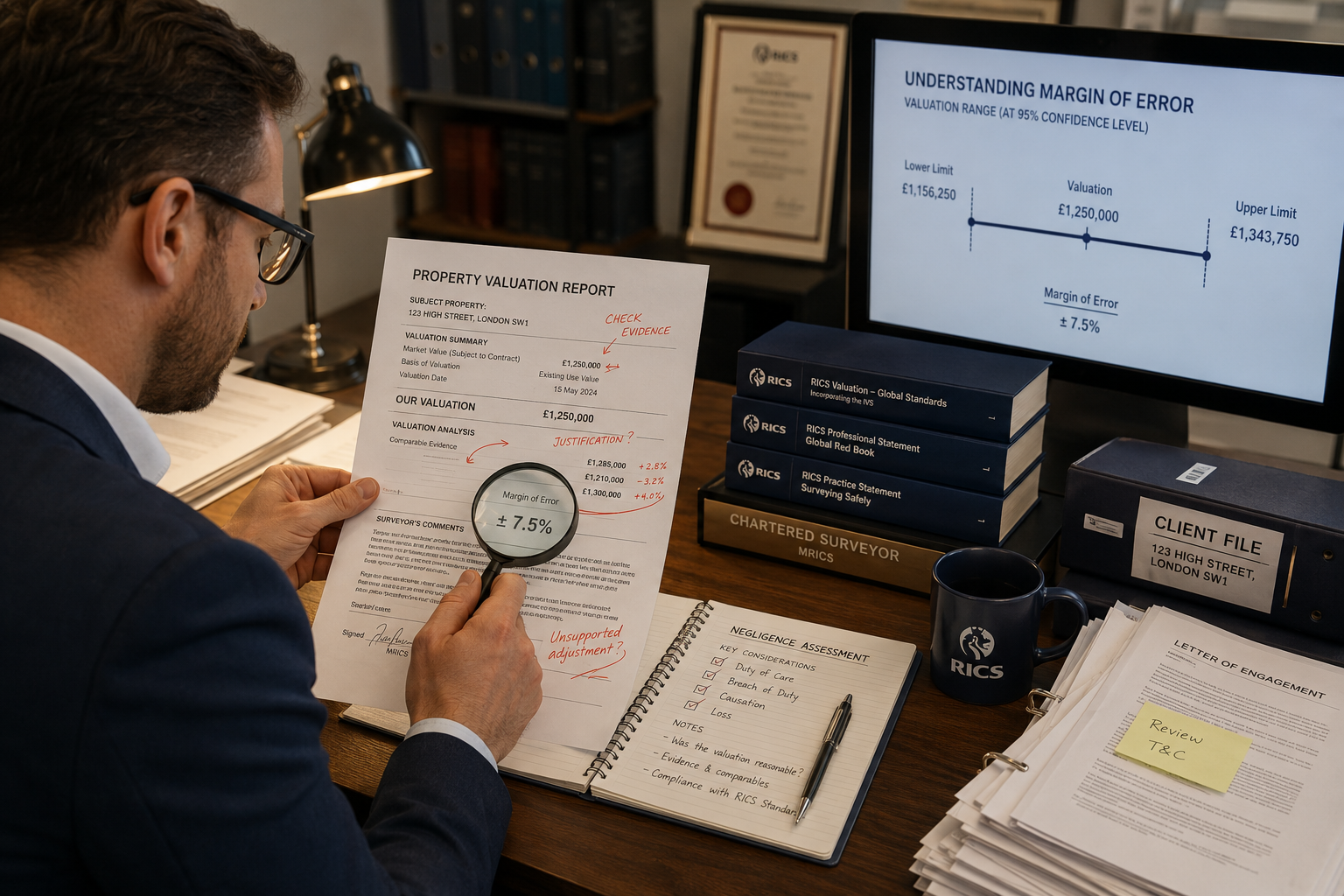
The "bracket" principle is central to every claim. Courts have confirmed that a surveyor's valuation is considered negligent only if it falls outside a permissible margin of error. That margin is approximately:
| Property Type | Acceptable Margin of Error |
|---|---|
| Standard residential | Up to 5% |
| One-off commercial | Up to 10% |
| Exceptional or complex properties | Up to 15% |
Pinsent Masons has reported that courts have confirmed this framework, noting that the margin should not generally exceed 15% even for the most complex properties [4]. Any valuation that strays beyond the applicable bracket creates a rebuttable presumption of negligence, and the burden then shifts to the defendant surveyor to justify the departure.
For those seeking to understand the range of valuation approaches a competent surveyor should apply, the methods of valuation used in practice provide important context for what courts expect as a baseline standard.
The Role of the Valuation Expert Witness in Professional Negligence Claims: Assessing Surveyor Liability and Market Value Impacts
When a negligence claim reaches litigation or pre-action proceedings, both claimant and defendant will typically instruct their own valuation expert witness. The expert's primary function is to provide the court with an independent, objective opinion on three interconnected questions:
- What was the correct market value of the property at the date of the original valuation?
- Did the original surveyor's figure fall outside the acceptable bracket?
- If so, what financial loss flows directly from that departure?
The expert witness must be qualified, experienced, and — critically — independent. Under Civil Procedure Rule 35, the expert's duty is to the court, not to the instructing party. Any expert who allows advocacy to colour their opinion risks having their evidence disregarded entirely [7].
Reconstructing Market Value at the Relevant Date
One of the most technically demanding aspects of the role is the retrospective valuation. The expert must assess what the property was worth at the date of the original survey, not at the date of the claim. This requires:
- Gathering comparable sales evidence from the relevant period
- Adjusting for market conditions, location, and property-specific factors
- Reviewing the information that was available to the original surveyor at the time
- Identifying any defects or features the original surveyor should have noted
A registered RICS valuer instructed as an expert witness will typically work within the Red Book (RICS Valuation — Global Standards) framework, even when critiquing a valuation produced under an earlier edition of those standards. Consistency with professional standards strengthens the credibility of the expert's opinion.
Identifying Survey Flaws and Their Value Impact
Beyond the headline valuation figure, the expert must examine the methodology the original surveyor used. Common flaws include:
- Inappropriate comparable selection — using sales that are not genuinely comparable in terms of condition, size, or location
- Failure to inspect adequately — missing structural defects, damp, or drainage issues that a competent surveyor would have identified
- Ignoring market evidence — disregarding available transaction data that contradicted the valuation
- Scope creep — producing a valuation that was then used for a purpose beyond its stated scope, without adequate caveats [3]
The American Bar Association has highlighted scope creep as a particularly significant source of liability exposure: an appraisal that is technically sound for its original purpose can still generate a successful negligence claim if the surveyor failed to limit its use appropriately [3]. This is equally relevant in the English context, where surveyors instructed for mortgage purposes must be explicit about the limitations of their report.
For claims involving structural defects that were missed, the expert witness will often work alongside specialists. Issues such as subsidence, drainage failures, or non-standard construction can all affect value materially, and a surveyor who failed to flag these during the original inspection may face significant liability.
Quantifying Financial Loss: Diminution in Value and Beyond
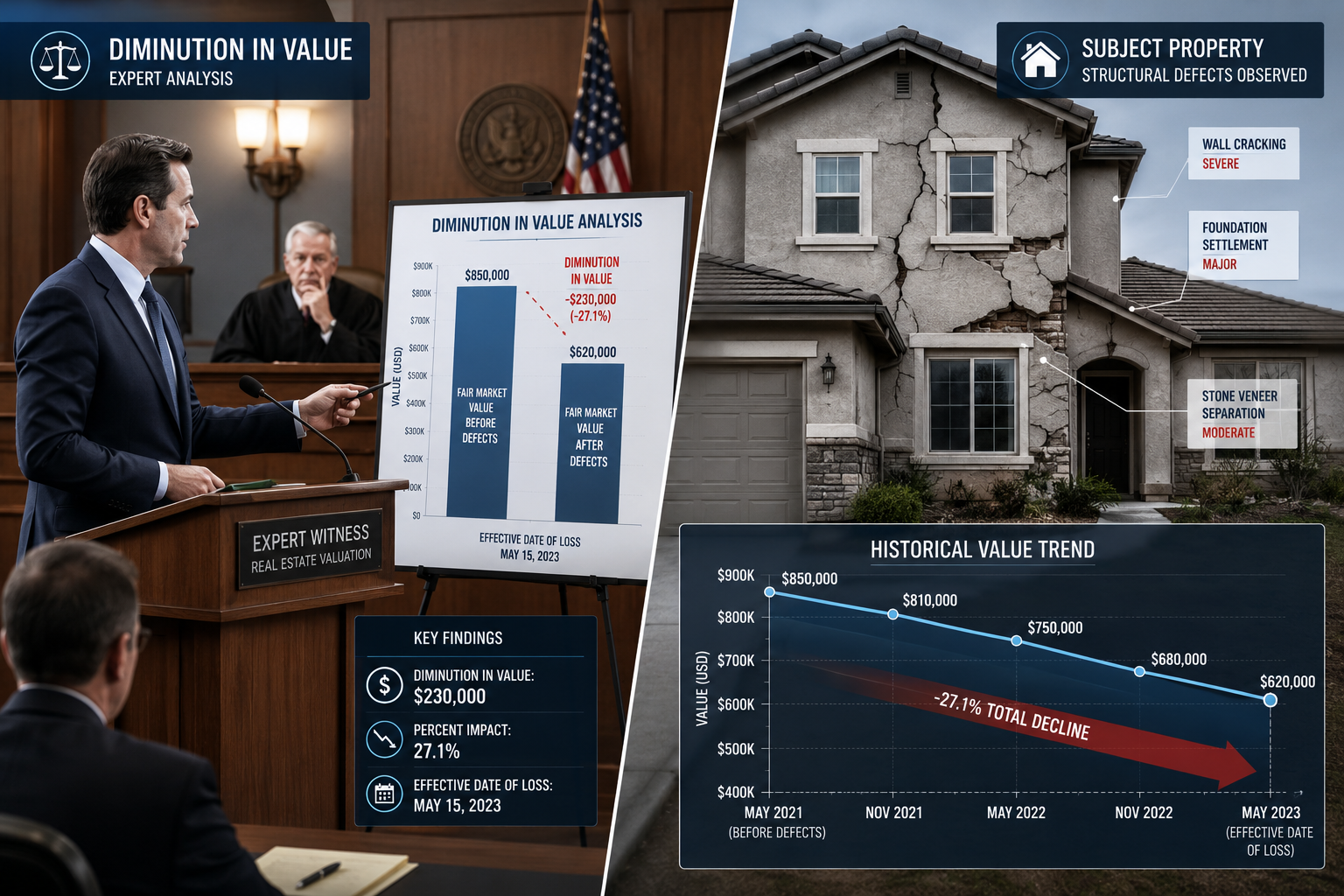
Once negligence is established, the claimant must prove that the breach caused their loss. This is where diminution in value (DIV) assessment becomes the primary analytical tool in valuation expert witness work in professional negligence claims.
How DIV Assessments Work
DIV measures the difference between what the claimant paid (or lent) and what the property was actually worth at the relevant date. Surveyors use two principal methodologies [6]:
Sales comparison approach: The expert identifies genuinely comparable properties that sold around the same time, adjusts for differences, and derives a supportable market value. The gap between this figure and the original valuation represents the overstatement.
Income capitalisation approach: Used primarily for investment or commercial properties, this method calculates value based on the income the property could generate, capitalised at an appropriate yield. It is particularly relevant where the original surveyor failed to account for tenancy issues or rental voids.
The expert must also consider whether the claimant would have proceeded with the transaction had they received a correct valuation. This "transaction test" is critical: if the claimant would have bought the property regardless, the causal link between the negligence and the loss may be broken.
Consequential Losses
In some cases, the financial impact extends beyond the overvaluation itself. Consequential losses that courts have accepted in surveyor negligence claims include:
- Mortgage interest paid on the excess sum borrowed
- Costs of remediation work that the surveyor should have identified
- Loss of rental income where defects rendered the property unlettable
- Legal and professional costs of the transaction
However, courts apply the principle from South Australia Asset Management Corporation v York Montague Ltd [1997] (the SAAMCO case) to limit a surveyor's liability to losses that fall within the scope of their duty. A surveyor instructed only to value a property is not liable for all losses flowing from a bad investment decision; liability is confined to the difference between the negligent valuation and the correct one [9].
Economic Cycles and Claim Patterns
The frequency of negligence claims against surveyors is closely tied to economic conditions. During market downturns, properties that were overvalued during boom periods come under scrutiny, and lenders who have suffered losses on repossessions look to recover against the original valuer [8]. In 2026, with ongoing fluctuations in the UK residential and commercial property markets, this dynamic remains highly relevant. Surveyors who produced valuations during periods of rapid price growth may find those figures challenged if values have since corrected.
Producing Defensible Expert Witness Reports in Solicitor-Instructed Cases
The quality of the expert witness report is often decisive. A technically sound opinion that is poorly presented, internally inconsistent, or fails to engage with the opposing expert's methodology will carry less weight with the court. The following principles guide defensible reporting.
Structure and Transparency
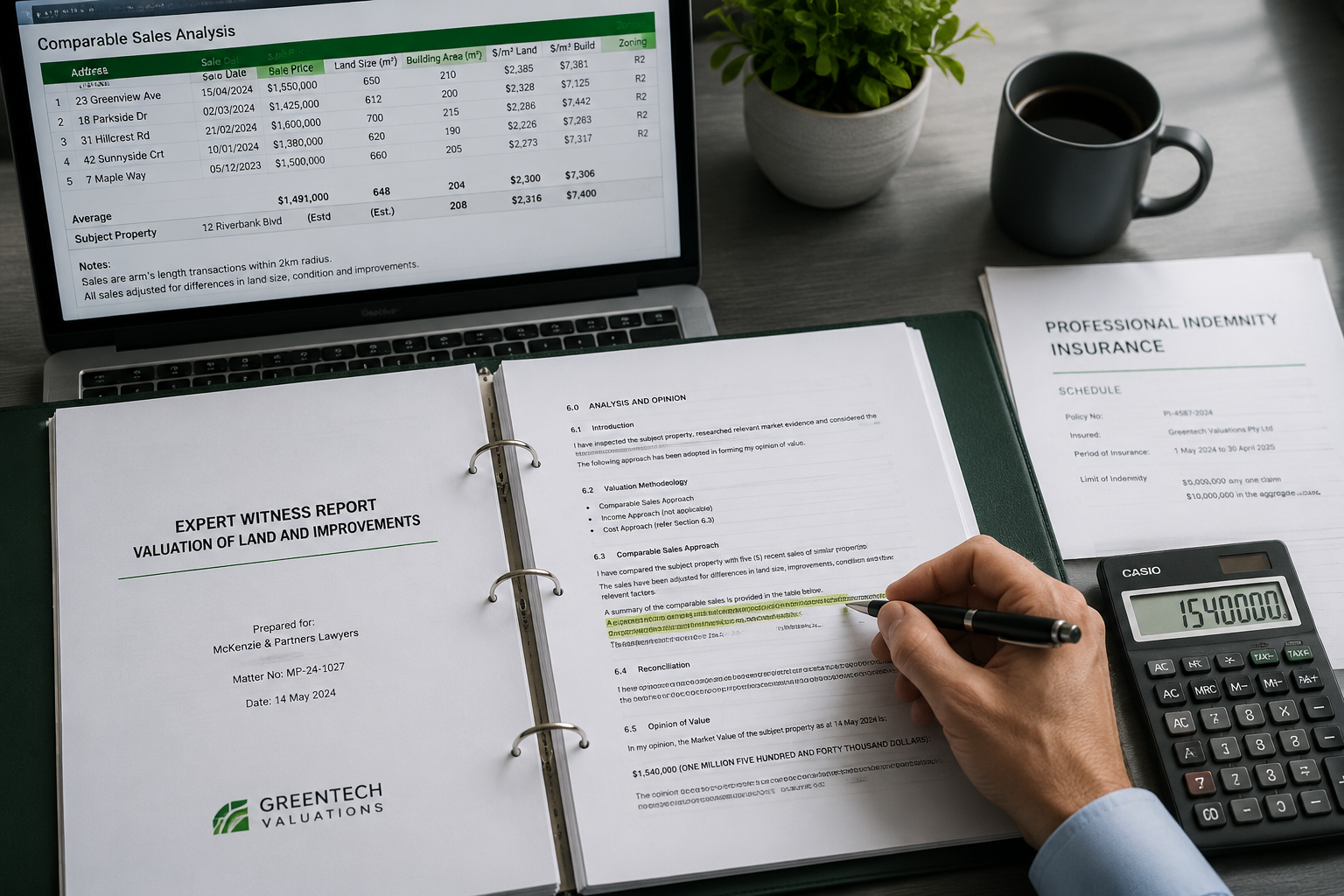
A well-structured expert witness report in a valuation negligence case should include:
- A clear statement of instructions and the questions the expert has been asked to address
- A summary of the expert's qualifications and relevant experience
- A description of the methodology used and why it was appropriate
- The comparable evidence relied upon, with full details and adjustments explained
- A reasoned conclusion on the correct market value at the relevant date
- An opinion on whether the original valuation fell within or outside the acceptable bracket
- A DIV calculation where loss quantification is required
- A statement of truth confirming the expert's independence
Transparency about uncertainty is also important. If the expert considers that the correct value fell within a range rather than at a single point, that range should be stated and explained. Courts are experienced in working with valuation ranges and will not penalise an expert for intellectual honesty.
Common Pitfalls to Avoid
Several failures recur in expert witness reports that are challenged or disregarded:
- Advocacy masquerading as expertise — selecting only evidence that supports the instructing party's case
- Failure to address the opposing expert's points — particularly in joint statements under CPR 35.12
- Outdated comparable evidence — using transactions that post-date the original valuation
- Ignoring the original surveyor's reasoning — a good expert engages with the methodology used, not just the conclusion reached
The cost of instructing a qualified expert witness is significant. Initial case reviews and report preparation typically range from £250 to £600 per hour, with court appearances costing between £350 and £900 per hour [5]. These costs underscore the importance of selecting an expert whose report is genuinely capable of withstanding cross-examination.
Professional Indemnity Insurance Implications
The rise in negligence claims has had a pronounced effect on the professional indemnity insurance (PII) market for surveyors. RICS has warned that, without intervention, valuation for secured lending could become effectively uninsurable [1]. Insurers have responded by reducing capacity, increasing premiums, and imposing more restrictive policy conditions [10].
For surveyors defending negligence claims, the quality of their original report and working papers is critical to their insurers' ability to mount a defence. Surveyors who maintain thorough records of their comparable evidence, site notes, and reasoning are significantly better placed than those whose files are sparse. RICS guidance makes clear that valuers must exercise a standard of skill and care consistent with a reasonable body of their peers, and that well-supported valuations are the most effective form of risk management [2].
Solicitors instructing expert witnesses should also be aware that the PII market pressures affecting surveyors have begun to influence the availability of experts willing to take on contentious cases. Working with RICS-registered valuers who have demonstrable experience in litigation support is increasingly important.
For claims involving specific property types, specialist valuation expertise may be required. Commercial property valuations involve different methodologies and risk profiles from residential work, and the expert instructed must have relevant sector experience. Similarly, claims arising from lease extension valuations or freehold valuations require specialists familiar with the statutory framework governing those transactions.
Where the original negligence involved a failure to identify physical defects — such as damp, drainage problems, or structural issues — the valuation expert will often need to work alongside a building surveyor. Understanding the difference between survey levels, as explained in guides comparing Level 2 and Level 3 surveys, helps clarify what standard of inspection was owed and whether the original surveyor met it.
Conclusion
The valuation expert witness in professional negligence claims plays a pivotal role in determining whether a surveyor's liability is established and what financial redress a claimant can recover. The work demands technical rigour, methodological transparency, and strict adherence to the expert's duty to the court rather than to the instructing party.
Actionable next steps for those involved in surveyor negligence claims:
- Instruct a RICS-registered valuation expert with demonstrable experience in litigation support at the earliest opportunity, ideally before the Letter of Claim is issued.
- Ensure the expert has access to the original surveyor's full file, including working papers and comparable evidence, not just the final report.
- Commission a DIV assessment that addresses both the overvaluation and any consequential losses within the SAAMCO scope of duty.
- In cases involving physical defects, instruct a parallel building surveying expert to address the inspection standard owed.
- Review the original valuation against the applicable bracket for the property type before assessing the prospects of a claim.
- For defending surveyors, engage with insurers promptly and ensure working papers are preserved and organised.
The intersection of property expertise and legal process is demanding, but a well-prepared expert witness report — grounded in sound methodology, honest about uncertainty, and directly responsive to the issues in dispute — remains the most powerful tool available in resolving these complex claims.
References
[1] Valuers PI Market Could Fail If Problems Go Unsolved RICS – https://www.insurancetimes.co.uk/valuers-pi-market-could-fail-if-problems-go-unsolved-rics/1394110.article?utm_source=openai
[2] Pii Risk Liability Insurance Valuation – https://ww3.rics.org/uk/en/journals/property-journal/pii-risk-liability-insurance-valuation.html?utm_source=openai
[3] Top Reasons Appraisers Get Sued – https://www.americanbar.org/groups/litigation/resources/newsletters/insurance-coverage/top-reasons-appraisers-get-sued/?utm_source=openai
[4] Court Confirms Surveyors Margin Of Error In Negligence Cases Should Not Generally Exceed 15 – https://www.pinsentmasons.com/out-law/news/court-confirms-surveyors-margin-of-error-in-negligence-cases-should-not-generally-exceed-15?utm_source=openai
[5] Expert Witness Reports For Professional Negligence Claims Building Surveyor Duties In 2026 Litigation – https://kingstonsurveyors.com/expert-witness-reports-for-professional-negligence-claims-building-surveyor-duties-in-2026-litigation/?utm_source=openai
[6] Diminution In Value Assessments By Expert Witnesses Surveyor Strategies For Property Damage Claims In 2026 – https://manchestersurveyors.com/diminution-in-value-assessments-by-expert-witnesses-surveyor-strategies-for-property-damage-claims-in-2026/?utm_source=openai
[7] Expert Witness Real Estate Agent – https://expertdassure.com/en/expert-witness-real-estate-agent/?utm_source=openai
[8] Insurance Claims Against Surveyors – https://www.isurv.com/info/390/features_archive/10631/insurance_claims_against_surveyors?utm_source=openai
[9] Viewcompounddoc – https://consultations.rics.org/riskliabilityinsurance/viewCompoundDoc?clientUID=&docid=12086420&partid=12088116&sessionid=&voteid=&utm_source=openai
[10] Professional Liability Market Outlook – https://www.rpsins.com/learn/professional-liability-market-outlook/?utm_source=openai