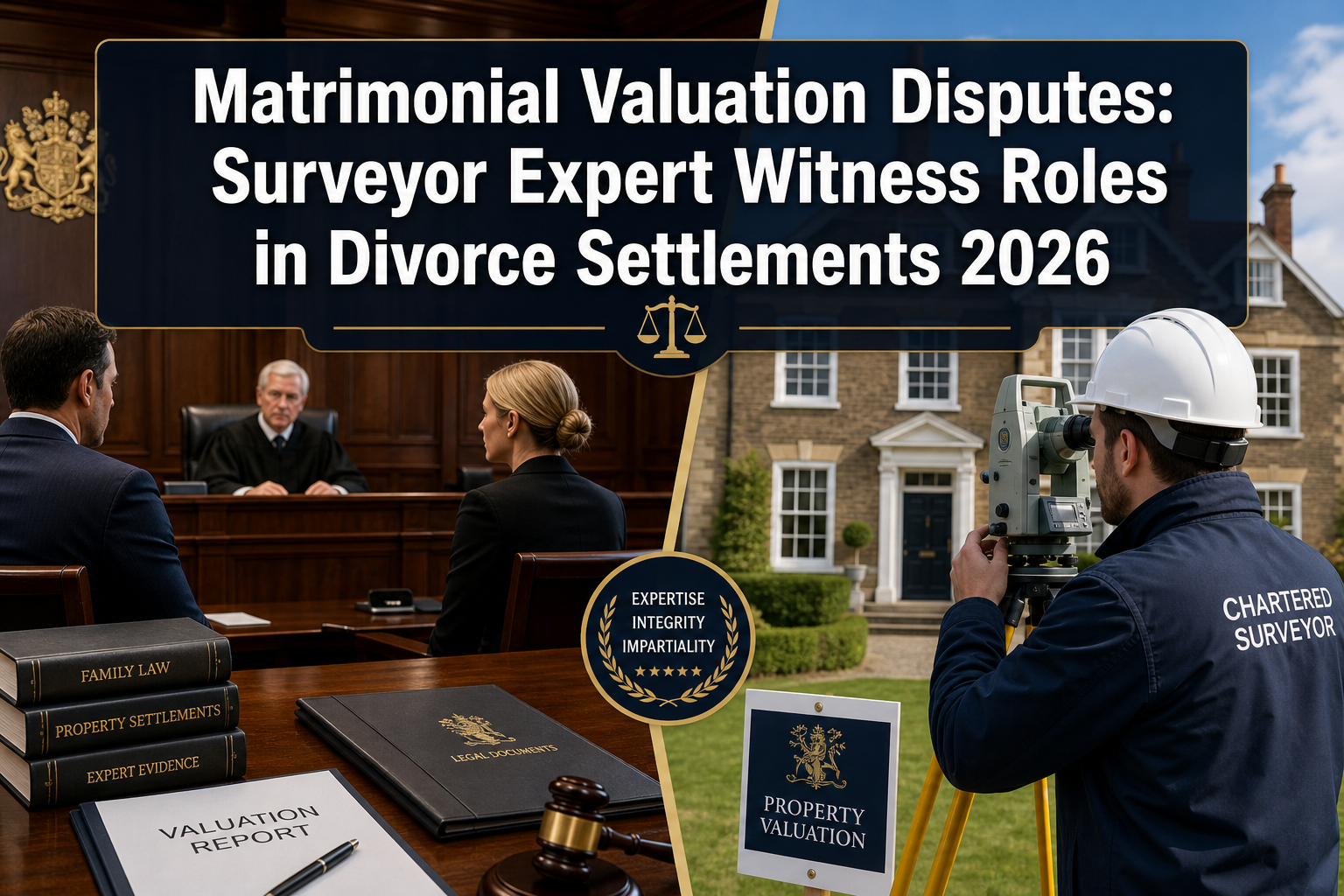
Fewer than one in five divorcing couples in England and Wales reach a clean financial settlement without a contested property valuation — a figure that has remained stubbornly consistent even as family law procedures have evolved. [1] When a matrimonial home represents the single largest shared asset, disagreements over its worth can derail settlements, inflate legal costs, and prolong emotional strain for everyone involved. Understanding how Matrimonial Valuation Disputes: Surveyor Expert Witness Roles in Divorce Settlements 2026 operate within the family court framework is no longer optional knowledge — it is essential for solicitors, separating couples, and the chartered surveyors appointed to assist them.
Key Takeaways
- RICS accreditation through the Expert Witness Accreditation Service (EWAS) is now a baseline credibility requirement for surveyors giving evidence in family court proceedings in 2026.
- Single Joint Expert (SJE) appointments are increasingly preferred by family courts to reduce costs and adversarial conflict in property valuation disputes.
- All matrimonial valuations for court use must comply with the RICS Valuation Global Standards (Red Book) and be based on Market Value as defined by the IVSC.
- Expert witness reports must include a Statement of Truth and Independence, and the surveyor's primary duty is to the court, not to the instructing party.
- Alternative dispute resolution routes — including mediation and arbitration — are growing in popularity, with chartered surveyors playing a central role in both.
Why Property Valuation Sits at the Heart of Divorce Disputes
Property is rarely straightforward in a divorce. Unlike a savings account with a fixed balance, a residential or commercial property carries a value that shifts with market conditions, physical condition, planning status, and comparable sales data. Two surveyors instructed by opposing parties can legitimately arrive at figures that differ by tens of thousands of pounds — sometimes more — using entirely defensible methodologies.
This gap creates fertile ground for dispute. When one spouse believes the family home is worth £650,000 and the other's surveyor values it at £590,000, the £60,000 difference is not trivial. It directly affects how assets are divided, what mortgage capacity each party retains, and how pension offsets are calculated.
Several factors have intensified the complexity of these disputes in recent years:
- Rising property prices across much of England and Wales have increased the financial stakes of every percentage-point valuation difference.
- Increased home improvement activity during and after the pandemic has created genuine uncertainty about whether works have added value or introduced latent defects.
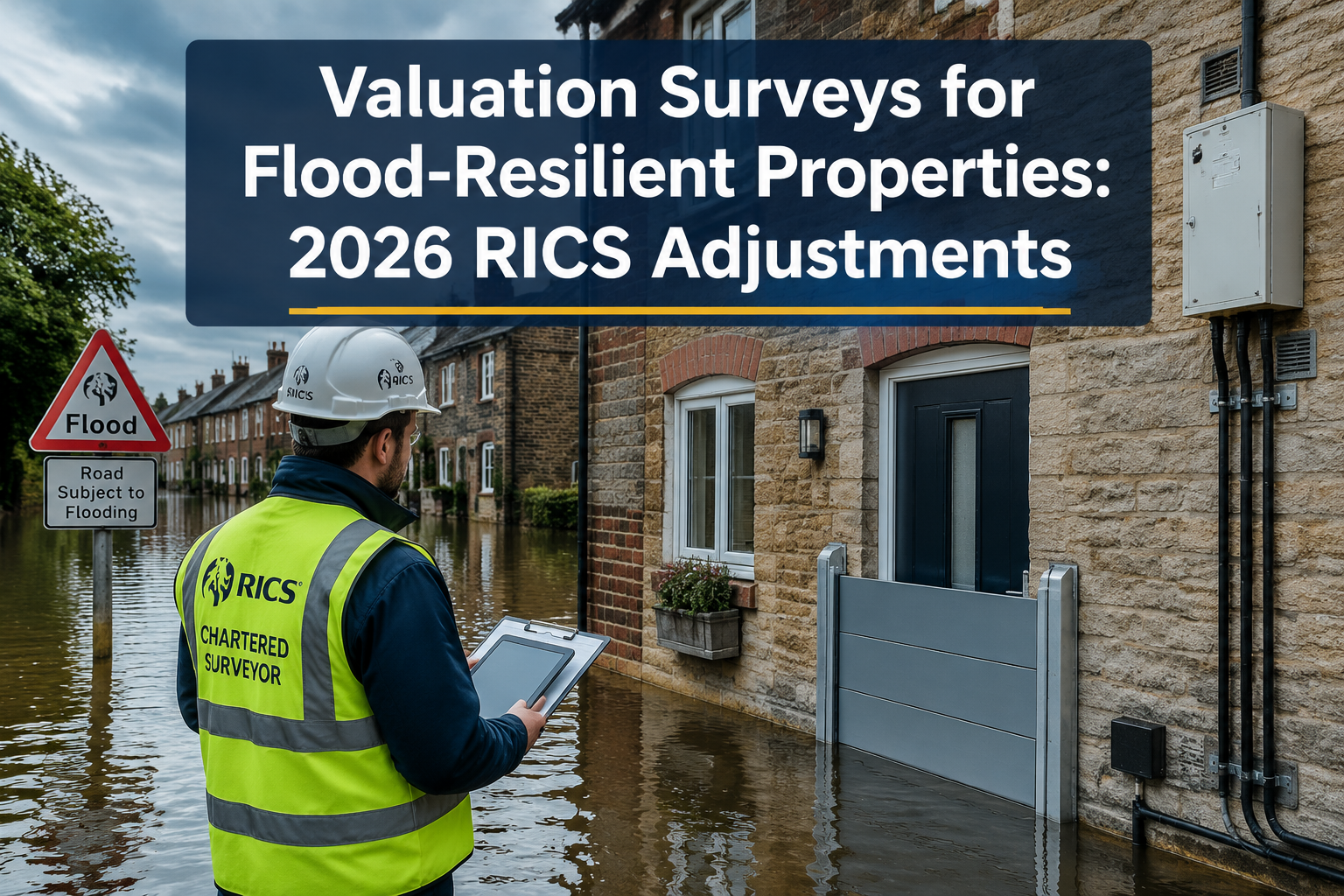
- Greater awareness of diminution in value — where structural issues, damp, or boundary disputes reduce a property's open market worth — has led to more contested expert evidence. [2]
- Commercial property interests held by one spouse through a business add another layer of complexity, requiring specialist commercial property valuation expertise alongside residential knowledge.
Understanding the legal framework that governs how surveyors operate in these cases is the first step toward resolving disputes efficiently.
The Legal Framework Governing Matrimonial Valuation Disputes: Surveyor Expert Witness Roles in Divorce Settlements 2026
Civil Procedure Rules and the Overriding Duty to the Court
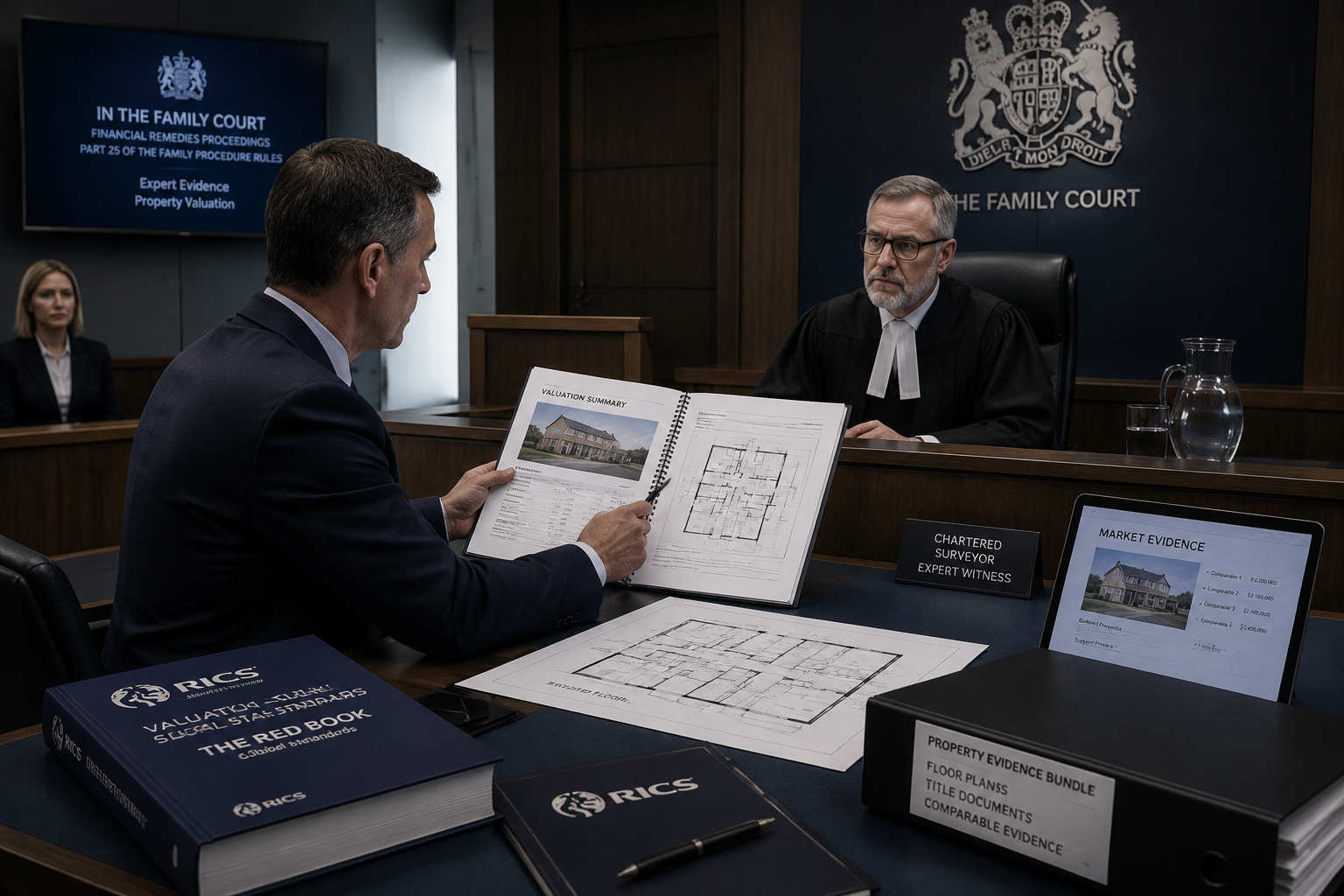
Expert witnesses in family proceedings operate under Civil Procedure Rules (CPR) Part 35, which establishes that an expert's primary duty is to the court — not to the party who instructs or pays them. This principle is non-negotiable. A surveyor who allows their opinion to be shaped by the preferred outcome of the instructing solicitor risks having their report disregarded entirely and faces potential disciplinary action from RICS.
The 5th edition of the RICS professional statement, "Surveyors Acting as Expert Witnesses," sets out mandatory obligations for all RICS members in this role. Key requirements include: [2]
- Prioritising duty to the court above the interests of any client
- Following Single Joint Expert protocols where directed by the court
- Responding to CPR Part 35.6 written questions within 28 days
- Declaring any actual or potential conflict of interest before accepting an instruction
RICS Red Book Compliance
Every matrimonial valuation prepared for court proceedings must comply with the RICS Valuation — Global Standards, commonly known as the Red Book. This is not a best-practice recommendation; it is a mandatory professional requirement. [2]
Red Book compliance means the surveyor must:
- Define the basis of value — almost always Market Value (MV) as defined by the International Valuation Standards Council (IVSC)
- Provide a formal written valuation report, not an informal estimate or desktop appraisal
- Disclose all assumptions and special assumptions relied upon
- Include a signed declaration confirming the valuation is independent and objective
A professional property valuation prepared to Red Book standards carries far greater legal weight than an informal agent's estimate, which courts routinely treat with caution.
RICS Expert Witness Accreditation Service (EWAS)
In 2026, RICS accreditation through the Expert Witness Accreditation Service (EWAS) has become a baseline credibility requirement in family court cases. [2] Courts and instructing solicitors now routinely ask whether a proposed expert holds EWAS accreditation before approving their appointment. This accreditation confirms that the surveyor:
- Has the relevant experience and competence for the specific type of property
- Understands their legal duties as an expert witness
- Is genuinely impartial and free from conflicts of interest
Surveyors without EWAS accreditation are not automatically excluded, but they face greater scrutiny and may find their evidence given less weight during proceedings.
Single Joint Expert Appointments and Asset Apportionment Valuations
The Rise of the Single Joint Expert
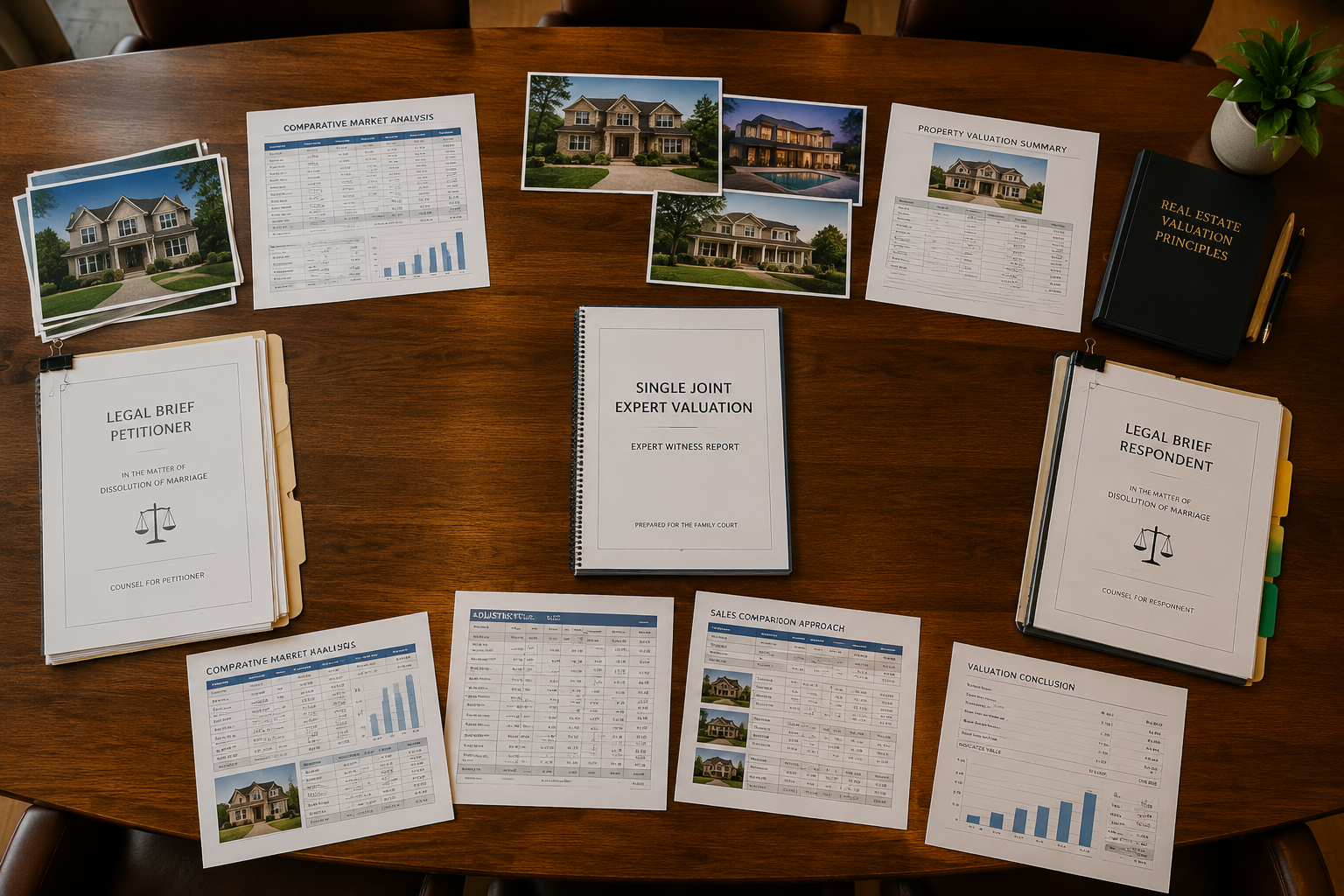
One of the most significant procedural shifts in recent years has been the growing preference for Single Joint Expert (SJE) appointments in family law property disputes. [7] Rather than each party instructing their own surveyor — a process that often produces conflicting reports and escalating costs — the court directs both parties to jointly instruct a single independent expert.
The SJE model offers clear advantages:
| Approach | Cost | Impartiality | Speed | Risk of Conflicting Evidence |
|---|---|---|---|---|
| Separate party experts | Higher | Lower | Slower | High |
| Single Joint Expert | Lower | Higher | Faster | Minimal |
The SJE is instructed by both parties under a joint letter of instruction, which must be agreed before it is sent. Both parties can submit questions to the expert, and the resulting report is shared by both sides. Neither party can claim the report as "their" evidence — it belongs to the court.
For the surveyor accepting an SJE appointment, the responsibilities are substantial. The instruction requires absolute neutrality. The surveyor must inspect the property thoroughly, consider all relevant comparable evidence, and produce a report that assists the court without favouring either party. [7]
Solicitors seeking a qualified expert witness surveyor should confirm that the proposed appointee has experience of SJE protocols and understands the specific disclosure requirements of family proceedings.
Asset Apportionment: What Surveyors Are Actually Asked to Value
In matrimonial disputes, surveyors are rarely asked to provide a single headline figure and nothing more. The scope of asset apportionment valuations in 2026 divorce settlements frequently includes:
- Open market value of the matrimonial home at the date of separation and/or the date of the final hearing
- Diminution in value caused by structural defects, damp, or outstanding works — a contested area requiring careful evidential support [2]
- Value of improvements made during the marriage, and whether they are attributable to one party's contribution
- Rental value where a property has been or could be let, relevant to income-needs calculations
- Leasehold considerations including the impact of a short lease on market value, where a lease extension valuation may be needed as part of the overall picture
- Commercial property interests where one spouse owns business premises, requiring a separate commercial valuation exercise
Each of these elements requires the surveyor to apply a distinct methodology and to explain their reasoning clearly enough for a judge with no surveying background to follow.
Handling Disagreement Between Experts
Where both parties have instructed separate experts and the reports conflict, the court may direct a without-prejudice meeting between the experts. The purpose of this meeting is not to negotiate a compromise but to identify the genuine areas of agreement and disagreement, and to narrow the issues the court must determine.
The experts must produce a joint statement setting out: [7]
- The matters on which they agree
- The matters on which they disagree
- A brief summary of the reasons for any disagreement
This joint statement often resolves more than the parties expect. When two experienced surveyors sit down without their respective clients in the room, methodological differences frequently narrow considerably.
Evidence Standards, Report Compliance, and Practical Challenges in 2026
What a Compliant Expert Witness Report Must Contain
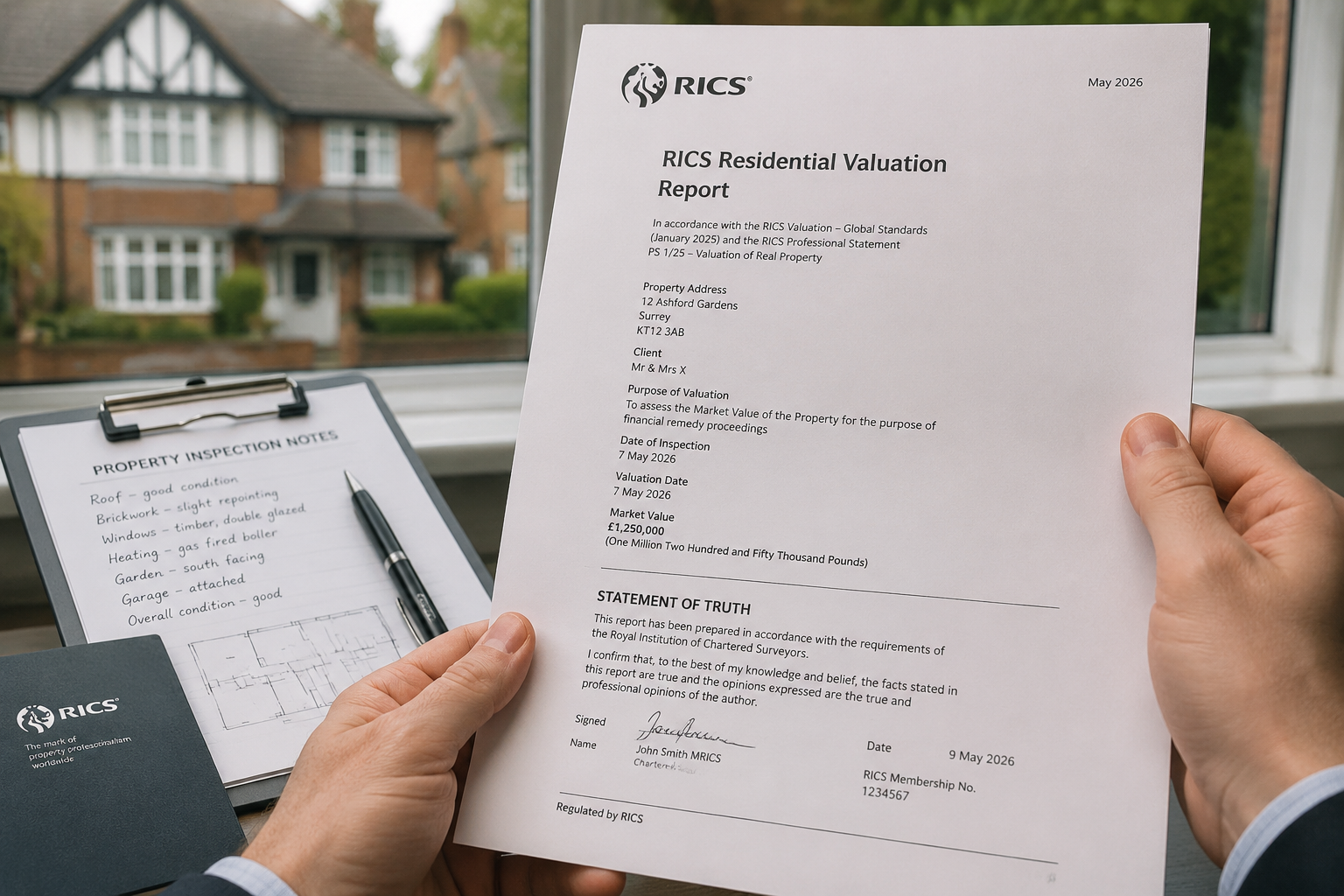
An expert witness report prepared for family court proceedings must meet specific structural and content requirements. A report that fails on formal grounds risks being excluded entirely, regardless of the quality of the underlying analysis. [7]
A compliant report will include:
- Details of the expert's qualifications and relevant experience
- A clear statement of the instructions received and the questions the report addresses
- The factual basis for the opinions expressed, including inspection notes and comparable evidence
- A summary of the methodology used to arrive at the valuation
- A Statement of Truth confirming the report is accurate to the best of the expert's knowledge
- A Statement of Independence confirming the expert understands their duty to the court and has no undisclosed interest in the outcome [7]
The absence of a Statement of Truth is not a minor omission — it can render the report inadmissible.
Diminution in Value: A Frequently Contested Area
Diminution in value claims have become one of the most technically demanding aspects of matrimonial property valuations. [2] A spouse may argue that the other party's failure to maintain the property, or works they carried out without consent, have reduced its market value. Quantifying that reduction requires the surveyor to:
- Establish the value the property would have achieved in good condition
- Assess the actual condition at the relevant valuation date
- Calculate the cost of remediation and its effect on buyer perception
- Express the net diminution as a figure supported by comparable market evidence
This is not a mechanical exercise. It requires professional judgment, and that judgment will be tested under cross-examination if the matter proceeds to a final hearing.
Alternative Dispute Resolution: Growing Role for Chartered Surveyors
Not every matrimonial property dispute ends up before a judge. There is a clear and growing preference for resolving these matters through mediation and arbitration, both of which are faster and less expensive than contested litigation. [3] Chartered Valuation Surveyors are increasingly asked to provide valuation evidence within these alternative processes, applying the same professional standards as they would in court.
In mediation, the surveyor may be appointed as a neutral expert to provide a single agreed value that both parties accept as the basis for negotiation. In arbitration, the process more closely mirrors court proceedings, and the surveyor's report may be subject to the same scrutiny as it would face before a judge. [4]
The demand for impartial, objective divorce appraisals has grown precisely because both parties — and their legal advisers — recognise that a credible, independent valuation reduces the scope for argument and accelerates settlement. [4]
Understanding Surveyor Costs in Matrimonial Instructions
Cost is a legitimate consideration for both parties in a divorce. Expert witness instructions are more time-intensive than standard survey or valuation work, and the fees reflect that. A surveyor instructed as an expert witness must allow time for: property inspection, comparable research, report preparation, potential questions under CPR Part 35.6, expert meetings, and possible attendance at court.
Parties seeking to understand the likely cost of instructing a surveyor should review guidance on surveyor rates and pricing before approaching firms. Under an SJE appointment, costs are typically shared equally between the parties unless the court directs otherwise.
For properties in specific regions, local expertise matters. Firms with established practices in areas such as South East London, Hertfordshire, and Guildford bring granular knowledge of local comparable evidence that strengthens the credibility of their valuations in court.
Conclusion
Matrimonial Valuation Disputes: Surveyor Expert Witness Roles in Divorce Settlements 2026 represent one of the most technically demanding and procedurally complex areas of property practice. The stakes are high: a poorly prepared valuation report, or one produced by an expert who does not understand their duties to the court, can distort financial settlements and expose both the surveyor and their instructing solicitor to serious professional risk.
Actionable next steps for those involved in matrimonial property disputes:
- Confirm RICS EWAS accreditation before appointing any surveyor as an expert witness — this is now a baseline requirement, not a bonus.
- Consider an SJE appointment early in proceedings to reduce costs and avoid the delays caused by conflicting party-appointed reports.
- Ensure the instruction letter is comprehensive — define the valuation date, the basis of value required, and every specific question the court needs answered.
- Request Red Book compliance confirmation from the appointed surveyor before the report is prepared.
- Engage a surveyor with local market knowledge relevant to the property in question — regional comparable evidence is the foundation of a defensible valuation.
- Explore mediation or arbitration as a first step before committing to contested litigation, particularly where the valuation gap between parties is relatively narrow.
A well-qualified, genuinely impartial chartered surveyor, instructed correctly and given a clear scope of work, remains the most effective tool available for resolving matrimonial property valuation disputes fairly, efficiently, and with the legal weight that family courts require.
References
[1] Party Wall Expert Witness Roles In Matrimonial Property Disputes Valuation Strategies And Rics Standards – https://www.canterburysurveyors.com/blog/party-wall-expert-witness-roles-in-matrimonial-property-disputes-valuation-strategies-and-rics-standards/?utm_source=openai
[2] Expert Witness Reports For Matrimonial Property Valuations Rics Protocols And Diminution Challenges In 2026 Divorces – https://www.canterburysurveyors.com/blog/expert-witness-reports-for-matrimonial-property-valuations-rics-protocols-and-diminution-challenges-in-2026-divorces/?utm_source=openai
[3] Expert Witness And Litigation – https://ringley.co.uk/surveys/expert_witness_and_ligtigation?utm_source=openai
[4] Divorce Appraisal – https://www.valuepros.com/divorce-appraisal/?utm_source=openai
[7] Expert Witness Reports For Property Disputes A Chartered Surveyors Guide – https://www.oldenproperty.com/blogs/expert-witness-reports-for-property-disputes-a-chartered-surveyors-guide?utm_source=openai