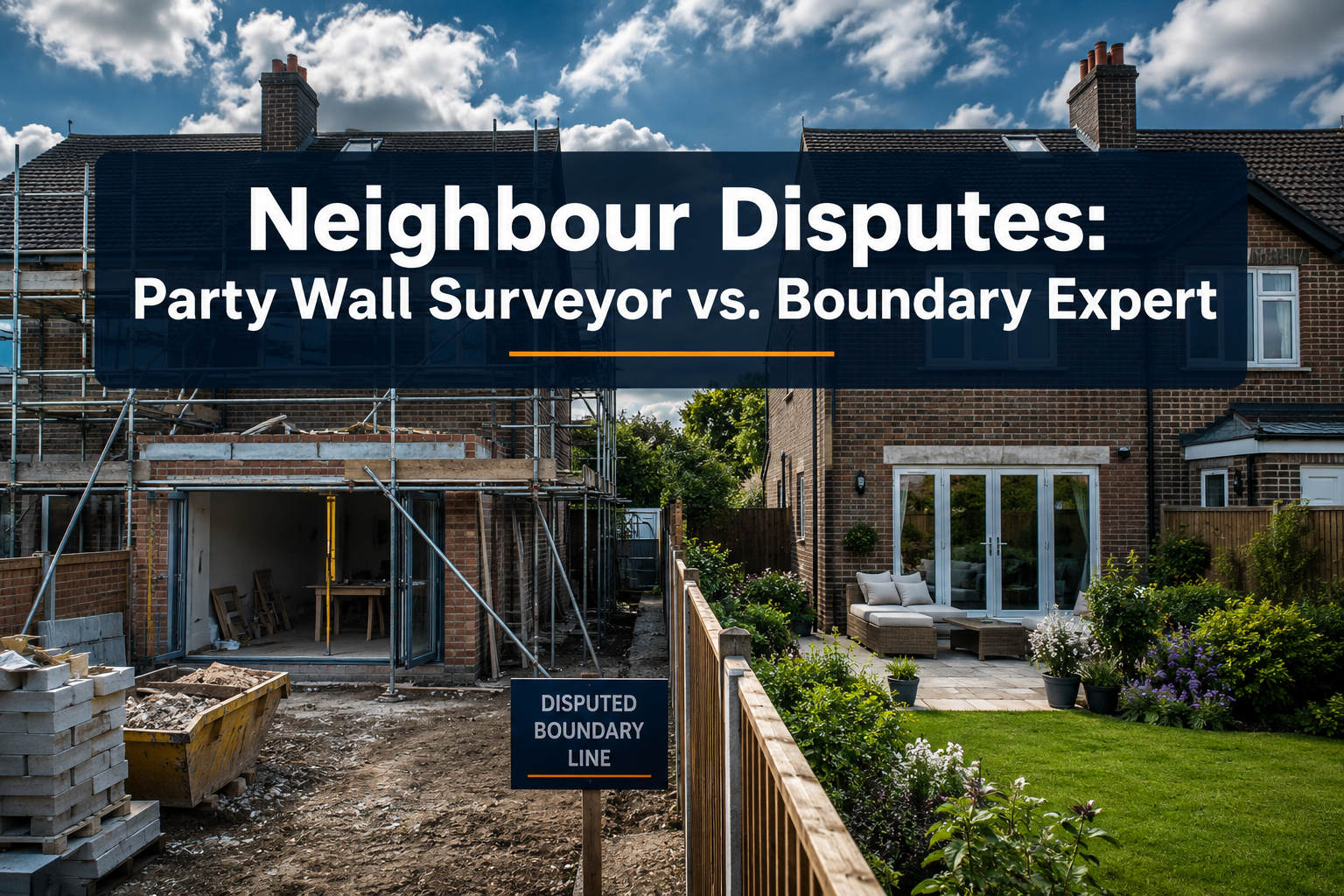
Boundary disagreements between neighbours have surged by more than 30% since 2020, driven largely by the wave of home extensions and garden developments that followed the shift to remote working [2]. At the same time, 2026 has seen a 40% rise in party wall disputes compared to the previous year, with the average additional surveyor cost per dispute now standing at approximately £3,500 [3]. These two trends frequently collide on the same plot of land — yet the professionals needed to resolve them are not the same person.
Understanding neighbour disputes over boundaries and extensions, and knowing when to bring in a party wall surveyor vs. a boundary expert, can be the difference between a swift resolution and years of costly litigation. This article walks through the most common UK scenarios where fence lines, garden walls, and extensions trigger both boundary uncertainty and party wall obligations, and explains which specialist to instruct first.
Key Takeaways
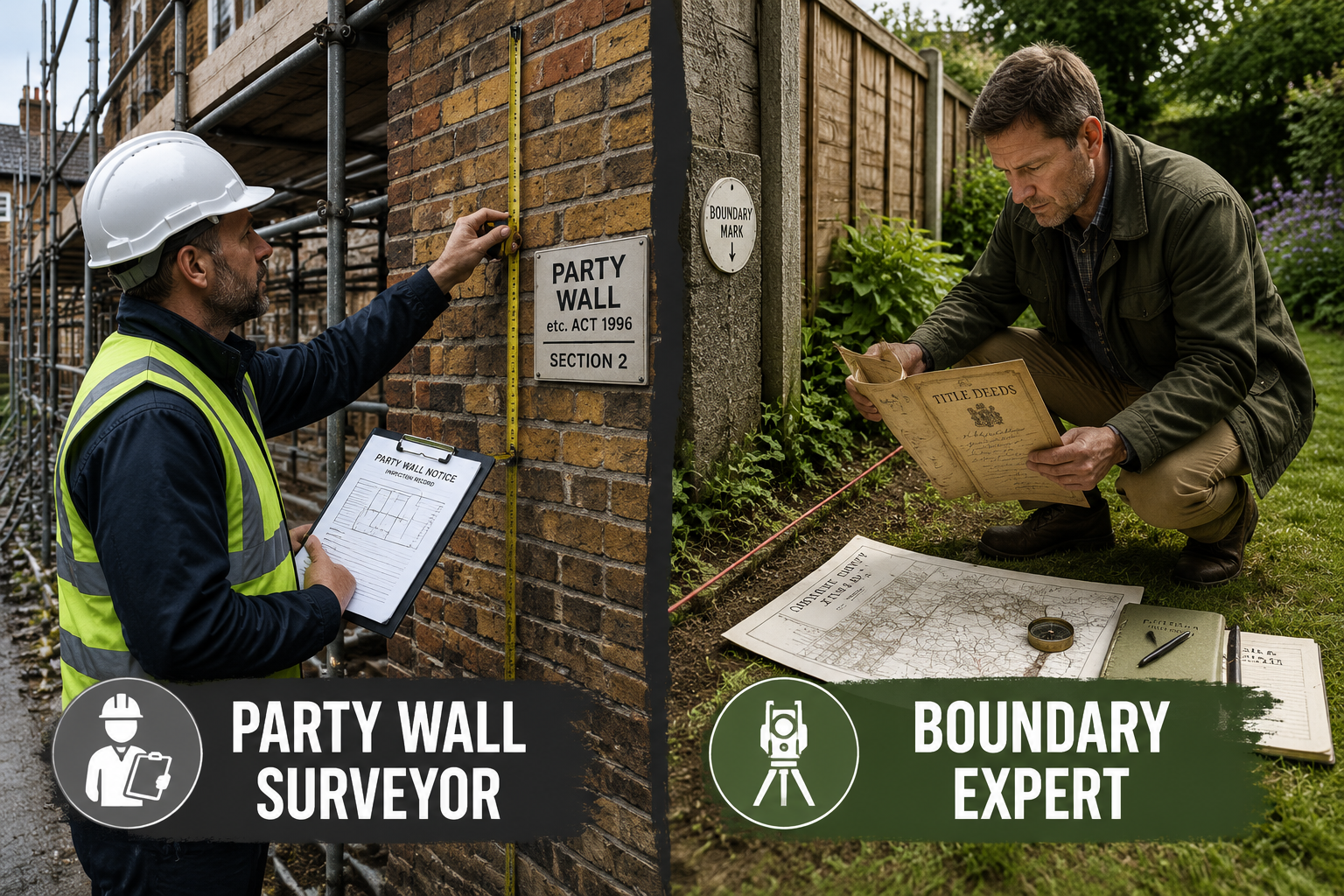
- Party wall surveyors operate under the Party Wall etc. Act 1996 and deal with shared structures and excavation works; boundary experts determine the precise legal line between properties.
- The two roles are distinct — a party wall surveyor cannot legally determine a boundary, and a boundary expert cannot serve a party wall award.
- Boundary disputes and party wall obligations often arise from the same building project, but must be handled separately and usually in a specific order.
- Land Registry title plans show only "general boundaries" and are not conclusive proof of where a legal boundary sits [2].
- Serving a valid party wall notice before work begins is the single most effective step a homeowner can take to avoid costly disputes [3].
What Triggers a Neighbour Dispute: Extensions, Fences, and Shared Walls
Most neighbour disputes do not begin with a legal argument. They begin with a builder arriving on a Monday morning.
Common triggers include:
- Rear extensions that run close to or along a shared boundary wall
- Loft conversions involving work to a chimney stack or party wall
- Garden walls or fences being moved, replaced, or built on a disputed line
- Basement excavations that come within three to six metres of a neighbour's foundations
- Outbuildings or garden rooms constructed near the boundary
In each of these scenarios, two separate legal questions arise almost simultaneously. First: does the work affect a shared structure or require excavation near a neighbour's foundations? Second: is the proposed line of work actually on the correct side of the legal boundary?
These questions sound related, but they are governed by entirely different legal frameworks and require different professionals to answer them.
The Party Wall etc. Act 1996: What It Covers and What It Does Not
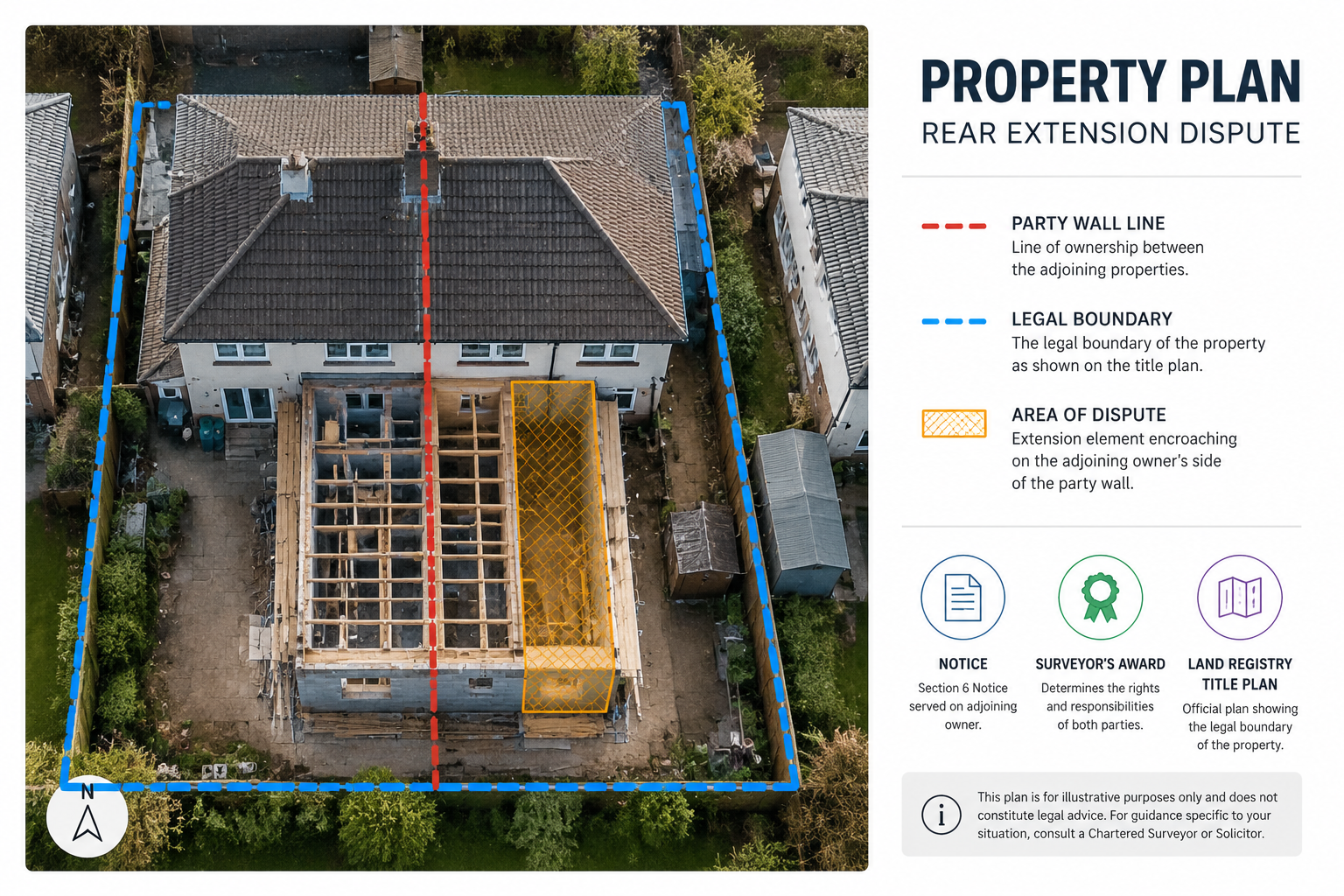
The Party Wall etc. Act 1996 creates a statutory process for managing building works that affect shared walls, floors, and structures between neighbouring properties. It applies in England and Wales and covers three main categories of work:
- Party structure work — cutting into, demolishing, or building on a wall shared with a neighbour
- New walls on the boundary line — building a new wall astride or at the boundary
- Excavation near neighbouring foundations — digging within three metres of a neighbour's structure to a depth below their foundations, or within six metres under certain conditions
When any of these works are planned, the building owner must serve a formal party wall notice on the adjoining owner before work begins. If the neighbour consents in writing, work can proceed. If they dissent — or fail to respond within 14 days — a dispute is deemed to have arisen, and a party wall surveyor (or surveyors) must be appointed to produce a legally binding Party Wall Award.
For a detailed breakdown of what a party wall dispute involves and how the process unfolds, the party wall dispute guide provides a thorough overview. Homeowners planning excavation work should also review the specific rules around notice for excavation near a neighbour.
What the Act does NOT cover:
- The precise legal position of the boundary itself
- Encroachment disputes where a structure has already been built over the boundary
- Disputes about ownership of a fence or garden wall where no notifiable works are planned
"The Party Wall etc. Act 1996 is a procedural mechanism for managing works, not a tool for resolving ownership of land."
This distinction matters enormously in practice.
Who Is a Party Wall Surveyor and What Do They Actually Do?
A party wall surveyor is appointed specifically to administer the Party Wall etc. Act 1996. Their role is quasi-judicial — they act impartially between the two parties, even when appointed by only one of them.
Their core responsibilities include:
- Reviewing party wall notices for validity
- Preparing a schedule of condition of the adjoining property before works begin
- Drafting and serving the Party Wall Award, which sets out the rights and obligations of both parties
- Assessing and awarding compensation for any damage to property caused by party wall works
Party wall surveyors also handle more specialist scenarios such as works affecting shared chimney stacks or the installation of insulation within a party wall.
In April 2026, RICS opened a consultation on the draft 8th edition of its Party Wall Legislation and Procedure guidance, which includes revised appointment letters, updated award templates, and strengthened guidance on fee practices and the use of the Third Surveyor [1]. The draft also addresses newer scenarios such as heat pump installations, reflecting how construction practices have evolved [4].
What a party wall surveyor cannot do:
Courts have become increasingly critical of expert evidence where surveyors stray outside their area of competence. Recent litigation has confirmed that party wall surveyors should not opine on boundary determinations without the specific qualifications to do so [5]. Instructing the wrong professional for the wrong question is not just unhelpful — it can actively damage a legal case.
Who Is a Boundary Expert and When Is One Needed?
A boundary expert — sometimes called a boundary surveyor or, in litigation, an expert witness surveyor — is a specialist whose primary task is to determine the precise legal position of a boundary between two properties.
This role becomes necessary when:
- Neighbours disagree about where a fence, wall, or hedge sits relative to the legal boundary
- A new extension or outbuilding is alleged to have encroached onto a neighbour's land
- A property is being sold and the buyer's solicitor raises a boundary query
- A dispute has reached the point of litigation and the court requires independent expert evidence
A key point that many homeowners do not realise: Land Registry title plans do not determine the exact legal boundary. They depict only "general boundaries" and are drawn at a scale that can represent several feet of uncertainty on the ground [2]. A boundary expert must therefore go beyond the title plan and examine historical OS maps, old conveyances, aerial photography, physical features on the ground, and expert measurement to establish where the boundary actually lies.
Under Civil Procedure Rules Part 35, an expert witness surveyor acting in litigation owes their primary duty to the court, not to the party who instructed them. RICS standards reinforce this obligation [2].
For homeowners in London and the South East, boundary survey services from a qualified chartered surveyor can provide the documented evidence needed to resolve disputes before they reach court.
Neighbour Disputes Over Boundaries and Extensions: When to Bring in a Party Wall Surveyor vs. a Boundary Expert — Common Scenarios Explained
Understanding the distinction in theory is one thing. Applying it to real situations is another. The following scenarios illustrate how the two roles interact in practice.
Scenario 1: Rear Extension Running Along a Shared Boundary Wall
A homeowner plans a single-storey rear extension that will run along the full length of the shared brick wall with the neighbour. The neighbour objects, claiming the proposed extension will sit partly on their land.
What applies here:
- The Party Wall etc. Act 1996 applies because work will be carried out on or adjacent to the shared wall. A party wall notice must be served, and if the neighbour dissents, a party wall surveyor must be appointed.
- The boundary dispute is a separate matter. Before or alongside the party wall process, a boundary expert should be instructed to confirm where the legal boundary sits and whether the proposed extension footprint encroaches.
Order of action: Instruct a boundary expert first to confirm the build line is within the correct land. Then serve the party wall notice. Both processes can run in parallel once the boundary position is established.
Scenario 2: A Fence Replaced in the Wrong Position
A neighbour replaces an old fence and, in doing so, moves it approximately 300mm into the adjoining garden. No building works are planned.
What applies here:
- The Party Wall etc. Act 1996 does not apply — there is no notifiable building work.
- A boundary expert is the correct professional. They will examine the title deeds, historical evidence, and physical features to determine the correct boundary position and produce a report that can be used in negotiation or litigation.
Order of action: Instruct a boundary expert only. No party wall surveyor is required.
Scenario 3: Loft Conversion with Chimney Stack Works
A homeowner plans a loft conversion that requires structural work to a shared chimney stack. The neighbour is broadly supportive but wants to understand their rights.
What applies here:
- The Party Wall etc. Act 1996 applies because the chimney stack is a shared structure. A party wall notice must be served and a surveyor appointed if required.
- Unless there is a specific dispute about where the chimney stack sits relative to the boundary, no boundary expert is needed.
Order of action: Serve the party wall notice. Appoint a party wall surveyor if the neighbour dissents. A boundary expert is not required unless a boundary dispute separately arises.
Scenario 4: Basement Excavation Near Neighbouring Foundations
A homeowner in a terrace plans a basement extension. The excavation will come within three metres of the neighbour's foundations.
What applies here:
- The Party Wall etc. Act 1996 applies under Section 6 (excavation near neighbouring structures). A notice must be served, and the party wall process followed.
- If there is also uncertainty about the exact boundary position — for example, whether a retaining wall belongs to one property or the other — a boundary expert may also be needed.
Order of action: Serve the party wall notice immediately, as the statutory process has fixed timelines. Instruct a boundary expert in parallel if ownership of a structure is genuinely in dispute.
The Cost of Getting It Wrong
Failing to serve a party wall notice before work begins does not make the Act inapplicable — it simply means the building owner proceeds without the protections the Act provides. The neighbour can apply to court for an injunction to stop the works, and the building owner loses the right to have a surveyor determine the dispute on their terms [3].
The financial consequences are significant. With average additional surveyor costs per dispute now at £3,500 and rising, and with legal costs in boundary litigation frequently reaching five figures, early professional advice is far cheaper than reactive dispute resolution [3].
Typical cost comparison:
| Action | Approximate Cost |
|---|---|
| Party wall notice (served correctly) | £300 – £700 |
| Agreed surveyor party wall award | £1,000 – £2,500 |
| Disputed party wall process (two surveyors) | £2,500 – £6,000+ |
| Boundary survey report | £500 – £2,000 |
| Boundary litigation (First-tier Tribunal) | £5,000 – £25,000+ |
For a full breakdown of what to expect, the party wall cost guide covers fees in detail.
Neighbour Disputes Over Boundaries and Extensions: When to Bring in a Party Wall Surveyor vs. a Boundary Expert — A Practical Decision Framework
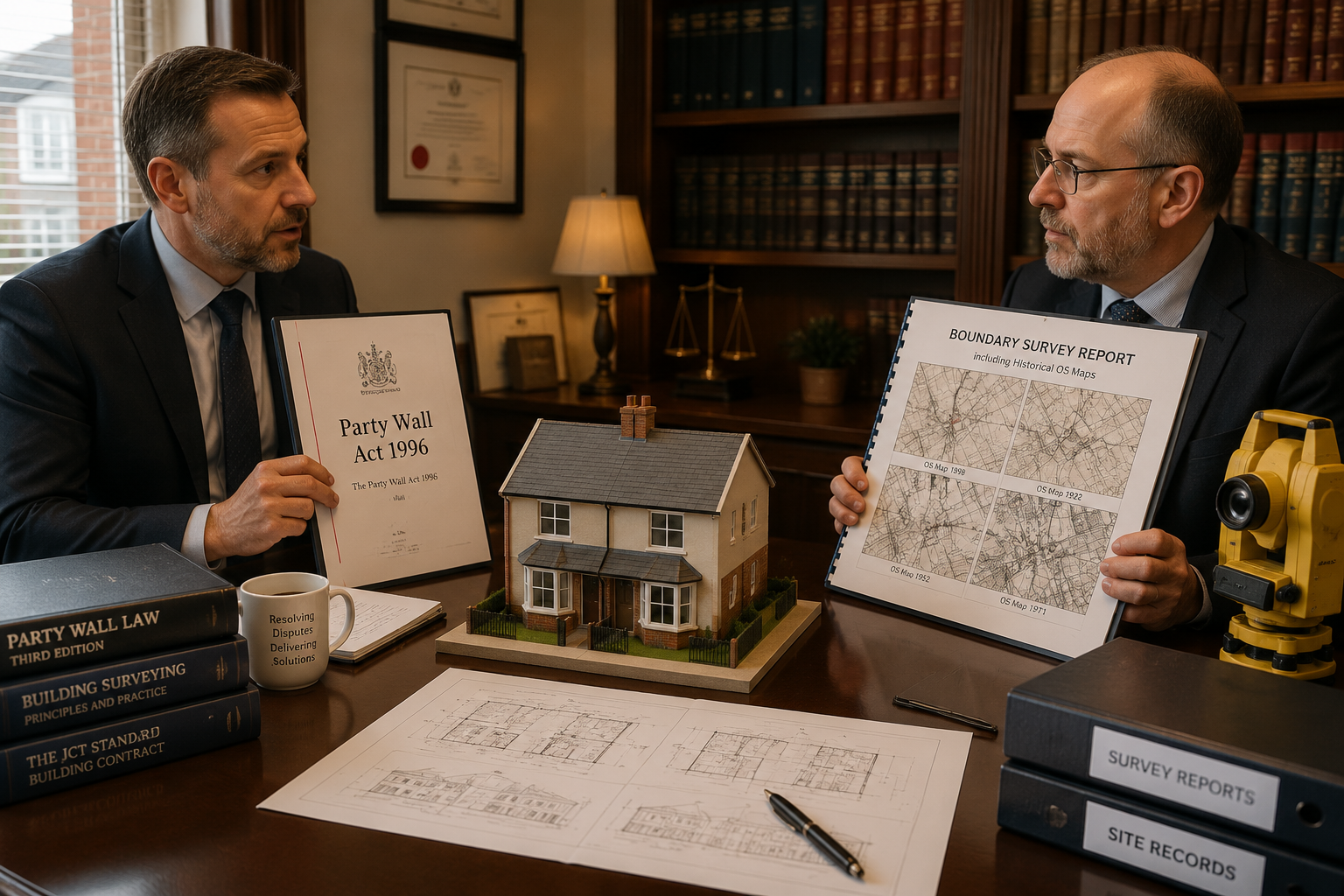
Use the following framework to decide which professional to instruct:
Instruct a party wall surveyor when:
- Building works will affect a shared wall, floor, or structure
- Excavation is planned within three or six metres of a neighbour's foundations
- A neighbour has dissented from a party wall notice
- Works have already started without a notice and the neighbour is objecting
Instruct a boundary expert when:
- There is genuine disagreement about where the legal boundary sits
- A structure has been built or is alleged to have been built over the boundary
- A property transaction is being delayed by a boundary query
- A dispute is heading toward the Property Chamber (First-tier Tribunal) or court
Instruct both when:
- A planned extension or excavation both triggers the Party Wall Act and involves a disputed boundary line
- A neighbour is using a boundary dispute to obstruct a legitimate building project
- Litigation is anticipated and both party wall procedure and boundary evidence will be relevant
The party wall services overview and boundary survey services pages can help homeowners identify the right starting point for their specific situation.
Conclusion
Neighbour disputes over boundaries and extensions are among the most stressful and financially damaging situations a UK homeowner can face. The core mistake most people make is assuming that one professional can handle everything — or that the dispute is simpler than it is.
The distinction between a party wall surveyor and a boundary expert is not a technicality. It reflects two entirely different legal frameworks, two different sets of professional obligations, and two different types of evidence. Confusing them wastes time, money, and goodwill.
Actionable next steps for homeowners in 2026:
- Before any building work begins, check whether the Party Wall etc. Act 1996 applies and serve the correct notice in time.
- If a boundary is in dispute, commission a formal boundary survey before assuming the title plan settles the matter.
- If both issues are present, instruct both professionals and let them work in parallel — do not wait for one process to conclude before starting the other.
- Document everything — photographs, correspondence, and a pre-works schedule of condition all reduce the risk of costly disputes later.
- Seek early advice from a chartered surveyor with experience in both party wall and boundary matters. The cost of a consultation is a fraction of the cost of litigation.
For homeowners across London and the South East, local chartered surveyors with expertise in both disciplines are best placed to provide the joined-up advice that complex neighbour disputes demand.
References
[1] Rics Opens Consultation On Party Wall Guidance Update – https://www.propertywire.com/news/uk/rics-opens-consultation-on-party-wall-guidance-update/?utm_source=openai
[2] Expert Witness Surveyors In Neighbour Boundary Disputes Rics Standards Vs Land Registry Evidence – https://www.canterburysurveyors.com/blog/expert-witness-surveyors-in-neighbour-boundary-disputes-rics-standards-vs-land-registry-evidence/?utm_source=openai
[3] Party Wall Surveys Amid 2026 Construction Boom Resolving High Demand Disputes In Uk Housing Hotspots – https://manchestersurveyors.com/party-wall-surveys-amid-2026-construction-boom-resolving-high-demand-disputes-in-uk-housing-hotspots/?utm_source=openai
[4] Party Wall Surveys For Heat Pump Installations In 2026 Rics Protocols Amid Uk Heat Network Expansion – https://wimbledonsurveyors.com/party-wall-surveys-for-heat-pump-installations-in-2026-rics-protocols-amid-uk-heat-network-expansion/?utm_source=openai
[5] Party Wall Surveyors As Expert Witnesses Scope Limitations And Boundary Determination Pitfalls From Recent Litigation – https://wimbledonsurveyors.com/party-wall-surveyors-as-expert-witnesses-scope-limitations-and-boundary-determination-pitfalls-from-recent-litigation/?utm_source=openai