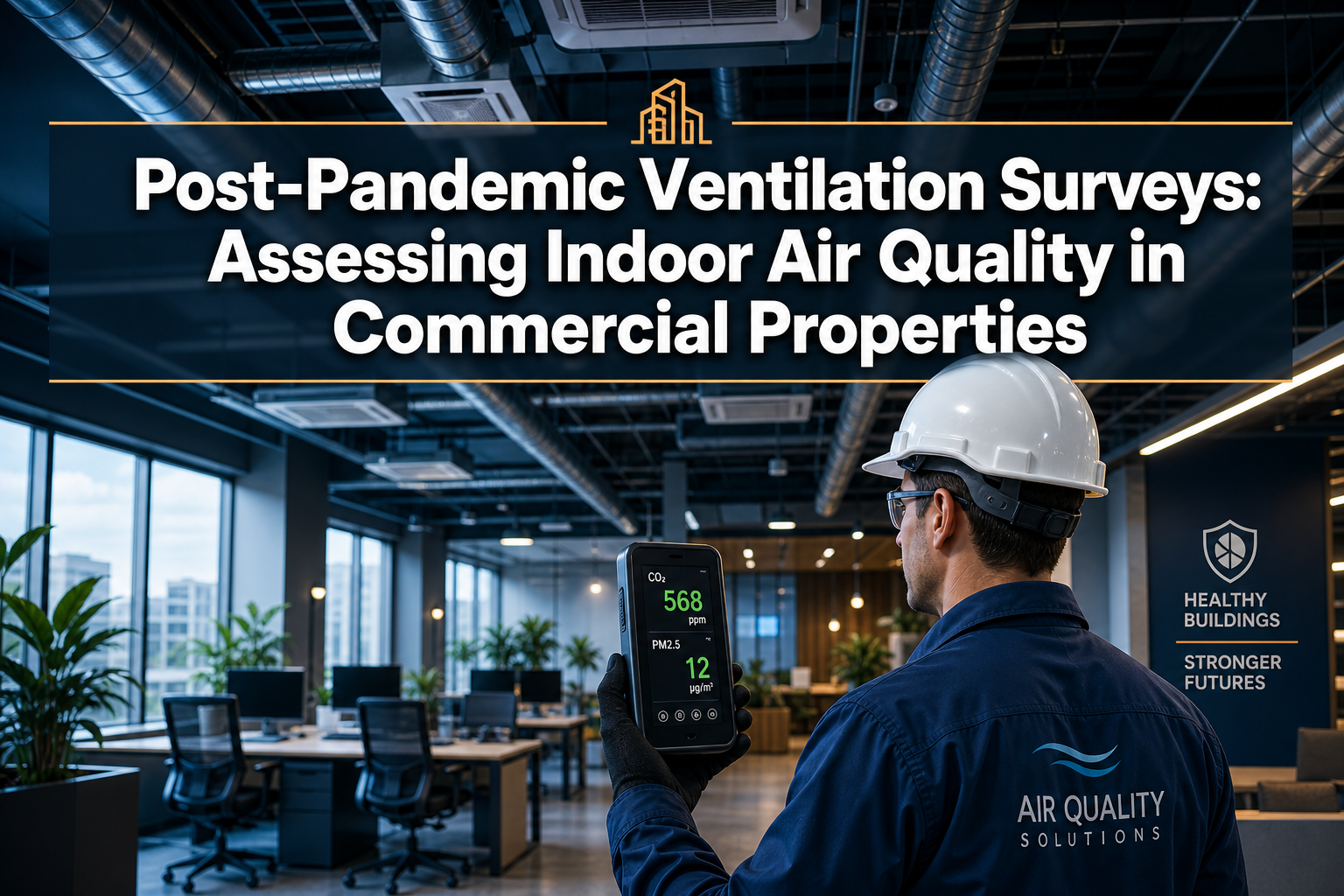

A 2023 post-occupancy evaluation of green-rated commercial interiors found that 41.9% of assessed areas had CO2 levels exceeding recommended thresholds — and this was in buildings specifically designed to perform well [3]. For the broader stock of commercial properties, the picture is often considerably worse. The shift to hybrid working, reduced maintenance during lockdowns, and a fundamental rethinking of how people use shared spaces has made post-pandemic ventilation surveys: assessing indoor air quality in commercial properties one of the most pressing obligations facing property owners and facilities managers in 2026.
This article explains what these surveys involve, why they matter under current health and regulatory frameworks, and how building professionals can use them to protect occupants, manage liability, and future-proof their assets.
Key Takeaways
- Poor indoor air quality in commercial buildings is measurable, common, and directly linked to occupant health and productivity outcomes.
- Post-pandemic ventilation surveys assess HVAC systems, airflow rates, CO2 levels, particulate matter, and volatile organic compounds against updated standards.
- Updated guidance recommends a minimum of 15 cfm/person, with optimal rates reaching 30 cfm/person in densely occupied spaces [2].
- Demand-controlled ventilation (DCV) and real-time occupancy sensing are now considered best practice for balancing air quality with energy efficiency.
- A qualified commercial building surveyor should lead or coordinate the assessment, integrating ventilation findings with the broader structural and mechanical condition of the property.
Why Indoor Air Quality Has Become a Commercial Property Priority
For decades, indoor air quality (IAQ) in offices and retail environments was treated as a background concern — something addressed during construction and then largely forgotten. The EPA's Building Assessment Survey and Evaluation (BASE) Study, conducted across 100 U.S. office buildings, provided early baseline data showing that IAQ problems were widespread even before the pandemic [5]. What changed after 2020 was the level of public and regulatory attention directed at those long-standing problems.
Several converging factors have elevated IAQ to a front-line property management issue:
- Occupancy disruption: Buildings left partially occupied or empty for extended periods saw HVAC systems fall into disrepair, filters become clogged, and ductwork accumulate contaminants.
- Hybrid working patterns: Variable occupancy creates uneven ventilation demands that fixed-rate systems were not designed to handle efficiently.
- Heightened occupant expectations: Employees and customers now actively consider air quality when choosing where to work or shop.
- Updated regulatory guidance: Health authorities across multiple jurisdictions have revised minimum ventilation standards upward since 2020.
"The pandemic fundamentally changed what building occupants expect from the air they breathe at work. Surveyors who ignore ventilation are leaving a significant risk unassessed."
The CIBSE Journal has noted the challenge of balancing improved IAQ against energy efficiency targets, emphasising that sustainable ventilation strategies — rather than simply increasing airflow — are the appropriate response [4]. This balance is central to any well-executed post-pandemic ventilation survey.
What Post-Pandemic Ventilation Surveys Cover in Commercial Properties
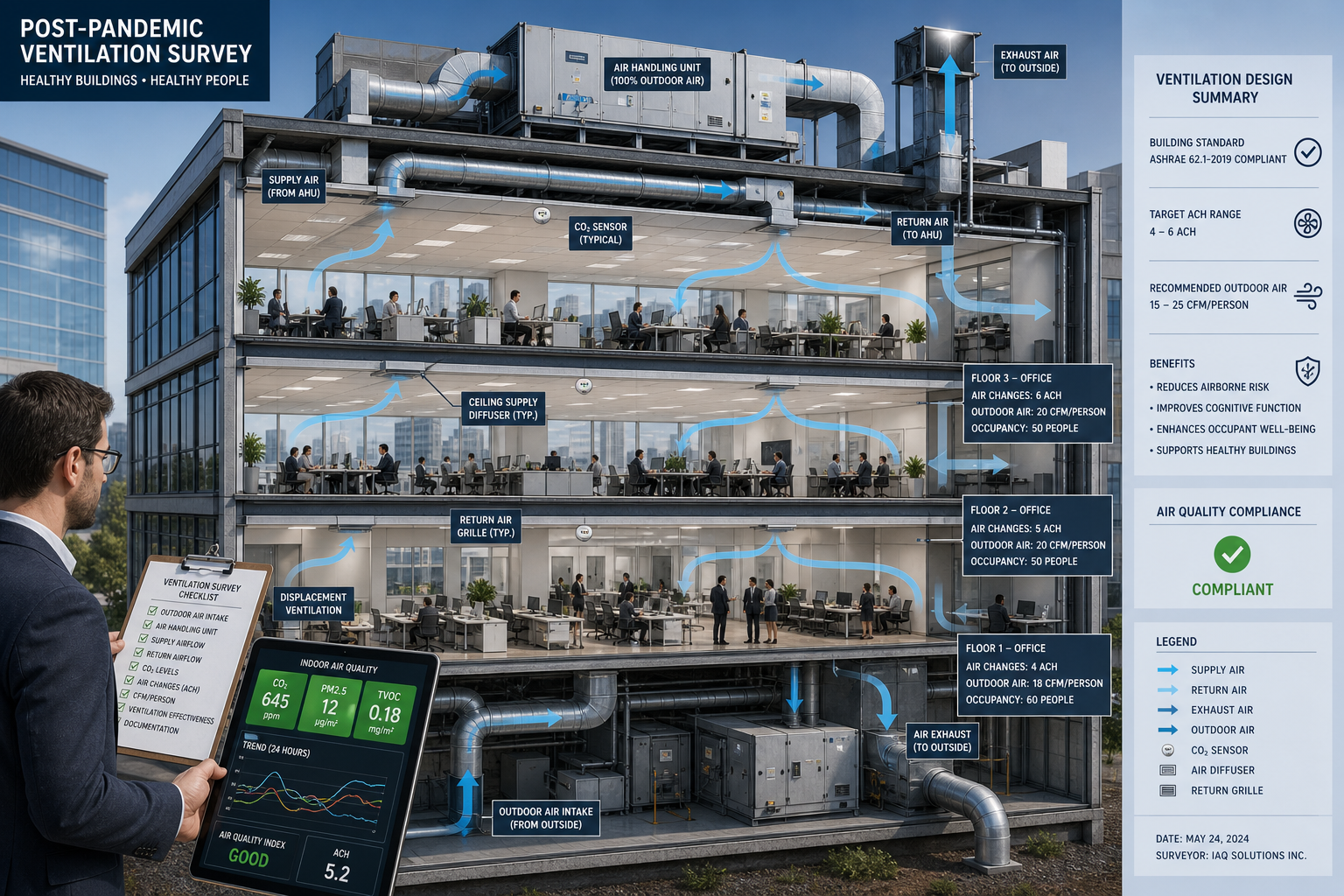
Post-pandemic ventilation surveys: assessing indoor air quality in commercial properties are structured technical assessments that go beyond a visual inspection of air conditioning units. A comprehensive survey examines the full chain from air intake to occupied space, identifying where the system is underperforming and why.
Core Components of a Ventilation Survey
| Survey Element | What Is Measured | Benchmark |
|---|---|---|
| Air change rates | Air changes per hour (ACH) per zone | Typically 6-10 ACH for offices |
| CO2 concentration | Parts per million (ppm) in occupied areas | Below 1,000 ppm (ASHRAE/CIBSE) |
| Particulate matter | PM2.5 and PM10 concentrations | WHO guidelines: PM2.5 below 15 ug/m3 |
| Volatile organic compounds | Total VOC levels from furnishings, cleaning products | Below 300 ug/m3 (typical guidance) |
| Supply air volume | Cubic feet per minute (cfm) per person | Minimum 15 cfm/person; optimal 30 cfm/person [2] |
| Filter condition | Visual and pressure-drop assessment | Per manufacturer specification |
| Ductwork integrity | Leakage, blockages, contamination | Zero visible mould or pest ingress |
HVAC System Evaluation
The mechanical inspection component examines air handling units (AHUs), fan coil units, heat recovery ventilators, and the ductwork network. Surveyors check:
- Whether supply and extract volumes are balanced
- The condition and specification of installed filters (HEPA or equivalent)
- Whether the system has been serviced and commissioned since pre-pandemic occupancy levels resumed
- The presence of demand-controlled ventilation (DCV) capability
This work integrates naturally with a commercial building survey, which assesses the fabric, structure, and mechanical systems of a property in a single coordinated exercise. Combining both avoids duplication and ensures that ventilation deficiencies are understood in the context of the building's overall condition.
Retail Environments: A Special Case
Retail spaces present particular challenges for IAQ management. A January 2026 study found that peak occupancy densities in retail environments can reach 0.2 to 0.4 persons per square metre during sales events, creating sudden spikes in CO2 and particulate levels that static ventilation systems cannot address [1]. Real-time occupancy sensing combined with DCV systems is now considered the appropriate technical response for larger retail properties.
For smaller retail units, surveyors should assess whether the existing mechanical ventilation or natural ventilation strategy is capable of managing these peaks, and document any shortfalls for the landlord or tenant's action plan.
How Building Surveys Evaluate HVAC Systems and Airflow Against Updated Health Standards
Regulatory and guidance frameworks for commercial ventilation have been updated significantly since 2020. The Washington State Department of Health's 2023 post-pandemic guidance recommends a minimum of 15 cfm/person for standard commercial occupancy, rising to 30 cfm/person where optimal IAQ is the target [2]. In the UK, CIBSE Guide A and the Health and Safety Executive's guidance on workplace ventilation set comparable benchmarks.
Post-pandemic ventilation surveys: assessing indoor air quality in commercial properties must be conducted against these current standards — not the older baselines that many existing HVAC systems were designed to meet.
The Surveyor's Role in Compliance Assessment
A qualified surveyor — ideally a chartered building surveyor with mechanical services experience, or working alongside a specialist mechanical engineer — will:
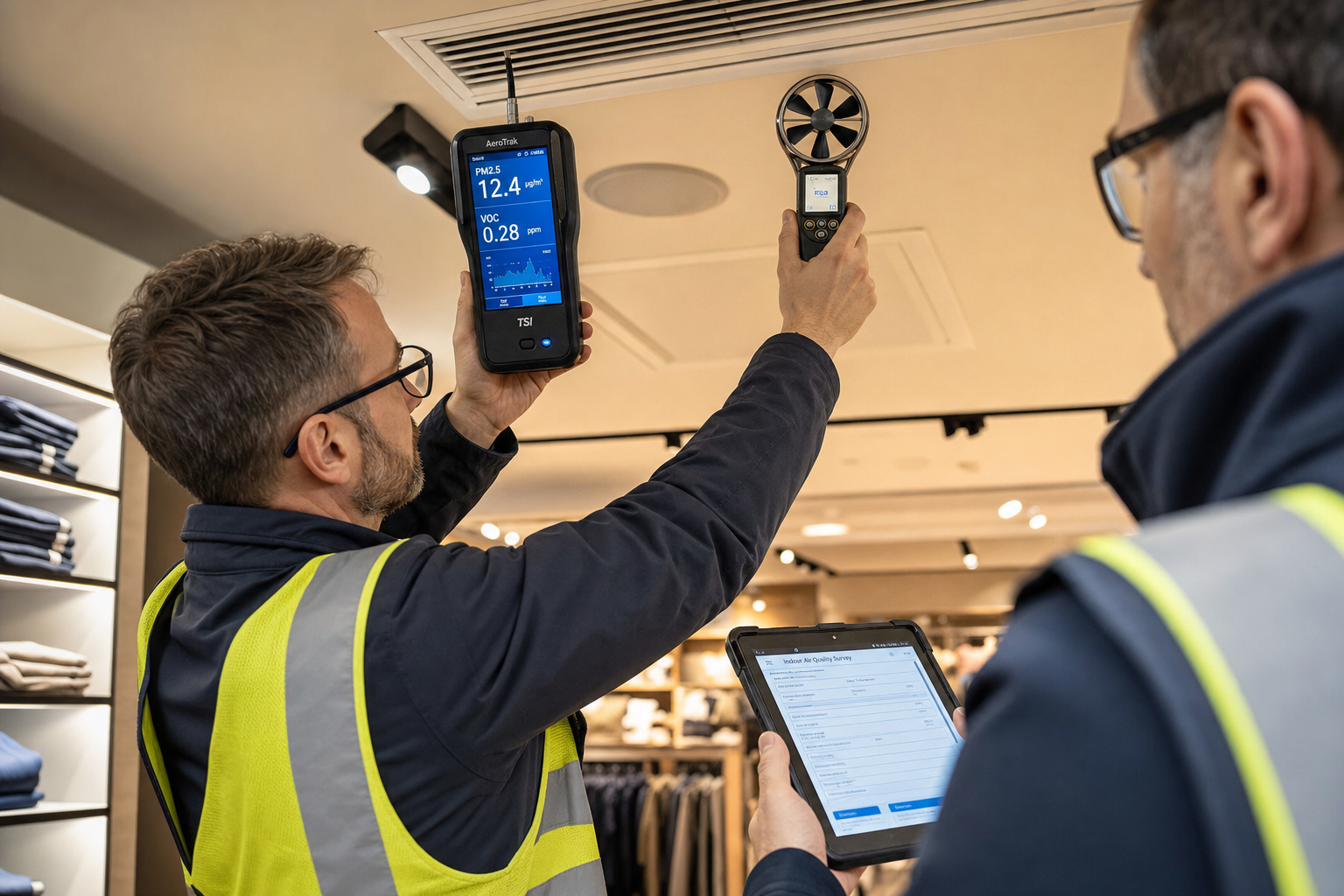
- Establish the current ventilation rate using anemometry and flow hood measurements at supply and extract grilles.
- Compare findings against applicable standards, noting any shortfall in cfm/person or ACH.
- Identify root causes of underperformance (e.g., undersized plant, blocked ductwork, failed controls).
- Recommend remedial action with a prioritised schedule, distinguishing between urgent health and safety issues and longer-term improvement works.
- Document findings formally, providing a written record that supports insurance, lease negotiation, and regulatory compliance.
This formal documentation is particularly important in the context of dilapidations surveys and lease-end assessments, where the condition of mechanical services — including ventilation — is a material factor in determining tenant liability. A schedule of dilapidations that fails to address ventilation system condition may expose landlords to challenge.
Integrating IAQ Data with Building Management Systems
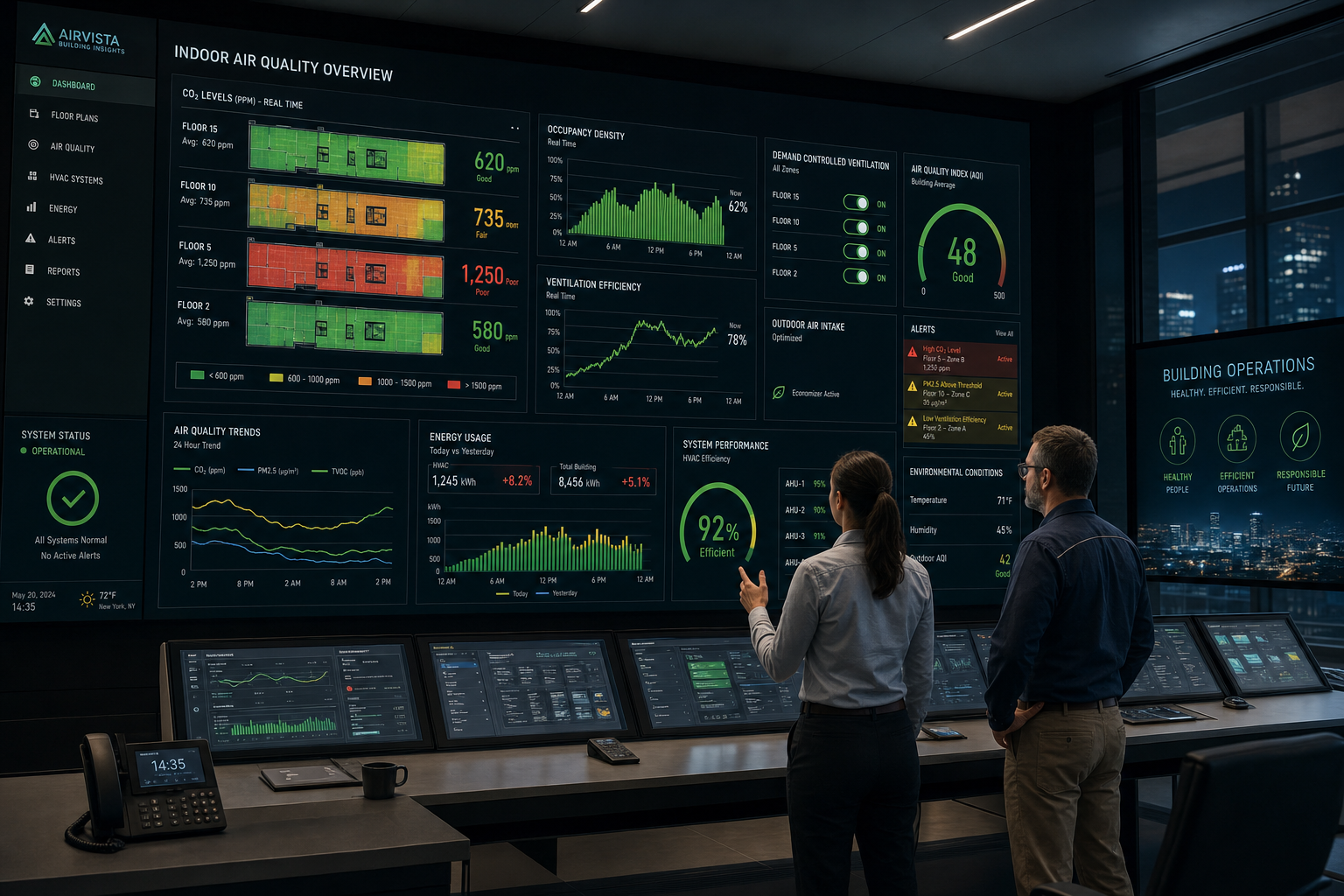
Modern commercial buildings increasingly use building management systems (BMS) to monitor and control ventilation in real time. Where a BMS is installed, surveyors should review logged IAQ data — CO2 trends, temperature records, and occupancy patterns — alongside physical measurements. This historical data can reveal intermittent problems that a single-visit survey might miss.
Where no BMS exists, the survey report should recommend whether installation is justified given the building's size, occupancy profile, and energy targets. The CIBSE Journal's analysis of post-pandemic ventilation strategies notes that intelligent, responsive systems consistently outperform fixed-rate ventilation in both IAQ outcomes and energy efficiency [4].
Practical Steps for Property Owners and Facilities Managers
Understanding the survey process is one thing; acting on its findings is another. The following framework gives commercial property stakeholders a structured path from assessment to improvement.
Before the Survey
- Gather existing documentation: Commissioning records, previous maintenance logs, and any prior IAQ complaints from occupants.
- Map current occupancy patterns: Provide the surveyor with accurate data on how many people use each zone, and when. Hybrid working schedules should be included.
- Identify recent changes: Any fit-out works, partition installations, or changes to cleaning products can affect IAQ and should be disclosed.
For properties that have undergone alterations, a licence to alter may have been required, and the associated technical documentation could include ventilation design information worth reviewing before the survey.
During the Survey
- Ensure full access to plant rooms, roof-mounted equipment, and ceiling voids.
- Allow the surveyor to take measurements during normal occupied hours where possible, so readings reflect real-world conditions.
- Make the facilities management team available to answer questions about system operation and recent maintenance history.
After the Survey
The survey report will typically categorise findings by urgency:
- Category 1 (Immediate action): Ventilation rates below minimum standards, evidence of mould in ductwork, failed extract systems in high-occupancy areas.
- Category 2 (Short-term action within 3-6 months): Filter replacements overdue, DCV controls not functioning, CO2 readings consistently above 1,000 ppm.
- Category 3 (Planned improvement): Upgrade to higher-specification filtration, BMS integration, recommissioning of underperforming zones.
Property owners should treat Category 1 findings as both a health and safety obligation and a potential liability issue. Tenants who can demonstrate that a landlord was aware of ventilation deficiencies and failed to act may have grounds for rent review claims or lease disputes. For guidance on how property condition intersects with lease obligations, commercial property surveyors can advise on both the technical and legal dimensions.
Emerging Technologies Shaping Post-Pandemic Ventilation Assessment
The tools available to surveyors conducting post-pandemic ventilation surveys have advanced considerably. Several technologies are now being integrated into both the assessment process and the long-term management of commercial IAQ.
Demand-Controlled Ventilation
DCV systems use CO2 sensors or occupancy sensors to modulate airflow in real time, increasing ventilation when a space is busy and reducing it when occupancy drops. This approach directly addresses the variable occupancy challenge identified in retail environments [1], and it aligns with the energy efficiency imperative that CIBSE has highlighted as essential to sustainable post-pandemic ventilation [4].
Portable Air Quality Monitors
Handheld and deployable monitors now measure CO2, PM2.5, PM10, total VOCs, temperature, and relative humidity simultaneously. These devices allow surveyors to build a detailed spatial picture of IAQ across a building in a single visit, rather than relying on fixed monitoring points.
Drone-Assisted Roof and Plant Inspections
For large commercial properties, drone surveys can inspect roof-mounted air handling units, cooling towers, and intake louvres without the need for scaffolding or access platforms. This reduces survey time and cost while improving the completeness of the mechanical inspection.
HEPA and Enhanced Filtration Upgrades
Where existing HVAC systems cannot achieve adequate ventilation rates through airflow alone, upgrading to HEPA or MERV-13 filtration provides a complementary layer of particulate removal. Surveyors should assess whether the existing ductwork and fan capacity can support higher-specification filters without reducing airflow below minimum rates.
The Link Between Ventilation, Damp, and Structural Defects
Ventilation surveys do not exist in isolation. Poor airflow is closely linked to condensation, damp, and mould growth — problems that affect both air quality and the structural fabric of a building. In commercial properties, inadequate extract ventilation in kitchens, bathrooms, and server rooms is a common source of moisture accumulation that can damage finishes, insulation, and structural elements over time.
A damp survey conducted alongside a ventilation assessment provides a more complete picture of the building's environmental performance. Where damp is identified in areas served by mechanical ventilation, the two issues are almost always connected and should be addressed together.
For a broader understanding of how different survey types relate to one another, reviewing the different types of survey comparison available for commercial properties helps owners choose the right combination of assessments for their specific circumstances.
Conclusion
The case for conducting post-pandemic ventilation surveys: assessing indoor air quality in commercial properties is no longer purely precautionary. With updated regulatory standards, measurable evidence of widespread IAQ shortfalls, and a workforce that is increasingly attentive to the environments in which it works, ventilation assessment has become a core component of responsible commercial property management in 2026.
Actionable next steps for property owners and managers:
- Commission a ventilation survey now if one has not been completed since pre-pandemic occupancy resumed — do not wait for occupant complaints or regulatory enforcement.
- Engage a chartered commercial building surveyor to lead or coordinate the assessment, ensuring findings are documented in a format suitable for lease, insurance, and compliance purposes.
- Prioritise Category 1 findings immediately — ventilation rates below current minimum standards represent both a health risk and a legal exposure.
- Evaluate DCV and BMS integration as part of any planned refurbishment, particularly for retail and open-plan office environments with variable occupancy.
- Combine the ventilation survey with damp and structural assessments to gain a complete picture of building performance and avoid addressing symptoms without resolving underlying causes.
Commercial property is a long-term asset. The air quality within it directly affects the health, productivity, and retention of the people who use it every day. A well-executed post-pandemic ventilation survey is not an overhead — it is an investment in the asset's performance and the people it serves.
References
[1] mdpi – https://www.mdpi.com/2075-5309/16/1/65?utm_source=openai
[2] Schoolehsworkshop Postpandemicventilationguidance 2023 – https://doh.wa.gov/sites/default/files/2023-11/SchoolEHSWorkshop-PostPandemicVentilationGuidance-2023.pdf?utm_source=openai
[3] Ppost Occupancy Evaluation Of Indoor Air Quality In Green Rated Commercial Interiorsp – https://www.cwejournal.org/index.php/vol18no1/ppost-occupancy-evaluation-of-indoor-air-quality-in-green-rated-commercial-interiorsp?utm_source=openai
[4] Ventilating The New Normal Balancing Iaq With Energy Efficiency – https://www.cibsejournal.com/technical/ventilating-the-new-normal-balancing-iaq-with-energy-efficiency/?utm_source=openai
[5] Building Assessment Survey And Evaluation Study – https://www.epa.gov/indoor-air-quality-iaq/building-assessment-survey-and-evaluation-study?utm_source=openai