By 2026, the oldest baby boomers are turning 80 — and the property sector is scrambling to keep pace. Senior housing occupancy reached 89.5% in Q1 2026, marking the 19th consecutive quarter of growth, yet new construction has fallen to its lowest level since 2012 [1]. That gap between surging demand and constrained supply makes precise, professional surveying not just useful but essential for every senior housing development that breaks ground this year.
Surveying for senior housing developments: meeting 2026 demographic demands requires more than standard site assessments. It demands a coordinated approach to boundary accuracy, structural integrity, accessibility compliance, and long-term condition monitoring — all shaped by the specific needs of an aging population.
Key Takeaways
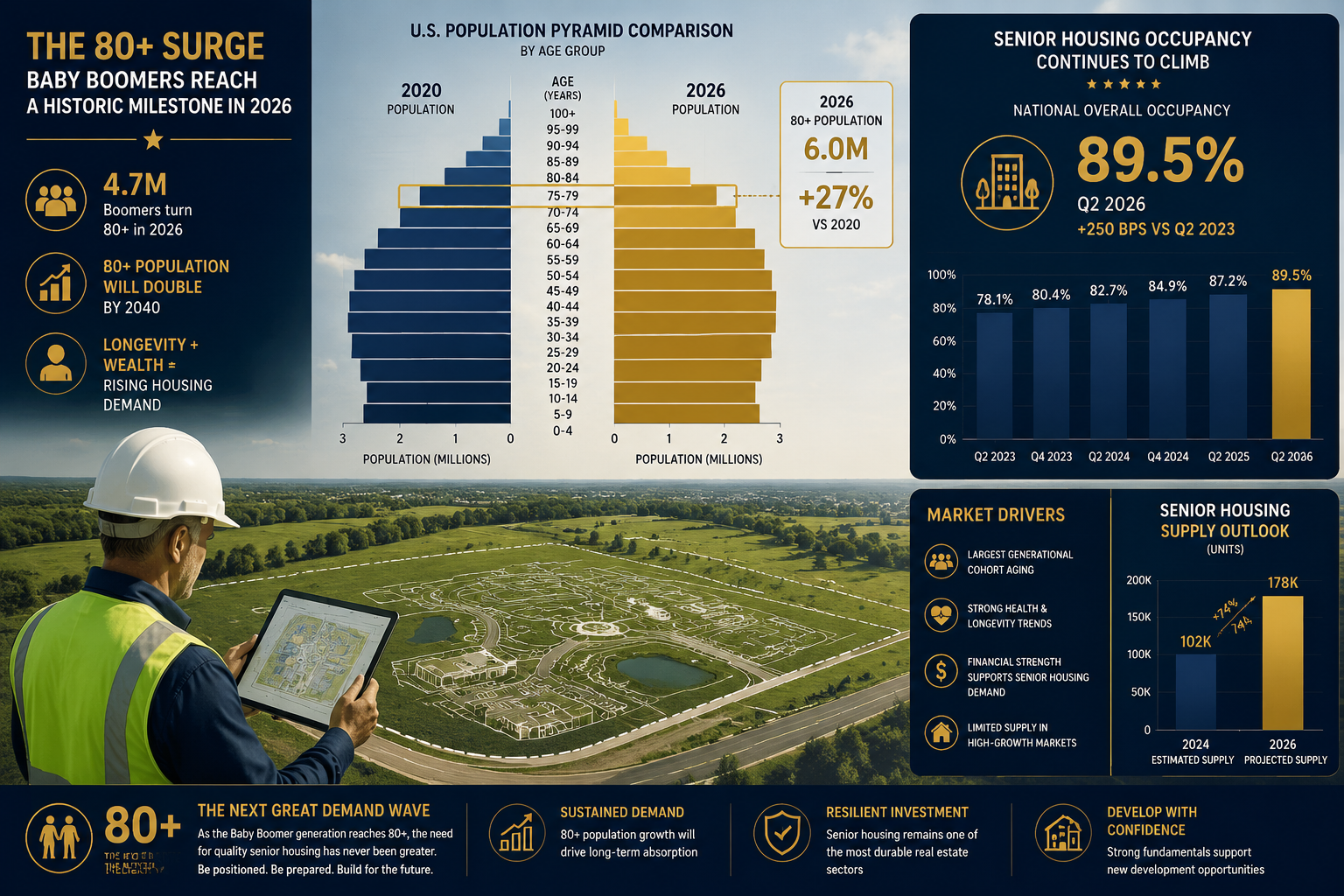
- Senior housing occupancy hit 89.5% in Q1 2026, driven by baby boomers turning 80 and a shrinking construction pipeline [1].
- New senior housing units under construction are at a 14-year low, with inventory growth of just 0.4% year-over-year [1].
- Investment in the sector reached a decade-high rolling transaction volume of $24 billion by end of 2025 [2].
- Accurate boundary surveys, structural assessments, and stock condition reports are critical for developers navigating tight sites and complex planning requirements.
- The 80-plus population is projected to grow by 36.6% over the next decade, meaning the surveying and development pipeline must scale urgently [4].
The 2026 Demographic Pressure Driving Senior Housing Development
Why Baby Boomers Are Reshaping the Market Right Now
The scale of demographic change in 2026 is not incremental — it is structural. The baby boomer generation, roughly 76 million people born between 1946 and 1964, is now entering the age bracket that historically drives the highest demand for purpose-built senior accommodation. According to PwC's Emerging Trends in Real Estate report, supply constraints and aging inventory risk creating a serious imbalance between what the market needs and what it can deliver [3].
The numbers reinforce this urgency. The 80-plus population is forecast to grow by 36.6% over the next decade [4]. At the same time, year-over-year inventory growth for senior housing sits at a record low of 0.4% in Q1 2026 [1]. Capital constraints, rising construction costs, and labor shortages have all contributed to a shrinking development pipeline [6].
"With industry-wide stabilized occupancy projected to approach 93% by 2028, developers who act now — and survey accurately — will capture the most value." [7]
For investors, the signals are equally clear. A rolling four-quarter transaction volume of $24 billion by end of 2025 marked the highest level since Q2 2015 [2]. Senior living valuations rose by more than 10% year-over-year in 2025, with cap rates compressing by 25 to 50 basis points [5]. An overwhelming 86% of investors surveyed plan to increase their exposure to the senior housing sector in 2026 [4].
What This Means for Surveyors and Developers
This confluence of demographic pressure, constrained supply, and investor confidence creates a high-stakes environment for every site brought forward for senior housing. Errors in boundary identification, missed structural defects, or inadequate condition assessments can delay planning consent, inflate costs, or — worse — result in buildings that fail to meet the functional needs of elderly residents.
Surveying for senior housing developments: meeting 2026 demographic demands therefore starts at the very beginning of the development process, not as an afterthought before practical completion.
Core Survey Types Required for Senior Housing Sites
Boundary and Topographic Surveys
Before any design work begins, precise boundary surveys establish the legal extent of the site. For senior housing developments, which frequently involve former care homes, redundant commercial properties, or greenfield edge-of-town plots, boundary disputes can stall projects for months. A thorough boundary survey identifies encroachments, rights of way, and easements that may restrict the footprint available for accessible, single-storey or low-rise design.
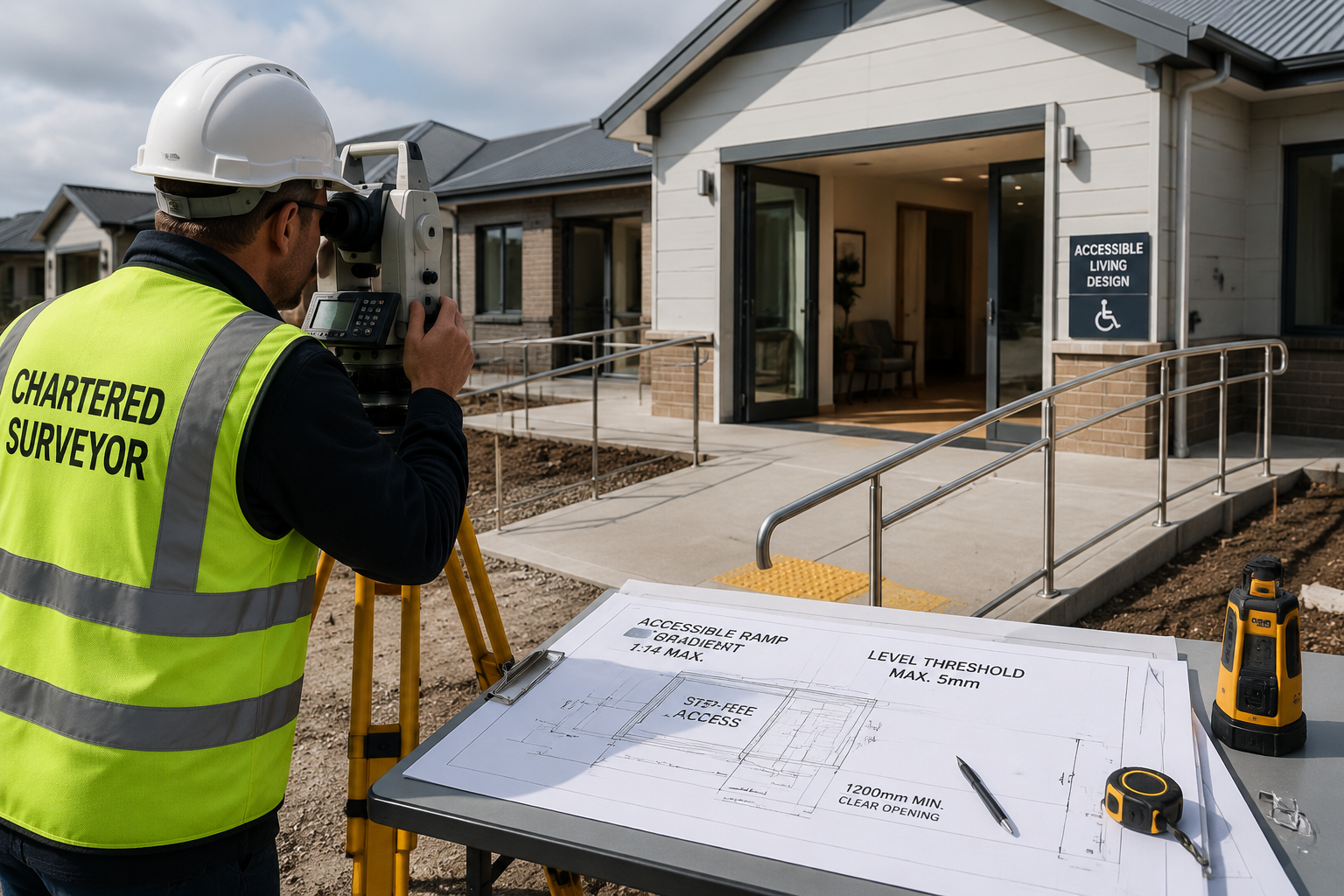
Topographic surveys add the three-dimensional layer: ground levels, drainage falls, and gradient changes that directly affect whether a site can accommodate step-free access, level thresholds, and accessible parking — all non-negotiable requirements for aging-in-place communities.
Structural Surveys and Building Condition Assessments
Many senior housing developments involve converting or extending existing buildings. A detailed structural survey is essential before any conversion project proceeds. Older buildings that appear sound may conceal significant defects: inadequate floor loadings, deteriorating roof structures, or damp penetration that would compromise the health of vulnerable residents.
For new-build schemes, structural assessments of the ground conditions — including soil bearing capacity and contamination risk — inform foundation design. Developers should also commission soil and water contamination assessments on brownfield sites, where legacy industrial use may have left hazardous residues incompatible with residential occupation.
A solid floor slab survey is particularly relevant for ground-floor senior living units, where level, durable flooring is a safety and accessibility requirement. Cracked or uneven slabs create trip hazards that are disproportionately dangerous for elderly residents.
Stock Condition Surveys for Existing Senior Housing Portfolios
Not all senior housing activity in 2026 involves new development. A significant portion of investor activity targets the acquisition and refurbishment of existing stock, where aging inventory is being repositioned to meet modern care standards. A stock condition survey provides a systematic assessment of the physical condition of an existing portfolio, identifying maintenance liabilities, capital expenditure requirements, and compliance gaps.
For operators acquiring portfolios in the current high-transaction environment, a stock condition survey is the evidence base for negotiating purchase price, planning refurbishment programmes, and satisfying lender due diligence requirements.
Damp and Specialist Defect Surveys
Damp is among the most common and consequential defects in older residential buildings. For senior housing, where residents may spend the majority of their time indoors, damp-related air quality issues carry real health risks. A damp survey identifies the source — whether rising damp, penetrating damp, or condensation — and informs remediation before occupation.
Where specific defects are identified during initial assessments, a specialist defect survey provides the detailed diagnosis needed to scope remedial works accurately and avoid costly surprises during construction.
Asbestos Surveys
Any senior housing development involving buildings constructed before 2000 must include an asbestos management survey as a legal requirement under the Control of Asbestos Regulations 2012. Surveys for asbestos identify the location, condition, and extent of asbestos-containing materials, enabling safe management or removal before refurbishment works begin. This is non-negotiable for the protection of both construction workers and future residents.
Accessibility, Compliance, and the Surveying Workflow for Aging-in-Place Communities

Designing for the Specific Needs of Older Residents
Surveying for senior housing developments: meeting 2026 demographic demands goes beyond standard residential practice because the end users have specific, well-documented physical requirements. Mobility limitations, visual impairment, and cognitive change all affect how buildings need to be designed, and surveyors play a direct role in ensuring that the physical evidence gathered on site translates into compliant, liveable spaces.
Key accessibility considerations that surveyors must capture and report on include:
- Level access thresholds: Ground levels must be surveyed with sufficient precision to confirm that step-free access is achievable at all entry points.
- Corridor and door widths: Existing buildings being converted must be measured to confirm compliance with Part M of the Building Regulations, which sets minimum widths for wheelchair access.
- Gradient of external paths and ramps: Topographic data must be detailed enough to design ramps within the maximum 1:20 gradient permitted for unassisted wheelchair use.
- Lift shaft feasibility: In multi-storey schemes, structural surveys must confirm whether existing floor-to-floor heights and structural bays can accommodate a compliant passenger lift.
- Bathroom and wet room layouts: Floor construction surveys inform whether wet room drainage can be installed without compromising structural integrity.
Party Wall Considerations in Dense Urban Sites
Senior housing developments in urban areas — where land is scarce and the demographic pressure is most acute — frequently involve works adjacent to or astride shared boundaries. The Party Wall etc. Act 1996 requires formal notice to be served on adjoining owners before excavation near foundations or works to shared walls commence.
Developers should understand their obligations early. Failure to serve proper notice can result in injunctions that halt construction. A schedule of condition report prepared before works begin protects both the developer and the adjoining owner by creating an agreed photographic and written record of pre-existing conditions — essential evidence if any dispute about alleged damage arises later.
Monitoring Surveys During Construction
Senior housing developments are often phased, with residents occupying completed units while construction continues nearby. Monitoring surveys track ground movement, structural settlement, and vibration levels throughout the construction programme, providing early warning of any movement that could affect occupied buildings or adjacent structures. This is particularly important where piling or deep excavation is required on constrained urban sites.
Commercial Building Surveys for Mixed-Use Senior Living Schemes
The senior housing market in 2026 increasingly includes mixed-use schemes that combine residential care with commercial elements: on-site pharmacies, GP surgeries, cafes, and community facilities. These elements require a commercial building survey to assess the condition of commercial floor plates, loading capacities, and mechanical and electrical installations that differ substantially from residential requirements.
Investment Due Diligence: Surveying in the Context of a High-Transaction Market
The record transaction volumes seen in the senior housing sector — $24 billion in rolling four-quarter activity by end of 2025 [2] — mean that surveying due diligence is being conducted at pace and at scale. Buyers and their lenders require comprehensive survey evidence before committing capital, and the compressed timelines typical of competitive acquisition processes place significant demands on surveying teams.
The following table summarises the key survey types relevant to different senior housing transaction scenarios:
| Transaction Type | Primary Survey Required | Secondary Surveys to Consider |
|---|---|---|
| Greenfield new-build | Topographic and boundary survey | Soil contamination, structural engineering |
| Conversion of existing building | Structural survey, damp survey | Asbestos survey, specialist defect survey |
| Portfolio acquisition | Stock condition survey | Schedule of condition, monitoring surveys |
| Mixed-use development | Commercial building survey | Party wall assessment, structural survey |
| Refurbishment of existing care home | RICS Level 3 Building Survey | Asbestos survey, damp survey |
For investors acquiring existing senior housing stock, understanding surveyor pricing early in the due diligence process helps budget accurately for the full suite of assessments required. Survey costs are a small fraction of total acquisition costs but can prevent disproportionately large remediation liabilities from being overlooked.
The Role of RICS-Qualified Surveyors
All surveys commissioned for senior housing developments should be carried out by RICS-qualified professionals. RICS membership signals adherence to professional standards, independent judgment, and professional indemnity insurance — all of which matter when survey findings are used to support planning applications, secure development finance, or defend against legal claims.
For complex senior housing schemes, the surveying workflow typically involves multiple RICS-qualified specialists: a building surveyor for structural and condition assessments, a valuation surveyor for acquisition and development appraisal, and a project manager to coordinate the delivery programme. Project management support from a firm experienced in residential and commercial development can significantly reduce the risk of programme delays caused by uncoordinated survey activity.
Conclusion
The demographic arithmetic of 2026 is unambiguous. With occupancy rates at near-historic highs, new construction at a 14-year low, and the 80-plus population set to grow by more than a third over the next decade, the senior housing sector faces a supply challenge that only well-planned, accurately surveyed development can address [1][4][7].
Surveying for senior housing developments: meeting 2026 demographic demands is not a back-office compliance exercise. It is the technical foundation on which every viable scheme is built — from the first boundary peg in the ground to the final snagging inspection before residents move in.
Actionable next steps for developers, investors, and operators:
- Commission boundary and topographic surveys at the earliest feasible stage of site appraisal to avoid costly redesigns.
- Instruct structural and damp surveys on any existing building being considered for conversion before heads of terms are agreed.
- Budget for a full stock condition survey on any portfolio acquisition, using findings to negotiate price and plan capital expenditure.
- Engage RICS-qualified surveyors with specific experience in residential care and senior living to ensure accessibility requirements are captured accurately.
- Build monitoring surveys into the construction programme for any scheme involving phased occupation or works adjacent to existing buildings.
- Consult a specialist surveying firm early to understand the full scope and cost of due diligence required for the specific transaction type.
The window to capture value in the senior housing market is open — but only for those who build on solid surveying foundations.
References
[1] Senior Housing Occupancy Rises As Capital Constraints Stall New Development – https://www.globest.com/2026/04/24/senior-housing-occupancy-rises-as-capital-constraints-stall-new-development/?utm_source=openai
[2] Seniors Housing Investment Reaches Decade High Of 24 Billion – https://www.jll.com/en-us/newsroom/seniors-housing-investment-reaches-decade-high-of-24-billion?utm_source=openai
[4] Seniors Housing Care Investor Survey And Trend Outlook – https://www.jll.com/en-us/insights/market-perspectives/seniors-housing-care-investor-survey-and-trend-outlook?utm_source=openai
[5] Senior Living Investors Bet On Tighter Cap Rates As Recovery Deepens – https://www.globest.com/2026/02/09/senior-living-investors-bet-on-tighter-cap-rates-as-recovery-deepens/?utm_source=openai
[6] Development Challenges High Demand Keep Senior Living Ma In The Spotlight In 2026 – https://seniorhousingnews.com/2026/05/26/development-challenges-high-demand-keep-senior-living-ma-in-the-spotlight-in-2026/?utm_source=openai
[7] Senior Housing Five Key Trends To Watch In 2026 – https://www.nicmap.com/blog/senior-housing-five-key-trends-to-watch-in-2026/?utm_source=openai