

Landlord instructions in the UK rental market fell to a net balance of -24% in January 2026, according to RICS data — yet tenant demand simultaneously climbed, with 28% of respondents anticipating rental price rises [3]. That gap between supply and demand is reshaping the economics of every renovation decision a landlord makes, including those that trigger obligations under the Party Wall etc. Act 1996. For landlords planning extensions, loft conversions, or basement works on tenanted properties, Party Wall Act compliance for 2026 lettings landlord instructions has never carried more financial weight — or more procedural complexity.
This article guides landlords, managing agents, and party wall surveyors through the specific pressures created by RICS-reported supply constraints, the evolving professional standards set out in the forthcoming 8th edition of RICS party wall guidance, and the intersection of party wall obligations with the newly enacted Renters' Rights Act 2026.
Key Takeaways
- Landlord instructions in January 2026 stood at a net balance of -24%, intensifying the financial stakes of any works that disrupt tenanted properties and trigger party wall obligations.
- RICS is consulting on the 8th edition of its party wall guidance, with the consultation closing on 5 June 2026 — surveyors must prepare for updated professional standards.
- The Renters' Rights Act 2026 introduces new tenant protections that run alongside, but independently of, the Party Wall etc. Act 1996.
- Serving correct party wall notices before works begin is not optional; failure to do so exposes landlords to injunctions, disputes, and compensation claims.
- Surveyors must remain impartial throughout the party wall process, acting in the interests of the wall structure itself rather than either appointing owner.
Why 2026 Lettings Market Conditions Raise the Stakes for Party Wall Compliance
The connection between rental market supply and party wall compliance may not be immediately obvious, but it is direct. When landlord instructions are suppressed — as RICS data clearly shows for early 2026 — the properties that remain in the rental stock become more valuable per unit. Any works that cause a void period, a rent reduction, or a deterioration in tenant relations carry a heavier financial penalty than they would in a balanced market [3].
The core dynamic in 2026 looks like this:
| Market Indicator | January 2026 Net Balance |
|---|---|
| New landlord instructions | -24% |
| Tenant demand (rent rise expectations) | +28% |
| New buyer enquiries (residential) | +1% (flat) |
Source: RICS Residential Market Survey, January 2026 [3]
For a landlord considering a rear extension that involves a shared wall with a neighbour, the decision to proceed quickly — without properly serving party wall notices — can result in an injunction halting works mid-build. In a market where void periods directly translate to lost income against a backdrop of rising tenant demand, that injunction is not merely an inconvenience. It is a significant financial event.
Party wall surveyors advising landlord clients in 2026 must therefore frame compliance not as bureaucratic overhead but as risk management with a measurable return on investment.
What Triggers a Party Wall Notice for Landlord Renovation Projects
Landlords undertaking works on tenanted or vacant rental properties most commonly trigger the Party Wall etc. Act 1996 through three categories of work:
- Rear extensions that involve cutting into or building on a party wall separating two terraced or semi-detached properties.
- Loft conversions requiring modifications to the party wall, including the insertion of steel beams or raising of the wall. For a detailed overview, see this guide on party wall loft conversions.
- Basement excavations or underpinning within three metres of a neighbouring structure's foundations. The three-metre rule explained is essential reading for any landlord planning below-ground works.
Additionally, works involving shared chimney stacks — common in Victorian and Edwardian terraced rental stock — may require notice. The obligations around shared chimneys and chimney stacks are frequently overlooked by landlords and their contractors.
"The Party Wall etc. Act 1996 is not a planning permission substitute. It is a separate statutory regime that runs in parallel with planning and building regulations — and ignorance of it is not a defence."
The RICS 8th Edition Consultation and What It Means for Surveyors in 2026
RICS has released a consultation draft for the 8th edition of its guidance on party wall legislation and procedure, with the consultation period closing on 5 June 2026 [1]. This is the most significant update to professional guidance in this area for several years, and its implications for surveyors working on landlord-instructed projects are substantial.
Elevated Professional Standards
The draft makes clear that while the Party Wall etc. Act 1996 sets minimum legal obligations, RICS members are expected to uphold higher standards of integrity, competence, and impartiality [2]. The quasi-judicial role that party wall surveyors occupy does not confer judicial immunity. Surveyors who act incompetently or engage in misconduct can face disciplinary action from RICS regardless of whether their party wall award is technically valid [2].
For surveyors working in the lettings sector — where landlord clients may be under commercial pressure to complete works quickly — this creates a specific professional tension. The surveyor's duty is to the process and the wall, not to the landlord's schedule.
Key professional obligations reinforced in the 8th edition consultation include:
- Maintaining impartiality even when appointed by one party [6]
- Avoiding practices that perpetuate bad professional habits, such as rubber-stamping inadequate notices [7]
- Ensuring schedules of condition are thorough and accurately reflect pre-works property states
- Communicating clearly with all parties, including adjoining owners who may be tenants rather than freeholders
Impartiality in Practice
RICS has long emphasised that party wall surveyors must act in the interests of the wall structure itself, not the appointing owner [6]. In the lettings context, this principle is tested when a landlord client pushes for a party wall award that minimises working hours restrictions or maximises the scope of permitted works. The surveyor's role is to produce an award that is fair, legally sound, and protective of all affected parties — including the adjoining owner and any tenants in either property.
For guidance on what a properly constituted award should contain, the party wall award guidance provides a practical framework.
Managing Party Wall Compliance When Landlord Supply Is Constrained
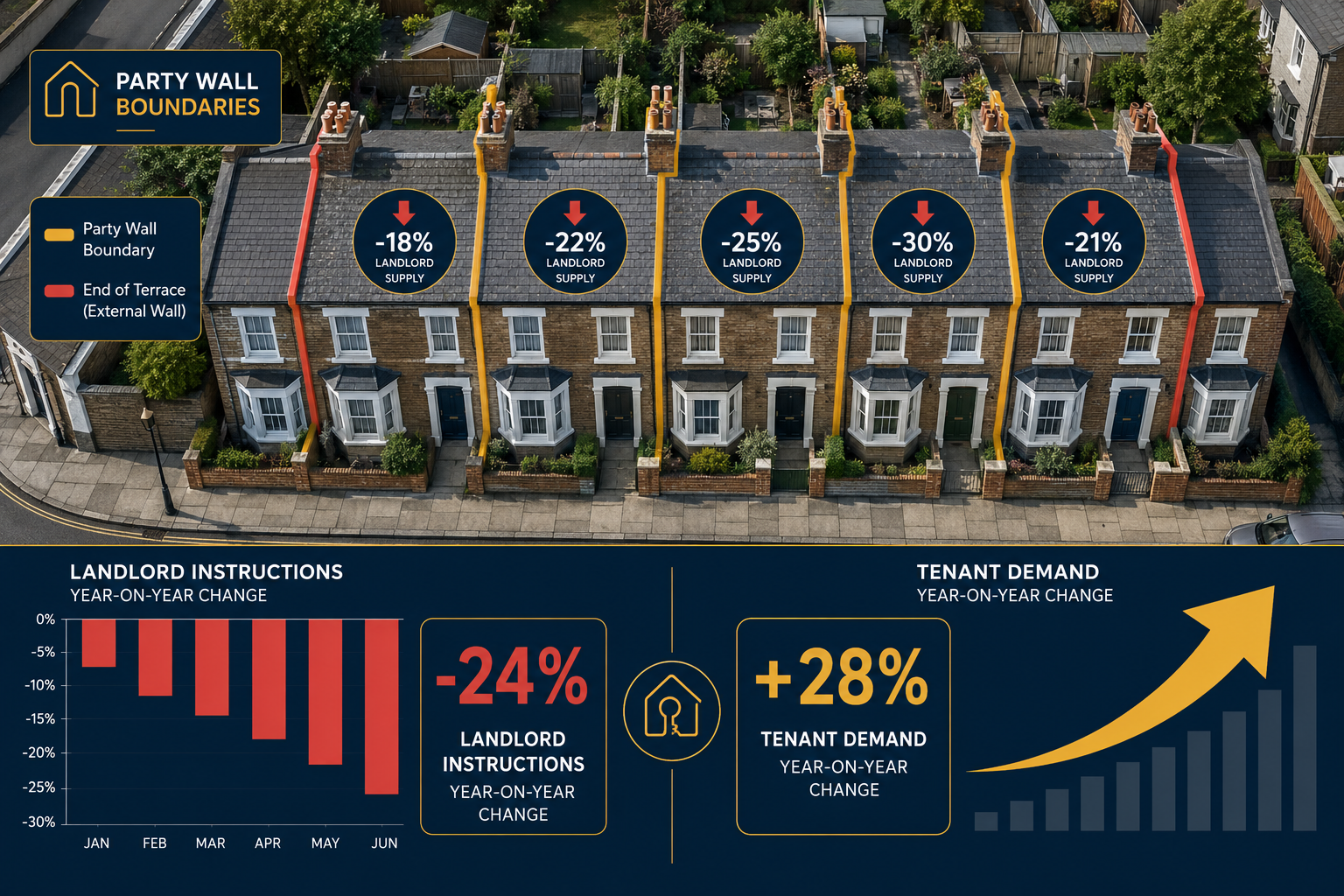
The practical challenge for party wall surveyors in 2026 is managing landlord clients who are operating under significant market pressure. With landlord instructions at -24% [3], those landlords who remain active in the market are often doing so by adding value through renovation — and they want works completed efficiently.
The Procedural Timeline and Why It Cannot Be Compressed
The Party Wall etc. Act 1996 sets statutory timeframes that cannot be shortened by agreement between the building owner and the surveyor alone. Key timelines include:
- Party wall notice period: One month's notice for party wall works; two months for new walls on the boundary line.
- Response period: The adjoining owner has 14 days to consent or dissent after receiving a notice.
- Award preparation: Once surveyors are appointed following a dissent, there is no fixed statutory deadline, but unreasonable delay can be challenged.
Landlords who fail to serve notice before beginning works face the risk of injunction, as explored in the consequences of party wall notice not being served. In a constrained rental market, a court-ordered halt to works is among the most costly outcomes a landlord can face.
Schedules of Condition for Tenanted Properties
One area where party wall compliance intersects directly with the lettings market is the schedule of condition. Before notifiable works begin, a thorough record of the adjoining property's condition is essential. This protects both the building owner (the landlord) and the adjoining owner from disputes about whether damage was caused by the works.
In the lettings context, the schedule of condition may need to reflect the state of a tenanted property — meaning the surveyor must coordinate access with both the adjoining owner and any sitting tenant. For leasehold and tenanted properties, a schedule of condition for leasehold properties provides relevant procedural detail.
If damage does occur during works, the damage to property under the Party Wall Act framework sets out how claims are assessed and resolved.
Excavation Near Neighbouring Rental Properties
Landlords adding basement conversions or underpinning existing foundations must serve notice under Section 6 of the Act when excavating within three metres of a neighbouring structure. For properties in dense urban rental markets — where Victorian terraces sit close together — this is a frequent trigger. The notice requirements for excavation near a neighbour outlines the specific obligations.
The Renters' Rights Act 2026 and Its Interaction with Party Wall Obligations
The Renters' Rights Act 2026 introduces a new layer of obligation for landlords planning renovation works. While the Act operates independently of the Party Wall etc. Act 1996, the two frameworks interact in practice [4].
Key areas of interaction include:
- Tenant displacement during works: The Renters' Rights Act 2026 strengthens tenant security of tenure. Landlords cannot use renovation works as a pretext for eviction without meeting specific statutory grounds. This means works must be planned around existing tenancies, not the other way around.
- Habitability standards during works: If party wall works create noise, dust, or structural disruption that renders part of a property temporarily uninhabitable, landlords may face rent reduction obligations under the new Act.
- Notice obligations: Landlords must give appropriate notice to tenants of planned works, separate from and in addition to party wall notices served on adjoining owners.
Party wall surveyors advising landlord clients should ensure their clients have taken separate legal advice on Renters' Rights Act 2026 compliance before works commence. The surveyor's role under the Party Wall etc. Act 1996 does not extend to tenancy law advice, but flagging the interaction is part of competent professional practice [4].

Practical Steps for Party Wall Surveyors Advising Landlord Clients in 2026
Given the convergence of RICS supply constraints, the forthcoming 8th edition guidance, and the Renters' Rights Act 2026, party wall surveyors working with landlord clients should follow a structured approach.
Step 1: Early Engagement and Works Assessment
Engage with the landlord client before any works are designed or contracted. Identify all elements of the proposed works that may trigger the Act, including:
- Any wall shared with an adjoining owner
- Any excavation within three or six metres of a neighbouring structure
- Any works to a boundary wall
Early identification allows notices to be served within the project programme rather than as an afterthought.
Step 2: Serve Correct and Complete Notices
Notices must be served in writing, must describe the works with sufficient precision, and must be served on all relevant adjoining owners. Common errors include:
- Serving notice on a tenant rather than the freeholder (or vice versa, depending on the lease structure)
- Failing to describe excavation works separately from party wall works
- Serving notice too late to allow the statutory response period before works are due to start
Step 3: Obtain Consent or Proceed to Award
If the adjoining owner consents in writing within 14 days, works may proceed without a formal award. If the adjoining owner dissents or fails to respond, both parties must appoint surveyors (or agree on a single agreed surveyor) to produce a party wall award. Understanding what a party wall dispute involves helps landlords and surveyors prepare for the dissent process.
For landlords who want to understand the consent process before a dispute arises, the consent for party wall work page sets out the options clearly.
Step 4: Prepare a Thorough Schedule of Condition
Before works begin, record the condition of all affected parts of the adjoining property with photographs, written descriptions, and measurements. This document is the primary evidence base if a damage claim arises later.
Step 5: Monitor Works and Address Obstruction Promptly
If the adjoining owner or their occupants obstruct access necessary to carry out party wall works, the Act provides remedies. Surveyors should be aware of the rules around obstruction in party wall matters to advise clients appropriately.
Conclusion
Party Wall Act compliance for 2026 lettings landlord instructions sits at the intersection of tightening professional standards, a constrained rental supply environment, and new tenant protection legislation. The RICS-reported net balance of -24% for landlord instructions is not just a market statistic — it is a signal that the properties landlords do bring to market, and the works they undertake to improve them, carry heightened financial and legal risk.
Actionable next steps for surveyors and landlords in 2026:
- Review the RICS 8th edition consultation draft before the 5 June 2026 closing date and assess how updated standards will affect current practice.
- Audit all planned renovation projects for party wall triggers before design is finalised — not after planning permission is granted.
- Serve party wall notices as early as the project programme allows, allowing maximum time for the statutory response period.
- Prepare comprehensive schedules of condition for all tenanted adjoining properties, coordinating access with both freeholders and sitting tenants.
- Ensure landlord clients have taken separate advice on Renters' Rights Act 2026 obligations before works affecting tenanted properties begin.
- Maintain strict impartiality throughout the survey and award process, consistent with both the Act and RICS professional standards.
The surveyors who will serve their landlord clients most effectively in 2026 are those who treat party wall compliance not as a procedural hurdle but as a professional discipline that protects all parties — and ultimately supports the rental market's ability to function.
References
[1] Consultationhome – https://consultations.rics.org/party_walls_8th_edition_guidance/consultationHome?utm_source=openai
[2] Viewcompounddoc – https://consultations.rics.org/party_walls_8th_edition_guidance/viewCompoundDoc?docid=16799988&partid=16800404&pfv=y&utm_source=openai
[3] Leveraging RICS January 2026 Residential Survey Recovery Signals In Party Wall Project Valuations – https://wimbledonsurveyors.com/leveraging-rics-january-2026-residential-survey-recovery-signals-in-party-wall-project-valuations-2/?utm_source=openai
[4] Party Wall Surveys Under Renters Rights Act 2026 Managing Landlord Extensions With New Tenant Protections – https://kingstonsurveyors.com/party-wall-surveys-under-renters-rights-act-2026-managing-landlord-extensions-with-new-tenant-protections/?utm_source=openai
[5] RICS Consumer Guide Party Walls – https://www.ricsfirms.com/residential/legal-issues/party-walls/rics-consumer-guide-party-walls/?utm_source=openai
[6] Party Wall Surveyors Impartiality – https://ww3.rics.org/uk/en/journals/built-environment-journal/party-wall-surveyors-impartiality.html?utm_source=openai
[7] Ethics And Party Wall Practice – https://ww3.rics.org/uk/en/journals/property-journal/ethics-and-party-wall-practice.html?utm_source=openai