

Multi-generational living has surged across the UK, with the number of households containing two or more adult generations rising by over 40% in the past decade, driven by remote working patterns, rising housing costs, and an ageing population. When families extend their homes to accommodate elderly parents or returning adult children, they rarely anticipate that a legal document called a Party Wall Award may be just as important as the planning permission itself. Understanding Party Wall Awards for Multi-Generational Home Adaptations: 2026 Survey Protocols for Family Extensions is now essential knowledge for any homeowner planning a granny annexe, side-return extension, or loft conversion.
Key Takeaways
- A Party Wall Award is a legally binding document required under the Party Wall etc. Act 1996 whenever notifiable building work affects a shared wall, boundary, or nearby excavation.
- No separate 2026 "multi-generational protocol" has been issued by government; the standard Party Wall framework applies to all family extension types, including granny annexes and side returns.
- The survey process in practice centres on a Schedule of Condition, risk-based controls, and clearly documented neighbour consent or dissent.
- Serving notice correctly and within statutory timelines is the single most effective way to prevent costly disputes and project delays.
- Engaging a qualified party wall surveyor early, ideally before drawings are finalised, reduces the risk of neighbour objections derailing a project.
What Is a Party Wall Award and Why Does It Matter for Family Extensions
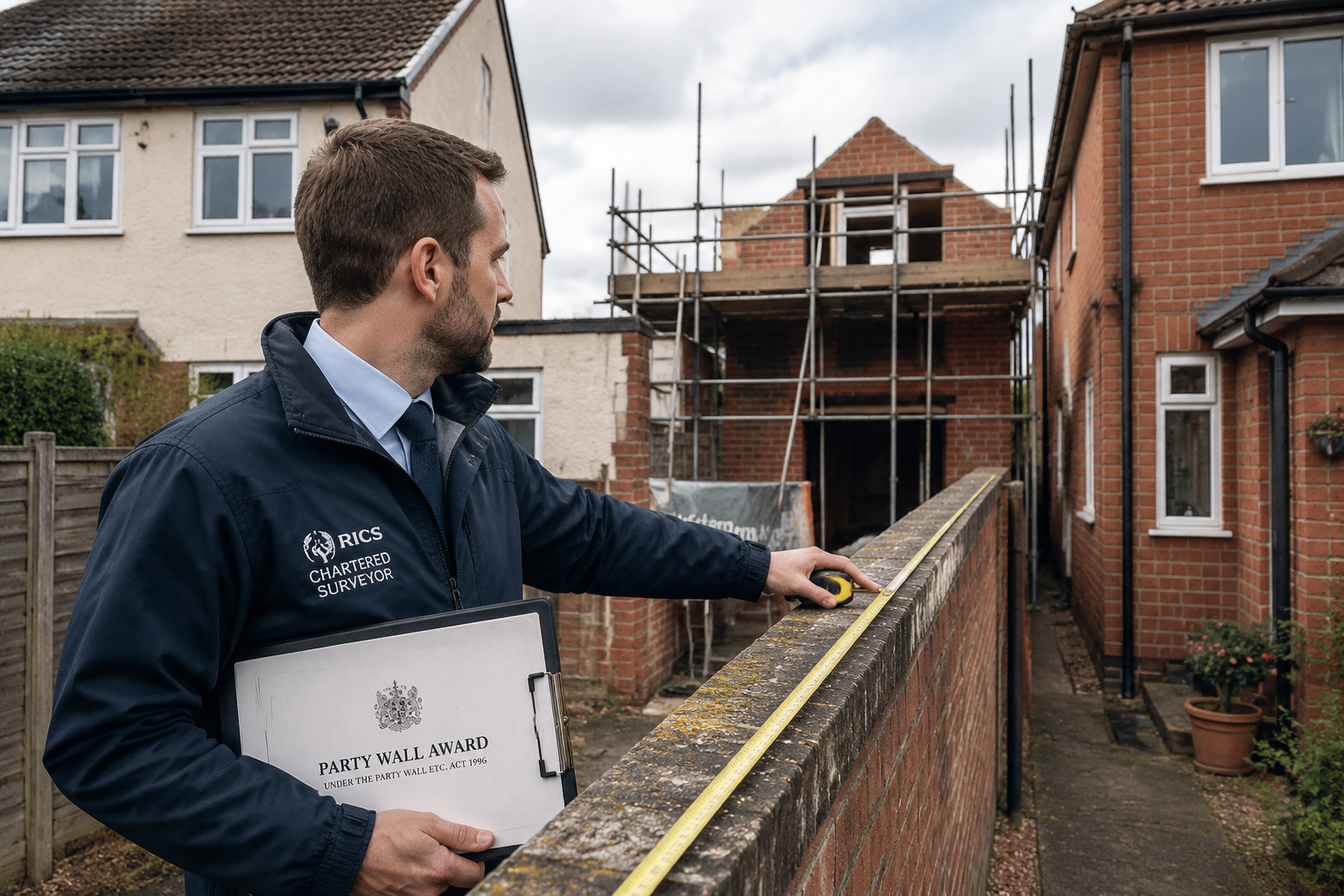
A Party Wall Award is a formal written agreement, produced by one or more appointed surveyors, that sets out the rights and obligations of both the building owner (the person doing the work) and the adjoining owner (the neighbour) [1]. It is not optional when the work is notifiable under the Party Wall etc. Act 1996.
For multi-generational home adaptations, the most common triggers are:
- Side-return extensions that build up to or astride the boundary line
- Rear extensions that involve excavation within three or six metres of a neighbouring structure, depending on depth
- Loft conversions that cut into or raise a shared party wall or chimney stack
- Granny annexe construction in the garden that requires new foundations near the boundary
The Award itself does not grant planning permission. It operates entirely within the separate legal framework of the Party Wall etc. Act 1996, and both processes must run in parallel [2]. Families who assume that planning approval covers everything frequently find themselves in dispute with neighbours after work has already begun.
For a detailed overview of how Party Wall Awards are structured, the guidance for Party Wall Awards from Canterbury Surveyors provides a practical breakdown of what the document must contain and how it protects both parties.
When Is a Party Wall Award Required for Multi-Generational Projects
Not every family extension triggers the Act. The key question is whether the proposed work falls within one of the three categories defined by the legislation.
Work on or Adjacent to a Party Wall
If the extension involves cutting into a party wall, raising its height, underpinning it, or inserting a steel beam through it, a notice must be served at least two months before work begins [3]. This is the most common scenario for loft conversions that form part of a multi-generational adaptation.
Excavation Near a Neighbouring Structure
When foundations for a new annexe or extension are dug within three metres of a neighbour's building and to a depth lower than their foundations, the Three Metre Rule applies. If the excavation goes within six metres and would undercut a 45-degree line drawn from the base of the neighbour's foundations, the Six Metre Rule is triggered. Full guidance on notice requirements for excavation near a neighbour explains how depth calculations are made and what supporting information must accompany the notice.
New Walls at the Boundary
Building a new wall directly on the line of junction between two properties requires a one-month notice period [4]. This is particularly relevant for granny annexe projects where a connecting structure is built against or along the shared boundary.
| Work Type | Notice Period | Trigger Condition |
|---|---|---|
| Party wall works (loft, beam insertion) | 2 months | Work on or to the party wall itself |
| Excavation (3m rule) | 1 month | Foundations deeper than neighbour's within 3m |
| Excavation (6m rule) | 1 month | Foundations undercutting 45-degree line within 6m |
| New wall at boundary | 1 month | Wall built on or at the line of junction |
2026 Survey Protocols for Family Extensions: What the Process Actually Looks Like
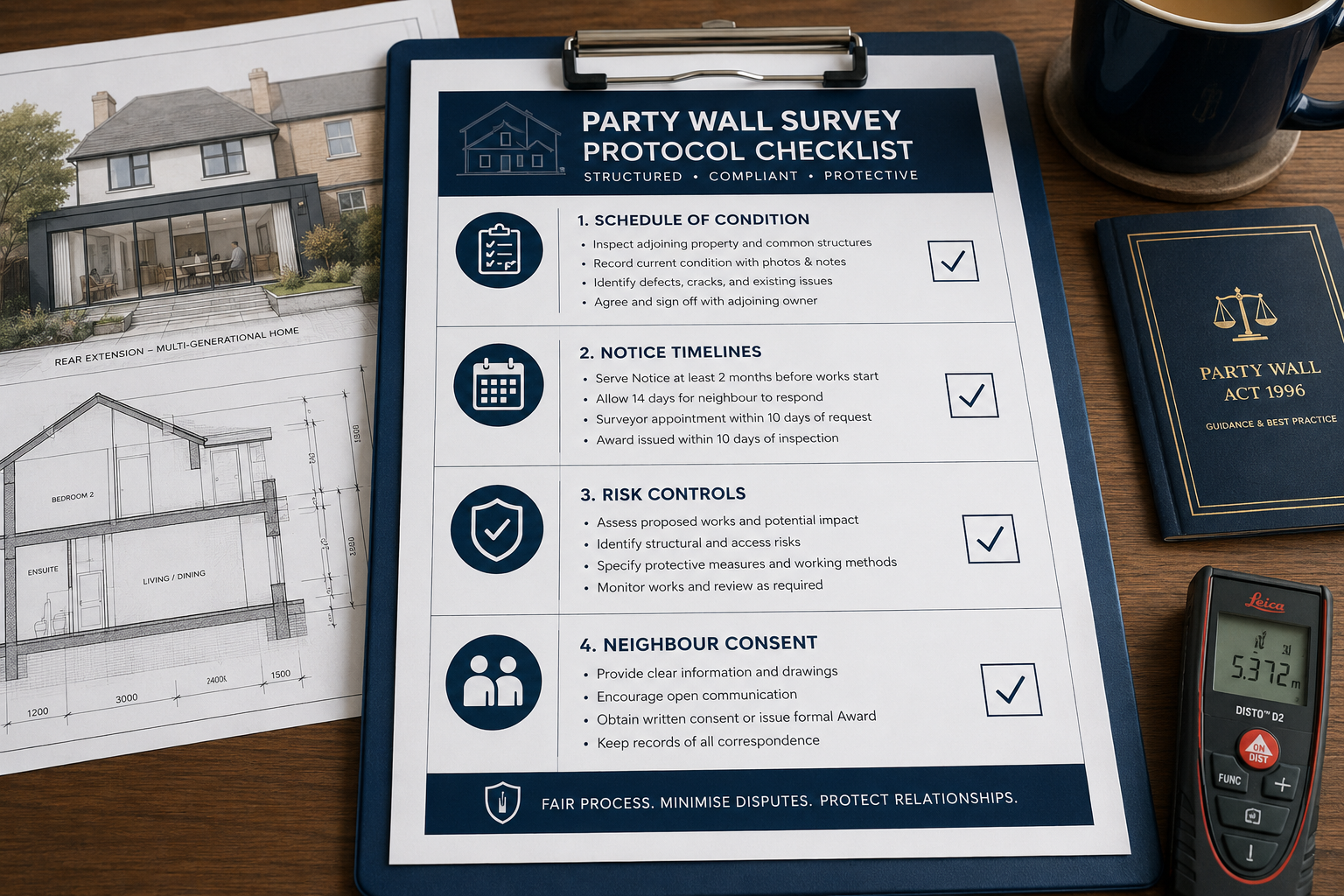
Despite widespread references to "2026 survey protocols," there is no new government rulebook specific to multi-generational home adaptations issued for 2026. The Party Wall etc. Act 1996 remains the governing legislation, and the RICS Party Wall Legislation and Procedure guidance (7th edition) continues to set professional standards [7]. What has evolved is best practice in how surveyors document condition, communicate risk, and manage neighbour expectations, particularly for the more complex, phased projects common in family extensions.
Step 1: Serve the Correct Notice
The process begins with the building owner serving a written Party Wall Notice on every adjoining owner. The notice must describe the proposed works, state the intended start date, and be accompanied by sufficient drawings for the neighbour to understand the scope. Errors at this stage are the most common cause of delays. For those uncertain about their obligations, the party wall FAQs page covers the most frequent misunderstandings around notice service.
"Serving notice is not a formality — it is the legal foundation on which the entire Award rests. A defective notice can invalidate the whole process."
Step 2: Await Consent or Dissent
After receiving notice, the adjoining owner has 14 days to respond. They can:
- Consent in writing, allowing work to proceed without a formal Award
- Dissent and appoint their own surveyor, triggering the Award process
- Fail to respond, which is treated as dissent after the 14-day period expires [2]
For multi-generational projects where the relationship with neighbours is ongoing and important, obtaining written consent is strongly preferable to proceeding after a deemed dissent. The consent for party wall work page outlines exactly what written consent must include to be legally effective.
Step 3: Appoint Surveyors and Prepare the Schedule of Condition
When dissent is recorded, both parties appoint surveyors. They may agree on a single "agreed surveyor" to act for both, which is common in family extension cases where the relationship with neighbours is amicable and cost is a concern [6].
The Schedule of Condition is one of the most practically important documents in the entire process. It records the existing state of the adjoining property before any work begins, typically including:
- Photographs of internal and external walls, ceilings, and floors
- Notes on existing cracks, settlement, and defects
- Measurements of any pre-existing movement
This document protects both parties. If the neighbour later claims that a crack appeared because of the extension work, the Schedule of Condition provides an objective baseline. The Schedule of Condition for party wall work explains how this survey is conducted and what it should contain.
Step 4: Draft and Serve the Award
The surveyors then prepare the Party Wall Award itself, which sets out:
- A description of the permitted works
- Working hours and site access arrangements
- Method statements for particularly sensitive operations (e.g., underpinning or beam insertion)
- Security for expenses if required
- The Schedule of Condition as an appendix
- Rights of access for inspection during construction
The Award is served on both parties and takes effect immediately unless appealed within 14 days to the County Court [3].
Minimising Neighbour Objections: Practical Templates and Approaches
The surge in multi-generational living has made neighbour relations around extensions more complex. Families often underestimate how unsettling construction noise, vibration, and access requests can be for elderly or vulnerable neighbours. A structured approach to communication, running alongside the legal process, significantly reduces the risk of formal objections.

Pre-Notice Communication
Before serving any formal notice, an informal conversation with neighbours explaining the purpose of the extension, its likely duration, and the measures planned to minimise disruption can transform the dynamic. Key points to cover:
- The reason for the extension (accommodating an elderly parent, for example)
- Approximate construction timeline
- Working hours and dust/noise controls
- Who to contact if concerns arise during construction
Using a Cover Letter with the Formal Notice
The statutory notice is a legal document and its wording is prescribed. However, nothing prevents the building owner from accompanying it with a plain-English cover letter that explains the project in accessible terms. A well-drafted cover letter should:
- Summarise the works in non-technical language
- Confirm the building owner's willingness to discuss concerns
- Provide contact details for the appointed surveyor
- Outline the neighbour's rights clearly and without legal jargon [4]
Risk-Based Controls in the Award
For multi-generational projects involving older or structurally sensitive buildings, surveyors increasingly include risk-based method statements within the Award. These specify how particular operations must be carried out to protect the adjoining structure. Common controls include:
- Phased excavation with monitoring of any ground movement
- Temporary propping of shared walls before beam installation
- Vibration limits during demolition or breaking out
- Dust suppression measures, particularly relevant where neighbours include elderly or health-vulnerable individuals
Understanding what constitutes a party wall dispute and how disputes escalate helps building owners appreciate why these controls matter and why they should be agreed before work starts rather than argued about afterwards.
Common Mistakes Families Make with Party Wall Awards
Several recurring errors appear in multi-generational extension projects, and awareness of them can save significant time and money.
Starting work without serving notice is the most serious mistake. Proceeding without notice gives the adjoining owner the right to seek an injunction to stop the works immediately, and the building owner may be required to undo completed work [10]. The consequences of not having a party wall agreement are explained in detail for those who have already found themselves in this position.
Assuming planning permission covers everything is the second most common error. Planning and party wall are entirely separate legal regimes with different purposes.
Failing to document pre-existing damage leaves the building owner exposed to inflated claims from neighbours after construction. The Schedule of Condition is the primary defence against such claims, and understanding damage to property in party wall situations clarifies how liability is assessed.
Choosing the cheapest surveyor without checking qualifications is a false economy. Party wall surveyors should be members of a recognised professional body, and their fees, while sometimes significant, are far less than the cost of a dispute or injunction.
Costs and Timelines for 2026 Family Extension Projects
Party wall surveyor fees vary depending on the complexity of the works, the number of adjoining owners, and whether an agreed surveyor or two separate surveyors are appointed. As a general guide for 2026:
| Scenario | Approximate Cost Range |
|---|---|
| Agreed surveyor (simple extension) | £700 – £1,200 |
| Two surveyors (standard extension) | £1,500 – £3,000 total |
| Complex project (multiple adjoining owners) | £3,000 – £6,000+ |
These figures cover the Award preparation and Schedule of Condition. Additional costs arise if a third surveyor is required to resolve a dispute between the two appointed surveyors [9].
Timeline-wise, the statutory notice periods alone add a minimum of one to two months to any project programme. When dissent is recorded and surveyors need time to inspect, correspond, and finalise the Award, a realistic additional lead time is six to ten weeks from notice service to an executable Award.
Families planning multi-generational adaptations should build these timelines into their project programme from the outset, ideally before appointing a contractor, to avoid the contractor standing idle while the legal process catches up.
Conclusion
Party Wall Awards for Multi-Generational Home Adaptations: 2026 Survey Protocols for Family Extensions remain grounded in the Party Wall etc. Act 1996, with no new legislation specific to granny annexes or family extensions introduced in 2026. What has changed is the context: more families are extending their homes, projects are more complex, and neighbour relationships carry greater long-term importance than in a standard development scenario.
The practical steps that make the difference are straightforward. Serve notice early and correctly. Accompany the legal notice with clear, human communication. Commission a thorough Schedule of Condition before any work begins. Include risk-based method statements in the Award for sensitive operations. And engage a qualified party wall surveyor before drawings are finalised, not after the contractor has already started.
Actionable next steps for homeowners planning a multi-generational extension in 2026:
- Identify whether your proposed works trigger the Party Wall etc. Act 1996 using the three categories described above.
- Appoint a qualified party wall surveyor to review your drawings and advise on notice requirements before submitting a planning application.
- Serve notices at least two months before the intended start date for party wall works, or one month for boundary and excavation works.
- Prepare a plain-English cover letter to accompany the formal notice and open dialogue with neighbours before the statutory process begins.
- Ensure the Schedule of Condition is completed and agreed before any machinery arrives on site.
Taking these steps in sequence protects the project, protects the neighbour, and protects the family relationships that matter most in multi-generational living arrangements.
References
[1] Party Wall Agreement Explained – https://arkiplan.co.uk/2026/05/22/party-wall-agreement-explained/
[2] Party Wall Agreement – https://hoa.org.uk/advice/guides-for-homeowners/i-am-improving/party-wall-agreement/
[3] Bg Party Wall Guide V4 – https://www.bailygarner.co.uk/wp-content/uploads/2025/06/BG-Party-wall-guide-v4.pdf
[4] Party Wall Agreements What You Need To Know – https://www.fmb.org.uk/find-a-builder/ultimate-guides-to-home-renovation/party-wall-agreements-what-you-need-to-know.html
[6] Case Study Party Wall Award As Agreed Surveyor – https://www.peterbarry.co.uk/blog/case-study-party-wall-award-as-agreed-surveyor/
[7] Jan 22 Party Wall Legislation And Procedure 7th Edition – https://www.rics.org/content/dam/ricsglobal/documents/standards/jan_22_party_wall_legislation_and_procedure_7th_edition.pdf
[9] Do You Need A Party Wall Agreement For An Extension – https://taylorsurveyors.co.uk/do-you-need-a-party-wall-agreement-for-an-extension/
[10] Seven Commonly Asked Questions About Party Wall Issues – https://www.squarepointsurveyors.co.uk/blog/seven-commonly-asked-questions-about-party-wall-issues/