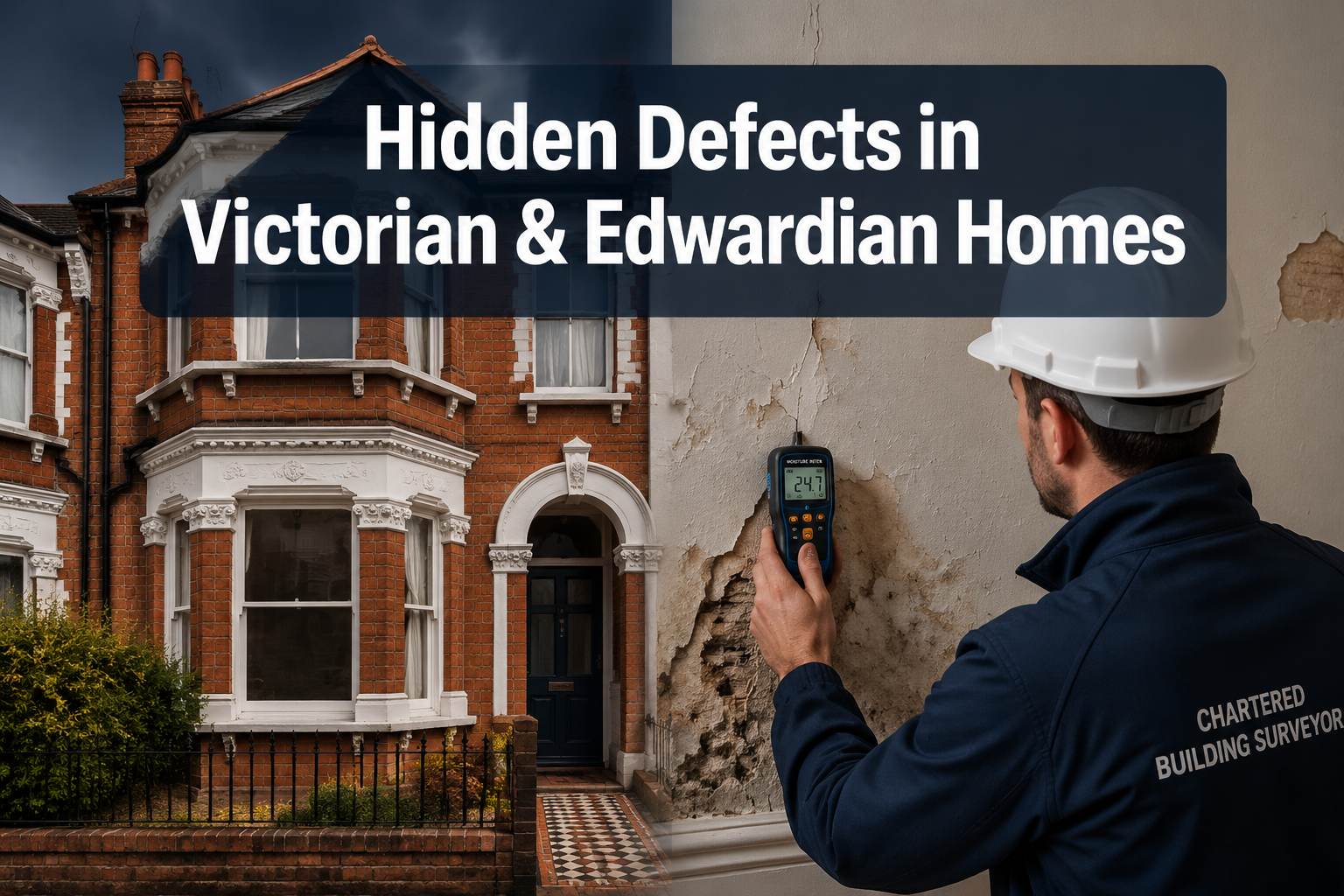

Roughly 5.7 million homes in England were built before 1919 — and a significant proportion of them are currently on the market wearing fresh paint, new carpets, and glossy estate agent photography that conceals decades of accumulated structural risk. Hidden defects in Victorian and Edwardian UK homes represent one of the most financially consequential blind spots in the residential property market, and what modern building surveys look for beyond the estate agent's brochure can mean the difference between a sound investment and a money pit that drains tens of thousands of pounds in remedial works.
This article examines the specific defects that qualified surveyors routinely uncover in pre-1919 housing stock, explains the diagnostic techniques used to identify and quantify risk, and provides buyers with a clear framework for acting on survey findings before exchange of contracts.
Key Takeaways
- Victorian and Edwardian homes were built without damp-proof courses, modern foundations, or current electrical and plumbing standards, making specialist survey essential.
- Structural movement, rising damp, timber decay, and roof deterioration are the four most commonly reported categories of hidden defect in pre-1919 properties.
- Inappropriate modern repairs — such as cement repointing over lime mortar — can accelerate hidden damage rather than resolve it.
- A Level 3 RICS Building Survey is the minimum recommended inspection for any property built before 1919.
- Identifying defects before exchange allows buyers to renegotiate price, request remedial works, or withdraw without financial penalty.
Why Pre-1919 Properties Demand a Different Approach to Surveying
The construction methods used during the Victorian (1837–1901) and Edwardian (1901–1910) eras were rational for their time but are fundamentally incompatible with many modern expectations of building performance. Solid brick walls with no cavity, lime-based mortars, shallow strip foundations, timber suspended ground floors, and lead or clay drainage systems were standard. None of these elements were designed with the benefit of twentieth-century building science.
Estate agents are legally required to market properties accurately, but their brochures are not technical documents. A description of "original period features" may be a genuine selling point — or it may be a polite way of noting that nothing has been updated since 1905. The only way to distinguish between the two is a thorough inspection by a qualified chartered surveyor.
A RICS Building Survey — formerly known as a Level 3 survey — is specifically designed to assess the condition of older and non-standard properties. Unlike a basic mortgage valuation, it provides a detailed account of defects, their likely cause, and the recommended remedial action. For pre-1919 stock, this level of scrutiny is not a luxury; it is a financial necessity.
The Most Common Hidden Defects in Victorian and Edwardian UK Homes
Damp: Rising, Penetrating, and Condensation-Related
Damp is the single most frequently identified defect in Victorian and Edwardian properties. The reasons are structural. Most homes of this era were built without a damp-proof course (DPC), relying instead on good ventilation and the breathability of lime mortar to manage ground moisture. When ventilation is blocked — by raised external ground levels, blocked air bricks, or the addition of impermeable floor coverings — rising damp becomes inevitable [1].
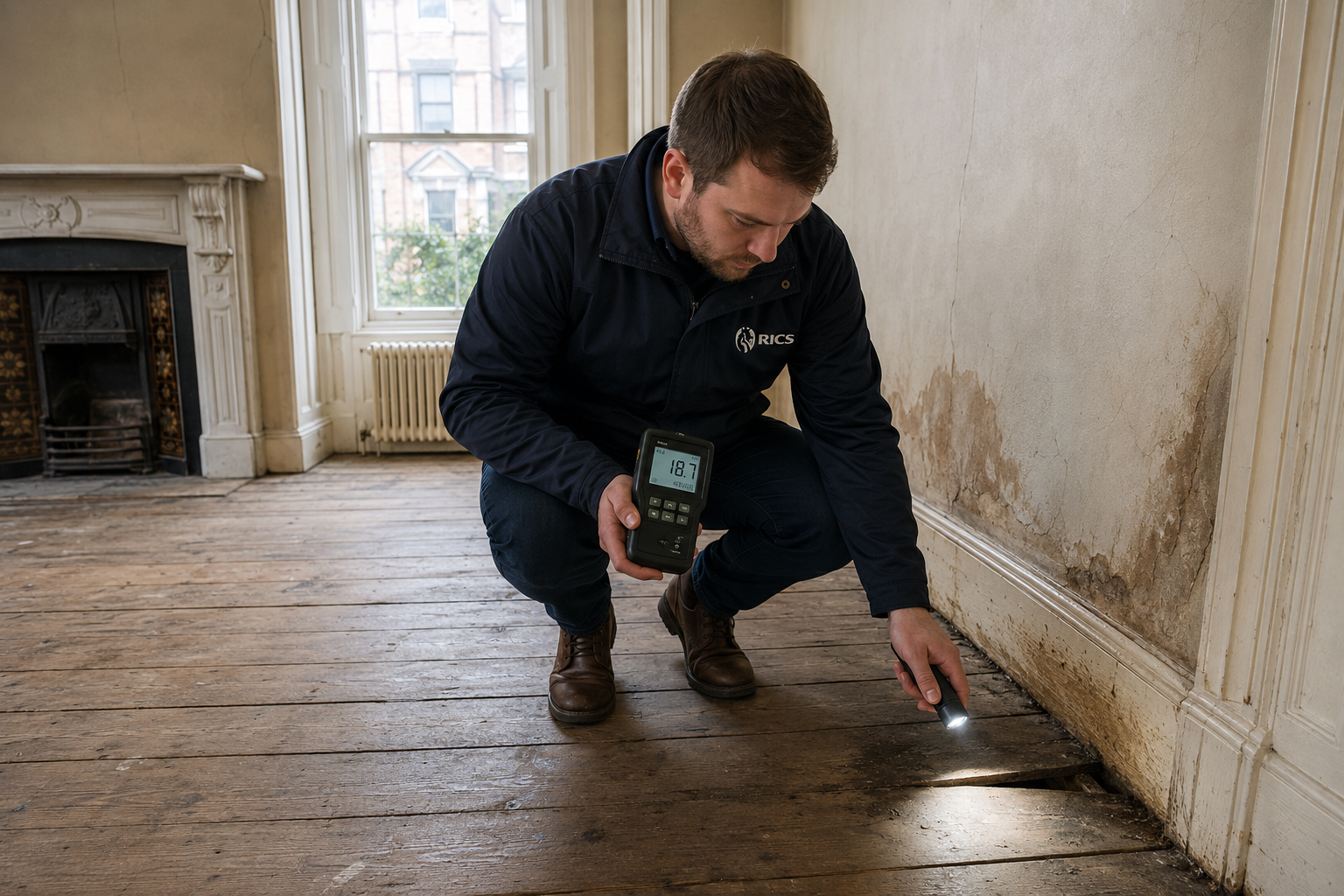
Penetrating damp is equally common. Solid brick walls, typically 225mm to 340mm thick, absorb rainwater directly. Defective pointing, failed render, and blocked or overflowing gutters all accelerate the process. Surveyors use calibrated moisture meters, thermal imaging cameras, and visual inspection of internal finishes to map the extent of moisture ingress [2].
A third category — condensation — is frequently misdiagnosed as rising damp. Edwardian homes often have solid walls and limited mechanical ventilation, creating conditions where warm internal air deposits moisture on cold surfaces [3]. Distinguishing between the three types of damp requires expertise, because the remedial approach for each is entirely different. Commissioning a professional damp survey before exchange is the most reliable way to establish the true cause and cost of moisture problems.
Key damp indicators surveyors look for:
- Tide marks on internal walls at low level (rising damp)
- Staining or efflorescence on external brickwork
- Peeling wallpaper or blistered paint on external walls
- Mould growth concentrated on cold external walls or in corners (condensation)
- Damp patches at high level near chimney breasts (penetrating damp)
Structural Movement and Subsidence
Structural movement in Victorian and Edwardian homes is common, but not all movement is dangerous. The critical question a surveyor must answer is whether movement is historic and stable, or active and progressive.
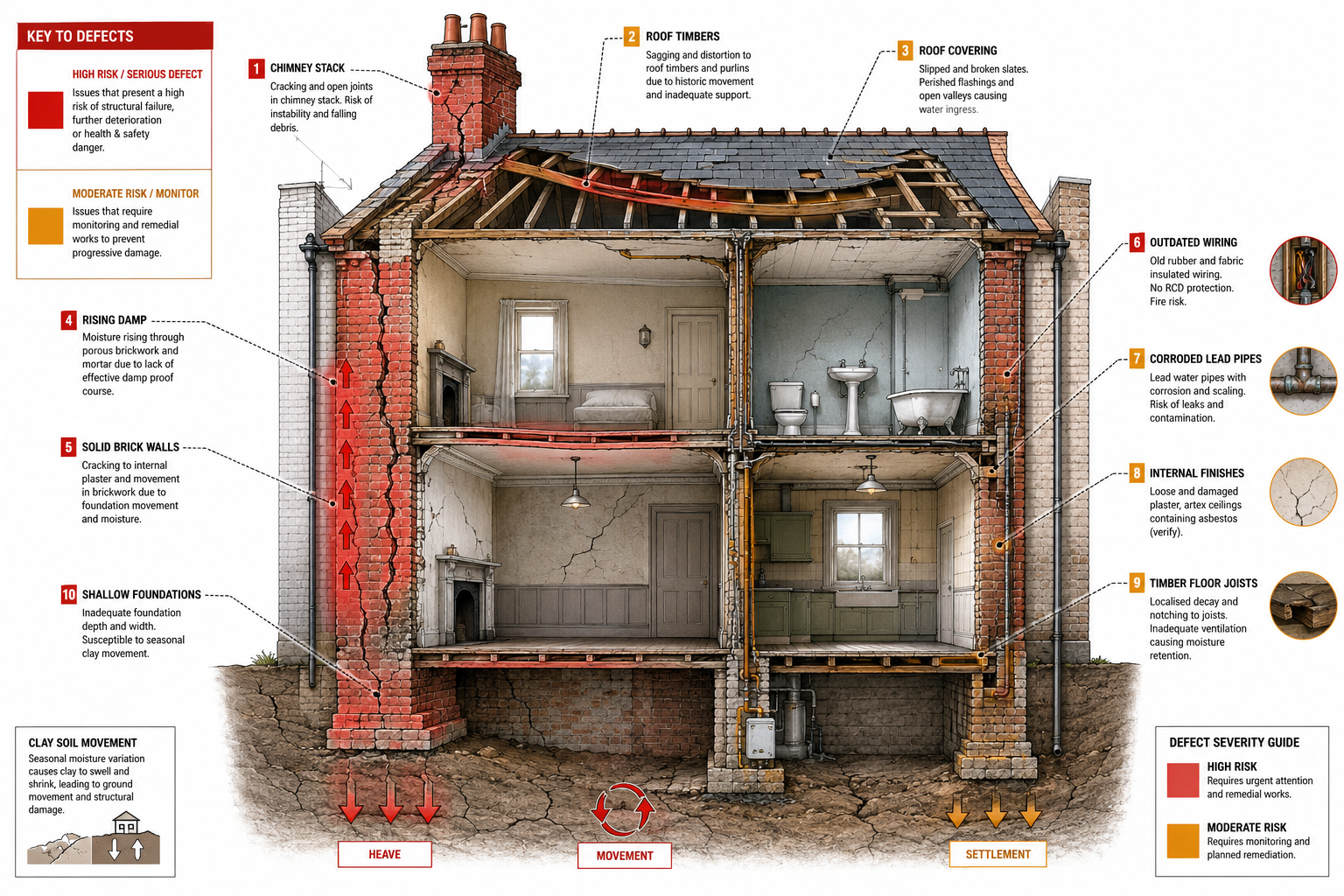
Shallow strip foundations — often as little as 450mm deep — are a defining characteristic of pre-1919 construction. In areas with shrinkable clay soils, such as much of London and the East Midlands, seasonal moisture changes cause the ground to expand and contract. This movement is transmitted directly to the building above [6]. Tree root activity compounds the problem: roots from mature trees can extract moisture from clay soils at depth, causing localised subsidence that produces characteristic diagonal cracking at window and door openings [2].
Surveyors assess crack patterns systematically. Tapered cracks that are wider at the top than the bottom typically indicate differential settlement. Horizontal cracking in brickwork may suggest lateral movement or wall tie failure. Stepped cracking along mortar joints often points to foundation movement. A subsidence survey can determine whether monitoring is required or whether remedial underpinning is necessary.
"A crack in a Victorian wall is not automatically a crisis — but it is always a question that demands a professional answer before money changes hands."
Structural movement red flags:
| Crack Type | Likely Cause | Urgency |
|---|---|---|
| Diagonal at corners of openings | Differential settlement | High |
| Horizontal in brickwork | Lateral thrust or wall tie failure | High |
| Stepped along mortar joints | Foundation movement | Medium-High |
| Fine hairline in plaster | Thermal movement or shrinkage | Low |
| Vertical at party wall junction | Differential movement between properties | Medium |
Timber Decay and Infestation
Structural timbers in Victorian homes — floor joists, roof rafters, wall plates, and lintels — were often installed green (unseasoned) and have been subject to a century or more of moisture fluctuation. Prolonged dampness creates ideal conditions for wet rot and dry rot (Serpula lacrymans), both of which can cause catastrophic loss of structural integrity while remaining invisible beneath floorboards or behind plasterwork [1].
Beetle infestation is equally prevalent. Common furniture beetle (woodworm) leaves characteristic 2mm flight holes in softwood timbers. Death watch beetle, which favours hardwoods in damp conditions, is a more serious concern and is associated with significant structural timbers such as roof purlins and floor beams [1]. Surveyors probe accessible timbers with a spike to test for softness, and use borescopes to inspect voids where direct access is not possible.
Suspended timber ground floors deserve particular attention. A springy or deflected feel underfoot may indicate that joists have lost cross-section to rot or beetle attack, or that the sub-floor ventilation has been compromised [7]. Replacing a failed suspended floor is a major undertaking, and the cost should be factored into any offer price.
Roof, Chimney, and External Fabric Defects Beyond the Brochure
Roof Condition and Structural Integrity
The roof of a Victorian or Edwardian property is one of the most expensive single elements to replace, and one of the most commonly misrepresented in estate agent particulars. Original clay or Welsh slate tiles, when sound, are excellent roofing materials — but they have a finite lifespan, and the fixings (nails and battens) often fail before the tiles themselves [3].
A critical and frequently overlooked problem arises when original lightweight slates have been replaced with heavier modern concrete tiles. The additional dead load can exceed the capacity of the original rafter and purlin structure, causing roof spread — a condition where the roof pushes outward on the supporting walls, causing them to bow or lean [7]. This is a structural defect that requires immediate engineering assessment.
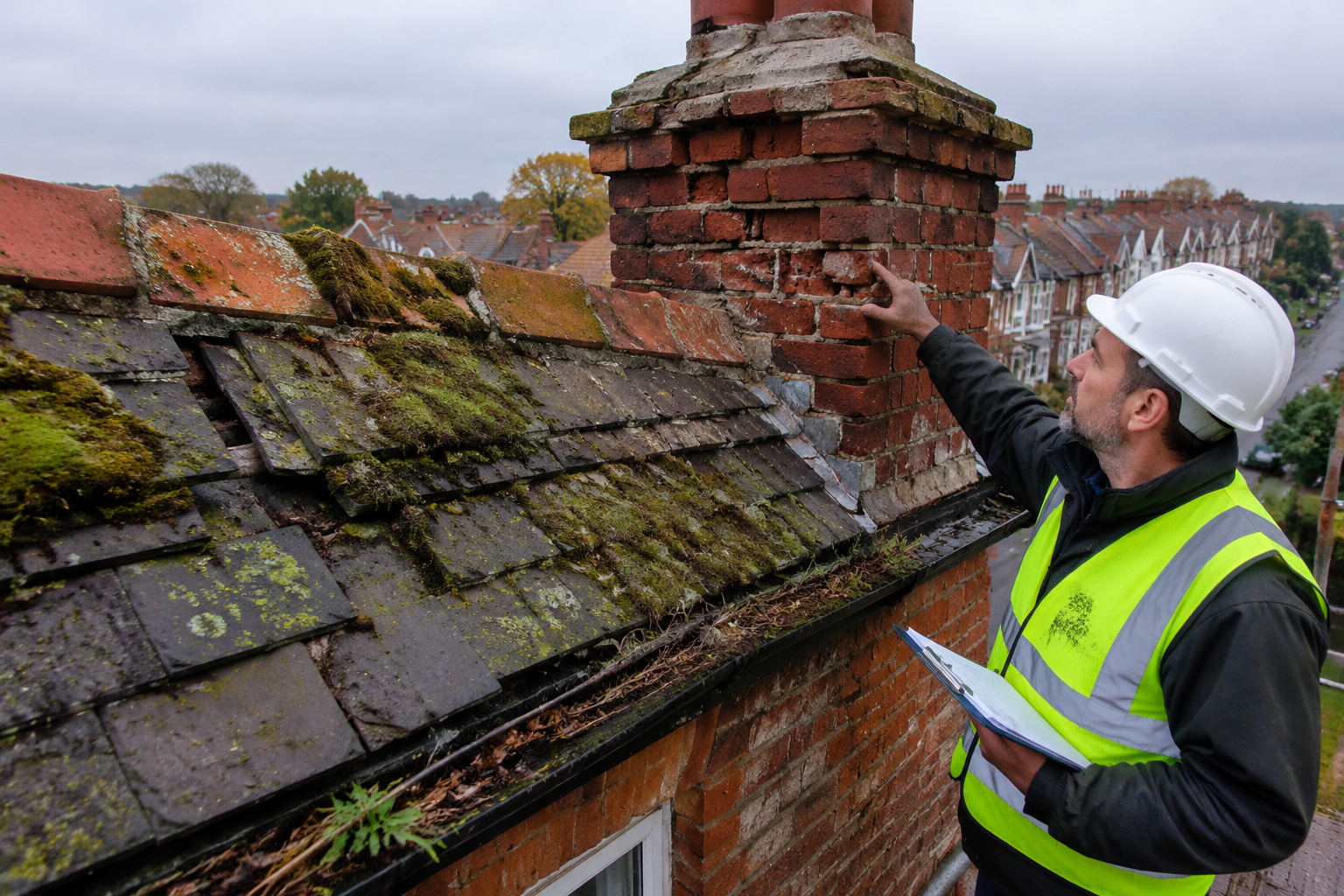
Chimneys present their own catalogue of problems. Exposed to wind, rain, and thermal cycling, chimney stacks are among the first elements to deteriorate. Surveyors look for eroded pointing, spalled brickwork, cracked or missing chimney pots, and failed lead flashings at the junction with the roof slope. A specialist roof survey — including drone inspection where access is limited — provides a level of detail that a ground-level visual inspection simply cannot achieve.
Defective Pointing and Brickwork
The mortar joints in Victorian and Edwardian brickwork were originally set in lime mortar, which is soft, flexible, and breathable. When repointed in cement mortar — a common twentieth-century intervention — the result is a hard, impermeable joint that traps moisture within the brick itself [4]. Over time, this causes spalling (where the face of the brick breaks away) and accelerates the very damp problems the repointing was intended to cure.
Surveyors assess pointing condition across all elevations and flag areas where cement has been used inappropriately. Remediation involves raking out the cement and repointing in a compatible lime mix — a labour-intensive process that can cost several thousand pounds on a typical terraced house.
Outdated Electrical and Plumbing Systems
Many Victorian and Edwardian homes retain wiring that pre-dates modern safety standards. Rubber-insulated cables from the 1960s and earlier become brittle with age, increasing the risk of short circuits and fire. Older fuse boards without residual current devices (RCDs) provide no protection against electric shock. Surveyors flag the presence of dated consumer units, single-pole fusing, and unprotected circuits as urgent matters requiring specialist electrical inspection [5].
Plumbing presents parallel concerns. Lead supply pipes — standard until the 1970s — remain in many pre-1919 homes and present a public health risk. Cast-iron and clay drainage systems are prone to root ingress, fracture, and collapse. A drainage survey using CCTV camera technology is the only reliable method of assessing underground drain condition without excavation.
Estimated remedial costs for common defects (2026 indicative figures):
| Defect | Indicative Cost Range |
|---|---|
| Full rewire (3-bed terraced) | £4,000 – £7,000 |
| Damp-proof course installation | £2,500 – £6,000 |
| Roof replacement (slate, 3-bed) | £8,000 – £18,000 |
| Dry rot treatment and repair | £3,000 – £15,000+ |
| Chimney stack rebuild | £2,000 – £5,000 |
| Lead pipe replacement | £1,500 – £4,000 |
| Underpinning (per metre run) | £1,500 – £3,000 |
Inappropriate Modern Interventions: When Repairs Make Things Worse
One of the most insidious categories of hidden defect in Victorian and Edwardian homes is not original deterioration but well-intentioned modern repair carried out with incompatible materials. This is a pattern that modern building surveys are specifically trained to identify.
Beyond cement repointing, common problematic interventions include:
Impermeable external renders. Applying modern polymer or sand-cement render to solid brick walls prevents the wall from breathing, trapping moisture internally and accelerating decay of both the masonry and any embedded timbers [4].
Loft conversions without structural support. Many period properties have had loft conversions added without adequate structural engineering. Removing purlins or installing inadequate steel beams can compromise the entire roof structure. Surveyors check for the presence of building regulation completion certificates and assess whether structural alterations are adequate [5].
Blocked sub-floor ventilation. The installation of new kitchens, bathrooms, or floor coverings frequently results in air bricks being plastered over or rendered shut. The resulting loss of ventilation to the sub-floor void accelerates timber decay in suspended floors [1].
Party wall works without agreement. In terraced and semi-detached Victorian properties, works to shared walls — including chimney removal, beam installation, or excavation near the boundary — require formal notification under the Party Wall etc. Act 1996. Evidence of works carried out without a party wall agreement can indicate unresolved liability for any resulting damage.
A specialist defect survey is particularly valuable when a property shows signs of recent cosmetic renovation, since fresh decoration can conceal both original defects and the consequences of poor repair work.
How Modern Building Surveys Identify and Quantify Risk
The methodology used in a modern Level 3 RICS Building Survey has evolved considerably from the clipboard-and-binoculars approach of earlier decades. Today's surveyors deploy a range of diagnostic tools that allow them to identify hidden defects in Victorian and Edwardian UK homes with far greater precision than was previously possible.
Thermal imaging cameras detect temperature differentials in walls and ceilings that indicate moisture, missing insulation, or cold bridging — all invisible to the naked eye.
Calibrated moisture meters distinguish between surface condensation and deep-seated damp within wall construction.
Borescopes and endoscopes allow inspection of roof voids, sub-floor spaces, and wall cavities without destructive opening-up works.
Drone surveys provide close-up inspection of roof slopes, chimney stacks, and high-level external fabric that would otherwise require expensive scaffold access. A drone survey is now standard practice for properties where roof access is restricted.
CCTV drain surveys map the condition of underground drainage without excavation, identifying root ingress, fractures, and displaced joints.
The output of a Level 3 survey is a detailed written report that categorises defects using a traffic-light system (Condition Ratings 1, 2, and 3), provides guidance on urgency and likely cost, and recommends specialist investigations where the surveyor's inspection has identified risk but cannot fully quantify it. This report becomes the basis for price renegotiation, further specialist reports, or — in serious cases — a decision to withdraw from the purchase entirely.
Understanding structural survey pricing is an important step in budgeting for a pre-purchase inspection. The cost of a thorough survey is invariably a fraction of the remedial costs it may help buyers avoid or renegotiate.
Conclusion: Protecting Your Investment Before Exchange
The estate agent's brochure is a marketing document. The building survey is a risk assessment. For anyone buying a Victorian or Edwardian property in 2026, conflating the two is an expensive mistake.
The hidden defects most commonly found in pre-1919 UK homes — structural movement, rising and penetrating damp, timber decay, roof deterioration, outdated services, and the consequences of inappropriate modern repairs — are rarely visible during a casual viewing. They require systematic inspection by a qualified professional using specialist equipment and an understanding of period construction techniques.
Actionable next steps for buyers of Victorian and Edwardian properties:
- Commission a Level 3 RICS Building Survey before exchange — not a basic mortgage valuation.
- Request a CCTV drainage survey if the property has original clay or cast-iron drains.
- Ask the vendor to provide building regulation completion certificates for any alterations carried out since 1985.
- Obtain specialist reports for any defects flagged as Category 3 (urgent) in the survey.
- Use the survey report as the basis for a price renegotiation or request for remedial works before contracts are exchanged.
- Consult a local chartered surveyor with specific experience in pre-1919 housing stock in the relevant area.
Period properties offer genuine value — architectural character, solid construction, and often excellent locations. The key is buying with eyes open, armed with professional advice that goes well beyond what any estate agent's brochure will ever reveal.
References
[1] Victorian Property Guide – https://www.housesurveys.co.uk/blog/victorian-property-guide.html?utm_source=openai
[2] Edwardian House Defects In London Complete Surveyors Guide – https://www.res-prop.com/edwardian-house-defects-in-london-complete-surveyors-guide/?utm_source=openai
[3] Edwardian Properties 3898 – https://www.samconveyancing.co.uk/news/house-survey/edwardian-properties-3898?utm_source=openai
[4] Survey Pre 1919 Property Selling – https://getpine.co.uk/guides/survey-pre-1919-property-selling?utm_source=openai
[5] Guide To Buying Victorian And Edwardian Homes – https://harrisonclarke.co.uk/guide-to-buying-victorian-and-edwardian-homes/?utm_source=openai
[6] Why Manchester S Clay Soils Are Quietly Wrecking Victorian Homes – https://www.structural-inspections.co.uk/post/why-manchester-s-clay-soils-are-quietly-wrecking-victorian-homes?utm_source=openai
[7] Building Defect Analysis – https://www.tayross.com/services/building-defect-analysis?utm_source=openai