

Shared ownership completions rose by an estimated 18% in the first quarter of 2026 compared to the same period in 2024, driven by renewed buyer confidence and government-backed affordability initiatives. That surge in activity is bringing a less-discussed challenge back into focus: how Party Wall Act Notices for Shared Ownership Schemes interact with the unique legal and structural realities of affordable housing. For surveyors, housing associations, and shared owners planning extensions or alterations, getting the notice process right has never been more consequential.

Key Takeaways
- Shared ownership properties carry a dual-consent obligation: the housing association as freeholder and the adjoining owner must both be considered in any party wall process.
- The Party Wall etc. Act 1996 applies fully to shared ownership homes, regardless of the percentage share owned by the occupier.
- Three distinct notice types exist under the Act, each with different trigger works and notice periods.
- Failing to serve a valid notice before starting work can result in injunctions, cost liability, and damage to resale value.
- In 2026's recovering affordable housing market, proactive compliance protects both the shared owner's investment and the housing association's portfolio.
Why Shared Ownership Adds Complexity to Party Wall Compliance
Standard party wall compliance is already a multi-step process. When shared ownership is layered on top, the legal picture becomes considerably more nuanced. A shared owner does not hold the freehold outright. Instead, they own a leasehold interest — typically between 25% and 75% of the property — while the housing association retains the freehold. This split creates an important question: who is the "building owner" for the purposes of the Party Wall etc. Act 1996?
The answer is the shared owner occupier, provided the proposed works fall within the scope of their lease. Most shared ownership leases permit internal alterations and, in some cases, extensions — subject to landlord consent. However, the Act's obligations attach to the person carrying out the work, not the freeholder. This means the shared owner must serve valid party wall notices as the building owner, while simultaneously obtaining written permission from the housing association before any structural work begins.
This dual-consent obligation is a common source of delay in 2026. Surveyors working in affordability-focused regions — particularly in areas with high concentrations of housing association stock — are increasingly reporting cases where shared owners begin the housing association consent process without first considering party wall timelines, causing avoidable project delays of two months or more.
For a broader understanding of the legal framework, the party wall overview from Canterbury Surveyors provides a useful starting point for shared owners and their advisers.
Understanding the Three Notice Types Under the 1996 Act
The Party Wall etc. Act 1996 creates three distinct categories of notifiable work, each with its own trigger conditions and notice periods. Understanding which notice applies is the first practical step in any shared ownership alteration or extension project.
Party Structure Notice
A Party Structure Notice is required when the proposed works directly affect an existing party wall or party fence wall. This includes:
- Cutting into the wall to insert a beam or joist
- Raising or lowering the wall's height
- Demolishing and rebuilding the wall
- Underpinning the wall or its foundations
- Any work that would expose the wall to the elements [2]
Notice period: two months before the planned start date.
This is the most common notice type for shared ownership loft conversions and rear extensions, where a shared gable or flank wall is frequently involved. For projects involving roof space, the guidance on party wall loft conversions explains how the Act applies when raising or altering a party wall above eaves level.
Line of Junction Notice
A Line of Junction Notice is served when a building owner intends to build a new wall on or at the boundary line between two properties — for example, a new garden wall or the external leaf of an extension that sits on the boundary. This notice does not require the wall to be shared; it applies even if the new wall will stand entirely on the building owner's land but is positioned at the boundary [3].
Notice period: one month before work begins.
Notice of Adjacent Excavation
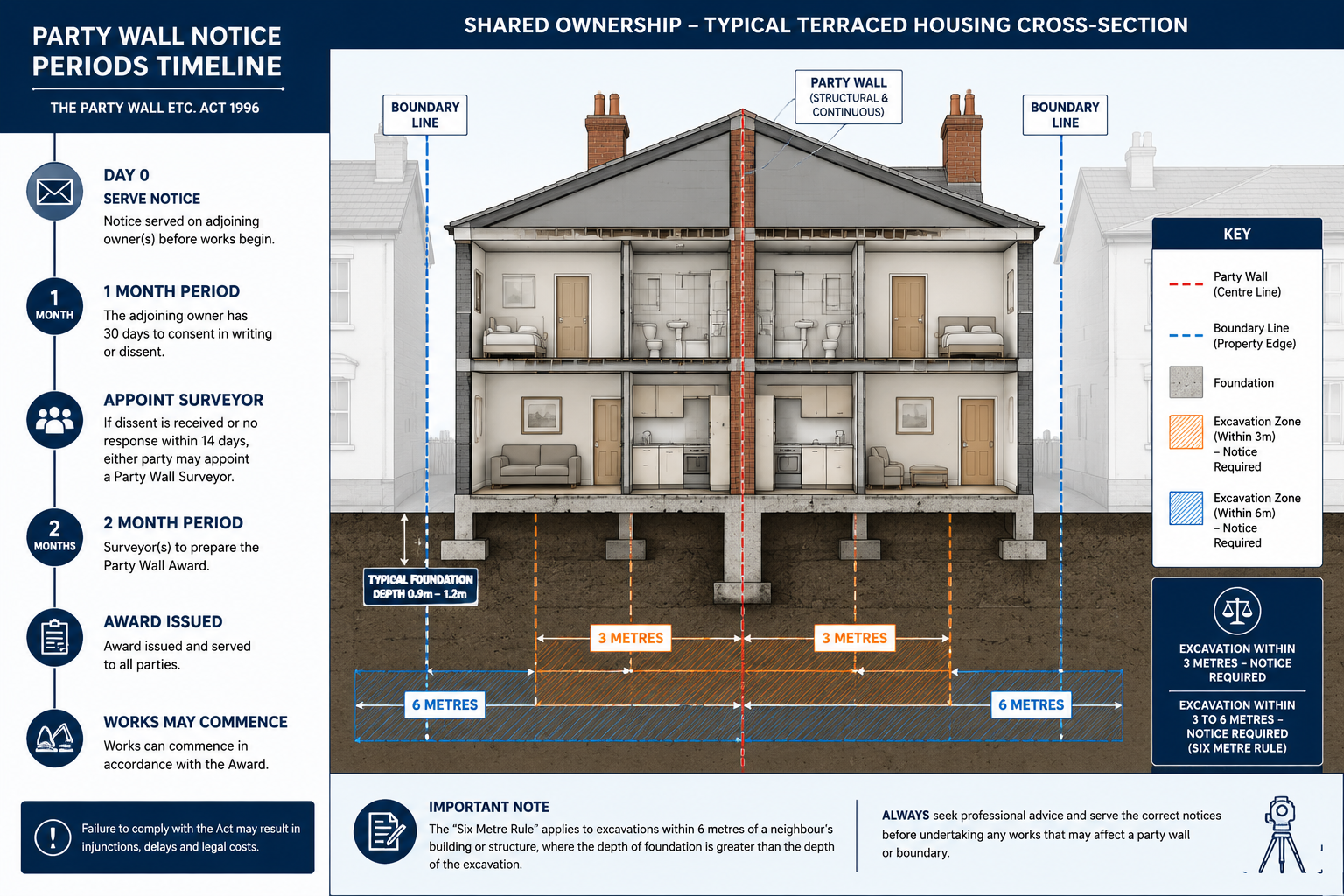
This notice type applies when excavation is planned within:
- 3 metres of a neighbouring building or structure, and the excavation goes below the bottom of the neighbour's foundations
- 6 metres of a neighbouring building, if the excavation line intersects a 45-degree angle drawn from the base of the neighbour's foundations [2]
Notice period: one month before excavation starts.
For shared ownership properties where a rear extension involves new foundations close to the boundary, this notice is frequently required alongside a Party Structure Notice. The three-metre rule explained provides further detail on how proximity to neighbouring foundations is measured and assessed.
| Notice Type | Trigger Works | Notice Period |
|---|---|---|
| Party Structure Notice | Works to existing party wall | 2 months |
| Line of Junction Notice | New wall on/at boundary | 1 month |
| Notice of Adjacent Excavation | Excavation within 3m or 6m of neighbour's foundations | 1 month |
2026 Protocols: Serving Valid Notices in Recovering Affordable Markets
The phrase "Party Wall Act Notices for Shared Ownership Schemes: 2026 Protocols in Recovering Affordable Markets" reflects a genuine shift in how surveyors and housing associations are approaching compliance as buyer activity recovers. Several practical protocols have emerged as best practice this year.
Identifying All Adjoining Owners Correctly
A valid notice must be served on every "adjoining owner" — defined as anyone with a freehold or leasehold interest of more than one year in the neighbouring property [1]. In shared ownership contexts, this can mean serving notice on:
- The neighbouring occupier (if they hold a qualifying leasehold interest)
- The neighbouring housing association (if they retain the freehold of the adjacent property)
- Any long leaseholder in a flat directly above or below
Failing to identify all adjoining owners is one of the most frequent grounds on which party wall notices are challenged. In dense affordable housing estates — where multiple properties may be owned by the same housing association — this step requires careful title register checks before any notice is served.
What the Notice Must Contain
A valid party wall notice must include [5]:
- The building owner's full name and address
- A clear description of the proposed works
- The planned start date
- Confirmation that the notice is served under the Party Wall etc. Act 1996
- Drawings or plans where relevant (particularly for complex structural works)
Notices served without adequate description of the works are routinely disputed. In 2026, surveyors are increasingly recommending that shared owners attach outline drawings even where the Act does not strictly require them, as this reduces the likelihood of a counter-notice or dispute.
Consent, Counter-Notice, and Dispute Procedures
Once a notice is served, the adjoining owner has 14 days to respond. They may:
- Consent to the works in writing — allowing the project to proceed after the notice period expires
- Serve a counter-notice requesting modifications to the proposed works
- Dissent — triggering the appointment of a party wall surveyor [4]
If no response is received within 14 days, a dispute is deemed to have arisen automatically, and the surveyor appointment process begins [6]. For shared owners, this timeline interacts directly with the housing association's own consent process, making early engagement with both parties essential.
The consent for party wall work page outlines what written consent should cover and how it protects both parties if a dispute arises later.
The Role of the Schedule of Condition
Before notifiable works begin, a Schedule of Condition should be prepared. This is a detailed photographic and written record of the neighbouring property's existing condition — particularly any pre-existing cracks, settlement, or defects. It serves as the baseline against which any damage claims are assessed after the works are complete [4].
For shared ownership properties, the schedule of condition for party wall works is especially important because the housing association — as freeholder — may have its own interest in documenting the condition of its portfolio properties before neighbouring works proceed.
Neighbour Disputes in Shared Ownership Contexts: What Surveyors Need to Know
Party wall disputes in shared ownership estates present particular challenges. When the adjoining owner is also a shared owner, both parties may be unfamiliar with the Act's procedures, increasing the risk of misunderstanding and escalation.
A party wall dispute does not have to mean a legal battle. The Act's surveyor-led dispute resolution process is designed to be faster and less adversarial than court proceedings — but only if both parties engage with it promptly.
Common dispute triggers in shared ownership settings include:
- Noise and vibration during structural works affecting a neighbour's enjoyment of their home
- Damage to shared chimney stacks or chimney breasts during extension works (see the guidance on shared chimneys and chimney stacks)
- Disagreement over the extent of the proposed works as described in the notice
- Disputes about whether damage was pre-existing or caused by the notified works
When a dispute is deemed to have arisen, both parties must appoint surveyors — either an agreed single surveyor or one each — who then produce a Party Wall Award. This award is a legally binding document that sets out the rights and obligations of both parties, the manner in which the works are to be carried out, and any compensation payable [4].
For shared owners who are uncertain whether their proposed works trigger the Act at all, the party wall FAQs address the most common scenarios, including loft conversions, rear extensions, and basement excavations.
Valuation Implications for Shared Ownership Properties

Party wall compliance has a direct bearing on the value of shared ownership properties — both at the point of staircasing and at resale. A property where notifiable works were carried out without a valid party wall notice, or where a dispute remains unresolved, can face significant complications during the conveyancing process.
Mortgage lenders are increasingly alert to party wall issues. A missing Party Wall Award where one was required can delay or prevent a mortgage offer, particularly where the works involved structural alterations to a shared wall or foundations close to a boundary. In the recovering affordable housing market of 2026, where many shared owners are looking to staircase to 100% ownership or sell their share, this risk is acutely relevant.
For shared owners considering the financial implications of proposed works alongside their property's current value, a shared ownership property valuation from a qualified RICS surveyor provides the evidence base needed for both housing association consent applications and mortgage purposes.
Additionally, where works affect the structural integrity of the building, lenders may require a specialist survey before proceeding. Understanding how to choose the right property survey helps shared owners commission the correct level of inspection at the right stage of the project.
Practical Steps for Shared Owners Planning Notifiable Works in 2026
The following checklist reflects the protocols that experienced surveyors are recommending for shared ownership projects in 2026's recovering affordable housing market:
-
Review the lease first. Confirm that the proposed works are permitted under the shared ownership lease and identify any conditions attached to the housing association's consent.
-
Check the title registers. Identify all adjoining owners — including any housing association freeholders of neighbouring properties — before serving any notice.
-
Determine which notice type applies. Use the three categories above to identify whether a Party Structure Notice, Line of Junction Notice, or Notice of Adjacent Excavation (or a combination) is required.
-
Prepare the notice correctly. Include all required information, attach plans where relevant, and serve the notice with sufficient lead time to allow the notice period to expire before works begin.
-
Commission a Schedule of Condition. Before works start, document the condition of all adjoining properties that could be affected.
-
Engage with the housing association in parallel. Do not wait for party wall consent before starting the landlord consent process — run both tracks simultaneously to avoid project delays.
-
Budget for surveyor costs. Party wall surveyor fees are typically borne by the building owner. Understanding party wall costs at the outset prevents budget surprises mid-project.
Conclusion
Party Wall Act Notices for Shared Ownership Schemes: 2026 Protocols in Recovering Affordable Markets represent a convergence of legal obligation, housing association governance, and practical surveying expertise. As shared ownership activity continues to recover, the risk of non-compliance — and the disputes that follow — grows in proportion to the volume of alteration and extension projects being planned.
The core message for shared owners, housing associations, and their advisers is straightforward: start the party wall process early, identify all adjoining owners accurately, serve the correct notice type with adequate detail, and commission a Schedule of Condition before any work begins. These steps are not bureaucratic obstacles; they are the mechanisms that protect all parties — including the shared owner's own investment — when structural works are carried out in close proximity to a neighbour's home.
Actionable next steps:
- Consult a RICS-qualified party wall surveyor at the earliest stage of project planning, before any contractor quotes are accepted.
- Request a copy of the shared ownership lease and confirm the scope of permitted alterations before serving any notice.
- Contact the housing association's asset management team to understand their internal consent timeline and documentation requirements.
- Commission a Schedule of Condition on all potentially affected neighbouring properties before works commence.
- Where a dispute arises, engage the surveyor-led dispute resolution process promptly rather than allowing the dispute to escalate.
Proactive compliance in 2026 is not just about avoiding legal risk. It is about preserving the value and integrity of affordable housing stock at a time when that stock is more important than ever.
References
[1] Your Party Wall Rights And Responsibilities – https://legalclarity.org/your-party-wall-rights-and-responsibilities/?utm_source=openai
[2] Work Tell Your Neighbour About – https://www.gov.uk/party-walls-building-works/work-tell-your-neighbour-about?utm_source=openai
[3] Party Wall Act Explained – https://planwatch.co.uk/guides/party-wall-act-explained?utm_source=openai
[4] Party Walls – https://www.rics.org/consumer-guides/party-walls?utm_source=openai
[5] Party Wall Notice Requirements Service And Counter Notices – https://legalclarity.org/party-wall-notice-requirements-service-and-counter-notices/?utm_source=openai
[6] Party Wall – https://www.redbridge.gov.uk/planning-and-building/building-control/party-wall/?utm_source=openai
[7] Party Wall Agreement Selling – https://getpine.co.uk/guides/party-wall-agreement-selling?utm_source=openai