

Nearly 70% of flat buyers in England and Wales purchase leasehold properties without fully understanding the legal and financial obligations attached to them — and a significant proportion skip or downgrade their survey to save a few hundred pounds, only to face repair bills running into tens of thousands. Building surveying for pre-purchase flats is not simply a box-ticking exercise; it is the single most effective tool a buyer has to uncover leasehold risks, decode service charge signals, and expose the hidden defects that a fresh coat of paint routinely conceals.
This guide is written for buyers who have already fallen in love with a flat and are now trying to make a rational decision. The focus is on what a professional building survey actually reveals — and what it cannot — so that buyers can enter exchange with their eyes open.
Key Takeaways 🔑
- A RICS Level 3 Building Survey is strongly recommended for most flats, particularly older conversions, ex-council blocks, and any property with cladding or fire safety concerns.
- Lease length, ground rent terms, and service charge history are as important as the physical condition of the flat itself.
- Service charge accounts and reserve fund balances are early-warning signals for future financial exposure — a surveyor can help interpret what they mean structurally.
- Hidden defects in communal areas (roofs, drainage, external walls) directly affect leaseholders even though they do not own those elements outright.
- Buyers who commission surveys before finalising legal due diligence are better positioned to negotiate price reductions, retentions, or walk away with minimal loss.
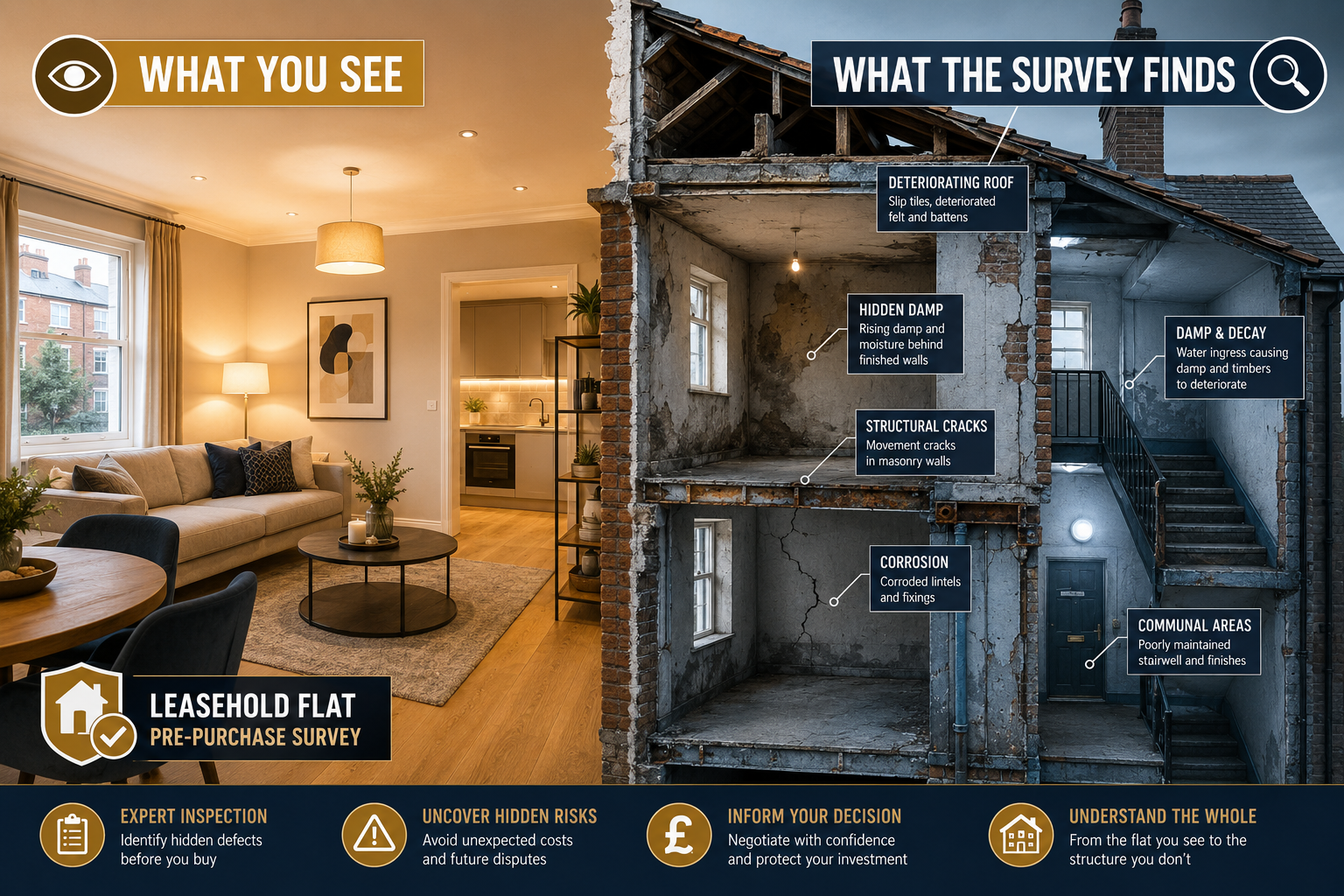
What Flat Buyers Focus On — And What They Should Be Asking Instead
Most buyers touring a flat notice the kitchen finish, the ceiling height, and the view. Very few ask to see the last three years of service charge accounts, the most recent fire risk assessment, or whether the building has an active major works notice under Section 20 of the Landlord and Tenant Act 1985.
This is the central problem that building surveying for pre-purchase flats is designed to solve. The flat itself may be immaculate. The building it sits within — and the lease that governs the buyer's rights within that building — may be anything but.
The Leasehold Structure: Why It Changes Everything
When someone buys a flat in England or Wales, they almost always buy a leasehold interest, not the bricks and mortar. The freeholder (or a management company acting on their behalf) retains ownership of the structure, the roof, the external walls, and the communal areas. The leaseholder pays for the upkeep of all of these through service charges — whether they like it or not [5].
This has several practical consequences for a building survey:
- Defects in communal areas (a failing roof, cracked render, deteriorating balconies) will eventually become the leaseholder's financial problem via service charges, even though the leaseholder has no direct control over the works.
- Ground rent terms embedded in older leases can be punitive. Doubling ground rents every ten years have been well-documented as creating serious mortgage and resale difficulties [2].
- Lease length directly affects mortgageability and resale value. Most lenders require at least 70–85 years remaining; below 80 years, the cost of a lease extension rises sharply.
💬 "A survey that only looks at the flat and ignores the building is like checking the condition of a cabin without inspecting the ship."
For a full overview of leasehold ownership rights and obligations, the leasehold guidance from Canterbury Surveyors provides a practical starting point.
Building Surveying for Pre-Purchase Flats: Leasehold Risks, Service Charge Clues, and Hidden Defects Buyers Miss — The Survey Scope
Choosing the Right Survey Level
Not all surveys are equal. The RICS Home Survey framework offers three levels:
| Survey Level | Best For | Covers Communal Areas? |
|---|---|---|
| Level 1 (Condition Report) | New-build or very modern flats | Limited |
| Level 2 (HomeBuyer Report) | Conventional flats in reasonable condition | Partial |
| Level 3 (Building Survey) | Older buildings, conversions, complex leasehold | Most comprehensive |
For most pre-purchase flat situations — particularly Victorian conversions, 1960s–1980s concrete blocks, and any property with fire safety concerns — a RICS Level 3 Building Survey is the appropriate choice. It provides the most detailed assessment of the building's fabric and is better equipped to identify structural movement, damp penetration, and defects in accessible roof spaces [8].
For buyers unsure which level is appropriate, a comparison of different survey types can help clarify the options before instructing a surveyor.
What the Surveyor Physically Inspects
A building survey for a flat will typically cover:
- The flat itself: walls, ceilings, floors, windows, internal doors, kitchen, bathrooms, and any accessible roof void above top-floor flats.
- Communal areas (where access is granted): entrance halls, stairwells, lift shafts (externally), roof terraces, and basement areas.
- External envelope: visible sections of the roof, external walls, balconies, gutters, and downpipes.
- Services: visual assessment of heating, plumbing, and electrics — though not a full test [4].
⚠️ Important limitation: Building surveys are non-invasive and visual. Surveyors do not lift floorboards, open up wall cavities, or test electrical circuits. Hidden defects behind finishes — including concealed damp, historic structural movement, or failing underfloor drainage — may not be detectable without specialist investigation [4]. This is why a specific defect report may be warranted as a follow-up where the surveyor flags concerns.
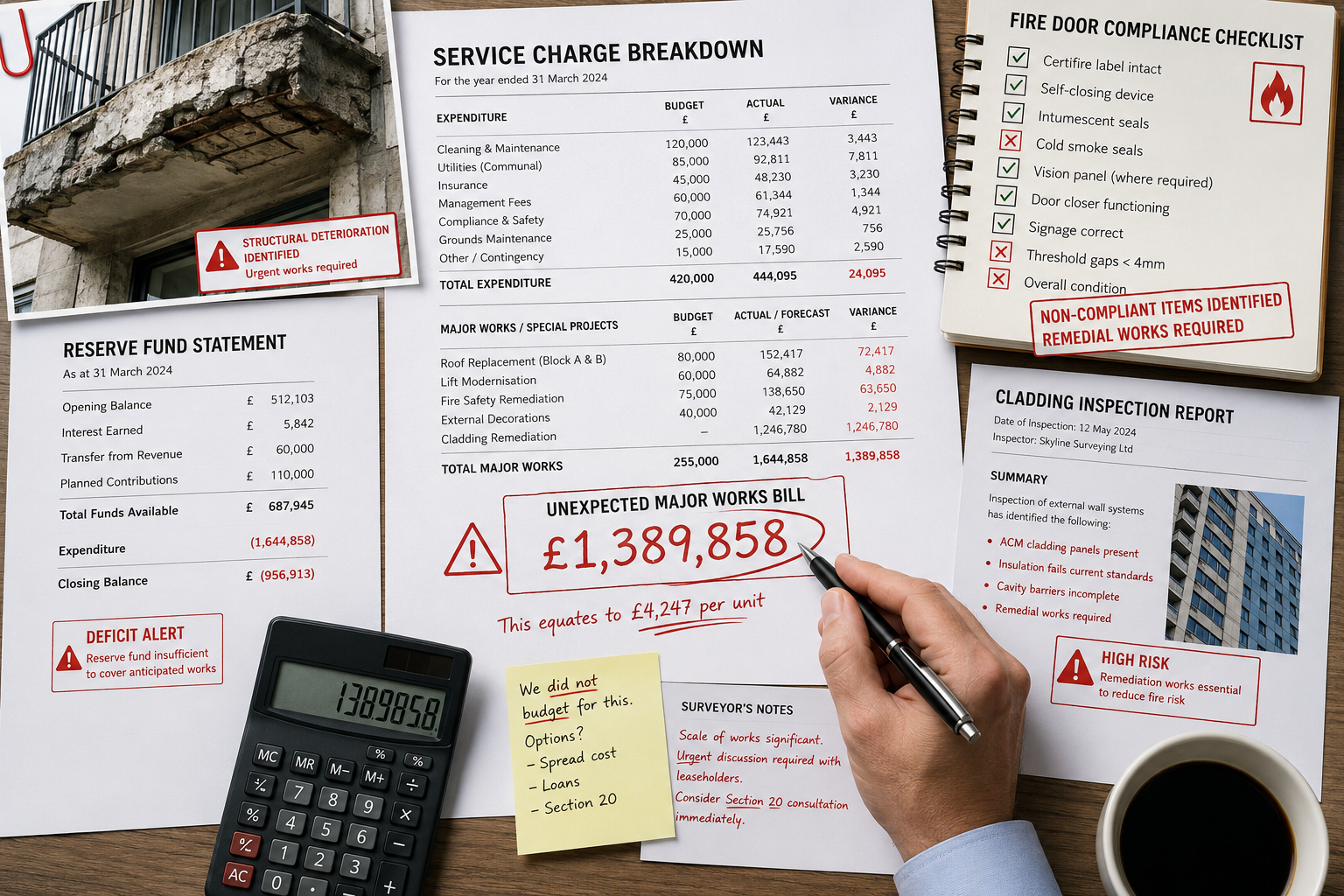
Service Charge Clues: Reading the Financial Health of a Building
Service charges are one of the most underestimated risks in flat purchases. They are not fixed; they can rise substantially year on year, and a single major works project — replacing a roof, repairing a façade, or installing a new lift — can result in a bill of £10,000–£50,000 or more per flat [5].
What to Request Before Exchange
Buyers and their solicitors should request the following documents as a matter of course:
- Three years of audited service charge accounts
- Reserve fund (sinking fund) balance and contribution history
- Any Section 20 major works notices already issued
- Minutes of recent leaseholder meetings
- The most recent fire risk assessment
- EWS1 form (if the building is over 11 metres or has cladding concerns)
A surveyor reviewing these documents alongside the physical inspection can connect the dots. A building with a low reserve fund balance and visible deferred maintenance — peeling render, rusting balcony railings, blocked gutters — is a building where a large special levy is likely on the horizon [3].
Ex-Council Flats: Elevated Risk 🏢
Ex-council flats deserve particular caution. Local authorities and housing associations, as freeholders, have the legal right to carry out major works and recharge leaseholders — sometimes with very little advance notice beyond the statutory minimum. Service charges in these blocks can be substantial and unpredictable, and buyers have limited recourse once they have completed [7].
A thorough pre-purchase survey of an ex-council flat should specifically assess:
- Condition of the communal roof and flat roof sections
- State of external concrete panels or brickwork (spalling, carbonation)
- Condition of communal windows (if included in the lease obligations)
- Evidence of water ingress in stairwells or basement car parks
Ground Rent: A Lease Term the Survey Flags But Cannot Fix
A building survey will note the lease details provided, but the ground rent review mechanism is a legal matter requiring solicitor scrutiny. Buyers should be wary of any lease with ground rent that doubles more frequently than every 20 years, or that is linked to RPI. The Leasehold Reform (Ground Rent) Act 2022 capped ground rents for new leases at a peppercorn, but millions of existing leases remain on older terms [2].
Where lease length is approaching 80 years, buyers should obtain an independent lease extension cost assessment before exchange, as this cost should logically be reflected in the negotiated purchase price.
Hidden Defects Buyers Miss: The Building Surveying for Pre-Purchase Flats Perspective
The physical inspection is where a skilled surveyor earns their fee. Cosmetic presentation — freshly plastered walls, new flooring, recently installed kitchens — can mask serious underlying problems that have been present for years.
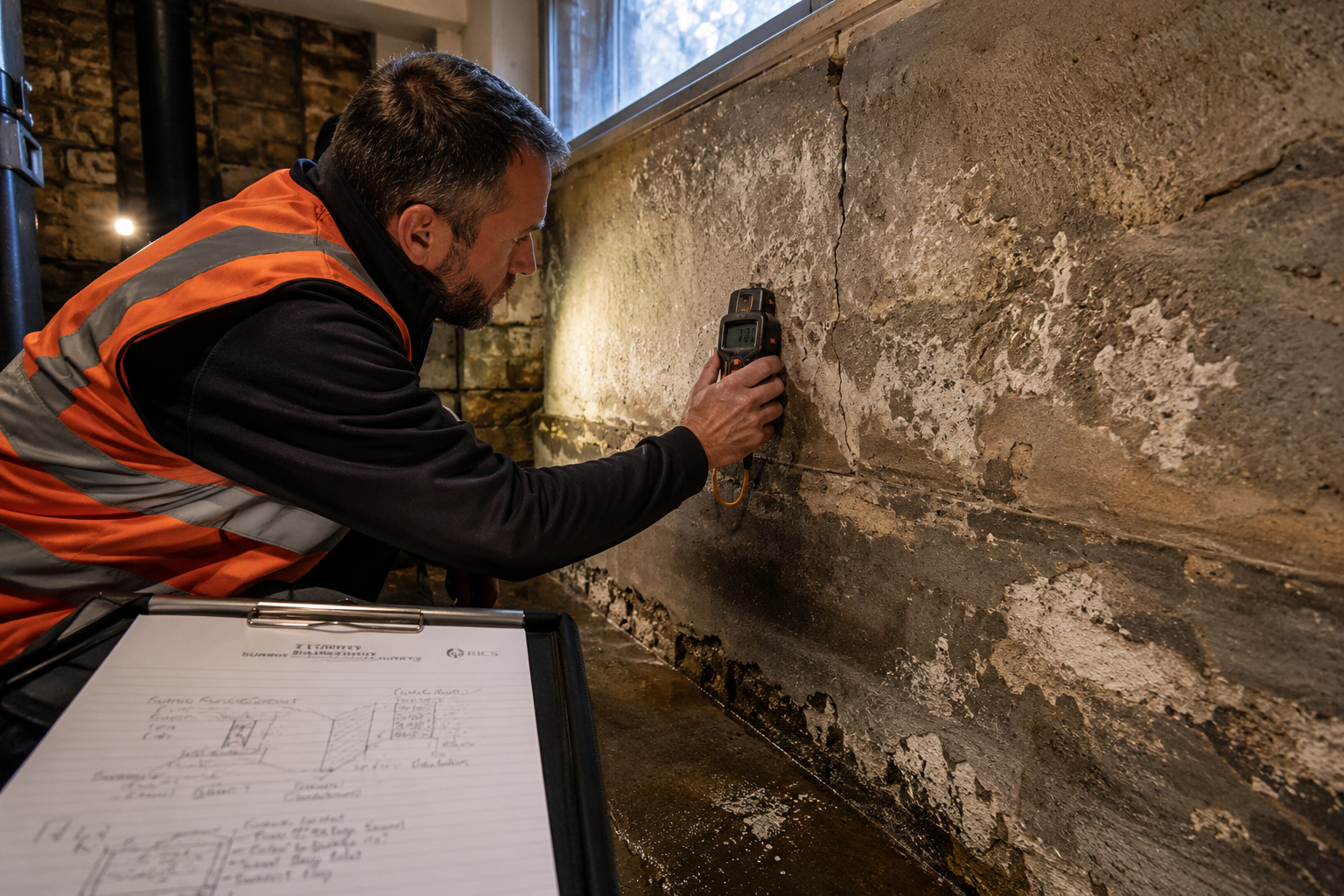
Damp and Water Ingress 💧
Damp is the single most commonly missed defect in flat purchases. It manifests in several forms:
- Rising damp in ground-floor or basement flats
- Penetrating damp through external walls, particularly in older solid-wall construction
- Interstitial condensation within flat roofs above top-floor units
- Lateral damp from communal areas or neighbouring flats
A surveyor will use a protimeter or capacitance meter to detect elevated moisture readings, even where fresh plaster or new paint has been applied over the affected area. Specialist damp surveys may be recommended where readings are ambiguous or where the source is unclear.
Structural Movement and Cracking
Not all cracks are equal. A surveyor will assess:
- Crack width, pattern, and location to distinguish between minor thermal movement and active structural settlement
- Differential movement between the flat and the wider building structure
- Evidence of historic repairs (repointing, crack stitching) that suggest recurring movement
In converted Victorian terraces, the original building may have experienced significant settlement over 100+ years. The question is whether movement is historic and stable or active and progressive — a distinction that carries major implications for insurability and future repair liability.
Fire Safety and Cladding Concerns 🔥
Post-Grenfell, fire safety has become a non-negotiable element of flat due diligence in 2026. Surveyors should flag:
- Cladding systems that may require EWS1 certification
- Fire door condition in communal areas (self-closing mechanisms, intumescent strips, gap tolerances)
- Compartmentation concerns where services penetrate fire-rated walls or floors
- Absence of sprinkler systems in taller blocks
Where fire safety remediation works are incomplete or unresolved, mortgage lenders may decline to lend entirely, and buyers could find themselves holding an unmortgageable asset.
Roof Condition in Communal Buildings
The roof of a flat block is rarely within the leaseholder's direct ownership, but it is almost always their financial responsibility via service charges. A roof survey or at minimum a thorough visual inspection from the surveyor is essential, particularly for:
- Flat roofs with felt or asphalt coverings (typical lifespan 15–25 years)
- Parapet walls and flashings on Victorian conversions
- Roof terraces with waterproofing membranes
A roof in poor condition that has not been reflected in the reserve fund balance is a direct financial liability for the incoming buyer.
Solid Floors and Drainage
Ground-floor flats and basement conversions may have solid concrete floor slabs that are difficult to inspect visually. Where there is any suspicion of moisture ingress, heave, or settlement, a solid floor slab survey can provide greater certainty before exchange.
How Survey Findings Connect to Transaction Risk
A pre-purchase survey is not just a condition report — it is a negotiating instrument [3]. When a surveyor identifies:
- A failing flat roof with an estimated replacement cost of £40,000 across 10 flats
- A reserve fund with a balance of £2,000
- No Section 20 notice yet issued
…the buyer can reasonably argue for a price reduction equivalent to their proportionate share of the anticipated cost, or request a retention held by solicitors pending resolution.
Buyers who skip the survey lose this leverage entirely. They also lose the protection of professional advice if defects emerge post-completion — a situation that can lead to expert witness surveyor involvement in subsequent disputes.
Leasehold conveyancing is already more complex and costly than freehold transactions, given the additional legal work required to review lease terms, service charge accounts, and planned major works [6]. Adding a thorough building survey to this process is a proportionate and rational investment.
Conclusion: Actionable Next Steps for Flat Buyers in 2026
Building surveying for pre-purchase flats is the bridge between a property that looks right and one that genuinely is right. The cosmetic appeal of a flat tells buyers almost nothing about the financial and structural risks embedded in the lease, the building, and the management arrangements that govern both.
Here are the actionable steps every flat buyer should take before exchange:
- ✅ Commission a RICS Level 3 Building Survey — not a Level 1 or basic mortgage valuation.
- ✅ Request three years of service charge accounts and the current reserve fund balance from the vendor's solicitor.
- ✅ Check the lease length — if it is below 85 years, obtain a lease extension cost estimate before proceeding.
- ✅ Ask specifically about fire safety — EWS1 status, fire risk assessment date, and any ongoing remediation works.
- ✅ Use survey findings to negotiate — defects identified by the surveyor are a legitimate basis for price renegotiation or retentions.
- ✅ Do not rely on the survey alone — commission an EICR, a gas safety check, and specialist reports where the surveyor flags concerns.
The cost of a professional survey is a fraction of the cost of a single major repair bill — or the cost of owning a flat that cannot be sold. For buyers across London and the South East, local chartered surveyors with specific leasehold and flat experience are best placed to provide the level of scrutiny these transactions demand.
References
[1] Do I Need A Survey On A Leasehold Flat – https://hoa.org.uk/advice/guides-for-homeowners/i-am-buying/do-i-need-a-survey-on-a-leasehold-flat/?utm_source=openai
[2] What Is A Leasehold – https://www.moneysavingexpert.com/mortgages/what-is-a-leasehold/?utm_source=openai
[3] Pre Lease Vs Pre Acquisition Survey – https://www.lembuildingsurveying.co.uk/commercial-surveys/pre-lease-vs-pre-acquisition-survey?utm_source=openai
[4] What Does A Home Survey Not Tell You – https://www.getkeywise.com/what-does-a-home-survey-not-tell-you?utm_source=openai
[5] Things To Know – https://www.lease-advice.org/buying-and-selling/leasehold-property/things-to-know/?utm_source=openai
[6] Leasehold Conveyancing Why It Costs More – https://www.propertypassport.uk/guides/leasehold-conveyancing-why-it-costs-more?utm_source=openai
[7] Buying Ex Council Property – https://www.homethink.co.uk/guides/buying-ex-council-property?utm_source=openai
[8] Full Structural Survey – https://www.surveymerchant.com/blog/full-structural-survey?utm_source=openai
[9] What To Check Before Buying Property Inspection Checklist – https://homemove.com/content/what-to-check-before-buying-property-inspection-checklist/?utm_source=openai