

By 2026, over 70% of surveying firms that have not adopted digital workflows risk losing clients to tech-enabled competitors — a stark reality reshaping the entire property sector. The surveying profession is no longer simply evolving; it is accelerating at a pace that demands immediate, strategic action.
The Six Key Surveying Trends for 2026: Doubling Down on Digital Transformation represent the most significant shifts currently redefining how surveyors collect data, deliver reports, and serve clients. From AI-driven defect detection to autonomous drone surveys, these trends are not distant possibilities — they are happening right now, and the firms embracing them are pulling ahead fast.
Whether working on residential building surveys or large-scale commercial assessments, understanding these digital shifts is essential for staying competitive, relevant, and profitable in 2026 and beyond.
Key Takeaways 📌
- AI and machine learning are transforming defect detection, report writing, and risk assessment in property surveys.
- Drone and LiDAR technology now enables faster, safer, and more accurate data collection across all property types.
- Real-time data processing is replacing slow, manual reporting workflows with instant, cloud-based outputs.
- Digital twins and BIM integration are becoming standard tools for complex structural and commercial survey projects.
- Sustainability and ESG reporting are driving demand for new specialist survey types and valuation methods.
- Surveyors who act now — upskilling and investing in digital tools — will define the next decade of the profession.
Trend 1: AI-Powered Defect Detection and Automated Reporting
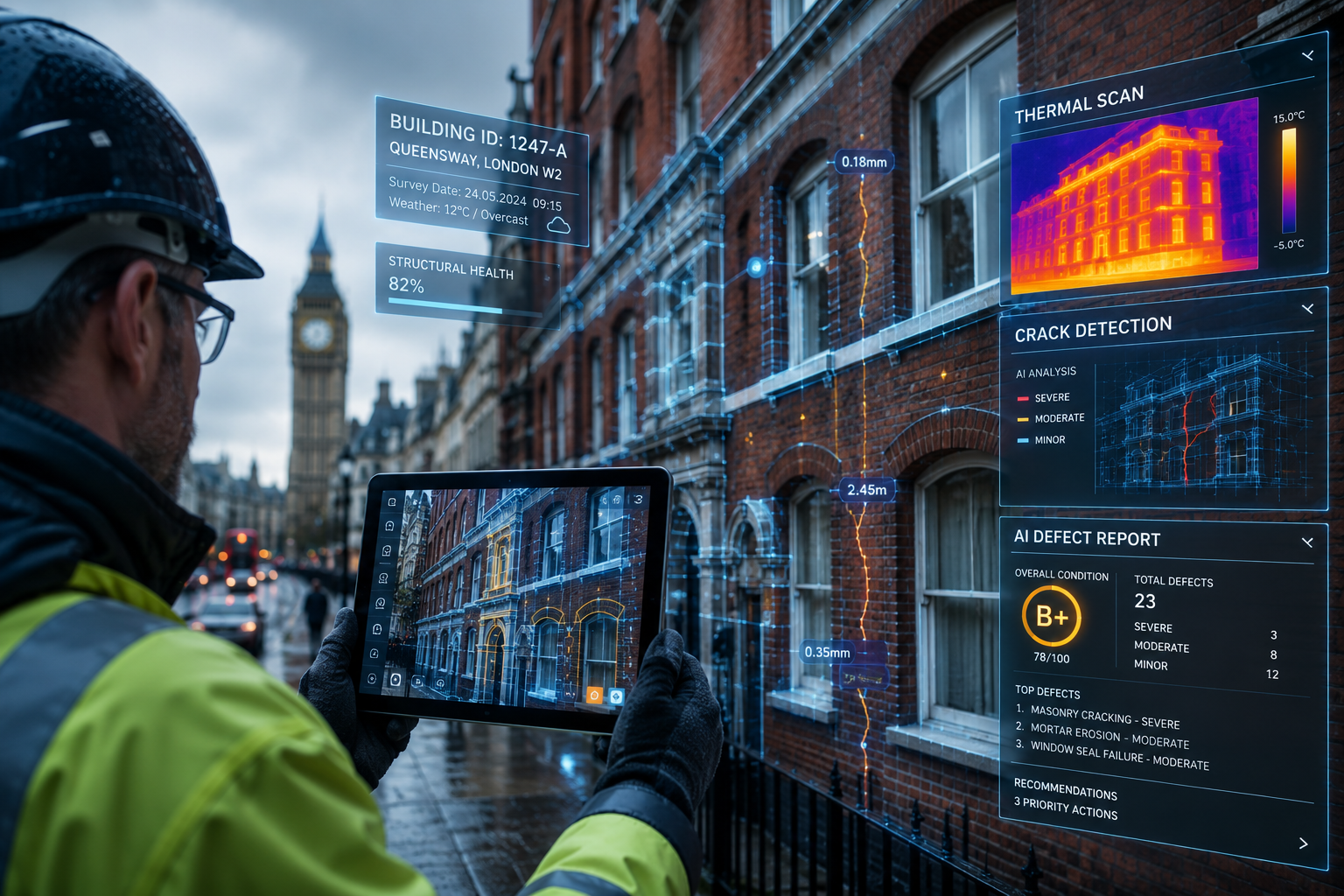
Artificial intelligence is no longer a buzzword in surveying — it is a working tool. In 2026, AI-powered platforms are actively analysing property images, flagging structural defects, and even drafting preliminary survey reports with remarkable accuracy.
How AI Is Changing the Survey Process
Traditional surveys rely entirely on a surveyor's trained eye and manual note-taking. AI-assisted tools now augment that process by:
- Scanning photographs of walls, roofs, and foundations for cracks, damp patches, and structural movement
- Cross-referencing findings against large databases of known defect patterns
- Auto-generating report sections based on flagged issues, saving hours of writing time
- Reducing human error in complex multi-element inspections
💬 "AI does not replace the surveyor's judgement — it sharpens it. The best outcomes come when human expertise and machine intelligence work together."
For clients commissioning a specialist defect survey, AI-enhanced analysis means faster turnaround times and more consistent findings. Surveyors who integrate these tools into their practice are delivering higher-quality outputs at lower cost — a compelling competitive advantage.
Actionable Step for Surveyors 🎯
Start by trialling AI-assisted photo analysis tools on lower-complexity residential surveys. Build confidence in the technology before deploying it on high-stakes commercial projects.
Trend 2: Drone Surveys and LiDAR — The New Standard for Data Collection
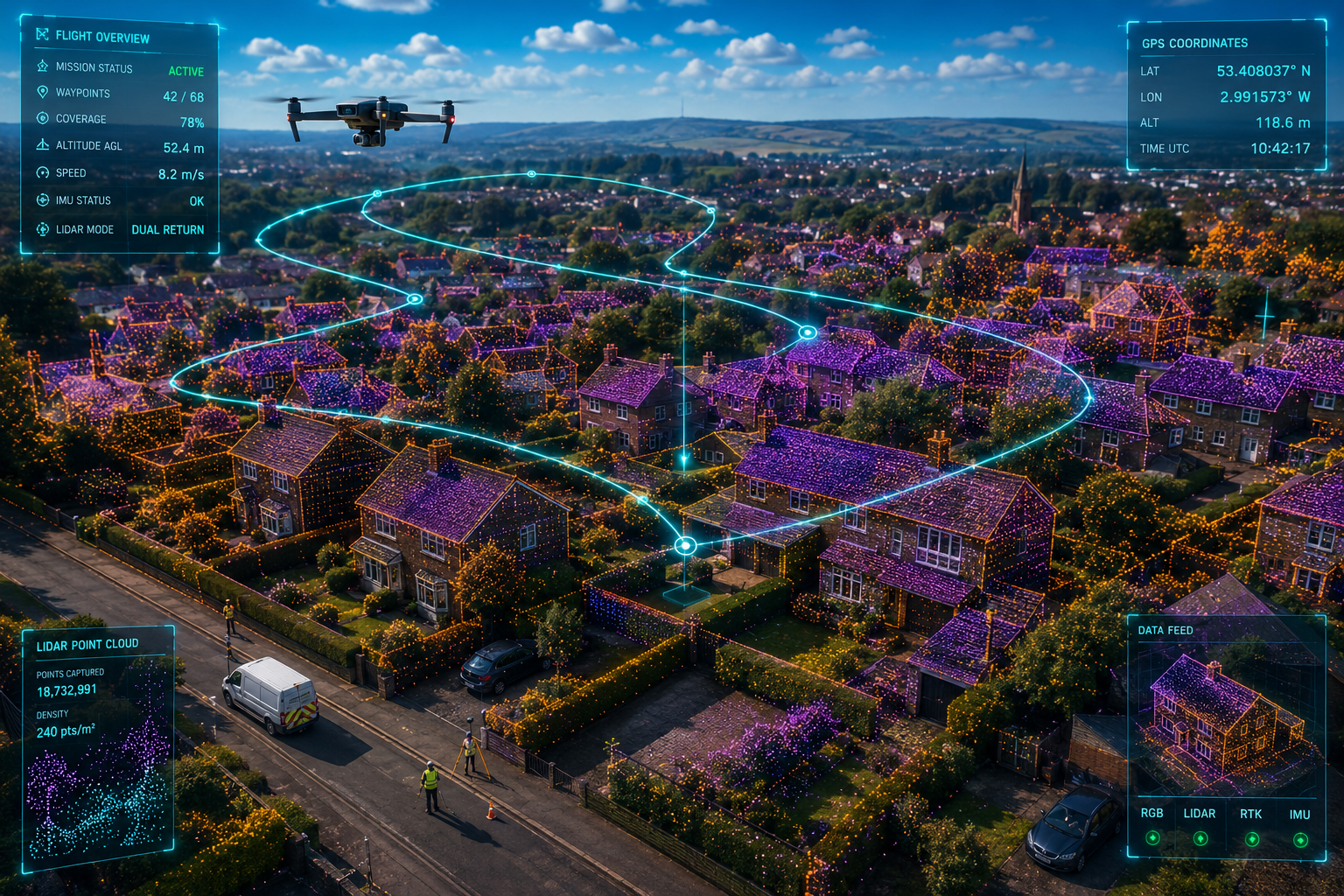
Drones equipped with LiDAR (Light Detection and Ranging) sensors and high-resolution cameras have fundamentally changed how surveyors gather site data. What once required scaffolding, rope access, or multiple site visits can now be completed in a single drone flight.
Key Benefits of Drone and LiDAR Integration
| Traditional Method | Drone + LiDAR Approach |
|---|---|
| Manual roof inspection (ladder/scaffold) | Safe aerial inspection in minutes |
| 2D sketches and photographs | Precise 3D point cloud models |
| Multiple site visits required | Single flight captures full dataset |
| High access costs | Significantly reduced overheads |
| Risk of missed defects | Comprehensive coverage of entire structure |
For roof surveys, drone technology is particularly transformative. Surveyors can now inspect inaccessible areas of pitched roofs, chimney stacks, and flat roof membranes without any physical access risk — producing detailed imagery and measurements in a fraction of the time.
LiDAR point clouds also integrate directly into Building Information Modelling (BIM) platforms, enabling seamless handoff to architects, engineers, and project managers.
Regulatory Considerations ⚠️
Drone operations in the UK require compliance with Civil Aviation Authority (CAA) regulations. Surveyors must hold appropriate drone operator registration and, for certain sites, specific flight authorisations. Staying compliant is non-negotiable.
Trend 3: Real-Time Data Processing and Cloud-Based Workflows
One of the most practically impactful of the Six Key Surveying Trends for 2026: Doubling Down on Digital Transformation is the shift from batch-processed, office-bound reporting to real-time, cloud-native workflows.
What Real-Time Processing Looks Like in Practice
Previously, a surveyor would spend days back in the office organising field notes, typing reports, and compiling photographs. Cloud-based surveying platforms now allow:
- Live data entry on mobile devices during the site inspection
- Instant photo tagging and annotation linked directly to report sections
- Automatic cloud backup eliminating the risk of data loss
- Client portals where reports are delivered and reviewed digitally
- Collaborative review between surveyors, engineers, and clients simultaneously
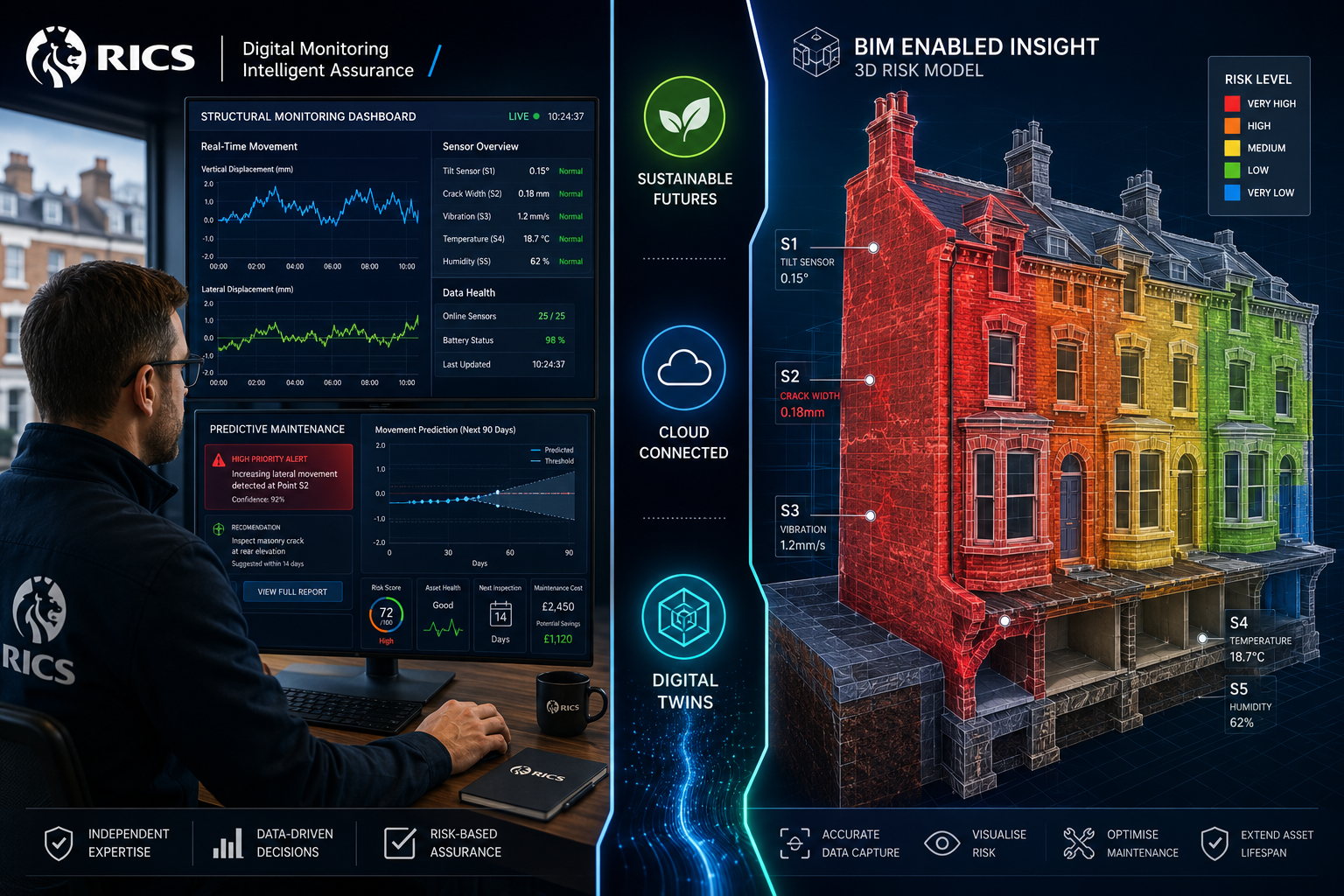
This shift is particularly valuable for monitoring surveys, where ongoing data collection and real-time alerts about structural movement or environmental changes are critical to client safety and decision-making.
The Speed Advantage 🚀
Firms using cloud-based workflows are delivering completed survey reports 40-60% faster than those still relying on traditional desktop-based processes. In a competitive market, speed of delivery is a significant differentiator.
💬 "Clients in 2026 expect the same digital experience from their surveyor that they get from their bank or their GP. Real-time access to information is no longer a luxury — it is an expectation."
Trend 4: Digital Twins and BIM Integration for Complex Projects
Digital twins — virtual replicas of physical buildings that update in real time using sensor data — are moving from large infrastructure projects into mainstream property surveying. Combined with Building Information Modelling (BIM), they are creating entirely new possibilities for how surveyors contribute to the property lifecycle.
Where Digital Twins Add the Most Value
- 🏗️ New build snagging: Comparing as-built conditions against BIM design models to identify discrepancies
- 🏢 Commercial property management: Continuous monitoring of building performance and maintenance needs
- 🏘️ Stock condition surveys: Tracking the condition of large housing portfolios over time
- 🔧 Structural assessments: Modelling how defects may evolve under different load or environmental conditions
For housing associations and local authorities commissioning stock condition surveys, digital twin integration means moving from periodic snapshot assessments to continuous, data-driven property management — a fundamental change in how large portfolios are maintained.
BIM and the Surveyor's Role
Surveyors who understand BIM workflows are increasingly valued as central coordinators in construction and refurbishment projects. The ability to read, contribute to, and quality-check BIM models is becoming a core professional competency — not an optional extra.
For those involved in project management alongside surveying, BIM proficiency creates significant opportunities to expand service offerings and client value.
Trend 5: Sustainability, ESG, and the Green Survey Imperative
The sustainability agenda is reshaping surveying demand in 2026 more profoundly than almost any other single factor. New legislation, lender requirements, and corporate ESG (Environmental, Social, and Governance) commitments are driving demand for specialist assessments that simply did not exist five years ago.
New Survey Types Driven by Sustainability
- Energy Performance Assessments: Detailed analysis of building fabric, insulation, and heating systems
- Embodied Carbon Surveys: Measuring the carbon footprint of building materials and construction methods
- Flood Risk Assessments: Increasingly required by lenders and insurers in at-risk areas
- Biodiversity Net Gain Reports: Required for many planning applications under UK legislation
- EPC Compliance Surveys: Critical for landlords facing tightening minimum energy efficiency standards
For residential clients, understanding a property's energy performance is now a key part of choosing the right property survey. Buyers increasingly want to know not just whether a building is structurally sound, but how much it will cost to heat — and what improvements are needed to meet future standards.
The Commercial Angle 🏢
In the commercial sector, ESG reporting requirements from institutional investors and lenders mean that commercial building surveys must now routinely incorporate sustainability metrics alongside traditional condition assessments.
Surveyors who develop genuine expertise in green building assessment are positioning themselves for a significant and growing revenue stream.
Trend 6: Autonomous Tools, Robotics, and the Future of Site Inspection
The sixth and perhaps most forward-looking of the Six Key Surveying Trends for 2026: Doubling Down on Digital Transformation involves the emergence of autonomous inspection tools — robots, crawlers, and AI-guided drones that can access and assess areas of buildings that are dangerous, inaccessible, or simply impractical for human surveyors.
Autonomous Tools Already in Use
| Tool Type | Application | Benefit |
|---|---|---|
| Ground-based robots | Crawl spaces, confined voids, drainage systems | Safe inspection of hazardous areas |
| Autonomous drones | Large roof areas, tall facades, complex rooflines | Speed and coverage without scaffolding |
| Pipe inspection cameras | Drainage and underground infrastructure | Precise defect location without excavation |
| Thermal imaging systems | Damp detection, insulation failures, heat loss | Non-invasive diagnosis of hidden defects |
For drainage surveys, robotic pipe inspection cameras have already become standard practice — delivering video evidence of blockages, root ingress, and pipe collapse that manual inspection simply cannot match.
What This Means for Surveyors 🤖
The rise of autonomous tools does not mean the end of the human surveyor. It means the role is evolving. The most successful surveyors in 2026 are those who:
- Understand and operate autonomous inspection technologies
- Interpret and contextualise the data these tools produce
- Communicate findings clearly to clients who may not understand the technology
- Apply professional judgement to situations where data alone is insufficient
The human element — experience, empathy, professional accountability — remains irreplaceable. Technology amplifies it.
How to Stay Competitive: A Practical Digital Transformation Roadmap
Understanding the Six Key Surveying Trends for 2026: Doubling Down on Digital Transformation is only valuable if it leads to action. Here is a practical framework for surveying firms at different stages of digital adoption:
🟢 Early Stage (Just Starting Out)
- Adopt cloud-based report writing software
- Invest in a quality drone and complete CAA registration
- Attend RICS-accredited CPD courses on digital surveying tools
- Subscribe to AI-assisted photo analysis platforms
🟡 Intermediate Stage (Some Digital Tools in Place)
- Integrate LiDAR data capture into standard workflows
- Develop BIM reading competency and offer BIM-linked reporting
- Build sustainability assessment skills and add ESG services
- Implement a client portal for digital report delivery
🔴 Advanced Stage (Digital-First Practice)
- Deploy digital twin monitoring for commercial and portfolio clients
- Offer autonomous inspection services using robotics partnerships
- Use AI for predictive maintenance recommendations in reports
- Develop proprietary data analytics capabilities
What Clients Are Expecting in 2026
The digital transformation of surveying is not just an internal professional matter — it is being driven, in part, by changing client expectations. Property buyers, investors, housing associations, and commercial occupiers all expect:
- Faster report turnaround (often within 24-48 hours of inspection)
- Digital-first delivery (PDF, interactive reports, online portals)
- Clear, jargon-free findings supported by photographs and video
- Actionable recommendations with cost estimates and priority ratings
- Ongoing relationships rather than one-off transactional surveys
For clients comparing survey options, resources like a guide to different types of survey help them understand what level of inspection they need — and why digital-enhanced surveys deliver better value.
Conclusion: Act Now or Fall Behind
The Six Key Surveying Trends for 2026: Doubling Down on Digital Transformation are not theoretical — they are the competitive reality of the property surveying market right now. AI-powered defect detection, drone and LiDAR data collection, real-time cloud workflows, digital twins, sustainability assessments, and autonomous inspection tools are collectively redefining what it means to deliver a professional survey.
The firms and individual surveyors who thrive in this environment will be those who embrace these tools with genuine curiosity and strategic intent — not those who wait for the profession to force change upon them.
Actionable Next Steps ✅
- Audit your current tech stack — identify the biggest gaps in your digital workflow
- Prioritise one new tool to trial in the next 90 days (start with cloud reporting or drone capture)
- Invest in CPD focused on digital surveying, BIM, and sustainability assessment
- Talk to your clients — ask what digital improvements would most improve their experience
- Partner strategically — consider alliances with drone operators, BIM specialists, or tech platforms rather than trying to build everything in-house
The surveying profession has always adapted to new tools and new demands. 2026 is simply the next — and perhaps most significant — chapter in that story. The surveyors who act decisively today will define the profession for the next decade.