
An estimated 231,000 flats in England remain effectively unsellable or unmortgageable due to unresolved cladding issues — a figure that has barely shifted since the post-Grenfell crisis began [5]. Against this backdrop, RICS published the second edition of its professional standard on Secured Lending Valuations for Flats with Cladding in 2026: What RICS' Updated Guidance Means in Practice, announced in May 2026 and coming into force on 1 November 2026 [7]. For valuers, lenders, and flat owners, this update is not a minor revision — it fundamentally reshapes how external wall risk is assessed, reported, and reflected in market value.
This article translates the new standard into a practical, step-by-step framework, complete with real-world scenarios showing how EWS1 decisions and remediation funding can swing valuations dramatically.
Key Takeaways 📌
- The second edition RICS standard takes effect on 1 November 2026, replacing earlier cladding valuation guidance.
- EWS1 forms must no longer be requested by default — only where specific risk criteria are met.
- Building height, visible cladding type, curtain wall glazing, and balcony construction are the key triggers for EWS1 assessment.
- Remediation funding status (developer pledges, government schemes) now directly affects how valuers reflect risk in their reports.
- Valuers face increased professional liability if they fail to follow the updated decision-making framework.
Why the Second Edition Matters: The Cladding Crisis in 2026
The original RICS guidance, first issued in the aftermath of the Grenfell Tower fire, helped establish the EWS1 (External Wall System) form as a tool for lenders assessing fire risk in multi-storey residential buildings. However, the system quickly became a bottleneck. Lenders began demanding EWS1 forms for buildings that posed little or no risk, freezing transactions across the market [8].
By 2026, the landscape has shifted considerably:
- The Building Safety Act 2022 established new leaseholder protections and developer accountability frameworks.
- The Developer Remediation Contract has seen major housebuilders commit to fixing buildings they developed.
- Government remediation data shows progress, but tens of thousands of buildings remain in assessment queues [10].
💬 "The second edition is designed to align valuation practice with where the building safety regime actually is in 2026 — not where it was in 2019." — Fire Protection Association commentary on the updated standard [6]
The new standard acknowledges this evolved landscape. It requires valuers to consider not just whether cladding exists, but whether risk is real, quantified, and unmitigated — and to reflect that nuance in their secured lending reports.
Understanding the full range of valuation factors that affect a property's market value is essential context for any valuer working in this space.
The Step-by-Step Framework for Valuers Under the New Standard
Step 1: Identify Whether the Building Falls Within Scope
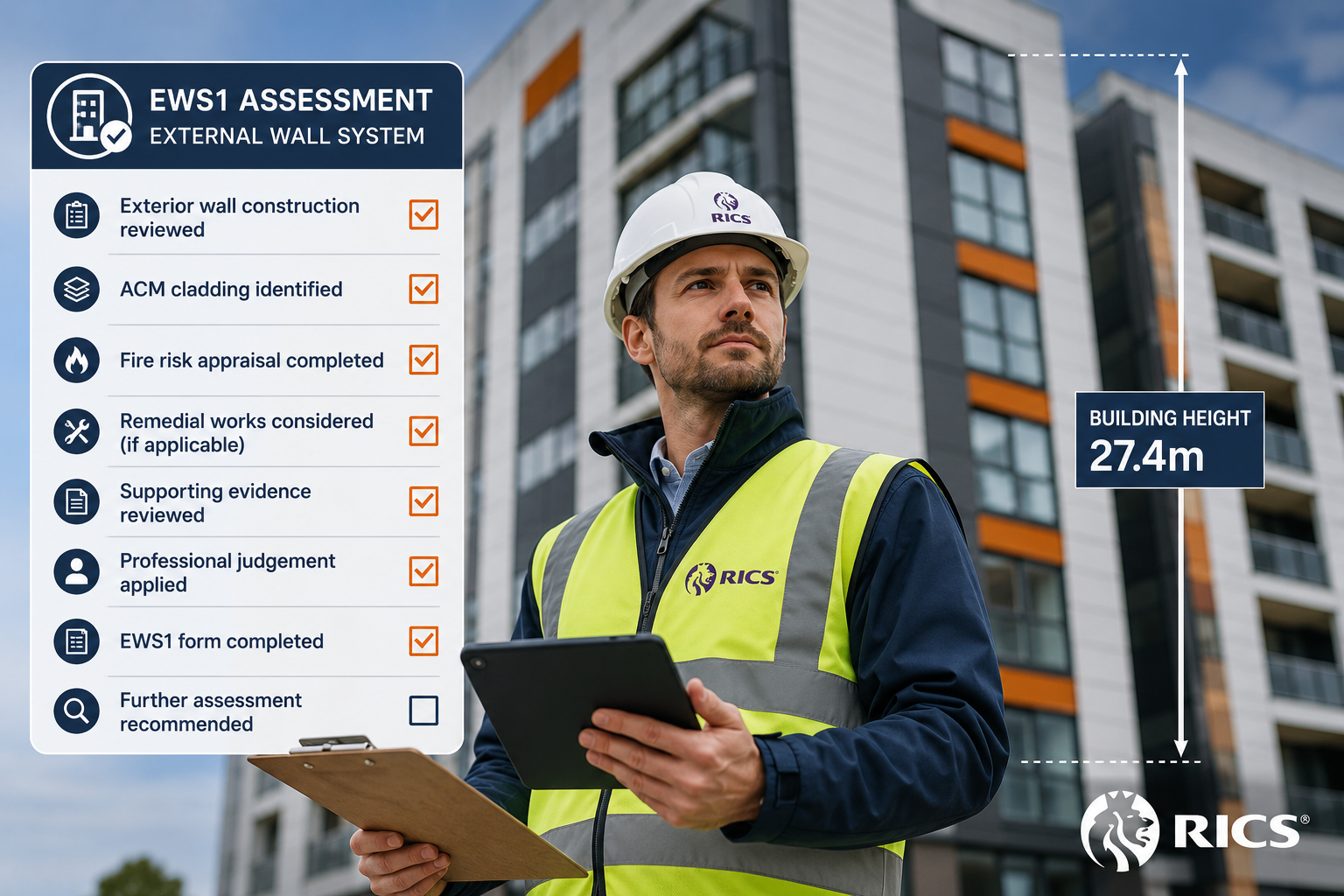
The second edition applies to multi-storey, multi-occupancy residential buildings where the valuer is instructed to provide a secured lending valuation. The first practical question is whether the building's characteristics trigger the cladding assessment pathway.
Scope triggers include:
| Factor | Threshold / Detail |
|---|---|
| Building height | Generally 11 metres or above |
| Visible external cladding | Any non-masonry cladding system |
| Curtain wall glazing | Present on any elevation |
| Combustible balcony construction | Timber or composite balconies |
| Known or suspected ACM/HPL panels | Any height |
If none of these factors apply, the valuer may proceed with a standard secured lending valuation without the cladding overlay.
Step 2: Apply the EWS1 Decision Matrix — Only Request Where Justified
This is the most significant practical change in the 2026 standard. EWS1 forms should only be requested where there is a defined reason, based on the criteria above [1][6]. Blanket requests for EWS1 on all flats — regardless of building type — are explicitly inconsistent with the updated guidance.
The decision logic works as follows:
- No cladding indicators present → No EWS1 required; value on normal market evidence.
- Cladding present but building under 11m → Generally no EWS1; note the position and consider any known issues.
- Cladding present, building 11m+, no existing EWS1 → Request EWS1 only if risk indicators are confirmed; consider whether remediation is already underway.
- EWS1 exists with A1/A2 rating → No material cladding risk; value normally.
- EWS1 exists with B1/B2 rating → Remediation required; assess funding position before reflecting in value.
This tiered approach prevents the market paralysis caused by indiscriminate EWS1 requests, while still protecting lenders from unquantified fire safety risk [8].
Step 3: Assess the Remediation Funding Position
Where cladding risk is identified, the valuer must investigate the remediation funding landscape before arriving at a market value. This is where the 2026 standard diverges most sharply from earlier practice.
Key funding routes to investigate:
- 🏗️ Developer Remediation Contract — Has the original developer signed the pledge? Are works scheduled?
- 🏛️ Building Safety Fund — Is the building registered and in the assessment pipeline? [10]
- 📋 Responsible Persons — Has the building owner accepted liability under the Building Safety Act 2022?
- 💷 Leaseholder protections — Are leaseholders legally protected from remediation costs under the Act?
⚠️ Critical point: A flat in a building where the developer has signed the remediation pledge and works are scheduled is in a fundamentally different risk position than an identical flat in a building with no funding route identified. The valuation must reflect this.
Working with RICS-registered valuers who understand this funding matrix is essential for lenders and borrowers alike.
Step 4: Reflect Risk in the Valuation Report
Once the cladding position and funding status are established, the valuer must translate this into a market value figure and, critically, a clear narrative in the report.
The report should address:
- Whether an EWS1 was requested and why (or why not)
- The current EWS1 rating (if available)
- Remediation status and funding source
- Any Special Assumptions used (e.g., assuming works will be completed)
- The impact on marketability and value — quantified where possible
Understanding the methods of valuation available — comparison, investment, residual — helps valuers select the most appropriate approach when comparable evidence is distorted by cladding uncertainty.
Secured Lending Valuations for Flats with Cladding in 2026: Scenario Examples
Scenario A: The "Clean" Building — No EWS1 Required
Property: 8th-floor flat in a 2015-built, 12-storey block in East London. Brick and render external finish. No visible cladding panels. No balconies.
Valuer's assessment: Building height exceeds 11m, but no cladding indicators are present. Under the 2026 standard, no EWS1 is required. The valuer proceeds on normal market evidence.
Outcome: Mortgage proceeds without delay. Market value reflects comparable sales in the area without cladding discount.
Scenario B: ACM Cladding, Developer Pledge Signed
Property: 5th-floor flat in a 2008-built, 18-storey tower in North London. ACM (Aluminium Composite Material) cladding confirmed. Developer has signed the Remediation Contract; works are programmed to start within 6 months.
Valuer's assessment: EWS1 required — building height and ACM cladding confirmed. Existing EWS1 shows B2 rating (remediation required). However, developer pledge is in place and works are funded and scheduled [2].
Special Assumption: Valuation prepared on the Special Assumption that remediation will be completed in accordance with the developer's programme.
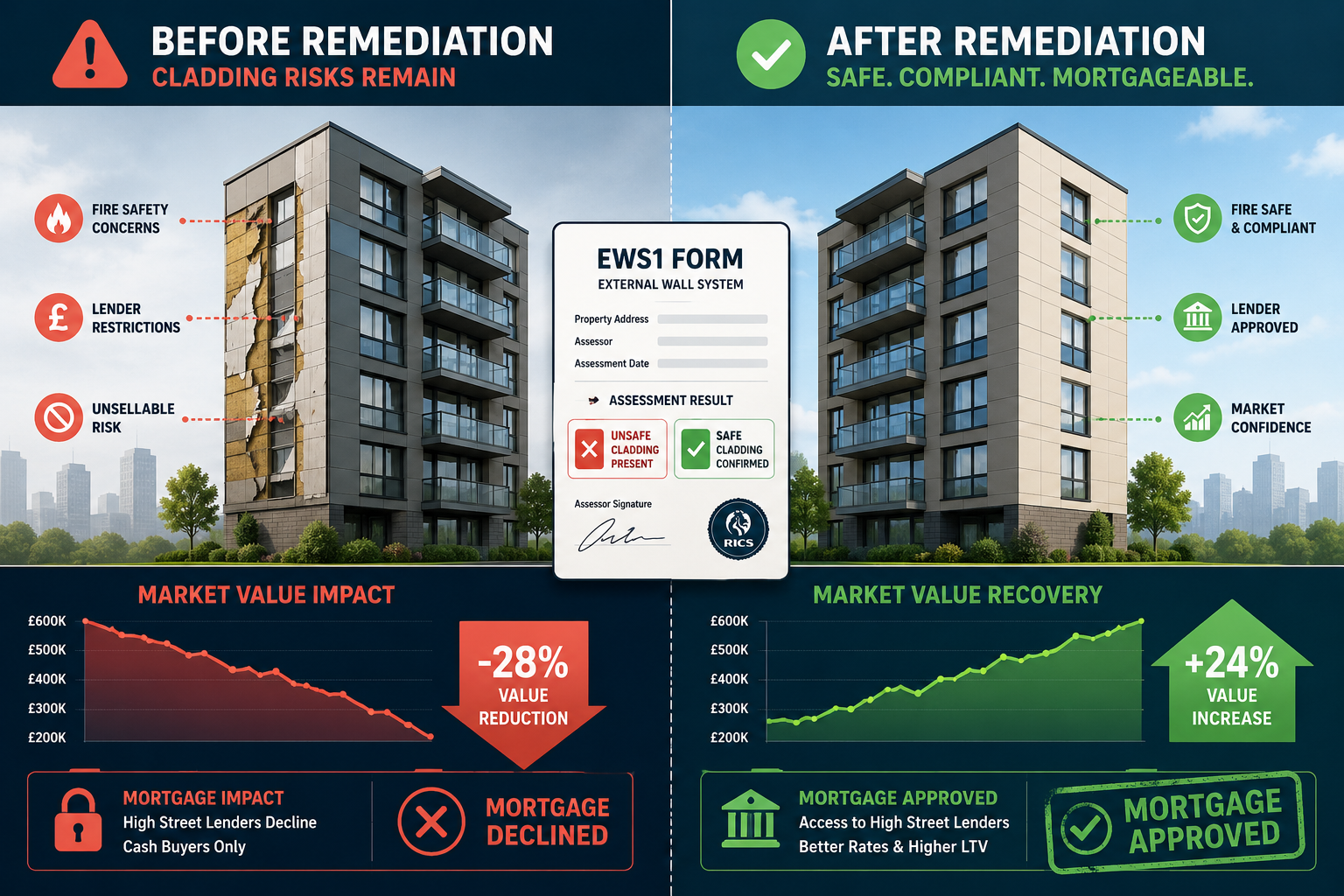
Outcome: Value reported at approximately 85–90% of unaffected market value, reflecting residual transaction risk and delay, but not a catastrophic discount. Lender may impose conditions on the mortgage offer.
Scenario C: HPL Cladding, No Funding Route Identified
Property: 3rd-floor flat in a 2003-built, 14-storey block in Central London. High-Pressure Laminate (HPL) cladding on upper floors. No developer pledge. Building Safety Fund application submitted but not yet assessed. Freeholder disputes liability.
Valuer's assessment: This is the most challenging scenario under the 2026 standard. EWS1 required; rating is B2. No confirmed funding route. Leaseholder protections may apply but are untested in this case [10].
Outcome: Valuer reports market value at a significant discount — potentially 30–50% below unaffected value — with a clear statement that the property may be unmortgageable until the remediation position is resolved. Some lenders will decline to lend entirely.
📊 This scenario reflects the reality facing an estimated 231,000 properties across England where no clear remediation pathway exists [5].
Scenario D: Curtain Wall Glazing — A Common Grey Area
Property: 2nd-floor flat in a 2012-built, 9-storey block in South West London. Full-height curtain wall glazing system. No traditional cladding panels.
Valuer's assessment: Under the 2026 standard, curtain wall glazing is a specific trigger for EWS1 assessment, regardless of whether traditional cladding is present [6]. The valuer requests an EWS1.
Outcome: EWS1 returns an A2 rating (combustible materials present but no remediation required). Valuer notes the position but proceeds with a normal valuation. Minor marketability caveat included.
What the 2026 Standard Means for Lenders and Borrowers
For Mortgage Lenders
Lenders who are members of UK Finance have historically aligned their cladding policies with RICS guidance [2]. The second edition creates a clearer framework for:
- Standardising valuation instructions to avoid over-requesting EWS1 forms
- Assessing risk proportionately based on building type and remediation status
- Reducing transaction delays for buildings that genuinely pose no elevated risk
Lenders should update their valuation panel instructions to reflect the 1 November 2026 effective date.
For Flat Owners and Buyers
The practical implications for anyone buying, selling, or remortgaging a flat in a clad building in 2026 include:
- ✅ Faster transactions where buildings clearly fall outside EWS1 scope
- ✅ Clearer valuation reports that explain the cladding position and its impact
- ⚠️ Continued difficulty for buildings in Scenario C — no funding route, disputed liability
- 📋 Greater importance of pre-purchase due diligence — checking building safety records before making an offer
For leasehold flat owners, understanding how cladding issues interact with lease terms is also important. Our guide to lease extension valuations explains how building safety concerns can affect leasehold value calculations.

Professional Liability and the Valuer's Obligations Under the New Standard
Compliance Is Not Optional
The second edition is a RICS professional standard, meaning compliance is mandatory for all RICS members undertaking secured lending valuations on clad buildings from 1 November 2026 [7]. Failure to follow the framework — whether by requesting unnecessary EWS1 forms or, conversely, failing to identify a genuine risk — exposes valuers to professional negligence claims.
Key obligations include:
- Documenting the decision-making process at each step of the framework
- Disclosing limitations where information is unavailable (e.g., no EWS1 exists and one cannot be obtained in time)
- Using Special Assumptions transparently and only where instructed or justified
- Keeping up to date with remediation programme data from government sources [10]
The price of a valuation for a clad building will typically reflect the additional complexity and time involved in following this framework properly — valuers should price their services accordingly.
The Role of Building Surveys Alongside Valuations
A secured lending valuation is not a building survey. Where cladding concerns are identified, buyers and lenders may also benefit from commissioning a RICS Level 3 Building Survey to understand the physical condition of the external wall system in greater detail. These two reports serve different purposes but are complementary in high-risk cases.
Secured Lending Valuations for Flats with Cladding in 2026: Common Questions Answered
Q: Does the new standard apply to all flats, or only those above 18 metres?
The standard applies to multi-storey, multi-occupancy buildings with cladding. The 18-metre threshold is relevant to certain government remediation schemes, but the RICS standard uses 11 metres as a key trigger point for EWS1 consideration [7].
Q: What if an EWS1 form is unavailable?
Valuers must report the absence of an EWS1 where one is required, note the impact on marketability and value, and may need to decline to provide a valuation figure or report subject to significant caveats [8].
Q: Can a valuer assume remediation will happen?
Only as a Special Assumption, clearly stated and agreed with the instructing lender. The valuation must also include a figure on the basis that the assumption does not hold [3].
Q: How does the standard interact with the Building Safety Act 2022?
The standard is designed to work alongside the Act. Where leaseholders are legally protected from remediation costs, this reduces the financial risk reflected in the valuation — but only where that protection is clearly established [2].
Conclusion: Actionable Next Steps for 2026
The second edition of the RICS secured lending valuation standard for clad buildings is the most significant update to cladding valuation practice since the EWS1 form was introduced. Its core message is one of proportionality — assess real risk, request EWS1 only where justified, and reflect remediation funding status accurately in every report.
For valuers:
- Review the full second edition standard before 1 November 2026.
- Update your internal decision-making checklists to reflect the new EWS1 criteria.
- Build relationships with building safety specialists who can advise on remediation status.
- Document every step of your cladding assessment in your valuation file.
For lenders:
- Update panel instructions and valuation briefs ahead of the November 2026 effective date.
- Align internal cladding policies with the UK Finance industry statement [2].
- Train credit teams on the distinction between funded and unfunded remediation risk.
For flat owners and buyers:
- Check whether your building is registered with the Building Safety Fund or covered by a developer pledge before proceeding [10].
- Commission a specialist valuation from a RICS-registered valuer experienced in cladding cases.
- Seek legal advice on leaseholder protections under the Building Safety Act 2022 before accepting any remediation cost demands.
The cladding crisis is far from over — but the 2026 RICS standard gives the market a clearer, fairer, and more proportionate framework for navigating it.
References
[1] Rics Releases Updated Home Valuation Guidance For Flats In Buildings With Cladding – https://bebeez.eu/2026/05/14/rics-releases-updated-home-valuation-guidance-for-flats-in-buildings-with-cladding/
[2] Industry Statement Cladding – https://www.ukfinance.org.uk/policy-and-guidance/guidance/industry-statement-cladding
[3] Valuation Approach For Properties In Residential Buildings With – https://www.rics.org/profession-standards/rics-standards-and-guidance/sector-standards/valuation-standards/valuation-approach-for-properties-in-residential-buildings-with-
[5] Cladding Scandal 2026 Update 231000 Unsellable Homes – https://www.propertysolvers.co.uk/youtube/cladding-scandal-2026-update-231000-unsellable-homes/
[6] Rics Publishes Updated Standard On Valuations For Clad Residential Buildings – https://www.thefpa.co.uk/fire-and-risk-management-journal/news/rics-publishes-updated-standard-on-valuations-for-clad-residential-buildings-
[7] Valuation Of Properties In Multi Storey Multi Occupancy Residential Buildings With Cladding – https://www.rics.org/profession-standards/rics-standards-and-guidance/sector-standards/valuation-standards/valuation-of-properties-in-multi-storey-multi-occupancy-residential-buildings-with-cladding
[8] Cladding External Wall System Ews Faqs – https://www.rics.org/news-insights/current-topics-campaigns/fire-safety/cladding-external-wall-system-ews-faqs
[10] Building Safety Remediation Technical Note January 2026 – https://www.gov.uk/government/publications/building-safety-remediation-monthly-data-release-january-2026/building-safety-remediation-technical-note-january-2026