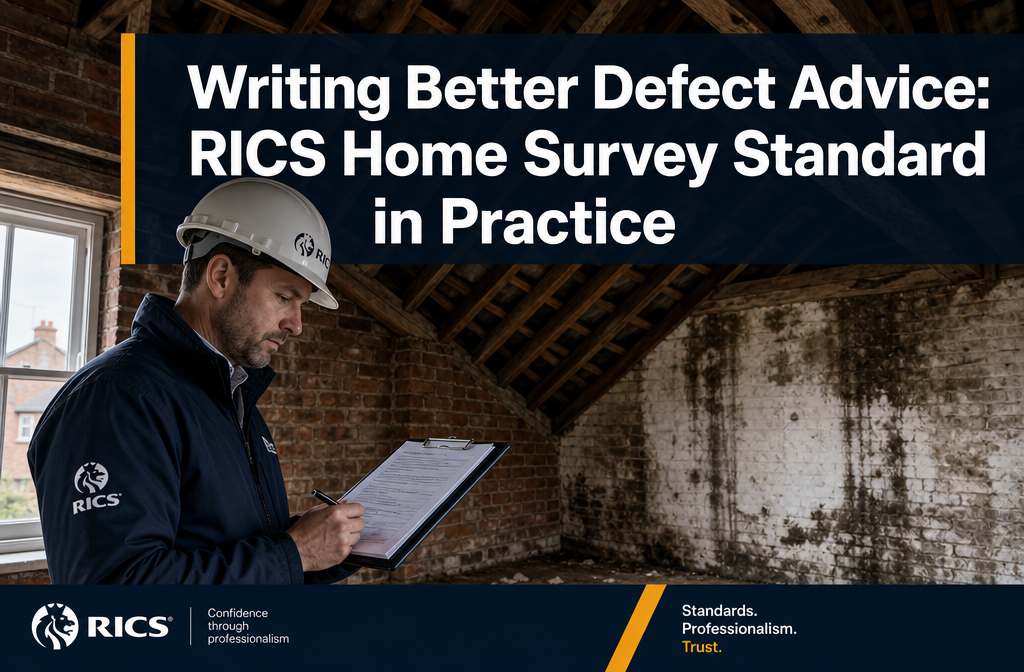

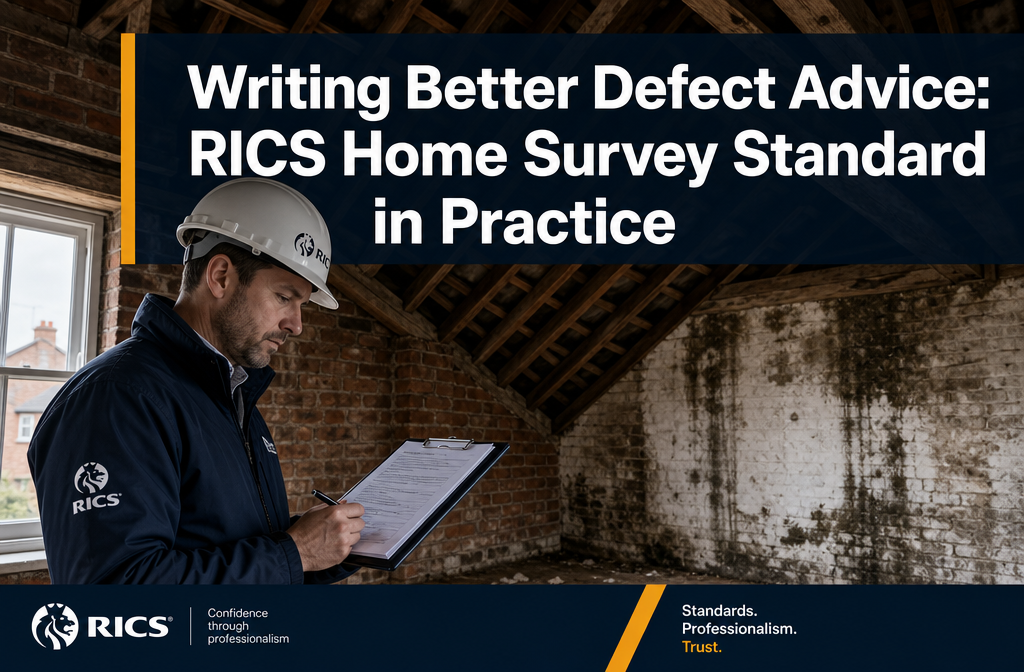
Fewer than one in five homebuyers fully understand the defect advice written in their survey report — not because the surveyor lacked knowledge, but because the language used failed to communicate risk clearly. That gap between expert observation and client understanding sits at the heart of what the RICS Home Survey Standard was designed to address. Putting the RICS Home Survey Standard in Practice: How to Write Better Defect Advice in Level 2 and Level 3 Reports is not merely a compliance exercise — it is a professional discipline that separates good surveyors from great ones.
This article is written for practising surveyors, trainee members, and APC candidates who want to move beyond boilerplate phrasing and write defect advice that is precise, proportionate, and genuinely useful to clients.
Key Takeaways 📋
- Condition ratings alone are not enough — the narrative around each defect must explain risk, consequence, and urgency in plain language.
- Level 2 and Level 3 reports demand different depths of defect description; conflating the two creates ambiguity and potential liability.
- "Further investigation" recommendations must be specific, not generic — naming the specialist and the reason adds real value.
- Active, direct language reduces misinterpretation and protects surveyors from complaints.
- The RICS Home Survey Standard sets a clear framework; applying it consistently improves both report quality and client outcomes.
Why Defect Advice So Often Falls Short
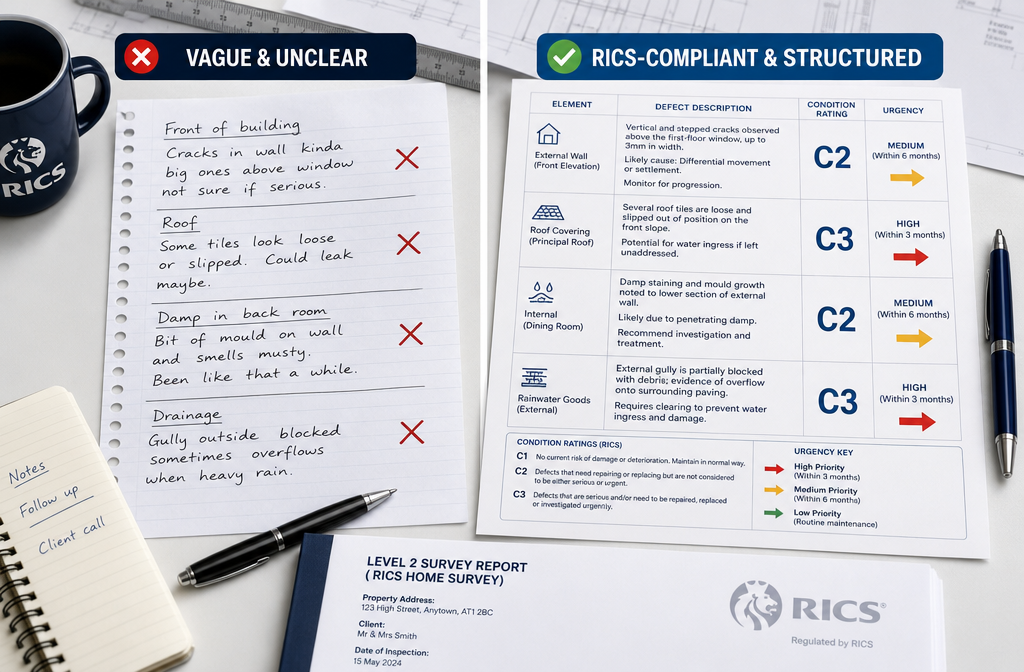
Most surveying complaints do not arise from missed defects. They arise from poorly communicated defect advice. A surveyor may correctly identify rising damp, assign it a Condition Rating 2 or 3, and still leave the client confused about what to do next, how much it might cost, or whether it is safe to proceed with the purchase.
The RICS Home Survey Standard (HSS), which became mandatory for RICS members in 2021, introduced a structured framework precisely to tackle this problem. Yet the standard describes what surveyors must cover — it does not always prescribe how to phrase it. That interpretive space is where report quality either rises or falls.
Common weaknesses in defect advice include:
- Vague urgency signals — phrases like "attention is recommended" without any indication of timeframe
- Passive voice overuse — "it was noted that…" distances the surveyor from their own professional opinion
- Generic further investigation clauses — "a specialist should be consulted" without specifying which type of specialist or why
- Condition rating without consequence — assigning C3 without explaining what happens if the defect is ignored
- Inconsistent risk language — using "significant" in one section and "notable" in another for defects of equal severity
Understanding the Framework: Level 2 vs Level 3 Defect Reporting
Before improving the writing, it helps to be clear on what each survey level requires. Understanding the difference between Level 2 and Level 3 surveys is foundational to calibrating defect advice correctly.
Level 2 (Home Survey – Survey): Proportionate Clarity
A Level 2 homebuyer survey is designed for conventionally constructed properties in reasonable condition. Defect advice at this level should be:
- Concise but complete — enough detail for the client to understand the issue without an engineering-level explanation
- Action-oriented — what should the client do, and roughly when?
- Risk-proportionate — a C2 defect should not read with the same urgency as a C3
Level 3 (Home Survey – Building Survey): Analytical Depth
A Level 3 building survey demands a significantly higher level of analytical commentary. Defect advice here should:
- Explain probable cause — not just what the defect is, but why it has occurred
- Assess likely extent — visible evidence and what it may indicate about hidden areas
- Quantify risk where possible — structural implications, cost ranges, or urgency timelines
- Specify investigation pathways — which specialist, what they should assess, and what outcome is needed before exchange
💡 Pull Quote: "A Level 3 report that reads like a Level 2 is not just a quality failure — it is a missed opportunity to protect the client from a decision they may deeply regret."
A Practical Comparison Table
| Element | Level 2 Expectation | Level 3 Expectation |
|---|---|---|
| Defect description | Brief, factual | Detailed, analytical |
| Probable cause | Optional | Required |
| Risk consequence | Summarised | Fully explained |
| Further investigation | Named specialist | Named specialist + scope |
| Cost indication | Not mandatory | Recommended where possible |
| Urgency language | Clear | Precise with timeframe |
Applying the RICS Home Survey Standard in Practice: Phrasing Risk and Urgency
This is where the RICS Home Survey Standard in Practice: How to Write Better Defect Advice in Level 2 and Level 3 Reports becomes most practically useful — not as a compliance checklist, but as a writing guide.
Condition Ratings Are a Starting Point, Not an Endpoint
The three-tier condition rating system (C1, C2, C3) is widely understood within the profession, but clients often misread it. A C3 rating assigned without a compelling explanatory paragraph can be downplayed by a motivated buyer. The narrative must carry the weight of the rating.
Weak example:
"Cracking was noted to the front elevation. A Condition Rating 3 has been assigned."
Stronger example:
"Diagonal stepped cracking was observed to the front elevation at first-floor level, consistent with differential settlement. The pattern and width of the cracks (up to 4mm) suggest movement that may be ongoing. This is a significant structural concern. A structural engineer should inspect the property before exchange of contracts to determine the cause, extent, and likely cost of remediation. A Condition Rating 3 has been assigned."
The second version communicates what was seen, what it suggests, why it matters, and what to do next — all within a short paragraph.
Writing Urgency Without Causing Panic
Urgency language must be calibrated. Overstating risk on a minor defect erodes credibility; understating it on a serious one creates liability. The RICS Home Survey Standard encourages proportionate language, and surveyors should develop a consistent internal vocabulary.
A useful tiered approach:
- Immediate action — safety risk or risk of rapid deterioration (e.g., exposed electrical wiring, active roof leak over habitable space)
- Before exchange — requires specialist investigation or significant negotiation (e.g., suspected subsidence, damp survey findings requiring specialist assessment)
- Within 12 months — maintenance or repair needed soon but not immediately critical
- Ongoing maintenance — routine items to monitor or address at next decoration cycle
Using these categories consistently across a report gives clients a clear action hierarchy.
The "Further Investigation" Problem
Few phrases in surveying reports are more abused than "further investigation is recommended." Without context, it is meaningless. With context, it becomes one of the most valuable pieces of advice in the report.
Every further investigation recommendation should answer three questions:
- Who? — Which type of specialist (structural engineer, damp specialist, arboriculturist, drainage contractor)?
- What? — What specifically should they assess or test?
- Why? — What is the surveyor concerned about, and what outcome is needed?
For example, a specialist defect survey may be needed when a defect falls outside the scope of a standard inspection. Saying so explicitly — and explaining why — demonstrates professional judgement rather than risk-aversion.
Practical Writing Techniques for Better Defect Advice
Use Active Voice and Direct Language
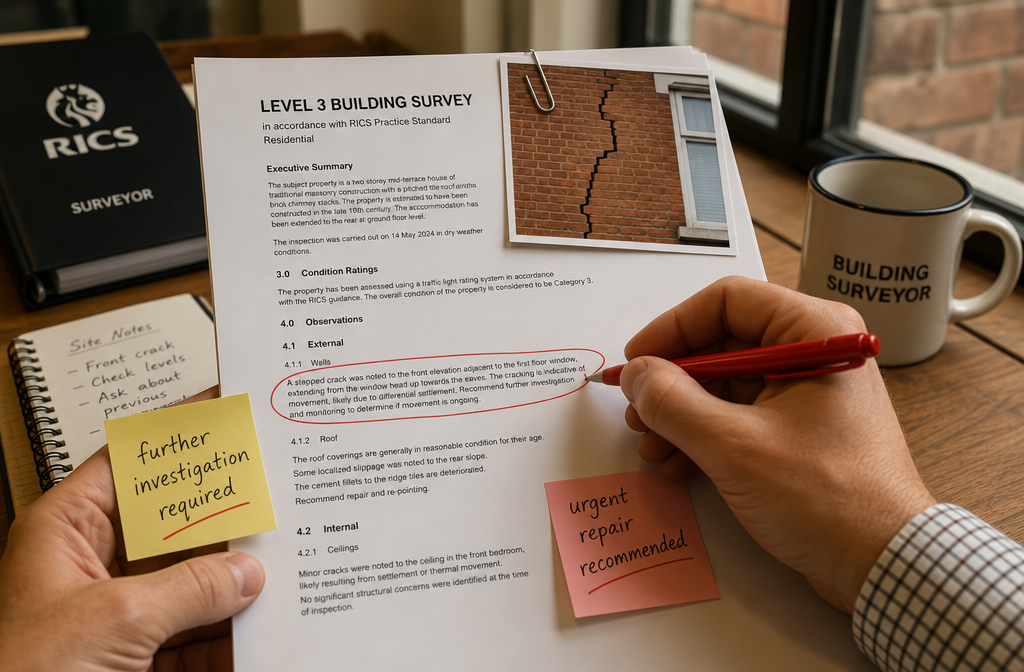
Active voice places the surveyor's professional opinion front and centre. It is clearer, shorter, and harder to misread.
| Passive (Avoid) | Active (Prefer) |
|---|---|
| "It was noted that…" | "The surveyor observed…" |
| "Attention is recommended…" | "Arrange repairs before…" |
| "Cracks were found…" | "Diagonal cracks are present…" |
| "A specialist should be consulted…" | "Instruct a structural engineer to…" |
Structure Each Defect Entry Consistently
A reliable structure for each defect section in both Level 2 and Level 3 reports:
- Observation — what was seen, where, and how extensive
- Assessment — probable cause and significance
- Risk — consequence of inaction
- Action — what the client should do, by when, and who should do it
- Condition Rating — stated clearly with brief rationale
This structure can be adapted in length for Level 2 (shorter) and Level 3 (longer), but the logical sequence remains the same.
Avoid Hedge Words That Dilute Advice
Certain phrases are so overused they have lost meaning:
❌ "May require attention"
❌ "Could potentially indicate"
❌ "It would be advisable to consider"
These phrases protect no one. If the surveyor has a professional opinion, it should be stated. Hedging language reads as evasion, not caution.
✅ "Requires repair within 12 months"
✅ "Indicates active water ingress"
✅ "Instruct a drainage contractor to CCTV survey the drains"
Tailor Language to the Client, Not the Profession
The RICS Home Survey Standard explicitly acknowledges that reports are written for clients, not for other surveyors. Avoid jargon where plain English works equally well.
- "Spalling brickwork" → "The brick faces are breaking away due to frost damage"
- "Interstitial condensation" → "Moisture is forming inside the wall construction"
- "Efflorescence" → "White salt deposits on the wall surface, indicating moisture movement"
Technical terms can still be used — but always with a plain-language explanation alongside.
Common Defect Scenarios and How to Write Them Better
The following scenarios illustrate how the RICS Home Survey Standard in Practice: How to Write Better Defect Advice in Level 2 and Level 3 Reports applies to real inspection findings.
🏚️ Scenario 1: Roof Condition (Level 2)
Weak: "The roof covering showed signs of wear. Condition Rating 2."
Better: "Several plain clay tiles are cracked or slipped on the rear slope. The ridge mortar is eroding in places. While no active leaks were identified at the time of inspection, the roof covering is approaching the end of its serviceable life. Arrange for a roofing contractor to inspect and quote for repairs or replacement within the next 12 months. Condition Rating 2."
For more complex roof structures, a dedicated roof survey may be warranted.
💧 Scenario 2: Damp (Level 3)
Weak: "Damp was noted to the ground floor. A damp specialist should be consulted."
Better: "Elevated moisture readings (above 20% WME) were recorded to the base of the front reception room walls using a calibrated moisture meter. The pattern is consistent with either rising damp or a bridged damp-proof course, though condensation cannot be excluded without further investigation. Instruct a RICS-accredited damp specialist to carry out a full damp investigation, including opening up works if necessary, before exchange of contracts. The cost of remediation can vary significantly depending on cause. Condition Rating 3."
Understanding damp survey costs can also help clients prepare financially for this next step.
🧱 Scenario 3: Cracking (Level 3)
For suspected subsidence or structural movement, the advice must be unambiguous:
Better: "Diagonal stepped cracking to the rear extension junction, up to 5mm wide, is consistent with differential settlement between the original structure and the extension. This requires assessment by a structural engineer before exchange of contracts. The engineer should determine whether movement is historic or ongoing, and advise on any necessary underpinning or repair. Do not proceed to exchange without this report. Condition Rating 3."
Quality Assurance: Reviewing Your Own Defect Advice
Before submitting any Level 2 or Level 3 report, apply this self-review checklist to each defect section:
- Is the observation specific (location, extent, measurement where relevant)?
- Is the probable cause stated or acknowledged as uncertain?
- Is the risk of inaction explained?
- Is the action recommendation specific (who, what, when)?
- Is the urgency language proportionate to the condition rating?
- Is the language accessible to a non-specialist reader?
- Have hedge words been replaced with direct professional opinion?
- Does the further investigation recommendation name a specialist type and scope?
Running every defect entry through this checklist adds only minutes to report preparation but significantly reduces the risk of complaints and misunderstandings.
Conclusion: Raising the Standard Through Better Writing ✅
The RICS Home Survey Standard provides the architecture for professional residential surveying practice. But the quality of a report — and the protection it offers to both client and surveyor — ultimately depends on the precision and clarity of the written defect advice.
Applying the RICS Home Survey Standard in Practice: How to Write Better Defect Advice in Level 2 and Level 3 Reports means moving beyond condition ratings and template paragraphs. It means writing advice that tells a client exactly what is wrong, why it matters, what happens if they ignore it, and what they should do next.
Actionable next steps for practitioners in 2026:
- Audit three recent reports — review each defect section against the checklist above and identify patterns in weak phrasing.
- Build a personal style guide — create a bank of approved phrases for common defect types at each urgency level.
- Replace all generic further investigation clauses — every recommendation should name a specialist type and scope.
- Test readability — read defect advice aloud; if it sounds evasive or unclear, rewrite it.
- Seek peer review — ask a colleague to read a report as if they were the client and flag anything confusing.
For clients choosing between survey types, understanding which survey is right for their property is the first step. For surveyors, writing reports that genuinely serve those clients is the professional obligation that follows.