
Survey problems are now the single largest cause of UK property deal collapses — accounting for 37.5% of all fall-throughs in Q1 2026 [1]. That figure alone should make every buyer pause before ticking the cheapest survey option on their solicitor's checklist.
The question of whether homebuyer reports are still enough in 2026, and when UK buyers should insist on a full building survey, has never been more pressing. With average completion times stretching from 11 weeks to 4.4 months [1], and surveyor booking queues pushing the mortgage-to-survey gap to 17 days [1], choosing the wrong level of inspection can cost buyers thousands — or collapse a purchase entirely.
This guide provides a clear decision framework for choosing between a RICS Level 2 Homebuyer Report and a Level 3 Full Building Survey, with real-world examples of defects that lighter-touch inspections routinely miss.
Key Takeaways 📋
- Survey problems cause 37.5% of UK property deal collapses in 2026 — the highest single factor on record.
- A Level 2 Homebuyer Report suits modern, well-maintained properties in good condition; it is not designed for older, extended, or structurally complex homes.
- A Level 3 Full Building Survey is essential for properties built before 1930, those with cladding concerns, extensions, or visible defects.
- Common defects missed by Level 2 surveys include hidden damp, roof structure failures, subsidence, and non-compliant cladding systems.
- Spending an extra £300–£600 on the right survey level can save buyers tens of thousands in unexpected repair costs.
Understanding the Two Main Survey Types in 2026
Before addressing whether homebuyer reports are still enough in 2026, it helps to understand exactly what each survey level covers — and, critically, what it does not.
RICS Level 2: The Homebuyer Report
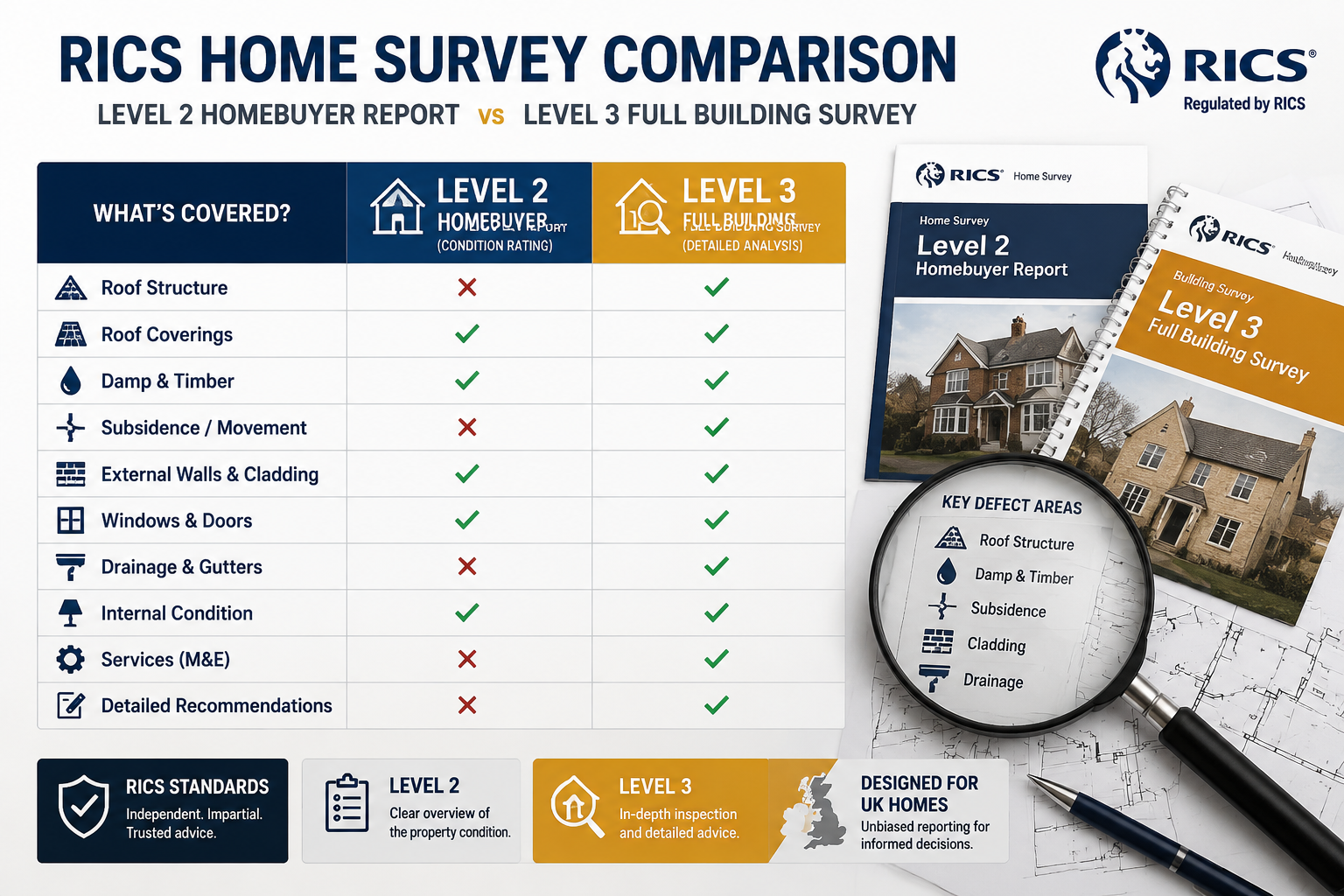
The RICS Level 2 Homebuyer Survey is a standardised, visual inspection of a property's accessible and visible elements. It uses a traffic-light rating system (Condition Ratings 1, 2, and 3) to flag concerns.
What it covers:
- Visible condition of roof coverings (from ground level or hatch)
- Internal walls, ceilings, and floors
- Windows, doors, and joinery
- Basic damp checks using a moisture meter
- Services (a visual check only — no testing)
- A market valuation (in most versions)
What it does NOT cover:
- Areas behind fitted furniture or under floor coverings
- Roof voids unless safely and readily accessible
- Structural calculations or load-bearing assessments
- Drainage systems
- Specialist cladding inspections
- Hidden or concealed defects
💬 "A Level 2 survey is designed to confirm a property is broadly as expected — not to uncover what is hidden."
RICS Level 3: The Full Building Survey
The Full Building Survey (formerly called a Structural Survey) is the most comprehensive residential inspection available. It involves a thorough examination of all accessible areas, detailed commentary on construction methods, and specific advice on repairs.
What it adds over Level 2:
- Inspection of roof void and roof structure
- Assessment of concealed areas where safe to do so
- Detailed analysis of damp, timber decay, and drainage
- Structural movement and subsidence assessment
- Advice on repair methods and likely costs
- Tailored narrative report (not a tick-box format)
| Feature | Level 2 Homebuyer | Level 3 Full Building |
|---|---|---|
| Visual inspection | ✅ | ✅ |
| Roof void inspection | ❌ (limited) | ✅ |
| Structural analysis | ❌ | ✅ |
| Damp investigation | Basic | Detailed |
| Drainage assessment | ❌ | Optional add-on |
| Repair cost guidance | Limited | ✅ |
| Cladding review | ❌ | ✅ |
| Typical cost range | £400–£700 | £700–£1,500+ |
The Defects That Homebuyer Reports Routinely Miss
This is where the real risk lies. The question of whether homebuyer reports are still enough in 2026 when UK buyers should insist on a full building survey becomes urgent once buyers understand how frequently Level 2 inspections fail to catch serious problems.
1. 🏗️ Roof Structure Failures
A Level 2 surveyor may note that roof tiles appear in fair condition from the ground — but without entering the roof void, they cannot assess the condition of rafters, purlins, ridge boards, or sarking felt. In properties over 40 years old, cut-rafter roofs frequently show signs of spread, rot, or beetle infestation that are entirely invisible from outside.
Repair cost if missed: £8,000–£25,000+ for partial or full roof structure replacement.
2. 💧 Hidden Damp and Timber Decay
Moisture meters used in Level 2 surveys detect surface readings — but rising damp, penetrating damp behind plasterboard, or condensation trapped within wall cavities can go undetected. A professional damp survey using invasive investigation techniques often reveals problems that a standard homebuyer report simply cannot identify.
Repair cost if missed: £2,000–£15,000 depending on extent and treatment required.
3. 🏚️ Subsidence and Ground Movement
Hairline cracks in render or plasterwork can be dismissed as "settlement" in a Level 2 report. But in areas with clay-heavy soils — particularly across southern England — these can indicate active subsidence requiring underpinning. A Level 3 surveyor will assess crack patterns, monitor movement, and recommend specialist investigation where needed.
Repair cost if missed: £10,000–£50,000+ for underpinning works.
4. 🔥 Non-Compliant Cladding Systems
Post-Grenfell, cladding has become one of the most significant risk factors in UK residential property. A Level 2 report is not designed to assess cladding systems in detail. For flats and houses with external insulation or composite cladding panels — particularly those built or refurbished between 1980 and 2015 — a Level 3 survey or specialist cladding inspection is essential.
Buyers purchasing leasehold flats should also review EWS1 form requirements and ensure their surveyor has assessed external wall systems thoroughly.
Cost implication if missed: Unmortgageable property, remediation bills of £30,000–£100,000+ per leaseholder.
5. 🔩 Structural Alterations Without Building Regulations Approval
Extensions, loft conversions, and removed walls are common in UK housing stock. A Level 2 report may flag that an alteration exists but will not assess whether it was carried out correctly or with proper approval. Residential structural engineering assessments are often needed to confirm load-bearing adequacy.
Cost implication if missed: Enforcement notices, retrospective works, or mortgage refusal.
6. 🚰 Drainage Problems
Collapsed drains, root ingress, and misaligned pipes are invisible to any surface inspection. A drainage survey using CCTV camera equipment is the only reliable method of identifying these issues — and it is not included in either Level 2 or Level 3 surveys as standard.
Repair cost if missed: £3,000–£20,000 for drain relining or excavation.
The 2026 Decision Framework: Level 2 vs Level 3
With survey delays now averaging 17 days from mortgage application [1] and total transaction times reaching 4.4 months [1], getting the survey level right first time is more important than ever. Re-surveys and renegotiations add weeks — and in a competitive market, that delay can kill a deal.
Use the framework below to determine the right survey level for any UK property purchase.
✅ A Level 2 Homebuyer Report is likely sufficient when:
- The property was built after 1980
- It is a standard construction (brick, block, or cavity wall — no timber frame, no unusual materials)
- It is in good visible condition with no obvious defects
- It has not been significantly extended or altered
- It is a flat in a modern purpose-built block with a valid EWS1 form
- The buyer is purchasing at or below the asking price with no major concerns
⚠️ A Level 3 Full Building Survey is essential when:
- The property was built before 1930 (pre-cavity wall construction)
- It is listed or in a conservation area
- It has visible cracks, damp staining, or uneven floors
- It has had extensions, loft conversions, or structural alterations
- It has external cladding, render, or insulation systems
- It is a large or high-value property (generally £500,000+)
- The buyer intends to renovate or extend
- There is any doubt about construction type or condition
💡 Rule of thumb: If the property is over 50 years old, has been altered, or shows any visible defect — even minor — always commission a Level 3 survey. The additional cost is negligible compared to the risk.
For buyers who are still unsure, the guide to choosing the right property survey provides further clarity based on property type and buyer circumstances.
The Cost Argument: Is Upgrading Worth It?
A common objection is cost. A Level 3 Full Building Survey typically costs £300–£800 more than a Level 2 Homebuyer Report. But consider:
- The average UK house price in 2026 sits above £285,000 [9]
- A missed structural defect can cost £15,000–£50,000 to rectify
- Survey problems now cause 37.5% of all transaction fall-throughs [1]
The maths strongly favour upgrading. For most buyers purchasing anything other than a brand-new or recently built property, the Level 3 survey pays for itself many times over — either by identifying problems before exchange, or by providing leverage for price renegotiation.
For a detailed breakdown of what to expect to pay, the structural survey pricing guide covers costs by property type, size, and region.
Why 2026 Has Changed the Survey Landscape
The UK property market in 2026 presents a unique set of pressures that make this decision more consequential than in previous years.
Longer Transactions Mean More Exposure
Average completion times have risen from 78 days five years ago to 132 days in 2026 [1]. The longer a transaction takes, the greater the chance that an undetected defect surfaces — either through a mortgage valuation downgrade, a lender's condition, or a buyer's own growing concern.
Survey Booking Delays Are Increasing Re-Survey Rates
The average gap between mortgage application and survey completion has more than doubled — from 7 days in 2021 to 17 days in 2026 [1]. Surveyor capacity constraints mean that if a report comes back with significant issues requiring specialist follow-up, the total survey process can extend by 4–8 weeks. Choosing the right level of survey upfront avoids this entirely.
Digital Sale-Ready Packs Remain Rare
Fewer than 1 in 10 property listings use full digital sale-ready packs [1], and mandatory upfront information standards remain in pre-legislative consultation. This means buyers still cannot rely on sellers to disclose structural or defect information proactively — making an independent, thorough survey the only reliable safeguard.
The Cladding Legacy Continues
Post-Grenfell remediation is still ongoing across thousands of UK buildings. Buyers of flats — particularly in urban areas — face real risk of purchasing properties with unresolved cladding issues that affect both safety and mortgageability. A Level 2 survey will not adequately address this risk.

Specialist Add-Ons Worth Considering
Even a Level 3 Full Building Survey has limits. For certain properties, specialist add-ons provide an additional layer of protection:
| Add-On | When to Use |
|---|---|
| Drainage CCTV survey | Any property over 30 years old |
| Damp and timber survey | Properties with visible damp, old plaster, or cellar |
| Subsidence survey | Clay soil areas, trees within 10m, visible cracking |
| Roof survey / drone survey | Complex or inaccessible roof structures |
| Snagging inspection | New-build properties |
These specialist surveys are often commissioned alongside — not instead of — a Level 3 survey, and they provide the granular detail that even the most thorough general inspection cannot offer.
Conclusion: Making the Right Call Before Exchange
The evidence is clear: are homebuyer reports still enough in 2026? For a significant proportion of UK properties, the answer is no — and the consequences of getting this wrong are more severe than ever.
With survey problems driving 37.5% of all deal collapses [1], transaction times at a five-year high [1], and cladding and structural defects continuing to affect thousands of properties, the Level 2 Homebuyer Report remains a useful tool — but only for the right property.
✅ Actionable Next Steps for UK Buyers in 2026:
- Assess the property age and type first. If it was built before 1930 or has been altered, go straight to Level 3.
- Never rely on the mortgage lender's valuation as a substitute for a survey — it is not designed to identify defects.
- Commission specialist add-ons for drainage, damp, or cladding concerns before exchange — not after.
- Factor survey costs into your budget early. A £900 Level 3 survey on a £350,000 property is 0.26% of the purchase price — and potentially worth far more.
- Use survey findings to renegotiate. A well-evidenced defect report is a legitimate basis for price reduction or seller remediation before exchange.
- Book your surveyor early. With booking queues now averaging 17 days [1], delays can push completion timelines further — and in a rising market, that matters.
For buyers across the South East, London, and surrounding counties, Canterbury Surveyors provide RICS-regulated Level 2 and Level 3 survey services with local expertise across a wide coverage area.
References
[1] Watch – https://www.youtube.com/watch?v=HBcwHbjo2L8
[2] House Price Forecast – https://hoa.org.uk/advice/guides-for-homeowners/i-am-buying/house-price-forecast/
[3] UK House Price Predictions 2026 What Buyers And Sellers Need To Know – https://www.fraser.uk.com/news/uk-house-price-predictions-2026-what-buyers-and-sellers-need-to-know-2/
[9] House Prices Updates – https://www.forbes.com/advisor/uk/personal-finance/2026/05/08/house-prices-updates/