

Only 14% of UK homeowners fully understand their obligations under the Party Wall etc. Act 1996 — yet in 2026, the volume of party wall notices being served has never been higher. For surveyors eyeing this growing niche, the question is no longer whether demand exists. The real question is whether chasing party wall works: is it worth it for UK surveyors in 2026? deserves a serious place in your business strategy — or whether the complexity, admin burden, and neighbour disputes make it more trouble than it's worth.
This article breaks down the numbers, the market conditions, the RICS regulatory shifts, and the honest pros and cons that experienced surveyors are debating right now.
Key Takeaways 📌
- Demand is surging in 2026 due to the UK construction recovery, urban renewal, and a boom in residential extensions and loft conversions.
- Fee benchmarks are clear: party wall awards typically cost around £1,000, with hourly rates of £150–£200 — but volume and efficiency determine profitability.
- The RICS 8th Edition guidance has changed compliance requirements, raising the bar for surveyors entering this space.
- Dispute complexity is rising, meaning surveyors need strong people skills alongside technical expertise.
- Regional opportunities vary: London, Northern England, and infrastructure corridors are the hottest markets right now.
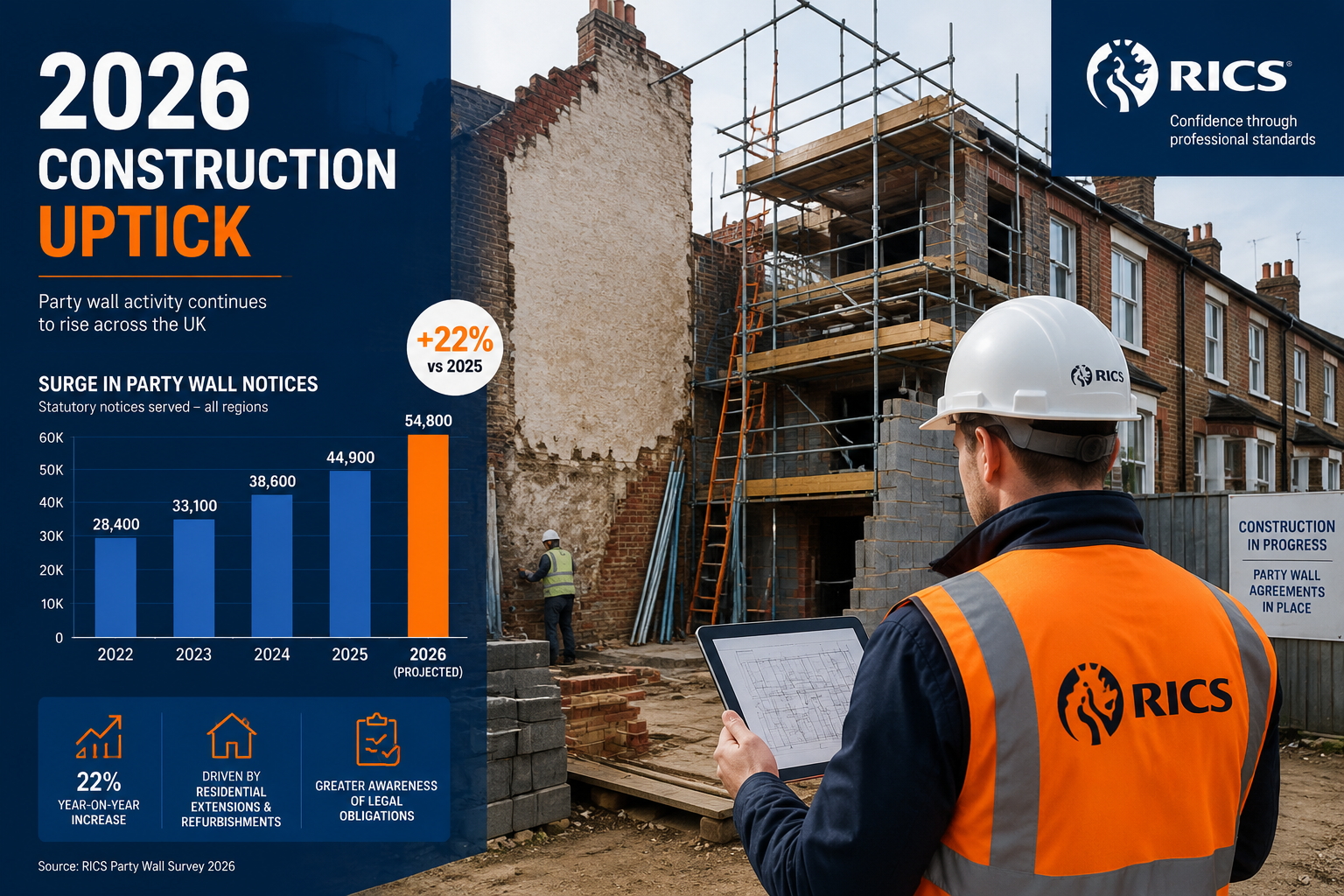
The 2026 Market Opportunity: Why Party Wall Works Are Booming
The UK construction sector is experiencing unprecedented growth in 2026, with a housing recovery driving a surge in residential extensions, basement digs, and loft conversions — all of which typically trigger party wall obligations [7]. Urban renewal programmes across English cities are generating a sharp rise in party wall disputes, rights-of-light claims, and nuisance actions [1].
This isn't a niche trend. It's a structural shift.
Northern England alone is seeing an unprecedented construction boom, from Manchester's expanding urban core to Leeds' residential regeneration corridors [8]. Meanwhile, London remains the single largest market for party wall surveyors, with dense terraced housing stock and high-value renovation projects creating near-constant demand. Surveyors operating in areas like Central London, Hampstead, and Camden are particularly well-placed to benefit.
Beyond residential work, party wall surveys for infrastructure projects represent one of the most pressing demands of 2026, particularly in high-demand regions like Staffordshire, where road, rail, and utility projects are triggering statutory obligations at scale [6].
What's Driving the Surge?
| Driver | Impact on Party Wall Demand |
|---|---|
| Housing recovery & extension boom | High — most extensions trigger notices |
| Urban regeneration projects | High — dense urban areas create shared wall conflicts |
| Infrastructure development | Medium-High — commercial and public works |
| Rising property values | Medium — owners investing more in improvements |
| Neighbour relations under strain | Medium — more disputes, more appointed surveyors |
💬 "The volume of party wall notices we're seeing in 2026 is unlike anything in the past decade. The question isn't whether there's work — it's whether you can manage it profitably." — Regional surveying firm principal, North West England
The Financial Case: Fee Structures and ROI for Party Wall Surveying
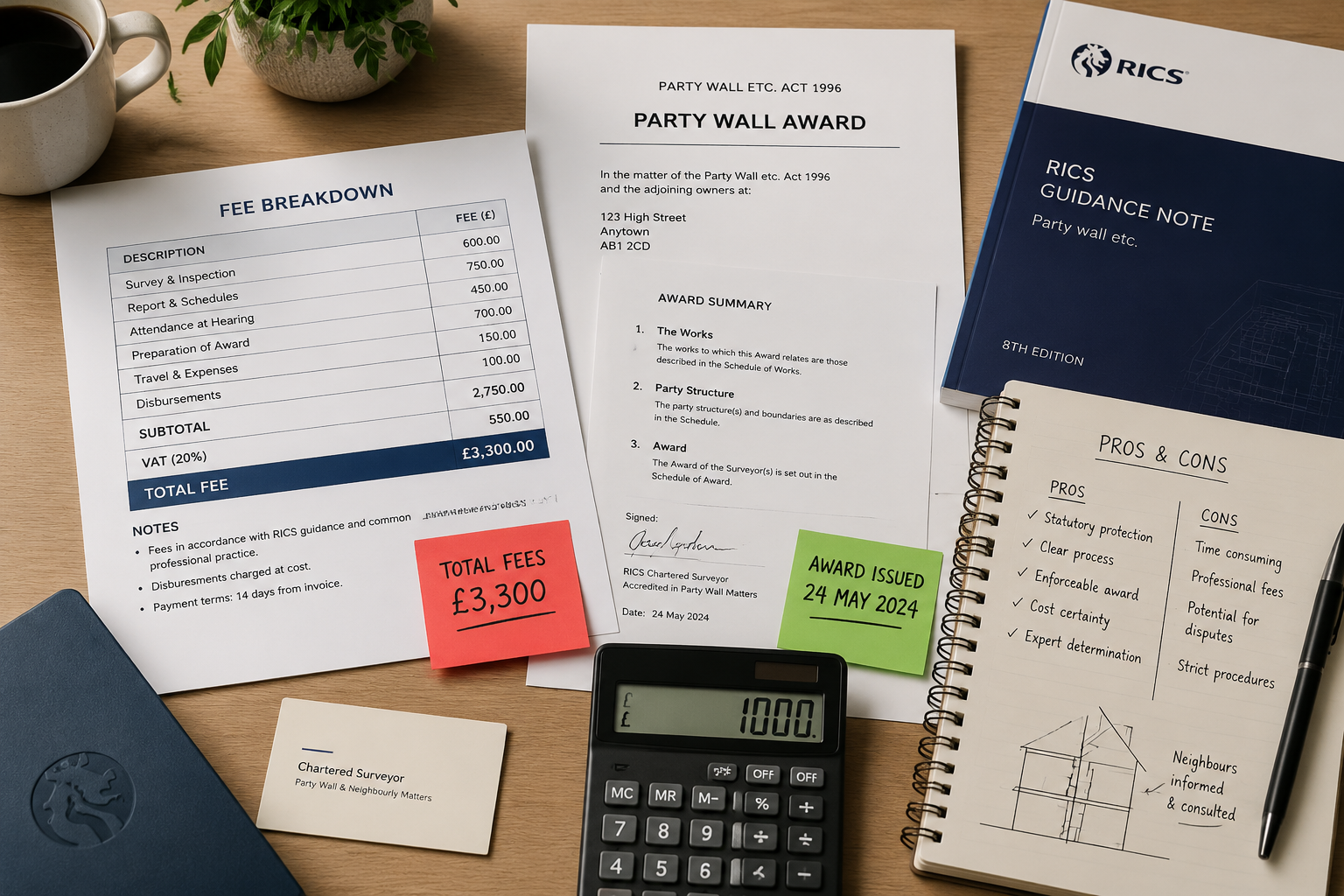
This is where the debate gets real. Chasing party wall works: is it worth it for UK surveyors in 2026? depends heavily on your fee model, efficiency, and client pipeline.
Standard Fee Benchmarks in 2026
According to current market data, surveyors' rates for party wall work range between £150 and £200 per hour, with a standard party wall award costing approximately £1,000 [2]. For a surveyor acting as an agreed surveyor (appointed by both parties), this represents a clean, single-fee engagement. For those acting as appointed surveyor for the adjoining owner, the building owner pays — removing collection risk entirely [2].
For a deeper look at how these costs break down, the party wall cost guide provides a useful reference point for both surveyors and clients.
Realistic Revenue Modelling
A surveyor handling 8–10 party wall awards per month at £1,000 each generates £8,000–£10,000 in monthly revenue from this service line alone. Add schedule of condition reports, loft conversion party wall work, and dispute resolution fees, and the numbers scale quickly.
Example monthly revenue breakdown:
- 8 x Party Wall Awards @ £1,000 = £8,000
- 4 x Schedules of Condition @ £400 = £1,600
- 2 x Dispute resolution (complex) @ £2,500 = £5,000
- Total: £14,600/month
This is achievable for a well-organised sole practitioner or small firm in a high-demand urban area.
The Hidden Costs Surveyors Overlook
Not all party wall instructions are equal. Some generate disproportionate admin, difficult neighbours, and time-consuming disputes that erode margins. Common margin killers include:
- ⚠️ Unresponsive adjoining owners — delays extend the clock without extra fees
- ⚠️ Complex multi-wall projects — terraced properties with multiple neighbours multiply complexity
- ⚠️ Disputes escalating to third surveyor — time-intensive with uncertain recovery
- ⚠️ Poor initial scoping — underquoting on complex awards
The key to profitability is selective instruction acceptance and robust fee agreements upfront.
Honest Pros & Cons: The Reddit-Style Breakdown
Let's cut through the marketing speak. Here's what surveyors actually say when discussing chasing party wall works: is it worth it for UK surveyors in 2026?
✅ The Pros
1. Guaranteed payment structure
The building owner (the one doing the works) pays all surveyor fees — including the adjoining owner's surveyor [2]. This creates a reliable revenue stream with low credit risk compared to many other surveying services.
2. Recurring demand in 2026
With the construction sector booming and neighbour relations under increasing strain [3], the pipeline of new instructions is self-replenishing. One completed project often generates referrals from neighbours who've seen the process firsthand.
3. Low capital requirements
Party wall surveying requires expertise, not equipment. Startup costs are minimal compared to, say, drone surveys or structural engineering services.
4. Upsell opportunities
A party wall instruction is a natural gateway to schedule of condition reports, structural surveys, and ongoing client relationships. Surveyors who understand what constitutes a party wall dispute can position themselves as trusted advisors throughout a project lifecycle.
5. Regional market gaps
Outside London, many areas are underserved. A surveyor willing to cover Northern England or the Midlands can command strong fees with limited local competition.
❌ The Cons
1. Emotional complexity
Party wall disputes involve neighbours — and emotions run high. Surveyors frequently act as de facto mediators, which is draining and time-consuming.
2. Regulatory burden is increasing
The RICS 8th Edition Party Wall Guidance released in 2026 has changed compliance requirements, demanding updated practices and professional development investment [10]. Surveyors who haven't adapted face reputational and legal risk.
3. Fee compression in competitive markets
In London especially, aggressive pricing by volume operators has compressed fees. Some firms are offering party wall awards at below-market rates to build market share, squeezing margins for independents.
4. Dispute escalation risk
When disputes escalate to a third surveyor, the process becomes lengthy and expensive. Surveyors can find themselves spending significant unpaid time on complex cases.
5. Scope creep without proper agreements
Without clear engagement letters, clients expect additional services (extra site visits, revised awards) within the original fee. This is a common complaint among surveyors new to this work.
Navigating RICS 8th Edition and Compliance in 2026
The release of RICS 8th Edition Party Wall Guidance in 2026 is arguably the most significant regulatory development for surveyors in this space in years [10]. Key changes affect how surveyors document their reasoning, communicate with parties, and handle disputes.
What's changed:
- Stricter requirements around impartiality documentation
- Updated protocols for digital service of notices
- Clearer guidance on timeframes and deemed dissent
- Enhanced expectations around professional development records
For surveyors already active in this space, the 8th Edition creates a competitive advantage — those who've invested in understanding the new guidance can market themselves as compliant specialists. For newcomers, it raises the entry bar.
Understanding the full scope of party wall consent requirements and the implications of proceeding without a party wall agreement is now more important than ever, both for surveyors advising clients and for their own professional protection.
Strategies for Making Party Wall Works Profitable in 2026

The surveyors making strong returns from party wall work in 2026 share several common strategies. Here's what separates the profitable operators from those who find this niche more trouble than it's worth.
1. Build a Referral Engine, Not Just a Client List
The most efficient party wall surveyors don't chase individual instructions — they build relationships with architects, planning consultants, and builders who generate a steady stream of referrals. One relationship with an active architectural practice can yield 20+ instructions per year.
2. Systemise the Process
Profitable firms treat party wall work like a production line. Standard templates for notices, awards, and schedules of condition reduce time-per-instruction dramatically. Software tools that automate notice tracking and deadline management are increasingly common among high-volume operators.
3. Price for Complexity, Not Just Volume
Not all party wall instructions are worth the same fee. Develop a tiered pricing structure:
| Instruction Type | Suggested Fee Range |
|---|---|
| Simple agreed surveyor award | £700–£1,000 |
| Adjoining owner appointed surveyor | £800–£1,200 |
| Complex multi-party award | £1,500–£3,000+ |
| Dispute resolution (third surveyor) | £2,000–£5,000+ |
| Schedule of condition | £300–£600 |
4. Leverage Geographic Positioning
Surveyors in high-demand urban corridors have a natural advantage. Those covering North London, South West London, and surrounding commuter belt areas are seeing particularly strong instruction volumes in 2026.
5. Stay Ahead of the Regulatory Curve
Investing in CPD around the RICS 8th Edition guidance isn't just a compliance requirement — it's a marketing differentiator. Surveyors who can demonstrate up-to-date expertise command higher fees and attract more sophisticated clients.
6. Know When to Say No
Experienced surveyors are selective. Instructions involving known serial complainants, properties with unresolved legal disputes, or developers with a history of non-payment are red flags. A robust client intake process protects margins and sanity.
Regional Spotlight: Where the Opportunity Is Strongest in 2026
The party wall opportunity isn't evenly distributed. Here's a quick regional breakdown:
🏙️ London — Highest fee rates, highest competition, strongest volume. Dense Victorian and Edwardian housing stock means almost every extension triggers obligations. Surrey and Hertfordshire commuter belt areas are also performing strongly.
🏗️ Northern England — Manchester and Leeds are experiencing a construction boom unlike anything seen in a generation [8]. Competition is lower than London, and surveyors willing to establish a presence here can build strong market positions quickly.
🔧 Infrastructure Corridors — Staffordshire and similar regions with active infrastructure projects represent a growing commercial opportunity for surveyors with experience in non-residential party wall work [6].
🏘️ South East — Consistent demand driven by high property values and active renovation markets. Areas like Essex and Buckinghamshire are seeing strong instruction growth.
Conclusion: Should UK Surveyors Chase Party Wall Works in 2026?
The verdict on chasing party wall works: is it worth it for UK surveyors in 2026? is a conditional yes — but with important caveats.
The market conditions are genuinely favourable. Demand is high, payment structures are reliable, and regional opportunities are expanding. Surveyors who approach this niche with a systemised process, strong referral networks, and a clear understanding of the RICS 8th Edition requirements are well-positioned to build a profitable service line.
However, surveyors who chase volume without proper fee agreements, take on every instruction regardless of complexity, or underestimate the emotional and administrative demands of dispute work will find their margins eroded quickly.
Actionable Next Steps for UK Surveyors in 2026:
- Audit your current fee structure against the £150–£200/hour benchmark and adjust where necessary.
- Invest in RICS 8th Edition CPD to differentiate yourself from less-prepared competitors.
- Build three to five referral relationships with architects or builders active in your target area.
- Create standard templates for notices, awards, and engagement letters to reduce time-per-instruction.
- Define your instruction acceptance criteria — know which jobs to decline before they cost you more than they earn.
- Explore regional gaps — if London competition is fierce, consider whether Northern England or infrastructure project work suits your practice.
Party wall work in 2026 rewards the prepared and penalises the reactive. For surveyors willing to treat it as a proper service line rather than an opportunistic add-on, the returns are genuinely compelling.
References
[1] Party Wall Surveys In 2026 Urban Renewal Managing High Demand Disputes And Neighbour Relations – https://princesurveyors.co.uk/blog/party-wall-surveys-in-2026-urban-renewal-managing-high-demand-disputes-and-neighbour-relations/
[2] Party Wall Agreement – https://hoa.org.uk/advice/guides-for-homeowners/i-am-improving/party-wall-agreement/
[3] Party Wall Helplines And Rics Resources Essential Support For Surveyors Managing 2026 Disputes – https://nottinghillsurveyors.com/blog/party-wall-helplines-and-rics-resources-essential-support-for-surveyors-managing-2026-disputes
[4] Party Walls Explained – https://www.td-re.co.uk/surveyors/party-wall/party-walls-explained/
[5] Party Wall Agreement London 2026 – https://www.mayfairstudio.co.uk/blog/party-wall-agreement-london-2026
[6] Party Wall Surveys For Infrastructure Projects 2026 Protocols In High Demand Regions Like Staffordshire – https://nottinghillsurveyors.com/blog/party-wall-surveys-for-infrastructure-projects-2026-protocols-in-high-demand-regions-like-staffordshire
[7] Party Wall Surveys Amid 2026 Construction Uptick Rics Framework For Managing Surging Neighbour Disputes – https://partywallsurveyorlondon.uk/blogs/party-wall-surveys-amid-2026-construction-uptick-rics-framework-for-managing-surging-neighbour-disputes/
[8] Party Wall Surveys For Northern Englands 2026 Construction Uptick Managing Compliance As Development Activity Accelerates In High Growth Regions – https://www.canterburysurveyors.com/blog/party-wall-surveys-for-northern-englands-2026-construction-uptick-managing-compliance-as-development-activity-accelerates-in-high-growth-regions/
[9] Party Wall Faqs – https://christopheranthony.org.uk/party-wall-faqs/
[10] Rics 8th Edition Party Wall Guidance 2026 Whats Changed And How Surveyors Must Adapt – https://wimbledonsurveyors.com/rics-8th-edition-party-wall-guidance-2026-whats-changed-and-how-surveyors-must-adapt/