Nearly £7 billion in inheritance tax was collected by HMRC in the 2023–24 tax year — a record figure that is set to climb sharply as 2026 inheritance tax reforms pull pension assets, agricultural land, and business property into the taxable estate for the first time in decades. When estates are disputed, a single poorly drafted valuation report can cost beneficiaries hundreds of thousands of pounds in unnecessary tax, penalties, or adverse costs orders.
That is precisely why Expert Witness Reports for Probate Valuations: RICS Best Practices Amid 2026 Inheritance Tax Reforms has become one of the most consequential areas of surveying practice in 2026. The intersection of updated RICS professional standards, sweeping legislative change, and increasingly litigious beneficiaries means that the quality, independence, and structure of expert witness reports matter more than ever before.
This guide sets out what executors, solicitors, and RICS-registered valuers need to know — from CPR-compliant report templates to the latest RICS conduct obligations — to navigate contentious probate estates with confidence.
Key Takeaways 📌
- RICS Red Book standards are the benchmark HMRC expects for all but the most straightforward probate valuations in 2026.
- The updated RICS Professional Standard on Expert Witnesses (consulted October 2025) introduces stricter duties on ongoing disclosure, report integrity, and expert meetings. [2]
- 2026 inheritance tax reforms — extending IHT to pension assets and tightening agricultural/business reliefs — significantly increase the number of estates requiring formal expert valuation.
- EWAS accreditation is increasingly critical for credibility when valuations are challenged in tribunal or court. [3]
- Withholding evidence tactically is now explicitly classified as unprofessional conduct under the revised RICS standard, carrying potential costs sanctions and misconduct charges. [2]
Why Probate Valuations Are Under the Microscope in 2026
The UK's inheritance tax landscape shifted dramatically on 30 October 2024 when the Chancellor announced reforms that took effect or began phasing in from April 2026. Key changes include:
| Reform Area | Pre-2026 Position | 2026 Position |
|---|---|---|
| Pension assets | Outside taxable estate | Brought into IHT scope |
| Agricultural Property Relief (APR) | 100% relief on qualifying land | Capped at £1m combined with BPR |
| Business Property Relief (BPR) | 100% relief on qualifying assets | Capped at £1m; 50% above threshold |
| Nil-rate band freeze | Frozen to 2028 | Continues frozen |
These changes mean that more estates will exceed the nil-rate band, more assets will require formal valuation, and more disputes will arise between HMRC and executors over the open market value of property at the date of death.
💬 "Where previously a family farm or business interest might pass free of tax, executors must now obtain defensible, RICS-standard valuations to support relief claims or risk HMRC challenge."
For property specifically, HMRC's Inheritance Tax Toolkit confirms that RICS valuations are expected "in all but the most straightforward cases." [5] While HMRC has confirmed to STEP that penalties will not be charged where the valuation method is "reasonable and proportionate in the circumstances," that flexibility disappears the moment a valuation is contested. [5]
Understanding the methods of valuation used by RICS-registered valuers — from the comparable method to the investment and residual approaches — is therefore essential groundwork for any executor or solicitor managing a complex estate.
What RICS Red Book Standards Require for Probate Valuations
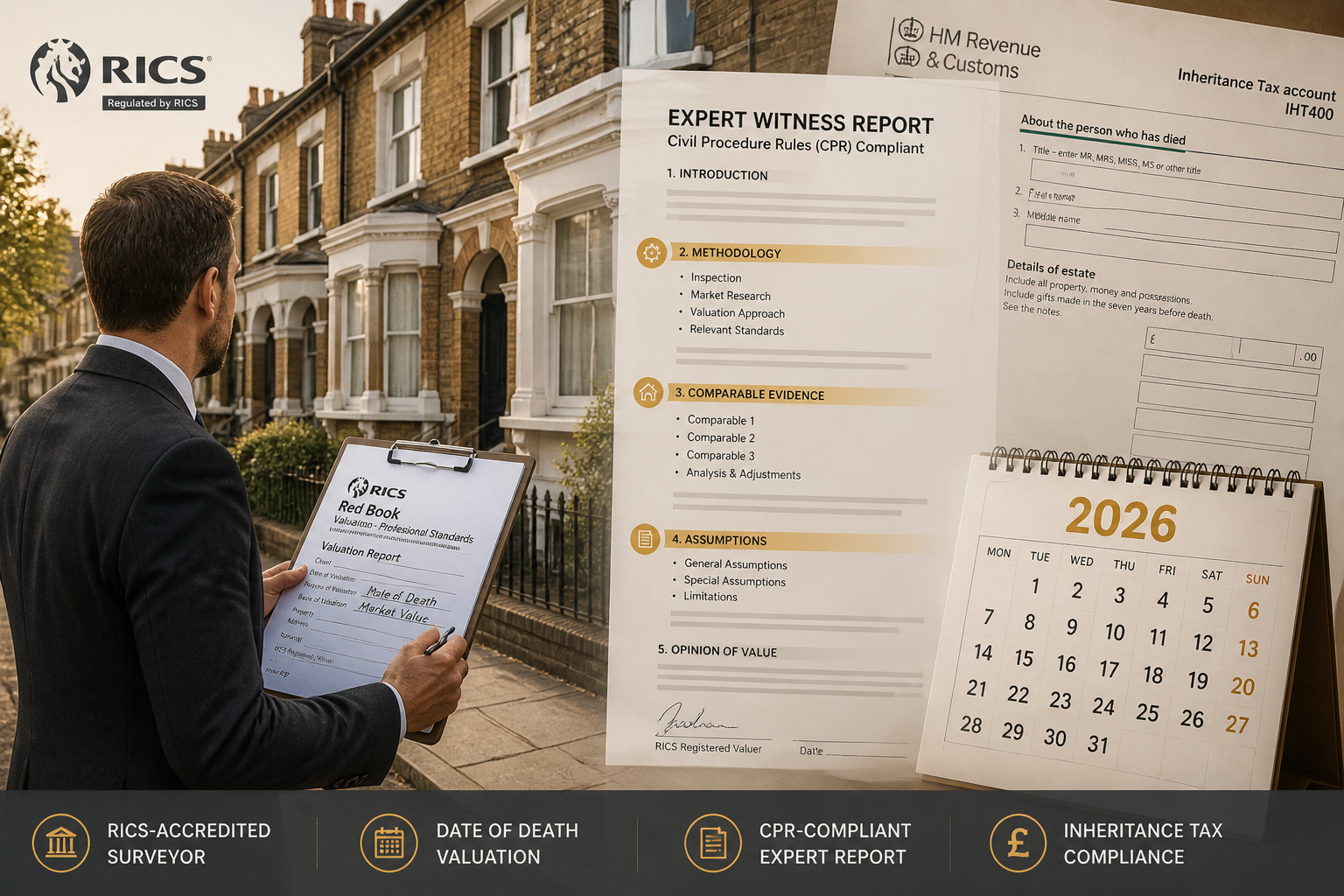
A Red Book valuation is the gold standard for any formal property valuation in the UK. The RICS Valuation Global Standards — colloquially known as the "Red Book" — set out mandatory requirements for registered valuers, including those instructed for probate purposes. [8]
HMRC's reference to valuations being "in line with RICS standards" specifically means compliance with the Red Book. [5] A compliant probate valuation report must include:
Core Report Components ✅
- Basis of value — "Market Value" as defined in the Red Book, reflecting a willing buyer/willing seller transaction at the date of death (not the date of instruction).
- Property inspection — A physical inspection of the property, noting condition, tenure, and any factors affecting value.
- Comparable market evidence — Analysis of genuinely comparable transactions, ideally within a reasonable radius and time period of the valuation date.
- Assumptions and special assumptions — Clearly stated, including any assumptions about planning, tenancies, or physical condition.
- Methodology — A transparent explanation of how the valuer arrived at the figure.
- Valuer's RICS registration — Confirmation of the valuer's qualifications and compliance with the Red Book. [4]
A Red Book valuation produced by a RICS-registered valuer carries significant weight with HMRC and, crucially, with the courts if a dispute escalates. Executors should be wary of relying on desktop valuations or estate agent appraisals for anything other than the simplest residential properties.
For more complex assets — commercial property, mixed-use buildings, or properties with unusual characteristics — a commercial valuation from a specialist is often essential to withstand HMRC scrutiny.
The "Date of Death" Valuation Challenge
One of the most technically demanding aspects of probate valuation is that the valuer must assess market value at a historic date — the date of death — using evidence available at that time. This is distinct from a current market valuation and requires careful selection of comparables that pre-date or closely surround the valuation date. In volatile markets, this distinction can be significant.
Expert Witness Reports for Probate Valuations: RICS Best Practices Amid 2026 Inheritance Tax Reforms — The Updated Professional Standard
When a probate valuation is disputed — whether by a beneficiary, a co-executor, or HMRC — the valuer may be required to act as an expert witness. This transforms the role fundamentally: the valuer's duty shifts from serving the instructing client to serving the court or tribunal.
The RICS Professional Standard "Surveyors Acting as Expert Witnesses" underwent a significant update, with a draft published in late August 2025 and a consultation period closing on 7 October 2025. [2] The revised standard introduces several important changes that every probate valuer must understand in 2026.
1. The Ongoing Duty to Disclose 🔔
The updated standard introduces an explicit "ongoing duty" requirement. Expert witnesses must advise the instructing party immediately if any circumstances change between the report date and trial that would alter previous declarations or affirmations. [2]
In the context of probate, this is particularly relevant where:
- New comparable sales evidence emerges after the report is filed
- The property's condition is found to have been materially different at the date of death
- The expert becomes aware of a conflict of interest
Failure to disclose promptly is not merely a professional courtesy — it is now a formal obligation under RICS standards.
2. Strict Controls on Report Alterations ✏️
The revised standard takes a firm stance on report integrity. Members must require instructing lawyers and other parties to correct any alterations to reports that do not accord with or distort their true opinion. If corrections are not made, the expert is required to:
- Report the issue to the professional body
- Refuse further instructions on the matter [2]
This is a significant shift. It places the expert witness in a position of active responsibility for the integrity of their report, even when under pressure from instructing solicitors.
3. Expert Witness Meetings: Prior Consent Required 🤝
New stringent requirements mandate that expert witnesses "must only meet with other expert witnesses during an instruction with the prior knowledge and consent of their client." [2]
Any settlement prospects identified during such meetings must be reported to the instructing party immediately. In contentious probate disputes — where HMRC's District Valuer and the estate's appointed expert may be directed to meet — this requirement has practical implications for how those meetings are arranged and documented.
4. Prohibition on Tactical Evidence Withholding 🚫
Perhaps the most striking provision in the updated standard is the explicit statement that "withholding evidence as a tactical approach" is regarded as unprofessional conduct. [2] The potential consequences are severe:
- Costs awards against the client
- Misconduct charges against the RICS member
- Damage to the expert's credibility in future proceedings
This provision reflects the courts' longstanding position under CPR Part 35 that expert witnesses owe their primary duty to the court, not to the party instructing them. The RICS standard now mirrors this principle with equal clarity.
Structuring a CPR-Compliant Expert Witness Report for Probate
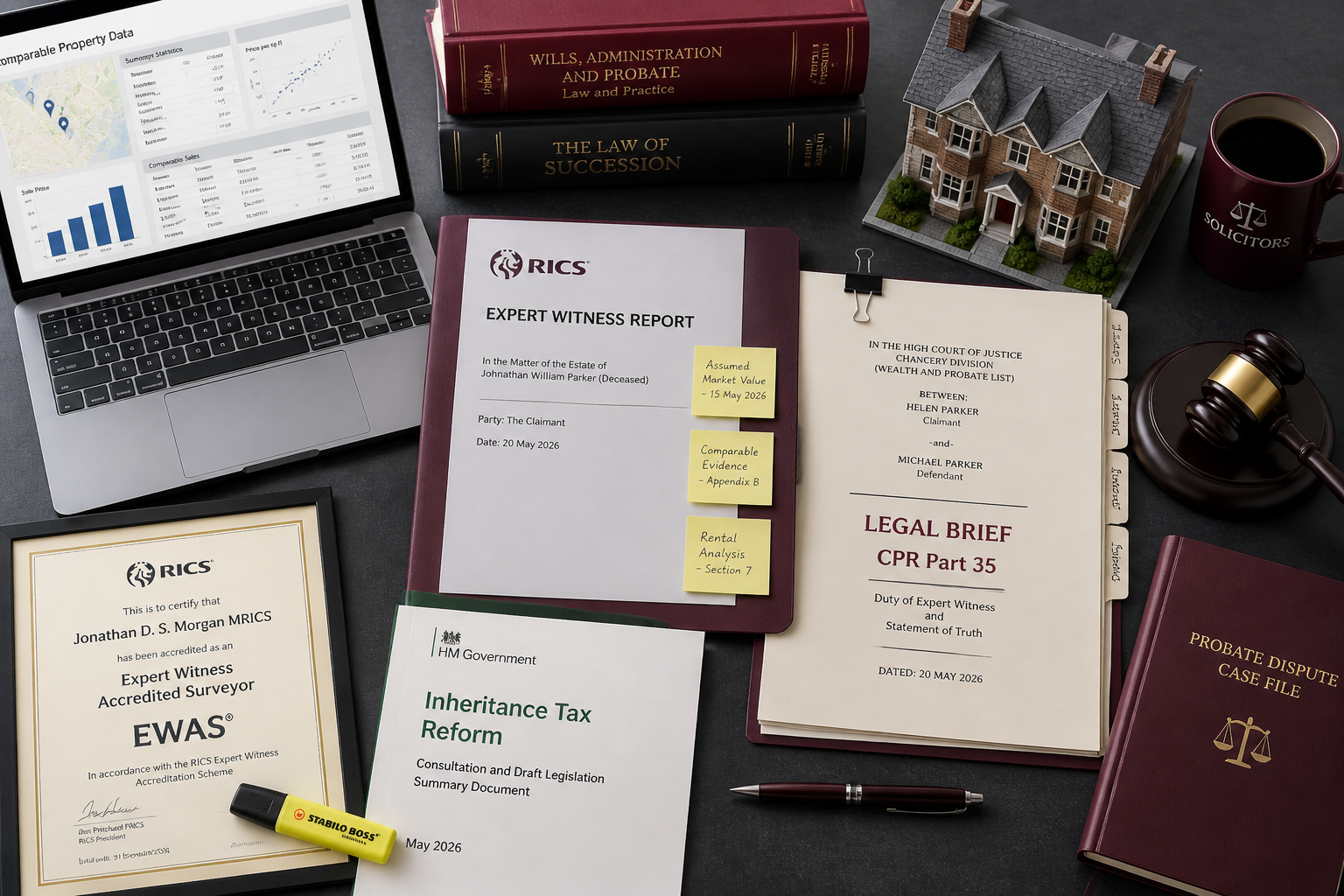
When a probate valuation dispute proceeds to the First-tier Tribunal (Tax Chamber) or the courts, the expert's written report must comply with CPR Part 35 and its accompanying Practice Direction. A well-structured report significantly reduces the risk of the evidence being challenged or excluded.
Recommended Report Structure 📋
Section 1: Introduction and Instructions
- Identity and qualifications of the expert (including RICS membership and EWAS accreditation where held)
- Nature of the instruction and date received
- Documents and information relied upon
Section 2: Property Description
- Address, tenure, and physical description
- Condition at the date of death (based on inspection evidence)
- Any planning history or constraints
Section 3: Valuation Date and Basis
- Confirmation of the date of death as the valuation date
- Basis of value (Market Value per RICS Red Book / IVS) [7]
- Assumptions and special assumptions clearly stated
Section 4: Market Analysis
- Overview of the relevant property market at the valuation date
- Selection and analysis of comparable transactions
- Adjustments made and rationale
Section 5: Valuation
- The valuer's opinion of Market Value
- Sensitivity analysis where appropriate (e.g., range of values)
Section 6: Expert's Declaration
- Statement of truth per CPR Part 35.3
- Confirmation of ongoing duty to update if circumstances change [2]
- Confirmation that no evidence has been withheld
💬 "EWAS accreditation is increasingly critical for credibility in 2026 valuation disputes — tribunals and courts are paying closer attention to whether expert witnesses have demonstrated competency through formal accreditation." [3]
For estates involving properties with structural issues or unusual defects that may affect value, commissioning a specialist defect survey before finalising the valuation can provide important supporting evidence and demonstrate due diligence.
Similarly, where the estate includes properties requiring reinstatement cost assessment for insurance purposes, a reinstatement cost valuation may be needed alongside the market value report.
Expert Witness Reports for Probate Valuations: RICS Best Practices Amid 2026 Inheritance Tax Reforms — Handling Contentious Estates
Contentious estates present unique challenges that go beyond technical valuation methodology. The following scenarios are among the most common in 2026 and require specific strategic approaches.
Scenario 1: Disputed Agricultural or Business Property Relief
With APR and BPR now capped at £1m combined, disputes over whether land or business assets qualify for relief — and at what value — are expected to increase significantly. Expert witnesses in these cases must be prepared to address:
- Whether the property was used for agricultural purposes at the date of death
- The distinction between agricultural value and market value (often the crux of APR disputes)
- Evidence of the business's trading activity and structure for BPR claims
A capital gains tax valuation specialist may also be needed where assets are subsequently sold and the base cost needs to be established from the probate value.
Scenario 2: Jointly Owned Properties
Where the deceased held a share in a jointly owned property, the valuation must reflect the appropriate discount for a co-ownership interest. HMRC and estate representatives frequently disagree on the size of this discount, making expert witness evidence particularly valuable. Valuers should be familiar with the principles applicable to shared ownership properties and the discount methodology accepted by the courts.
Scenario 3: Non-Domiciled Deceased
For estates involving non-domiciled individuals, the 2026 reforms have introduced a residence-based test that significantly expands the scope of UK IHT. Valuers instructed on such estates should be aware of the specific requirements for non-domicile tax valuations and ensure their reports address the relevant situs rules for UK property assets.
Scenario 4: Leasehold Properties
Leasehold properties — particularly those with short leases — require careful consideration of the lease length at the date of death and its impact on value. The lease extension valuation methodology may be relevant where the deceased held enfranchisement rights that could affect the property's market value.
Common Pitfalls to Avoid ⚠️
Even experienced valuers can fall into traps that undermine the credibility of their expert witness reports. The most frequent issues include:
| Pitfall | Risk | Mitigation |
|---|---|---|
| Using post-death comparables without adjustment | HMRC challenge; tribunal criticism | Clearly document comparable selection rationale |
| Failing to inspect the property | Report may be inadmissible | Always conduct a physical inspection [4] |
| Accepting instructed amendments to opinion | Misconduct charge; report distortion [2] | Refuse alterations; report to RICS if necessary |
| Attending expert meetings without client consent | Breach of updated RICS standard [2] | Obtain written consent before any meeting |
| Omitting the expert's declaration | CPR non-compliance | Use a standard declaration checklist |
| Inadequate comparable evidence | Valuation successfully challenged | Minimum three comparables; ideally five or more |
The Role of EWAS Accreditation in 2026
The Expert Witness Accreditation Service (EWAS), operated by the Academy of Experts and the Expert Witness Institute, provides a formal route for RICS members to demonstrate competency as expert witnesses. In 2026, EWAS accreditation is increasingly being scrutinised by tribunals and courts when assessing the weight to give expert evidence. [3]
For probate valuers who regularly act as expert witnesses, EWAS accreditation offers:
- ✅ Formal recognition of training in CPR Part 35 obligations
- ✅ Demonstrated understanding of the advocate versus expert distinction [2]
- ✅ Enhanced credibility with HMRC, solicitors, and the courts
- ✅ A competitive differentiator in an increasingly contested market
The updated RICS standard specifically addresses the distinction between the role of advocate and the role of expert witness — a boundary that must never be crossed. [2] An expert witness who argues their client's case rather than providing independent opinion risks having their evidence disregarded entirely.
Conclusion: Actionable Next Steps for Executors, Solicitors, and Valuers
The combination of sweeping 2026 inheritance tax reforms and a significantly updated RICS Professional Standard for expert witnesses has created a more demanding environment for probate valuations than at any point in recent memory. The stakes — financial, professional, and legal — are high for all parties involved.
For Executors and Solicitors 📁
- Instruct a RICS-registered valuer early — ideally before the grant of probate — to avoid delays and ensure the valuation date is correctly identified.
- Specify Red Book compliance in the letter of instruction and confirm the valuer holds appropriate professional indemnity insurance.
- Do not amend the expert's report without their written agreement; any changes that distort their opinion must be corrected. [2]
- Consider EWAS-accredited experts for any estate where HMRC challenge or beneficiary dispute is anticipated. [3]
For RICS-Registered Valuers 🏠
- Familiarise yourself with the updated Professional Standard (post-October 2025 consultation) and ensure your practice procedures reflect the new obligations. [2]
- Implement an ongoing duty checklist to monitor whether new evidence or changed circumstances require updated declarations between report and trial.
- Obtain prior written consent before attending any expert witness meeting during a live instruction.
- Refuse instructions where you are asked to alter your report in a way that distorts your true opinion — and document your refusal.
- Consider EWAS accreditation if you regularly act as an expert witness in probate or tax disputes.
The quality of Expert Witness Reports for Probate Valuations: RICS Best Practices Amid 2026 Inheritance Tax Reforms will define outcomes for families, businesses, and agricultural estates across the UK for years to come. Getting it right from the outset is not just good professional practice — it is a duty owed to the court, the client, and the integrity of the valuation profession.
For a comprehensive overview of professional valuation services and how they apply to probate and tax contexts, explore the full range of valuation reports available from RICS-registered chartered surveyors.
References
[1] Surveyors Acting As Expert Witnesses – https://www.rics.org/profession-standards/rics-standards-and-guidance/sector-standards/dispute-resolution-standards/surveyors-acting-as-expert-witnesses
[2] New Expert Witness Guidance For Rics Members – https://www.nmrk.com/en-gb/perspectives/new-expert-witness-guidance-for-rics-members
[3] Expert Witness Testimonies In 2026 Valuation Disputes Rics Strategies Amid Stabilising House Prices And Regional Divides – https://nottinghillsurveyors.com/blog/expert-witness-testimonies-in-2026-valuation-disputes-rics-strategies-amid-stabilising-house-prices-and-regional-divides
[4] Probate Valuation Surveyor London Complete Guide To Probate Property Valuations By Rics Registered Valuers And Chartered Surveyors – https://www.res-prop.com/probate-valuation-surveyor-london-complete-guide-to-probate-property-valuations-by-rics-registered-valuers-and-chartered-surveyors/
[5] Rics Valuations For Probate – https://swiftvalues.co.uk/rics-valuations-for-probate/
[6] Expert Witness Valuations In 2026s Stabilizing Market Rics Standards For Mortgage Disputes And Property Disagreements – https://nottinghillsurveyors.com/blog/expert-witness-valuations-in-2026s-stabilizing-market-rics-standards-for-mortgage-disputes-and-property-disagreements
[7] Finalised Ivs Consultation Response – https://www.rics.org/content/dam/ricsglobal/documents/standards/Finalised-IVS-consultation-response.pdf
[8] Valuation Standards – https://www.rics.org/profession-standards/rics-standards-and-guidance/sector-standards/valuation-standards