
Nearly 40% of residential property transactions in England and Wales involve defects that were either missed or inadequately reported during pre-purchase surveys — a statistic that makes the arrival of RICS's mandatory AI governance framework both timely and transformative. Integrating RICS Global AI Standards into Level 3 Building Surveys: Practical Protocols for Defect Detection in 2026 is no longer a theoretical exercise for forward-thinking practices; it is a compliance obligation that reshapes how chartered surveyors identify hidden defects, document findings, and communicate risk to clients.
This article breaks down the RICS Responsible Use of Artificial Intelligence standard — published in September 2025 and now fully operative in 2026 — and translates its requirements into practical, actionable protocols specifically suited to Level 3 building survey work.
Key Takeaways
- ✅ RICS's AI standard is mandatory for all members using AI in surveying services, with no opt-out for practices already deploying AI tools [2]
- ✅ Surveyors must record in writing whether AI outputs have materially influenced any part of a Level 3 survey, including which areas to inspect [2]
- ✅ A pre-implementation governance assessment must be completed and documented before any AI system is deployed in practice [4]
- ✅ Client transparency about AI use — including its limitations — is a non-negotiable requirement under the standard [2]
- ✅ Firms must maintain a risk register covering AI failure modes, bias risks, hallucination potential, and mitigation plans [4]
What the RICS AI Standard Actually Requires in 2026
The RICS Responsible Use of Artificial Intelligence in Surveying Practice standard applies globally and is designed to slot into existing professional workflows without demanding that surveyors become software engineers [5]. However, "no technical knowledge required" does not mean "no obligations." Membership of RICS is voluntary, but any member who uses AI tools in the delivery of surveying services — including Level 3 building surveys — must comply with every requirement of the standard [2].
The Core Compliance Pillars
The standard rests on five interconnected pillars that directly affect how a Level 3 survey is planned, conducted, and reported:
| Pillar | What It Requires | Level 3 Survey Relevance |
|---|---|---|
| Knowledge | Understanding AI types, failure modes, hallucination risks, and bias | Knowing when AI crack-detection tools may produce false positives |
| Pre-Implementation Governance | Written assessment before deploying any AI system | Documenting why a specific thermal imaging AI was chosen |
| Risk Register | Documented risks, likelihood, impact, and mitigations | Recording the risk that AI misses rising damp behind plasterboard |
| Material Impact Recording | Written record of whether AI influenced the survey | Noting that AI flagged the roof void for closer inspection |
| Client Transparency | Clear communication about AI use and limitations | Disclosing AI-assisted analysis in the survey report |
💡 Pull Quote: "The standard does not require surveyors to understand how to build AI — it requires them to understand how AI can fail, and to govern that risk professionally." — RICS Construction Journal [2]
Mandatory Knowledge Requirements
Before deploying any AI tool in a Level 3 context, RICS members must demonstrate understanding of:
- Different AI types — distinguishing between machine learning models, large language models (LLMs), and computer vision tools
- Limitations and failure modes — understanding that AI trained on one housing stock may perform poorly on another
- Hallucination risks — recognising that LLMs can generate plausible but incorrect defect descriptions
- Bias risks — acknowledging that AI trained predominantly on modern construction may under-detect defects in pre-1919 properties
- Data protection risks — ensuring client property data fed into AI systems complies with UK GDPR [2]
For practices working across diverse property types — from Georgian terraces to post-war concrete construction — understanding non-standard construction surveys is essential context for evaluating AI tool limitations.
Pre-Implementation Governance: The Checklist Every Practice Needs
Before a single AI tool is switched on for use in a Level 3 building survey, RICS requires firms to conduct and record in writing a system governance assessment [4]. This is not a one-time exercise — it must be repeated for each new AI system or significant update to an existing one.
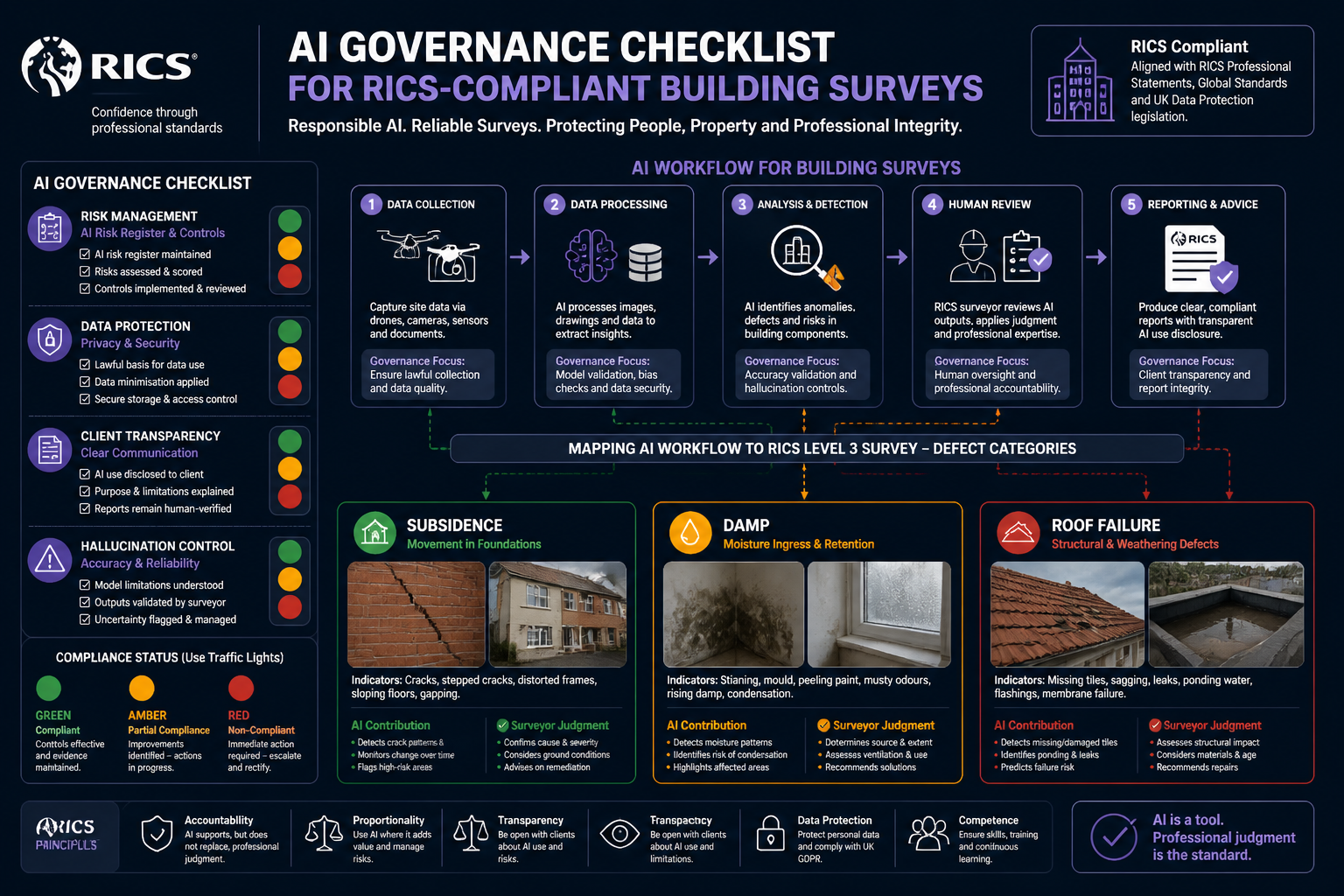
Pre-Implementation Governance Checklist ✅
Step 1 — Identify the Application
- What specific surveying task will the AI perform? (e.g., crack pattern analysis, moisture detection, roof condition assessment)
- Which stage of the Level 3 survey process does it affect?
Step 2 — Assess Potential Risks
- Could the AI produce false negatives for structural defects?
- What is the consequence if the tool misses evidence of subsidence?
- Does the AI have documented accuracy rates for UK residential property types?
Step 3 — Assess Potential Benefits
- Does the tool improve consistency across surveyors?
- Can it process thermal imaging data faster than manual review?
- Does it reduce the risk of human fatigue-related oversights on complex properties?
Step 4 — Consider Alternative Approaches
- Could the same outcome be achieved without AI?
- Is the AI replacing professional judgment or augmenting it?
Step 5 — Document Everything
- Record all four steps above in writing
- Store documentation in the firm's practice management system
- Review and update when the AI system changes [4]
Building the Risk Register
RICS-regulated firms must maintain a living risk register for every AI system in use. Each entry must include [4]:
- 📋 Risk description — e.g., "AI moisture detection model produces false negatives in properties with cavity wall insulation"
- 📊 Likelihood rating — Low / Medium / High
- ⚠️ Impact rating — Low / Medium / High
- 🛡️ Mitigation plan — e.g., "Surveyor to conduct manual moisture meter checks in all cavity wall properties regardless of AI output"
- 🎯 Firm risk appetite — documented tolerance level for each risk category
- 🔄 Regular status updates — scheduled review dates
This register is not a bureaucratic formality. In the context of a Level 3 structural survey, a poorly documented risk register could become a central exhibit in a professional negligence claim if AI-assisted defect detection fails.
Data Governance and Procurement Protocols
Data governance is now a mandatory component of practice management under the RICS AI standard [5]. When procuring third-party AI tools, firms must conduct:
- Due diligence on the AI provider's data handling practices
- Sustainability impact assessments — evaluating the environmental cost of AI processing
- Documented procurement decision-making — recording why one tool was selected over alternatives
Critically, firms developing proprietary AI systems in-house face identical obligations. Internal tools must be treated with the same governance rigour as commercial third-party solutions [4].
Practical Protocols for Defect Detection: Integrating RICS Global AI Standards into Level 3 Building Surveys
The operational heart of integrating RICS Global AI Standards into Level 3 Building Surveys: Practical Protocols for Defect Detection in 2026 lies in translating governance requirements into survey-day practice. Level 3 surveys — the most comprehensive residential survey product — cover the full range of building pathology, from structural movement to damp and timber defects.
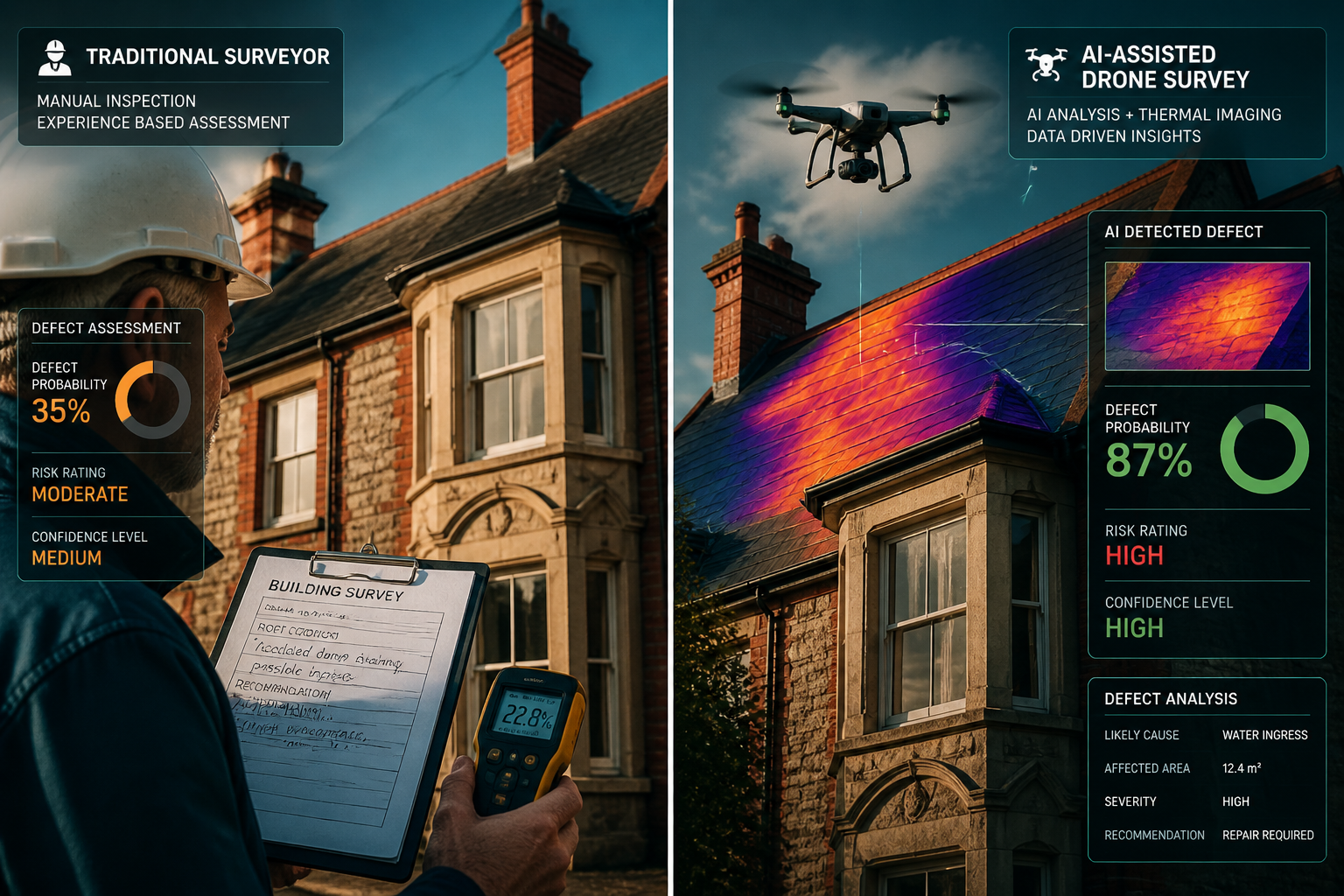
The Material Impact Recording Obligation
This is arguably the most operationally significant requirement in the standard. RICS members must record in writing whether AI outputs have materially influenced the delivery of a surveying service [2]. In a Level 3 context, this covers:
- Decisions about which building areas to investigate — if AI thermal imaging flagged the north elevation as a priority, this must be recorded
- Document summarisation — if an LLM was used to summarise planning history or previous survey reports, this must be disclosed
- Opinion composition — if AI assisted in drafting defect descriptions or risk ratings, this must be noted
🔑 Key Principle: AI can inform — it cannot decide. Professional judgment must remain with the chartered surveyor at every stage.
Defect-Specific AI Integration Protocols
Different defect categories require different AI governance approaches within a Level 3 survey:
🏗️ Structural Movement and Subsidence
- AI crack-pattern analysis tools can classify crack types and predict likely causes
- Protocol: AI output must be cross-referenced with manual inspection; surveyor must document whether AI classification influenced the decision to recommend further investigation
- Risk register entry: AI may misclassify thermal movement cracks as structural in older properties
💧 Damp and Moisture Ingress
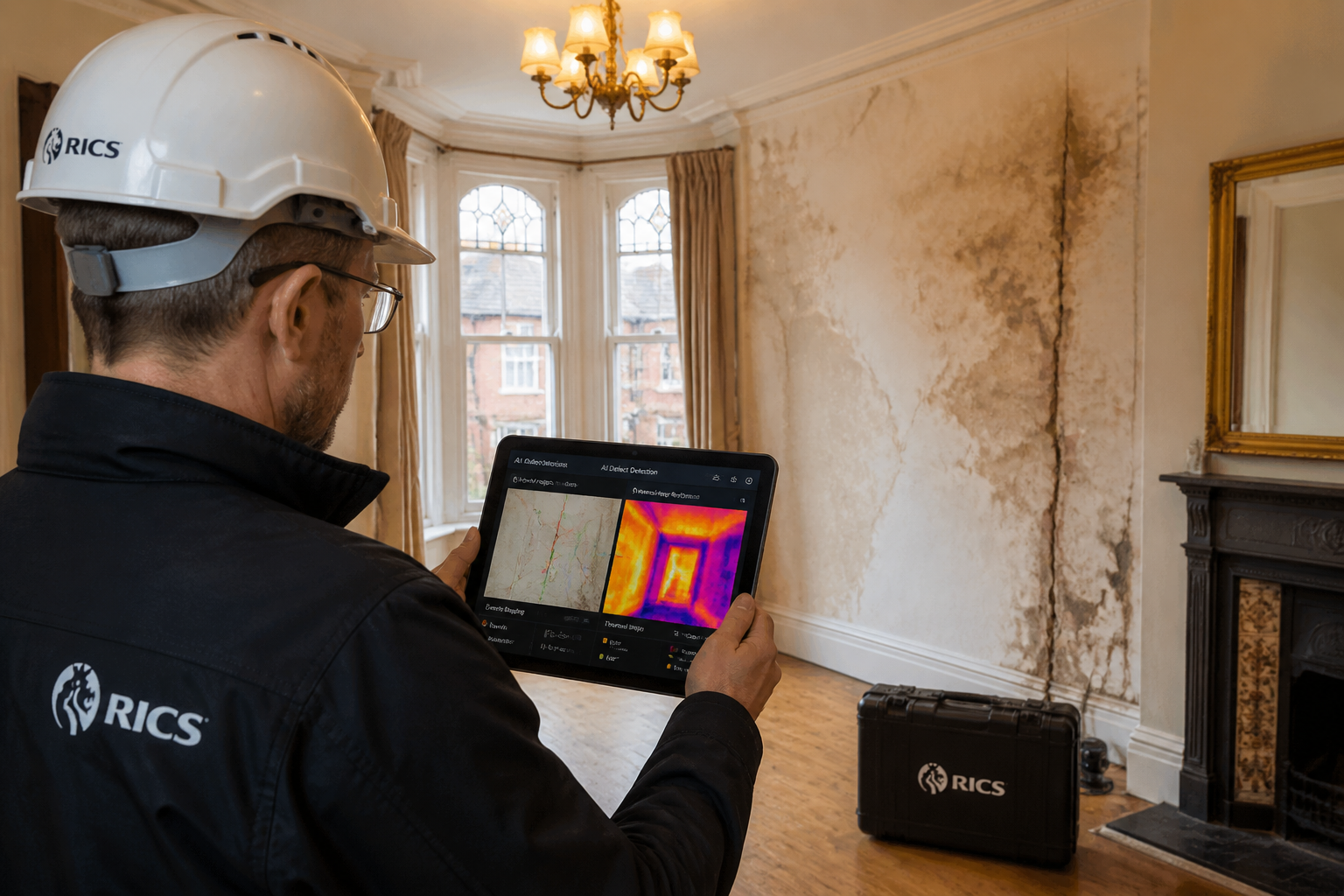
- AI-enhanced thermal cameras can identify moisture patterns invisible to the naked eye
- Protocol: AI moisture mapping must be validated with calibrated moisture meters; AI output recorded as "informing" rather than "determining" the damp assessment
- Understanding damp survey costs helps clients appreciate why AI-enhanced surveys may carry a premium
🏠 Roof Condition Assessment
- Drone surveys with AI image analysis can inspect inaccessible roof areas
- Protocol: AI defect flagging on drone footage must be reviewed frame-by-frame by the surveyor; any AI-identified defect included in the report must be noted as AI-assisted
- Risk register entry: AI may miss hairline cracks in clay tiles under certain lighting conditions
🪵 Timber and Infestation
- AI tools can analyse moisture readings and visual patterns to predict timber decay risk
- Protocol: AI risk scores must not replace physical probing and specialist timber reports where decay is suspected
Client Transparency: What Must Be Disclosed
The RICS standard mandates clear communication with clients regarding AI use, covering [2]:
- What AI was used — e.g., "Thermal imaging analysis was processed using AI-assisted software"
- What it did — e.g., "The AI system identified three areas of potential moisture ingress for closer manual inspection"
- Its limitations — e.g., "AI analysis of roof imagery may not detect all defect types; areas of concern were manually verified"
- How it influenced the service — e.g., "AI output materially influenced the decision to recommend specialist investigation of the chimney stack"
This transparency requirement is designed to build client confidence while maintaining professional accountability [5]. Practically, it means survey reports must include a standardised AI disclosure section — a new document component that practices should template now.
Output Reliability and Assurance Protocols
Before any AI output influences a survey finding, the standard requires output reliability checks [5]:
| Check | Purpose | Method |
|---|---|---|
| Plausibility review | Does the AI output make sense given the property type and age? | Surveyor cross-references with professional experience |
| Consistency check | Does AI output align with other survey findings? | Compare AI moisture flags with visual damp evidence |
| Hallucination screening | For LLM-generated text, does the output contain fabricated facts? | Verify all specific claims against primary sources |
| Bias assessment | Is the AI tool validated for this property type? | Check vendor documentation for training data scope |
Staying Ahead: Preparing Your Practice for Evolving Standards
The RICS AI standard is explicitly designed as a baseline — regular reviews are planned to maintain relevance as AI technology evolves [2]. This means practices that implement minimum compliance today may face additional obligations within 12–24 months.
Immediate Action Steps for Practices in 2026
- Audit current AI use — identify every tool, from spell-checkers to thermal imaging software, that could be classified as AI in a surveying context
- Build the risk register — document risks for each tool before the next survey that uses it
- Draft the AI disclosure template — create a standardised section for survey reports
- Train all fee-earners — ensure every surveyor can articulate AI types, failure modes, and hallucination risks
- Review procurement contracts — ensure AI vendor agreements include data governance commitments
- Schedule governance reviews — set calendar reminders to reassess each AI tool quarterly
Practices offering specialist defect surveys or specific defect reports should prioritise governance documentation for the AI tools most likely to influence high-stakes defect conclusions.
The Professional Liability Dimension
The introduction of mandatory AI governance creates a new dimension of professional liability. If a Level 3 survey misses a significant defect that an AI tool was used to assess, the adequacy of the firm's governance framework — its risk register, pre-implementation assessment, and material impact records — will be central to any negligence investigation.
Firms without documented governance are not simply non-compliant with RICS standards; they are exposed to significantly greater liability risk. Engaging local chartered surveyors who have already embedded these protocols offers clients an additional layer of assurance.
Conclusion: Actionable Next Steps
Integrating RICS Global AI Standards into Level 3 Building Surveys: Practical Protocols for Defect Detection in 2026 demands more than awareness — it demands documented, auditable action. The RICS AI standard has transformed AI from an informal productivity tool into a governed professional resource, with obligations that mirror the rigour applied to valuation methodology or structural engineering assessments.
The five most important steps to take before the next Level 3 survey:
- 📁 Complete a written pre-implementation governance assessment for every AI tool currently in use — retroactively if necessary
- 📊 Build and maintain a risk register with entries for each AI application, covering hallucination, bias, and failure mode risks
- 📝 Add an AI disclosure section to all Level 3 survey report templates
- 🎓 Invest in AI literacy training — surveyors must be able to critically evaluate AI outputs, not just accept them
- 🔄 Schedule quarterly governance reviews to stay ahead of standard updates
The integration of AI into building pathology is not a threat to professional expertise — it is an amplifier of it. But only when governed responsibly does it enhance the quality of defect detection rather than introduce new categories of risk. The RICS standard provides the framework; the protocols above provide the practice.
References
[1] RICS AI Standards in Building Surveys 2026 Practical Protocols for Level 3 Assessments and Risk Detection – https://nottinghillsurveyors.com/blog/rics-ai-standards-in-building-surveys-2026-practical-protocols-for-level-3-assessments-and-risk-detection
[2] AI Responsible Use Standard – https://ww3.rics.org/uk/en/journals/construction-journal/ai-responsible-use-standard.html
[4] Responsible Use of Artificial Intelligence in Surveying Practice September 2025 – https://www.rics.org/content/dam/ricsglobal/documents/standards/Responsible-use-of-artificial-intelligence-in-surveying-practice_September-2025.pdf
[5] Responsible Use of AI – https://www.rics.org/profession-standards/rics-standards-and-guidance/conduct-competence/responsible-use-of-ai
[6] RICS Introduces Mandatory AI Standard for Surveyors: What Insurers and Their Clients Need to Know – https://cms.law/en/gbr/legal-updates/rics-introduces-mandatory-ai-standard-for-surveyors-what-insurers-and-their-clients-need-to-know