
Nearly one in three office-to-residential conversions completed in major UK urban centres since 2020 has required significant post-purchase remediation — yet the majority of buyers entered those transactions without a Level 3 building survey. As demand for converted flats continues to surge in 2026, that gap between risk and due diligence is becoming dangerously wide.
Building Surveys for Non-Standard Construction in 2026 Urban Conversions: Hidden Defects and Valuation Risks sits at the intersection of three powerful forces: a booming conversion market, increasingly complex building typologies, and tightening insurance and mortgage scrutiny. Understanding how these forces interact is no longer optional for buyers, surveyors, or lenders.
Key Takeaways 📋
- Level 3 building surveys are essential for any non-standard or converted property — a Level 2 Homebuyer Report will not capture the structural complexity of conversion projects.
- Hidden defects in urban conversions frequently include inadequate party wall separation, compromised fire stopping, concealed damp, and legacy structural systems never designed for residential use.
- Valuation adjustments of 10–25% are increasingly common where surveys reveal material defects in converted buildings, with insurers now demanding greater evidence of structural integrity.
- RICS 2026 standards have raised the bar for Level 3 assessments, with enhanced protocols for foundation examination and structural analysis [7].
- Early specialist engagement — before exchange — is the single most effective risk-reduction strategy for buyers of non-standard converted properties.
Why Non-Standard Construction Demands a Different Approach in 2026
The term "non-standard construction" covers a wide spectrum: steel-framed buildings, concrete panel systems, timber-framed structures, and — most relevant to the 2026 urban market — former commercial and industrial buildings repurposed as residential units. These properties do not behave like traditionally built brick-and-block homes, and standard survey methodologies were never designed with them in mind.
Demand for office-to-residential conversions remains strong across high-vacancy urban corridors [3], and major city centres continue to lead the way in converting redundant commercial stock into housing [4]. With UK housing starts reaching robust levels in early 2026 [6], conversion projects represent a significant proportion of new residential supply — particularly in areas where greenfield land is scarce.
The structural DNA of a converted building reflects its original purpose. An office block built in the 1970s using a concrete frame was engineered for open-plan floor plates, uniform loading, and commercial mechanical systems. Subdividing that structure into individual flats introduces entirely new demands: acoustic separation, fire compartmentation, domestic plumbing and drainage routes, and party wall interfaces that the original design never anticipated.
💬 "The greatest risk in a converted flat is not what you can see — it's what the conversion has hidden." — A recurring observation among RICS-accredited building surveyors working on urban conversion stock.
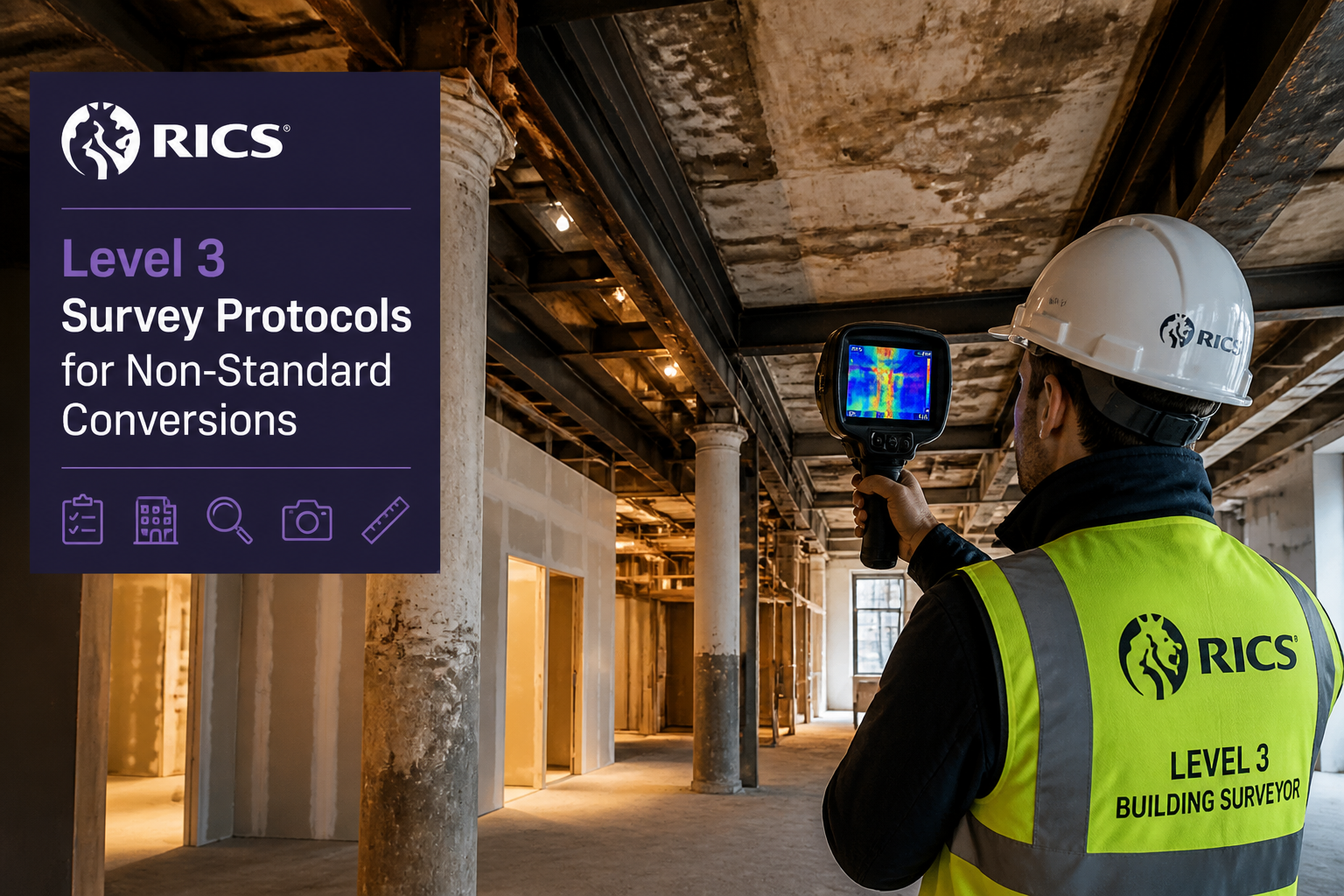
For buyers and their advisors, this means that non-standard construction surveys must go substantially beyond visual inspection. Thermal imaging, moisture mapping, structural load tracing, and drainage investigation are not optional extras — they are baseline requirements for defensible due diligence.
The Limits of a Level 2 Survey in Conversion Contexts
A Level 2 Homebuyer Survey is designed for conventional properties in reasonable condition. It follows a traffic-light rating system and provides a useful snapshot — but it is explicitly not suited to properties of unusual construction, significant age, or where major works have been carried out. Converted flats tick all three boxes simultaneously.
The RICS 2026 Building Survey Quality Standards have reinforced this distinction, with enhanced Level 3 requirements that include more rigorous structural assessment and foundation examination protocols [7]. Choosing the wrong survey level is not merely a missed opportunity — it is a liability.
Hidden Defects: What Building Surveys for Non-Standard Construction in 2026 Urban Conversions Must Uncover
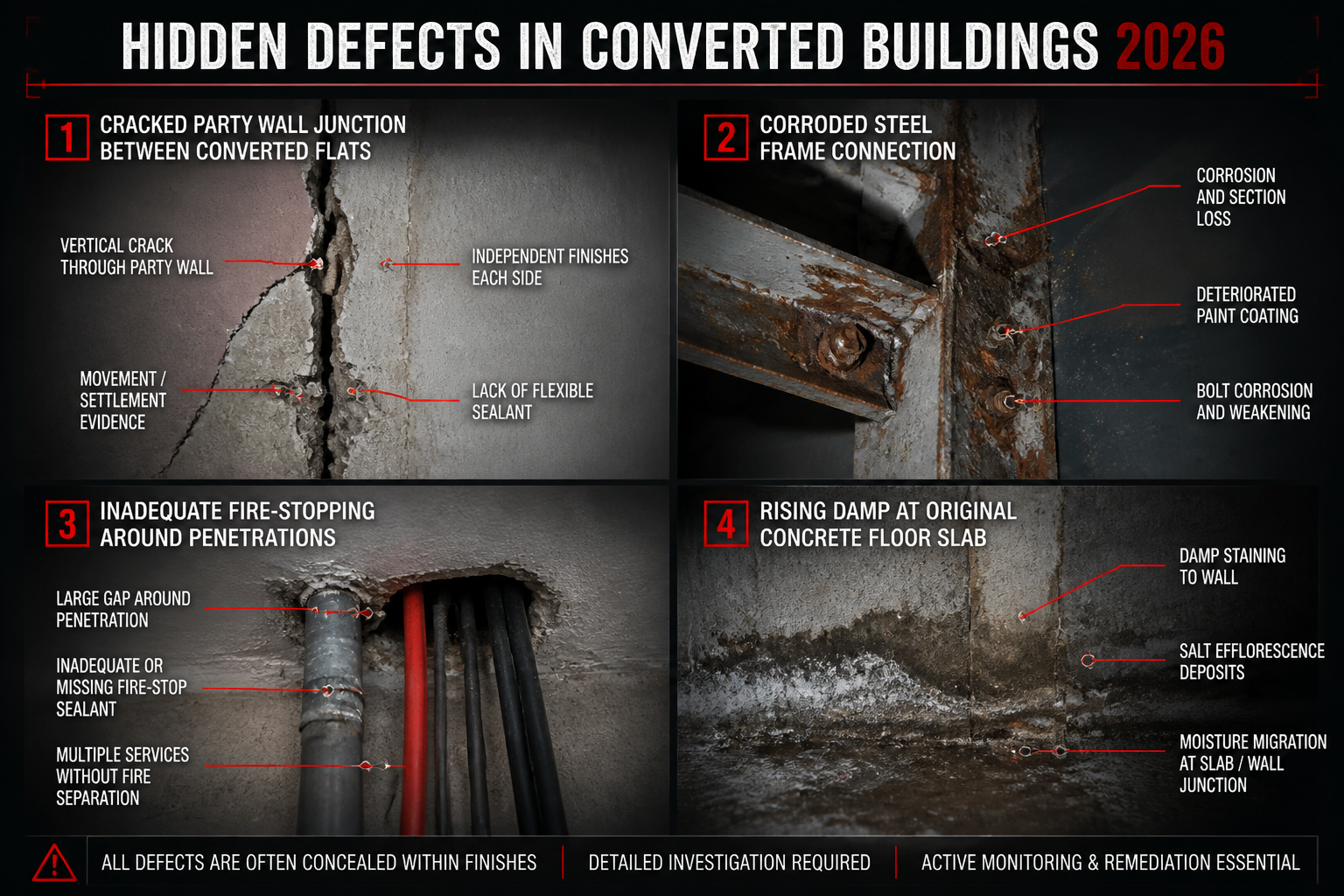
The defect profile of a converted building is unlike that of a new-build or a period residential property. The following categories represent the highest-frequency, highest-impact issues identified in 2026 urban conversion surveys.
🧱 Party Wall and Acoustic Separation Failures
When a single commercial floor plate is divided into multiple residential units, new party walls must be constructed to provide both structural separation and acoustic insulation. In many conversions — particularly those completed under permitted development rights with minimal oversight — these walls are inadequate.
Common failures include:
- Insufficient mass in the separating wall, leading to poor airborne sound transmission
- Flanking paths where sound travels through the original concrete frame, bypassing the new partition entirely
- Structural connections between the new party wall and the original frame that create vibration bridges
- Fire stopping gaps at junctions between the party wall and the ceiling/floor assembly
A thorough RICS Level 3 building survey will probe these junctions carefully, using borescopes and thermal cameras where direct access is unavailable.
💧 Concealed Damp and Drainage Conflicts
Commercial buildings are rarely designed with domestic drainage in mind. When bathrooms and kitchens are inserted into former office floors, drainage routes must be created — often by cutting through structural concrete slabs or running pipes within newly constructed floor voids. Both approaches introduce significant damp risk.
Key indicators surveyors should investigate:
| Defect Type | Common Location | Detection Method |
|---|---|---|
| Slab penetration leaks | Below wet rooms | Moisture meter + thermal imaging |
| Condensation in floor voids | Between converted floors | Borescope inspection |
| Inadequate falls on flat roofs | Roof terraces, plant rooms | Visual + drone survey |
| Rising damp at original slab | Ground floor conversions | Carbide testing |
A drainage survey should be considered standard practice for any conversion where drainage routes have been modified or newly installed. The cost of identifying a failed drain before purchase is trivial compared to the remediation bill after.
🔩 Structural Frame Integrity and Load Redistribution
Original commercial frames — whether steel, reinforced concrete, or post-tensioned concrete — were designed for specific load patterns. Residential conversion changes those patterns fundamentally. New partition walls add point loads; removed partitions eliminate bracing; roof terraces introduce dynamic loads from occupants and planters.
Surveyors must assess:
- Whether structural calculations were produced for the conversion and whether they remain available
- Evidence of deflection or cracking in the original frame members
- Corrosion in steel frame elements, particularly where new wet areas have been introduced nearby
- Post-tensioned concrete risks — cutting into post-tensioned slabs during conversion is extremely hazardous and has caused catastrophic failures
Where concerns arise, a specialist structural engineering assessment should be commissioned alongside the building survey.
🔥 Fire Safety and Compartmentation
Post-Grenfell legislation has dramatically raised the fire safety bar for residential buildings, and converted structures face particular scrutiny. Many conversions completed between 2010 and 2020 were built to standards that are now considered inadequate.
Critical fire safety checks include:
- Integrity of fire doors — specification, self-closing mechanisms, and intumescent seals
- Cavity barriers in wall and ceiling voids — frequently omitted in fast-track conversions
- Compartmentation at service penetrations — pipes, cables, and ducts passing through fire-rated elements must be properly sealed
- External wall systems — cladding and insulation combinations that may not comply with current guidance
Where asbestos is suspected in pre-2000 commercial buildings, an asbestos survey is a legal requirement before any intrusive investigation.
Valuation Risks: How Building Surveys for Non-Standard Construction in 2026 Urban Conversions Affect Property Worth
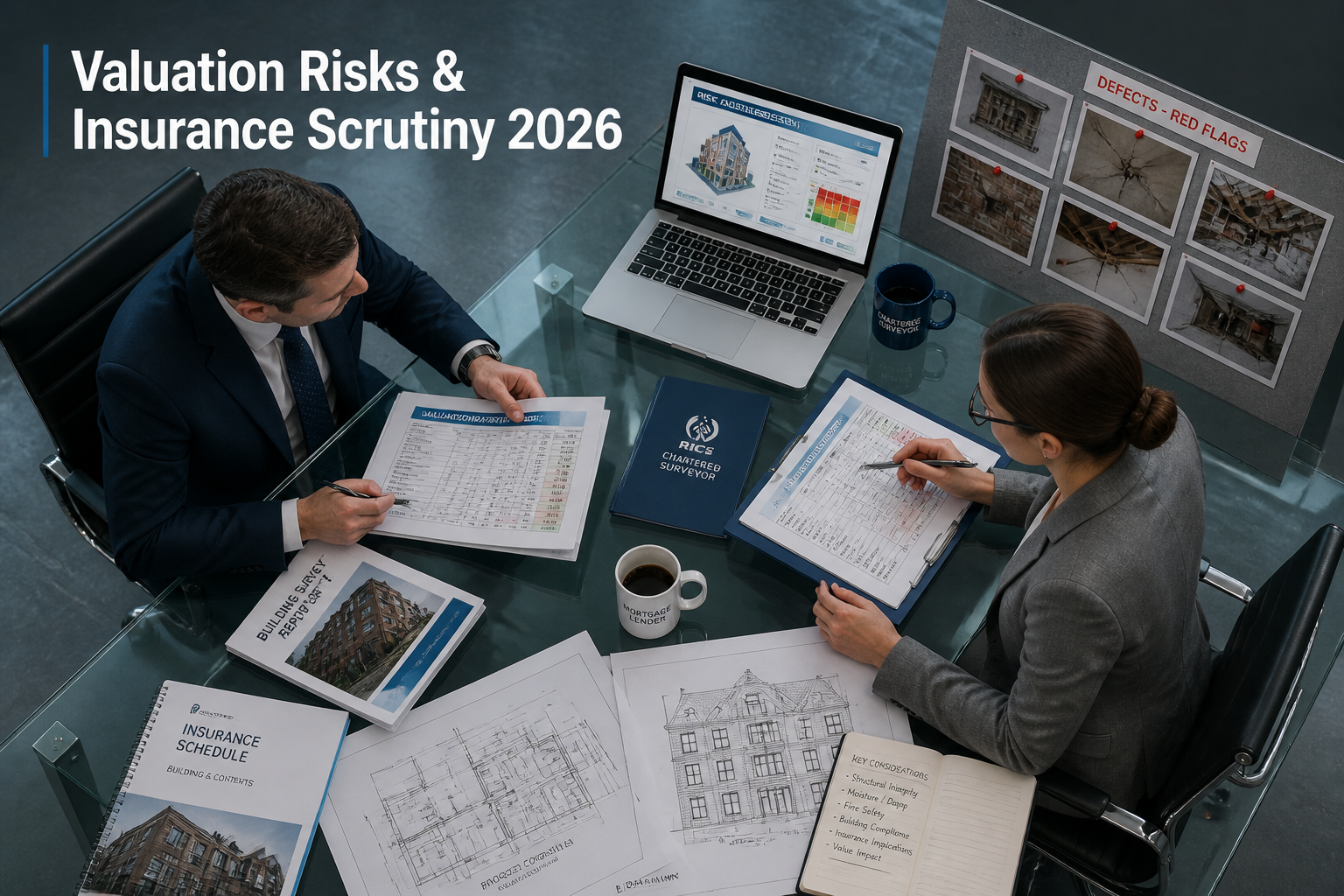
The financial consequences of undetected defects in converted properties extend well beyond repair costs. In 2026, the valuation landscape for non-standard converted flats has become significantly more complex, driven by three converging pressures: lender caution, insurance market hardening, and evolving RICS guidance.
The Lender Perspective: Mortgage Retention and Refusal
Mortgage lenders increasingly rely on professional property valuations that reflect not just market comparables but structural risk. When a building survey reveals material defects — inadequate fire stopping, structural frame concerns, or non-compliant party walls — lenders have three options:
- Proceed without adjustment (rare for significant defects)
- Apply a retention — withholding a portion of the mortgage until defects are remedied
- Decline to lend — particularly where fire safety or structural integrity is in question
Retentions of £20,000–£80,000 are not uncommon on converted flats where surveys identify remediable defects. Where defects are more fundamental — such as a compromised post-tensioned slab or non-compliant external wall system — lenders may withdraw entirely, leaving buyers unable to complete.
Understanding the factors that influence property valuation is essential context for anyone purchasing a converted flat. A surveyor who identifies significant defects has a professional duty to reflect those risks in their assessment.
Insurance Market Scrutiny in 2026
The buildings insurance market for converted residential properties has hardened considerably. Insurers are now routinely requesting:
- Evidence of EWS1 certification for buildings over 11 metres
- Fire risk assessment reports for the common parts
- Structural warranties or professional indemnity-backed reports for recent conversions
- Drainage condition reports where drainage routes have been modified
Where this documentation is absent, premiums increase sharply — or cover is declined altogether. An uninsurable property is, in practice, unmortgageable and unsaleable.
⚠️ Key Risk: A converted flat that passes a superficial inspection but fails insurance underwriting can collapse an entire transaction chain — affecting not just the buyer but every linked sale.
Valuation Adjustment Methodology for Converted Properties
When defects are identified, surveyors must make defensible valuation adjustments. The methodology should reflect:
- Remediation cost — obtained from specialist contractors, not rule-of-thumb estimates
- Residual risk — some defects (e.g., post-tensioned slab damage) carry ongoing uncertainty even after repair
- Market perception — converted flats with known defect histories trade at a discount even after remediation
- Lease and service charge implications — major remediation works in converted blocks are typically funded through service charges, affecting all leaseholders
For leasehold converted flats, understanding the freehold valuation and the financial health of the managing entity is equally important. A freeholder with inadequate reserves facing a £500,000 remediation bill represents a significant contingent liability for every leaseholder in the block.
The Role of Schedule of Condition Reports
Before purchasing a converted flat — or before a developer completes a conversion — a schedule of condition report provides a timestamped baseline of the property's condition. This document becomes invaluable in:
- Dilapidations disputes where condition at a specific date is contested
- Insurance claims where pre-existing defects are disputed
- Legal proceedings where the extent of conversion-related damage must be established
For commercial-to-residential conversions where the original building remains partly in commercial use, dilapidations surveys may also be relevant to establish the condition of retained commercial elements.
Choosing the Right Survey and Surveyor for Non-Standard Conversions
Not all building surveyors have equal experience with non-standard and converted properties. The complexity of these buildings demands a surveyor who combines RICS Level 3 competency with genuine hands-on experience of conversion projects.
What to Look for in a Surveyor 🔍
- RICS accreditation at the appropriate level — confirm the surveyor is qualified to deliver a Level 3 building survey
- Specific experience with the construction type — concrete frame, steel frame, or timber frame conversions each have distinct defect profiles
- Access to specialist sub-consultants — drainage engineers, structural engineers, asbestos surveyors, and thermal imaging specialists
- Local market knowledge — understanding comparable sales and the valuation context for converted properties in the specific area
For properties in London and the South East — where the majority of urban conversions are concentrated — working with chartered surveyors with central London expertise or East London specialists provides both technical competence and local market intelligence.
The Survey Process: What to Expect
A properly conducted Level 3 survey for a non-standard converted property should include:
- Pre-survey document review — planning permissions, building regulations completion certificates, structural warranties, fire risk assessments
- On-site inspection — minimum 3–4 hours for a converted flat; longer for larger or more complex properties
- Specialist equipment — thermal imaging camera, moisture meters, borescope, and potentially a drone survey for roof and external wall assessment
- Detailed written report — with clear condition ratings, defect descriptions, remediation recommendations, and valuation commentary
- Post-report consultation — a surveyor who will not discuss their findings by telephone is not providing adequate service
Conclusion: Actionable Next Steps for Buyers, Surveyors, and Lenders
Building Surveys for Non-Standard Construction in 2026 Urban Conversions represent one of the most technically demanding — and financially consequential — areas of residential property due diligence. The combination of complex structural heritage, conversion-specific defect risks, and a hardening insurance and lending environment means that cutting corners on survey quality is a gamble with very poor odds.
✅ Actionable Next Steps
For buyers:
- Commission a RICS Level 3 building survey for any converted or non-standard property — before exchange, not after
- Request all building regulations documentation, structural warranties, and fire risk assessments from the seller before survey
- Budget for specialist sub-reports (drainage, structural, asbestos) as part of your due diligence costs
For surveyors:
- Apply enhanced 2026 RICS protocols [7] rigorously to all conversion instructions
- Do not accept instructions where access limitations prevent adequate inspection — note limitations clearly and recommend specialist follow-up
- Ensure valuation adjustments are supported by remediation cost evidence, not estimates
For lenders:
- Treat converted properties as a distinct risk category requiring specialist valuation input
- Require EWS1 and fire risk assessment documentation as standard for buildings over 11 metres
- Consider mandatory Level 3 survey requirements for non-standard construction as a condition of mortgage offer
The urban conversion market is not slowing down. But the risks embedded in these buildings are real, measurable, and — with the right survey approach — manageable. The cost of a thorough Level 3 survey is measured in hundreds of pounds. The cost of discovering a hidden defect after completion is measured in tens of thousands.
References
[1] Nonresidential Construction Starts Regional Analysis March 2026 – https://news.constructconnect.com/nonresidential-construction-starts-regional-analysis-march-2026
[2] Alta Surveys Revised 2026 – https://www.bvna.com/needs/alta-surveys-revised-2026
[3] Engineering And Construction Industry Outlook – https://www.deloitte.com/us/en/insights/industry/engineering-and-construction/engineering-and-construction-industry-outlook.html
[4] Downtown Areas Leading The Way In Office To Residential Conversions – https://bohlerengineering.com/blog/insight/downtown-areas-leading-the-way-in-office-to-residential-conversions/
[5] Construction Analytics Outlook 2026 – https://edzarenski.com/2026/03/05/construction-analytics-outlook-2026/
[6] Newresconst – https://www.census.gov/construction/nrc/pdf/newresconst.pdf
[7] Building Survey Quality Standards 2026 Navigating Rics Updates And Enhanced Home Inspection Requirements – https://nottinghillsurveyors.com/blog/building-survey-quality-standards-2026-navigating-rics-updates-and-enhanced-home-inspection-requirements