
Nearly one in three UK homebuyers skips a professional survey entirely — and many of those who do commission one choose the wrong type for their property. For 2026 buyers navigating a complex market, the decision between ISVA Homebuyer Surveys vs RICS Level 2 reports is one of the most consequential choices in the entire purchase process. Both sit at the same tier of the survey ladder, both focus on conventional residential properties, and yet the differences in format, valuation inclusion, and professional accreditation can meaningfully affect what buyers receive and how much protection they gain. This guide cuts through the confusion.
Key Takeaways 📋
- ISVA HomeSurvey Level 2 and RICS Level 2 are broadly equivalent in scope and depth, but differ in professional body affiliation and report structure [2]
- RICS Level 2 surveys can include a formal market valuation and insurance reinstatement figure — a significant advantage for mortgage buyers [5]
- Both survey types are visual-only inspections suited to standard, conventional properties in reasonable condition [3]
- Costs typically range from £400 to £1,000 depending on property size and location [1]
- For properties built from the mid-20th century onwards, a Level 2 survey is generally the most sensible and balanced option [3]
Understanding the Two Survey Types: A Clear Starting Point
Before comparing ISVA Homebuyer Surveys vs RICS Level 2 reports in detail, it helps to understand the professional bodies behind each product.
RICS (Royal Institution of Chartered Surveyors) is the UK's largest and most widely recognised surveying body. Its Level 2 Home Survey — formerly called the HomeBuyer Report — follows a standardised national format governed by the RICS Home Survey Standard [6].
ISVA (Independent Surveyors' and Valuers' Association) is a smaller, independent professional body. Its HomeSurvey Level 2 product is exclusively available through ISVA members and is broadly equivalent to the RICS Level 2 in terms of scope and purpose [2].
💡 Key distinction: ISVA surveys are only available from ISVA-registered surveyors, whereas RICS Level 2 surveys are delivered by RICS-accredited members — a much larger pool of practitioners across the UK.
Both survey types are designed for conventional, standard properties in reasonable condition that have not been significantly altered [1][6]. Neither is appropriate for older, unusual, or heavily extended homes — that's where a RICS Level 3 Building Survey becomes necessary.
What Does Each Survey Actually Cover?
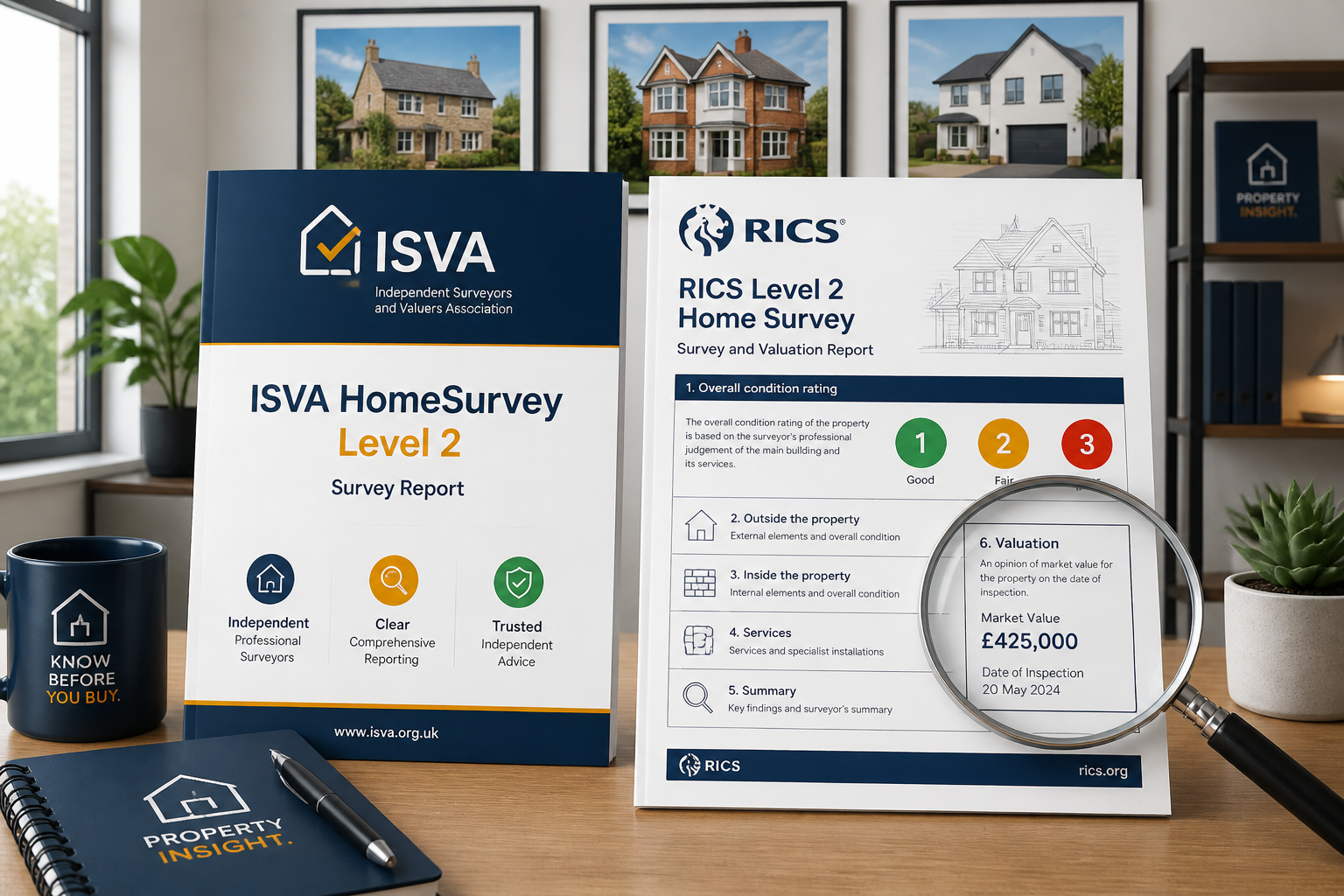
RICS Level 2: Structure and Format
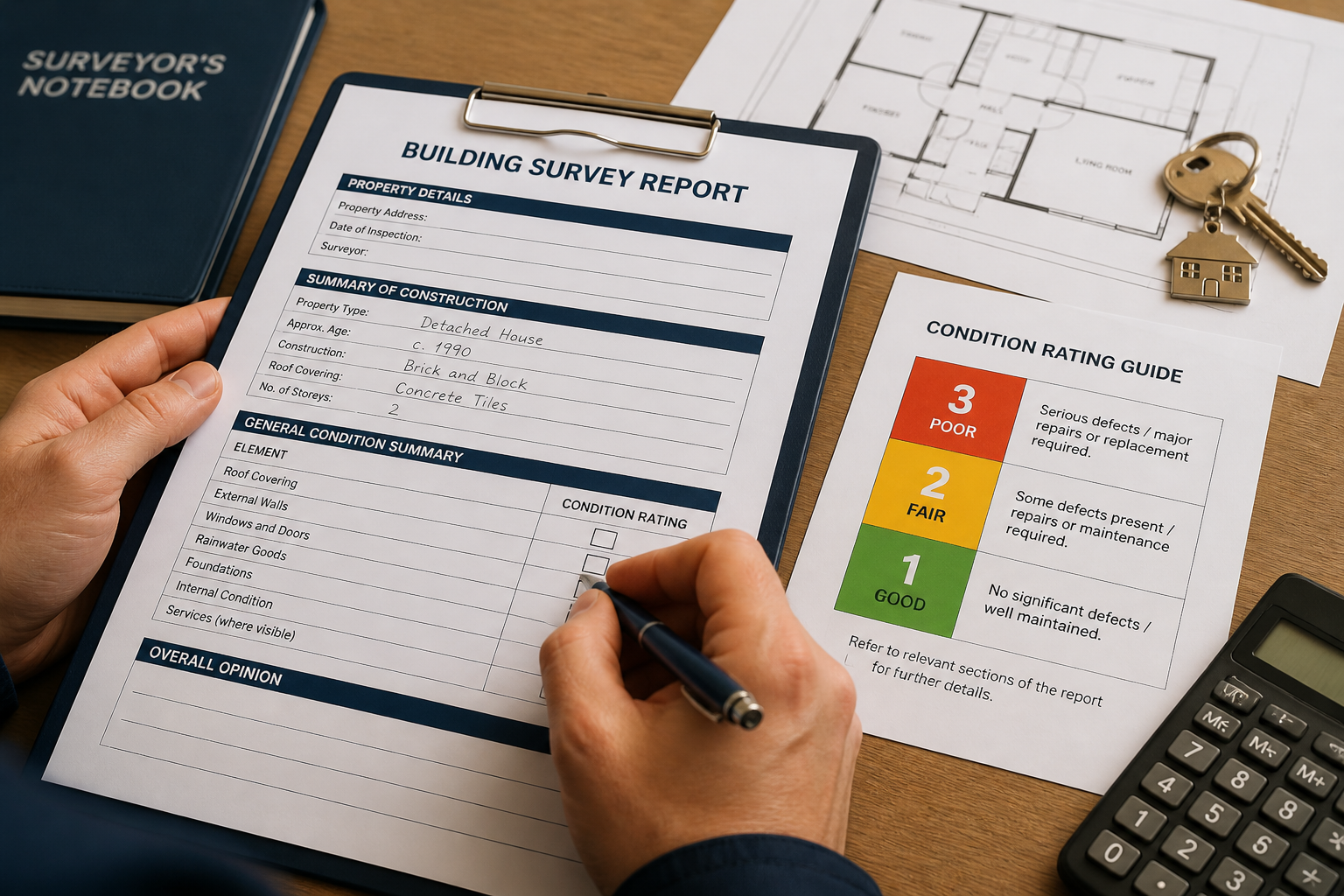
The RICS Level 2 Home Survey provides condition ratings for all main building parts using a traffic light system [3]:
| Rating | Colour | Meaning |
|---|---|---|
| 1 | 🟢 Green | No repair needed |
| 2 | 🟡 Amber | Defects requiring attention |
| 3 | 🔴 Red | Serious defects needing urgent repair |
The report typically includes:
- ✅ Condition ratings for roof, walls, floors, windows, and services
- ✅ Damp checks and moisture readings
- ✅ Energy efficiency observations
- ✅ Photographs throughout the report [3]
- ✅ Legal issues flagged for the buyer's solicitor
- ✅ Optional: market valuation and insurance reinstatement cost [5]
The survey itself takes 90 minutes to four hours on-site, depending on property size and access [1].
Importantly, RICS Level 2 surveys are available in two formats:
- Survey only (RHS2) — a more affordable option covering condition only
- Survey with valuation — includes market value and reinstatement figures [5]
For buyers using a mortgage, the survey-with-valuation option can be especially valuable, as it provides an independent check against the lender's own mortgage valuation. Learn more about what affects a property valuation to understand how surveyors arrive at their figures.
ISVA HomeSurvey Level 2: Structure and Format
The ISVA HomeSurvey Level 2 follows a similar inspection scope but uses a distinctive report structure [2]:
- A "Surveyor's Overall Opinion" section appears at the very beginning of the report — giving buyers an immediate headline summary
- The body is organised into numbered sections covering all main elements
- A "Summary of Condition and Recommendations" appears at the end, consolidating key findings [2]
This front-loaded opinion section is a notable structural difference from the RICS format and can make the report feel more immediately accessible to non-specialist readers.
Shared Limitations: What Neither Survey Does
Both survey types share the same core limitations — and buyers must understand these clearly:
- ❌ No structural opening-up works — inspections are visual only [3]
- ❌ No building regulation compliance confirmation
- ❌ No structural calculations [3]
- ❌ Generally no repair cost estimates [3]
- ❌ Not suitable for properties with significant alterations or unusual construction
If a specific concern is flagged — such as suspected damp or timber decay — a specialist follow-up may be needed. A damp survey or a specific defect report can provide targeted investigation beyond the Level 2 scope.
ISVA Homebuyer Surveys vs RICS Level 2: The Valuation Question
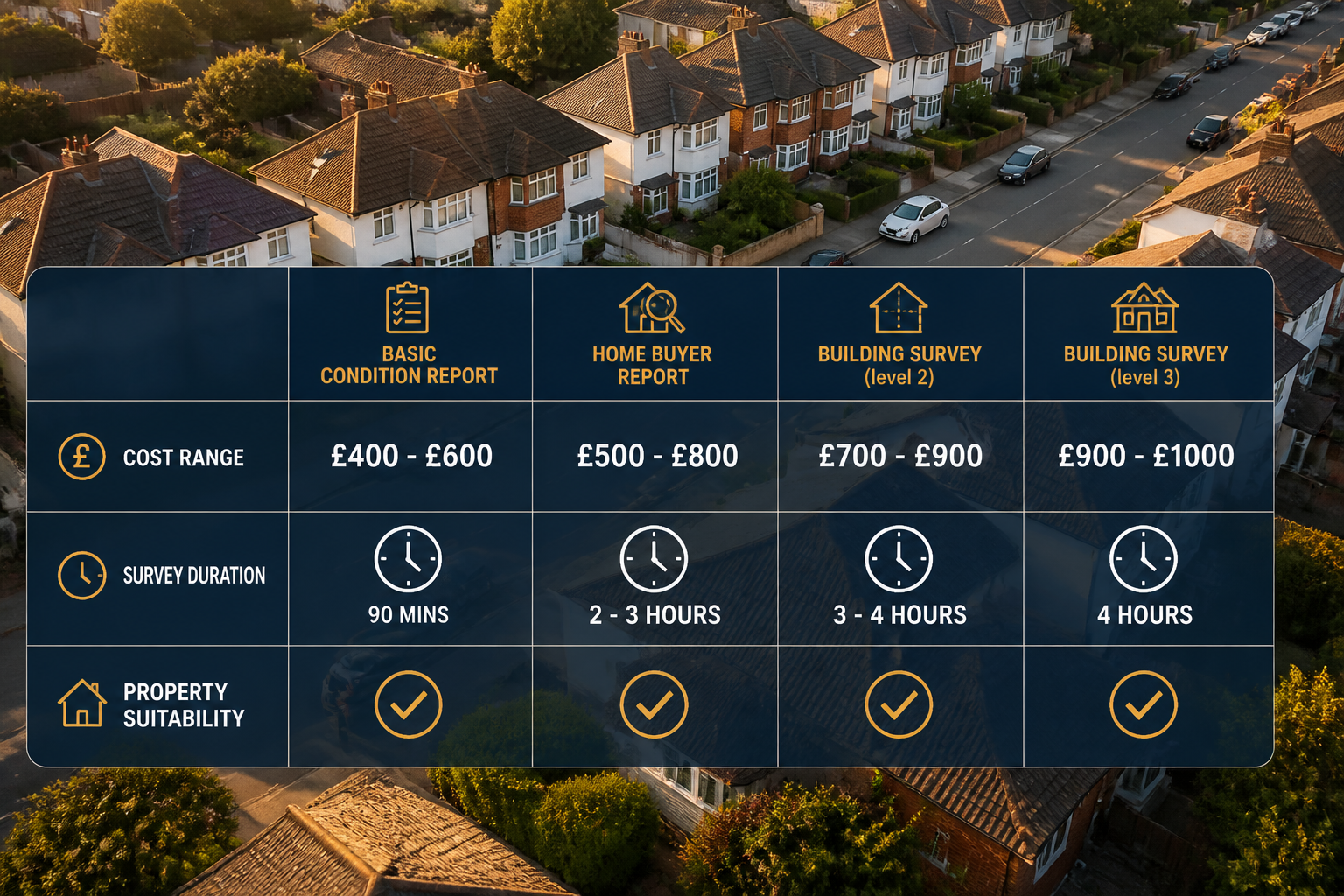
For many 2026 buyers, the valuation component is the deciding factor when comparing ISVA Homebuyer Surveys vs RICS Level 2 options. Here's why it matters so much.
Why a Survey Valuation Adds Real Value
A mortgage lender's valuation is conducted for the lender's benefit — not the buyer's. It confirms only that the property is adequate security for the loan. It does not protect the buyer if the agreed purchase price is too high.
An independent market valuation included within a RICS Level 2 survey gives buyers:
- A professional opinion of open market value
- An insurance reinstatement figure (the cost to rebuild the property from scratch) [5]
- Grounds to renegotiate the purchase price if the valuation comes in below the agreed price
🏠 Pull Quote: "An independent market valuation within a survey is one of the few tools buyers have to challenge an inflated asking price before contracts exchange."
For buyers who want to understand the full cost of commissioning a valuation separately, the price of a valuation report provides useful context on how fees are structured.
Does the ISVA Survey Include a Valuation?
The ISVA HomeSurvey Level 2 can include a valuation element, but this depends on the individual surveyor and the specific package commissioned. Unlike the RICS framework, which has a clearly defined survey-with-valuation product (RHS2 with valuation add-on), the ISVA format is somewhat less standardised in this respect [2][5].
Bottom line for 2026 buyers: If a formal, documented market valuation is a priority — particularly for mortgage purposes or price negotiation — the RICS Level 2 with valuation option offers a more clearly defined and widely recognised product.
Cost Comparison
| Survey Type | Typical Cost Range | Valuation Included? |
|---|---|---|
| RICS Level 2 (survey only) | £400 – £700 | ❌ No |
| RICS Level 2 (with valuation) | £500 – £1,000 | ✅ Yes |
| ISVA HomeSurvey Level 2 | £400 – £900 | Varies by surveyor |
Costs vary by property size, location, and surveyor [1]. No significant 2026 price changes have been confirmed at time of publication.
Which Properties Are Suitable for a Level 2 Survey?
Both ISVA and RICS Level 2 surveys are designed for the same category of property [1][6]:
✅ Suitable:
- Conventional brick or stone construction
- Properties built within the last 150 years [4]
- Homes in broadly reasonable condition
- Properties without major extensions or significant alterations
- Modern and post-war housing stock — from the mid-20th century onwards, Level 2 represents the most sensible option [3]
❌ Not suitable:
- Listed buildings or properties of historical significance
- Non-standard construction (timber frame, concrete, prefabricated)
- Properties with obvious major defects or extensive alterations
- Very old properties (pre-1875 in many cases)
For properties outside these parameters, a full building survey or a RICS Level 3 Building Survey will provide the depth of investigation required. Buyers unsure which survey level is appropriate can explore a guide to choosing the right property survey before making a decision.
Comparing ISVA Homebuyer Surveys vs RICS Level 2: A Head-to-Head Summary
| Feature | RICS Level 2 | ISVA HomeSurvey Level 2 |
|---|---|---|
| Professional body | RICS | ISVA |
| Surveyor availability | Very wide | ISVA members only |
| Traffic light ratings | ✅ Yes [3] | ✅ Yes |
| Photographs included | ✅ Typically yes [3] | ✅ Yes |
| Upfront overall opinion | ❌ Not standard | ✅ Yes — at report start [2] |
| End summary section | ✅ Yes | ✅ Yes [2] |
| Valuation option | ✅ Clearly defined [5] | Varies by surveyor |
| Survey-only option | ✅ RHS2 available [5] | ✅ Available |
| Repair cost estimates | ❌ Generally not [3] | ❌ Generally not |
| Structural calculations | ❌ Not included [3] | ❌ Not included |
| Suitable property age | Up to 150 years [4] | Conventional properties |
Practical Guidance for 2026 Buyers: Making the Right Choice
When to Choose RICS Level 2
- The property is a standard post-war or modern home in good to fair condition
- A formal market valuation is needed for mortgage or negotiation purposes
- Access to a wide choice of local surveyors is important
- The buyer wants a nationally standardised report format recognised by lenders and solicitors
For buyers in specific regions, working with local chartered surveyors ensures familiarity with local market conditions — a factor that directly affects valuation accuracy.
When to Consider an ISVA HomeSurvey Level 2
- The buyer has found a qualified ISVA member they trust or have been recommended
- The upfront overall opinion format appeals as a clearer communication style
- The property fits standard Level 2 criteria
- The buyer is comfortable confirming valuation arrangements directly with the surveyor
Red Flags That Suggest Upgrading to Level 3
Regardless of which Level 2 product is chosen, certain property characteristics should prompt an upgrade:
- 🚩 Visible cracks in external walls
- 🚩 Evidence of damp or water ingress
- 🚩 Roof age unknown or clearly aging
- 🚩 Property is pre-1900 or of unusual construction
- 🚩 Significant extensions or conversions present
In these cases, a RICS Level 3 Building Survey provides the investigative depth that Level 2 simply cannot offer.
A Note on the 2026 RICS Home Survey Standard Update
It is worth noting that RICS published a 2nd Edition update to its Home Survey Standard in April 2026 [7]. Buyers commissioning surveys in 2026 should confirm with their chosen surveyor that the report will comply with the latest edition of the standard. This update refines guidance on reporting obligations and professional conduct, reinforcing the importance of working with an accredited, up-to-date practitioner.
Conclusion: Making a Confident Survey Decision in 2026
The comparison of ISVA Homebuyer Surveys vs RICS Level 2 ultimately comes down to three practical questions: Who is your surveyor? Do you need a formal valuation? And what type of property are you buying?
For the vast majority of 2026 buyers purchasing a conventional, post-war or modern home, both survey types offer a solid, proportionate level of investigation. The RICS Level 2 with valuation option holds a clear edge for mortgage buyers and those who want documented price protection. The ISVA HomeSurvey Level 2 offers a well-structured, accessible alternative — particularly where an ISVA-registered surveyor comes highly recommended.
✅ Actionable Next Steps
- Confirm property suitability — check whether the property's age, condition, and construction type fall within Level 2 parameters
- Decide on valuation — if a market value figure is needed, ensure the RICS Level 2 with valuation option is explicitly commissioned
- Verify accreditation — confirm the surveyor is a current RICS or ISVA member and is working to the latest 2026 standards
- Ask about photographs and follow-up — ensure the report will include photographic evidence and clarify what happens if defects are flagged
- Consider specialist add-ons — if damp, timber, or drainage concerns exist, budget for a damp and timber report alongside the main survey
Choosing the right survey is not just due diligence — it is one of the most effective ways to protect a significant financial investment. Take the time to get it right.
References
[1] Homebuyer Surveys Explained – https://hoa.org.uk/advice/guides-for-homeowners/i-am-buying/homebuyer-surveys-explained/
[2] ISVA HomeSurvey Level 2 – https://isva.org.uk/which-survey-do-i-need/isva-homesurvey-level-2/
[3] Watch – https://www.youtube.com/watch?v=fKTVS0xu9dE
[4] Difference – https://www.houzecheck.com/blog/difference
[5] Understanding The Differences Between RICS Home Survey Level Two And Level Three – https://www.nuvensurveyors.co.uk/blog/understanding-the-differences-between-rics-home-survey-level-two-and-level-three/
[6] House Surveys UK: The Costs, Types And Benefits Of An RICS Home Survey – https://www.rics.org/consumer-guides/house-surveys-uk-the-costs-types-and-benefits-of-an-rics-home-survey
[7] RICS Home Survey Standard 2nd Edition April 2026 Update – https://nottinghillsurveyors.com/blog/rics-home-survey-standard-2nd-edition-april-2026-update
[8] Chartered Surveyors – https://www.comparemymove.com/chartered-surveyors