
Defective guttering is responsible for more neighbour disputes than most people realise — and when those disputes reach mediation or court, the quality of an expert witness report can determine the entire outcome. Expert Witness Reports for Defective Guttering Disputes: Building Pathology Insights and CPR Compliance sits at the intersection of technical building science, legal procedure, and professional ethics. This guide explains how chartered surveyors diagnose guttering failures, how those findings translate into court-ready evidence, and what Civil Procedure Rules (CPR) compliance actually demands in practice.
Key Takeaways 📋
- Defective guttering disputes often involve damp penetration, structural damage, and boundary liability — all of which require precise building pathology evidence.
- A CPR Part 35-compliant expert witness report must be impartial, structured, and addressed to the court, not to the instructing party.
- Building pathology techniques — including moisture mapping, thermal imaging, and visual inspection — are essential diagnostic tools for guttering defect cases.
- The expert witness's duty is to the court first, regardless of who pays their fee.
- Instructing a RICS-qualified specialist early in a dispute can prevent costly litigation escalation.
Why Guttering Defects Escalate Into Serious Disputes
A blocked downpipe or a sagging gutter joint might seem trivial. But left unresolved, defective guttering causes cascading damage: saturated brickwork, penetrating damp, rotting timber fascias, and even foundation erosion. When the source of that water is a neighbour's property, the dispute quickly becomes a matter of legal liability.
🔑 Key fact: Water ingress caused by poorly maintained or defectively installed guttering is one of the most frequently cited causes of neighbour property damage claims in England and Wales.
Common triggers for formal disputes include:
| Scenario | Typical Outcome |
|---|---|
| Neighbour's gutter overflows onto shared boundary wall | Damp penetration claim |
| Newly installed guttering discharges onto adjacent land | Trespass / nuisance claim |
| Shared or party wall guttering falls into disrepair | Joint liability dispute |
| Developer installs undersized guttering on new build | Construction defect litigation [1] |
| Guttering removed during extension work, not replaced | Dilapidations claim |
Once a dispute becomes formal — whether through solicitors, a party wall surveyor, or a court claim — both sides typically need independent expert evidence. That is where Expert Witness Reports for Defective Guttering Disputes: Building Pathology Insights and CPR Compliance becomes critical.
For disputes involving shared walls or boundary structures, understanding what constitutes a party wall dispute is an important first step before commissioning expert evidence.
Building Pathology: How Surveyors Diagnose Guttering Defects
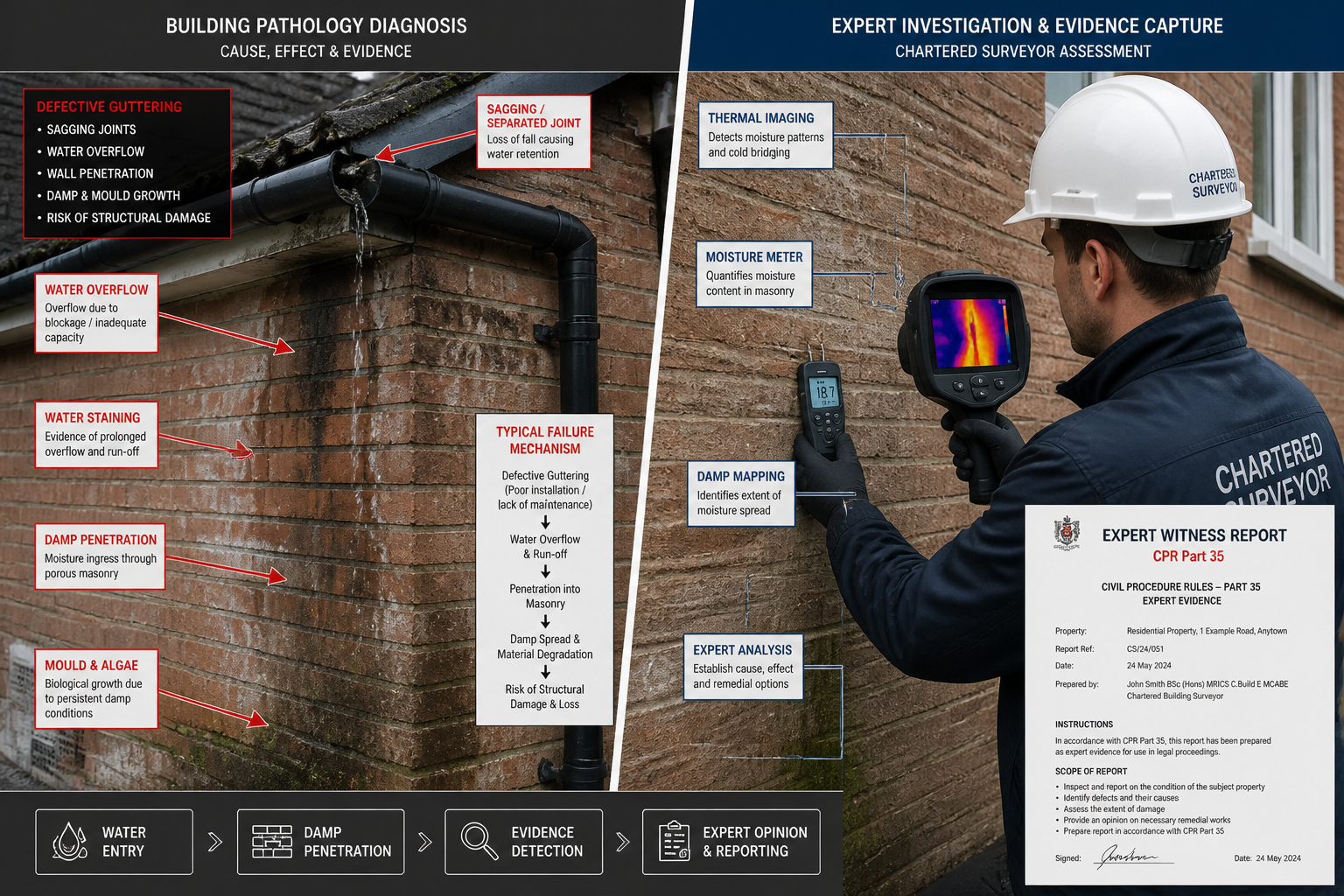
Building pathology is the systematic investigation of building failures — their causes, mechanisms, and consequences [7]. When applied to guttering disputes, it provides the scientific backbone of any credible expert witness report.
The Diagnostic Process
A qualified surveyor does not simply observe that a gutter is leaking. They trace the failure pathway from the defect source to the resulting damage, establishing causation — the critical legal link between one party's failure and another party's loss.
Stage 1: Visual Inspection
The surveyor examines:
- Gutter alignment, fall, and joint integrity
- Downpipe connections and discharge points
- Fascia board condition and fixings
- Evidence of overflow staining, algae, or moss
- Proximity to windows, doors, and DPC (damp proof course) levels
Stage 2: Moisture Investigation
Using calibrated moisture meters and, where appropriate, thermal imaging cameras, the surveyor maps the extent of water ingress within the affected structure. This is essential for quantifying damage — not just identifying its presence.
For complex cases involving suspected damp penetration through walls, a damp and timber report may be commissioned alongside the expert witness report.
Stage 3: Photographic and Documentary Evidence
Every finding must be photographed with scale references and GPS-tagged timestamps. Drone surveys are increasingly used for high-level guttering on multi-storey buildings — providing aerial photographic evidence that is difficult to challenge [2]. A drone survey can capture gutter alignment, debris accumulation, and overflow points that are inaccessible from ground level.
Stage 4: Causation Analysis
This is the most legally significant stage. The surveyor must determine:
- Was the defect caused by poor installation, lack of maintenance, or design failure?
- Is the damage consistent with the alleged cause?
- Could the damage have arisen from an alternative source?
"The strength of an expert witness report lies not in what the surveyor observed, but in how convincingly they connect observation to causation."
Stage 5: Remediation Scoping
A credible report quantifies the cost of making good. This includes guttering replacement, fascia repairs, damp treatment, and any redecoration. Without this, a court cannot assess damages.
Common Guttering Defect Findings in Dispute Cases
- 🔴 Sagging gutters — caused by failed brackets; leads to standing water and overflow
- 🔴 Failed joints — sealant degradation or incorrect assembly; direct source of water discharge
- 🔴 Incorrect fall — installation error; water pools rather than drains
- 🔴 Undersized guttering — design failure; overwhelmed in moderate rainfall [1]
- 🔴 Blocked downpipes — maintenance failure; overflow onto adjacent structures
- 🔴 Missing or displaced sections — often following building works; immediate water ingress risk
A specific defect report focused solely on the guttering system can provide the targeted evidence needed without the cost of a full building survey.
CPR Compliance: What Expert Witness Reports for Defective Guttering Disputes Must Contain
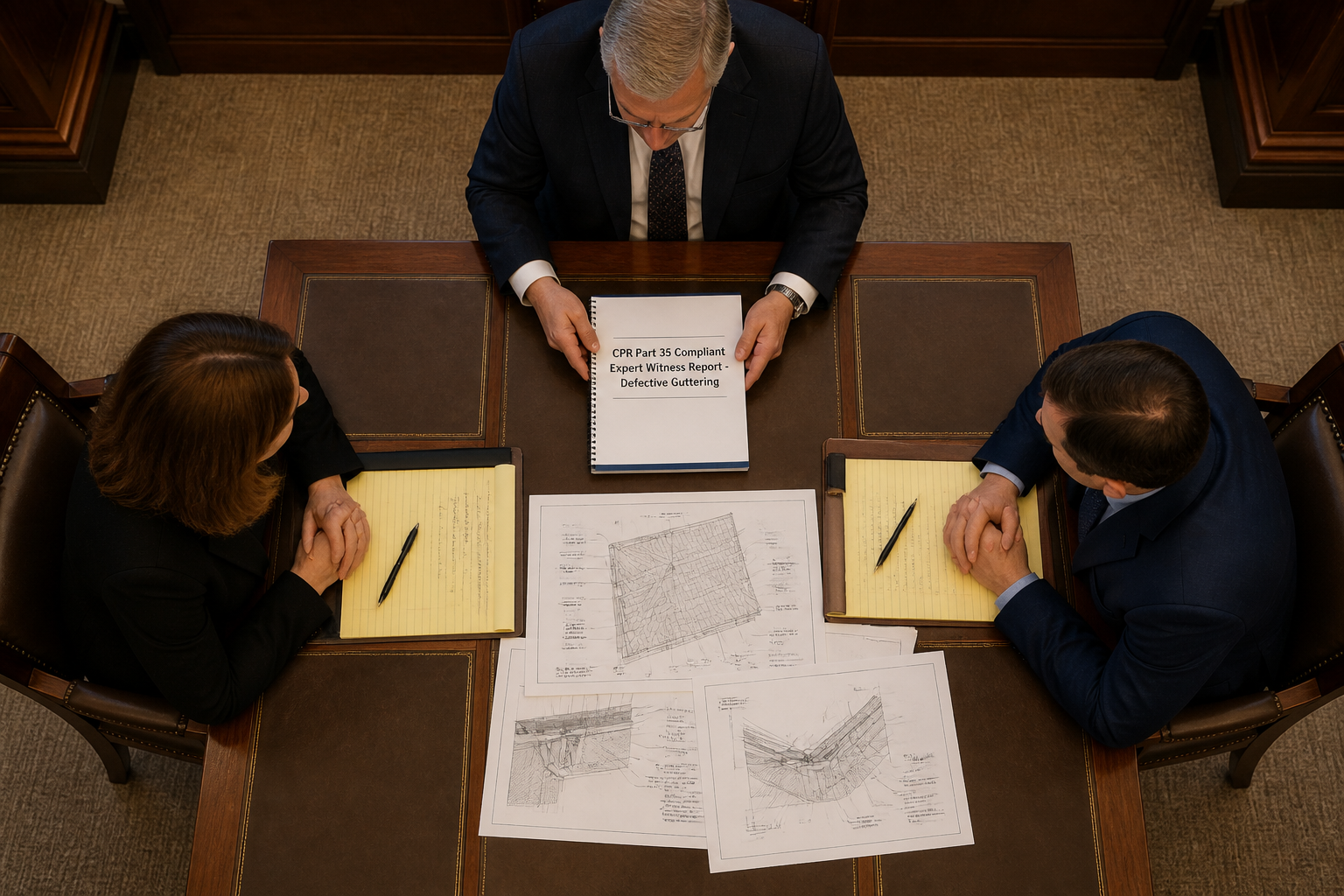
The Civil Procedure Rules (CPR) govern how expert evidence is presented in civil litigation in England and Wales. Part 35 of the CPR, together with the accompanying Practice Direction and the Protocol for the Instruction of Experts, sets out binding requirements for any expert witness report used in court proceedings.
Failure to comply with CPR Part 35 can result in the report being inadmissible — regardless of how technically sound it is.
The Core CPR Part 35 Requirements
| Requirement | What It Means in Practice |
|---|---|
| Duty to the court | The expert's overriding duty is to the court, not the instructing party |
| Statement of truth | The report must include a signed declaration of truth |
| Expert's qualifications | Full details of relevant qualifications and experience must be stated |
| Instructions summary | The report must summarise the instructions received |
| Range of opinion | Where opinion varies in the field, the report must acknowledge this |
| Summary of conclusions | A clear, concise summary must be provided separately |
| Declaration of compliance | A statement confirming CPR Part 35 awareness and compliance |
The Expert's Overriding Duty
Perhaps the most misunderstood aspect of CPR compliance is the independence requirement. An expert witness is not an advocate. They are not hired to win a case. Their report must reflect their genuine professional opinion, even where that opinion is unfavourable to the instructing party [3].
In guttering disputes, this means:
- If the surveyor finds that the claimant's own guttering contributed to the damage, that must be stated.
- If the alleged defect could have multiple causes, all credible causes must be addressed.
- If remediation costs are disputed, the expert must give a reasoned, evidence-based figure — not one inflated to support a claim.
Courts have struck out expert evidence where reports read as partisan advocacy rather than impartial analysis [4]. Instructing solicitors and property owners should understand this before commissioning a report.
Single Joint Expert vs. Party-Appointed Expert
In lower-value guttering disputes (typically under £25,000), courts frequently direct that a Single Joint Expert (SJE) be appointed — one surveyor instructed by both parties jointly. This reduces cost and avoids a "battle of experts."
In higher-value or more complex cases, each party may appoint their own expert. Where this occurs, CPR Part 35 requires experts to meet and produce a joint statement identifying areas of agreement and disagreement before the hearing.
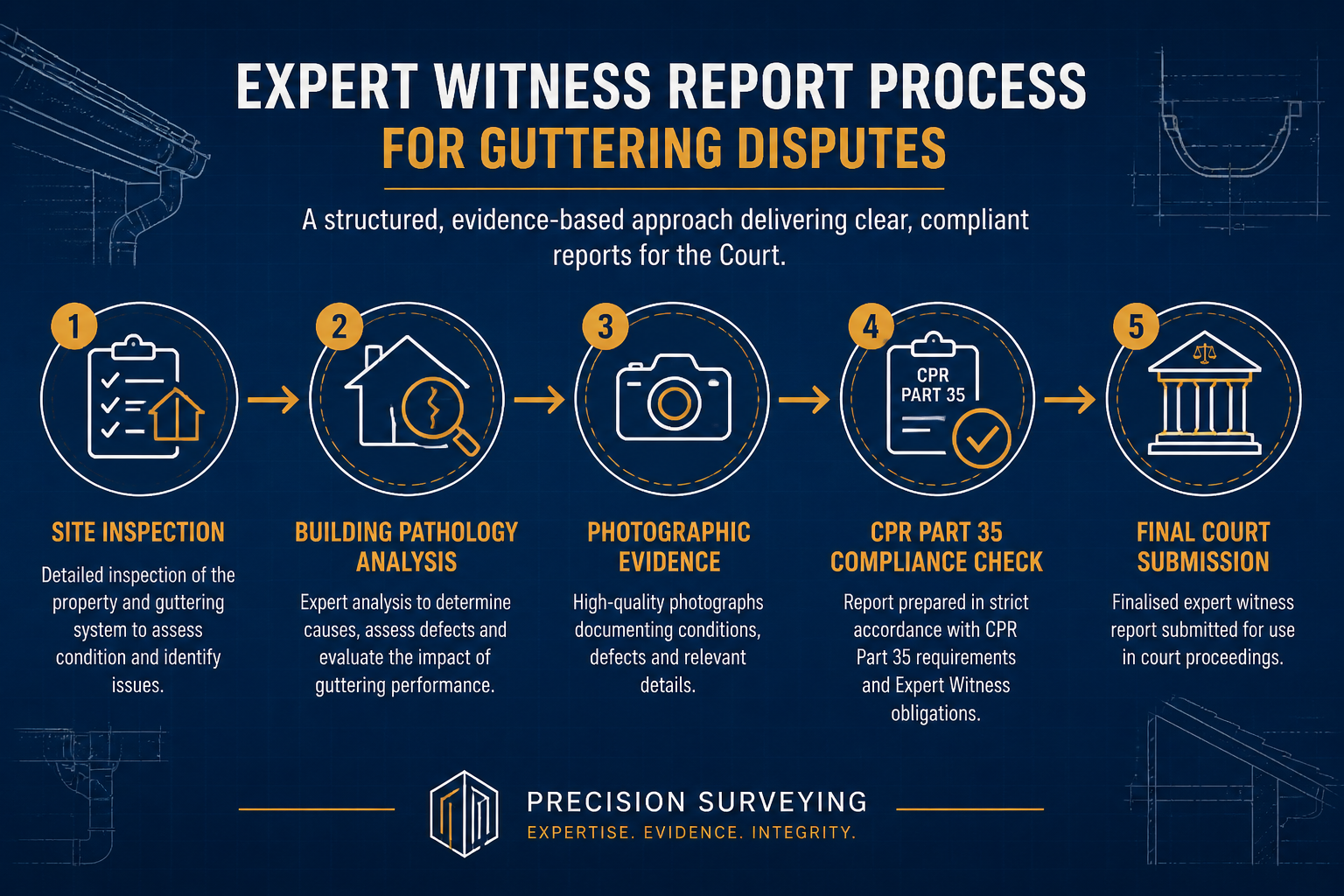
Structuring an Expert Witness Report for Defective Guttering Disputes: Building Pathology Insights and CPR Compliance
A well-structured report serves two audiences simultaneously: the court, which requires legal compliance, and the technical reader, who requires building pathology rigour. The following structure reflects best practice for guttering defect cases [5][6].
Recommended Report Structure
1. Title Page
- Expert's name, qualifications, and firm
- Instructing party and solicitors
- Property address and inspection date
- Statement: "Prepared in accordance with CPR Part 35"
2. Executive Summary
- One-page summary of key findings and conclusions
- Suitable for non-technical readers (judges, mediators)
3. Instructions and Scope
- Verbatim or summarised instructions
- Scope of inspection and any limitations
4. Expert's Qualifications and Experience
- Relevant RICS or equivalent membership
- Specific experience in building pathology and defect analysis
5. Methodology
- Inspection techniques used (visual, moisture meter, thermal imaging, drone)
- Standards referenced (BS EN 12056, BS 8000-13, NHBC standards)
6. Findings
- Systematic description of each defect observed
- Photographic evidence with captions
- Moisture readings and mapping
7. Causation Analysis
- Reasoned connection between defect and damage
- Alternative causes considered and addressed
8. Remediation and Quantum
- Itemised schedule of works
- Cost estimates with basis stated
9. Opinion and Conclusions
- Clear, unambiguous professional opinion
- Areas of uncertainty acknowledged
10. Statement of Truth and CPR Declaration
- Signed declaration per CPR Part 35.3
Real-World Application: Guttering Disputes in Neighbour and Leasehold Contexts
Neighbour Disputes
The most common scenario involves a detached or semi-detached property where one neighbour's guttering discharges water onto the adjacent property. The expert surveyor must:
- Establish the source of water (the defective gutter)
- Trace the pathway (over the boundary, onto the wall or garden)
- Quantify the damage caused
- Assess the cost of repair
Where the dispute involves a shared or party wall structure, the schedule of condition prepared before works began (if one exists) becomes vital comparative evidence.
Leasehold and Block Management Disputes
In leasehold properties, guttering maintenance is typically the freeholder's or management company's responsibility. When guttering fails and causes damage to a flat, the leaseholder may pursue a claim against the landlord. Expert witness reports in these cases must address:
- The lease obligations relating to external maintenance
- Whether the defect arose from neglect or latent defect
- The consequential damage to the leaseholder's demise
A dilapidations survey may also be relevant where end-of-lease obligations are in dispute alongside the guttering defect.
New Build Defect Claims
Defective guttering on new build properties — whether from undersized specification, incorrect installation, or failed joints — falls under construction defect litigation [1][8]. Expert witnesses in these cases must be familiar with:
- Building Regulations Approved Document H (drainage)
- NHBC Buildmark warranty standards
- Developer's design specifications vs. as-built condition
A roof survey is often commissioned alongside guttering expert evidence, since roof drainage design and guttering performance are interdependent.
Selecting the Right Expert: Qualifications and Red Flags
What to Look For ✅
- RICS membership (Chartered Building Surveyor or Chartered Surveyor)
- Demonstrated experience in building pathology and defect analysis [7]
- Familiarity with CPR Part 35 and prior court or mediation experience
- Professional indemnity insurance appropriate to the claim value
- Willingness to act as Single Joint Expert if directed by the court
- Clear, jargon-free writing style accessible to non-technical readers
Red Flags to Avoid ❌
- Reports that read as advocacy for the instructing party
- Lack of photographic or measurable evidence
- No acknowledgement of alternative causation
- Missing CPR declaration or statement of truth
- Qualifications not relevant to building defects or drainage
"An expert who tells you only what you want to hear is not an asset in litigation — they are a liability."
The Role of Expert Evidence in Mediation and Alternative Dispute Resolution
Not every guttering dispute reaches a courtroom. Many are resolved through mediation, adjudication, or negotiation between solicitors. Expert witness reports are equally valuable in these settings — often more so, because a well-evidenced report frequently brings a dispute to early resolution without the cost and stress of a trial.
In mediation, the expert may be asked to:
- Present findings to both parties jointly
- Answer questions from mediators or opposing solicitors
- Revise quantum figures in light of agreed facts
The impartiality required by CPR Part 35 makes a compliant report credible to both sides — which is precisely why it is effective in settlement negotiations. A party holding a robust, CPR-compliant expert witness report has a significant negotiating advantage.
Conclusion: Actionable Next Steps for Guttering Dispute Parties
Expert Witness Reports for Defective Guttering Disputes: Building Pathology Insights and CPR Compliance is not a niche specialism — it is a well-defined professional service with clear legal requirements and established diagnostic methodology. Whether a dispute involves a leaking gutter between neighbours, a freeholder's maintenance failure, or a developer's construction defect, the pathway to resolution runs through credible, impartial expert evidence.
Actionable Next Steps 🎯
-
Document everything immediately — photograph the defective guttering and all resulting damage as soon as the dispute arises. Timestamps matter.
-
Instruct a RICS-qualified surveyor early — before solicitors become involved if possible. Early expert opinion can prevent disputes from escalating.
-
Clarify the scope of the report — decide whether a specific defect report or a full building survey is appropriate for the complexity of the case.
-
Check CPR compliance — ensure any report commissioned meets CPR Part 35 requirements before it is served on the opposing party or filed with the court.
-
Consider mediation — a CPR-compliant expert report is a powerful tool in settlement negotiations and can save significant legal costs.
-
Engage a specialist with court experience — not all surveyors have given expert evidence. Confirm that the expert has relevant litigation or mediation experience before instructing them.
Defective guttering disputes are winnable — but only with evidence that is technically sound, legally compliant, and professionally impartial. The right expert witness report does not just describe a problem; it resolves it.
References
[1] Construction Defects – https://www.lexvisio.com/expert-witnesses/construction-defects
[2] Construction Failure Analysis – https://www.experts.com/expert-witnesses/categories/construction-failure-analysis
[3] Construction Defects Expert Witness – https://seakexperts.com/specialties/construction-defects-expert-witness?state=new-jersey
[4] Construction S 231 – https://www.jurispro.com/category/construction-s-231
[5] Construction Defects – https://witnessdirectory.com/USAexpertwitnesses/non-medical-experts/construction-defects/
[6] forstconsultingllc – https://forstconsultingllc.com
[7] Building Pathology – https://www.dobanti.com/services/building-pathology/
[8] Construction Defects Expert Witness – https://seakexperts.com/specialties/construction-defects-expert-witness?state=new-york