

A net balance of -26% for buyer enquiries in February 2026 — that single RICS figure tells surveyors everything they need to know about the challenge ahead. [1] Navigating RICS February 2026 Market Volatility: Building Survey Demand Strategies When Buyer Enquiries Drop 26% and Regional Price Divergence Widens is no longer a theoretical exercise; it is the daily operational reality for every chartered surveyor firm trying to maintain revenue while the market shifts beneath their feet. With London house prices posting a -40% net balance, mortgage rates climbing back above 5%, and the market deteriorating further into March, the firms that adapt their survey positioning and client communication strategies now will be the ones still thriving when conditions stabilise.
Key Takeaways 📌
- Buyer enquiries fell 26% in February 2026 (net balance -26%), then worsened to -39% in March — the weakest reading since August 2023.
- Regional divergence is extreme: London (-40%), South East (-24%), and East Anglia (-26%) face sharp price pressure, while Northern Ireland, Scotland, and the North West remain firmer.
- Mortgage rates above 5% are the primary demand suppressant, concentrating active buyers among "have to move" clients rather than discretionary movers.
- Survey demand strategies must be regionally differentiated — a one-size approach will leave revenue on the table in resilient markets and damage trust in cautious ones.
- The rental market offers a partial buffer, with landlord rent expectations at +20% net balance, creating demand for condition and dilapidation surveys even as sales activity slows.
Understanding the February 2026 RICS Data: What the Numbers Really Mean
Before building any demand strategy, it is essential to read the February 2026 RICS data accurately — not just the headline figure, but the trajectory it reveals.
The 26% Drop in Context
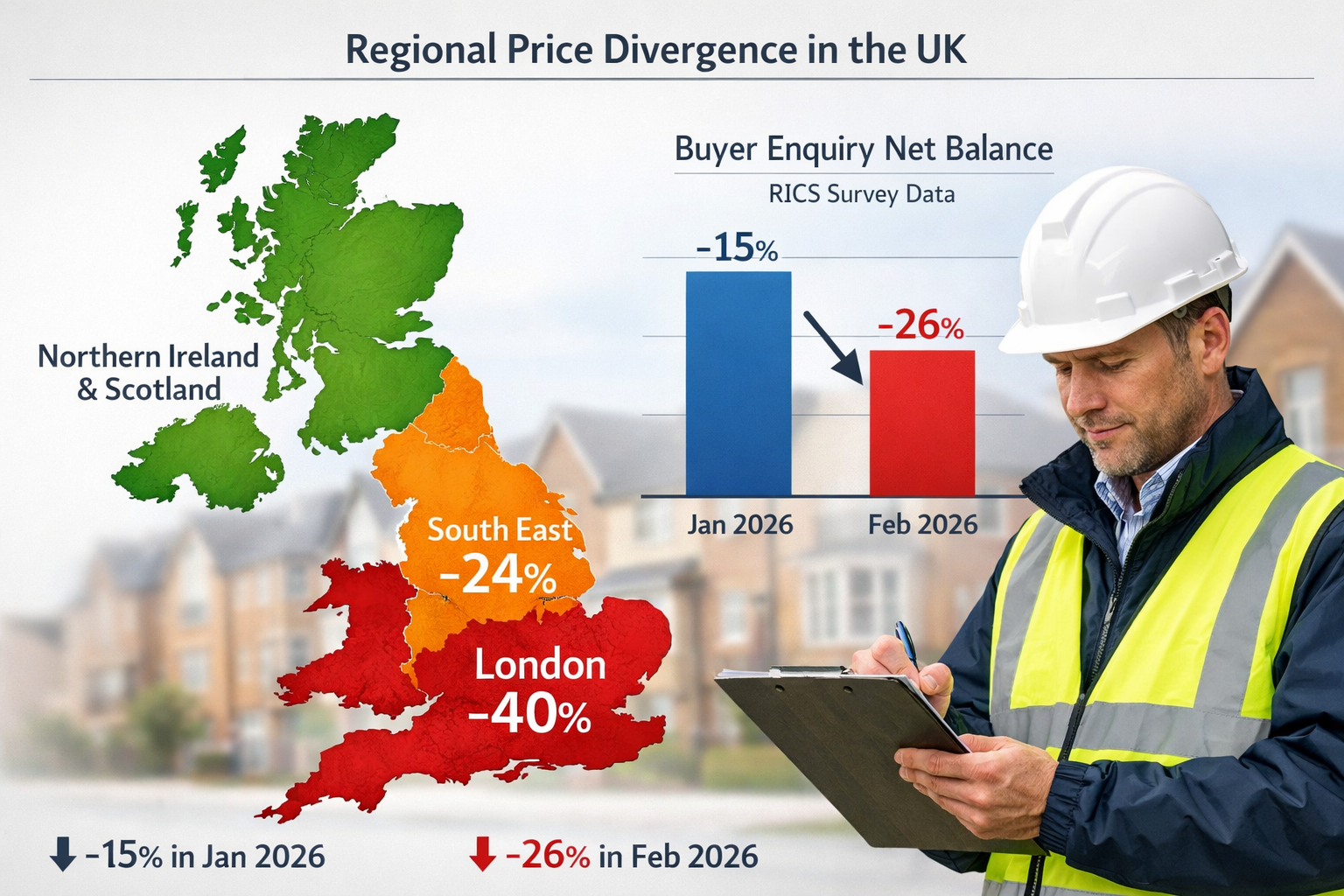
The -26% net balance for buyer enquiries in February 2026 represents a sharp acceleration from -15% in January. [1] That 11-point deterioration in a single month signals that the tentative optimism seen at the start of 2026 was fragile. More telling still, the deterioration continued aggressively into March, with buyer enquiries plummeting to -39% — the weakest reading since August 2023. [3]
💬 "Most of our clients are 'have to move' not 'want to move' amid national and international uncertainty and stagnant prices." — RICS survey respondent, March 2026 [3]
This shift from discretionary to distressed-seller-driven activity has profound implications for survey demand. Discretionary buyers commission surveys as part of a considered purchase process. Distressed or time-pressured movers may deprioritise surveys to save costs — unless surveyors make a compelling, targeted case for why a survey is non-negotiable in a volatile market.
Agreed Sales and Forward Expectations
Agreed sales weakened from -13% in February to -34% in March 2026. [3] Short-term sales expectations dropped to -33% in March from -4% in February, and the 12-month outlook deteriorated to -1% versus +17% previously anticipated. [3] The market has shifted from expecting a gradual recovery to bracing for a broadly flat period at best.
Three-month ahead price expectations fell to a dramatic -43% net balance by March, pointing to continued downward pressure on property values. [3] For surveyors, this means valuation accuracy and defect identification become more commercially critical to buyers, not less — a key message to embed in client communications.
The Regional Divergence Problem: Why a Single Strategy Fails in 2026

The national headline figures for February 2026 mask a regional story that is arguably more important for surveying firms than the aggregate data. Navigating RICS February 2026 Market Volatility: Building Survey Demand Strategies When Buyer Enquiries Drop 26% and Regional Price Divergence Widens requires a granular, location-by-location approach.
The North-South Divide in Sharp Relief
| Region | February 2026 Price Net Balance | Market Condition |
|---|---|---|
| London | -40% | 🔴 Severe pressure |
| South East | -24% | 🔴 Significant pressure |
| East Anglia | -26% | 🔴 Significant pressure |
| North West England | Positive/Stable | 🟢 Resilient |
| Scotland | Positive/Stable | 🟢 Resilient |
| Northern Ireland | Positive/Stable | 🟢 Resilient |
Source: RICS UK Residential Survey, February 2026 [1]
This divergence creates two entirely different surveying environments operating simultaneously within the same national market.
Strategy for Pressure Zones: London, South East, East Anglia
In markets where prices are falling and buyer enquiries have collapsed, surveyors face a counterintuitive opportunity: falling prices make survey findings more consequential, not less. A buyer paying close to peak value for a property in a declining market has zero margin for hidden defects. A RICS Level 3 building survey becomes a risk management tool, not just a due diligence formality.
Key messaging for pressure-zone clients:
- 🏠 "In a falling market, defects cost more proportionally" — a £15,000 structural issue is a bigger problem on a property that may lose 5% of its value in the next year.
- 🔍 Highlight the negotiation value of a detailed survey report — buyers can use findings to renegotiate price in a buyer's market.
- ⚠️ Emphasise mortgage lender requirements — as lenders tighten criteria above 5% mortgage rates, survey-backed valuations carry more weight.
For specialist defect surveys in London and the South East, the case writes itself: older housing stock combined with price pressure means buyers cannot afford to discover problems post-completion.
Strategy for Resilient Zones: Scotland, Northern Ireland, North West
In markets maintaining firmer price trends, the challenge is different. Transaction volumes may be lower nationally, but motivated buyers in these regions are still active. The priority here is speed and availability — being the surveyor who can turn around a homebuyer survey quickly when a buyer finds a property they want to proceed on.
Firms operating across South East London, Battersea, and Clapham need fundamentally different client messaging than those operating in resilient northern markets. The data demands this differentiation.
Building Survey Demand Strategies: Practical Frameworks for 2026
Navigating RICS February 2026 Market Volatility: Building Survey Demand Strategies When Buyer Enquiries Drop 26% and Regional Price Divergence Widens ultimately comes down to four operational pillars: positioning, pricing, partnerships, and pipeline diversification.

Pillar 1: Reposition the Survey as Risk Insurance, Not a Cost
The single most effective shift in a volatile market is reframing the survey from an optional expense to a mandatory risk management tool. When mortgage rates are above 5% and prices are falling in key regions, buyers are financially stretched. [3] They need to understand that a survey is not an additional cost — it is protection against a far larger potential loss.
Practical actions:
- Update website copy and client-facing materials to lead with risk language, not process language.
- Create simple cost-comparison content: "The average cost of undiscovered structural defects vs. the cost of a Level 3 survey."
- Train client-facing staff to use the RICS data as a conversation tool: "The market data shows prices are under pressure — here's why that makes a survey more important, not less."
For properties with specific concerns, a damp survey or subsidence survey can be positioned as targeted risk assessments that give buyers precise, actionable information before committing.
Pillar 2: Tiered Survey Offerings to Match Market Segments
Not all buyers in a depressed market have the same needs or budgets. A tiered offering allows surveyors to capture demand across the full spectrum:
| Survey Type | Best For | Market Positioning in 2026 |
|---|---|---|
| Level 2 Homebuyer Survey | Standard residential, newer builds | Entry point for cost-conscious buyers |
| Level 3 Building Survey | Older properties, complex structures | Essential in falling-price markets |
| Specialist Defect Survey | Specific concerns (damp, structure) | Targeted risk management tool |
| Structural Survey | High-value or non-standard properties | Premium offering for complex cases |
Communicating this tiered structure clearly — with guidance on choosing the right property survey — helps buyers self-select rather than default to no survey at all.
Pillar 3: Pipeline Diversification Through the Rental Market
The RICS February 2026 data contains one genuinely positive signal: landlord rent expectations posted a +20% net balance expecting rental price rises over the coming three months. [1] While landlord instructions remain negative (-27% net balance), the rental market is still transacting and landlords still have legal obligations. [1]
This creates demand for:
- Schedule of condition reports for new tenancies
- Dilapidation surveys at tenancy end
- Stock condition surveys for portfolio landlords managing multiple properties
Surveyors who pivot a portion of their capacity toward the rental sector during a sales slowdown can maintain revenue while the sales market recovers. This is not a permanent shift — it is a counter-cyclical buffer.
Pillar 4: Geographic Reach and Local Expertise Signalling
Supply remained broadly stable in February 2026 at +2% net balance for new instructions. [1] This means properties are still coming to market — the issue is buyer hesitation, not a lack of stock. Surveyors who can demonstrate genuine local expertise across multiple micro-markets are better positioned to capture the transactions that do proceed.
Firms with established presence across locations such as Berkshire, Essex, Bromley, and West London can serve buyers across the full range of market conditions — from the pressured London zones to the more stable commuter belt markets.
Local expertise signals that matter to buyers in 2026:
- ✅ Demonstrable knowledge of regional price trends
- ✅ Understanding of local housing stock characteristics (e.g., Victorian terraces, post-war builds)
- ✅ Familiarity with local authority requirements and planning history
- ✅ Fast turnaround times in specific postcode areas
Managing Client Expectations: The Communication Imperative
Perhaps the most underrated demand strategy in a volatile market is proactive, transparent client communication. When buyers are hesitant and prices are uncertain, the surveyor who provides clear, honest guidance becomes a trusted advisor rather than a commodity service provider.
Key communication principles for 2026:
- Lead with data — share the RICS regional findings relevant to the buyer's target area.
- Be specific about timelines — in a market where agreed sales fell from -13% to -34% in a single month, buyers need realistic expectations about completion timescales.
- Explain the survey's role in negotiation — a detailed survey report is a negotiating asset in a buyer's market.
- Avoid false reassurance — with 3-month price expectations at -43%, buyers need honest guidance, not optimistic spin. [3]
The Mortgage Rate Factor: Positioning Surveys as the Antidote to Lending Risk
Mortgage rates climbing back above 5% by March 2026 is the single most important macro driver of the current demand weakness. [3] For surveyors, this creates a specific opportunity: lenders conducting their own valuations are under pressure to be conservative. A comprehensive independent survey gives buyers leverage and information that a basic lender valuation does not provide.
The practical implication is straightforward. When a lender's valuation comes in below the agreed purchase price — increasingly common in a falling market — a detailed building survey provides the evidential basis for price renegotiation. Surveyors should make this explicit in their marketing and client conversations.
The borrowing cost argument for surveys:
- Higher mortgage rates mean higher monthly costs — buyers cannot afford post-purchase surprises.
- Conservative lender valuations create renegotiation opportunities that only a detailed survey can support.
- Lenders themselves increasingly flag survey requirements for older or non-standard properties.
Conclusion: Turning Market Volatility Into a Competitive Advantage
The February 2026 RICS data is sobering. A 26% drop in buyer enquiries, London prices at -40%, and mortgage rates above 5% would challenge any sector. But for surveyors who adapt their strategies intelligently, this volatility creates genuine competitive opportunity. [1][3]
Actionable next steps for surveying firms in 2026:
- Audit your regional exposure — map your current instruction pipeline against the RICS regional divergence data and identify where you are over-reliant on pressure zones.
- Rewrite your client-facing messaging — lead with risk management language, not process language. Use the RICS data as a credibility anchor.
- Develop a tiered survey product structure — ensure you can serve buyers across all budget levels without compromising on quality.
- Build rental sector capacity — even a 20% pivot toward condition reports and dilapidation surveys can meaningfully offset sales market slowdown.
- Invest in local expertise signalling — update location-specific content to reflect current market conditions in each area you serve.
- Train client communication protocols — every client-facing team member should be able to explain the RICS data and its implications in plain, accessible language.
The firms that treat navigating RICS February 2026 market volatility as a strategic challenge — rather than simply waiting for conditions to improve — will emerge from this period with stronger client relationships, broader service offerings, and more resilient revenue streams. The market will recover. The question is which surveying firms will be best positioned when it does.
References
[1] UK Residential Survey February 2026 – https://www.rics.org/news-insights/uk-residential-survey-february-2026
[2] UK Residential Market Survey February 2026 – https://www.rics.org/content/dam/ricsglobal/documents/market-surveys/uk-residential-market-survey/UK-Residential-Market-Survey_February-2026.pdf
[3] Housing Market Loses Momentum As Borrowing Costs Rise RICS Survey Shows – https://theintermediary.co.uk/2026/04/housing-market-loses-momentum-as-borrowing-costs-rise-rics-survey-shows/
[4] UK RICS Residential Market Survey Feb 2026 – https://www.capitaleconomics.com/publications/uk-housing-market-update/uk-rics-residential-market-survey-feb-2026
[5] Building Survey Risk Assessment In Spring 2026's Cautious Market – https://nottinghillsurveyors.com/blog/building-survey-risk-assessment-in-spring-2026s-cautious-market-adjusting-for-26-buyer-enquiry-decline-and-regional-price-divergence