Structural defects cost UK property owners an estimated £2.5 billion annually in repair bills, legal disputes, and devalued assets — yet the majority of those defects were detectable long before they became catastrophic. The discipline of defect diagnosis in building pathology sits at the sharp end of this problem, equipping chartered surveyors with the tools, methodologies, and forensic thinking needed to find hidden structural issues before they escalate into costly insurance claims or courtroom battles.
This article explores how building pathology works in practice — from the first visual inspection to the expert witness stand — and why early, rigorous diagnosis is the single most powerful lever for protecting property value and avoiding liability.
Key Takeaways 🏗️
- Building pathology is a systematic, evidence-based discipline used to diagnose the root causes of structural defects, not just their symptoms.
- Hidden defects — including moisture ingress, foundation movement, and concealed cracking — are routinely missed by basic surveys but revealed through specialist diagnostic techniques.
- Early defect diagnosis can reduce remediation costs by up to 70% compared with addressing defects after failure.
- Surveyors operating as expert witnesses rely on rigorous diagnostic records to support or defend claims in disputes and litigation.
- Choosing the right level of survey is critical — a Level 2 report will not always uncover what a full building survey can.
What Is Building Pathology and Why Does It Matter in 2026?
Building pathology is the study of how and why buildings deteriorate. Like medical pathology, it is concerned not just with identifying that something is wrong, but with understanding why it went wrong, how far the problem has progressed, and what the likely trajectory will be if left untreated.
In 2026, the discipline is evolving rapidly. The Building Pathology Conference [8] continues to bring together specialists working on material degradation mechanisms, moisture-related pathology, and defect investigation methodologies — reflecting a growing consensus that the built environment demands the same rigorous diagnostic frameworks applied in clinical settings.
💬 "The best surveyors don't just see cracks — they read them. Every crack has a story about load, movement, moisture, or time."
For property buyers, owners, and investors, this matters enormously. A defect missed at the point of purchase can become a six-figure liability within years. For lenders and insurers, undiagnosed structural issues represent hidden risk on their books.
The intersection of building pathology and legal liability is where defect diagnosis becomes especially high-stakes. When disputes arise over who is responsible for a defect — the builder, the previous owner, the surveyor, or the contractor — the quality of diagnostic evidence determines the outcome.
The Core Diagnostic Toolkit: How Surveyors Find What Others Miss
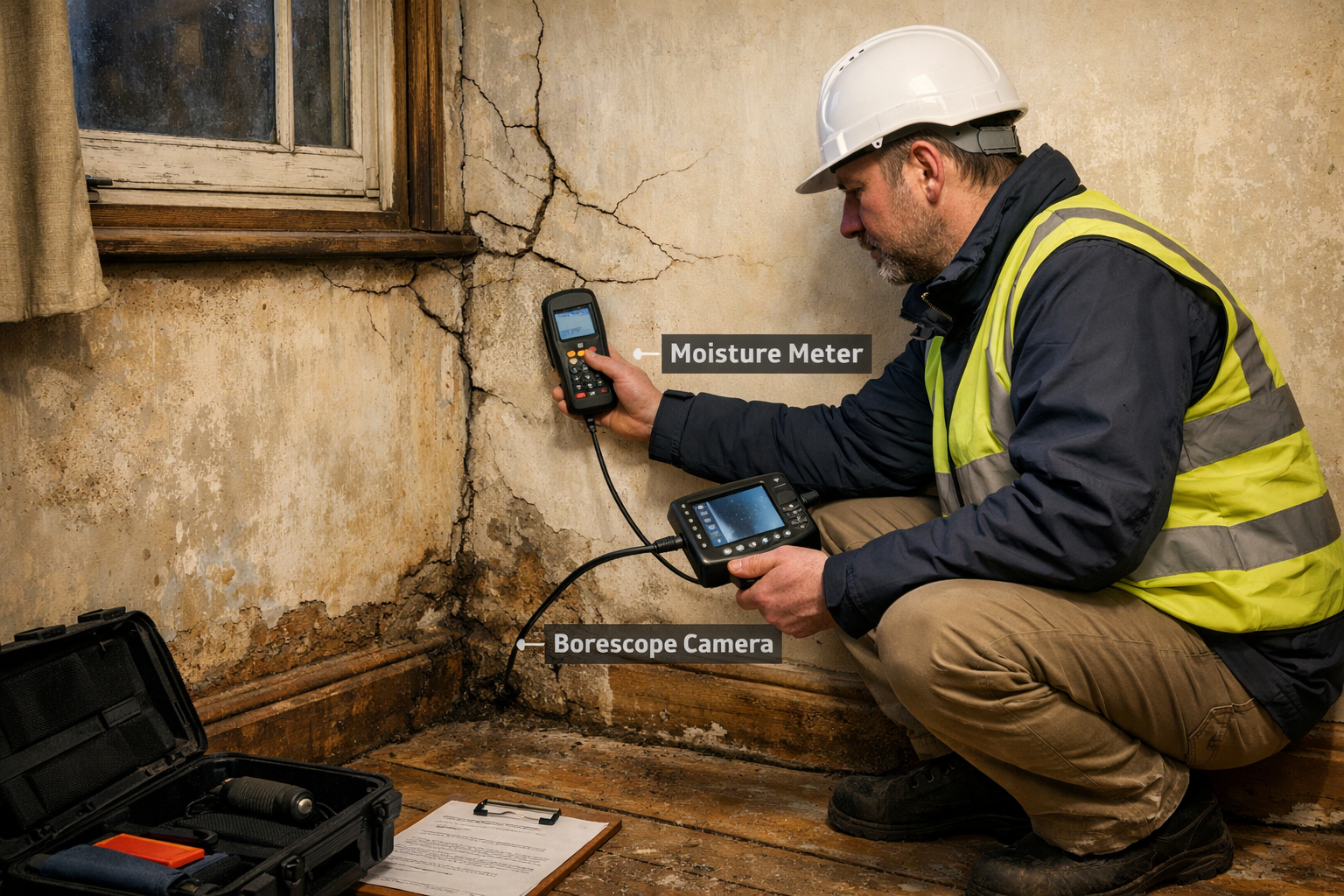
Defect diagnosis in building pathology relies on a layered approach. No single tool or technique is sufficient on its own. Experienced surveyors combine visual inspection, instrumental testing, and forensic analysis to build a complete picture.
1. Visual Inspection and Pattern Recognition
The foundation of any building pathology investigation is a thorough visual inspection. Skilled surveyors are trained to recognise crack patterns, staining, distortion, and surface irregularities that signal deeper problems.
| Crack Type | Likely Cause | Urgency |
|---|---|---|
| Diagonal stair-step cracks in brickwork | Differential settlement or subsidence | High |
| Horizontal cracks in retaining walls | Lateral soil pressure | Critical |
| Vertical cracks at corners | Thermal movement or shrinkage | Medium |
| Map cracking (crazing) on render | Carbonation or sulphate attack | Medium |
| Rust staining around fixings | Corroding embedded metalwork | High |
Pattern recognition is a skill developed over years. A surveyor conducting a full building survey will systematically assess every accessible element, from the roof structure to the subfloor, looking for these diagnostic signals.
2. Moisture Measurement and Damp Investigation
Moisture is the single most destructive agent in the built environment. It enables rot, corrosion, mould growth, and freeze-thaw damage. Yet moisture problems are frequently concealed behind finishes, within cavities, or beneath floor coverings.
Surveyors use a range of instruments:
- Protimeter moisture meters for surface and sub-surface readings
- Carbide bomb testing for accurate moisture content in masonry
- Thermal imaging cameras to detect cold bridges and moisture patterns invisible to the naked eye
- Borescopes to inspect cavities and concealed spaces without destructive opening-up
Understanding the true cost of a damp survey is often the first step for property owners who suspect a problem. Early investigation is almost always cheaper than remediation after damage has spread.
A professional damp survey distinguishes between rising damp, penetrating damp, and condensation — three conditions that look similar but require completely different treatments. Misdiagnosis here is a major source of wasted expenditure and recurring defects.
3. Structural Assessment and Movement Analysis
Where visual inspection suggests foundation movement or structural instability, surveyors escalate to more detailed structural assessment. This may include:
- Tell-tale crack monitors installed over weeks to measure active movement
- Level surveys to detect differential settlement across floor plates
- Drain surveys to identify whether leaking drains are undermining foundations — a surprisingly common cause of subsidence in older properties
A drainage survey is often the missing piece of the puzzle in subsidence investigations. Tree root intrusion and collapsed drain runs frequently cause localised soil movement that manifests as cracking in walls and ceilings above.
4. Specialist Material Testing
Some defects require laboratory analysis to confirm diagnosis. Common examples include:
- Carbonation depth testing in concrete structures
- Sulphate analysis in mortar and ground conditions
- Asbestos identification in older buildings — a legal requirement before any intrusive works
Surveyors working on pre-1980 properties routinely recommend asbestos surveys as part of the diagnostic process, both for safety and to avoid triggering contamination liability.
From Diagnosis to Documentation: The Expert Witness Dimension
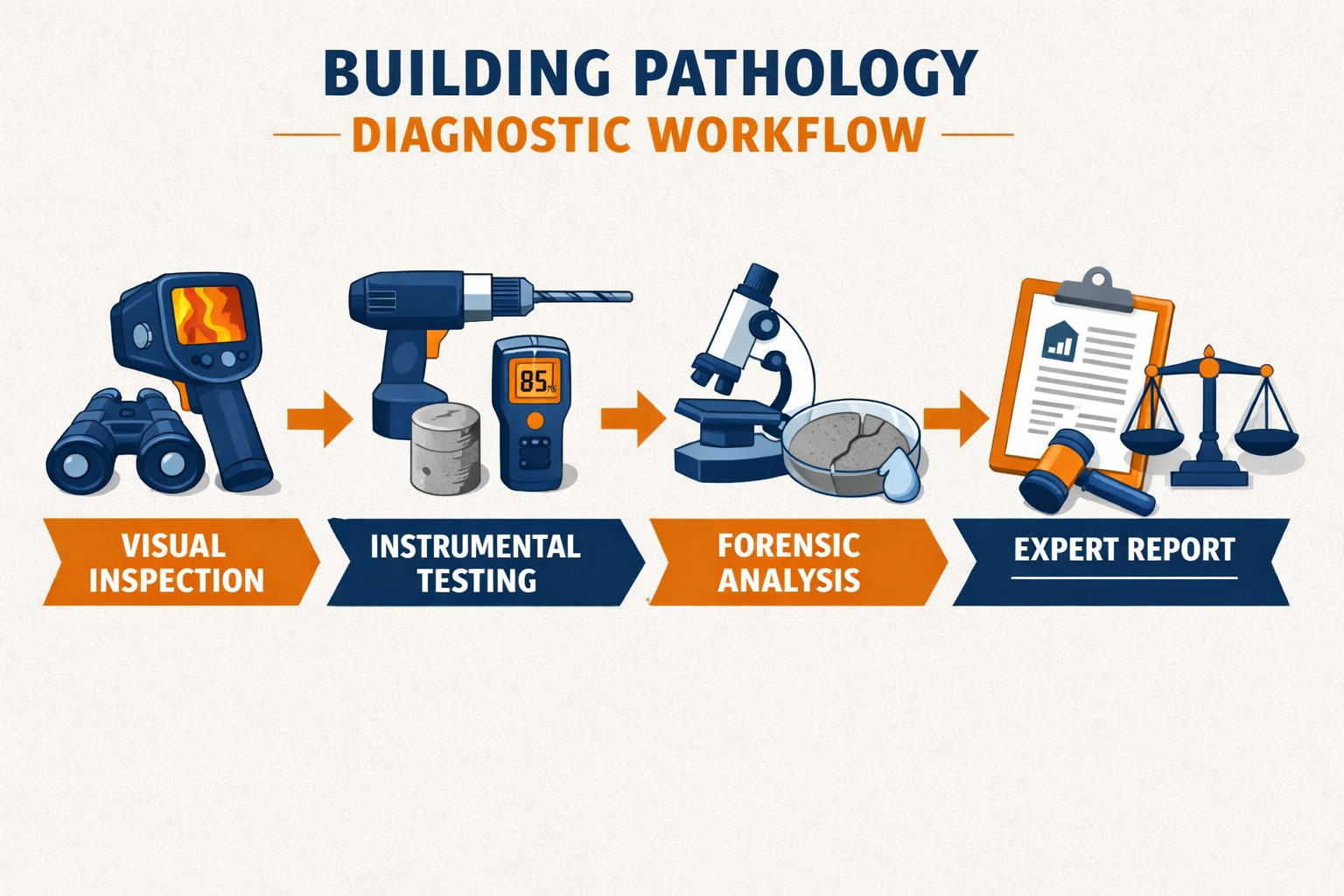
Defect diagnosis in building pathology does not end with identifying a problem. In an increasing number of cases, the diagnostic findings become legal evidence — used in insurance claims, professional negligence actions, boundary disputes, and construction litigation.
This is where the role of the expert witness surveyor becomes critical. An expert witness is not simply a surveyor who has inspected a property — they are a specialist who can present impartial, court-admissible evidence about the nature, cause, and extent of defects, and the standard of care expected of professionals involved.
What Makes Expert Witness Evidence Compelling?
Courts and arbitration panels look for several qualities in expert witness reports:
✅ Objectivity — the expert's duty is to the court, not the client who instructed them
✅ Methodological rigour — diagnosis must follow a defensible, systematic process
✅ Proportionality — findings must be calibrated to the actual evidence, not overstated
✅ Clarity — technical findings must be explained in terms a non-specialist can understand
The quality of the underlying diagnostic work directly determines the quality of the expert evidence. A surveyor who has used calibrated instruments, documented findings with photographs and readings, and followed recognised protocols will produce reports that withstand cross-examination. One who has relied on visual impression alone will not.
Common Disputes Where Building Pathology Evidence Is Decisive
- Pre-purchase survey negligence — where a buyer claims a surveyor failed to identify a defect that was present and detectable at the time of inspection
- Construction defect claims — where a contractor disputes responsibility for cracking, water ingress, or structural failure
- Insurance claim disputes — where an insurer challenges whether damage was caused by an insured event or pre-existing deterioration
- Dilapidations disputes — where landlords and tenants disagree about the condition of a property at lease end
In dilapidations cases, a schedule of dilapidations prepared by a qualified surveyor, backed by thorough diagnostic evidence, can be the difference between a fair settlement and a protracted legal battle.
Why Hidden Defects Escalate: The Pathology of Neglect
Understanding why defects remain hidden — and why they worsen — is central to the building pathology discipline.
Several mechanisms drive escalation:
🔁 The concealment problem: Modern construction and renovation practices frequently cover defects behind new finishes. A damp-proofing treatment applied over a structural crack does not fix the crack — it hides it. Future surveyors and buyers may not see what lies beneath.
⏳ The latency problem: Some defects develop slowly over years or decades. Carbonation of concrete, for example, progresses at roughly 1mm per year in sheltered conditions. A structure that appears sound today may have reinforcement at significant corrosion risk within a decade.
💸 The cost escalation curve: Research consistently shows that defect repair costs increase exponentially with delay. A crack addressed when it first appears may cost hundreds of pounds to repair. The same crack, left for five years while moisture penetrates and structural movement continues, may cost tens of thousands.
📋 The survey gap: Many buyers opt for a Level 2 HomeBuyer Survey when a full Level 3 Building Survey would be more appropriate for their property type. Understanding the difference between Level 2 and Level 3 surveys is essential for making an informed decision about the level of diagnostic scrutiny applied at purchase.
Choosing the Right Survey: A Diagnostic Framework for Property Owners
Not every property requires the same level of diagnostic investigation. The appropriate survey type depends on:
| Property Type | Age | Recommended Survey Level |
|---|---|---|
| Modern flat or new-build | Post-2000 | Level 1 Condition Report or Snagging |
| Standard semi-detached house | 1950–2000 | Level 2 HomeBuyer Survey |
| Victorian or Edwardian terrace | Pre-1920 | Level 3 Full Building Survey |
| Listed building or unusual construction | Any | Level 3 + Specialist Reports |
| Commercial property | Any | Commercial Building Survey |
For older or complex properties, a full building survey is not a luxury — it is the minimum standard of due diligence. Surveyors working in areas with specific geological or heritage challenges, such as chartered surveyors in Sussex or chartered surveyors in Surrey, bring local knowledge that is invaluable in identifying region-specific risks such as shrinkable clay soils, historic mining activity, or coastal exposure.
The Evolving Science of Building Defect Detection
The methodologies underpinning defect diagnosis in building pathology are advancing alongside broader developments in diagnostic science. The National Construction Defect Conference [3] continues to track emerging practices in defect investigation, reflecting an industry increasingly open to technology-driven approaches.
Key developments shaping the field in 2026 include:
- Drone-assisted roof and facade surveys — enabling safe, detailed inspection of elements previously accessible only by scaffold
- Ground-penetrating radar (GPR) — detecting voids, buried services, and rebar corrosion without intrusive investigation
- AI-assisted crack analysis — pattern recognition tools that can classify crack types and suggest probable causes from photographic data
- Infrared thermography — now standard practice for moisture and thermal bridge detection in energy performance assessments
These tools do not replace surveyor expertise — they extend it. The interpretation of diagnostic data still requires the professional judgement of a qualified building pathologist. Technology produces data; expertise produces diagnosis.
Conclusion: Act Early, Document Thoroughly, Dispute Less
The core message of defect diagnosis in building pathology is straightforward: problems found early are problems solved cheaply. The discipline exists to close the gap between what a building appears to be and what it actually is — and to provide the documented evidence that protects all parties when disputes arise.
For property buyers, the actionable step is clear: commission the right level of survey for the property in question, and do not allow budget pressure to substitute a basic report for a thorough investigation. For property owners, periodic inspection by a qualified surveyor is a cost-effective form of risk management. For professionals involved in construction or property management, rigorous diagnostic documentation is the foundation of defensible expert evidence.
Actionable Next Steps ✅
- Commission a full building survey on any older, unusual, or high-value property — not just a basic valuation or Level 2 report.
- Investigate moisture concerns early — a professional damp survey costs a fraction of what remediation will cost after damage has spread.
- Keep diagnostic records — photographs, readings, and reports are your evidence if a dispute arises later.
- Consult a specialist when cracks, settlement, or moisture patterns appear — do not wait for the problem to become unmistakeable.
- Engage an expert witness surveyor at the earliest sign of a legal dispute — the quality of your diagnostic evidence will shape the outcome.
Building pathology is not about finding fault — it is about finding truth. In a built environment where hidden defects routinely become costly claims, that truth is worth every penny of the diagnostic investment.
References
[3] Cd26 – https://www.perrinconferences.com/conferences/cd26/
[8] Building Pathology Conference 2026 – https://handr.co.uk/about-us/building-pathology-conference-2026/