
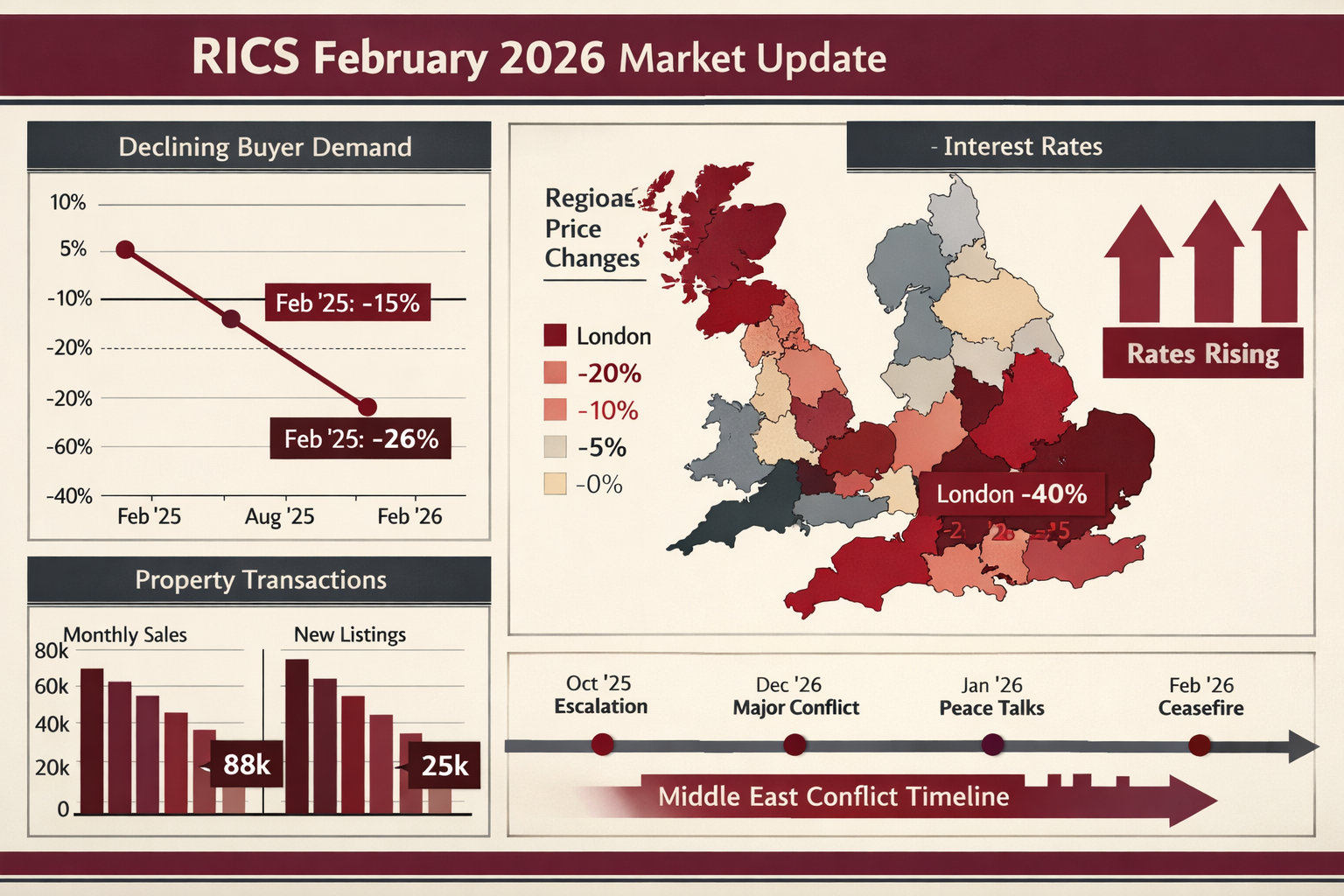
The RICS February 2026 Residential Market Survey revealed a stark reality: new buyer enquiries plummeted to a net balance of -26%, marking a sharp decline from -15% in January as Middle East conflict escalation sent shockwaves through UK property markets.[4] For expert witnesses tasked with providing defensible valuations in litigation, arbitration, and dispute resolution, this data presents both challenges and opportunities to demonstrate professional rigor in an increasingly volatile environment.
Expert Witness Valuations Under Geopolitical Uncertainty: RICS February 2026 Survey Insights for Evidence-Based Adjustments examines how valuation professionals can leverage current market intelligence to support credible, evidence-based opinions when traditional comparable analysis becomes complicated by external shocks. The intersection of geopolitical instability, buyer hesitancy, and regional market divergence demands sophisticated analytical frameworks that courts and tribunals will accept as reliable.
Key Takeaways
- Market sentiment deteriorated rapidly between January and March 2026, with buyer enquiries falling from -15% to -39% net balance, requiring expert witnesses to adjust valuation dates and comparable selection carefully
- Regional price divergence intensified, with London experiencing -40% net balance pressure while Northern Ireland and Scotland saw continued growth, necessitating location-specific adjustment methodologies
- RICS Red Book standards mandate material uncertainty clauses when geopolitical events significantly affect market conditions, providing expert witnesses with established protocols for qualifying opinions
- Evidence-based adjustments must reference specific market data from RICS surveys, transaction volumes, and interest rate trajectories to withstand cross-examination
- Expert witness credibility depends on transparent methodology that acknowledges uncertainty while providing defendable value conclusions supported by multiple analytical approaches
Understanding the February 2026 Market Context for Expert Witness Valuations
The February 2026 RICS survey data provides critical context for expert witnesses preparing valuation reports during this period. Buyer demand weakened significantly as concerns over interest rate outlook intensified, with new buyer enquiries posting a net balance of -26%, down from -15% in January.[4] This deterioration accelerated further in March, reaching -39%, the weakest reading since summer 2023.[2]
Geopolitical Factors Affecting Market Confidence
The survey explicitly noted that market momentum was "tempered by heightened geopolitical and macroeconomic uncertainty following the escalation of the conflict in the Middle East."[4] For expert witnesses, this statement provides authoritative evidence that external geopolitical events materially affected UK residential property markets during this period.
Expert witnesses must distinguish between:
- 📊 Market-wide sentiment shifts affecting all properties in a region
- 🏘️ Property-specific factors unrelated to geopolitical events
- 💷 Pricing adjustments attributable to interest rate changes versus uncertainty premiums
- 📉 Transaction volume reductions that limit comparable evidence availability
When preparing valuations for litigation involving valuation dates in early 2026, expert witnesses can cite RICS survey data as objective evidence of market conditions. This approach strengthens credibility compared to unsupported assertions about market uncertainty.
Regional Market Divergence and Adjustment Implications
The February 2026 data revealed significant regional variation in price pressure across the UK. London experienced downward pressure at -40% net balance, the South East at -24%, and East Anglia at -26%, while Northern Ireland and Scotland continued to see rising prices.[4]
| Region | Net Balance (%) | Market Characteristic |
|---|---|---|
| London | -40% | Severe downward pressure |
| South East | -24% | Moderate decline |
| East Anglia | -26% | Moderate decline |
| Northern Ireland | Positive | Continued growth |
| Scotland | Positive | Continued growth |
For expert witnesses valuing properties in different regions during this period, these divergences require location-specific comparable analysis. A valuation approach appropriate for a London property may be entirely unsuitable for a Scottish property during the same timeframe. Commercial property surveyors must apply similar regional differentiation when preparing expert witness reports.
Expert Witness Valuations Under Geopolitical Uncertainty: Applying RICS Standards and Material Uncertainty Clauses
RICS Valuation – Global Standards (the Red Book) provides specific guidance for valuations conducted under extreme or uncertain conditions. VPGA 10 of RICS Valuation – Global Standards specifically covers scenarios where material uncertainty clauses should be inserted in valuation reports.[3]
When Material Uncertainty Clauses Are Required
RICS requires material uncertainty clauses in valuation reports under extreme conditions, including war zones and natural disaster areas where "market conditions are suspended or significantly adversely affected, and comparable open-market transactions or cost information is lacking."[3]
While the February 2026 UK market did not constitute a war zone, the escalation of Middle East conflict combined with rapidly declining buyer confidence created conditions where expert witnesses should consider whether material uncertainty declarations are appropriate.
Key indicators that material uncertainty may be warranted:
- ✅ Transaction volumes fall below levels necessary for reliable comparable analysis
- ✅ Market sentiment shifts rapidly within short timeframes, making historical data less predictive
- ✅ External geopolitical events create uncertainty about future market direction
- ✅ Regional price divergence exceeds historical norms, complicating comparable selection
- ✅ Interest rate volatility creates uncertainty about buyer affordability and demand
Structuring Material Uncertainty Declarations
When expert witnesses determine that material uncertainty exists, the declaration must be specific and evidence-based. Generic statements about "market uncertainty" lack the precision required for expert witness reports subject to cross-examination.
Effective material uncertainty language includes:
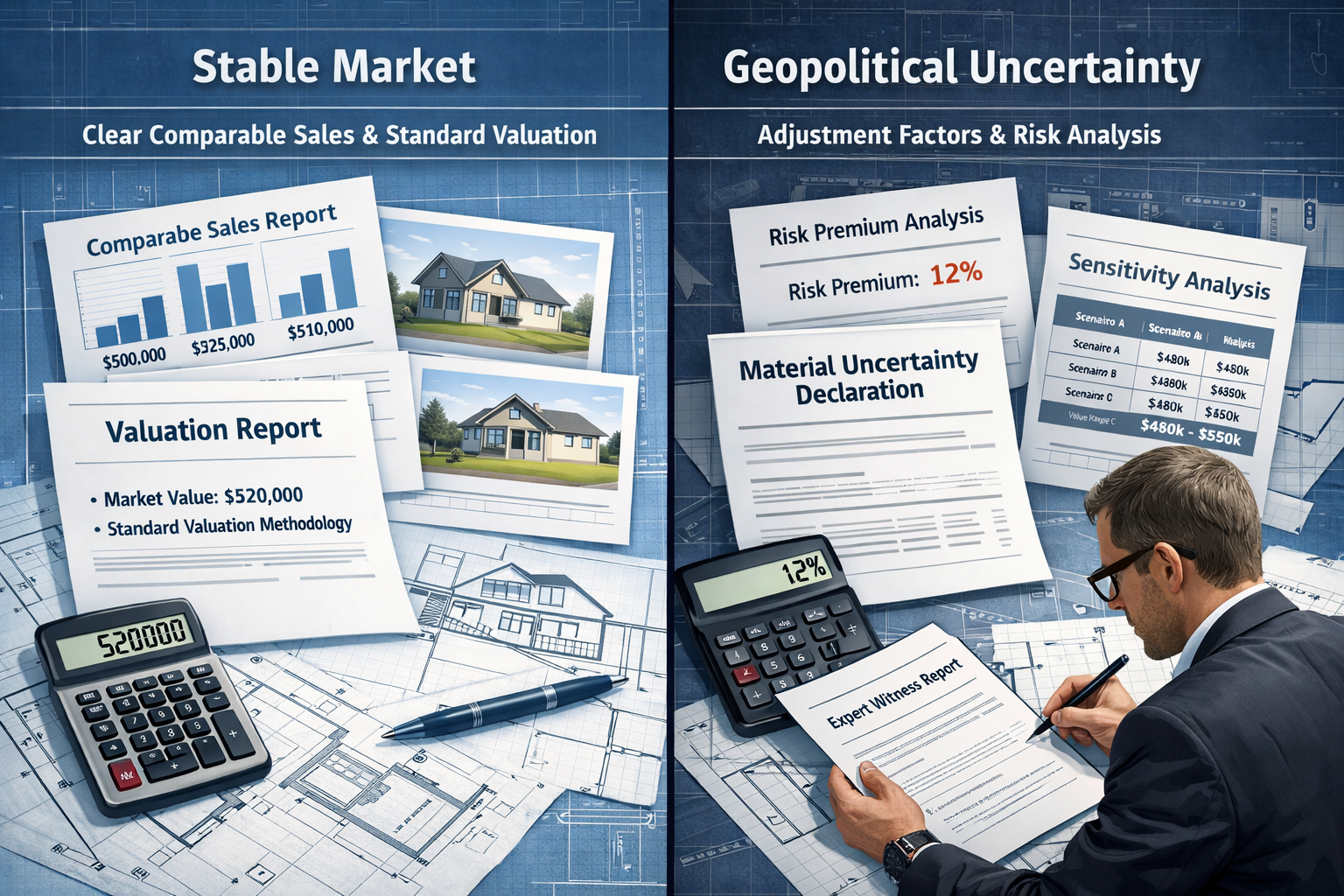
"This valuation is reported as being subject to 'material valuation uncertainty' as defined by VPS 3 and VPGA 10 of the RICS Valuation – Global Standards. Consequently, less certainty – and a higher degree of caution – should be attached to this valuation than would normally be the case. The material uncertainty arises from the significant deterioration in buyer demand (net balance of -26% in February 2026 per RICS survey data) following escalation of the Middle East conflict, combined with reduced transaction volumes limiting comparable evidence availability for the subject property type in this location."
This approach provides specific factual support for the uncertainty declaration while maintaining professional standards. Expert witnesses preparing commercial building surveys should apply similar precision when market conditions warrant uncertainty qualifications.
Evidence-Based Adjustment Methodologies for Expert Witness Valuations Under Geopolitical Uncertainty
Expert witnesses must demonstrate how geopolitical uncertainty affects specific valuation adjustments. The RICS February 2026 data provides quantitative benchmarks for evidence-based methodology.
Transaction Volume Adjustments
Agreed sales declined in February, posting a net balance of -12%, indicating reduced transaction completion momentum amid market uncertainty.[4] By March, near-term sales expectations turned significantly pessimistic, with the net balance dropping to -33% from a neutral reading of -4% in February.[2]
Expert witnesses can apply transaction volume adjustments by:
- Quantifying the reduction in comparable sales during the relevant period
- Expanding the search parameters for comparable evidence to include earlier transactions
- Applying time adjustments to older comparables to reflect market movement
- Weighting recent transactions more heavily despite limited availability
- Using multiple valuation approaches (income, cost, comparable sales) to triangulate value
When transaction volumes decline significantly, expert witnesses must expand their comparable search timeframes while applying appropriate time adjustments. A comparable sale from six months prior may be more reliable than a distressed sale completed during peak uncertainty.
Interest Rate and Affordability Adjustments
Inflationary pressures and rising borrowing costs weakened buyer demand by March 2026, with the survey noting that "intensifying inflationary pressures pushing borrowing costs higher" led to reduced market activity.[2]
Expert witnesses can quantify interest rate impacts through:
- 💰 Mortgage affordability calculations showing how rate increases affect buyer purchasing power
- 📊 Yield adjustments for investment properties reflecting higher financing costs
- 🏦 Debt service coverage ratio changes for commercial properties
- 📉 Capitalization rate increases reflecting higher required returns in uncertain environments
For example, if mortgage rates increased from 4.5% to 5.5% during the relevant period, expert witnesses can calculate the reduction in borrowing capacity for a typical buyer and adjust comparable sales prices accordingly.
Regional Risk Premium Adjustments
The stark regional divergence in the February 2026 data requires expert witnesses to apply location-specific risk adjustments. Properties in London (-40% net balance) faced materially different market conditions than properties in Scotland (positive net balance) during the same period.[4]
Regional adjustment framework:
| Adjustment Factor | High Pressure Regions (London) | Moderate Regions (South East) | Growth Regions (Scotland) |
|---|---|---|---|
| Risk Premium | +2-3% yield increase | +1-2% yield increase | No adjustment or reduction |
| Time on Market | +30-50% increase | +20-30% increase | Stable or declining |
| Negotiation Discount | 5-10% from asking | 3-5% from asking | Minimal or none |
These adjustments must be supported by specific market data rather than general assumptions. Expert witnesses should reference RICS survey data, local transaction records, and estate agent reports to substantiate regional adjustments.

Case Study Precedents: Expert Witness Valuations During Previous Geopolitical Events
Historical precedents provide valuable guidance for expert witnesses navigating the February 2026 market conditions. Previous geopolitical events offer tested methodologies that courts and tribunals have accepted.
Brexit Referendum Uncertainty (2016-2019)
The Brexit referendum created sustained market uncertainty similar to the February 2026 geopolitical environment. Expert witnesses during this period successfully applied:
- Material uncertainty clauses citing unprecedented political uncertainty
- Scenario-based valuations providing multiple value conclusions under different Brexit outcomes
- Sensitivity analysis showing value ranges based on different market assumptions
- Expanded comparable timeframes to capture pre-referendum transactions
Courts accepted these approaches when expert witnesses clearly articulated their methodology and provided transparent reasoning for adjustments.
COVID-19 Pandemic (2020-2021)
The pandemic created market disruption requiring expert witnesses to adapt valuation methodologies rapidly. Successful approaches included:
- Explicit material uncertainty declarations during lockdown periods
- Adjustment factors for properties with specific features (home offices, outdoor space) that gained premium value
- Transaction volume analysis distinguishing between distressed sales and arm's-length transactions
- Forward-looking adjustments based on emerging market trends as restrictions eased
The pandemic precedent demonstrates that expert witnesses can maintain credibility even when providing qualified opinions, provided the methodology is transparent and evidence-based.
Financial Crisis (2008-2009)
The financial crisis offers the most relevant precedent for expert witnesses dealing with the February 2026 market conditions, as both involved:
- 📉 Rapid deterioration in buyer confidence and transaction volumes
- 💷 Credit availability constraints affecting buyer purchasing power
- 🌍 External economic shocks beyond the UK property market
- 📊 Significant regional variation in market impacts
Expert witnesses during the financial crisis who provided well-reasoned, evidence-based opinions with appropriate uncertainty qualifications generally withstood cross-examination better than those who attempted to provide false precision.
Practical Strategies for Expert Witness Valuations Under Geopolitical Uncertainty
Expert witnesses preparing valuations during periods like February 2026 should adopt specific practical strategies to enhance credibility and defensibility.
Multiple Valuation Approaches
When uncertainty increases, relying on a single valuation method becomes more vulnerable to challenge. Expert witnesses should employ:
- Comparable sales approach with expanded search parameters and time adjustments
- Income capitalization approach with sensitivity analysis on yield assumptions
- Cost approach as a reasonableness check, particularly for specialized properties
- Residual valuation for development properties, with multiple scenario testing
The convergence (or divergence) of multiple approaches provides valuable evidence about valuation reliability. When different methods produce similar conclusions despite market uncertainty, this strengthens the expert witness's opinion.
Sensitivity Analysis and Value Ranges
Rather than providing a single point estimate, expert witnesses can enhance credibility by presenting sensitivity analysis showing how value changes under different assumptions:
Example sensitivity table:
| Scenario | Yield Assumption | Transaction Volume Adjustment | Resulting Value Range |
|---|---|---|---|
| Optimistic | 5.0% | -5% | £950,000 – £1,000,000 |
| Base Case | 5.5% | -10% | £900,000 – £950,000 |
| Pessimistic | 6.0% | -15% | £850,000 – £900,000 |
This approach demonstrates professional judgment while acknowledging uncertainty. Courts and tribunals often find sensitivity analysis more credible than false precision during volatile periods.
Documentation and Audit Trail
Expert witnesses must maintain comprehensive documentation of their methodology, particularly when applying adjustments for geopolitical uncertainty:
- 📁 Market data sources including RICS surveys, transaction records, and comparable evidence
- 📝 Adjustment calculations with clear explanations of each factor
- 📊 Alternative approaches considered and reasons for selection or rejection
- 🗓️ Timeline of market events affecting the valuation date
- 📧 Communications with local agents or market participants supporting market condition assessments
This documentation provides the audit trail necessary to defend the valuation under cross-examination. Expert witnesses preparing RICS building surveys should maintain similar documentation standards.
Expert Witness Valuations Under Geopolitical Uncertainty: Integration with Survey Evidence
Expert witnesses often rely on survey evidence to support their valuation opinions. The February 2026 market conditions highlight the importance of integrating survey findings with valuation methodology.
Increased Demand for Detailed Surveys
The RICS data indicated increased demand for RICS Home Surveys (Level 2 and Level 3) as buyers adopted more cautious approaches to purchases, using surveys to identify defects and support price negotiations.[1] This trend provides expert witnesses with additional evidence about market behavior during uncertain periods.
When buyers increase their reliance on detailed surveys, this suggests:
- 🔍 Higher scrutiny of property condition before commitment
- 💷 Greater willingness to negotiate based on identified defects
- ⚠️ Increased risk aversion affecting market pricing
- 📋 More comprehensive due diligence becoming market standard
Expert witnesses can reference this behavioral shift when explaining valuation adjustments for properties with identified defects or deferred maintenance. A defect that might warrant a 5% adjustment in a strong market may justify a 7-10% adjustment when buyers are highly risk-averse.
Survey Evidence Supporting Material Uncertainty
Detailed surveys can provide objective evidence supporting material uncertainty declarations. When RICS Level 3 surveys reveal significant defects or uncertainties about property condition, this reinforces the appropriateness of material uncertainty clauses in expert witness valuations.
Expert witnesses should consider:
- Structural issues requiring further investigation before accurate valuation
- Environmental concerns (contamination, flooding risk) affecting marketability
- Planning uncertainties impacting development potential
- Legal issues (boundary disputes, easements) complicating title
When survey evidence reveals these issues during periods of market uncertainty, expert witnesses have dual justification for material uncertainty declarations.
Coordinating Survey and Valuation Evidence
Expert witnesses often work alongside surveyors providing technical reports. Effective coordination ensures:
- 📊 Consistent assumptions between survey and valuation reports
- 🔗 Clear linkage between identified defects and valuation adjustments
- 📝 Complementary evidence supporting the overall expert opinion
- ⚖️ Unified presentation in litigation or arbitration proceedings
When preparing expert witness reports, consider engaging commercial building survey specialists to provide supporting technical evidence that strengthens the valuation opinion.
Preparing Expert Witness Reports: Best Practices for February 2026 Market Conditions
Expert witnesses preparing reports for valuations during the February 2026 period should follow specific best practices to enhance credibility and defensibility.
Report Structure and Content
Executive summary should clearly state:
- The valuation date and purpose
- Whether material uncertainty applies and why
- The value conclusion or range
- Key assumptions and limiting conditions
- Summary of methodology employed
Market context section should include:
- RICS survey data for the relevant period
- Regional market analysis specific to the property location
- Transaction volume trends affecting comparable availability
- Interest rate and affordability analysis
- Geopolitical factors affecting market sentiment
Valuation methodology section should detail:
- Comparable selection criteria and adjustments
- Alternative approaches employed
- Sensitivity analysis and scenario testing
- Explanation of adjustments for market uncertainty
- Reconciliation of different valuation approaches
Anticipating Cross-Examination
Expert witnesses should prepare for likely cross-examination challenges:
Challenge: "Your material uncertainty clause suggests you cannot provide a reliable valuation."
Response: "The material uncertainty declaration reflects professional standards under RICS guidelines when market conditions are affected by external events. I have provided a value conclusion based on available evidence, with the uncertainty clause ensuring transparency about the limitations of that evidence during this specific period."
Challenge: "You've relied heavily on RICS survey data rather than actual transaction evidence."
Response: "RICS survey data represents the collective experience of hundreds of practicing surveyors and provides authoritative evidence of market conditions. I have supplemented this with actual transaction data where available, but the limited transaction volumes during February 2026 (net balance of -12% for agreed sales) necessitate reliance on broader market indicators."
Challenge: "Your regional adjustments appear arbitrary."
Response: "The regional adjustments are based on specific RICS data showing London at -40% net balance compared to positive readings in Scotland. I have applied these differentials proportionately to reflect the relative market pressure in the subject property's location, supported by local transaction evidence and estate agent reports."
Preparing written responses to anticipated challenges strengthens the expert witness's position and demonstrates thorough preparation.
Valuation Adjustments for Specific Property Types Under Geopolitical Uncertainty
Different property types require tailored approaches when applying Expert Witness Valuations Under Geopolitical Uncertainty: RICS February 2026 Survey Insights for Evidence-Based Adjustments.
Residential Properties
For standard residential properties, expert witnesses should focus on:
- Buyer affordability analysis showing how interest rate changes affect purchasing power
- Time on market adjustments reflecting the -26% decline in buyer enquiries[4]
- Negotiation discount factors based on increased buyer caution
- Location-specific risk premiums reflecting regional divergence
Properties in high-pressure regions like London require more substantial adjustments than those in growth regions like Scotland.
Commercial Properties
Commercial property valuations require additional considerations:
- Tenant covenant strength becomes more critical during uncertain periods
- Lease terms and break clauses affect investment value
- Yield adjustments reflecting higher required returns
- Void period assumptions may need extension due to reduced occupier demand
Expert witnesses preparing commercial valuations should apply sector-specific analysis based on how different commercial uses (retail, office, industrial) respond to geopolitical uncertainty.
Development Properties
Development site valuations face particular challenges during uncertain periods:
- Sales rate assumptions require adjustment for reduced buyer demand
- Construction cost inflation may accelerate during geopolitical instability
- Financing costs increase with interest rate rises
- Planning risk may intensify if local authorities become more cautious
Expert witnesses should employ scenario-based residual valuations testing multiple combinations of sales rates, costs, and financing assumptions.
Investment Properties
Investment property valuations must consider:
- Yield shift analysis based on market uncertainty and financing costs
- Rental growth assumptions may require downward revision
- Tenant retention risk during economic uncertainty
- Exit strategy assumptions affecting long-term value
For properties valued on an investment basis, expert witnesses should provide explicit sensitivity analysis showing how value changes with different yield assumptions.
Ethical Considerations for Expert Witnesses During Market Uncertainty
Expert witnesses face particular ethical challenges when providing valuations during periods like February 2026.
Independence and Objectivity
The pressure to provide opinions favorable to the instructing party intensifies during uncertain periods when value ranges widen. Expert witnesses must maintain strict independence by:
- 🎯 Providing honest opinions even when unfavorable to the instructing party
- 📊 Disclosing limitations in available evidence or methodology
- ⚖️ Applying consistent methodology across different instructions
- 🚫 Refusing instructions where conflicts of interest exist
Expert witnesses who compromise independence risk professional sanctions and damage to reputation that far outweigh any short-term commercial benefits.
Transparency and Disclosure
During uncertain periods, transparency becomes paramount. Expert witnesses should:
- Clearly disclose all assumptions and limiting conditions
- Explain the rationale for material uncertainty declarations
- Provide sensitivity analysis showing value ranges
- Acknowledge alternative approaches and explain why specific methods were selected
- Disclose any information gaps or evidence limitations
Courts and tribunals value transparent acknowledgment of uncertainty over false precision that later proves indefensible.
Professional Development and Market Knowledge
Expert witnesses have an ongoing obligation to maintain current market knowledge, particularly during rapidly changing conditions. This includes:
- Regular review of RICS survey data and market reports
- Engagement with local property professionals
- Attendance at professional development events
- Review of case law involving valuation disputes during uncertain periods
- Understanding of current RICS standards and guidance
Expert witnesses who fail to maintain current knowledge risk providing outdated or inappropriate opinions that may be successfully challenged.
Conclusion
Expert Witness Valuations Under Geopolitical Uncertainty: RICS February 2026 Survey Insights for Evidence-Based Adjustments requires sophisticated analytical frameworks that balance professional rigor with appropriate acknowledgment of market limitations. The RICS February 2026 survey data provides authoritative evidence of significant market deterioration, with buyer enquiries falling to -26% net balance and regional divergence reaching extreme levels.[4]
Expert witnesses can enhance credibility by:
✅ Applying material uncertainty clauses in accordance with RICS Red Book standards when market conditions warrant
✅ Employing multiple valuation approaches to triangulate value and demonstrate methodological robustness
✅ Providing evidence-based adjustments supported by specific RICS survey data, transaction analysis, and regional market intelligence
✅ Maintaining comprehensive documentation creating a defensible audit trail for all assumptions and adjustments
✅ Presenting sensitivity analysis showing how value changes under different scenarios rather than false precision
✅ Integrating survey evidence with valuation methodology to provide comprehensive expert opinions
The February 2026 market conditions demonstrate that expert witnesses can maintain professional credibility even during periods of significant uncertainty, provided they apply transparent, evidence-based methodology and clearly communicate the limitations of their opinions.
Actionable Next Steps
For expert witnesses preparing valuations during uncertain periods:
- Review current RICS survey data to understand prevailing market conditions at the relevant valuation date
- Assess whether material uncertainty clauses are appropriate based on specific market factors
- Expand comparable search parameters to capture sufficient evidence despite reduced transaction volumes
- Prepare comprehensive sensitivity analysis showing value ranges under different assumptions
- Document methodology thoroughly to create a defensible audit trail for cross-examination
- Consider engaging specialist surveyors to provide supporting technical evidence through professional survey services
- Maintain professional development through regular review of market data and case law
- Consult RICS guidance on valuation under extreme conditions and material uncertainty requirements
For property owners, legal professionals, or parties involved in litigation requiring expert witness valuations during uncertain periods, engaging qualified chartered surveyors with demonstrable expertise in evidence-based valuation methodology ensures credible, defensible expert opinions that withstand scrutiny.
The February 2026 market conditions serve as a reminder that expert witness valuations require not only technical competence but also professional judgment, ethical integrity, and transparent communication of uncertainty. By applying the evidence-based frameworks outlined in this analysis, expert witnesses can provide valuable, credible opinions that assist courts and tribunals in reaching just decisions even during periods of significant geopolitical uncertainty.
References
[1] Uk Residential Market Survey February 2026 – https://www.navah-consulting.co.uk/news/uk-residential-market-survey-february-2026
[2] Uk Residential Market Survey March 2026 – https://www.rics.org/content/dam/ricsglobal/documents/market-surveys/uk-residential-market-survey/UK-Residential-Market-Survey-March-2026.pdf
[3] Real Estate Valuation Extreme Conditions – https://ww3.rics.org/uk/en/journals/property-journal/real-estate-valuation-extreme-conditions.html
[4] Uk Residential Market Survey February 2026 – https://www.rics.org/content/dam/ricsglobal/documents/market-surveys/uk-residential-market-survey/UK-Residential-Market-Survey_February-2026.pdf