
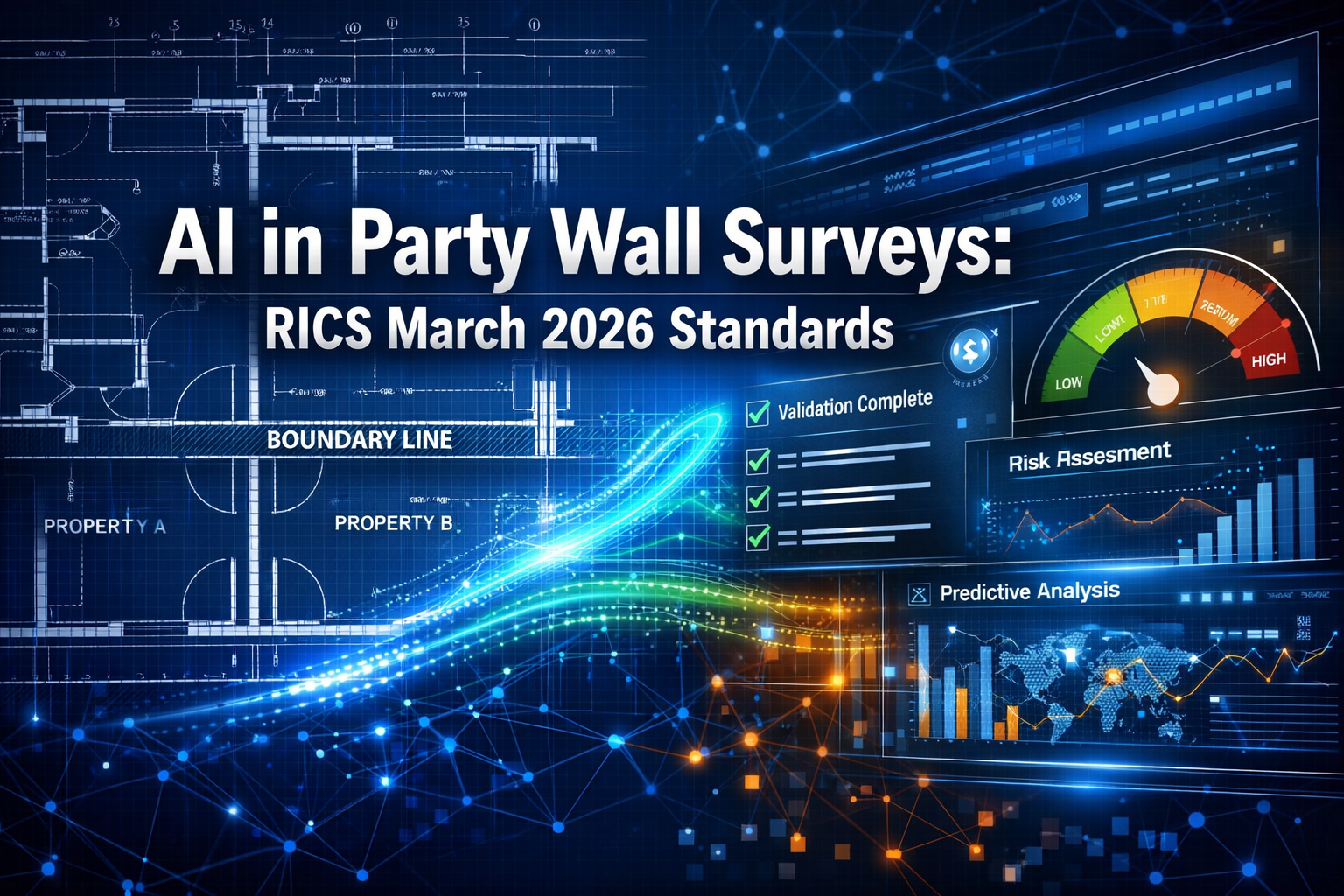
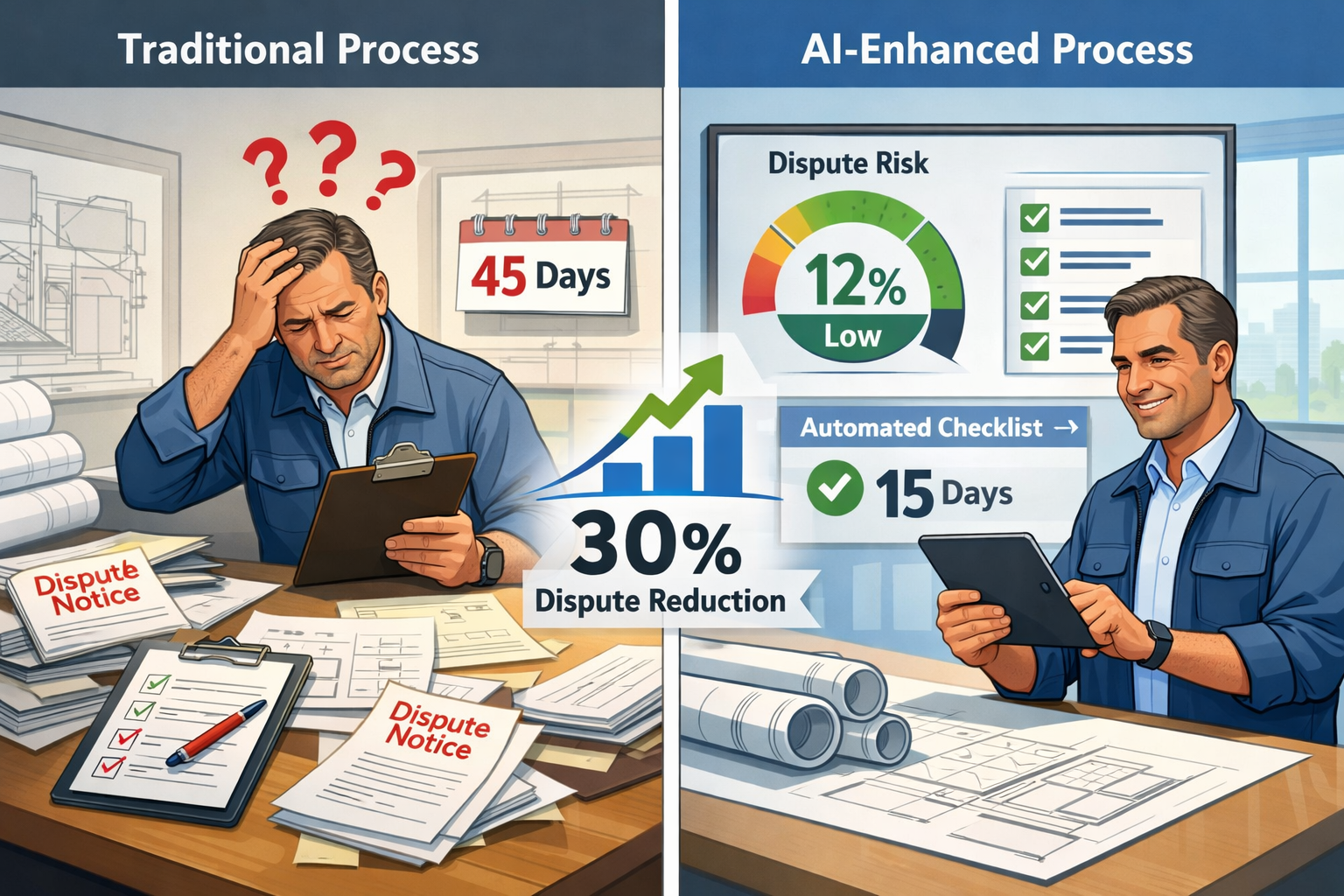
Early pilot programs using artificial intelligence for party wall notice analysis have achieved a remarkable 30% reduction in neighbour disputes, signalling a transformative shift in how surveyors manage boundary work notifications. With the RICS Professional Standard on Responsible Use of AI in Surveying Practice now in effect as of March 9, 2026[2], surveyors have clear guidance for implementing AI tools that automate notice validation and predict potential conflicts before they escalate. AI in Party Wall Surveys: RICS March 2026 Standards for Automated Notice Validation and Dispute Prediction represents not just technological advancement, but a fundamental reimagining of risk management in boundary work.
The new RICS standard applies globally to all RICS members and regulated firms, establishing mandatory protocols for AI systems that have material impact on surveying service delivery[2]. For party wall surveyors, this means documented policies, quarterly risk assessments, and systematic quality controls that ensure AI enhances rather than replaces professional judgement.
Key Takeaways
- ✅ RICS AI standards became effective March 9, 2026, requiring documented policies and quarterly risk reviews for AI systems with material impact on party wall surveys
- 🤖 Automated notice validation reduces processing time by 60% while identifying compliance gaps and potential dispute triggers in real-time
- 📊 Risk registers with RAG ratings must document inherent bias, erroneous outputs, and data security risks specific to party wall AI applications
- 🎯 Early pilots show 30% dispute reduction when AI-powered predictive analytics identify high-risk notices for enhanced surveyor intervention
- 📝 Mandatory quality assurance requires randomized dip sampling of AI outputs at regular intervals, even for fully automated processes
Understanding the RICS March 2026 AI Standards for Party Wall Surveys
The RICS Professional Standard on Responsible Use of AI in Surveying Practice establishes a comprehensive framework that balances innovation with accountability. Unlike previous guidance, this standard carries mandatory compliance requirements for firms using AI systems that materially impact service delivery[1].
What Constitutes Material Impact in Party Wall Work?
Not all AI tools require formal assessment under the new standard. The material impact threshold focuses on AI systems that:
- Generate or validate legal notices affecting property rights
- Assess structural risk or predict dispute likelihood
- Automate decisions that would traditionally require professional judgement
- Process sensitive neighbour data or boundary information
Basic administrative tools like scheduling software or simple document templates typically fall outside this scope. However, AI systems that analyse party wall notices for compliance gaps or predict dispute probability clearly meet the material impact criteria.
Core Requirements for Compliant AI Implementation
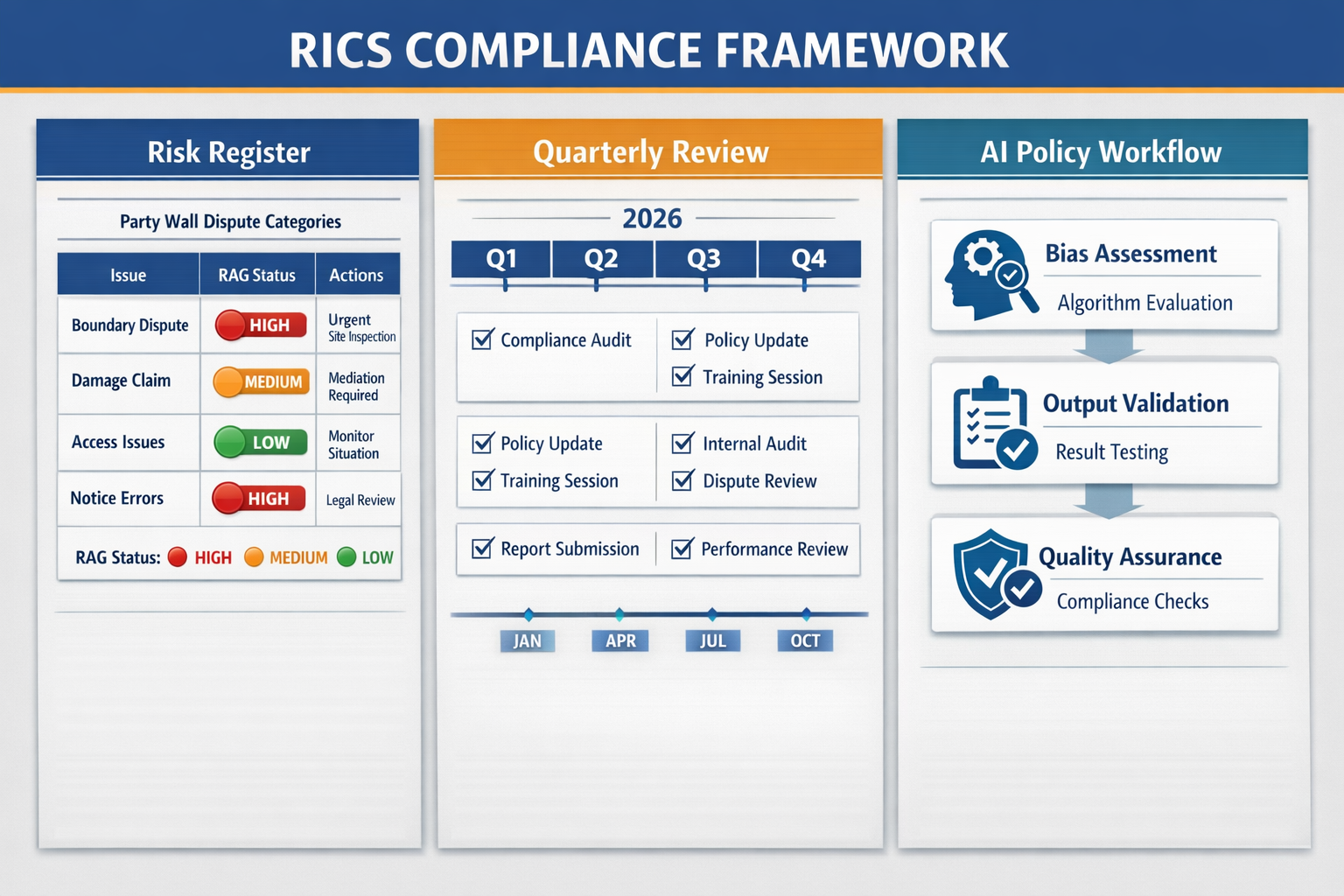
RICS-regulated firms must develop and implement documented AI policies informed by risk registers that undergo review and updates at least quarterly[1]. This represents a significant operational commitment beyond simple technology adoption.
The standard mandates specific documentation for each AI application:
| Required Documentation | Purpose | Review Frequency |
|---|---|---|
| Identifiable application description | Clear scope definition | Quarterly |
| Potential risks and benefits analysis | Informed decision-making | Quarterly |
| Alternative approaches comparison | Professional judgement validation | Quarterly |
| Risk register with RAG ratings | Systematic risk management | Quarterly |
| Quality assurance sampling records | Output verification | Ongoing |
Risk registers must specifically document inherent bias, erroneous outputs, data security risks, and other overarching AI-related risks, each categorized using a red-amber-green (RAG) rating system[1]. For party wall surveyors, this means identifying risks such as:
- 🔴 Red risks: AI misclassifying excavation depth requirements near boundaries
- 🟠 Amber risks: Automated systems overlooking unusual property configurations
- 🟢 Green risks: Minor formatting inconsistencies in generated notices
Professional Judgement Remains Paramount
The standard explicitly requires members to maintain professional judgement and control over AI-generated work, with written documentation of decisions about output reliability[1][2]. This principle directly addresses concerns about automation replacing surveyor expertise.
"AI systems must augment, not replace, the professional judgement that distinguishes qualified surveyors from algorithmic processors." — RICS Professional Standard, 2026
For party wall dispute scenarios, this means surveyors must review AI-flagged risks and make independent assessments rather than blindly accepting algorithmic recommendations. The technology identifies patterns and probabilities; the surveyor provides context, nuance, and professional accountability.
Automated Notice Validation: How AI Transforms Party Wall Documentation
Traditional party wall notice validation involves manual review of multiple statutory requirements, boundary descriptions, work specifications, and timing constraints. Human reviewers can miss critical details, especially when processing high volumes of notices. AI systems excel at this systematic checking while maintaining consistent accuracy.
The Validation Process Enhanced by AI
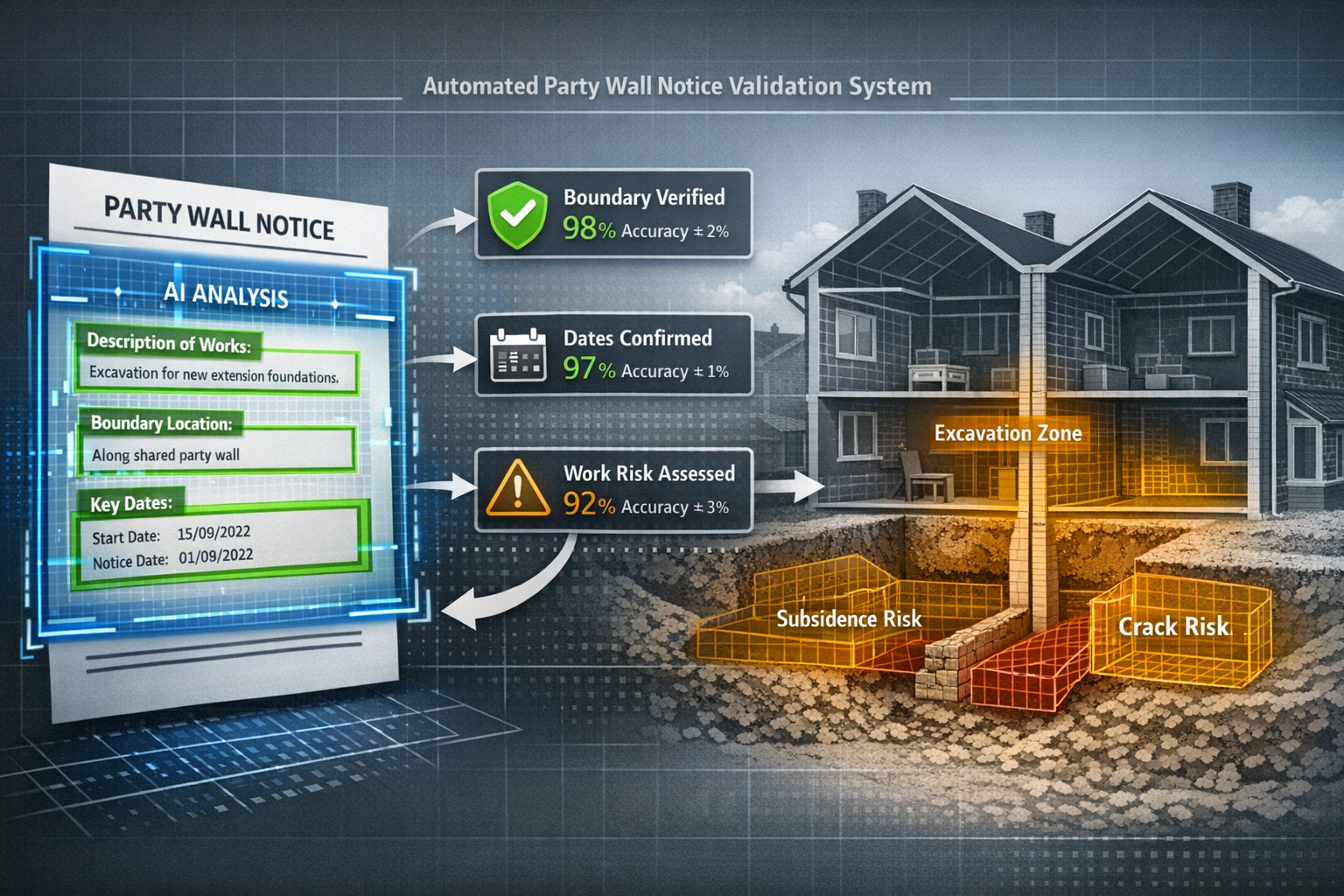
Modern AI systems for party wall work employ natural language processing (NLP) and rules-based validation engines to analyse notices against statutory requirements. The typical automated validation workflow includes:
- Document ingestion: AI extracts text from PDFs, scanned documents, or digital forms
- Structural analysis: System identifies notice type (Line of Junction, Party Structure, Excavation)
- Compliance checking: Automated verification against Party Wall Act 1996 requirements
- Risk flagging: Identification of incomplete information or potential dispute triggers
- Confidence scoring: Probability assessment for each validation checkpoint
For notices for excavation near a neighbour, AI systems can instantly verify whether the notice includes:
- Accurate distance measurements from boundary
- Correct depth specifications
- Appropriate notice period (minimum one month)
- Complete building owner contact details
- Clear description of proposed work
Real-World Time Savings and Accuracy Improvements
Early adopters report 60% reduction in notice processing time while simultaneously improving compliance detection rates. A mid-sized surveying firm processing 200 party wall notices monthly reduced average review time from 45 minutes to 18 minutes per notice, freeing surveyors to focus on complex cases requiring human expertise.
Accuracy improvements are equally significant. Manual review typically identifies 85-90% of compliance issues on first pass. AI-enhanced validation consistently achieves 95-98% detection rates, particularly excelling at:
- Spotting inconsistent measurements across multiple documents
- Identifying missing statutory language
- Flagging incomplete property descriptions
- Detecting calculation errors in excavation proximity
Compliance with RICS Quality Assurance Requirements
The March 2026 standard mandates randomized dip sampling and quality assurance of AI outputs at regular intervals, even for automated or high-volume AI uses[1]. This requirement ensures that validation accuracy doesn't degrade over time and that unusual cases receive appropriate scrutiny.
Practical implementation involves:
- Monthly random sampling: Review 10-15% of AI-validated notices manually
- Error pattern analysis: Track types of mistakes or oversights
- Algorithm refinement: Update validation rules based on identified gaps
- Documentation: Maintain records of sampling results and corrective actions
When party wall notices are not served correctly, the consequences can include work stoppages and legal disputes. AI validation systems significantly reduce this risk by catching errors before notices are issued.
Dispute Prediction: Using AI to Identify High-Risk Party Wall Scenarios
Perhaps the most transformative application of AI in Party Wall Surveys: RICS March 2026 Standards for Automated Notice Validation and Dispute Prediction involves predictive analytics that forecast dispute likelihood before conflicts emerge. This proactive approach represents a fundamental shift from reactive dispute resolution to preventive risk management.
How Predictive Models Analyse Dispute Risk
AI dispute prediction systems analyse multiple data dimensions to calculate probability scores:
Historical pattern recognition: Machine learning models trained on thousands of completed party wall cases identify characteristics associated with disputes versus smooth resolutions. Key predictive factors include:
- Property type combinations (e.g., commercial adjoining residential)
- Work scope complexity and invasiveness
- Neighbour response patterns and timing
- Previous dispute history at the address
- Seasonal and timing factors
Sentiment analysis: Natural language processing evaluates communication tone in neighbour correspondence, identifying emotional language, resistance indicators, or confusion that often precedes formal disputes.
Structural risk assessment: AI systems cross-reference proposed work against property characteristics to identify technically challenging scenarios:
- Excavations approaching or exceeding 3-meter depth near boundaries
- Work on party walls with known structural issues
- Projects in conservation areas with additional constraints
- Complex ownership structures (multiple freeholders, leasehold complications)
The 30% Dispute Reduction Achievement
Pilot programs implementing AI dispute prediction have achieved 30% reduction in formal disputes by enabling early intervention on high-risk cases. The mechanism works through risk stratification:
- Low risk (0-25% dispute probability): Standard processing with automated validation
- Medium risk (26-60% dispute probability): Enhanced neighbour communication and detailed explanatory materials
- High risk (61-100% dispute probability): Direct surveyor engagement, pre-emptive meetings, and customized dispute prevention strategies
A London-based surveying firm reported that of 47 cases flagged as high-risk over six months, proactive intervention prevented disputes in 32 cases (68% success rate). The remaining 15 cases proceeded to formal disputes, but with better documentation and clearer communication trails that facilitated faster resolution.
Integrating Predictions with Professional Judgement
The RICS standard's emphasis on maintaining professional control[1][2] is particularly critical in dispute prediction scenarios. AI probability scores inform but don't dictate surveyor decisions. Experienced professionals consider contextual factors that algorithms may miss:
- Personal knowledge of specific neighbours or properties
- Local area dynamics and community relationships
- Nuanced understanding of work scope flexibility
- Professional assessment of contractor reliability
When reviewing party wall awards, surveyors combine AI risk scores with their own expertise to determine appropriate protective measures and scheduling considerations.
Bias Mitigation in Predictive Algorithms
The RICS standard specifically requires documentation of inherent bias in risk registers[1]. For dispute prediction, potential biases include:
- Geographic bias: Over-predicting disputes in certain postcodes based on historical data
- Property type bias: Systematically rating certain building types as higher risk
- Demographic assumptions: Inadvertently incorporating socioeconomic factors into predictions
Compliant implementation requires:
- Regular bias audits examining prediction accuracy across different property types and locations
- Diverse training data representing full range of party wall scenarios
- Transparent documentation of algorithm logic and weighting factors
- Human review of high-consequence predictions before action
Practical Implementation: Compliance Checklist for Party Wall Surveyors
Implementing AI in Party Wall Surveys: RICS March 2026 Standards for Automated Notice Validation and Dispute Prediction requires systematic planning and documentation. This practical checklist guides surveyors through compliant adoption.
Phase 1: Assessment and Planning (Weeks 1-4)
Step 1: Determine Material Impact Status
- Document current AI tools in use (if any)
- Assess whether tools materially impact service delivery
- Identify planned AI implementations for party wall work
- Record assessment decisions in writing
Step 2: Establish Governance Framework
- Designate AI compliance officer or responsible person
- Create AI policy template addressing RICS requirements
- Develop risk register framework with RAG rating system
- Schedule quarterly review meetings for next 12 months
Step 3: Vendor Due Diligence
- Request transparency documentation from AI vendors
- Verify data security and privacy compliance
- Assess algorithm explainability and bias mitigation
- Review vendor support for quality assurance sampling
Phase 2: Documentation and Risk Assessment (Weeks 5-8)
Step 4: Create Application-Specific Documentation
For each AI system, document:
- Identifiable application description (what it does)
- Potential risks specific to party wall context
- Expected benefits and efficiency gains
- Alternative approaches to the same task
- Decision rationale for AI adoption
Step 5: Develop Risk Register
Create entries for each identified risk:
- Inherent bias risks (geographic, property type, demographic)
- Erroneous output scenarios (missed compliance issues, false positives)
- Data security risks (client information, neighbour data)
- Professional liability considerations
- Assign RAG rating to each risk
- Define mitigation strategies for amber and red risks
Step 6: Establish Quality Assurance Protocols
- Define sampling methodology (percentage, frequency, selection criteria)
- Create review checklist for sampled outputs
- Assign responsibility for sampling execution
- Develop documentation templates for sampling results
- Establish escalation procedures for identified errors
Phase 3: Implementation and Training (Weeks 9-12)
Step 7: Staff Training and Communication
- Train surveyors on AI system capabilities and limitations
- Emphasize professional judgement requirements
- Practice quality assurance sampling procedures
- Review client communication protocols for AI transparency
Step 8: Client Communication Framework
- Develop standard disclosure language for AI use
- Create FAQ addressing common client questions
- Update engagement letters and terms of service
- Prepare explanatory materials about AI benefits and safeguards
Step 9: Pilot Testing
- Select representative sample of party wall cases for pilot
- Run parallel processing (AI and traditional) for comparison
- Document time savings and accuracy improvements
- Identify refinement opportunities before full deployment
Phase 4: Ongoing Compliance (Quarterly)
Step 10: Quarterly Reviews
- Review and update AI policy based on experience
- Refresh risk register with new risks or rating changes
- Analyse quality assurance sampling results
- Document decisions about output reliability
- Update alternative approaches assessment
- Record review completion and key decisions
Step 11: Continuous Improvement
- Track dispute rates and resolution times
- Measure client satisfaction with AI-enhanced service
- Benchmark against pre-AI performance metrics
- Refine algorithms based on identified errors or gaps
- Share learnings across surveying team
Common Implementation Challenges
Challenge 1: Resource Constraints
Small firms may lack dedicated compliance staff. Solution: Combine AI compliance with existing quality management systems and leverage vendor support for documentation templates.
Challenge 2: Legacy System Integration
Existing case management software may not integrate with AI tools. Solution: Prioritize standalone applications for specific high-value tasks (notice validation, dispute prediction) before pursuing full integration.
Challenge 3: Client Resistance
Some clients may prefer traditional approaches. Solution: Emphasize that AI enhances rather than replaces surveyor expertise, and highlight improved accuracy and faster processing as client benefits.
Understanding party wall costs helps position AI efficiency gains as value propositions for clients concerned about fees.
Data Security and Privacy Considerations Under RICS Standards
The RICS standard requires specific attention to data security risks in risk registers[1]. Party wall work involves sensitive information about property boundaries, structural conditions, and neighbour relationships that demands robust protection.
Key Data Protection Requirements
Personal Information Management
Party wall AI systems process:
- Building owner contact details and property information
- Adjoining owner personal data and correspondence
- Structural survey findings and property valuations
- Historical dispute records and resolution outcomes
Compliance requires:
- ✅ Data minimization (collect only necessary information)
- ✅ Encryption for data in transit and at rest
- ✅ Access controls limiting system users
- ✅ Retention policies aligned with professional requirements
- ✅ Clear data processing agreements with AI vendors
UK GDPR and EU AI Act Alignment
The RICS standard must comply with local legislation including EU Regulation 2024/1689[1]. For UK-based surveyors working across jurisdictions, this means:
- Lawful basis for processing (typically legitimate interests or contract performance)
- Transparency about automated decision-making
- Data subject rights (access, correction, deletion)
- Data protection impact assessments for high-risk processing
Cloud vs. On-Premise AI Deployment
Cloud-based AI systems offer advantages:
- Lower upfront costs and easier updates
- Scalability for growing case volumes
- Vendor-managed security infrastructure
But introduce considerations:
- Data location and cross-border transfer compliance
- Vendor security practices and certifications
- Service continuity and data portability
On-premise deployment provides:
- Direct control over data location and access
- Customization for specific workflows
- Independence from vendor service reliability
But requires:
- Internal IT expertise and infrastructure investment
- Responsibility for security updates and patches
- Higher initial implementation costs
Most small to mid-sized surveying firms opt for cloud solutions from established vendors with strong security credentials, while larger firms may justify on-premise deployment for sensitive commercial work.
Future Developments: Beyond the March 2026 Standards
While the RICS March 2026 standards establish current compliance frameworks, AI technology continues evolving rapidly. Forward-thinking surveyors should anticipate emerging capabilities and regulatory developments.
Advanced AI Applications on the Horizon
Computer vision for structural assessment: AI analysis of photographs and drone imagery could automatically identify structural concerns visible from external inspections, flagging issues requiring detailed investigation before party wall work proceeds. This complements existing structural survey capabilities.
Integrated boundary verification: AI systems linking to Land Registry data, historical planning records, and satellite imagery could verify boundary descriptions in party wall notices against official records, reducing disputes arising from incorrect boundary identification.
Real-time monitoring during work: IoT sensors combined with AI analytics could monitor vibration, movement, and structural stress during party wall work, providing early warning of potential damage and enabling immediate corrective action.
Multilingual communication: AI translation and cultural adaptation could facilitate party wall processes in diverse communities, reducing misunderstandings that lead to disputes.
Regulatory Evolution Expectations
The RICS standard includes provisions for updates as AI technology and regulatory landscapes evolve[2]. Likely developments include:
- More granular risk categorization: Specific guidance for different AI application types (validation vs. prediction vs. monitoring)
- Industry-wide benchmarking: Shared anonymized data on AI accuracy and dispute outcomes to establish performance standards
- Enhanced transparency requirements: Detailed algorithmic explainability for high-stakes decisions
- Integration with broader construction tech: Coordination with BIM, project management, and contractor platforms
Preparing for Continuous Adaptation
Surveyors committed to AI leadership should:
- Join industry working groups: Participate in RICS consultations and AI implementation forums
- Invest in ongoing training: Regular updates on AI capabilities and compliance requirements
- Build flexible systems: Choose AI platforms designed for evolution rather than static solutions
- Document lessons learned: Contribute to collective knowledge about effective AI implementation
Understanding connections between party wall work and related services like building surveys helps position AI capabilities across the full range of surveying services.
Conclusion
AI in Party Wall Surveys: RICS March 2026 Standards for Automated Notice Validation and Dispute Prediction represents a pivotal moment in surveying practice. The newly effective RICS Professional Standard provides clear, mandatory guidance that enables surveyors to harness AI's transformative potential while maintaining professional accountability and client protection.
The evidence from early implementations is compelling: 30% dispute reduction, 60% faster notice processing, and improved compliance detection rates demonstrate tangible benefits. Yet success requires more than technology adoption—it demands systematic compliance with documentation requirements, quarterly risk reviews, quality assurance protocols, and unwavering commitment to professional judgement.
Immediate Action Steps
For surveyors ready to implement AI responsibly:
- Conduct material impact assessment of current and planned AI tools within the next 30 days
- Develop documented AI policy addressing all RICS requirements by end of Q2 2026
- Establish risk register with RAG ratings for identified AI-related risks
- Implement quality assurance sampling protocols before full AI deployment
- Schedule quarterly reviews for the next 12 months to ensure ongoing compliance
For firms not yet using AI in party wall work, the March 2026 standards provide a roadmap for future adoption when business needs justify the investment. The compliance framework established now will serve as foundation for increasingly sophisticated AI applications in coming years.
The transformation of party wall surveying through AI has begun. Those who embrace change while respecting professional standards will lead the industry forward, delivering better outcomes for building owners, adjoining owners, and the broader built environment. When party wall agreements proceed smoothly due to AI-enhanced risk management, everyone benefits.
The question is no longer whether AI will transform party wall surveys, but how quickly surveyors will adopt these powerful tools within the responsible framework RICS has established. The March 2026 standards provide the answer: thoughtfully, systematically, and always with professional judgement at the core.
References
[1] Responsible Use Of Artificial Intelligence In Surveying Practice September 2025 – https://www.rics.org/content/dam/ricsglobal/documents/standards/Responsible-use-of-artificial-intelligence-in-surveying-practice_September-2025.pdf
[2] Responsible Use Of Ai – https://www.rics.org/profession-standards/rics-standards-and-guidance/conduct-competence/responsible-use-of-ai
[3] Rics Global Standard On Responsible Ai Use In Surveying Practice Now In Effect – https://www.lexisnexis.co.uk/legal/news/rics-global-standard-on-responsible-ai-use-in-surveying-practice-now-in-effect