
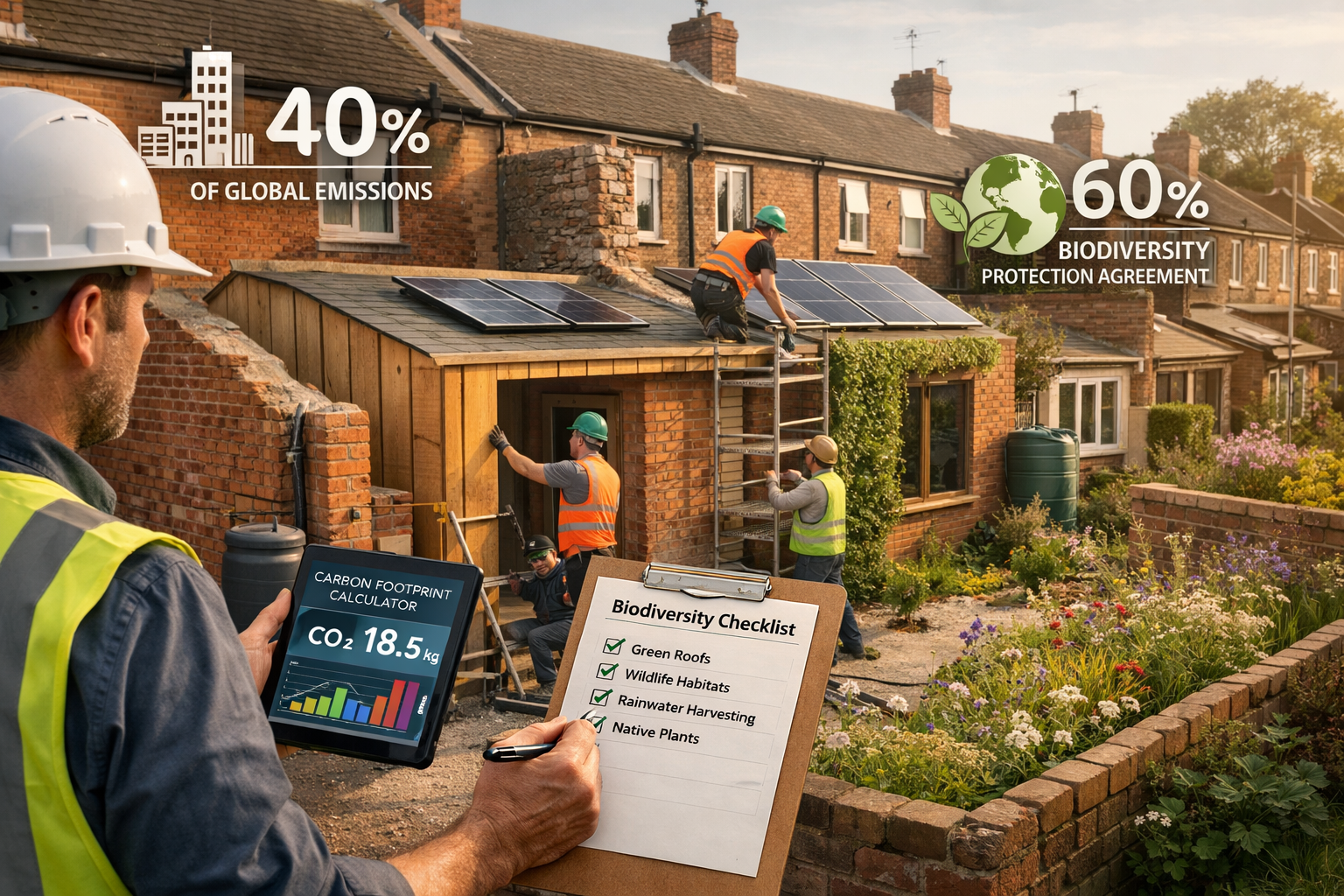
The construction industry faces a stark reality: 46% of professionals still do not measure embodied carbon on projects, even as buildings account for nearly 40% of global carbon emissions [1]. This alarming statistic from the RICS Sustainability Report 2025 has triggered a fundamental shift in how party wall surveyors approach extension projects in 2026. Party Wall Awards Incorporating RICS Sustainability Report 2025: Carbon and Biodiversity Checks for 2026 Extensions represent the new standard for responsible construction practice, merging traditional boundary rights with urgent environmental accountability.
The integration of sustainability metrics into party wall procedures marks a watershed moment for UK property development. Surveyors now balance neighbour protection with planetary protection, transforming routine party wall awards into comprehensive environmental audits that assess carbon footprints and biodiversity impacts alongside structural safety.
Key Takeaways
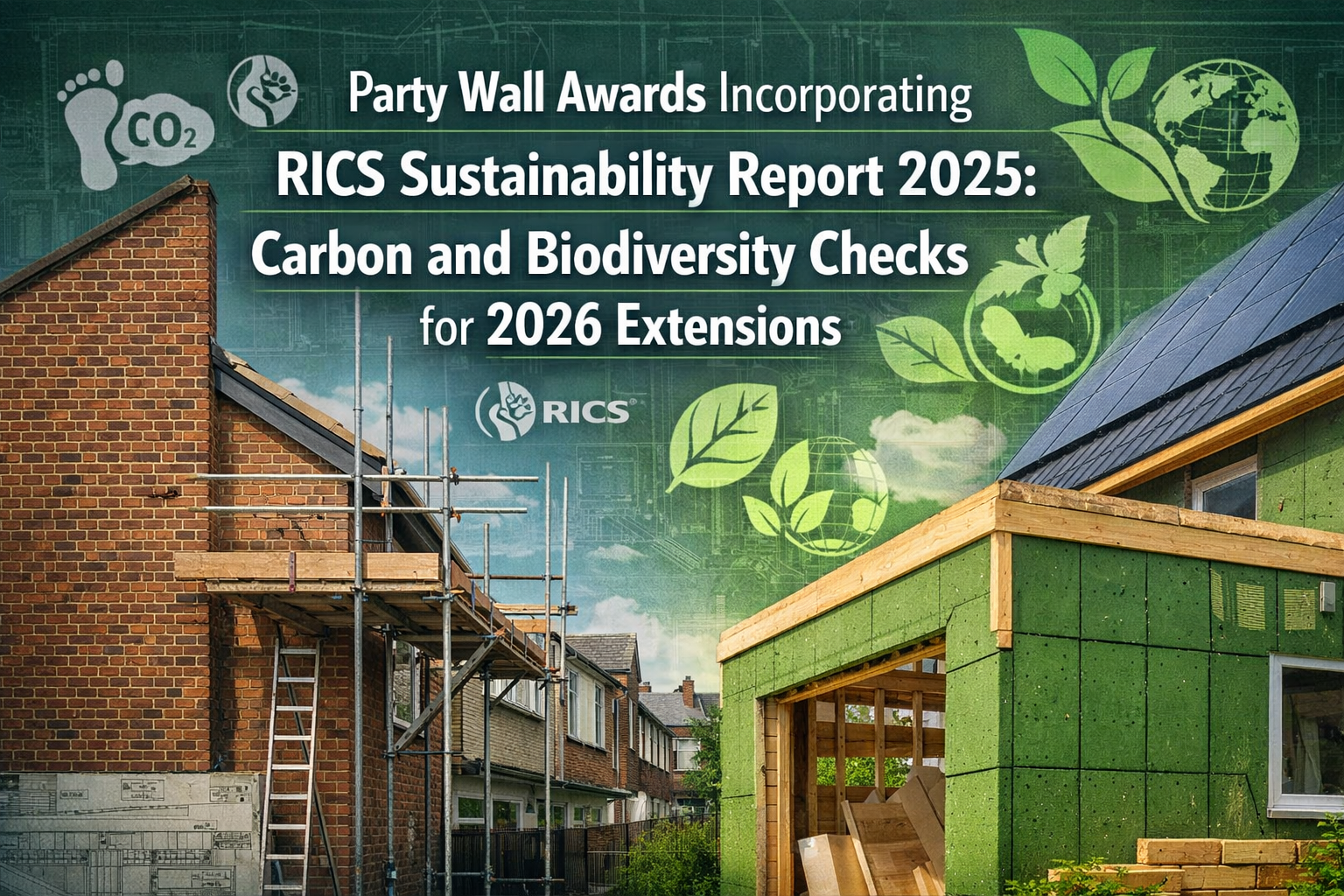
- 46% of construction professionals fail to measure embodied carbon, creating urgent need for mandatory sustainability checks in party wall awards [1]
- 60% of surveyed professionals agree biodiversity protection is critical, driving new ecological assessments for 2026 extension projects [1]
- Party wall surveyors now integrate carbon audits and biodiversity checks into standard award procedures following RICS 2025 guidance
- Buildings contribute 40% of global emissions, making sustainable extension practices essential for climate targets [3]
- New 2026 compliance frameworks require documented environmental impact assessments alongside traditional party wall schedules
Understanding the RICS Sustainability Report 2025 Framework
The Royal Institution of Chartered Surveyors published its comprehensive Sustainability Report 2025 on November 10, 2025, surveying over 3,500 global professionals across 36 countries [1]. This landmark research exposed critical gaps in construction sustainability practices while establishing new benchmarks for professional responsibility.
Key Findings Reshaping Party Wall Practice
The report revealed troubling trends that directly impact how surveyors approach extension projects:
Carbon Measurement Crisis 📊
- 46% of professionals do not measure embodied carbon, up from 34% in 2024 [1]
- Lack of standardized measurement tools cited as primary barrier
- Growing regulatory pressure for mandatory carbon accounting
- Insurance implications for projects without environmental documentation
Biodiversity Awareness Gap 🌿
- 60% recognize biodiversity protection as critical [1]
- Limited practical implementation frameworks available
- Increasing legal requirements for ecological impact assessments
- Neighbour concerns about habitat destruction during construction
Regulatory Momentum
The report's findings have accelerated policy changes across the UK construction sector. Local planning authorities now frequently require sustainability statements for extensions, particularly those involving excavation near a neighbour or significant structural modifications.
Why This Matters for Party Wall Awards
Traditional party wall awards focused exclusively on:
- Structural integrity and safety
- Protection of adjoining owner's property
- Schedule of condition documentation
- Construction methodology and access rights
Party Wall Awards Incorporating RICS Sustainability Report 2025: Carbon and Biodiversity Checks for 2026 Extensions now expand these parameters to include:
| Traditional Elements | New Sustainability Elements |
|---|---|
| Structural calculations | Embodied carbon assessments |
| Party wall condition survey | Biodiversity impact evaluation |
| Construction methodology | Low-carbon material specifications |
| Damage prevention protocols | Habitat protection measures |
| Access arrangements | Waste reduction strategies |
Carbon Audits in 2026 Extension Projects
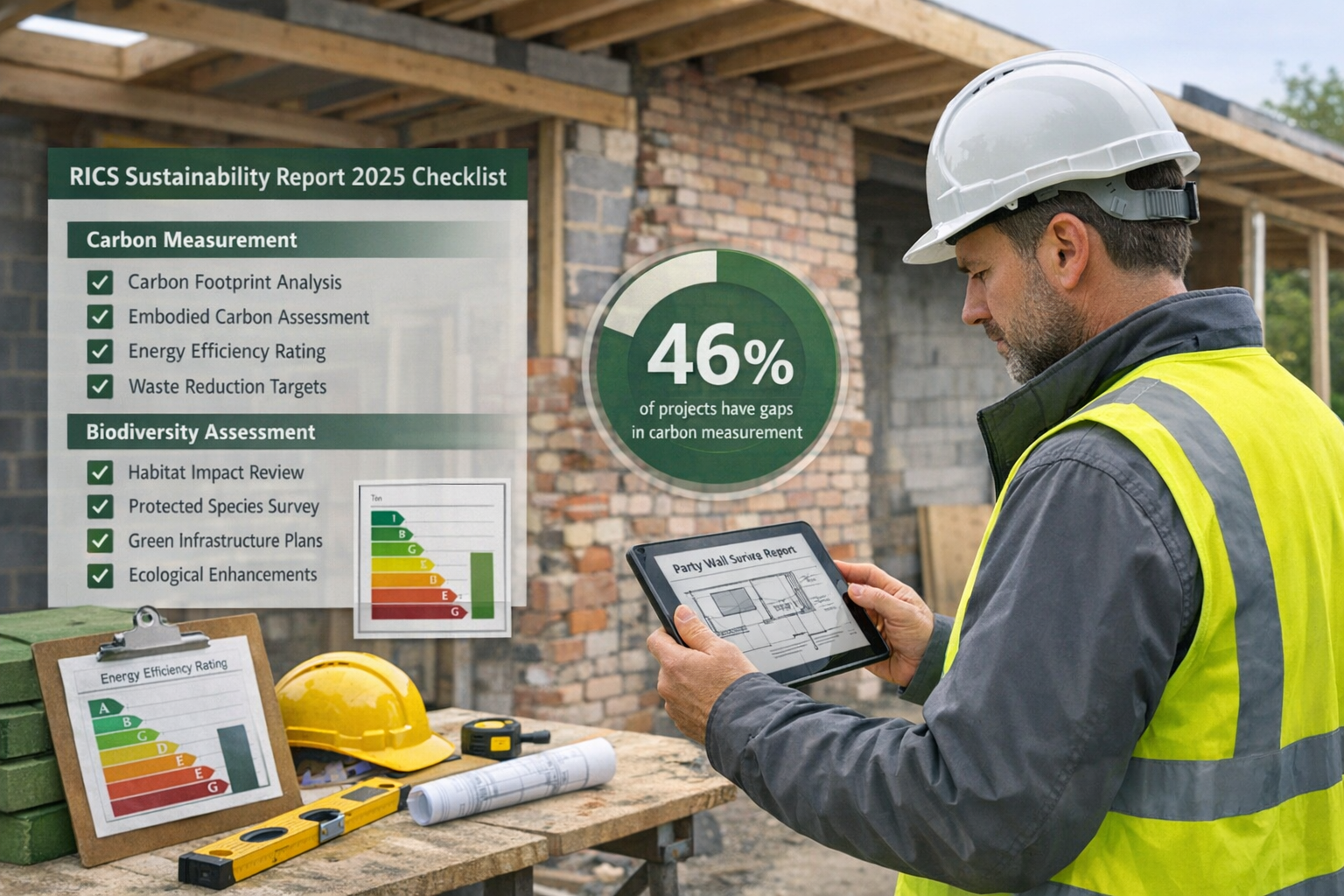
The integration of carbon auditing into party wall procedures represents the most significant practical change for building owners and surveyors in 2026. Understanding embodied carbon—the total greenhouse gas emissions from material extraction, manufacturing, transportation, and construction—has become essential for compliant extension projects.
What Carbon Checks Involve
Material Selection Analysis 🏗️
Surveyors now evaluate construction materials based on carbon intensity:
- Concrete alternatives: Hempcrete, lime-based mortars, recycled aggregates
- Timber sourcing: FSC-certified wood with documented carbon sequestration
- Insulation choices: Natural materials versus petroleum-based products
- Steel specifications: Recycled content percentages and production methods
Calculation Methodologies
Professional surveyors use standardized tools to quantify embodied carbon:
- Material quantity takeoffs from architectural drawings
- Carbon coefficient application using RICS-approved databases
- Transportation impact assessment based on supplier locations
- Construction process emissions including equipment and waste
- Whole-life carbon projections for 60-year building lifespan
Practical Implementation in Party Wall Awards
When preparing awards for extension projects, surveyors now include dedicated carbon assessment sections:
Baseline Carbon Audit
- Document existing structure's embodied carbon
- Establish pre-construction environmental baseline
- Identify opportunities for carbon reduction
- Compare proposed materials against low-carbon alternatives
Mitigation Strategies
The award specifies binding commitments:
- Minimum percentages of recycled materials
- Local sourcing requirements to reduce transportation emissions
- Waste management protocols with recycling targets
- Energy-efficient construction equipment specifications
Monitoring and Verification
Unlike traditional awards that end at project completion, sustainability-integrated awards require:
- Regular carbon accounting updates during construction
- Third-party verification of material specifications
- Post-completion carbon performance reporting
- Integration with building control sustainability submissions
Common Challenges and Solutions
Challenge: Increased project costs for low-carbon materials
Solution: Life-cycle cost analysis demonstrating long-term savings through energy efficiency and potential carbon tax avoidance
Challenge: Limited availability of carbon data for traditional building materials
Solution: Conservative estimation using industry databases, with provisions for updates as better data emerges
Challenge: Neighbour concerns about experimental "green" materials
Solution: Enhanced communication protocols within party wall process, including educational materials about proven sustainable alternatives
For projects involving consent for party wall work, building owners must now demonstrate sustainability considerations alongside traditional structural safety documentation.
Biodiversity Checks for Extension Projects
The RICS Sustainability Report 2025 highlighted that 60% of professionals recognize biodiversity protection as critical [1], yet practical implementation frameworks remain underdeveloped. Party Wall Awards Incorporating RICS Sustainability Report 2025: Carbon and Biodiversity Checks for 2026 Extensions address this gap by establishing mandatory ecological assessments for construction projects.
Understanding Biodiversity Impact
Urban and suburban extensions affect local ecosystems more significantly than most property owners realize:
Habitat Disruption 🦎
- Demolition of walls hosting invertebrate populations
- Removal of climbing plants providing pollinator resources
- Disturbance of nesting birds during construction periods
- Soil compaction affecting underground ecosystems
Cumulative Effects
Individual extensions may seem insignificant, but collective impact across neighbourhoods creates substantial biodiversity loss. Party wall surveyors now consider:
- Existing ecological corridors between properties
- Native species present in gardens and boundary structures
- Water drainage patterns affecting local habitats
- Light pollution from new structures
Biodiversity Assessment Protocol
Pre-Construction Ecological Survey
Professional ecologists work alongside party wall surveyors to document:
-
Protected Species Checks
- Bat roost surveys for roof and wall cavities
- Nesting bird assessments (seasonal restrictions apply)
- Great crested newt presence in excavation zones
- Reptile surveys for garden clearance areas
-
Habitat Mapping
- Native plant species inventory
- Mature tree assessment and root protection zones
- Hedgerow quality evaluation
- Soil biodiversity indicators
-
Neighbour Property Considerations
- Shared gardens and boundary plantings
- Wildlife corridors crossing property lines
- Existing biodiversity enhancement features
- Ecological connectivity between adjoining properties
Integration with Party Wall Awards
The biodiversity assessment feeds directly into award specifications:
Timing Restrictions ⏰
- Construction windows avoiding bird nesting season (March-August)
- Bat activity periods requiring modified working hours
- Seasonal planting requirements for habitat restoration
Protective Measures
Awards now mandate:
- Tree protection zones with physical barriers
- Hedgerow retention where structurally feasible
- Soil preservation protocols for replanting
- Wildlife-friendly fencing specifications
Enhancement Requirements
Forward-thinking awards include biodiversity net gain provisions:
- Swift bricks and bat boxes integrated into new structures
- Green roofs on single-storey extensions
- Native plant species in landscaping plans
- Permeable paving to maintain drainage patterns
Case Study: Terraced House Extension
A typical 2026 rear extension project demonstrates integrated biodiversity checks:
Project: Two-storey extension on Victorian terraced house
Party Wall Implications: Work to party wall, excavation within three meters of neighbour's foundation
Biodiversity Assessment Findings:
- Mature ivy on party wall hosting nesting birds
- Established hedgerow along boundary
- Bat foraging route through rear gardens
- Native wildflower patch in excavation area
Award Provisions:
- Construction delayed until September (post-nesting season)
- Ivy carefully relocated to new wall structure
- Hedgerow protected with 2-meter buffer zone
- Wildflower seeds harvested and replanted post-construction
- Three swift bricks installed in new extension wall
- Green roof with sedum species on single-storey element
Neighbour Benefits:
The adjoining owner appreciated enhanced biodiversity provisions, reducing potential party wall disputes and creating shared ecological value.
Regulatory Context
Local planning authorities increasingly require biodiversity net gain assessments, particularly following the Environment Act 2021 implementation. Party wall surveyors who proactively integrate these checks help building owners:
- Avoid planning application delays
- Demonstrate environmental responsibility
- Reduce risk of enforcement action
- Enhance property value through ecological features
For projects where party wall notice was not served initially, retrospective sustainability assessments become more complex and costly, emphasizing the importance of early integration.
Practical Implementation: The 2026 Party Wall Award Process
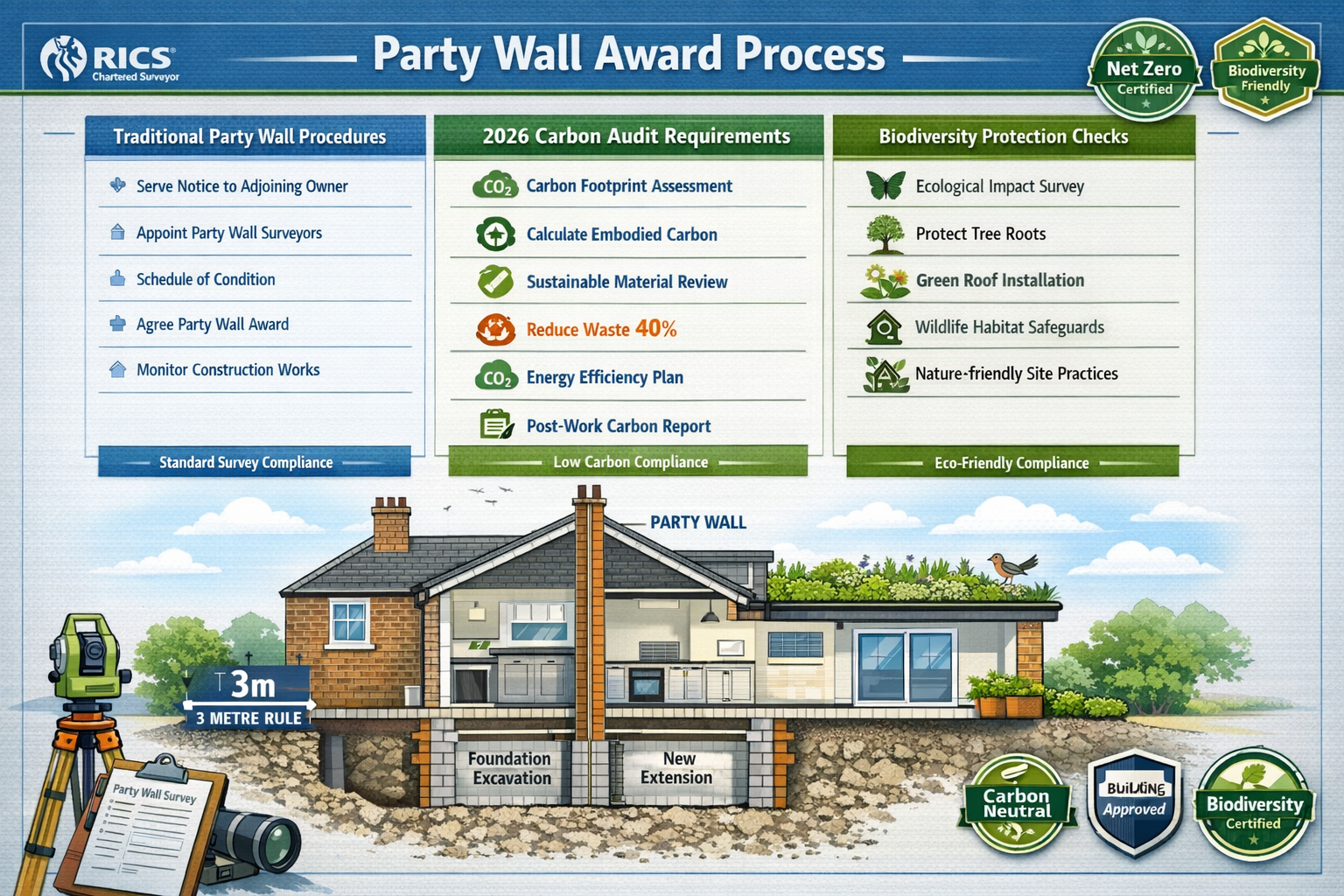
Party Wall Awards Incorporating RICS Sustainability Report 2025: Carbon and Biodiversity Checks for 2026 Extensions require modified procedures that balance traditional neighbour protection with environmental responsibility.
Step-by-Step Process
Stage 1: Pre-Notice Assessment (Weeks 1-2)
Before serving party wall notices, building owners should:
- Commission preliminary carbon audit of proposed materials
- Arrange ecological survey of construction zone
- Identify sustainability opportunities and constraints
- Prepare environmental impact summary for neighbours
Stage 2: Enhanced Notice Service (Week 3)
Party wall notices now include supplementary sustainability information:
- Summary of carbon reduction strategies
- Biodiversity protection measures
- Low-impact construction methodology
- Environmental monitoring protocols
This transparency reduces neighbour objections and demonstrates professional responsibility.
Stage 3: Surveyor Appointment and Award Preparation (Weeks 4-8)
Appointed surveyors integrate sustainability assessments:
Carbon Documentation 📋
- Detailed material specifications with carbon coefficients
- Comparison against conventional construction approaches
- Quantified emissions reduction targets
- Verification methodology for material substitutions
Biodiversity Provisions
- Ecological survey results and recommendations
- Seasonal construction restrictions
- Habitat protection zones
- Enhancement features and net gain calculations
Traditional Party Wall Elements
Standard provisions remain essential:
- Schedule of condition for adjoining property
- Structural calculations and methodology
- Access requirements and working hours
- Insurance and indemnity arrangements
Stage 4: Award Execution and Monitoring (Construction Phase)
The integrated award requires ongoing verification:
- Monthly carbon accounting updates
- Photographic evidence of material specifications
- Ecological monitoring reports
- Compliance certification for sustainability provisions
Cost Implications
Building owners frequently ask about additional expenses:
Typical Cost Breakdown (2026):
- Traditional party wall award: £1,200-£2,500
- Carbon audit addition: £400-£800
- Ecological survey: £500-£1,200
- Enhanced monitoring: £300-£600
- Total integrated award: £2,400-£5,100
Value Considerations:
- Reduced planning application challenges
- Lower risk of neighbour disputes
- Potential insurance premium reductions
- Enhanced property value from sustainability credentials
- Future-proofing against stricter regulations
Common Pitfalls to Avoid
❌ Insufficient Early Planning
Sustainability assessments require lead time. Rushing ecological surveys during bird nesting season or failing to source low-carbon materials creates project delays.
❌ Inadequate Neighbour Communication
Environmental provisions affect adjoining owners. Failing to explain biodiversity benefits or carbon reduction strategies increases dispute risk.
❌ Incomplete Documentation
Awards lacking specific carbon targets or biodiversity metrics create enforcement challenges and potential liability.
❌ Ignoring Seasonal Constraints
Biodiversity requirements may restrict construction timing. Planning extensions without considering ecological calendars causes costly delays.
Professional Support
The complexity of integrated sustainability assessments makes professional guidance essential. Chartered surveyors with RICS accreditation understand both traditional party wall procedures and emerging environmental requirements.
Building owners should seek surveyors who:
- Demonstrate knowledge of RICS Sustainability Report 2025 [1]
- Have experience with carbon auditing methodologies
- Maintain relationships with ecological consultants
- Understand local planning authority sustainability requirements
- Communicate effectively with neighbours about environmental benefits
Legal and Regulatory Framework
The integration of sustainability checks into party wall awards operates within evolving legal and regulatory contexts that building owners and surveyors must navigate carefully.
Party Wall Act 1996 Foundation
The Party Wall etc. Act 1996 remains the statutory foundation, but interpretation now incorporates sustainability considerations:
Traditional Statutory Duties:
- Prevent or minimize inconvenience to adjoining owners
- Ensure structural safety of party walls
- Provide fair compensation for damage
- Establish clear construction methodologies
Modern Sustainability Integration:
Courts and tribunals increasingly recognize environmental responsibility as part of reasonable construction practice. Awards that ignore carbon impacts or biodiversity damage may face challenges on grounds of inadequate professional standards.
Planning Policy Context
Local planning authorities enforce sustainability requirements through:
Building Regulations Part Z (Proposed 2026)
- Mandatory whole-life carbon assessments for extensions over 30m²
- Biodiversity net gain calculations for projects affecting gardens
- Material sourcing documentation requirements
- Energy performance projections
Local Development Frameworks
Many authorities have adopted enhanced sustainability policies:
- Carbon reduction targets (typically 20-40% below baseline)
- Native species planting requirements
- Green infrastructure provisions
- Climate adaptation measures
Professional Standards and Liability
RICS members face heightened professional obligations following the 2025 Sustainability Report [1]:
Duty of Care Expansion ⚖️
- Environmental impact assessment as standard practice
- Climate change risk consideration in all advice
- Biodiversity protection as professional responsibility
- Sustainability literacy as competency requirement
Liability Considerations
Surveyors who prepare awards without adequate sustainability provisions may face:
- Professional negligence claims for incomplete advice
- Regulatory enforcement by local authorities
- Reputational damage and RICS disciplinary action
- Insurance coverage questions for environmental damages
Neighbour Rights and Environmental Protection
Adjoining owners gain additional protections through sustainability integration:
Enhanced Information Rights
Neighbours can request:
- Carbon impact assessments for proposed work
- Biodiversity survey results
- Material specifications and sourcing documentation
- Environmental monitoring protocols
Grounds for Objection
While the Party Wall Act limits objection grounds, sustainability concerns create legitimate bases for:
- Requesting alternative low-carbon materials
- Requiring enhanced biodiversity protection
- Seeking seasonal construction restrictions
- Demanding environmental monitoring provisions
Dispute Resolution
When party wall disputes involve sustainability issues, appointed surveyors must:
- Balance traditional structural concerns with environmental impacts
- Apply RICS professional standards including sustainability guidance
- Consider long-term environmental consequences
- Document sustainability provisions clearly in awards
Insurance and Risk Management
The integration of sustainability checks affects insurance considerations:
Professional Indemnity Coverage
Surveyors should verify their insurance covers:
- Environmental impact assessment advice
- Carbon calculation errors or omissions
- Biodiversity survey recommendations
- Sustainability compliance verification
Building Owner Protection
Project insurance should address:
- Environmental damage during construction
- Failure of sustainable materials or systems
- Biodiversity habitat restoration costs
- Carbon performance shortfalls
Future Trends and Emerging Practices
Party Wall Awards Incorporating RICS Sustainability Report 2025: Carbon and Biodiversity Checks for 2026 Extensions represent the beginning of a fundamental transformation in construction practice, not the endpoint.
Anticipated Regulatory Developments
Mandatory Carbon Accounting (2027-2028)
Government proposals suggest:
- Statutory carbon limits for all construction projects
- Digital carbon passports for buildings
- Real-time emissions monitoring during construction
- Carbon taxation for high-impact projects
Biodiversity Net Gain Requirements
Following agricultural and major development precedents:
- 10% biodiversity net gain for all extensions over 20m²
- Habitat banking schemes for urban projects
- 30-year biodiversity management plans
- Third-party ecological verification
Technological Innovations
Digital Carbon Tracking 💻
Emerging tools streamline sustainability integration:
- AI-powered material carbon databases
- Automated embodied carbon calculations from BIM models
- Blockchain verification of material sourcing
- Real-time construction emissions monitoring
Ecological Assessment Technology
- Drone surveys for habitat mapping
- eDNA sampling for species identification
- Automated biodiversity net gain calculations
- Remote ecological monitoring systems
Industry Standardization
Professional bodies are developing standardized frameworks:
RICS Sustainability Standards (In Development)
- Mandatory carbon competency for surveyors
- Standardized assessment methodologies
- Quality assurance protocols
- Continuing professional development requirements
Party Wall Surveyor Sustainability Toolkit
Industry groups are creating:
- Template sustainability award clauses
- Carbon calculation spreadsheets
- Biodiversity checklist protocols
- Neighbour communication materials
Market Dynamics
Property Value Implications 📈
Research indicates sustainability credentials increasingly affect property values:
- Premium of 5-15% for verified low-carbon extensions
- Enhanced marketability of biodiversity-rich properties
- Reduced insurance costs for sustainable buildings
- Future-proofing against climate-related devaluation
Competitive Advantage
Building professionals who embrace sustainability integration gain:
- Differentiation in competitive markets
- Access to environmentally conscious clients
- Reduced regulatory risk and project delays
- Alignment with societal expectations
International Perspectives
The UK's approach to Party Wall Awards Incorporating RICS Sustainability Report 2025: Carbon and Biodiversity Checks for 2026 Extensions reflects global trends:
European Union Leadership
- Mandatory whole-life carbon assessments since 2024
- Biodiversity net gain requirements across member states
- Circular economy principles in construction
- Climate adaptation requirements
Global Best Practices
- Australia's biodiversity offset schemes
- Canada's embodied carbon limits
- New Zealand's climate-positive construction targets
- Singapore's green building certification requirements
The RICS Sustainability Report 2025 surveyed professionals across 36 countries [1], ensuring UK practices align with international standards while addressing local contexts.
Preparing for Change
Building owners and professionals should:
Stay Informed 📚
- Monitor RICS guidance updates
- Track local planning policy changes
- Engage with sustainability training opportunities
- Join professional networks focused on green building
Invest in Capability
- Develop carbon assessment skills
- Build relationships with ecological consultants
- Adopt digital tools for sustainability tracking
- Enhance communication about environmental benefits
Lead Proactively
Rather than viewing sustainability integration as regulatory burden, forward-thinking professionals recognize opportunity:
- Differentiate services through environmental expertise
- Build reputation as sustainability leaders
- Attract environmentally conscious clients
- Contribute to climate change mitigation
The transition to comprehensive sustainability integration in party wall practice reflects broader societal recognition that buildings account for 40% of global carbon emissions [3] and that every project—including modest residential extensions—contributes to collective environmental impact.
Conclusion
The integration of carbon audits and biodiversity checks into party wall awards represents a paradigm shift in UK construction practice. Party Wall Awards Incorporating RICS Sustainability Report 2025: Carbon and Biodiversity Checks for 2026 Extensions transform routine neighbour protection procedures into comprehensive environmental stewardship frameworks that address the urgent climate and ecological challenges highlighted in the RICS Sustainability Report 2025 [1].
The statistics are compelling: 46% of construction professionals still fail to measure embodied carbon [1], while buildings contribute nearly 40% of global emissions [3]. Simultaneously, 60% of surveyed professionals recognize biodiversity protection as critical [1], yet practical implementation frameworks remain underdeveloped. This gap between awareness and action creates both challenge and opportunity for building owners, surveyors, and adjoining owners navigating extension projects in 2026.
Key Implementation Points
✅ Early Integration: Sustainability assessments must begin during project conception, not as afterthoughts during party wall notice service
✅ Professional Expertise: Engage chartered surveyors with demonstrated sustainability competency and RICS accreditation
✅ Comprehensive Documentation: Awards should specify carbon targets, biodiversity protections, and verification methodologies alongside traditional structural provisions
✅ Neighbour Communication: Transparent discussion of environmental benefits reduces disputes and builds community support
✅ Regulatory Compliance: Integrated sustainability checks help satisfy planning requirements and future-proof projects against evolving standards
Actionable Next Steps
For Building Owners Planning Extensions:
- Commission preliminary sustainability assessments before finalizing design to identify opportunities and constraints
- Budget appropriately for integrated party wall awards (typically £2,400-£5,100 including carbon and biodiversity checks)
- Engage professionals early to ensure adequate lead time for ecological surveys and material sourcing
- Communicate proactively with neighbours about environmental benefits and protection measures
- Document thoroughly to demonstrate compliance and protect against future liability
For Party Wall Surveyors:
- Develop sustainability competency through RICS training and professional development
- Build consultant networks including ecological specialists and carbon assessment experts
- Update award templates to incorporate carbon and biodiversity provisions systematically
- Invest in digital tools for carbon calculation and environmental tracking
- Lead client education about regulatory trends and professional responsibilities
For Adjoining Owners:
- Request sustainability information when receiving party wall notices
- Engage constructively with environmental protection measures that benefit shared spaces
- Consider appointing surveyors with sustainability expertise to represent interests comprehensively
- Document ecological features on your property that may be affected by neighbour's work
- Explore opportunities for collaborative biodiversity enhancement across property boundaries
The evolution of party wall practice reflects broader recognition that environmental responsibility cannot be separated from professional competency. As regulatory frameworks tighten and societal expectations rise, the integration of sustainability checks into party wall awards will transition from innovative practice to standard requirement.
Building owners who embrace this transformation gain competitive advantage, regulatory compliance, and the satisfaction of contributing to climate change mitigation and biodiversity protection. Surveyors who develop sustainability expertise position themselves as essential advisors in an evolving market. Neighbours who engage constructively with environmental provisions create shared ecological value.
The RICS Sustainability Report 2025 [1] provides the evidence base and professional framework for this transformation. The challenge now lies in translating awareness into consistent, high-quality implementation across thousands of extension projects annually. Party Wall Awards Incorporating RICS Sustainability Report 2025: Carbon and Biodiversity Checks for 2026 Extensions offer a practical mechanism for achieving this goal, one project at a time.
For guidance on your specific project, including party wall procedures and sustainability integration, consult with qualified professionals who understand both traditional requirements and emerging environmental responsibilities. The investment in comprehensive, sustainability-integrated party wall awards protects all parties—building owners, neighbours, and the planet we share.
References
[1] Sustainability Report 2025 – https://www.rics.org/news-insights/current-topics-campaigns/sustainability/sustainability-report-2025
[2] Watch – https://www.youtube.com/watch?v=H7KaLmn4MAQ
[3] Sustainability Report 2025 Royal Institution Chartered Surveyors – https://build-up.ec.europa.eu/en/resources-and-tools/publications/sustainability-report-2025-royal-institution-chartered-surveyors
[4] Sustainability – https://www.rics.org/news-insights/current-topics-campaigns/sustainability
[5] Sustainability Report 2025 – https://www.rics.org/content/dam/ricsglobal/documents/reports/Sustainability-report-2025.pdf