

{"cover":"Professional landscape format (1536x1024) hero image featuring bold text overlay 'Building Surveys for Buy-to-Let Institutional Portfolios: Due Diligence Amid 2026 Landlord Tax Pressures' in extra large 70pt white sans-serif font with dark shadow and semi-transparent navy overlay box, positioned in upper third. Background shows modern multi-unit residential property portfolio with surveyor in high-visibility vest conducting inspection with digital tablet, architectural blueprints visible, financial charts and tax documents subtly overlaid. Color scheme: deep navy blue, white, gold accents. High contrast, editorial quality, professional investment magazine aesthetic with clean composition following rule of thirds.","content":["Detailed landscape format (1536x1024) image showing professional chartered surveyor conducting comprehensive building inspection of buy-to-let property, close-up of hands holding moisture meter against brick wall with digital readings displayed, clipboard with detailed survey checklist visible, thermal imaging camera on tripod in background, multiple residential units visible through window, professional lighting highlighting structural elements, color scheme navy and orange, technical assessment atmosphere, institutional investment focus with RICS standards documentation visible on tablet screen.","Wide-angle landscape format (1536x1024) image depicting institutional investor boardroom meeting with large wall-mounted screen displaying property portfolio performance metrics, tax impact analysis charts showing 2026 changes, building survey reports spread across conference table, diverse team of investment managers reviewing due diligence documents, financial calculators and yield projections visible, modern corporate setting with glass walls overlooking city skyline, professional business aesthetic with burgundy and grey color scheme, emphasis on strategic decision-making and compliance documentation.","Detailed landscape format (1536x1024) image showing split-screen composition: left side features detailed building survey report with structural assessment findings, defect annotations, and cost estimates; right side shows financial analysis spreadsheet with tax calculations, yield projections, and ROI metrics for 2026, calculator and pen positioned strategically, property photographs attached with sticky notes, color-coded risk assessment matrix visible, professional desk setting with warm lighting, emphasis on integration of technical survey data with financial planning, navy blue and gold accents throughout."]}
Institutional investors face a complex landscape in 2026. The buy-to-let sector remains attractive for professional portfolios, yet heightened tax pressures demand more rigorous due diligence than ever before. Building Surveys for Buy-to-Let Institutional Portfolios: Due Diligence Amid 2026 Landlord Tax Pressures has become a critical consideration for fund managers, pension schemes, and real estate investment trusts (REITs) seeking to maximize returns while managing compliance risks.
The intersection of technical property assessment and fiscal strategy now defines successful portfolio acquisition. With mortgage interest relief restrictions fully phased in and capital gains tax adjustments impacting exit strategies [1], institutional investors cannot afford to overlook the structural integrity and maintenance liabilities that directly affect net yields. A comprehensive building survey provides the foundation for accurate financial modeling in this challenging environment.

Key Takeaways
- Tax pressures in 2026 require institutional investors to conduct more thorough building surveys to accurately forecast maintenance costs and protect yield calculations [4]
- Comprehensive structural assessments identify hidden defects that could significantly impact long-term portfolio performance and tax-deductible expenses
- Professional survey protocols aligned with RICS standards help institutional buyers meet lender requirements and satisfy fiduciary responsibilities
- Integration of survey findings with financial modeling enables better risk-adjusted return projections in the current tax environment
- Portfolio-wide survey strategies reduce costs while maintaining quality standards across multiple property acquisitions
Understanding the 2026 Tax Landscape for Institutional Landlords
Current Tax Challenges Facing Buy-to-Let Investors
The tax environment for landlords in 2026 presents significant challenges that directly impact investment returns. The complete phase-out of mortgage interest tax relief means that landlords can no longer deduct mortgage interest from rental income before calculating tax liability [2]. Instead, a basic-rate tax credit applies, which substantially reduces the tax efficiency of leveraged property investments.
For institutional investors operating through corporate structures, the landscape differs slightly. Limited companies continue to deduct mortgage interest as a business expense, making this structure increasingly attractive for professional portfolios [6]. However, corporation tax rates and dividend taxation still compress overall returns compared to previous years.
Capital gains tax considerations also influence acquisition strategies. With potential rate increases and reduced allowances, institutional investors must carefully evaluate exit strategies during the acquisition phase [5]. This makes accurate property valuation and condition assessment more critical than ever.
How Tax Pressures Influence Survey Requirements
The heightened tax burden in 2026 fundamentally changes how institutional investors approach building surveys. Every pound spent on unexpected repairs directly impacts net yields, and with reduced tax relief, the margin for error has narrowed considerably [7].
Key survey considerations driven by tax pressures include:
- 📊 Accurate maintenance forecasting to model tax-deductible repair expenses versus capital improvements
- 🏗️ Identification of immediate defects that could trigger non-deductible capital expenditure
- 💰 Assessment of energy efficiency to evaluate potential tax incentives and regulatory compliance costs
- 🔍 Structural integrity verification to avoid unexpected capital outlays that cannot be offset against rental income
- 📋 Compliance documentation for lender requirements and audit trails
Institutional investors now require comprehensive building surveys that go beyond basic condition reports. The survey must provide sufficient detail to distinguish between revenue repairs (tax-deductible) and capital improvements (non-deductible), enabling accurate financial modeling.
Essential Survey Protocols for Institutional Buy-to-Let Portfolios
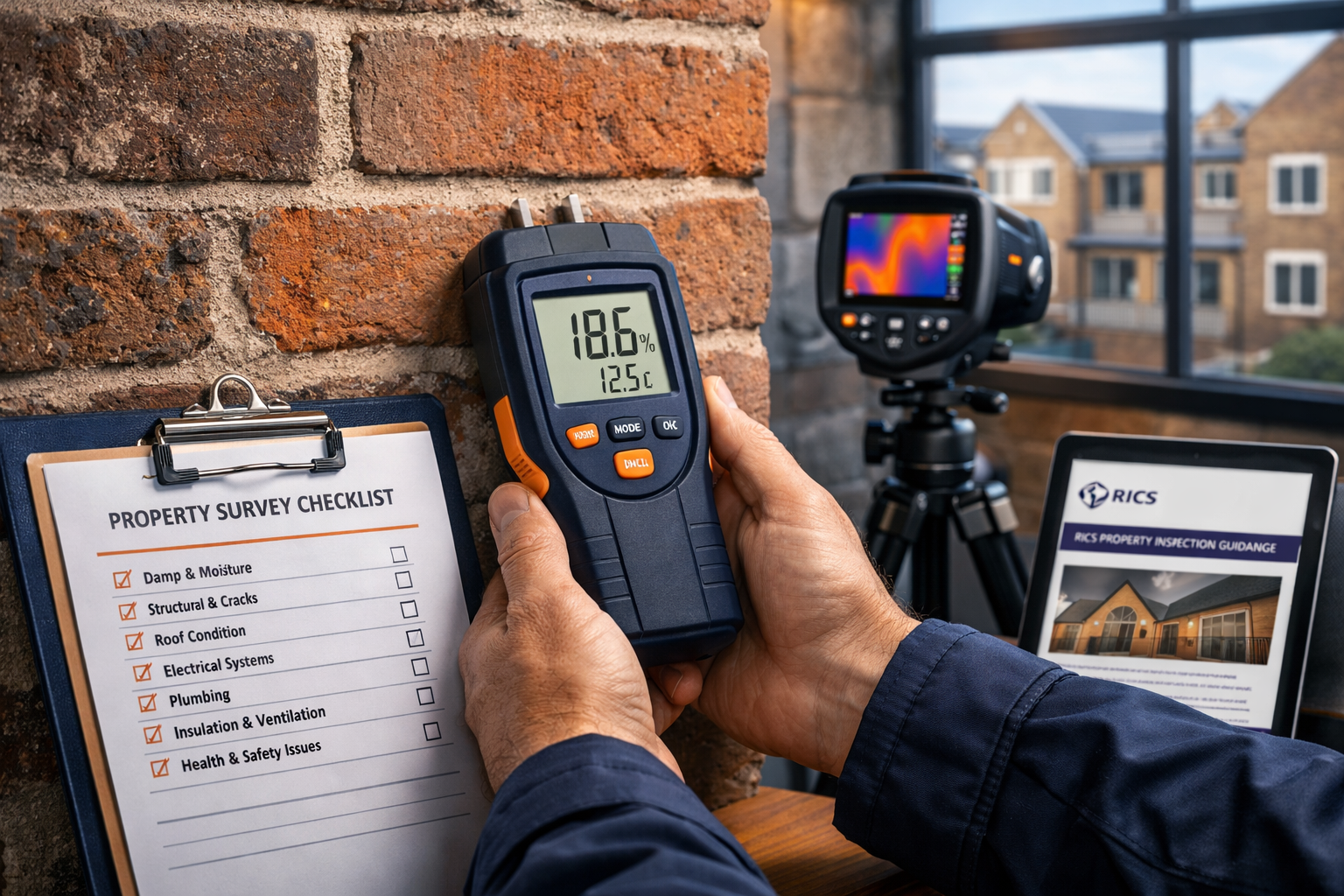
Selecting the Appropriate Survey Level
Institutional investors must choose survey types that balance thoroughness with cost efficiency across portfolio acquisitions. The three main survey levels serve different purposes, and understanding the difference between Level 2 and Level 3 surveys is essential for portfolio managers.
Survey Level Comparison for Institutional Portfolios:
| Survey Type | Best For | Key Benefits | Typical Cost Range |
|---|---|---|---|
| RICS Level 2 | Modern properties (post-1990) in good condition | Cost-effective for multiple units | £400-£800 per property |
| RICS Level 3 | Older properties, unusual construction, or visible defects | Comprehensive structural analysis | £800-£1,500+ per property |
| Bespoke Portfolio Survey | Large-scale acquisitions (10+ units) | Standardized reporting, volume discounts | Negotiated rates |
For most institutional buy-to-let portfolios, a RICS Level 3 building survey provides the most comprehensive assessment. This detailed inspection examines structural elements, identifies defects, and provides cost estimates for remedial work—all critical information for accurate financial modeling in the 2026 tax environment.
Critical Survey Components for Portfolio Due Diligence
A thorough building survey for institutional portfolios must address specific elements that impact long-term investment performance. These components directly influence yield calculations and tax planning strategies.
Structural Assessment Requirements:
Professional surveyors should evaluate foundations, load-bearing walls, roof structures, and floor systems. Any structural defects identified represent potential capital expenditure that cannot be offset against rental income under current tax rules [1]. Structural surveys provide the technical detail necessary for accurate cost projections.
Moisture and Damp Analysis:
Damp issues remain one of the most common and costly problems in rental properties. A comprehensive damp survey identifies rising damp, penetrating moisture, and condensation issues. Early detection allows investors to factor remediation costs into acquisition negotiations and maintenance budgets.
Building Services Evaluation:
Electrical systems, heating installations, plumbing, and drainage require thorough assessment. Outdated or defective services may require immediate replacement, representing significant capital outlay. Drainage surveys can prevent costly surprises after acquisition.
Energy Performance and Compliance:
With minimum Energy Performance Certificate (EPC) requirements for rental properties, institutional investors must verify compliance and assess upgrade costs. Properties below the legal threshold require capital investment before letting, impacting initial yields and tax positions.
Portfolio-Wide Survey Strategies
Institutional investors acquiring multiple properties benefit from standardized survey protocols that ensure consistency while controlling costs. A portfolio approach enables better risk assessment and resource allocation.
Volume Survey Arrangements:
Engaging a single surveying firm for multiple properties often secures preferential rates while maintaining quality standards. Local chartered surveyors with portfolio experience understand institutional requirements and can deliver consistent reporting formats.
Risk-Based Survey Allocation:
Not every property in a portfolio requires the same level of scrutiny. Newer properties with warranties might justify Level 2 surveys, while older or problematic assets demand Level 3 assessments. This tiered approach optimizes due diligence budgets without compromising risk management.
Standardized Reporting Templates:
Institutional investors benefit from consistent survey reports that facilitate comparison across properties. Standardized formats should include:
- ✅ Executive summary with traffic-light risk ratings
- ✅ Detailed defect schedule with cost estimates
- ✅ Maintenance planning recommendations
- ✅ Compliance status for rental regulations
- ✅ Priority ranking for remedial works
Integrating Survey Findings with Financial Modeling and Tax Planning

Translating Survey Results into Financial Projections
The true value of comprehensive building surveys emerges when findings integrate seamlessly with financial models. In the 2026 tax environment, this integration directly impacts investment decisions and portfolio performance.
Maintenance Reserve Calculations:
Survey findings should inform realistic maintenance reserves that account for identified defects and projected lifecycle replacements. With mortgage interest relief restrictions reducing net income [2], accurate maintenance forecasting prevents yield surprises.
A typical institutional portfolio might allocate 15-25% of gross rental income for maintenance and repairs. However, survey findings may justify higher or lower provisions for specific properties based on condition and age.
Capital vs. Revenue Expenditure Classification:
One of the most critical aspects of survey analysis involves distinguishing between repairs (tax-deductible) and improvements (capital expenditure). This distinction significantly impacts tax liability and cash flow projections [6].
Revenue repairs restore property to its original condition and are fully deductible against rental income. Examples include:
- Replacing broken windows with equivalent units
- Repairing damaged plasterwork
- Fixing leaking pipes
- Redecorating to maintain rental standards
Capital improvements enhance the property beyond its original specification and must be capitalized. Examples include:
- Installing a new kitchen where a basic one existed
- Adding an extension or conservatory
- Upgrading single glazing to double glazing
- Installing central heating where none existed
Survey reports should clearly identify which remedial works fall into each category, enabling accurate tax planning.
Yield Optimization Through Strategic Survey Analysis
Institutional investors in 2026 must maximize every basis point of yield. Strategic analysis of survey findings can identify opportunities to enhance returns while managing tax efficiency.
Prioritizing High-Impact Repairs:
Survey reports typically identify numerous defects of varying severity. Institutional investors should prioritize repairs that:
- Prevent further deterioration that could trigger expensive capital works
- Enable higher rental values through improved property presentation
- Qualify as revenue expenditure for immediate tax deduction
- Improve energy efficiency to meet regulatory requirements and reduce void periods
Negotiating Acquisition Prices:
Detailed survey findings provide powerful negotiation leverage. Identified defects with cost estimates enable buyers to request price reductions or retention amounts. In the competitive 2026 market, this evidence-based approach protects yields and investment returns [4].
Planning Tax-Efficient Remediation Schedules:
Timing of repair works can optimize tax efficiency. Institutional investors might schedule revenue repairs to offset peak rental income periods, while deferring capital improvements to years with lower taxable profits or planning them strategically around property sales.
Lender Requirements and Institutional Standards
Institutional lenders impose specific survey requirements for portfolio financing. Understanding these standards ensures smooth transaction completion and optimal financing terms.
Mortgage Lender Valuation vs. Building Survey:
Standard mortgage valuations focus on property value, not condition. Institutional lenders typically require separate building surveys for portfolio acquisitions, particularly for older properties or those with visible defects. The survey provides security for the lending decision and protects both lender and borrower interests.
RICS Professional Standards:
Institutional investors should insist on surveys conducted by RICS-qualified chartered surveyors who maintain professional indemnity insurance. This ensures reports meet recognized standards and provides recourse if defects are missed.
Portfolio Reporting Requirements:
Institutional lenders often require consolidated reporting for portfolio acquisitions, including:
- 📊 Summary risk assessment across all properties
- 📊 Aggregate maintenance cost projections
- 📊 Compliance status for all units
- 📊 Priority ranking for remedial works
- 📊 Impact analysis on projected yields
Compliance, Risk Management, and Professional Standards
Regulatory Compliance in the 2026 Rental Market
The regulatory environment for landlords continues to evolve, with compliance failures potentially triggering penalties and rental restrictions. Building surveys play a crucial role in identifying compliance risks before acquisition.
Key Compliance Areas:
🏠 Energy Performance: Properties must meet minimum EPC ratings (currently E or above) to be legally let. Surveys should assess current ratings and identify upgrade requirements.
🏠 Electrical Safety: Landlords must provide valid Electrical Installation Condition Reports (EICR) every five years. Surveys should flag outdated electrical systems requiring testing or replacement.
🏠 Gas Safety: Annual gas safety certificates are mandatory. Surveys should assess gas installation condition and identify potential safety issues.
🏠 Fire Safety: Smoke alarms, carbon monoxide detectors, and fire doors (in HMOs) must meet current standards. Survey findings should address these requirements.
🏠 Housing Health and Safety Rating System (HHSRS): Local authorities use this system to assess rental property conditions. Serious hazards identified in surveys require prompt remediation to avoid enforcement action.
Risk Mitigation Strategies for Institutional Investors
Comprehensive building surveys form the foundation of effective risk management for institutional buy-to-let portfolios. Several strategies help minimize exposure to unexpected costs and compliance failures.
Pre-Acquisition Risk Assessment:
Survey findings enable informed go/no-go decisions before legal commitment. Properties with extensive structural issues or compliance deficits may not meet institutional investment criteria, regardless of initial yield projections [7].
Insurance Considerations:
Survey reports inform insurance underwriting and premium calculations. Identified defects may require disclosure to insurers, and some issues might affect coverage availability or cost. Addressing defects before acquisition can secure better insurance terms.
Warranty and Retention Arrangements:
For newer properties, survey findings help verify warranty coverage and identify issues that should be addressed under existing guarantees. For acquisitions from developers, retention amounts can be negotiated based on survey findings, protecting investors from post-completion defect costs.
Selecting Qualified Survey Professionals
The quality of building surveys directly impacts investment decisions and portfolio performance. Institutional investors should apply rigorous selection criteria when appointing surveyors.
Essential Qualifications and Experience:
- ✅ RICS membership (MRICS or FRICS designation)
- ✅ Specialist experience in residential investment properties
- ✅ Portfolio survey experience with institutional clients
- ✅ Professional indemnity insurance (minimum £1 million coverage)
- ✅ Local market knowledge for regional portfolios
- ✅ Understanding of landlord tax and compliance requirements
Choosing the right surveying firm involves evaluating technical expertise, reporting quality, and commercial understanding. Firms experienced in institutional work understand the financial modeling requirements and provide reports that integrate seamlessly with investment analysis.
For portfolio acquisitions, consider engaging firms that offer stock condition surveys designed specifically for multi-property assessments. These specialized services provide consistent evaluation frameworks across entire portfolios.
Conclusion
Building Surveys for Buy-to-Let Institutional Portfolios: Due Diligence Amid 2026 Landlord Tax Pressures represents more than a compliance exercise—it forms the foundation of successful investment strategy in a challenging fiscal environment. The complete phase-out of mortgage interest relief and ongoing tax pressures have fundamentally altered the economics of buy-to-let investing, making thorough due diligence essential for protecting yields and maximizing returns [4].
Institutional investors must recognize that comprehensive building surveys deliver value far beyond defect identification. These assessments enable accurate financial modeling, inform tax-efficient maintenance planning, and provide the evidence base for acquisition negotiations. In 2026, the cost of a thorough survey represents a minimal investment compared to the potential losses from unexpected repairs or compliance failures.
Key action steps for institutional investors:
- Implement standardized survey protocols across all portfolio acquisitions, with survey level determined by property age, condition, and value
- Engage RICS-qualified surveyors with institutional experience and ensure reports address both technical and financial considerations
- Integrate survey findings directly into financial models, distinguishing between revenue repairs and capital expenditure for accurate tax planning
- Establish maintenance reserves based on survey evidence rather than industry averages, protecting yields from unexpected costs
- Use survey findings strategically in acquisition negotiations to secure price reductions or retention arrangements
- Maintain comprehensive documentation for lender requirements, tax compliance, and audit trails
The buy-to-let sector remains attractive for institutional investors despite tax headwinds [1]. Professional portfolios benefit from economies of scale, corporate tax structures, and sophisticated management systems that individual landlords cannot match. However, success in this environment demands rigorous due diligence, with building surveys serving as the cornerstone of informed investment decisions.
As the market continues to evolve, institutional investors who prioritize comprehensive survey protocols and integrate technical findings with financial strategy will outperform competitors who treat surveys as mere formalities. The additional cost and effort invested in thorough due diligence pays dividends through enhanced yields, reduced risk exposure, and optimized tax efficiency.
For institutional investors planning portfolio acquisitions in 2026 and beyond, partnering with experienced surveying professionals who understand both technical assessment and commercial implications is essential. Contact qualified chartered surveyors to discuss portfolio survey strategies tailored to your investment objectives and risk parameters.
References
[1] New Tax Rules For Buy To Let Landlords From 2026 – https://www.thornleygroves.co.uk/about-thornley-groves/insights/new-tax-rules-for-buy-to-let-landlords-from-2026/
[2] Buy To Let Tax Changes – https://www.simplybusiness.co.uk/knowledge/landlord-tax/buy-to-let-tax-changes/
[4] Landlords 2026 – https://theindependentlandlord.com/landlords-2026/
[5] Buy To Let Are The Tax Benefits Still Worth It – https://www.sjp.co.uk/individuals/news/buy-to-let-are-the-tax-benefits-still-worth-it
[6] Tax Changes For Landlords 2026 Complete Guide – https://www.djh.co.uk/latest-news/news-insights/tax-changes-for-landlords-2026-complete-guide/
[7] The Tax Landscape For Uk Property Landlords In 2026 What Property Owners Need To Be Thinking About Now – https://www.lovewell-blake.co.uk/news/the-tax-landscape-for-uk-property-landlords-in-2026-what-property-owners-need-to-be-thinking-about-now