
When property markets surge and transaction volumes spike, building surveyors face an uncomfortable truth: demand can quickly outpace capacity. In 2026, as the UK property market experiences renewed momentum, surveying practices confront a critical challenge—how to maintain rigorous Building Survey Quality Standards Under Market Pressure: Maintaining RICS Excellence During High-Volume Recovery without compromising the professional integrity that protects both clients and reputations.
The temptation to cut corners during busy periods is real. Rushed inspections, abbreviated reports, and skipped verification steps can seem like necessary compromises when appointment books overflow. Yet these shortcuts carry devastating consequences: missed defects, professional liability claims, regulatory sanctions, and irreparable damage to hard-earned reputations. The Royal Institution of Chartered Surveyors (RICS) recognizes these pressures, actively developing enhanced standards and guidance to help practitioners navigate high-volume periods without sacrificing quality.
Key Takeaways
- 📊 RICS is actively strengthening survey standards in 2026 with the Home Survey Standard 2nd Edition incorporating over 70 hours of expert development and feedback from 1,600+ industry professionals[5]
- ⚖️ Quality assurance protocols are non-negotiable during high-volume periods, requiring systematic peer review, technical verification, and compliance checkpoints before report delivery
- 🤖 Technology integration enables quality at scale, with AI-assisted defect detection, drone inspections, and digital workflows helping maintain standards while managing capacity
- 👥 Strategic capacity management protects standards, including realistic scheduling, selective client acceptance, and investment in trained personnel rather than compromising inspection rigor
- ✅ Clear mandatory requirements distinguish professional practice, with RICS emphasizing "must" provisions versus "should" recommendations to eliminate ambiguity during pressure situations[5]
Understanding Building Survey Quality Standards Under Market Pressure
The Current RICS Standards Framework
The RICS standards framework provides the foundation for professional building survey practice across the UK. These standards define minimum requirements for inspection scope, reporting format, professional competence, and quality assurance that all chartered surveyors must follow. The different types of survey comparison available to property buyers—from basic condition reports to comprehensive structural surveys—all operate within this regulatory framework.
In 2026, RICS is implementing significant updates through the Home Survey Standard 2nd Edition, currently in active development with expected Standards and Regulation Board approval in Q1 2026[5]. This revision represents the most comprehensive update to residential survey standards in years, incorporating technological advances, clarifying mandatory requirements, and strengthening quality assurance expectations.
The development process has been remarkably thorough, involving:
- Over 70 hours of expert group work across more than 20 specialized meetings[5]
- Consultation with 1,600+ professionals at conferences, training events, and industry gatherings[5]
- Analysis of 1,000+ consultation comments reflecting diverse practitioner perspectives[5]
- Integration of technological guidance covering AI applications, drone inspections, and digital reporting tools[4]
Market Pressures Threatening Quality Standards
Several converging factors in 2026 create unprecedented pressure on surveying practices to prioritize speed over thoroughness:
📈 Transaction Volume Surges: Property market recoveries generate sudden spikes in survey demand, with appointment books filling weeks in advance. Practices face difficult decisions about accepting additional work beyond comfortable capacity levels.
⏰ Time Compression Expectations: Mortgage lenders, estate agents, and anxious buyers increasingly expect rapid turnaround times, sometimes requesting survey completion within 48-72 hours—timelines that challenge thorough inspection protocols.
💰 Fee Pressure and Competition: Online comparison platforms and automated valuation tools create downward pressure on survey fees, tempting practices to compensate through volume rather than value, potentially sacrificing inspection time per property.
👥 Skills Shortages: The surveying profession faces demographic challenges, with experienced practitioners retiring faster than new professionals enter the field, leaving practices struggling to maintain adequate staffing during busy periods.
🏗️ Property Complexity: Modern properties increasingly feature complex construction methods, energy efficiency systems, and non-standard construction requiring specialized knowledge and extended inspection time.
These pressures create a dangerous environment where quality standards face erosion through incremental compromises rather than deliberate decisions to cut corners.
Implementing Robust Quality Assurance Protocols for Building Survey Quality Standards
Essential QA Checkpoints During High-Volume Periods
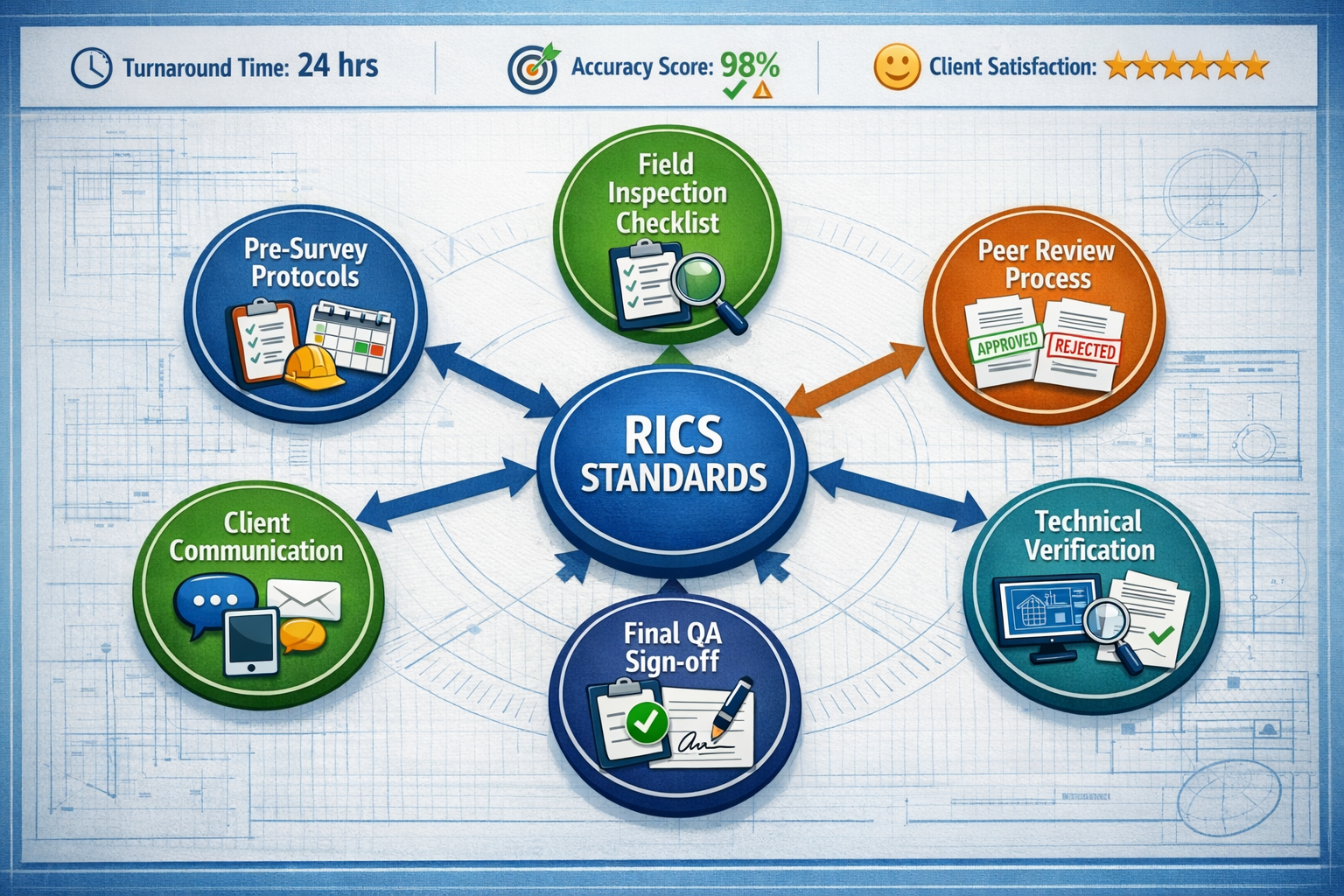
Maintaining Building Survey Quality Standards Under Market Pressure: Maintaining RICS Excellence During High-Volume Recovery requires systematic quality assurance protocols embedded throughout the survey process. These checkpoints function as safety nets, catching potential quality lapses before they reach clients.
Pre-Survey Quality Gates 🚦
Before any surveyor arrives at a property, several verification steps should occur:
| QA Checkpoint | Purpose | Responsibility |
|---|---|---|
| Competence Verification | Confirm surveyor qualifications match property complexity | Practice Manager |
| Instruction Clarity | Ensure complete client brief, property details, access arrangements | Administrative Team |
| Equipment Preparation | Verify all necessary tools, safety equipment, technology ready | Surveyor |
| Schedule Realism | Confirm adequate time allocated for property size and type | Scheduling Coordinator |
| Previous Survey Review | Check for relevant historical data or recurring issues | Surveyor |
Field Inspection Quality Controls 🔍
During the property inspection itself, surveyors should follow standardized protocols that prevent rushed or incomplete examinations:
- Mandatory inspection checklists covering all property elements systematically
- Photographic documentation standards requiring minimum images per property area
- Measurement verification protocols for dimensional accuracy
- Defect classification consistency using standardized severity ratings
- Site notes completeness checks before leaving property
For specialized investigations like damp surveys or roof surveys, additional technical protocols ensure proper diagnostic procedures are followed regardless of time pressures.
Post-Inspection Technical Review 📋
The most critical quality assurance occurs between field inspection and report delivery:
- Peer Technical Review: A second qualified surveyor reviews field notes, photographs, and preliminary findings before report drafting begins
- Defect Verification: Significant defects undergo independent verification through additional research, specialist consultation, or photographic analysis
- Recommendation Appropriateness: Proposed further investigations and cost estimates receive technical validation
- Report Drafting Standards: Templates, language consistency, and RICS format compliance checked systematically
- Final Sign-Off Protocol: Senior surveyor approval required before any report leaves the practice
Technology-Enabled Quality Maintenance
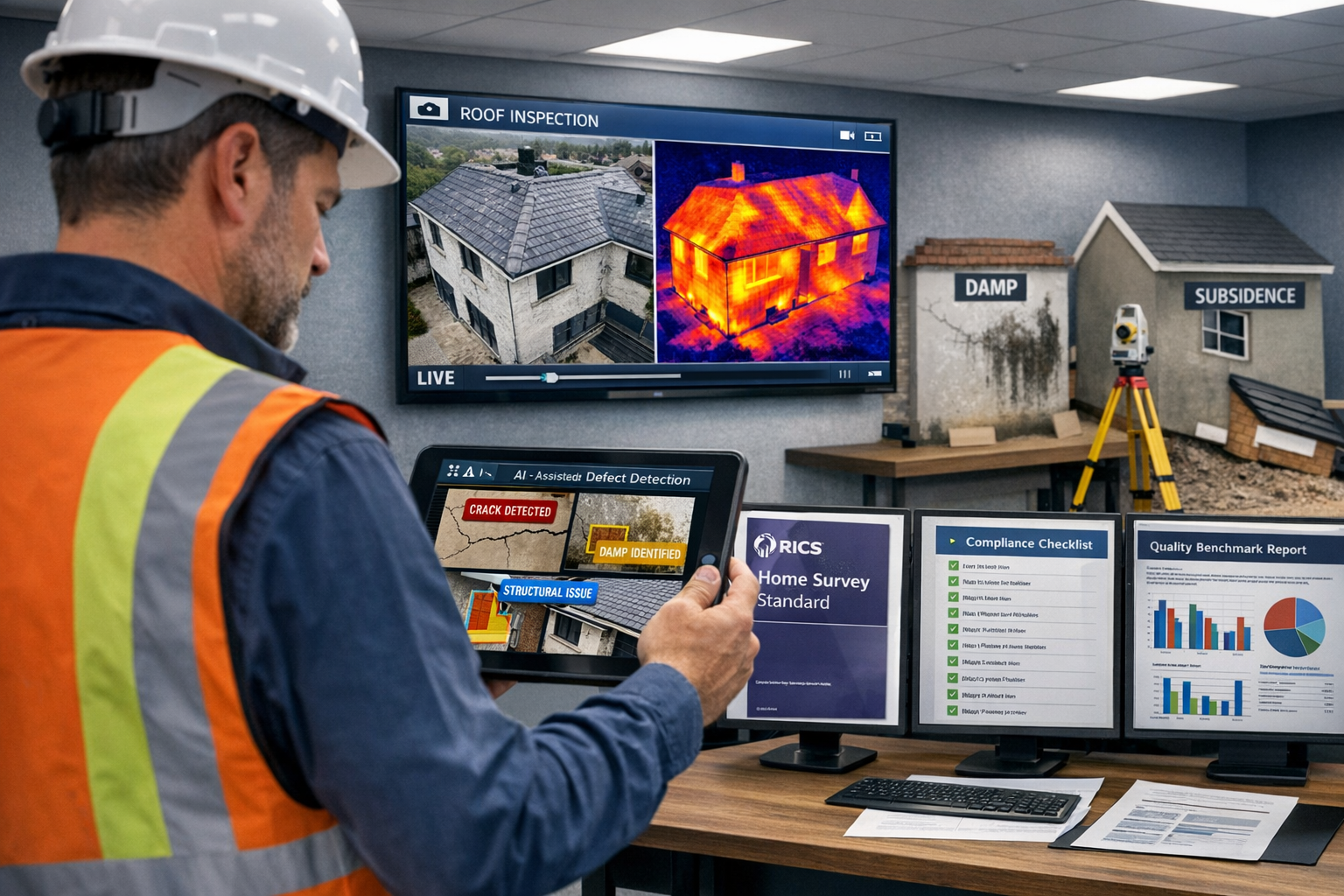
The RICS Home Survey Standard 2nd Edition explicitly addresses technological integration, recognizing that digital tools can enhance rather than compromise quality standards[4]. Strategic technology adoption enables practices to maintain rigorous standards while managing higher volumes.
AI-Assisted Defect Detection 🤖
Artificial intelligence applications in 2026 provide valuable quality support:
- Image analysis algorithms that scan survey photographs identifying potential defects surveyors might overlook during initial review
- Pattern recognition systems comparing current property conditions against databases of known defect signatures
- Consistency checking tools that flag unusual findings requiring additional verification
- Report completeness verification ensuring all mandatory sections contain appropriate content
These tools function as quality enhancement rather than replacement for professional judgment, providing additional verification layers during high-pressure periods.
Digital Workflow Management 📱
Comprehensive digital platforms help practices maintain quality through systematic process enforcement:
- Automated checklist systems that prevent report progression until all mandatory steps complete
- Time tracking integration alerting managers when inspections appear rushed or abbreviated
- Quality metrics dashboards displaying real-time performance indicators across all surveyors
- Client communication automation managing expectations while maintaining professional standards
Remote Inspection Technologies 🚁
Drone inspections and thermal imaging capabilities enable more thorough examinations in less time:
- Aerial roof surveys capturing comprehensive roof condition data without safety risks or time-consuming access arrangements
- Thermal imaging analysis revealing hidden moisture, insulation defects, and structural issues invisible to visual inspection
- 360-degree photography creating permanent property records for later verification and quality review
When properly integrated into RICS specialist defect surveys, these technologies enhance rather than compromise inspection thoroughness.
Strategic Capacity Management to Protect Building Survey Quality Standards
Recognizing and Respecting Capacity Limits
The most fundamental quality protection during market pressure is honest capacity assessment. Practices must recognize that accepting work beyond realistic capacity guarantees quality compromise, regardless of good intentions or robust protocols.
Calculating Realistic Survey Capacity 📊
Professional practices should establish clear capacity calculations based on:
- Property type and complexity: A Victorian terrace requires different inspection time than a modern apartment
- Surveyor experience levels: Junior surveyors need more time and supervision than senior practitioners
- Geographic distribution: Travel time between appointments affects daily capacity
- Report drafting requirements: Complex properties require proportionally more analysis and writing time
- Quality assurance time allocation: Peer review and technical verification consume additional capacity
A realistic calculation might reveal that a single experienced surveyor can complete 3-4 comprehensive residential surveys weekly while maintaining RICS standards—far fewer than volume-focused practices might attempt.
Strategic Client Selection During Peak Periods ✅
When demand exceeds capacity, practices face difficult decisions about which instructions to accept. Quality-focused approaches include:
- Existing client prioritization: Maintaining relationships with solicitors, estate agents, and repeat clients who value quality
- Property complexity matching: Accepting instructions matching available surveyor expertise and capacity
- Realistic timeline communication: Declining instructions requiring impossible turnaround times
- Premium pricing for rush work: Charging appropriately for expedited service enabling additional resource allocation
- Selective referral partnerships: Redirecting overflow work to trusted peer practices maintaining similar standards
This approach protects reputation far more effectively than accepting all work and delivering compromised quality.
Building Sustainable Capacity Through Investment
Rather than compromising standards during high-volume periods, forward-thinking practices invest in sustainable capacity expansion:
Personnel Development Strategies 👥
- Structured training programs bringing junior surveyors to full competence faster
- Mentorship systems pairing experienced practitioners with developing professionals
- Specialist skill development creating expertise in complex areas like commercial building surveys or structural engineering assessments
- Competitive compensation packages attracting and retaining quality professionals
- Professional development support funding RICS qualifications and continuing education
Operational Efficiency Improvements ⚙️
Streamlining non-technical processes creates capacity for quality-focused survey work:
- Administrative automation reducing surveyor time on scheduling, invoicing, and client communication
- Template standardization accelerating report drafting without compromising content
- Geographic route optimization maximizing field time through efficient appointment scheduling
- Supplier relationships ensuring rapid access to specialist services when needed
- Technology infrastructure providing tools that enhance rather than complicate workflows
Strategic Service Offerings 🎯
Diversifying service mix helps balance capacity and demand:
- Offering homebuyer surveys alongside comprehensive building surveys provides flexibility in capacity allocation
- Developing schedule of condition reports and other specialized services creates revenue streams with different capacity requirements
- Establishing expert witness capabilities provides high-value work balancing volume pressures
Maintaining RICS Excellence Through Clear Standards and Accountability
The Importance of Mandatory Requirements
The RICS Home Survey Standard 2nd Edition places significant emphasis on distinguishing mandatory requirements from recommended practices[5]. This clarity becomes essential during high-pressure situations when surveyors face decisions about what can be abbreviated or deferred.
"Must" Versus "Should" Provisions ⚖️
The updated standards framework explicitly categorizes requirements:
Mandatory "Must" Requirements include:
- Minimum inspection scope covering all accessible property areas
- Specific defect identification and classification protocols
- Required report sections and content elements
- Professional indemnity insurance maintenance
- Continuing professional development completion
- Quality assurance documentation
Recommended "Should" Practices include:
- Best practice inspection techniques
- Enhanced reporting approaches
- Client communication suggestions
- Technology adoption guidance
- Professional development opportunities
This distinction eliminates ambiguity: mandatory requirements cannot be compromised regardless of market pressure, while recommended practices represent aspirational standards practices should strive toward.
Professional Accountability and Regulatory Compliance
RICS enforcement mechanisms ensure standards compliance isn't optional:
Regulatory Oversight 🔍
- Practice monitoring programs conducting random audits of survey quality
- Complaint investigation procedures examining alleged standards breaches
- Disciplinary processes imposing sanctions for quality failures
- Continuing competence requirements ensuring practitioners maintain current knowledge
- Public accountability through published disciplinary decisions
Professional Liability Exposure ⚠️
Beyond regulatory sanctions, quality failures create significant liability risks:
- Negligence claims from clients suffering financial loss due to missed defects
- Professional indemnity claims potentially exceeding policy limits for serious failures
- Reputational damage destroying practices built over decades
- Referral source loss as solicitors and agents avoid unreliable surveyors
- Market value impact reducing practice sale value or partnership opportunities
The financial and professional consequences of quality compromise far exceed any short-term revenue gains from volume-focused approaches.
Building a Quality-First Culture
Ultimately, maintaining Building Survey Quality Standards Under Market Pressure: Maintaining RICS Excellence During High-Volume Recovery requires organizational culture prioritizing quality over volume:
Leadership Commitment 👔
Practice leaders must consistently demonstrate quality prioritization through:
- Resource allocation decisions investing in quality systems over volume capacity
- Compensation structures rewarding quality metrics alongside productivity
- Client communication setting realistic expectations rather than impossible promises
- Peer recognition celebrating quality achievements and learning from mistakes
- Strategic planning building sustainable practices rather than chasing short-term volume
Team Empowerment 💪
Individual surveyors need authority and support to maintain standards:
- Permission to decline work when capacity limits reached
- Time allocation autonomy allowing adequate inspection duration
- Technical support access providing specialist consultation when needed
- Quality concern escalation creating safe channels for raising standards issues
- Professional development opportunities maintaining and enhancing competence
Client Education 📚
Educating clients about quality standards helps manage expectations:
- Explaining the relationship between inspection thoroughness and report value
- Clarifying why choosing the right property survey requires appropriate time and expertise
- Demonstrating the cost consequences of missed defects versus survey fees
- Highlighting RICS standards compliance as quality assurance
- Providing realistic timelines reflecting proper inspection protocols

Regional Considerations for Maintaining Quality Standards
Different property markets across the UK experience varying pressure levels, requiring adapted approaches to quality maintenance. Practices operating in high-demand areas like chartered surveyors in Central London face different challenges than those serving chartered surveyors in Sussex or chartered surveyors in Hertfordshire.
Urban Market Pressures 🏙️
Metropolitan areas like chartered surveyors in North London, chartered surveyors in East London, and chartered surveyors in North West London experience:
- Higher transaction volumes creating sustained capacity pressure
- Greater property complexity requiring specialized expertise
- More competitive fee environments
- Shorter expected turnaround times
- Higher professional liability exposure due to property values
Suburban and Regional Markets 🏘️
Areas like chartered surveyors in Bexley, chartered surveyors in Harrow, and chartered surveyors in Enfield face different dynamics:
- More seasonal volume fluctuations
- Greater property type diversity
- Stronger relationship-based referral networks
- More realistic timeline expectations
- Travel time affecting daily capacity
Understanding regional dynamics helps practices develop appropriate capacity management and quality assurance strategies for their specific markets.
The Cost of Quality Failures Versus Quality Investment
Financial analysis clearly demonstrates that quality investment generates superior returns compared to volume-focused approaches compromising standards.
Direct Costs of Quality Failures
When quality lapses occur, practices face immediate financial consequences:
| Cost Category | Typical Impact | Example Scenario |
|---|---|---|
| Professional Indemnity Claims | £50,000-£500,000+ | Missed structural defect requiring major repairs |
| Legal Defense Costs | £10,000-£50,000 | Defending negligence claim regardless of outcome |
| Regulatory Sanctions | £5,000-£25,000 | RICS disciplinary fines and costs |
| Remedial Work | £2,000-£10,000 | Re-surveying property and issuing corrected report |
| Reputational Damage | Unquantifiable | Lost referrals and market position |
A single significant quality failure can eliminate profits from hundreds of surveys conducted properly.
Return on Quality Investment
Conversely, systematic quality investment generates measurable returns:
Enhanced Client Retention 📈
- Repeat instructions from satisfied clients
- Positive referrals to new clients
- Premium fee justification based on quality reputation
- Reduced marketing costs through word-of-mouth reputation
Reduced Liability Exposure 🛡️
- Lower professional indemnity insurance premiums
- Fewer complaints and claims
- Faster claim resolution when issues arise
- Stronger legal defense position
Competitive Differentiation 🏆
- Market positioning as quality leader
- Ability to attract quality-focused clients
- Higher average fees reflecting value delivery
- Stronger practice valuation for eventual sale
Team Satisfaction and Retention 😊
- Lower staff turnover reducing recruitment costs
- Higher morale and productivity
- Attraction of quality professionals
- Reduced supervision requirements
Future-Proofing Quality Standards in an Evolving Market
Looking beyond 2026, several trends will continue shaping the relationship between market pressure and quality standards:
Regulatory Evolution 📜
RICS continues strengthening standards and enforcement, with the Home Survey Standard 2nd Edition representing ongoing commitment to quality elevation rather than a one-time update[5]. Practices should anticipate:
- More prescriptive mandatory requirements
- Enhanced monitoring and enforcement
- Greater emphasis on continuing competence
- Stricter accountability for quality failures
Technology Integration 💻
Digital tools will increasingly enable quality at scale through:
- AI-powered quality assurance systems
- Automated compliance verification
- Enhanced remote inspection capabilities
- Integrated workflow management platforms
Market Sophistication 🎓
Clients increasingly understand survey value, creating demand for:
- Transparent quality credentials
- Detailed inspection protocols
- Technology-enhanced thoroughness
- Clear differentiation from basic services
Professional Demographics 👥
The surveying profession's evolution will impact quality maintenance:
- Younger practitioners embracing technology
- Experienced professionals mentoring next generation
- Specialization increasing in complex areas
- Practice consolidation creating larger quality-focused firms
Conclusion
Maintaining Building Survey Quality Standards Under Market Pressure: Maintaining RICS Excellence During High-Volume Recovery represents one of the most significant challenges facing surveying practices in 2026. As transaction volumes surge and client expectations intensify, the temptation to prioritize speed over thoroughness threatens the professional integrity that protects both clients and practitioners.
However, the path forward is clear: quality and volume are not mutually exclusive when practices implement systematic approaches to capacity management, quality assurance, and technological integration. The RICS Home Survey Standard 2nd Edition provides enhanced guidance distinguishing mandatory requirements from recommended practices, eliminating ambiguity about non-negotiable standards[5].
Success requires commitment at every level—from practice leadership investing in sustainable capacity rather than chasing short-term volume, to individual surveyors empowered to maintain standards regardless of pressure, to clients educated about the value of thorough professional surveys. The financial analysis is unambiguous: quality investment generates superior long-term returns compared to volume-focused approaches that inevitably compromise standards and generate costly failures.
Actionable Next Steps for Surveying Practices
Immediate Actions ⚡
- Audit current capacity: Calculate realistic survey capacity based on property complexity, surveyor experience, and quality assurance requirements
- Review QA protocols: Implement or strengthen peer review, technical verification, and sign-off procedures before report delivery
- Assess technology gaps: Identify digital tools that could enhance quality while managing volume
- Establish capacity limits: Define maximum weekly survey volumes per surveyor that maintain RICS standards
Short-Term Initiatives 📅
- Develop training programs: Create structured pathways bringing junior surveyors to full competence faster
- Implement quality metrics: Establish dashboards tracking quality indicators alongside productivity measures
- Strengthen client communication: Educate clients about quality standards and realistic timelines
- Build referral networks: Develop trusted peer relationships for overflow work during peak periods
Long-Term Strategic Planning 🎯
- Invest in personnel development: Build sustainable capacity through recruitment, training, and retention
- Integrate quality-enhancing technology: Adopt AI-assisted analysis, drone inspections, and digital workflows systematically
- Position as quality leader: Market quality credentials and RICS compliance as competitive differentiators
- Plan for regulatory evolution: Anticipate strengthening standards and proactively exceed minimum requirements
The surveying profession stands at a critical juncture in 2026. Practices that embrace quality as non-negotiable—implementing robust systems, investing in capacity, and refusing to compromise standards regardless of market pressure—will emerge as industry leaders. Those that chase volume at quality's expense will face inevitable consequences: regulatory sanctions, liability claims, reputational damage, and ultimately, business failure.
The choice is clear: maintain RICS excellence, or risk everything built through years of professional practice. Quality standards aren't obstacles to business success during market recovery—they're the foundation upon which sustainable, reputable, and profitable surveying practices are built.
References
[1] Building Survey Standards Evolution How Rics Quality Strengthening Initiatives Impact Surveyor Practice In 2026 – https://nottinghillsurveyors.com/blog/building-survey-standards-evolution-how-rics-quality-strengthening-initiatives-impact-surveyor-practice-in-2026
[4] Home Survey Standards – https://www.rics.org/profession-standards/rics-standards-and-guidance/sector-standards/building-surveying-standards/home-surveys/home-survey-standards
[5] Home Survey Standard 2nd Edition A Progress Update – https://www.rics.org/news-insights/home-survey-standard-2nd-edition-a-progress-update