

The UK property market in early 2026 has exposed one of the most dramatic regional price divergences in recent memory. While the North West demonstrates resilient upward momentum, the South East faces significant downward pressure—creating a perfect storm for valuation disputes. For expert witnesses navigating these cases, understanding the Expert Witness Preparation for Regional Price Divergence Disputes: North West vs South East Cases in March 2026 RICS Context has become essential for delivering credible, defensible testimony in court and arbitration settings.
When a property valuation dispute lands on your desk in 2026, the regional context matters more than ever. The February 2026 RICS UK Residential Survey revealed that the South East experienced -24% downward pressure on prices, while the North West maintained firmer price trends—a gap that translates directly into contentious legal battles over property values.[1] Expert witnesses must now build evidence frameworks that account for these regional extremes while maintaining professional credibility under cross-examination.
Key Takeaways
- 📊 Regional divergence is extreme: The North West shows positive momentum while the South East faces -24% downward pressure, creating unprecedented valuation challenges for expert witnesses in March 2026
- ⚖️ RICS data provides credible foundation: February 2026 survey data offers authoritative evidence for regional price trends, buyer demand differentials, and market sentiment shifts essential for court testimony
- 🎯 Preparation requires multi-layered analysis: Effective expert witness work demands integration of national trends, regional specifics, local comparables, and geopolitical factors affecting each market differently
- 📈 Forward-looking expectations matter: London's 49-point swing in 12-month price expectations demonstrates volatility that impacts valuation methodologies and dispute outcomes
- 🛡️ Defensibility trumps advocacy: Expert witnesses must prioritize methodological rigor and transparent data sourcing over partisan positioning to withstand legal scrutiny
Understanding the Regional Price Divergence Landscape in 2026
The property market landscape across England has fractured into distinct regional performance zones, with the North West and South East representing opposite ends of the spectrum. This divergence isn't merely statistical noise—it reflects fundamental structural differences in affordability, demand dynamics, and economic resilience that expert witnesses must articulate clearly in dispute proceedings.
The North West Resilience Story
The North West region has emerged as a relative bright spot in the UK property market through early 2026. While national headline figures paint a cautious picture, chartered surveyors in the North West report firmer price trends with sustained buyer interest.[1] This resilience stems from several interconnected factors:
Affordability advantages continue to attract buyers priced out of southern markets. The North West maintains a significantly lower price-to-earnings ratio compared to the South East, creating sustained demand even as mortgage rates remain elevated. For expert witnesses, this structural advantage provides a defensible foundation for explaining positive price momentum.
Economic diversification across Manchester, Liverpool, and surrounding areas has created employment stability that supports housing demand. Unlike regions heavily dependent on London's financial services sector, the North West benefits from a broader economic base including advanced manufacturing, logistics, and digital industries.
First-time buyer activity remains comparatively robust in the North West, with entry-level properties seeing consistent demand. This demographic factor creates upward pressure on prices that expert witnesses can quantify through transaction data analysis.
The South East Decline Dynamic
In stark contrast, the South East faces pronounced downward pressure that has intensified through early 2026. The -24% price balance recorded in February represents one of the most significant regional declines nationally.[1] Chartered surveyors in East London and surrounding South East areas report multiple headwinds:
Affordability constraints have reached critical levels in the South East, where property prices remain stubbornly high relative to local incomes despite recent softening. The January 2026 RICS survey specifically identified "ongoing affordability challenges" as a structural impediment to recovery in this region.[2]
Buyer demand weakness has become particularly acute. The national new buyer enquiries balance fell to -26% in February 2026, but southern regions including the South East showed even more pronounced declines.[1] This demand deficit directly impacts price negotiations and valuation outcomes.
Activity slowdown manifests in agreed sales data, which posted a net balance of -12% nationally in February, with southern regions experiencing disproportionate declines.[1] For expert witnesses, this transaction volume data provides crucial context for valuation date considerations.
National Context Masking Regional Extremes
The national headline price balance of -12% in February 2026 obscures the true extent of regional variation.[1] While this figure suggests modest national decline, it masks the reality that regions like the North West trend positively while the South East and East Anglia (-26%) face severe pressure. Expert witnesses must emphasize this regional heterogeneity in testimony to avoid misleading generalizations.
"The national average tells you almost nothing about what's happening in specific regional markets. An expert witness who relies solely on national data in 2026 will be torn apart under cross-examination."
Expert Witness Preparation for Regional Price Divergence Disputes: Building Your Evidence Framework

Effective preparation for valuation disputes requires a systematic approach to evidence gathering and analysis. The Expert Witness Preparation for Regional Price Divergence Disputes: North West vs South East Cases in March 2026 RICS Context demands multiple layers of documentation, each serving a specific purpose in building a defensible position.
Layer 1: Establishing Regional Baseline Data
Begin with authoritative regional data from RICS surveys, which provide the most credible foundation for expert testimony. The February 2026 RICS UK Residential Survey offers specific regional price balances, buyer demand indices, and sales activity metrics that courts recognize as professionally sourced.[1]
Key data points to extract and document:
- Regional price balance percentages (North West positive vs. South East -24%)
- New buyer enquiries by region
- Agreed sales activity levels
- Near-term and 12-month price expectations
- Sales-to-stock ratios indicating market liquidity
When preparing as an expert witness surveyor, create a comprehensive data table comparing these metrics across both regions for the relevant valuation date. This comparative framework immediately establishes the divergence magnitude that underlies the dispute.
Layer 2: Transaction Evidence and Comparables
Raw RICS survey data must be supplemented with actual transaction evidence. Compile comprehensive comparable sales data from both regions, focusing on:
Temporal clustering: Group transactions by month to identify trend acceleration or deceleration around the valuation date. The sharp shift from January to February 2026 in market sentiment means timing matters enormously.[1]
Property type segmentation: Different segments show varying resilience. First-time buyer properties in the North West may show strength while high-value family homes in the South East face particular pressure.
Adjustment transparency: Document every adjustment made to comparable sales with explicit justification. Regional divergence cases often hinge on the appropriateness of adjustments for location, condition, and market timing.
Layer 3: Demand and Supply Dynamics
Beyond prices, expert witnesses must explain the underlying market mechanics driving regional divergence. The February 2026 RICS data reveals that buyer demand weakened nationally to -26%, but this headline obscures stronger demand persistence in the North West versus the South East.[1]
Create visual representations showing:
- Buyer enquiry trends over 6-12 months
- New instruction levels (supply side)
- Sales-to-stock ratios indicating market balance
- Time-on-market data showing absorption rates
These metrics help explain why prices diverge, not merely that they diverge—a crucial distinction under cross-examination.
Layer 4: Forward-Looking Expectations
Valuation disputes often involve future expectations, particularly in development scenarios or lease renewal contexts. The dramatic volatility in forward-looking sentiment during early 2026 provides critical context.
London's 12-month price expectations collapsed from +56% in January to +7% in February—a 49-point swing that demonstrates how rapidly sentiment can shift.[1] For expert witnesses, this volatility underscores the importance of:
- Valuation date specificity: A valuation dated January 31 versus February 28, 2026 could justify materially different conclusions
- Sensitivity analysis: Presenting a range of defensible values rather than false precision
- Expectation grounding: Tying forward projections to surveyor sentiment data rather than speculation
Layer 5: External Factors and Market Shocks
The February 2026 RICS survey explicitly documented that the Iran conflict influenced price expectations downward, with surveyors naming it as a market factor.[1] Southern regions appeared more severely affected by this geopolitical uncertainty.
Expert witnesses must address:
Geopolitical impacts: How international events affect regional markets differently based on buyer demographics and economic exposure
Interest rate environment: The persistence of elevated mortgage rates and their differential impact on affordability-constrained South East versus more affordable North West
Policy changes: Any government interventions or tax changes affecting property markets during the relevant period
Methodological Considerations for Expert Witness Preparation in North West vs South East Cases
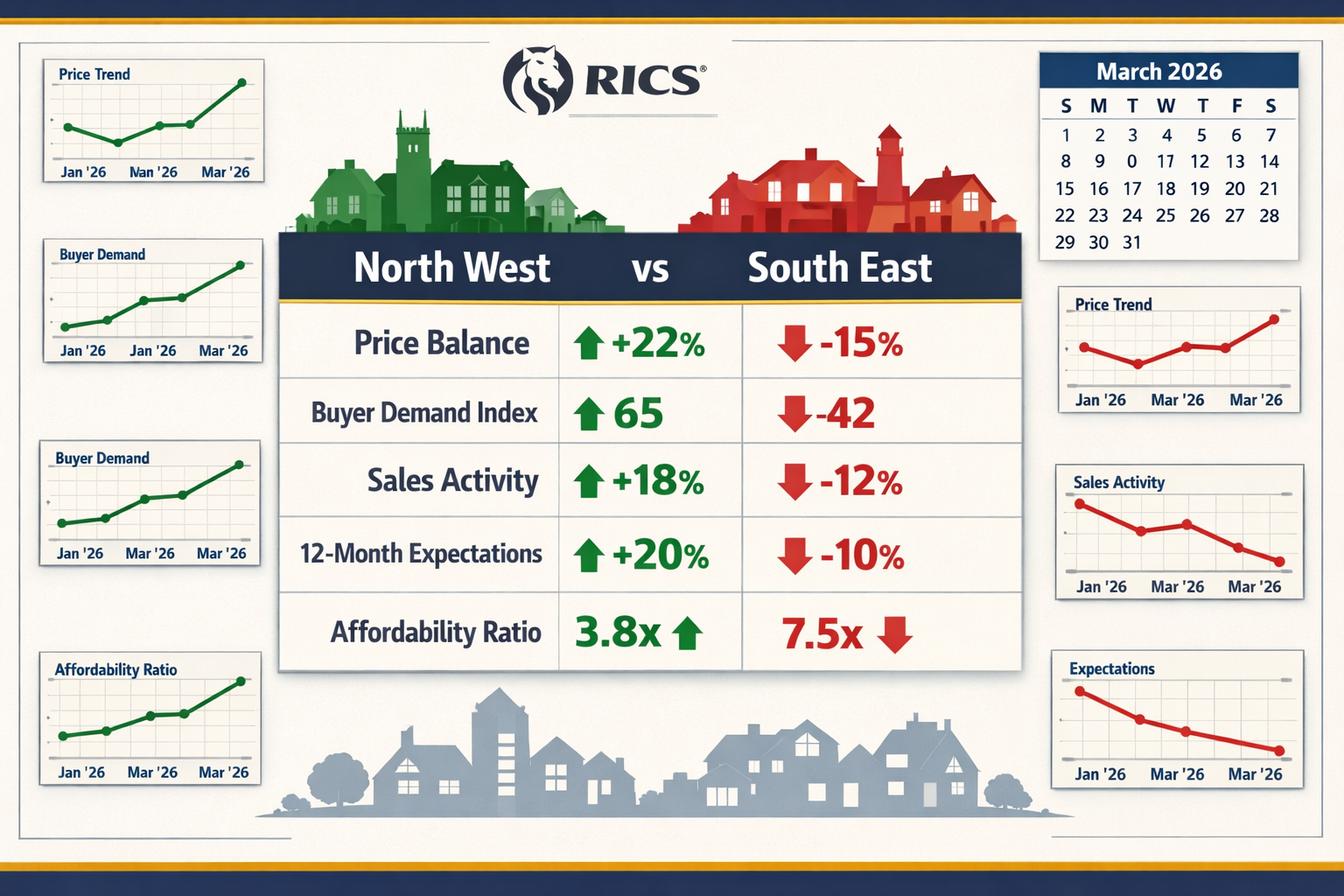
The extreme regional divergence in March 2026 requires expert witnesses to carefully consider their valuation methodology choices. Different approaches may yield materially different conclusions when regional markets move in opposite directions.
Comparable Sales Method Challenges
The comparable sales approach—typically the primary method for residential valuations—faces unique challenges in divergent markets:
Geographic radius decisions become contentious. How far can you reasonably extend your search for comparables when the subject property sits in a transitional zone between strong and weak markets? Expert witnesses must articulate clear, defensible criteria for inclusion and exclusion.
Temporal adjustments require exceptional rigor. With the North West showing positive momentum and the South East declining -24%, time adjustments to comparable sales become a major dispute flashpoint.[1] Document your adjustment methodology with reference to:
- Regional RICS price balance data
- Actual transaction price movements in the specific submarket
- Sales-to-stock ratios indicating market velocity changes
Cross-regional comparables should generally be avoided unless absolutely necessary, with extensive adjustment justification. A North West comparable used for a South East valuation (or vice versa) will face intense scrutiny.
Investment Method Considerations
For income-producing properties, the investment method requires careful consideration of yield assumptions in divergent markets. The South East's affordability challenges may support higher yields (lower capital values) while the North West's relative strength suggests yield compression.
Expert witnesses should:
- Reference rental market data showing regional divergence in tenant demand
- Analyze void periods and tenant turnover rates by region
- Consider covenant strength of tenants in different regional economic contexts
- Apply appropriate risk premiums reflecting regional market volatility
Residual Method for Development Valuations
Development site valuations become particularly contentious when regional markets diverge. The residual method's sensitivity to exit value assumptions means North West versus South East location can dramatically impact viability conclusions.
Exit value assumptions must be rigorously justified with reference to:
- Regional price expectations from RICS surveys (12-month forward data)[1]
- Comparable new-build sales in the specific region
- Buyer demand trends for new construction versus existing stock
Build cost differentials between regions should be factored, though these typically show less variation than end values.
Contingency and profit margins may warrant regional adjustment reflecting market risk profiles.
Red Book Compliance and Regional Context
All expert witness valuations must comply with RICS Valuation – Global Standards (Red Book). The Red Book valuation framework requires explicit consideration of market context, making regional divergence documentation essential.
Key Red Book requirements in divergent market contexts:
VPS 3 (Valuation Reports) mandates disclosure of any material uncertainty affecting the valuation. In March 2026, the extreme regional divergence and rapid sentiment shifts constitute material factors requiring explicit discussion.
VPGA 10 (Matters that may give rise to material valuation uncertainty) provides guidance on handling volatile markets. The 49-point swing in London expectations and -24% South East price balance clearly trigger these considerations.[1]
Assumption transparency becomes paramount. If you assume market stabilization, buyer demand recovery, or any other forward-looking scenario, the Red Book requires explicit statement and justification.
Case Study Approach: Preparing North West vs South East Comparative Testimony
Effective expert witness preparation requires developing a clear narrative that explains regional divergence to legal professionals and judges who may lack property market expertise. Consider this structured approach:
The Divergence Narrative Framework
Opening position: Establish that 2026 represents an unusual period of extreme regional variation, supported by authoritative RICS data showing the North West's resilience versus the South East's -24% decline.[1]
Structural factors: Explain the fundamental differences—affordability ratios, economic bases, buyer demographics—that create different trajectories rather than temporary fluctuations.
Temporal evolution: Walk through the January to February 2026 shift, showing how market sentiment deteriorated nationally but with regional variation.[1][2] This timeline establishes that your valuation date matters enormously.
Comparable analysis: Present your selected comparables with explicit regional context, showing why North West transactions cannot reliably inform South East valuations (or vice versa) without substantial adjustment.
Conclusion and range: Offer a defensible value conclusion or range that explicitly acknowledges the uncertainty inherent in volatile, divergent markets.
Anticipating Cross-Examination Challenges
Expert witnesses must prepare for predictable challenges in regional divergence cases:
Challenge 1: "Isn't the national trend more reliable than regional data?"
Response framework: Explain that the -12% national balance masks -24% South East versus positive North West performance, making national averages misleading for specific property valuations.[1] Reference the RICS survey methodology showing regional disaggregation.
Challenge 2: "How can you justify such different values for similar properties in different regions?"
Response framework: Present the affordability data, buyer demand differentials, and transaction evidence showing that "similar properties" face fundamentally different market conditions. The South East's ongoing affordability challenges versus the North West's relative accessibility create different value levels.[2]
Challenge 3: "Aren't you cherry-picking data to support your client's position?"
Response framework: Demonstrate comprehensive data gathering including contrary evidence, explain your methodology for weighting different data sources, and emphasize adherence to Red Book standards requiring objective analysis regardless of client preferences.
Documentation Standards for Defensibility
Maintain meticulous documentation throughout your preparation:
- Data source log: Record every data source with access date, specific figures extracted, and relevance to your analysis
- Methodology decisions: Document why you chose specific approaches and rejected alternatives
- Assumption register: List every assumption with justification and sensitivity analysis
- Comparable selection criteria: Create explicit written criteria applied consistently
- Peer review: Have another qualified surveyor review your methodology and conclusions
This documentation serves dual purposes: supporting your testimony under cross-examination and demonstrating professional competence if your work faces later scrutiny.
Practical Preparation Steps for March 2026 RICS Context Cases

When engaging with a specific regional divergence dispute in the March 2026 context, follow this systematic preparation workflow:
Step 1: Establish Precise Valuation Date and Regional Classification
Confirm the exact valuation date with legal counsel. Given the rapid market shifts between January and February 2026, even a few weeks' difference materially impacts applicable market conditions.[1]
Precisely classify the subject property's regional location. Properties in transitional zones between regions require particularly careful analysis. Consider engaging local chartered surveyors with specific submarket expertise.
Step 2: Compile Comprehensive RICS Survey Data
Gather all relevant RICS UK Residential Survey reports covering the period surrounding your valuation date:
- January 2026 report: Showed early signs of recovery despite caution[2]
- February 2026 report: Revealed sharp deterioration and regional divergence[1]
- March 2026 report (if available): Provides most current context
Extract and tabulate specific metrics for both North West and South East regions:
| Metric | North West | South East | National |
|---|---|---|---|
| Price Balance | Positive trend | -24% | -12% |
| New Buyer Enquiries | Relatively stronger | Weaker | -26% |
| Agreed Sales | Less negative | More negative | -12% |
| 12-Month Expectations | [Extract specific] | [Extract specific] | [Extract specific] |
Step 3: Gather Transaction Evidence with Regional Focus
Compile comparable sales data with meticulous attention to:
- Transaction dates relative to your valuation date
- Property characteristics allowing meaningful comparison
- Regional location ensuring appropriate geographic scope
- Market conditions at the time of each comparable sale
For a comprehensive approach, consider commissioning a Level 3 RICS Building Survey if the subject property's condition may materially affect value and comparability.
Step 4: Analyze Demand-Supply Dynamics
Beyond transaction prices, investigate the underlying market mechanics:
Buyer demand analysis: Review new enquiry trends, viewing patterns, and offer rates in the specific submarket. The -26% national buyer enquiry figure obscures significant regional variation.[1]
Supply pipeline: Assess new instruction levels and inventory accumulation. Rising stock levels in the South East versus stable or declining stock in the North West affects price dynamics.
Absorption rates: Calculate how quickly properties sell in each region, providing objective evidence of market strength or weakness.
Step 5: Address External Factors with Regional Impact
Document how broader market forces affect your specific regions differently:
Geopolitical uncertainty: The Iran conflict mentioned in February 2026 RICS survey responses affected southern regions more severely.[1] Investigate whether this reflects buyer demographics (international buyers in South East) or economic exposure.
Interest rate sensitivity: Higher-priced South East properties face greater absolute payment increases from rate rises compared to more affordable North West properties.
Policy environment: Any regional variations in planning policy, local taxation, or development incentives.
Step 6: Prepare Visual Aids and Demonstrative Evidence
Courts and arbitrators respond well to clear visual presentations:
- Regional comparison charts showing divergent price trends
- Heat maps illustrating geographic variation in market performance
- Timeline graphics showing market evolution around the valuation date
- Comparable sales maps with adjustment annotations
Step 7: Conduct Sensitivity Analysis
Given the market volatility in early 2026, present sensitivity analysis showing how different assumptions affect your conclusion:
- Scenario 1: North West momentum continues (justify probability)
- Scenario 2: South East decline moderates (justify probability)
- Scenario 3: Regional convergence occurs (justify probability)
This approach demonstrates professional judgment while acknowledging inherent uncertainty—a hallmark of credible expert testimony.
Step 8: Peer Review and Challenge Testing
Before finalizing your report, subject it to rigorous internal review:
- Have a colleague attempt to identify weaknesses in your methodology
- Role-play cross-examination scenarios
- Verify every data citation and calculation
- Ensure Red Book compliance throughout
Consider engaging specialists for specific aspects—specialist defect surveys if structural issues affect value, or valuation experts for complex methodology questions.
Common Pitfalls in Regional Divergence Expert Witness Work
Even experienced surveyors can stumble when handling extreme regional divergence cases. Avoid these frequent errors:
Pitfall 1: Over-Reliance on National Data
Using national average figures when regional data is available undermines credibility. The -12% national price balance tells you nothing useful about a specific North West or South East property when those regions diverge by 30+ percentage points.[1]
Pitfall 2: Insufficient Temporal Precision
Treating "early 2026" as a homogeneous period ignores the dramatic shift from January to February. Market conditions on January 15 differed materially from March 15, 2026.[1][2]
Pitfall 3: Advocacy Over Objectivity
Expert witnesses serve the court, not the client. Building a case to support a predetermined conclusion rather than following evidence to a conclusion destroys credibility and violates professional standards.
Pitfall 4: Inadequate Assumption Documentation
Failing to explicitly state and justify assumptions leaves your valuation vulnerable to challenge. In volatile, divergent markets, transparent assumption documentation becomes essential.
Pitfall 5: Ignoring Structural Factors
Treating regional divergence as temporary cyclical variation rather than recognizing structural factors (affordability, economic base, demographics) leads to flawed forward-looking conclusions.
Pitfall 6: Comparable Sales Without Sufficient Adjustment
Simply presenting comparable sales without rigorous adjustment for regional market conditions fails to account for the divergence that underlies the dispute.
Pitfall 7: Neglecting Red Book Requirements
Cutting corners on Red Book compliance—particularly regarding material uncertainty disclosure and assumption transparency—creates professional liability exposure and weakens testimony.
Future Outlook: Regional Divergence Beyond March 2026
While this article focuses on the March 2026 context, expert witnesses must consider how regional divergence may evolve:
Potential convergence scenarios: If affordability improves in the South East through price corrections while the North West faces supply constraints, regions may converge. Expert witnesses should assess convergence probability when providing forward-looking opinions.
Sustained divergence scenarios: Structural factors may support continued divergence, with the North West maintaining advantages in affordability and economic resilience. This scenario has implications for long-term investment valuations.
Policy intervention impacts: Government initiatives to address regional imbalances could materially affect future trajectories. Expert witnesses should monitor policy developments and incorporate them into forward-looking analysis.
Economic shock sensitivity: The differential impact of the Iran conflict on regional markets demonstrates that external shocks affect regions differently.[1] Future geopolitical or economic events may similarly create or exacerbate divergence.
Conclusion
The Expert Witness Preparation for Regional Price Divergence Disputes: North West vs South East Cases in March 2026 RICS Context requires a sophisticated, multi-layered approach that goes far beyond traditional valuation methodology. The extreme divergence documented in the February 2026 RICS survey—with the North West showing resilience while the South East faces -24% downward pressure—creates unprecedented challenges for expert witnesses navigating valuation disputes.[1]
Success in these cases demands:
✅ Comprehensive data gathering from authoritative sources, particularly RICS regional surveys providing credible foundation evidence
✅ Rigorous methodology with explicit documentation of every assumption, adjustment, and analytical choice
✅ Regional context expertise demonstrating deep understanding of structural factors driving divergence
✅ Red Book compliance throughout the valuation process, with particular attention to material uncertainty disclosure
✅ Defensible presentation anticipating cross-examination challenges and preparing clear, evidence-based responses
✅ Professional objectivity prioritizing accurate analysis over client advocacy
Actionable Next Steps
For expert witnesses preparing for regional divergence disputes in 2026:
-
Audit your data sources: Ensure you have access to comprehensive RICS regional survey data and local transaction databases covering both North West and South East markets
-
Develop regional expertise: If you typically work in one region, invest time understanding the structural factors affecting the contrasting region to provide credible comparative analysis
-
Update methodology protocols: Revise your standard valuation procedures to explicitly address regional divergence scenarios with enhanced documentation requirements
-
Seek specialist support: Engage expert witness surveyors with specific regional expertise when cases fall outside your primary geographic competence
-
Maintain continuing professional development: Stay current with evolving RICS guidance on valuation in uncertain markets and regional analysis best practices
-
Build demonstrative evidence libraries: Create templates for visual presentations of regional divergence data that can be customized for specific cases
-
Establish peer review networks: Develop relationships with other qualified surveyors who can provide objective review of your methodology and conclusions
The regional price divergence characterizing the UK property market in March 2026 presents both challenges and opportunities for expert witnesses. Those who invest in rigorous preparation, comprehensive evidence gathering, and transparent methodology will deliver testimony that withstands legal scrutiny and serves the interests of justice. The stakes in these disputes—often involving substantial property values and significant financial consequences—demand nothing less than excellence in expert witness preparation.
For professional support with complex valuation disputes or expert witness services, contact qualified chartered surveyors with demonstrated expertise in regional market analysis and litigation support.
References
[1] UK Residential Survey February 2026 – https://www.rics.org/news-insights/uk-residential-survey-february-2026
[2] UK Resi Survey Jan 2026 Report Shows Early Signs Market Recovery Despite Caution – https://www.rics.org/news-insights/uk-resi-survey-jan-2026-report-shows-early-signs-market-recovery-despite-caution