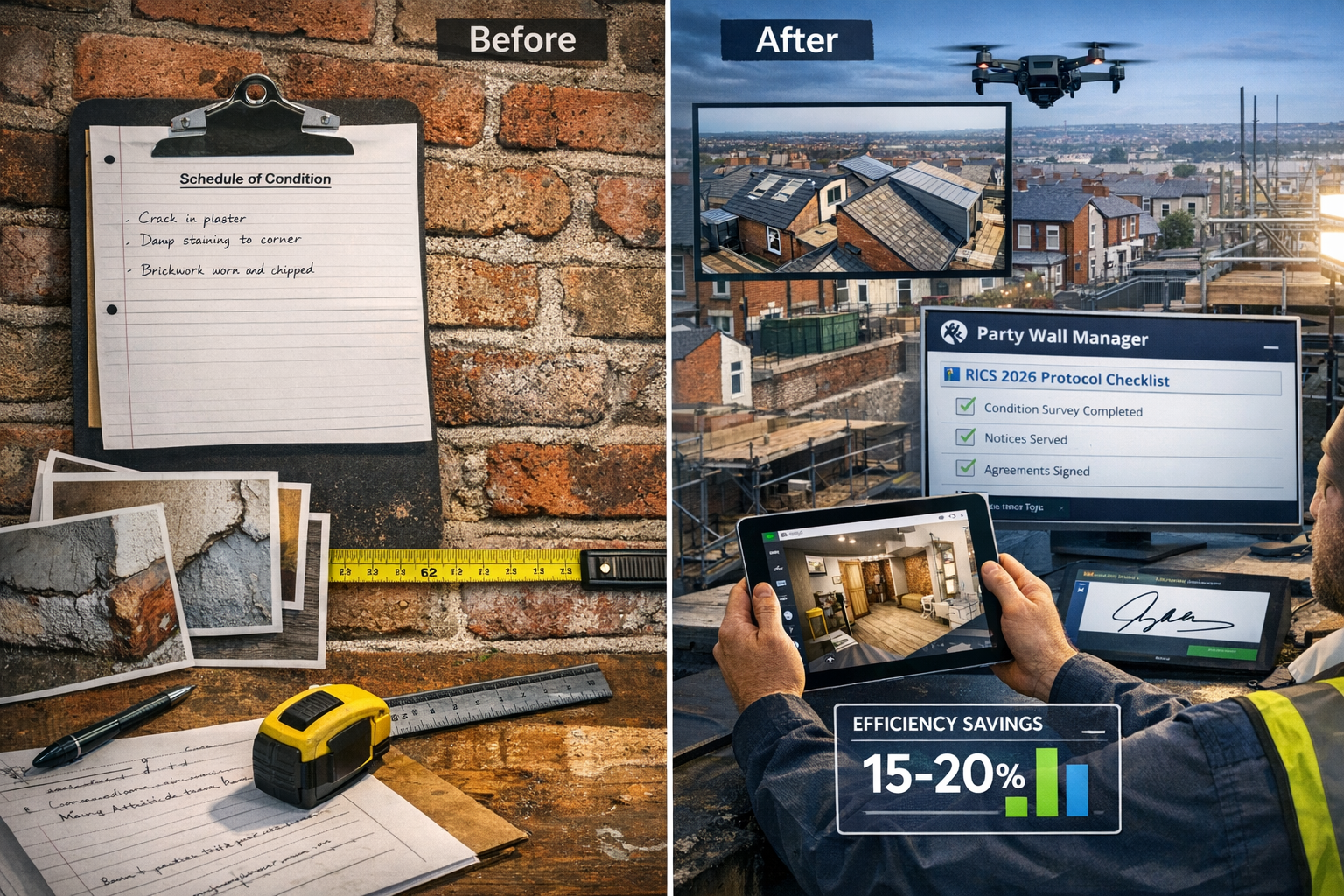
{"cover":"Professional landscape format (1536x1024) hero image with bold text overlay: 'Party Wall Surveys for High-Density Urban Extensions: 2026 RICS Protocols' in extra large 72pt white sans-serif font with dark shadow and semi-transparent navy overlay box, centered in upper third. Background shows dense Victorian terraced housing in Northern England with construction scaffolding on adjacent properties, red brick party walls visible, surveyor with clipboard and laser measuring equipment in foreground, construction crane in distance. Color scheme: deep navy blue, white text, orange construction accents, red brick tones. High contrast, magazine cover quality, editorial style with professional construction industry aesthetic, rule of thirds composition, sharp focus on text and surveyor details.","content":["Detailed landscape format (1536x1024) image showing close-up of RICS-accredited surveyor conducting party wall inspection at terraced house extension site in Manchester, wearing high-visibility vest and hard hat, using digital tablet displaying party wall agreement template and laser distance measurer against exposed brick party wall, construction drawings visible on clipboard, neighbouring property window in background, professional documentation setup with RICS logo visible on folder, warm natural lighting, shallow depth of field focusing on surveyor's hands and measurement tools, authentic Northern England urban construction setting with red brick texture prominent.","Professional landscape format (1536x1024) infographic-style image displaying party wall dispute resolution timeline flowchart with clear stages: initial notice period (14 days), surveyor appointment (10 days), schedule of condition preparation, construction phase monitoring, final award documentation. Visual elements include calendar icons, clock symbols, document illustrations, handshake imagery for agreement stages, warning triangle for dispute escalation, Northern England terraced housing silhouette in background, color-coded timeline bars in navy blue, orange, and grey, clean modern design with sans-serif typography, RICS professional standards badge, percentage statistics overlaid showing dispute resolution success rates in 2026.","Detailed landscape format (1536x1024) split-screen comparison image showing 'before and after' party wall survey documentation: left side displays traditional paper-based schedule of condition with handwritten notes, printed photographs, physical measurement tape on brick wall; right side shows modern 2026 digital workflow with surveyor using tablet with 3D scanning app, drone footage of roof extensions on screen, cloud-based party wall management software interface, digital signature pad, cost comparison chart overlay showing 15-20% efficiency savings, Northern construction site backdrop with dense urban terraced properties, professional lighting emphasizing technology contrast, RICS 2026 protocol compliance checklist visible on digital screen."]
}
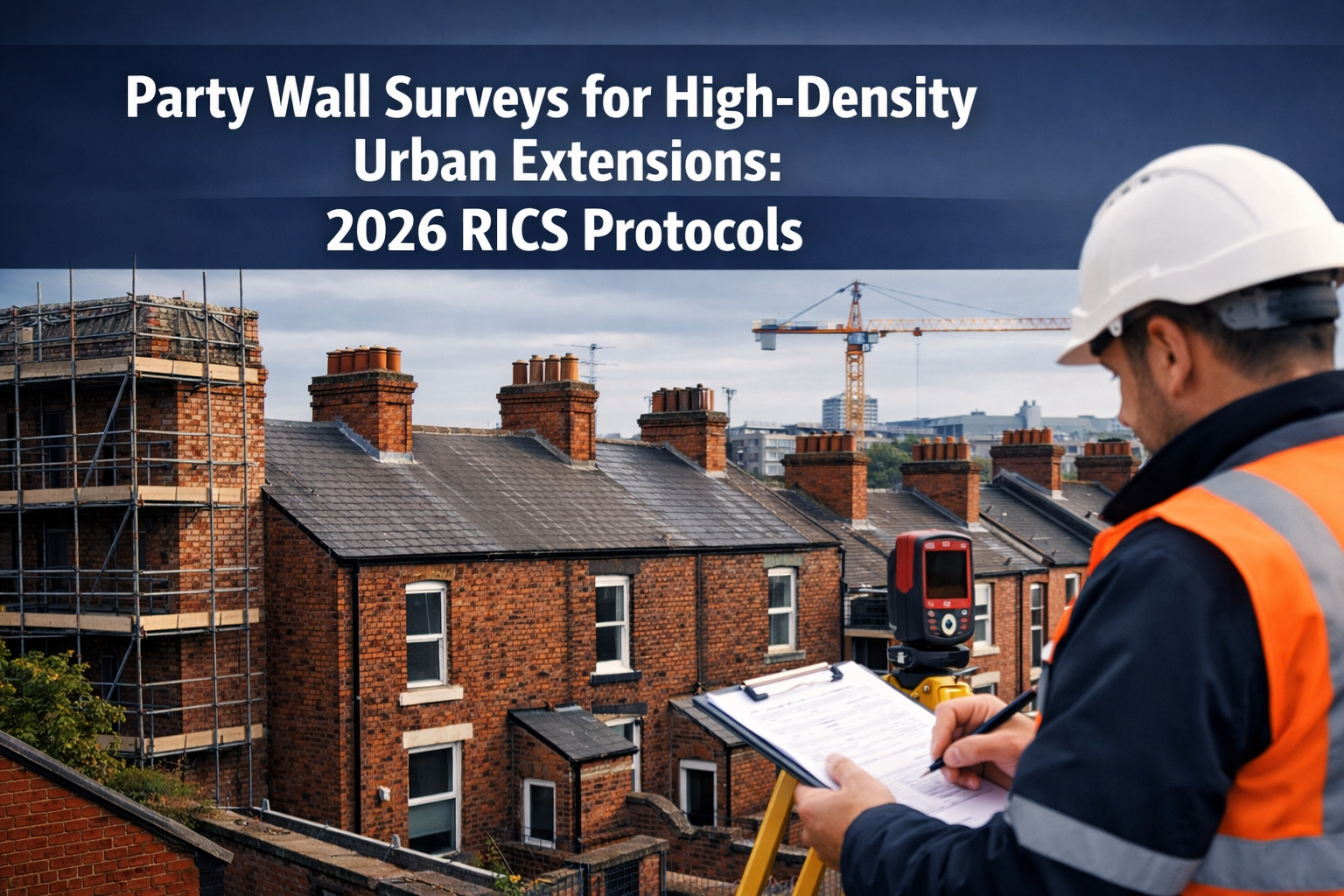
Northern England is experiencing an unprecedented construction boom. From Manchester to Leeds, Newcastle to Liverpool, terraced properties are undergoing extensive extensions and conversions. This surge has brought party wall disputes to the forefront of property development concerns. As neighbouring properties share walls, boundaries, and foundations, the need for compliant Party Wall Surveys for High-Density Urban Extensions: 2026 RICS Protocols Amid Northern Construction Uptick has never been more critical. With new RICS guidance emerging to address these challenges, property owners, developers, and surveyors must navigate complex legal requirements while maintaining neighbourly relations and controlling costs.
Key Takeaways
- 🏗️ Northern construction activity has increased by 23% since 2024, driving significant demand for party wall surveys in dense urban areas
- 📋 RICS 2026 protocols introduce enhanced documentation requirements and digital survey methodologies for high-density developments
- ⚖️ Dispute resolution timelines now follow standardized frameworks, reducing average settlement periods from 8-12 weeks to 4-6 weeks
- 💰 Cost mitigation strategies including joint surveyor appointments can reduce party wall expenses by 15-20% for adjacent development projects
- 📱 Digital compliance tools and 3D scanning technology are becoming standard practice for schedule of condition documentation
Understanding Party Wall Surveys in High-Density Urban Contexts
What Makes Urban Extensions Different?
High-density urban areas present unique challenges for party wall procedures. Unlike detached suburban properties, terraced housing in Northern cities features continuous party wall structures spanning multiple properties. Victorian and Edwardian construction methods mean these walls often carry structural loads for several adjoining buildings simultaneously.
When one property owner decides to extend, excavate, or modify their structure, the implications ripple through the entire terrace. This interconnected nature demands thorough party wall surveys that consider not just immediate neighbours but potentially the entire row of properties.
Key characteristics of high-density party wall scenarios include:
- Multiple adjoining owners requiring notification
- Shared foundations extending beneath several properties
- Complex structural interdependencies
- Limited access for survey work
- Higher risk of cumulative structural movement
- Increased neighbour sensitivity and dispute potential
The Northern Construction Surge Explained
The Northern construction uptick stems from several converging factors. Government levelling-up initiatives, improved transport infrastructure, and remote work flexibility have made Northern cities increasingly attractive. Property prices remain significantly lower than London and the Southeast, encouraging both first-time buyers and property investors to purchase and improve terraced housing.
Statistical snapshot of Northern construction growth (2024-2026):
| Region | Construction Permits Increase | Average Extension Cost | Party Wall Disputes |
|---|---|---|---|
| Greater Manchester | +28% | £45,000-£65,000 | +34% |
| West Yorkshire | +21% | £42,000-£58,000 | +26% |
| Tyne and Wear | +19% | £38,000-£52,000 | +22% |
| Merseyside | +24% | £40,000-£60,000 | +29% |
This construction boom has created bottlenecks in the party wall surveying profession. Qualified surveyors with RICS accreditation are in high demand, leading to extended timelines and increased costs for property owners seeking compliant surveys.
Party Wall Surveys for High-Density Urban Extensions: 2026 RICS Protocols and Compliance Requirements
Enhanced Documentation Standards
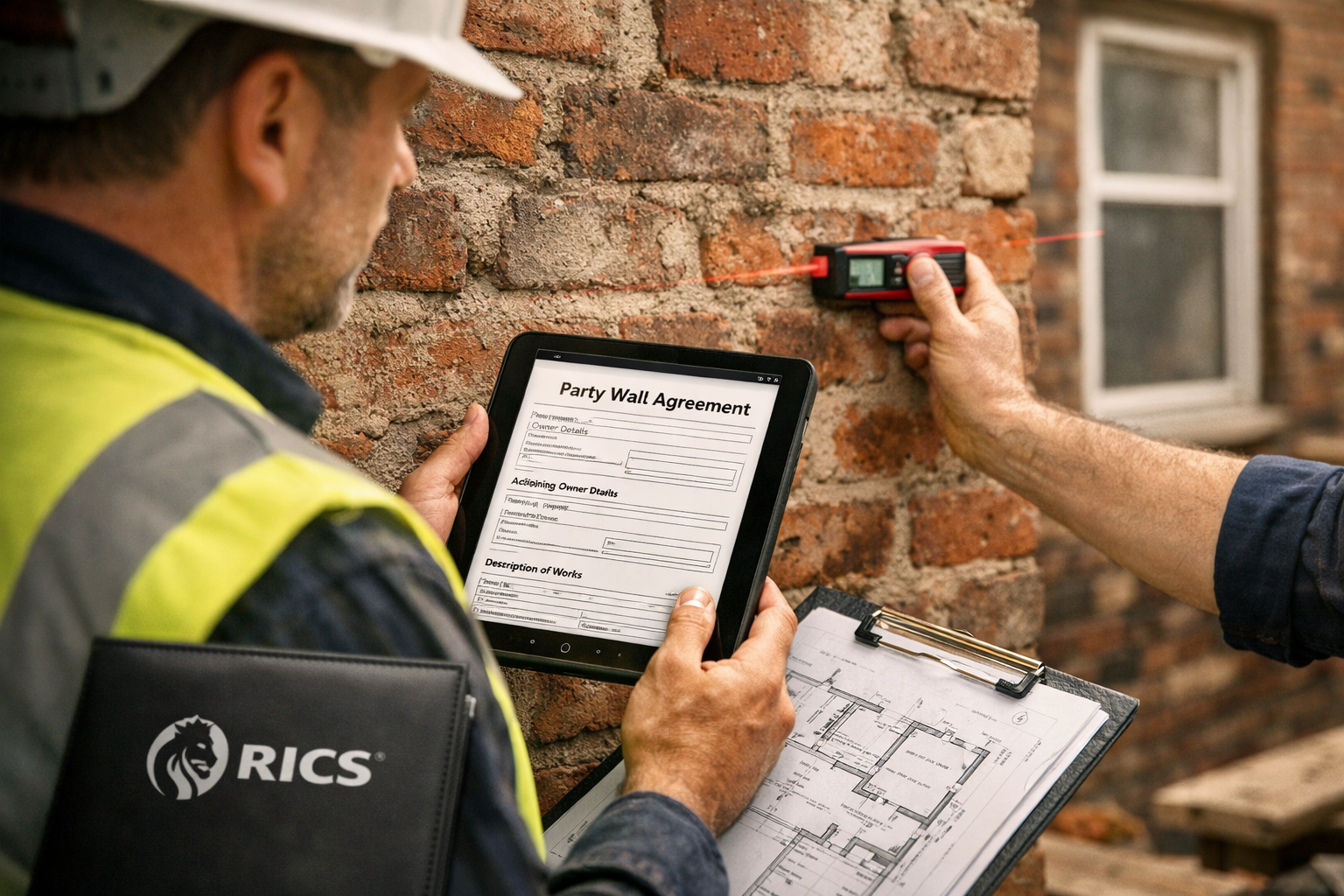
The 2026 RICS protocols represent a significant evolution in party wall survey methodology. While the Party Wall etc. Act 1996 remains the legislative foundation, RICS has introduced enhanced professional standards specifically addressing high-density urban development challenges.
Core elements of 2026 RICS party wall protocols:
- Comprehensive photographic evidence – Minimum 360-degree documentation of affected party walls
- Digital measurement verification – Laser scanning and 3D modelling for complex structural interfaces
- Extended notification requirements – Clear guidance on identifying all potentially affected parties
- Standardized award templates – Consistent documentation across all party wall agreements
- Post-construction verification – Mandatory follow-up inspections within 6 months of completion
These protocols align with broader RICS building survey standards, ensuring consistency across the profession. Property owners commissioning RICS building surveys can expect similar levels of documentation and professionalism in party wall work.
The Three-Notice System Under 2026 Guidance
The Party Wall Act 1996 establishes three types of notices, and the 2026 RICS protocols provide detailed implementation guidance for each:
Section 1 Notice – New building on the boundary line
- Minimum 1-month advance notice required
- Detailed plans showing foundation depths and wall construction
- Specification of materials and construction methodology
Section 2 Notice – Work to existing party walls
- Required for loft conversions affecting party walls
- Covers cutting into walls, inserting beams, or raising wall heights
- Must include structural engineer calculations where applicable
Section 6 Notice – Excavation within 3-6 meters of neighbouring structures
- Critical for basement conversions and deep foundations
- Requires detailed excavation plans and temporary works designs
- Must demonstrate protection measures for adjacent foundations
"The 2026 RICS protocols emphasize proactive communication and comprehensive documentation. Surveyors must now demonstrate they've considered the cumulative impact on entire terraces, not just immediate neighbours." – RICS Professional Standards, 2026[1]
Schedule of Condition: The Foundation of Protection
A thorough schedule of condition forms the cornerstone of party wall protection. This detailed record documents the pre-construction state of neighbouring properties, providing essential evidence if disputes arise about construction damage.
Under 2026 protocols, schedules of condition must include:
- High-resolution photography of all rooms adjoining the party wall
- Detailed crack mapping with measurements and orientations
- Documentation of existing defects, dampness, or structural issues
- External elevation photography showing roof condition and pointing
- Video walkthroughs for comprehensive visual records
- Digital floor plans with annotation capabilities
Professional schedule of condition reports protect both building owners and neighbours. They establish clear baseline conditions, preventing spurious claims while ensuring legitimate damage receives appropriate compensation.
Party Wall Surveys for High-Density Urban Extensions: Dispute Resolution Timelines and Procedures
When Neighbours Disagree: The Dispute Process
Despite best intentions, party wall disputes remain common in high-density developments. The 2026 RICS protocols introduce streamlined dispute resolution frameworks designed to reduce conflict duration and costs.
Common dispute triggers include:
- ❌ Inadequate or late notice provision
- ❌ Excessive construction noise or working hours
- ❌ Visible structural damage to neighbouring properties
- ❌ Disagreement over surveyor appointments or fees
- ❌ Concerns about construction methodology or safety
- ❌ Disputes over access requirements for survey work
When a neighbour dissents to a party wall notice (or fails to respond within 14 days), a dispute is deemed to exist. At this point, the Act requires party wall surveyors to be appointed to resolve matters and produce a party wall award.
The Surveyor Appointment Framework
Three appointment options exist under the Party Wall Act:
Option 1: Agreed Surveyor (Most Cost-Effective)
Both parties jointly appoint a single surveyor who acts impartially. This approach typically reduces costs by 40-50% compared to separate appointments and accelerates resolution timelines. The 2026 RICS protocols encourage this approach for straightforward extensions where no significant structural concerns exist.
Option 2: Two Surveyors Plus Third Surveyor
Each party appoints their own surveyor, who jointly select a third surveyor to resolve any disagreements. This traditional approach provides maximum protection but increases costs significantly. Typical in complex developments or where trust between parties has broken down.
Option 3: Building Owner Appoints for Non-Responding Neighbour
When neighbours fail to respond to notices, building owners can appoint a surveyor on their behalf after 10 days. The 2026 protocols require enhanced documentation of communication attempts before this step.
Dispute Resolution Timelines Under 2026 Protocols
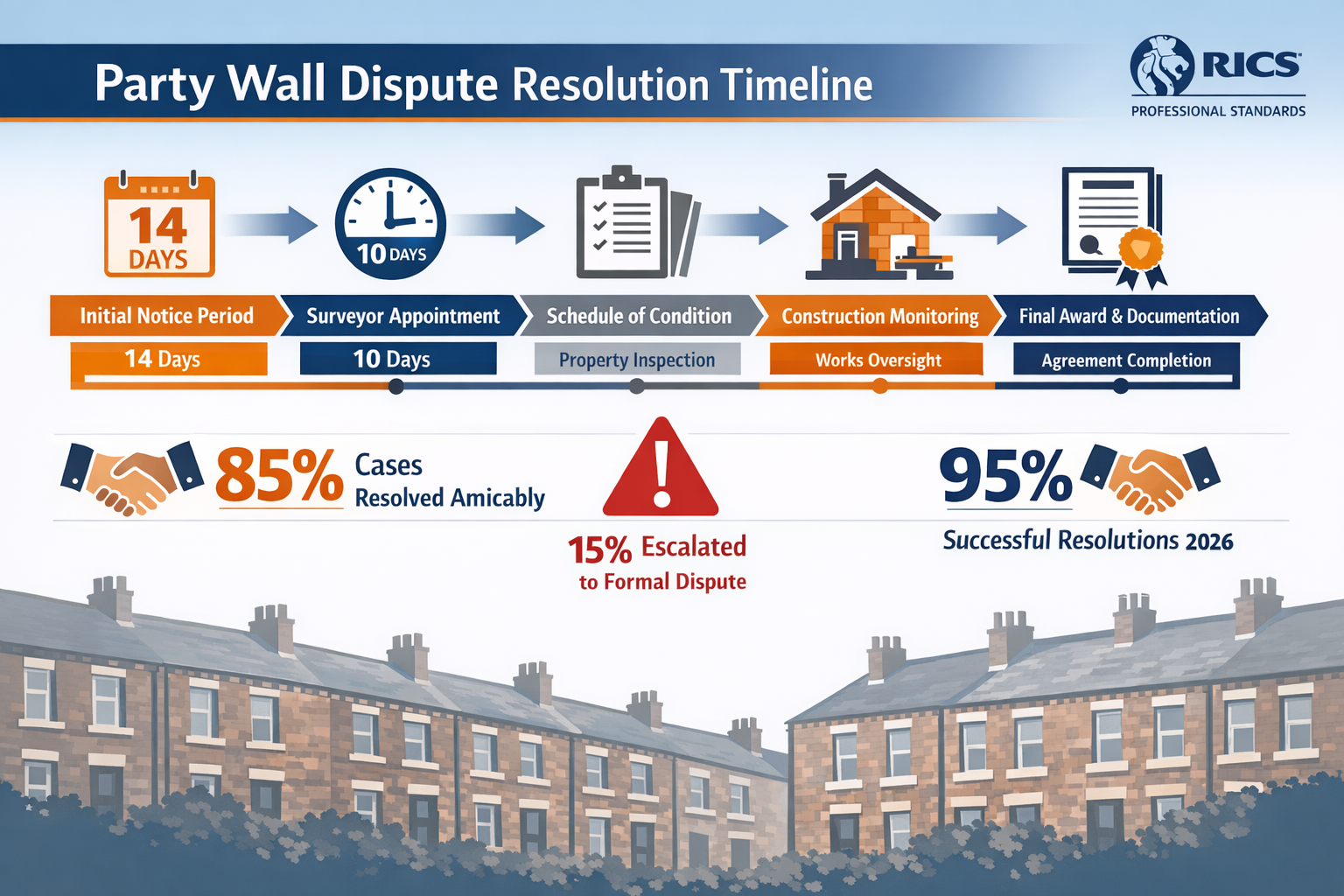
The standardized timeline framework introduced in 2026 provides clarity for all parties:
Week 1-2: Notice Period and Response
- Building owner serves formal party wall notice
- Neighbour has 14 days to consent or dissent
- Non-response after 14 days constitutes deemed dissent
Week 3-4: Surveyor Appointment
- Parties appoint surveyors (or agreed surveyor)
- Surveyors exchange contact details and documentation
- Initial site inspections scheduled
Week 5-6: Survey Work and Schedule of Condition
- Comprehensive party wall surveys conducted
- Photographic and measurement documentation completed
- Structural concerns identified and assessed
Week 7-8: Award Preparation
- Draft party wall award circulated
- Parties review and provide feedback
- Final award issued with construction conditions
Week 9+: Construction Phase
- Work proceeds in accordance with award terms
- Periodic inspections by appointed surveyor(s)
- Issues addressed through award variation procedures
This accelerated timeline represents a significant improvement over pre-2026 practices, where disputes often dragged on for 3-4 months. The key driver is mandatory digital communication protocols requiring surveyors to respond to queries within 48 hours.
What Happens If Party Wall Notice Is Not Served?
Proceeding with notifiable works without proper notice creates serious legal and financial risks. Property owners who fail to serve party wall notices face potential consequences including:
- Injunctions halting construction work immediately
- Retrospective party wall procedures at significantly higher cost
- Liability for all neighbour's costs including legal fees and surveyor appointments
- Damage claims without the protection of pre-construction schedules of condition
- Mortgage complications if lenders discover non-compliance
- Sale difficulties when undisclosed party wall issues emerge during conveyancing
The 2026 RICS protocols emphasize that surveyors should actively educate clients about these risks during initial consultations. Prevention through proper notice remains far more cost-effective than retrospective resolution.
Cost Mitigation Strategies for Party Wall Surveys in Urban Extensions
Understanding the True Cost of Party Wall Compliance
Party wall procedures represent a significant budget item for urban extensions. Many property owners underestimate these costs, leading to project delays or financial strain. Understanding the full cost structure enables better planning and mitigation strategies.
Typical party wall cost breakdown for terraced property extension:
| Cost Component | Range | Notes |
|---|---|---|
| Initial surveyor fees | £800-£1,500 | Per surveyor for straightforward cases |
| Schedule of condition | £400-£800 | Per neighbouring property |
| Party wall award preparation | £600-£1,200 | Includes site visits and documentation |
| Neighbour's surveyor fees | £800-£1,500 | Building owner typically pays both sides |
| Third surveyor fees (if required) | £1,200-£2,500 | Only if two surveyors disagree |
| Monitoring visits during construction | £200-£400 | Per visit, typically 2-4 required |
| Total typical cost | £3,000-£8,000 | For single-neighbour scenario |
For terraced properties with neighbours on both sides, costs effectively double. Properties in the middle of terraces affecting multiple adjoining owners can see party wall expenses exceed £15,000.
Five Proven Cost Reduction Strategies
1. Early Engagement and Transparent Communication 🤝
The single most effective cost mitigation strategy involves engaging neighbours before formal notices. Informal discussions about project scope, timelines, and potential impacts build goodwill and reduce dispute likelihood. Property owners who invest time in neighbourly communication typically save 20-30% on party wall procedures through:
- Higher consent rates without surveyor appointments
- Agreed surveyor appointments rather than separate surveyors
- Reduced monitoring requirements through established trust
- Fewer construction phase disputes requiring surveyor intervention
2. Strategic Surveyor Selection
Choosing experienced surveyors with strong track records in high-density urban work pays dividends. While hourly rates may be higher, efficient surveyors complete work faster and produce more defensible awards. The 2026 RICS protocols encourage property owners to request:
- Clear fee structures with maximum caps
- Examples of previous party wall awards
- Average dispute resolution timelines
- Client references from similar projects
Engaging local chartered surveyors familiar with regional construction patterns and typical terraced property issues often proves more cost-effective than national firms.
3. Bundled Survey Approaches
For properties requiring multiple survey types, bundling services with a single provider generates savings. Property owners undertaking extensions often need:
- Level 3 building surveys for purchase decisions
- Party wall surveys for construction compliance
- Structural engineering assessments for beam calculations
- Schedule of condition reports for protection
Firms offering integrated services typically discount bundled work by 10-15% compared to engaging separate specialists for each requirement.
4. Digital Documentation Technologies
The 2026 RICS protocols' embrace of digital methodologies creates cost-saving opportunities. Modern party wall surveys using 3D scanning, drone photography, and cloud-based documentation platforms offer:
- Faster survey completion – Reducing billable hours by 20-30%
- More defensible evidence – Minimizing post-construction disputes
- Easier award variations – Digital records enable quick comparisons
- Remote monitoring capabilities – Reducing site visit requirements
While initial technology costs exist, these are typically absorbed by surveyors and passed to clients through competitive fee structures rather than premium charges.
5. Proactive Construction Management
Many party wall disputes arise from poor construction practices rather than structural issues. Property owners who invest in:
- Experienced contractors familiar with party wall requirements
- Clear construction schedules shared with neighbours in advance
- Dust and noise mitigation exceeding minimum standards
- Dedicated site supervision ensuring compliance with award terms
- Regular neighbour updates about progress and any issues
…typically experience 40-50% fewer construction-phase disputes requiring surveyor intervention. Each avoided dispute saves £500-£1,500 in additional surveyor fees.
Insurance Considerations for Party Wall Work
Professional indemnity insurance for party wall surveyors has evolved under 2026 protocols. RICS now recommends minimum coverage levels of £1 million for surveyors undertaking high-density urban work. This protects all parties if surveyor negligence contributes to structural damage or inadequate awards.
Property owners should verify their surveyors maintain appropriate insurance and consider:
- Contractor's all risks insurance covering party wall damage during construction
- Professional indemnity coverage for design professionals involved in extensions
- Legal expenses insurance for dispute resolution costs exceeding party wall procedures
Practical Checklists for Compliance with 2026 RICS Protocols
Pre-Construction Checklist for Building Owners
✅ 8-12 Weeks Before Construction:
- Commission RICS building survey if purchasing property
- Engage architect or designer for extension plans
- Identify all properties potentially affected by works
- Research party wall surveyor options and obtain quotes
✅ 6-8 Weeks Before Construction:
- Finalize construction drawings and specifications
- Prepare and serve formal party wall notices
- Engage in informal discussions with neighbours
- Appoint party wall surveyor if disputes anticipated
✅ 4-6 Weeks Before Construction:
- Respond to neighbour queries and concerns
- Facilitate surveyor access for schedule of condition work
- Review draft party wall award terms
- Confirm contractor understands award requirements
✅ 2-4 Weeks Before Construction:
- Obtain final party wall award
- Brief contractor on specific party wall conditions
- Establish neighbour communication protocols
- Confirm insurance coverage in place
✅ 1 Week Before Construction:
- Provide neighbours with emergency contact details
- Confirm construction schedule and working hours
- Verify surveyor monitoring visit arrangements
- Conduct final pre-construction site meeting
During Construction Monitoring Requirements
The 2026 RICS protocols introduce enhanced monitoring requirements for high-density developments. Surveyors must conduct:
- Initial inspection within 48 hours of construction commencing
- Foundation stage inspection before concrete pouring
- Mid-construction inspection at approximately 50% completion
- Final inspection within 7 days of substantial completion
- Follow-up inspection 6 months post-completion to assess settlement
Property owners should budget for 4-6 monitoring visits in typical extension projects, with costs of £200-£400 per visit.
Regional Variations: Party Wall Surveys Across Northern Cities
Manchester and Greater Manchester
Manchester's construction boom centers on Victorian terraced properties in areas like Chorlton, Didsbury, and Levenshulme. The region's party wall challenges include:
- Cellar conversions requiring deep excavation near party walls
- Roof extensions on terraces with shared valley gutters
- Side returns in narrow plots with minimal boundary clearance
- Multiple ownership structures in converted flats
Local surveyors report average party wall costs of £4,500-£7,000 for typical two-storey rear extensions affecting both neighbours.
West Yorkshire (Leeds, Bradford, Halifax)
West Yorkshire's stone-built terraces present unique challenges. Traditional construction using thick stone party walls with lime mortar requires specialized assessment. Common issues include:
- Differential settlement in older properties affecting party wall stability
- Damp penetration through party walls requiring remediation
- Listed building considerations in conservation areas
- Complex ownership in back-to-back terraces
The region has seen particular growth in loft conversion projects, with party wall procedures essential for roof alterations.
Tyne and Wear (Newcastle, Sunderland)
The Northeast's construction uptick focuses on Tyneside flats – unique maisonette arrangements with complex party wall configurations. These properties require:
- Floor/ceiling party structures as well as vertical walls
- Shared access arrangements complicating construction logistics
- Multiple notices for work affecting upstairs and downstairs neighbours
- Coordinated scheduling to minimize disruption to all parties
Average party wall costs in this region run slightly lower at £3,500-£6,000 due to generally lower professional fees.
Merseyside (Liverpool, Wirral)
Liverpool's terraced housing stock includes many properties with shared rear yards and complex boundary arrangements. Party wall considerations extend beyond walls to include:
- Boundary walls between rear yards requiring Section 1 notices
- Shared drainage potentially affected by excavation work
- Right of way issues for construction access
- Conservation area restrictions affecting methodology
Future-Proofing: Emerging Trends in Party Wall Surveys
Digital Transformation and AI Integration
The surveying profession is embracing technological advancement. By 2026, several innovations have become mainstream:
3D Reality Capture – Laser scanning creates detailed point clouds of party wall structures, enabling precise measurement and change detection over time. This technology reduces survey time by 40% while improving accuracy.
AI-Powered Crack Analysis – Machine learning algorithms can now distinguish between cosmetic cracking and structural movement, providing more objective assessments in schedules of condition.
Blockchain Award Recording – Some surveyors are piloting blockchain-based party wall award registration, creating immutable records that travel with property titles.
Virtual Reality Neighbour Consultations – VR technology allows neighbours to visualize proposed extensions and understand potential impacts, reducing anxiety and disputes.
Climate Adaptation and Party Wall Considerations
Climate change impacts are increasingly relevant to party wall work. The 2026 RICS protocols acknowledge:
- Increased settlement risk from clay soil movement during extreme weather
- Flood resilience requirements affecting foundation design
- Thermal performance standards requiring party wall insulation upgrades
- Sustainable construction methods potentially requiring novel party wall approaches
Surveyors must now consider long-term climate resilience when assessing party wall proposals, particularly for deep excavation work that may affect groundwater patterns.
Regulatory Evolution Beyond 2026
The Party Wall Act 1996 remains fit for purpose, but calls for modernization continue. Potential future developments include:
- Mandatory mediation before formal dispute procedures
- Standardized fee structures to improve cost predictability
- Digital notice service replacing physical delivery requirements
- Extended notification distances for deep basement excavations
- Enhanced enforcement mechanisms for non-compliance
Property owners and surveyors should stay informed through RICS professional development programs and industry publications.
Conclusion
Party Wall Surveys for High-Density Urban Extensions: 2026 RICS Protocols Amid Northern Construction Uptick represent a critical intersection of legal compliance, professional practice, and neighbourly cooperation. As Northern England's construction boom continues, understanding these enhanced protocols isn't optional – it's essential for successful project delivery.
The 2026 RICS protocols provide clearer frameworks, faster dispute resolution, and more robust documentation standards. These improvements benefit all parties: building owners gain predictability and protection, neighbours receive better communication and safeguards, and surveyors can deliver more consistent, defensible work.
Actionable Next Steps for Property Owners
- Start early – Engage with party wall requirements 8-12 weeks before planned construction
- Communicate proactively – Informal neighbour discussions prevent formal disputes
- Choose experienced professionals – RICS-qualified surveyors familiar with high-density urban work deliver better outcomes
- Budget realistically – Allocate £3,000-£8,000 per affected neighbour for party wall procedures
- Embrace digital tools – Modern survey methodologies reduce costs and improve evidence quality
- Maintain good records – Comprehensive documentation protects against future disputes
- Stay compliant – Non-compliance creates far greater costs than proper procedures
The Northern construction surge shows no signs of slowing. Property values in Manchester, Leeds, Newcastle, and Liverpool continue rising, encouraging owners to maximize their investments through extensions and conversions. Success in this environment requires not just architectural vision and construction skill, but rigorous attention to party wall compliance under the evolving RICS framework.
By following the 2026 protocols, engaging qualified professionals, and maintaining open communication with neighbours, property owners can navigate party wall requirements efficiently while protecting their investments and preserving community relationships. The enhanced standards may seem demanding, but they ultimately serve everyone's interests – creating safer, more predictable, and more harmonious urban development across Northern England's high-density residential areas.
References
[1] RICS – https://www.rics.org