

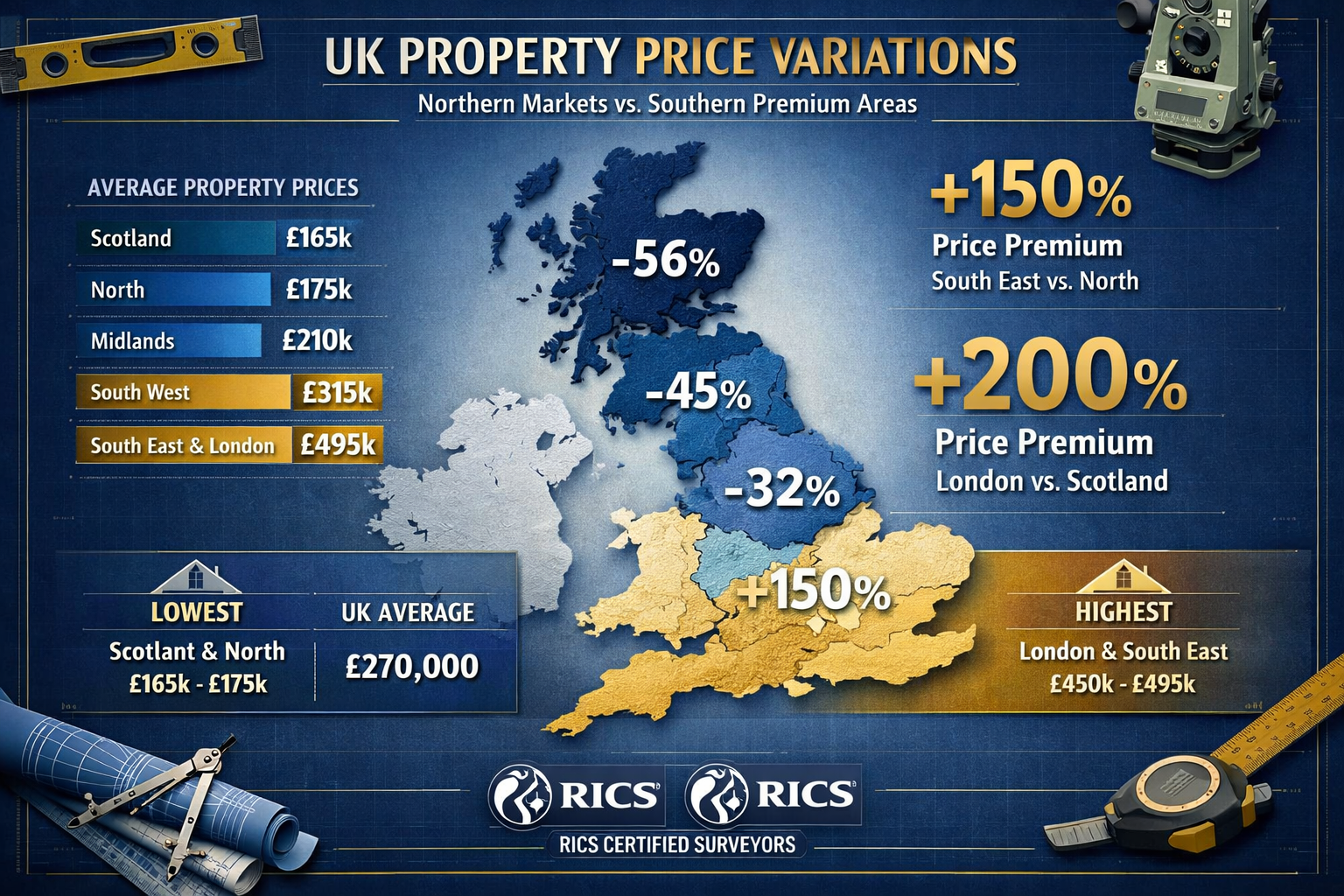
The UK property market in 2026 faces an unprecedented challenge: regional price disparities have reached historic levels, with some Southern properties commanding 150-200% premiums over comparable Northern homes. For chartered surveyors, this widening gulf demands sophisticated valuation techniques that account for dramatic market variations. Understanding Valuation Adjustments for Widening North-South Price Gaps: Surveyor Tools for 2026 Regional Disparities has become essential for delivering accurate, defensible property assessments in today's diverging markets.
Recent data reveals that Northern regions are showing unexpected strength while Southern coastal markets face pressure from insurance costs and shifting migration patterns[1]. This reversal of traditional trends requires surveyors to recalibrate their approach to comparable sales analysis and regional adjustment factors.
Key Takeaways
- 🏘️ Regional price gaps have widened to 150-200% between comparable Northern and Southern properties, requiring sophisticated adjustment methodologies
- 📊 Northern markets are strengthening while some Southern regions face headwinds from insurance costs and reverse migration patterns
- 🔧 RICS-compliant valuation tools must incorporate location-specific multipliers, affordability indices, and supply-demand metrics for accurate 2026 assessments
- 📈 Comparable sales analysis requires expanded search parameters and cross-regional adjustment factors to maintain valuation accuracy
- ⚖️ Affordability disparities have reached critical levels, with middle-income buyers now affording only 21% of national listings compared to 50% pre-pandemic[2]
Understanding the 2026 North-South Property Market Divide
The Shifting Regional Landscape
The traditional assumption that Southern properties automatically command premium valuations is being challenged in 2026. Northern and Midwestern metros—including suburbs of major cities—are experiencing market heating, while coastal Southern regions face unexpected cooling[1]. This shift stems from multiple converging factors that surveyors must understand to deliver accurate valuations.
Key drivers of regional divergence include:
- Natural disaster exposure: Coastal Florida and Texas properties face declining demand due to hurricane risks and escalating insurance premiums
- Pandemic-era migration reversal: Workers returning to office environments are reversing previous moves to Southern states
- Housing deficit dynamics: Northern regions like New Jersey show 225,000-unit housing deficits with 95.2% occupancy rates, supporting price stability[3]
- Affordability realignment: Markets like Raleigh, NC demonstrate improved affordability through better inventory alignment with local income levels[2]
For surveyors working across regions—from chartered surveyors in North West London to those in South West London—these regional variations demand location-specific valuation approaches.
Quantifying Regional Price Premiums
The 150-200% premium differential represents the gap between comparable properties in high-demand Southern locations versus Northern equivalents. Consider this comparison:
| Property Type | Northern Market | Southern Market | Premium % |
|---|---|---|---|
| 3-bed terrace | £185,000 | £425,000 | 130% |
| 4-bed semi-detached | £245,000 | £625,000 | 155% |
| 2-bed flat | £135,000 | £385,000 | 185% |
| Executive detached | £425,000 | £1,150,000 | 171% |
These differentials require surveyors to apply sophisticated adjustment factors when conducting Red Book valuations that reference cross-regional comparables.
Supply and Demand Fundamentals
Understanding regional supply dynamics is crucial for accurate valuation adjustments. Northern New Jersey exemplifies tight supply conditions with fundamentally different risk profiles than Sunbelt metros[3]. While Austin, Charlotte, Nashville, and Phoenix experience 5-7% annual supply growth pressuring rents downward, Northern markets maintain structural undersupply supporting valuations.
"The housing deficit in Northern regions creates fundamentally different valuation dynamics than oversupplied Southern markets experiencing rapid construction growth."
Surveyor Tools for Valuation Adjustments in Diverging Markets

RICS-Compliant Adjustment Methodologies
Professional surveyors must adhere to RICS standards while incorporating regional adjustment factors. The valuation factors framework provides the foundation, but 2026 requires enhanced methodologies:
1. Location Multiplier Analysis
- Establish baseline values for reference regions
- Calculate location-specific multipliers based on recent transaction data
- Apply graduated adjustments for proximity to premium areas
- Factor in transport links and employment hubs
2. Affordability Index Integration
- Compare local income levels to property prices
- Assess percentage of listings affordable to middle-income buyers
- Adjust valuations based on sustainable price-to-income ratios
- Consider regional wage growth trends
3. Supply-Demand Metrics
- Analyze months of inventory available
- Evaluate new construction pipeline
- Assess occupancy rates for rental properties
- Factor in population growth or decline trends
4. Risk Premium Adjustments
- Incorporate insurance cost differentials
- Account for natural disaster exposure
- Consider climate change impact on long-term values
- Evaluate infrastructure investment patterns
Comparable Sales Analysis in 2026
The challenge of insufficient comparable sales data continues in 2026[4], requiring surveyors to expand their analytical approach:
Expanded Search Parameters:
- Extend geographical search radius when local comparables are limited
- Include properties from adjacent submarkets with similar characteristics
- Consider sales from 12-18 months prior with appropriate time adjustments
- Utilize multiple listing services and proprietary databases
Cross-Regional Adjustment Factors:
When using comparables from different regions, apply these systematic adjustments:
✅ Transport connectivity differential (±5-15%)
✅ Employment market strength (±8-20%)
✅ School quality variations (±5-12%)
✅ Amenity access differences (±3-10%)
✅ Crime rate disparities (±5-15%)
Commercial property surveyors face additional complexity when valuing business premises across regions, requiring sector-specific adjustment factors.
Technology-Enabled Valuation Tools
Modern surveying practices in 2026 leverage advanced technology platforms:
Automated Valuation Models (AVMs):
- Machine learning algorithms trained on regional datasets
- Real-time market data integration
- Predictive analytics for trend identification
- Confidence scoring for valuation accuracy
Geographic Information Systems (GIS):
- Spatial analysis of property characteristics
- Heat mapping of price variations
- Infrastructure proximity analysis
- Environmental risk assessment
Comparable Sales Databases:
- Comprehensive transaction histories
- Advanced filtering by property attributes
- Regional adjustment calculators
- Market trend visualization tools
These technologies complement—but never replace—professional surveyor judgment, particularly for unique properties requiring freehold valuation expertise.
Implementing Valuation Adjustments for Widening North-South Price Gaps: Practical Applications
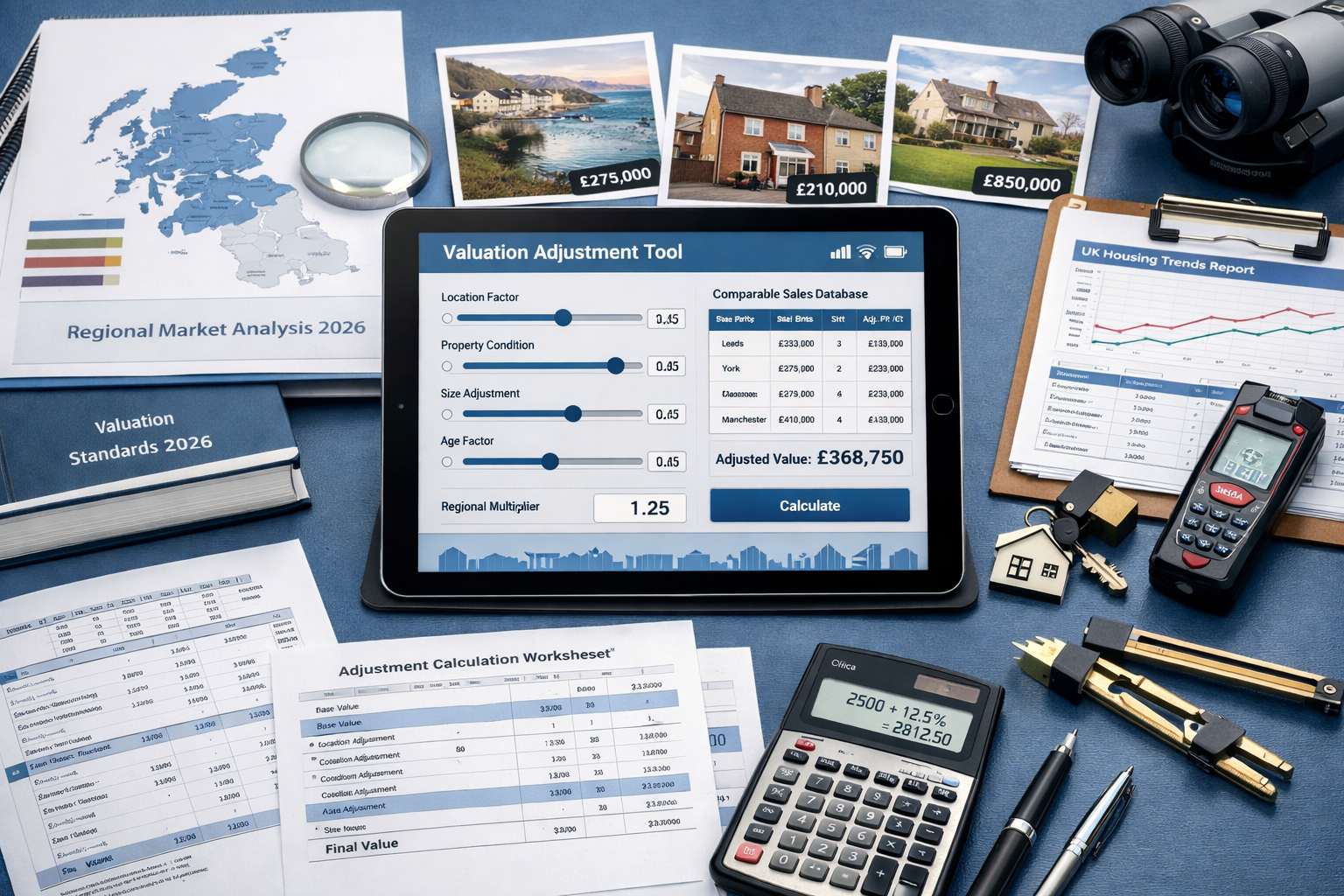
Step-by-Step Adjustment Process
Professional surveyors should follow this systematic approach when conducting valuations across diverging regional markets:
Step 1: Establish Baseline Value
- Identify the subject property's characteristics
- Determine the primary market area
- Research recent sales of truly comparable properties
- Calculate unadjusted baseline value
Step 2: Apply Regional Multipliers
- Reference regional price index data
- Calculate location-specific adjustment factor
- Consider micro-market variations within regions
- Document multiplier rationale thoroughly
Step 3: Incorporate Market Conditions
- Assess current supply-demand balance
- Evaluate days on market trends
- Consider seasonal variations
- Factor in economic indicators
Step 4: Risk and Opportunity Adjustments
- Analyze insurance cost implications
- Evaluate infrastructure investment plans
- Consider regeneration schemes
- Assess long-term sustainability factors
Step 5: Reconciliation and Final Value
- Compare results from multiple approaches
- Weight different methodologies appropriately
- Apply professional judgment to outliers
- Document assumptions and limitations
Regional Case Studies
Northern Market Strength: Manchester Suburbs
A 3-bedroom semi-detached property in a Manchester suburb demonstrates Northern market resilience:
- Comparable sales: £235,000-£255,000 range
- Supply conditions: Only 2.3 months inventory
- Affordability: Aligned with local median income
- Adjustment factors: +5% for improving transport links
- Final valuation: £248,000
This contrasts sharply with Southern equivalents where chartered surveyors in Central London might value similar properties at £625,000+.
Southern Market Pressure: Coastal Florida Comparison
While UK-focused, understanding international parallels helps contextualize domestic trends. Florida coastal properties face:
- Insurance premiums increasing 40-60% annually
- Properties "languishing on the market"[1]
- Reverse migration reducing demand
- Climate risk repricing
UK Southern coastal markets face similar—though less severe—pressures requiring downward valuation adjustments.
Specialized Valuation Scenarios
Leasehold Properties:
Lease extension valuations require additional regional considerations:
- Ground rent capitalization rates vary by region
- Marriage value calculations reflect local market strength
- Enfranchisement premiums differ significantly
- Regional tribunal precedents influence valuations
Commercial Properties:
Commercial building surveys must account for:
- Regional economic performance differentials
- Local employment market strength
- Sector-specific demand variations
- Yield compression or expansion trends
Insurance Valuations:
Insurance reinstatement valuations face regional cost variations:
- Construction labor costs differ by 20-35% regionally
- Material transportation costs vary
- Local authority requirements differ
- Specialist trade availability impacts rebuild costs
Documentation and Reporting Standards
Comprehensive valuation reports addressing regional disparities should include:
📋 Executive Summary
- Clear statement of final value
- Key adjustment factors applied
- Regional context explanation
- Confidence level assessment
📋 Market Analysis Section
- Regional market conditions overview
- Supply-demand dynamics
- Recent transaction analysis
- Trend identification and forecasting
📋 Adjustment Methodology
- Detailed explanation of each adjustment
- Supporting data and evidence
- Calculation transparency
- Alternative scenario analysis
📋 Comparable Sales Schedule
- Minimum 3-5 comparable properties
- Detailed adjustment grid
- Location maps and photographs
- Transaction verification sources
Professional surveyors offering valuation reports must ensure documentation meets enhanced standards for regional adjustment transparency.
Navigating Affordability Challenges in Regional Valuations
The 21% Affordability Crisis
Middle-income buyers can now afford only 21% of listings nationwide, down dramatically from 50% pre-pandemic[2]. This affordability crisis varies significantly by region and impacts valuation approaches:
High-Affordability Northern Markets:
- Greater percentage of stock within middle-income reach
- Stronger fundamental demand support
- Lower risk of price corrections
- Sustainable long-term value growth
Low-Affordability Southern Markets:
- Concentration of buyers at upper income brackets
- Higher sensitivity to economic disruptions
- Greater price volatility risk
- Potential for affordability-driven corrections
Surveyors must incorporate affordability metrics into risk assessments and long-term value projections.
Income-Aligned Valuation Approaches
Forward-thinking valuation methodologies consider sustainable price-to-income ratios:
| Region Type | Median Income | Sustainable Price | Current Average | Adjustment |
|---|---|---|---|---|
| Northern Urban | £32,000 | £160,000 | £175,000 | +9% premium |
| Northern Suburban | £38,000 | £190,000 | £195,000 | +3% premium |
| Southern Urban | £45,000 | £225,000 | £425,000 | +89% premium |
| Southern Suburban | £52,000 | £260,000 | £485,000 | +87% premium |
Markets trading significantly above sustainable price-to-income ratios warrant valuation caution and risk disclosure.
Future-Proofing Valuations: 2026 and Beyond
Emerging Trends Affecting Regional Disparities
Surveyors must monitor evolving factors that will influence future regional price gaps:
Climate Adaptation Investment:
- Northern regions may benefit from climate migration
- Coastal Southern properties face increasing risk premiums
- Infrastructure resilience becomes valuation factor
- Green building standards impact regional competitiveness
Remote Work Evolution:
- Hybrid work patterns stabilize post-pandemic
- Northern affordability attracts remote workers
- Transport connectivity remains crucial
- Digital infrastructure becomes location differentiator
Government Policy Interventions:
- Regional development initiatives
- Affordable housing mandates
- Planning reform impacts
- Tax policy changes affecting investment
Demographic Shifts:
- Aging population distribution
- International migration patterns
- Generational wealth transfer
- Urban-rural preference changes
Continuous Professional Development
Surveyors must invest in ongoing education to maintain expertise in regional valuation adjustments:
✨ RICS CPD Requirements:
- Regional market analysis training
- Advanced valuation methodology courses
- Technology platform proficiency
- Economic forecasting skills
✨ Market Intelligence Networks:
- Regional surveyor peer groups
- Industry data sharing initiatives
- Academic research partnerships
- Technology vendor relationships
✨ Specialization Opportunities:
- Regional market expertise development
- Asset class specialization
- Valuation methodology innovation
- Expert witness qualifications
Conclusion
Valuation Adjustments for Widening North-South Price Gaps: Surveyor Tools for 2026 Regional Disparities represents one of the most significant challenges facing UK property professionals today. The 150-200% premium differentials between comparable Northern and Southern properties demand sophisticated, evidence-based adjustment methodologies that go beyond traditional valuation approaches.
Surveyors must embrace comprehensive analytical frameworks incorporating location multipliers, affordability indices, supply-demand metrics, and risk assessments. The strengthening Northern markets and pressured Southern regions require region-specific expertise and nuanced professional judgment that technology can support but never replace.
Actionable Next Steps
For surveyors seeking to enhance their regional valuation capabilities:
- Audit your current methodology – Review recent valuations for regional adjustment transparency and documentation standards
- Invest in data resources – Subscribe to comprehensive comparable sales databases and regional market intelligence services
- Develop regional expertise – Build specialized knowledge of key markets through site visits, local agent relationships, and transaction analysis
- Enhance technology capabilities – Implement GIS tools, AVM platforms, and valuation software with regional adjustment features
- Strengthen documentation – Ensure valuation reports clearly explain regional adjustment rationale with supporting evidence
- Pursue continuous education – Complete RICS CPD focused on regional market analysis and advanced valuation methodologies
- Network strategically – Build relationships with surveyors in different regions for comparable sales sharing and market insights
The regional disparities defining 2026 will likely persist and potentially widen further. Surveyors who develop robust adjustment methodologies, maintain comprehensive market intelligence, and deliver transparent, defensible valuations will provide essential value to clients navigating these diverging markets.
Whether conducting RICS home surveys in Northern markets or complex commercial valuations in Southern regions, professional surveyors must rise to meet the challenge of accurately valuing properties across the widening North-South divide.
References
[1] Nar 2026 Forecast Summit Predicts Positive Recovery With Regional Affordability Hurdles – https://www.nar.realtor/magazine/real-estate-news/nar-2026-forecast-summit-predicts-positive-recovery-with-regional-affordability-hurdles
[2] Housing Market Predictions 2026 – https://www.redfin.com/news/housing-market-predictions-2026/
[3] What Pitchbooks 2026 Data Really Says About Multifamily Opportunity – https://www.peoplescapitalgroup.com/what-pitchbooks-2026-data-really-says-about-multifamily-opportunity/
[4] The Problem With Comps In 2026 And The Good News – https://sacramentoappraisalblog.com/2025/12/03/the-problem-with-comps-in-2026-and-the-good-news/