Choosing between a comprehensive building survey and a basic valuation can mean the difference between discovering a £50,000 structural problem before purchase or facing it as a homeowner. In 2026, with UK property prices remaining high and mortgage rates fluctuating, making the right survey decision has never been more critical for buyers and lenders alike.
Understanding when do you need a full building survey vs. a valuation only requires a chartered surveyor's decision framework that considers property age, construction type, condition, and your specific circumstances as a UK buyer or lender. This comprehensive guide provides that framework, helping you navigate the survey landscape with confidence and avoid costly mistakes.
Key Takeaways
- Level 2 HomeBuyer Reports suit conventional properties built after 1900 in reasonable condition, while Level 3 Full Building Surveys are essential for properties over 100 years old, listed buildings, or homes with visible defects
- Valuation-only inspections serve lender requirements but provide minimal protection for buyers, focusing solely on market value rather than structural condition
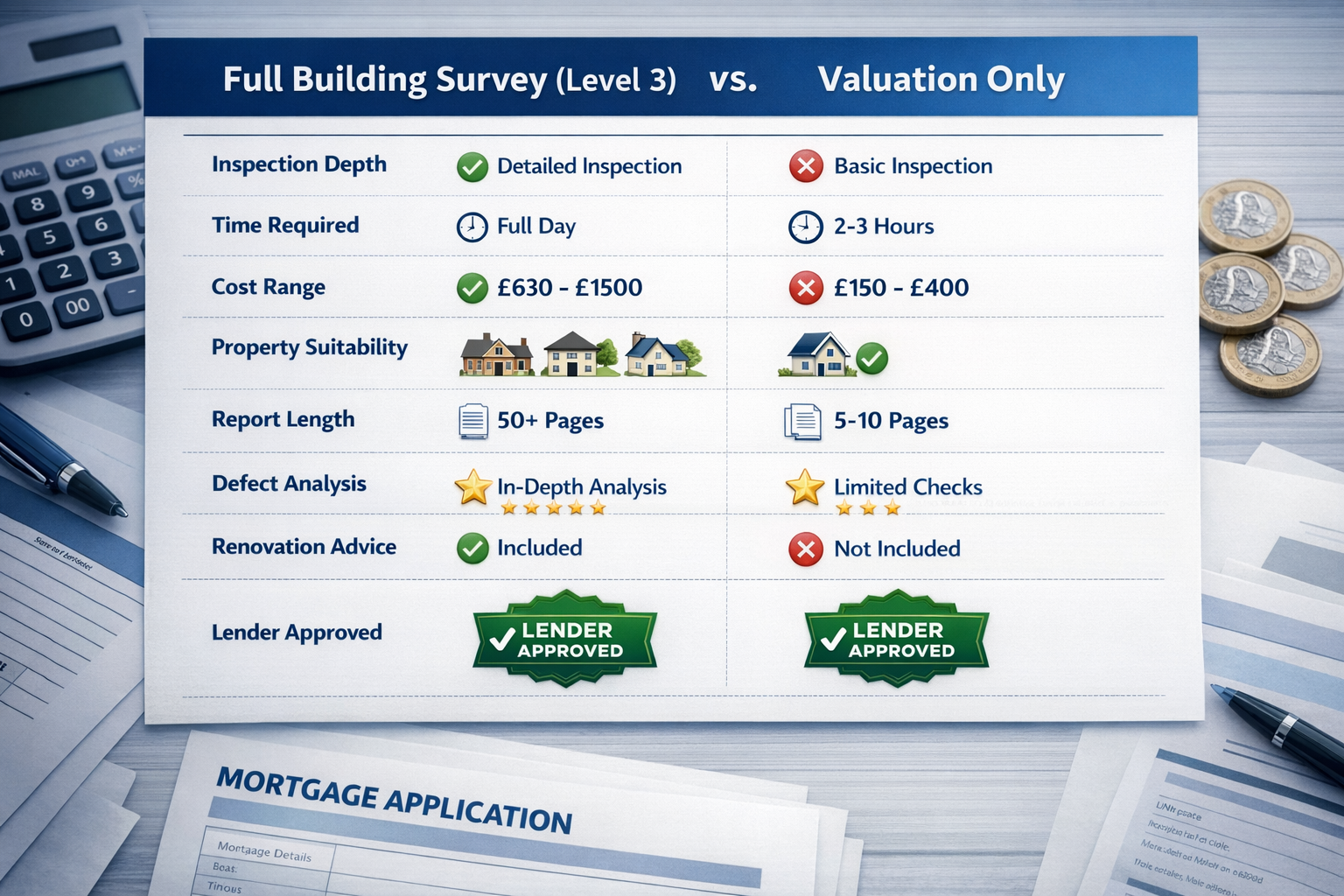
- Cost differences range from £150-£400 for basic valuations to £630-£1,500+ for comprehensive Level 3 surveys, with the investment often preventing five-figure repair surprises
- Property characteristics including age, construction type, alterations, and visible defects should drive your decision more than price alone
- Lender and buyer needs diverge significantly, with mortgage providers requiring valuations while purchasers benefit from detailed structural assessments
Understanding the Three Main Survey Options in the UK Property Market
The UK property survey landscape offers three distinct levels of inspection, each serving different purposes and property types. Recognizing these options forms the foundation of making an informed decision.
Level 1: Condition Report (Basic Assessment)
The Level 1 Condition Report represents the most basic survey option, suitable only for new-build properties or recently constructed homes in excellent condition. This report provides a straightforward traffic-light rating system (red, amber, green) for different property elements but offers minimal detail about defects or repair recommendations.
Most buyers purchasing older or period properties should avoid this option, as it lacks the depth needed to identify potential structural issues or maintenance concerns.
Level 2: HomeBuyer Report (Standard Survey)
The Level 2 HomeBuyer Report serves as the most popular choice for standard residential purchases. According to RICS guidance, this survey suits conventional properties built after 1900 that are in reasonable condition with standard construction methods.[1]
Key features of Level 2 surveys include:
- Visual inspection of accessible areas without moving furniture or lifting floor coverings
- Traffic-light condition ratings for major property elements
- Identification of urgent defects requiring immediate attention
- Optional valuation component providing market value and reinstatement cost for insurance purposes[2]
- Completion time of approximately 2-4 hours depending on property size[5]
- Cost range between £400-£1,000 for most properties[5]
The Level 2 survey can optionally include a valuation, making it an efficient choice when you need both survey information and a market value assessment for mortgage purposes.[2] For more guidance on selecting the appropriate survey type, explore our resource on choosing the right property survey.
Level 3: Full Building Survey (Comprehensive Assessment)
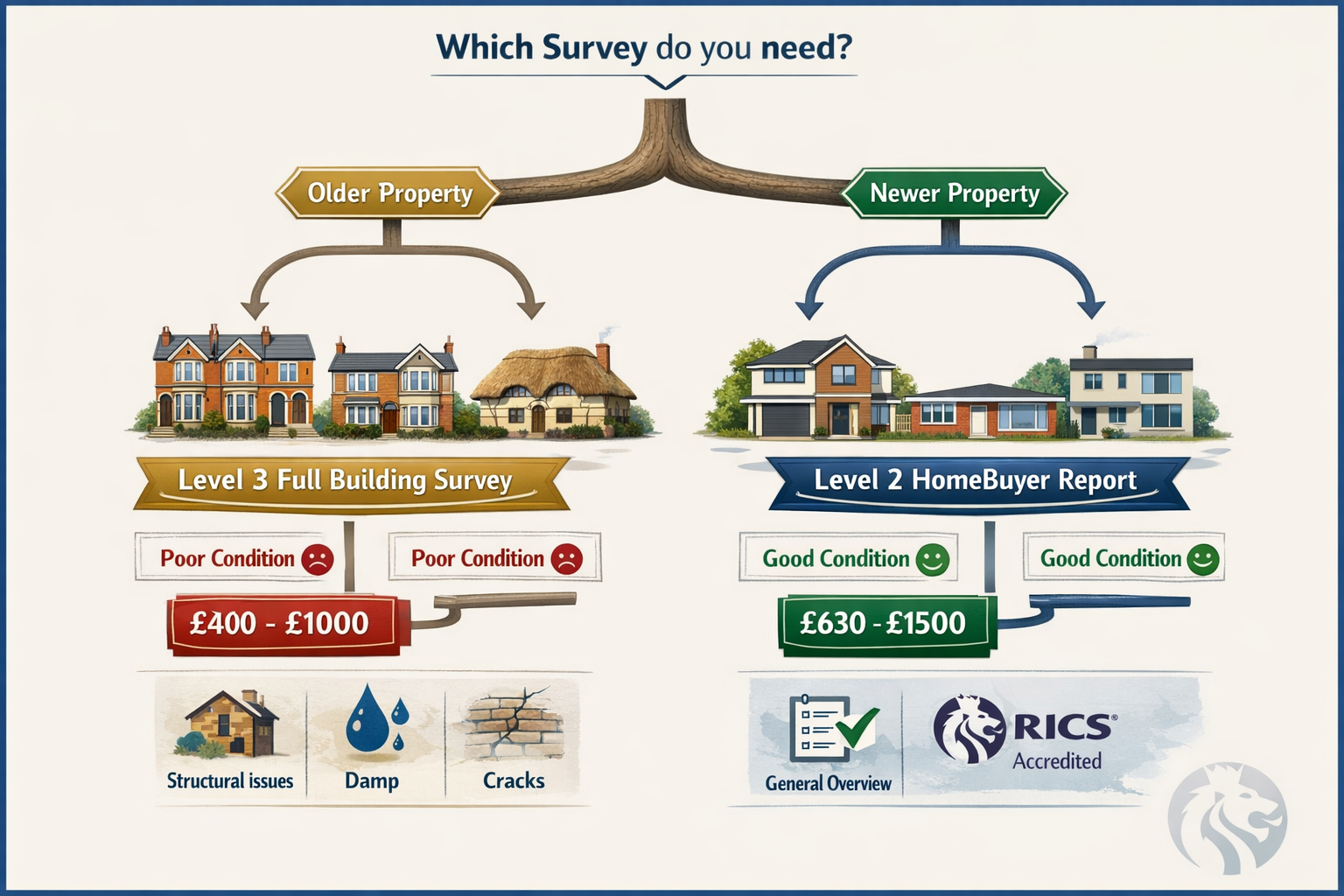
The Level 3 Full Building Survey provides the most detailed and comprehensive property assessment available. This extensive inspection is essential for properties over 100 years old, period homes, listed buildings, or any property with visible defects such as cracks, damp, or uneven floors.[1]
Critical characteristics include:
- Extensive visual inspection covering roof spaces, grounds, and all accessible areas
- Detailed defect analysis with repair timelines and consequence assessments
- Comprehensive reporting typically spanning 50+ pages
- Renovation planning guidance for buyers intending structural works[3]
- Inspection duration of up to a full day for complex properties[5]
- Investment range from £630 to £1,500 or more depending on size and complexity[5]
Notably, Level 3 surveys focus exclusively on structural assessment and do not include valuation or reinstatement sum elements.[4] Learn more about this comprehensive option through our RICS Building Surveys Level 3 service.
Valuation-Only Inspections
Valuation-only inspections serve lender requirements rather than buyer protection. These brief assessments typically take 30 minutes to 2 hours and focus solely on confirming the property's market value supports the mortgage amount.
⚠️ Important distinction: Valuations protect the lender's investment, not yours. They rarely identify structural defects, maintenance issues, or repair costs that could affect your purchase decision.
When Do You Need a Full Building Survey vs. a Valuation Only? Property Characteristics That Drive the Decision
Understanding which survey level suits your property requires analyzing specific characteristics that indicate structural complexity, age-related risks, and potential hidden defects.
Property Age: The Primary Decision Factor
Property age represents the single most important factor in determining survey requirements:
| Property Age | Recommended Survey Level | Rationale |
|---|---|---|
| New build – 10 years | Level 1 or Valuation | Modern construction standards, NHBC warranty coverage |
| 10-50 years | Level 2 HomeBuyer | Standard construction, predictable maintenance needs |
| 50-100 years | Level 2 or Level 3 | Depends on condition and alterations |
| Over 100 years | Level 3 Full Building Survey | Period construction methods, age-related defects likely[5] |
Properties over 50 years old, listed buildings, or those in poor condition are specifically recommended for Level 3 surveys by RICS guidance.[5] The older the property, the greater the likelihood of structural movement, outdated materials, and hidden defects requiring expert assessment.
Construction Type and Materials
Non-standard construction significantly increases survey requirements:
- Timber-frame properties require specialist assessment of structural integrity
- Thatched roofs demand expert evaluation of condition and fire safety
- Steel-frame buildings need corrosion and structural connection inspection
- Concrete construction (especially pre-1970s) may require concrete carbonation testing
- Cob, wattle and daub, or earth construction necessitates specialist knowledge
For properties with non-standard construction methods, consult our guide on non-standard construction to understand specific survey needs.
Visible Defects and Warning Signs
🚨 Red flags requiring Level 3 surveys:
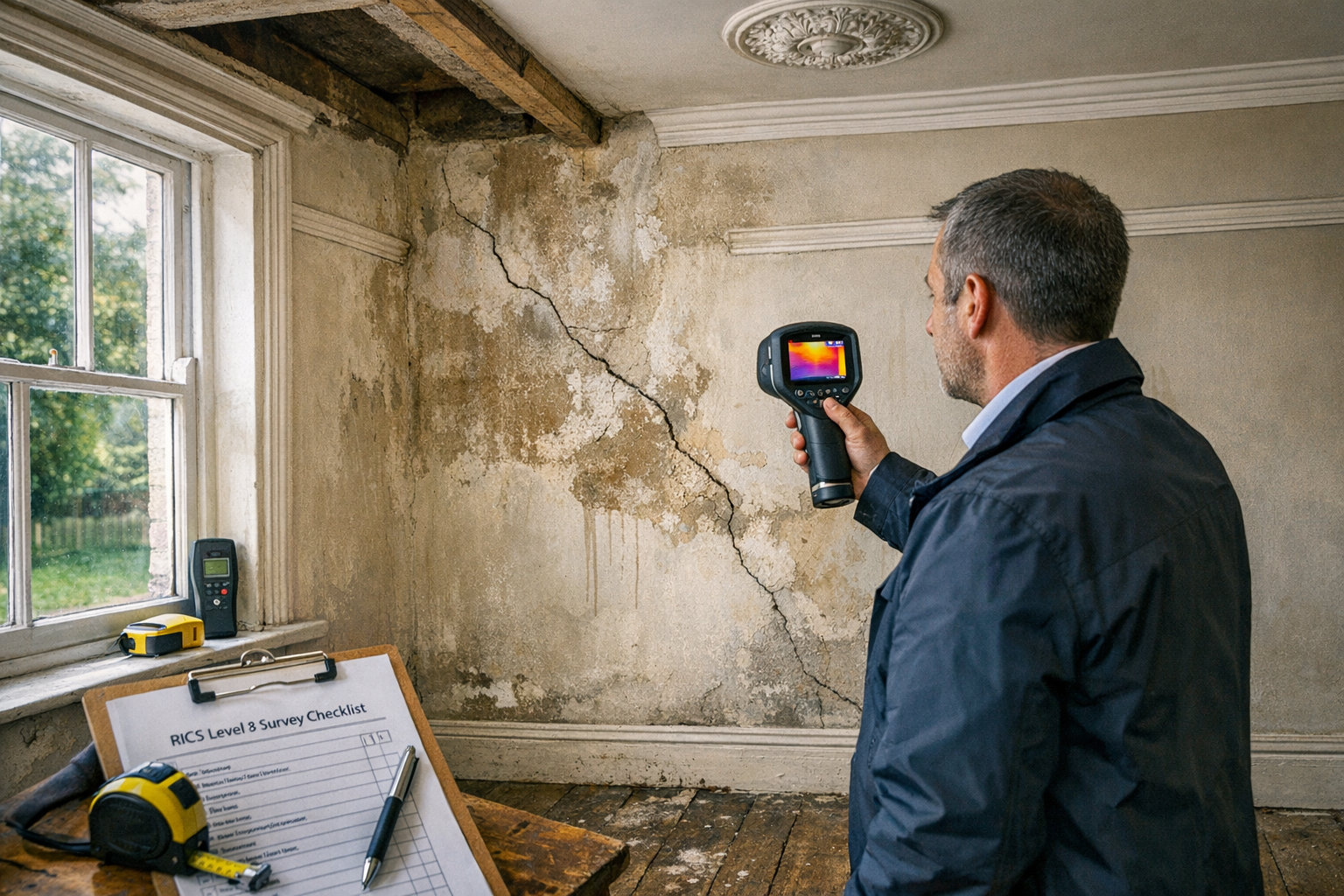
- Structural cracks wider than 3mm or showing progressive movement
- Damp patches on walls, ceilings, or around windows
- Uneven or sloping floors indicating potential subsidence
- Bowing walls or bulging brickwork
- Roof sagging or missing tiles
- Timber decay in visible structural elements
- Previous underpinning or structural repairs
Even a single visible defect warrants upgrading from Level 2 to Level 3, as surface symptoms often indicate deeper structural issues. For properties showing signs of moisture problems, consider our specialized damp surveys service.
Alterations, Extensions, and Conversions
Properties that have undergone major alterations, extensions, conversions, or structural changes require Level 3 surveys to assess work quality and building regulation compliance.[3]
Critical scenarios include:
- Loft conversions (especially without visible building control certificates)
- Rear or side extensions
- Internal wall removal or structural alterations
- Basement conversions or excavations
- Garage conversions
- Significant plumbing or electrical rewiring
"Level 3 surveys are essential when properties have undergone major alterations, extensions, conversions, or structural changes, as you need deeper analysis and advice on defects, repairs and maintenance."[3]
Listed Buildings and Conservation Areas
Listed buildings (Grade I, II*, or II) automatically warrant Level 3 surveys due to:
- Specialized construction methods and historic materials
- Restricted repair and alteration options requiring expert guidance
- Higher maintenance costs and specialized contractor requirements
- Potential for hidden defects in historic fabric
- Planning and listed building consent complexities
Properties in conservation areas, while not necessarily requiring Level 3 surveys, benefit from the additional detail when planning future alterations.
The Decision Framework: When Do You Need a Full Building Survey vs. a Valuation Only for UK Buyers and Lenders?
This practical decision framework helps buyers and lenders determine the appropriate survey level based on risk tolerance, property characteristics, and specific circumstances.
For Property Buyers: Risk-Based Decision Making
Choose a Level 3 Full Building Survey when:
✅ The property is over 100 years old or has period features
✅ You've identified visible defects during viewings
✅ The property has undergone significant alterations or extensions
✅ You're planning major renovations or structural works[2]
✅ The property is listed or of unusual construction
✅ You're purchasing a high-value property where survey costs represent minimal percentage of price
✅ You have limited DIY knowledge and want comprehensive maintenance guidance
✅ The property has been empty for extended periods
✅ You're risk-averse and want maximum information before commitment
Choose a Level 2 HomeBuyer Report when:
✅ The property was built after 1900 using conventional construction
✅ The property appears in reasonable condition with no obvious defects
✅ You need concurrent survey and valuation for mortgage purposes[2]
✅ The property is a standard house type (semi-detached, terraced, detached) without unusual features
✅ You want good value survey coverage without extensive detail
✅ The property has been well-maintained with recent updates
Choose Valuation Only when:
⚠️ Caution: Valuation-only inspections provide minimal buyer protection. Consider this option only when:
- You're a cash buyer with significant property expertise
- You've already commissioned an independent building survey
- You're purchasing a new-build with comprehensive warranty coverage
- The lender requires valuation but you've obtained separate structural assessment
To understand the depth difference between survey levels, review our detailed comparison of Level 2 and Level 3 surveys.
For Mortgage Lenders: Balancing Risk and Cost
Lender requirements typically mandate valuation-only inspections to confirm loan-to-value ratios, but prudent lending practices increasingly recognize survey benefits:
When lenders should require Level 2 or Level 3 surveys:
- High loan-to-value mortgages (over 85%) on older properties
- Properties flagged during initial valuation as having potential defects
- Listed buildings or non-standard construction
- Properties in areas with known subsidence or flooding risks
- Buy-to-let mortgages where property condition affects rental viability
- Commercial lending where property condition impacts business operations
For commercial property lending, explore our commercial building survey services tailored to lender requirements.
Cost-Benefit Analysis: Survey Investment vs. Risk Exposure
Understanding survey costs relative to potential repair bills clarifies the value proposition:
| Survey Type | Typical Cost | Potential Issues Identified | Risk Reduction Value |
|---|---|---|---|
| Valuation Only | £150-£400 | Market value only | Minimal buyer protection |
| Level 2 HomeBuyer | £400-£1,000 | Urgent defects, maintenance needs | £5,000-£25,000 repair discovery |
| Level 3 Building Survey | £630-£1,500+ | Comprehensive defect analysis | £10,000-£100,000+ issue prevention |
Real-world scenario: A £900 Level 3 survey identifying £40,000 of underpinning requirements provides negotiation leverage or informed withdrawal, representing a 4,400% return on survey investment.
For detailed pricing information, consult our guide on structural survey pricing.
Geographic Considerations Across the UK
Regional factors influence survey requirements:
- London and South East: Higher property values justify comprehensive surveys; Victorian and Edwardian stock predominates. Find chartered surveyors in London for local expertise.
- Northern regions: Lower property values may make Level 2 surveys more cost-effective for standard stock
- Coastal areas: Salt exposure and weather damage warrant detailed assessment
- Mining areas: Subsidence risks require specialist evaluation
- Flood-prone regions: Water damage history and future risk assessment essential
Timeline Considerations
Survey duration impacts purchase timelines:
- Valuation only: 1-3 days from instruction to report
- Level 2 HomeBuyer: 5-7 days from instruction to report
- Level 3 Building Survey: 7-14 days from instruction to report
Factor survey timelines into offer negotiations and exchange deadlines. Learn more about how long a homebuyer survey takes to plan your purchase schedule.
Special Circumstances Requiring Additional Surveys
Beyond standard survey levels, specific issues warrant specialist defect surveys:
- Subsidence concerns: Dedicated subsidence surveys with monitoring
- Drainage problems: Drainage surveys using CCTV inspection
- Damp issues: Specialist damp and timber reports beyond standard survey scope
- Structural concerns: Targeted specialist defect surveys for specific issues
Making Your Decision: Practical Steps for UK Property Buyers and Lenders
Armed with the decision framework, follow these practical steps to select the appropriate survey level for your circumstances.
Step 1: Assess the Property Objectively
Create a property assessment checklist:
Age and Construction
□ Built before 1900? → Consider Level 3
□ Non-standard construction? → Consider Level 3
□ Listed building? → Require Level 3
Condition Indicators
□ Visible cracks or structural movement? → Require Level 3
□ Damp patches or water staining? → Consider Level 3
□ Uneven floors or sagging? → Require Level 3
□ Poor maintenance evident? → Consider Level 3
Alterations and History
□ Major extensions or conversions? → Require Level 3
□ Structural alterations visible? → Require Level 3
□ Long-term vacancy? → Consider Level 3
Your Plans
□ Planning major renovations? → Require Level 3[2]
□ Intending structural changes? → Require Level 3
□ Need detailed maintenance guidance? → Consider Level 3
Step 2: Calculate Your Risk Tolerance
Consider these personal factors:
- Property knowledge: Limited experience warrants more comprehensive surveys
- Financial buffer: Smaller contingency funds require better defect identification
- Purchase price: Higher values justify proportionally smaller survey investment
- Property importance: Forever homes deserve more thorough assessment than short-term purchases
Step 3: Consult RICS-Accredited Professionals
Engage qualified chartered surveyors early in the process. RICS-accredited members can provide personalized recommendations based on your specific situation.[2]
When selecting a surveyor:
✓ Verify RICS membership and professional indemnity insurance
✓ Confirm local expertise in your property type and region
✓ Request sample reports to assess detail and clarity
✓ Discuss additional services like valuation, defect investigation, or project management
✓ Clarify report timelines and communication during the process
Find experienced professionals through our network of local chartered surveyors across the UK.
Step 4: Understand What Your Survey Will and Won't Cover
Level 2 and Level 3 surveys include:
- Visual inspection of accessible areas
- Assessment of main building elements
- Identification of defects and maintenance issues
- Advice on repairs and ongoing maintenance
Surveys do NOT typically include:
- Testing of electrical, gas, or drainage systems (separate specialists required)
- Moving furniture or lifting carpets
- Accessing areas requiring specialist equipment
- Opening up walls or destructive investigation
- Detailed cost estimates for repairs (approximate guidance only)
Step 5: Review and Act on Survey Findings
Once you receive your survey report:
- Read thoroughly: Don't skip sections or focus only on the summary
- Prioritize issues: Distinguish urgent defects from routine maintenance
- Obtain quotes: Commission specialist reports or repair estimates for significant defects
- Negotiate appropriately: Use findings to renegotiate price or request repairs
- Plan maintenance: Create a long-term maintenance schedule based on recommendations
- Consider withdrawal: Serious structural issues may warrant reconsidering the purchase
Updated RICS Standards for 2026
The RICS introduced updated Home Survey Standards on 1 March 2021 to increase consistency and transparency across survey reports.[2] These standards ensure:
- Standardized formatting making reports easier to compare
- Clear condition ratings using consistent traffic-light systems
- Enhanced transparency about inspection limitations
- Improved guidance on repair urgency and estimated costs
When commissioning surveys in 2026, ensure your surveyor follows current RICS standards for maximum clarity and usefulness.
Conclusion
Determining when you need a full building survey vs. a valuation only requires careful analysis of property characteristics, personal circumstances, and risk tolerance. While valuation-only inspections serve lender requirements, they provide minimal buyer protection and should rarely be the sole assessment for property purchases.
Level 2 HomeBuyer Reports offer excellent value for conventional properties built after 1900 in reasonable condition, combining structural assessment with optional valuation services. However, Level 3 Full Building Surveys become essential for properties over 100 years old, those with visible defects, unusual construction, or when planning major renovations.
The survey investment—ranging from £400 to £1,500+—represents a fraction of typical property values but can identify five-figure or six-figure repair requirements, providing negotiation leverage or informing withdrawal decisions. In 2026's competitive UK property market, comprehensive survey information remains one of the most valuable tools for making informed purchase decisions.
Next Steps
- Assess your property using the decision framework and checklist provided
- Engage a RICS-accredited surveyor with local expertise in your property type
- Commission the appropriate survey level based on property characteristics and risk assessment
- Review findings thoroughly and obtain specialist reports for significant defects
- Negotiate or withdraw based on comprehensive understanding of property condition
For expert guidance tailored to your specific property and circumstances, contact qualified professionals who can provide personalized recommendations aligned with current RICS standards and best practices. Your survey decision today protects your property investment for decades to come.
References
[1] Difference Between Level 2 And Level 3 Survey Which One Do You Actually Need – https://westernbuildingconsultants.com/2026/02/27/difference-between-level-2-and-level-3-survey-which-one-do-you-actually-need/
[2] House Surveys Uk The Costs Types And Benefits Of An Rics Home Survey – https://www.rics.org/consumer-guides/house-surveys-uk-the-costs-types-and-benefits-of-an-rics-home-survey
[3] Choosing The Right House Survey In 2026 – https://www.house-survey.co.uk/news/choosing-the-right-house-survey-in-2026/
[4] What Are The Different Surveys When Buying A House – https://www.suffolkbuildingsociety.co.uk/blog/what-are-the-different-surveys-when-buying-a-house/
[5] What Sort Of Survey Should I Have – https://hoa.org.uk/advice/guides-for-homeowners/i-am-buying/what-sort-of-survey-should-i-have/