{"cover":"Professional landscape format (1536x1024) hero image featuring bold text overlay 'Expert Witness Valuations in Office-to-Residential Conversions: Evidence Strategies for 2026 Planning Disputes' in extra large 70pt white sans-serif font with dark shadow and semi-transparent overlay box, positioned in upper third. Background shows split-screen composition: left side displays modern office building exterior with conversion construction, right side shows courtroom setting with expert witness stand and legal documents. Color scheme: deep navy blue, white, gold accents. High contrast, magazine cover quality, editorial style with professional architectural photography aesthetic. Include subtle elements of valuation reports, RICS standards documentation, and planning dispute imagery.","content":["Detailed landscape format (1536x1024) image showing professional surveyor in business attire reviewing architectural conversion plans on large table, surrounded by multiple evidence documents including market analysis charts, comparable sales data spreadsheets, and RICS Red Book guidelines. Scene includes laptop displaying valuation software, measuring tools, and annotated floor plans highlighting office-to-residential conversion specifications. Background features wall-mounted comparison photos of before/after conversion projects. Lighting: bright professional office setting. Color palette: professional blues, whites, document yellows. Include visible text labels on documents reading 'Valuation Report', 'Market Evidence', 'RICS Standards'. Photorealistic, high-detail business documentation aesthetic.","Detailed landscape format (1536x1024) infographic-style image displaying three distinct columns representing different valuation methodologies for conversion projects. Left column shows 'Comparable Sales Method' with miniature building icons and price tags. Center column illustrates 'Residual Valuation Method' with mathematical formulas, construction cost breakdowns, and profit margin calculations. Right column depicts 'Investment Method' with rental yield percentages and capitalization rate diagrams. Each column features color-coded charts, arrows showing calculation flow, and professional icons. Background: clean white with subtle grid pattern. Color scheme: teal, orange, gray. Include calculator imagery, percentage symbols, and property value indicators. Modern infographic design with data visualization focus.","Detailed landscape format (1536x1024) image of formal planning dispute hearing environment showing expert witness presenting evidence on large display screens. Foreground features professional witness stand with microphone and organized evidence binders labeled 'Valuation Report', 'Market Analysis', 'Comparable Evidence'. Multiple screens display graphs comparing pre-conversion office values versus post-conversion residential values, market trend data from 2024-2026, and location-specific comparable sales maps. Scene includes partial view of legal representatives reviewing documents, planning committee members, and architectural renderings of conversion project. Lighting: formal hearing room with professional presentation setup. Color palette: authoritative navy, white, wood tones. Photorealistic courtroom documentation aesthetic with emphasis on evidence presentation credibility."]}
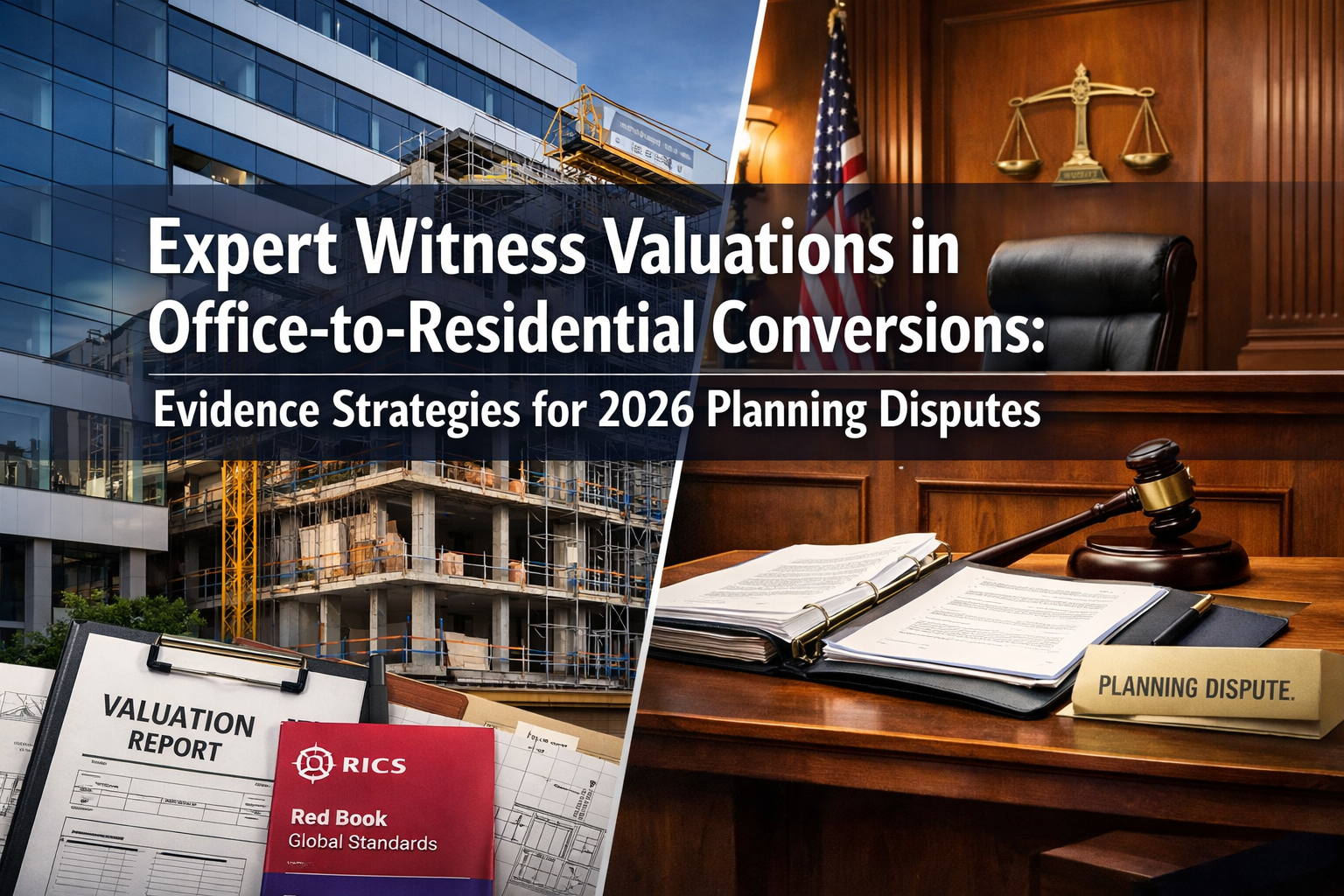
The transformation of underutilized office buildings into residential units has accelerated dramatically across urban centers, creating a complex landscape of planning disputes that demand rigorous expert witness valuations. As 2026 unfolds, surveyors and property professionals face unprecedented scrutiny in conversion projects, where accurate valuation evidence can determine the outcome of costly planning appeals and litigation. Understanding how to build robust, court-credible valuation reports has never been more critical for professionals navigating Expert Witness Valuations in Office-to-Residential Conversions: Evidence Strategies for 2026 Planning Disputes.
The surge in conversion projects stems from shifting workplace patterns and housing shortages, but these developments frequently encounter opposition from local authorities, neighboring property owners, and community groups. When disputes escalate to formal hearings or court proceedings, the quality of expert witness testimony becomes the pivotal factor in resolution outcomes.
Key Takeaways
- RICS-compliant valuation reports form the foundation of credible expert witness testimony in conversion planning disputes, requiring detailed market analysis and methodology transparency
- Evidence-based valuation strategies must incorporate comparable sales data, residual valuation techniques, and market recovery metrics specific to 2026 conditions
- Court credibility depends on comprehensive documentation, professional qualifications, and the ability to defend valuation assumptions under cross-examination
- Planning dispute success requires understanding legal frameworks, local policy considerations, and the specific challenges of adaptive reuse projects
- Proper methodology selection between comparable sales, residual valuation, and investment approaches directly impacts dispute outcomes
Understanding the Role of Expert Witness Valuations in Conversion Planning Disputes
Expert witness valuations serve as the technical backbone of planning disputes involving office-to-residential conversions. These specialized assessments provide independent, professional opinions on property values, development viability, and financial impacts that courts and planning inspectors rely upon when adjudicating contested projects.
The Legal Framework for Conversion Disputes
Planning disputes arise when stakeholders challenge conversion proposals on various grounds, including viability assessments, affordable housing contributions, or community impact concerns. Expert witnesses must navigate complex legal considerations while maintaining objectivity and professional standards [1].
The legal framework governing these disputes requires experts to:
- Provide unbiased opinions regardless of which party retains their services
- Base all conclusions on verifiable evidence and accepted methodology
- Clearly distinguish between factual observations and professional judgment
- Remain within their area of expertise and qualification
Professional expert witness services demand comprehensive knowledge of both valuation principles and litigation procedures, ensuring testimony withstands rigorous cross-examination.
Why Conversion Projects Generate Valuation Disputes
Office-to-residential conversions present unique valuation challenges that frequently trigger disputes:
Market uncertainty – Converting office space to residential use involves substantial assumptions about future market conditions, buyer demand, and pricing that stakeholders may contest.
Development costs – Construction expenses for conversions often exceed initial estimates, affecting viability calculations and affordable housing obligations.
Comparable evidence scarcity – Limited transaction data for similar conversion projects makes establishing accurate values more contentious.
Planning policy interpretation – Local authorities may dispute developer valuations regarding Section 106 contributions or community infrastructure levies.
These factors create fertile ground for disagreement, making expert witness involvement essential for dispute resolution.
Building RICS-Compliant Valuation Reports for Court Credibility
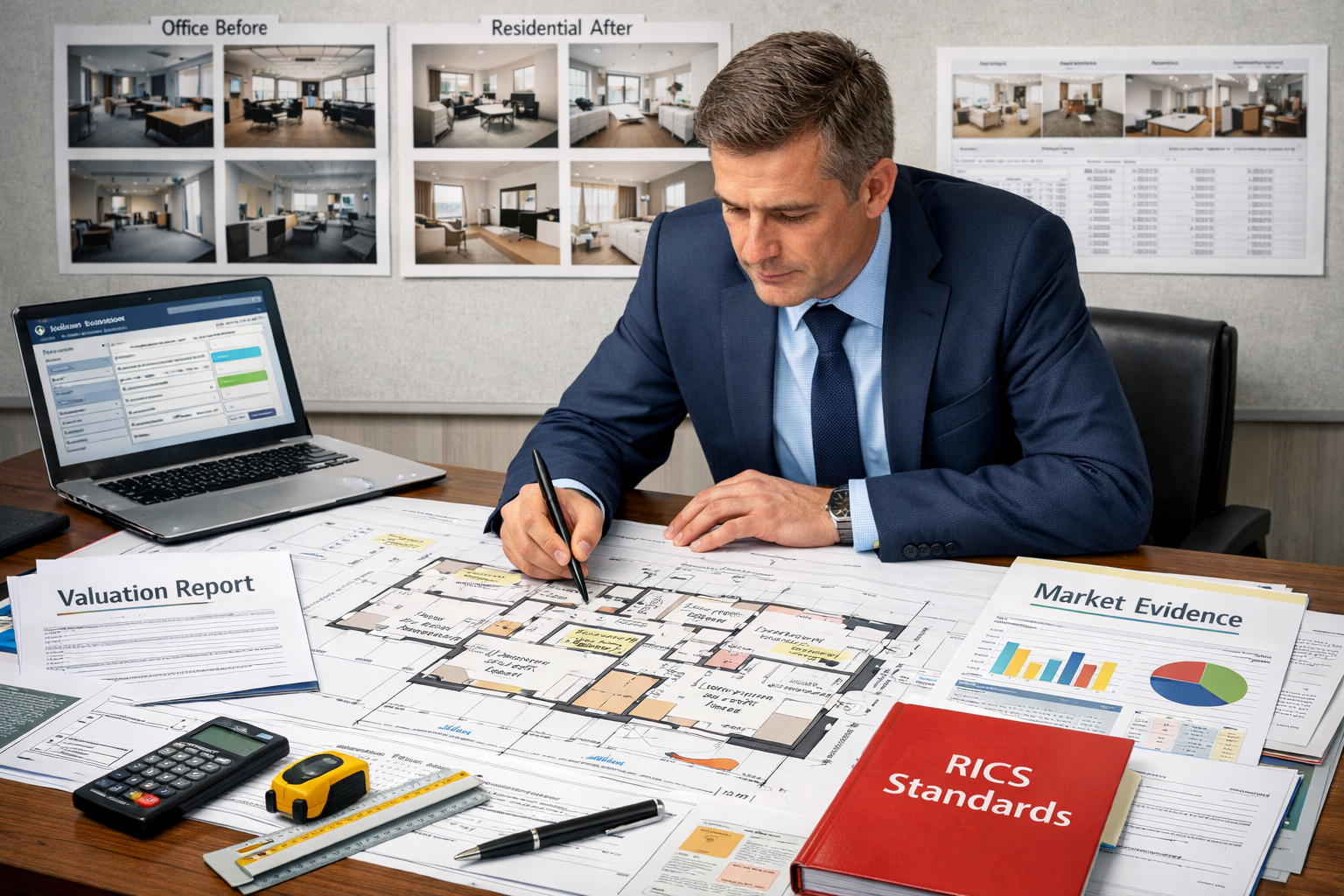
The Royal Institution of Chartered Surveyors (RICS) Red Book provides the professional framework that underpins credible expert witness valuations. Adherence to these standards separates authoritative testimony from questionable opinions in planning dispute proceedings.
Essential RICS Standards for Conversion Valuations
RICS Valuation – Global Standards (Red Book) establishes mandatory requirements for professional valuations used in litigation contexts. For office-to-residential conversion disputes, surveyors must ensure:
Terms of engagement clarity – Written confirmation detailing the valuation purpose, basis, assumptions, and any special assumptions or departures from standard methodology.
Competence and objectivity – Demonstrable expertise in both commercial and residential property sectors, plus conversion project experience.
Inspection requirements – Thorough site inspection documenting existing office conditions, structural considerations, and conversion feasibility factors.
Valuation approach transparency – Clear explanation of methodology selection, whether comparable sales, residual valuation, or investment approach.
Professional expert witness surveyors understand that RICS compliance forms the foundation of court credibility, with any departures requiring explicit justification.
Documentation Standards That Withstand Cross-Examination
Robust documentation separates defensible valuations from those that crumble under legal scrutiny. Expert witnesses must maintain comprehensive records including:
| Documentation Element | Purpose | Critical Details |
|---|---|---|
| Inspection notes | Verify site conditions | Photographs, measurements, structural observations |
| Comparable evidence | Support value conclusions | Transaction details, adjustments, market timing |
| Calculation worksheets | Demonstrate methodology | Formula applications, assumption justifications |
| Market research | Establish context | Demand data, pricing trends, absorption rates |
| Correspondence files | Track instruction evolution | Client communications, scope changes, clarifications |
Every assumption, adjustment, and conclusion requires documentary support that can be produced and explained during testimony. Understanding various methods of valuation ensures appropriate technique selection for specific dispute circumstances.
Incorporating 2026 Market Recovery Data
Current market conditions significantly impact conversion project valuations. Expert witnesses must integrate 2026 market recovery indicators including:
- Office vacancy rates – Current availability percentages affecting pre-conversion values
- Residential demand metrics – Housing shortage data supporting conversion rationale
- Construction cost indices – Updated material and labor expenses for accurate residual valuations
- Financing conditions – Interest rate environments affecting development viability
- Regulatory changes – Recent planning policy modifications influencing conversion feasibility
Market recovery data provides essential context for value opinions, demonstrating awareness of current economic conditions rather than relying on outdated pre-pandemic assumptions.
Evidence Strategies for Expert Witness Valuations in Office-to-Residential Conversions
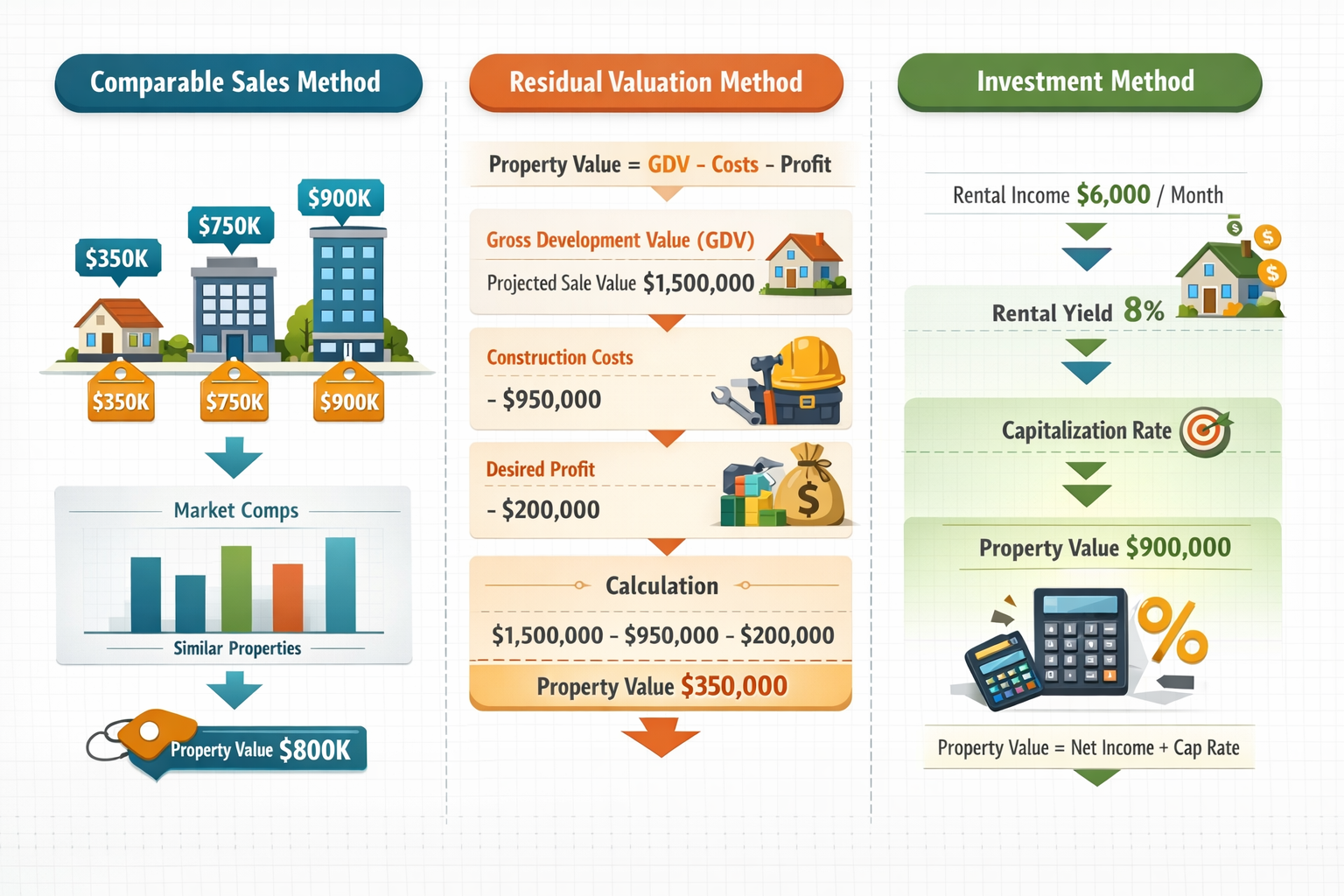
Strategic evidence preparation determines whether expert witness testimony persuades decision-makers or fails under challenge. Successful strategies combine technical rigor with clear communication tailored to planning dispute contexts.
Selecting Appropriate Valuation Methodologies
Different dispute scenarios require specific valuation approaches. Expert witnesses must select methodologies that align with the dispute's central questions:
Comparable Sales Approach – Most appropriate when:
- Sufficient transaction evidence exists for similar conversion projects
- Establishing market value of completed residential units
- Demonstrating achievable sales prices for viability assessments
This method requires careful adjustment for differences in location, specification, timing, and conversion complexity between comparables and the subject property.
Residual Valuation Method – Essential for:
- Development viability disputes
- Affordable housing contribution negotiations
- Demonstrating financial feasibility or lack thereof
Residual valuations work backward from estimated completed development value, deducting all costs (construction, professional fees, finance, profit) to determine site value. This approach directly addresses viability questions central to many conversion disputes [2].
Investment Valuation Approach – Utilized when:
- Properties will be held for rental income
- Establishing value for institutional investors
- Comparing conversion returns against alternative uses
This methodology capitalizes projected rental income streams at appropriate yields, requiring robust evidence for both rental values and capitalization rates.
Gathering and Presenting Comparable Evidence
Comparable evidence forms the empirical foundation of persuasive valuations. Expert witnesses should:
Cast a wide net initially – Research all potentially relevant transactions including:
- Direct office-to-residential conversion sales
- New-build residential developments in similar locations
- Refurbishment projects with comparable specifications
- Office sales pre-conversion for residual valuation inputs
Apply rigorous adjustments – Document clear reasoning for adjustments addressing:
- Location differences (accessibility, amenities, prestige)
- Physical characteristics (size, specification, condition)
- Market timing (transaction dates relative to valuation date)
- Terms of sale (special conditions, related party transactions)
Present evidence systematically – Organize comparables in clear schedules showing:
- Property addresses and descriptions
- Transaction dates and prices
- Key physical characteristics
- Adjustment calculations with explanations
- Adjusted price indicators
Transparency in comparable selection and adjustment methodology demonstrates professional rigor that enhances credibility.
Addressing Viability and Financial Feasibility
Viability disputes represent the most contentious area of conversion valuations, often determining affordable housing obligations and Section 106 contributions. Expert witnesses must address:
Development appraisal inputs – Every assumption requires justification:
- Gross development value – Supported by comparable sales evidence
- Construction costs – Based on quantity surveyor estimates or industry benchmarks
- Professional fees – Realistic percentages for architects, engineers, surveyors
- Finance costs – Current lending rates and arrangement fees
- Developer profit – Market-appropriate returns reflecting project risk
Sensitivity analysis – Demonstrating how value conclusions change with varying assumptions shows analytical depth and acknowledges uncertainty.
Alternative use values – Comparing conversion returns against continued office use or alternative development scenarios provides essential context.
Professional commercial property surveyors bring specialized expertise to these complex viability assessments, understanding both commercial and residential market dynamics.
Preparing for Planning Dispute Hearings and Court Testimony
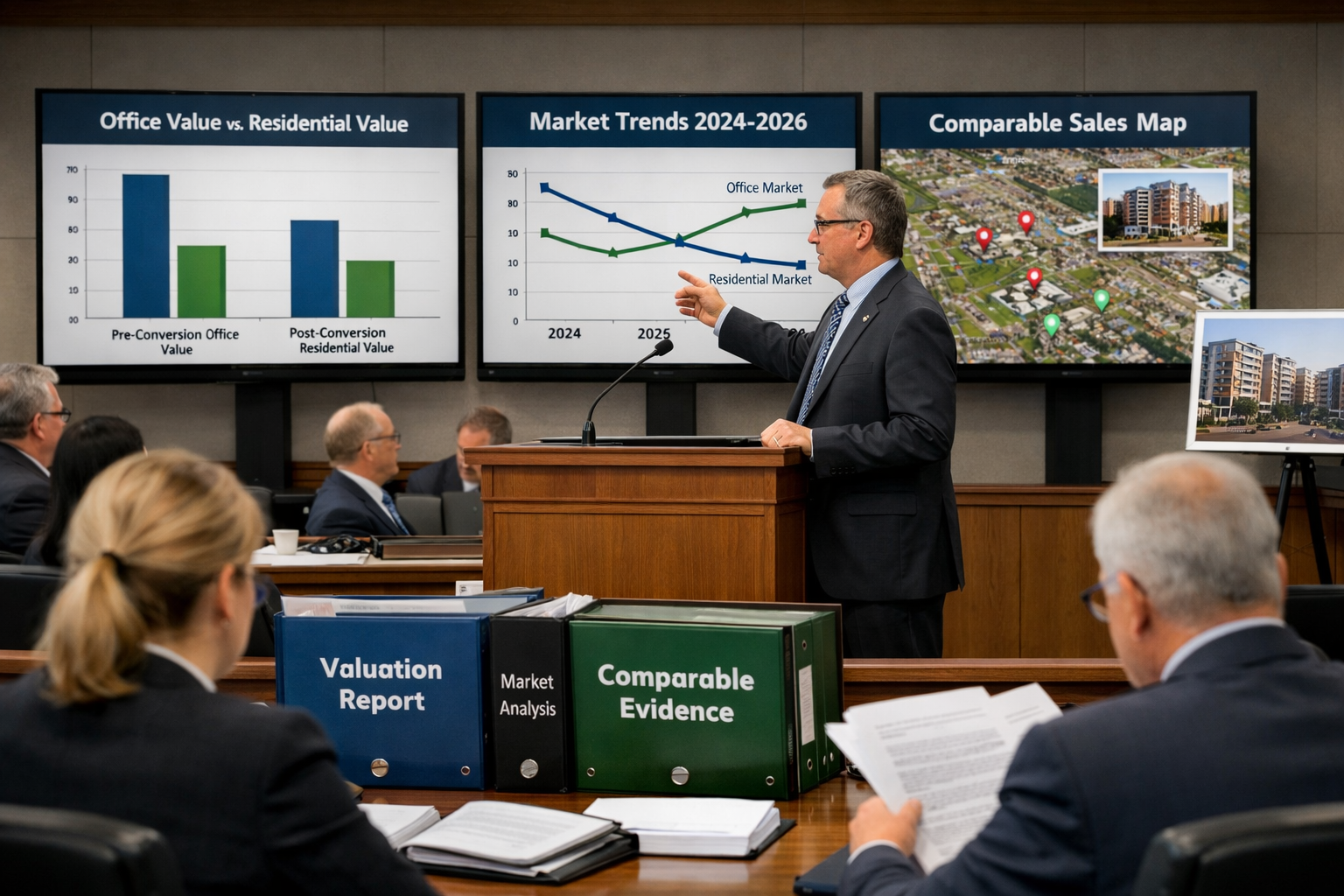
Technical excellence in valuation means little if expert witnesses cannot communicate findings effectively under the pressure of cross-examination. Preparation for testimony requires distinct skills beyond valuation competence.
Structuring Expert Witness Reports
Expert witness reports serve as both written evidence and the foundation for oral testimony. Effective structure includes:
Executive summary – Concise overview of:
- Instructions received
- Property and proposal description
- Valuation conclusions
- Key factors influencing opinions
Introduction – Establishing credentials:
- Professional qualifications (MRICS, FRICS)
- Relevant experience with conversion projects
- Confirmation of expert witness duties and compliance
Property description – Detailed documentation of:
- Location and site characteristics
- Existing office building specifications
- Proposed residential conversion details
- Planning history and current status
Market analysis – Comprehensive context including:
- Office market conditions affecting pre-conversion value
- Residential market demand and pricing trends
- Conversion project precedents and outcomes
- Economic factors influencing development viability
Valuation methodology – Transparent explanation of:
- Approach selection rationale
- Assumptions and special assumptions
- Comparable evidence and adjustments
- Calculation processes and results
Conclusions – Clear statement of:
- Value opinions with effective dates
- Caveats and limitations
- Matters requiring further investigation
Defending Valuations Under Cross-Examination
Cross-examination tests the robustness of valuation opinions and the credibility of expert witnesses. Effective preparation involves:
Anticipating challenges – Identify potential weaknesses in:
- Comparable evidence (limited data, questionable adjustments)
- Assumptions (optimistic projections, understated costs)
- Methodology (approach selection, calculation errors)
Preparing detailed responses – Document supporting evidence for every assumption and conclusion, enabling confident, specific answers rather than vague generalizations.
Maintaining professional demeanor – Regardless of aggressive questioning:
- Remain calm and courteous
- Answer only the question asked
- Acknowledge limitations or uncertainties honestly
- Avoid advocacy for the instructing party
Understanding opposing expert positions – Review contrary valuations thoroughly, identifying:
- Methodological differences
- Divergent assumptions
- Alternative comparable evidence
- Areas of potential agreement
The ability to explain complex valuation concepts in accessible language helps judges, planning inspectors, and lay decision-makers understand technical evidence.
Common Pitfalls in Conversion Valuation Disputes
Expert witnesses should avoid these frequent errors that undermine credibility:
❌ Advocacy rather than objectivity – Appearing to argue for the instructing party rather than providing independent professional opinion
❌ Insufficient comparable evidence – Relying on limited or poorly adjusted transactions
❌ Opaque methodology – Failing to explain calculation processes clearly
❌ Ignoring contrary evidence – Dismissing alternative viewpoints without reasoned analysis
❌ Overconfidence in uncertain projections – Presenting speculative assumptions as established facts
❌ Poor documentation – Unable to produce supporting records during cross-examination
❌ Exceeding expertise boundaries – Offering opinions on matters outside valuation competence (construction methodology, planning policy interpretation)
Awareness of these pitfalls enables expert witnesses to maintain professional standards throughout dispute proceedings.
Case Study Applications: Expert Witness Valuations in Office-to-Residential Conversions
Examining practical scenarios illustrates how evidence strategies apply to real-world conversion disputes.
Scenario 1: Viability Dispute Over Affordable Housing Contribution
Situation: A developer proposes converting a 1970s office building into 85 residential units. The local authority requires 35% affordable housing based on policy, but the developer claims financial viability supports only 15%.
Expert witness role: Provide independent viability assessment examining:
- Gross development value based on comparable residential sales
- Conversion costs including structural modifications, services upgrades
- Existing office building value (alternative use)
- Development profit expectations relative to project risk
- Sensitivity to assumption variations
Evidence strategy:
- Gather residential comparables from similar conversion projects
- Obtain detailed quantity surveyor cost estimates
- Research office transaction evidence for existing use value
- Analyze developer profit benchmarks from comparable schemes
- Prepare residual valuations under various scenarios
Outcome determinants: Quality of comparable evidence, reasonableness of profit assumptions, and transparency in methodology typically determine whether planning inspectors accept developer or authority positions.
Scenario 2: Neighboring Property Impact Valuation
Situation: Adjacent property owners appeal a conversion approval, claiming the development will diminish their property values through overlooking, parking pressure, and character change.
Expert witness role: Assess potential diminution in neighboring property values:
- Establish baseline values for affected properties
- Analyze comparable sales near similar conversion projects
- Quantify any demonstrable value impacts
- Distinguish between planning concerns and actual market effects
Evidence strategy:
- Research sales of properties near conversion developments
- Identify any price differentials attributable to proximity
- Consider alternative explanations for price variations
- Provide range estimates acknowledging uncertainty
Outcome determinants: Strength of comparable evidence showing actual market impacts versus theoretical concerns typically influences decision-maker conclusions.
Integrating Technology and Data Analytics in Valuation Evidence
Modern expert witness practice increasingly incorporates technological tools enhancing evidence quality and presentation effectiveness.
Valuation Software and Modeling Tools
Specialized software enables:
Automated comparable analysis – Database tools identifying relevant transactions and calculating adjustments systematically
Development appraisal modeling – Spreadsheet and dedicated software performing residual valuations with sensitivity analysis
Visual presentation aids – Creating charts, graphs, and maps that communicate complex data clearly to non-technical audiences
Data verification – Cross-referencing multiple sources to confirm transaction details and market trends
Technology enhances efficiency and accuracy but cannot replace professional judgment in assumption selection and evidence interpretation.
Market Data Sources for 2026 Conversion Projects
Robust valuations require current, reliable market data from:
- Land Registry – Verified transaction prices and property details
- Commercial property databases – Office market rental and capital values
- Residential sales platforms – New-build and conversion project pricing
- Construction cost indices – BCIS and similar resources for current build costs
- Economic indicators – Interest rates, housing demand metrics, employment data
Expert witnesses must demonstrate familiarity with authoritative data sources and explain any limitations in available evidence.
Professional Development and Continuing Competence
Maintaining expertise in Expert Witness Valuations in Office-to-Residential Conversions: Evidence Strategies for 2026 Planning Disputes requires ongoing professional development.
Essential Qualifications and Training
Expert witnesses should possess:
Professional qualifications – MRICS or FRICS status with relevant valuation pathway experience
Specialist knowledge – Understanding of both commercial and residential property sectors, plus conversion project specifics
Expert witness training – Formal courses covering legal obligations, report writing, and testimony skills
Market awareness – Regular engagement with current transaction evidence and market trends
Legal developments – Understanding of planning law changes and case precedents
Continuing professional development ensures expert witnesses maintain current competence as markets and regulations evolve.
Building Credibility Through Track Record
Reputation development requires:
✅ Consistent RICS compliance in all valuation work
✅ Transparent methodology in reports and testimony
✅ Balanced opinions regardless of instructing party
✅ Effective communication of complex technical matters
✅ Professional conduct under cross-examination pressure
✅ Ongoing learning about conversion market developments
Expert witnesses who demonstrate these qualities build reputations that enhance the persuasive weight of their evidence in future disputes.
Conclusion
Expert witness valuations play a decisive role in office-to-residential conversion planning disputes, where technical evidence quality directly influences outcomes affecting millions in development value and community impact. As 2026 brings continued evolution in conversion markets, surveyors must combine rigorous RICS compliance, comprehensive evidence gathering, and effective communication skills to provide credible testimony that withstands legal scrutiny.
Building robust valuation reports requires careful methodology selection appropriate to specific dispute questions, whether addressing viability concerns through residual valuations or establishing market values through comparable sales analysis. Documentation standards must support every assumption and conclusion with verifiable evidence that survives cross-examination challenges.
Success in Expert Witness Valuations in Office-to-Residential Conversions: Evidence Strategies for 2026 Planning Disputes demands ongoing professional development, market awareness, and commitment to objectivity over advocacy. Expert witnesses who master these elements provide invaluable service to the planning system, helping decision-makers navigate complex conversion projects with confidence in the technical evidence before them.
Actionable Next Steps
For surveyors and property professionals engaged in conversion project disputes:
- Review RICS standards – Ensure complete familiarity with Red Book requirements for litigation valuations
- Build comparable databases – Systematically collect conversion project transaction evidence for future reference
- Develop methodology expertise – Strengthen skills in residual valuation, comparable analysis, and investment approaches
- Pursue expert witness training – Complete formal courses on legal obligations and testimony techniques
- Engage specialist support – Consult experienced expert witness professionals when facing complex or high-value disputes
- Document comprehensively – Maintain detailed records supporting all valuation work from initial instruction through final testimony
- Stay current – Monitor market developments, planning policy changes, and conversion project precedents
The complexity of office-to-residential conversion valuations in planning disputes demands specialized expertise, but professionals who invest in developing these skills position themselves to provide essential services in this growing practice area throughout 2026 and beyond.
References
[1] Office To Residential Conversion Legal Considerations – https://darroweverett.com/office-to-residential-conversion-legal-considerations/
[2] appraisalinstitute – https://www.appraisalinstitute.org/education/search/office-to-multifamily-conversions-c-marime/525777