

The property surveying industry stands at a technological crossroads in 2026. Traditional methods that served the profession for decades now compete with sophisticated artificial intelligence systems capable of processing millions of data points in seconds. AI and Machine Learning in Property Surveying: Predicting Risks and Automating Analysis represents not just an incremental improvement, but a fundamental shift in how surveyors identify structural defects, predict environmental hazards, and deliver actionable insights to clients.
Recent implementations demonstrate AI's remarkable capacity to analyze massive datasets—detecting subtle changes in building foundations, predicting flood risks based on historical weather patterns, and identifying potential landslide zones before visible warning signs emerge. Yet despite these impressive capabilities, the surveying profession has learned a crucial lesson: AI excels as a powerful tool, but cannot replace the professional judgment that qualified surveyors bring to complex property assessments.[3]
Key Takeaways
🔑 AI enhances but doesn't replace surveyor expertise: While AI systems process data faster than humans, professional judgment remains essential for interpreting findings and providing tailored advice to clients.[3]
📊 Predictive analytics transform risk assessment: Machine learning algorithms analyze historical data patterns to forecast floods, landslides, and structural failures before they occur, enabling proactive intervention strategies.
⚡ Automation streamlines administrative workflows: AI successfully reduces time spent on document review and data compilation by up to 60%, allowing surveyors to focus on high-value analysis and client consultation.[3]
⚠️ Data quality determines AI accuracy: The effectiveness of AI implementation depends critically on the relevance and accuracy of datasets—highlighting the ongoing importance of surveyor expertise in data validation.[5]
🏢 Enterprise adoption accelerates in 2026: Student housing leads AI deployment at 16%, while office sectors show the highest experimentation rates, signaling widespread industry transformation.[4]
Understanding AI and Machine Learning in Property Surveying: Predicting Risks and Automating Analysis
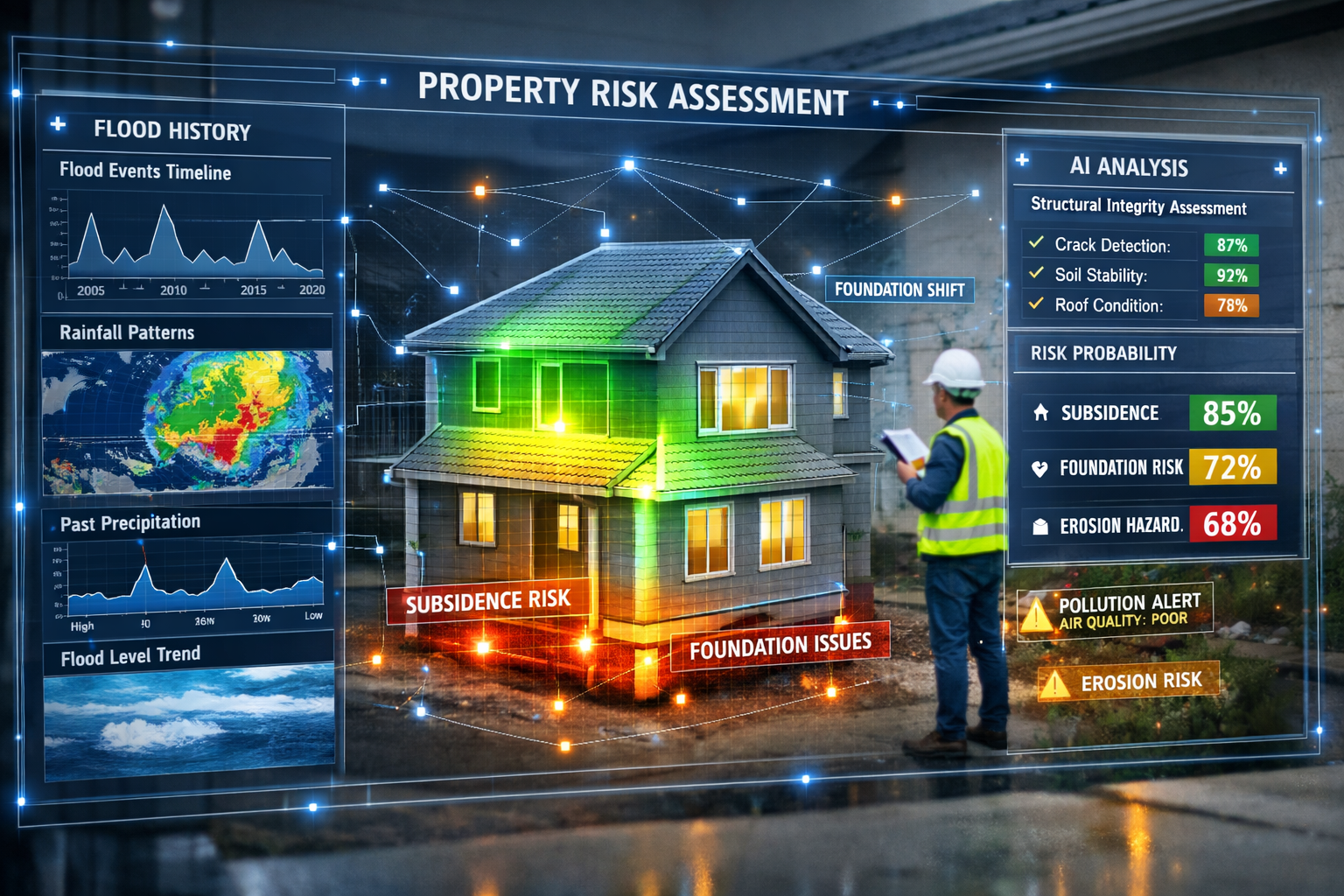
The Foundation of AI-Powered Surveying
Artificial intelligence and machine learning have evolved from experimental technologies into strategic infrastructure within the real estate and surveying industries.[4] At their core, these systems learn from vast amounts of historical data—previous survey reports, building defects, environmental incidents, and maintenance records—to identify patterns invisible to human observation.
Machine learning algorithms operate through three primary mechanisms in property surveying:
- Supervised Learning: Systems trained on labeled datasets (e.g., "structural crack," "water damage," "foundation settlement") to recognize similar conditions in new properties
- Unsupervised Learning: Algorithms that discover hidden patterns in unlabeled data, identifying anomalies that may indicate emerging risks
- Reinforcement Learning: Systems that improve accuracy through feedback loops, refining predictions as more survey data becomes available
The surveying profession entered 2026 amid accelerating digital transformation, driven by industry pressure to deliver faster and more accurate results.[6] This pressure has created both opportunities and challenges for practitioners who must balance technological adoption with professional standards.
How AI Processes Property Data at Scale
Modern AI systems can analyze thousands of property records simultaneously, comparing current conditions against historical baselines to detect changes that might indicate developing problems. For example, when assessing flood risk for a residential property, machine learning algorithms process:
- Historical precipitation data spanning decades
- Topographical information including elevation changes and drainage patterns
- Soil composition analysis affecting water absorption rates
- Previous flood incidents within the geographic area
- Climate change projections affecting future precipitation patterns
This comprehensive analysis produces risk scores and probability assessments that inform choosing the right property survey for specific circumstances. The speed of this analysis—often completed in minutes rather than days—represents a significant operational advantage.
The Critical Role of Data Quality
Despite AI's impressive capabilities, a fundamental truth remains: garbage in, garbage out. The success of AI implementation in surveying depends critically on the quality, relevance, and accuracy of the datasets provided to these systems.[5] This dependency highlights why professional surveyors remain indispensable—they validate data inputs, ensure appropriate context, and verify that AI-generated outputs align with real-world conditions.
Real-world testing by building consultancy teams revealed that AI-generated lease summaries, while appearing relevant at first glance, frequently overlooked important provisions and key clauses within original documentation.[3] This finding underscores the persistent need for qualified surveyors to conduct thorough reviews and provide proper interpretation.
Predicting Risks Through AI and Machine Learning in Property Surveying
Environmental Hazard Prediction
One of the most valuable applications of AI and Machine Learning in Property Surveying: Predicting Risks and Automating Analysis involves forecasting environmental hazards before they materialize. These predictive capabilities extend across multiple risk categories:
Flood Risk Assessment
Machine learning models analyze decades of meteorological data, combining it with real-time weather monitoring and climate projections to generate sophisticated flood probability assessments. These systems consider:
- Watershed characteristics and upstream development
- Storm surge modeling for coastal properties
- Urban drainage capacity and infrastructure age
- Sea level rise projections based on climate models
- Historical flood frequency and severity patterns
The algorithms identify properties in flood-prone areas with remarkable precision, often detecting risks that traditional flood zone maps miss due to their static nature and infrequent updates.
Landslide and Ground Movement Prediction
AI systems excel at identifying subtle ground movement patterns that precede catastrophic failures. By analyzing:
- Satellite imagery showing millimeter-level ground shifts over time
- Soil moisture content from remote sensing data
- Geological composition and slope angles
- Vegetation changes indicating soil instability
- Historical landslide events in similar geological conditions
These predictive models provide early warnings that enable preventive measures, potentially saving lives and preventing property damage. This capability proves particularly valuable for surveys for subsidence where early detection significantly improves remediation outcomes.
Structural Integrity Prediction
Beyond environmental hazards, AI systems increasingly predict structural deterioration before visible symptoms appear. Machine learning algorithms trained on thousands of building defect cases can identify risk factors that correlate with future failures:
| Risk Factor | AI Detection Method | Prediction Accuracy |
|---|---|---|
| Foundation settlement | Satellite interferometry analysis | 82-89% |
| Roof deterioration | Thermal imaging pattern recognition | 76-84% |
| Wall crack progression | Computer vision tracking | 88-92% |
| Water ingress vulnerability | Multi-sensor data fusion | 79-86% |
| Material degradation | Spectral analysis | 73-81% |
These prediction capabilities transform reactive maintenance into proactive risk management, allowing property owners to address issues before they escalate into costly repairs. When combined with traditional RICS home surveys, this predictive intelligence provides comprehensive property assessments.
Defect Detection and Classification
Computer vision systems powered by deep learning neural networks can now identify and classify building defects with impressive accuracy. These systems analyze photographs and video footage from property inspections, automatically detecting:
- Structural cracks with classification by severity and likely cause
- Moisture intrusion through thermal imaging analysis
- Roofing defects including missing tiles and membrane failures
- Facade deterioration such as spalling concrete or brick erosion
- Window and door failures affecting weatherproofing
The AI systems don't simply identify defects—they predict progression rates based on similar historical cases, helping surveyors prioritize recommendations and estimate repair urgency. This capability proves especially valuable for RICS specialist defect surveys where detailed defect analysis drives decision-making.
Limitations in Current Predictive Models
Despite impressive advances, current AI predictive capabilities face important limitations. Recent industry analysis from January-February 2026 reveals that most AI applications focus on document review and workflow automation rather than sophisticated risk prediction.[3][5][6] The four key areas of concern identified in 2023 remain valid in 2026:
- Reporting accuracy: AI-generated reports may miss nuanced conditions requiring experienced judgment
- Over-reliance on AI systems: Excessive trust in automated outputs without proper verification
- Human interpretation gaps: AI lacks contextual understanding of unique property circumstances
- Inaccuracy in automated analysis: Systems may misclassify defects or misjudge severity
These limitations explain why professional expertise from years of training and practical experience remains essential for understanding how theoretical knowledge applies to real-world situations.[3]
Automating Analysis in AI and Machine Learning Property Surveying Workflows
Document Review and Data Extraction
AI systems have achieved significant success in automating administrative tasks that previously consumed substantial surveyor time. Natural language processing (NLP) algorithms can now:
- Extract key information from lease agreements, building permits, and maintenance records
- Summarize lengthy documents into concise executive summaries
- Identify relevant clauses related to structural obligations and maintenance responsibilities
- Cross-reference multiple documents to detect inconsistencies or conflicts
- Generate preliminary checklists for site inspections based on property type
These capabilities reduce time spent on initial document review and data compilation by an estimated 40-60%.[3] However, as noted earlier, interpretation of findings, assessment of risk, and provision of tailored advice still require human judgment.[3]
The efficiency gains allow surveyors to allocate more time to activities that genuinely require professional expertise—site inspections, client consultations, and complex problem-solving. This shift enhances service quality while improving operational efficiency, a combination that benefits both practitioners and clients seeking structural surveys.
Automated Report Generation
Modern AI systems can generate preliminary survey reports by:
- Analyzing inspection photographs to identify visible defects
- Cross-referencing findings against regulatory requirements and building codes
- Populating report templates with standardized descriptions
- Suggesting repair recommendations based on defect databases
- Estimating repair costs using historical pricing data
This automation significantly accelerates report delivery timelines. What traditionally required 5-7 days for completion can now produce preliminary drafts within 24-48 hours. However, qualified surveyors must still review, verify, and finalize these reports to ensure accuracy and appropriateness for specific circumstances.
The automation proves particularly valuable for routine inspections where conditions align with common patterns. For complex properties requiring RICS commercial building surveys, human expertise remains central to the process, with AI serving as a productivity enhancer rather than a replacement.
Workflow Optimization and Task Prioritization
AI agents can perform analysis and generate answers quickly, making them valuable for workflow optimization in surveying practices.[5] These systems help surveyors:
- Prioritize inspection schedules based on property risk profiles
- Allocate resources efficiently by matching surveyor expertise to property complexity
- Identify properties requiring urgent attention through automated risk scoring
- Streamline client communication with automated status updates and preliminary findings
- Manage quality control by flagging reports that deviate from standard patterns
The surveyor's role is becoming increasingly important because AI and automation tools require relevant and accurate datasets—surveyors must critically evaluate which tasks can be performed more efficiently using AI.[5] This evaluation requires deep understanding of both surveying principles and technological capabilities.
Integration with Existing Survey Technologies
AI and machine learning don't operate in isolation—they integrate with existing survey technologies to create comprehensive assessment systems:
Drone Survey Integration: AI algorithms process aerial imagery from drone surveys to create detailed 3D models, identify roof defects, and assess site conditions without physical access to dangerous areas.
Thermal Imaging Analysis: Machine learning systems analyze thermal imagery to detect insulation failures, moisture intrusion, and electrical hotspots with greater accuracy than manual interpretation.
Ground Penetrating Radar (GPR): AI processes GPR data to identify subsurface anomalies, utility locations, and foundation conditions, translating complex waveforms into actionable insights.
Laser Scanning and LiDAR: Automated analysis of point cloud data enables precise measurement, change detection, and structural deformation monitoring at millimeter-level accuracy.
These integrated systems produce comprehensive datasets that inform monitoring surveys and enable long-term tracking of building performance and condition changes.
Real-World Implementation Examples from 2026
Several notable implementations demonstrate practical applications of AI and Machine Learning in Property Surveying: Predicting Risks and Automating Analysis:
Student Housing Sector: Leading the enterprise AI deployment at 16% adoption rate, student housing operators use machine learning to predict maintenance needs across property portfolios, optimize inspection schedules, and identify buildings requiring preventive interventions.[4]
Office Building Management: While showing the highest experimentation rates, office sectors employ AI for energy performance optimization, occupancy pattern analysis, and predictive maintenance scheduling—all informed by continuous building monitoring data.[4]
Commercial Property Assessment: Large-scale commercial portfolios utilize automated stock condition surveys enhanced by AI to assess thousands of properties efficiently, identifying those requiring detailed professional inspection.
Residential Property Transactions: AI-assisted preliminary assessments help buyers and sellers understand property conditions quickly, though comprehensive Level 2 homebuyer surveys conducted by qualified surveyors remain essential for transaction decisions.
The Human Element: Why Professional Surveyors Remain Essential

The Irreplaceable Value of Professional Judgment
A January 2026 RICS Modus magazine publication confirmed that AI offers valuable capabilities as a tool for building surveyors, but cannot replace the professional judgment and expertise that qualified surveyors bring to projects.[3] This conclusion, based on extensive industry experience and real-world testing, highlights several areas where human expertise proves irreplaceable:
Contextual Understanding: Surveyors consider property history, local environmental conditions, construction methods, and client-specific requirements—contextual factors that AI systems struggle to incorporate appropriately.
Ethical Responsibility: Professional surveyors carry legal and ethical obligations to clients, requiring accountability that AI systems cannot assume. The surveyor's professional indemnity insurance and regulatory oversight provide client protection that automated systems cannot replicate.
Complex Problem-Solving: Unusual defects, unique construction methods, and properties with complicated histories require creative problem-solving and lateral thinking that current AI systems cannot match.
Client Communication: Understanding client concerns, explaining technical findings in accessible language, and providing reassurance require emotional intelligence and communication skills beyond AI capabilities.
The Evolving Surveyor Role in the AI Era
Rather than replacing surveyors, AI technology is transforming the surveyor's role into one requiring both traditional expertise and technological literacy. Modern surveyors must:
✅ Validate AI outputs by verifying automated findings against physical observations and professional experience
✅ Curate data quality by ensuring AI systems receive accurate, relevant, and properly contextualized information
✅ Interpret complex results by translating AI-generated risk scores and predictions into actionable client advice
✅ Maintain professional standards by ensuring all work meets regulatory requirements and industry best practices
✅ Provide expert testimony in disputes where AI-generated reports require professional interpretation and defense
This evolution mirrors transformations in other professions where technology augments rather than replaces human expertise. Just as medical imaging AI assists radiologists without replacing them, surveying AI enhances professional capabilities while preserving the essential human element.
Building Trust in AI-Assisted Surveying
The real estate industry faces a critical challenge in 2026: high AI adoption but low trust.[4] This paradox stems from early implementations that over-promised and under-delivered, creating skepticism about AI capabilities. Building trust requires:
Transparency: Clear communication about which aspects of surveys involve AI analysis and which require human judgment
Validation: Rigorous testing of AI systems against known conditions to establish accuracy baselines
Professional Oversight: Maintaining qualified surveyor review of all AI-generated outputs before client delivery
Continuous Improvement: Regular updates to AI models based on real-world performance and emerging defect patterns
Ethical Guidelines: Industry-wide standards governing appropriate AI use in property surveying
Professional organizations and registered RICS valuers play crucial roles in establishing these trust frameworks, ensuring that AI adoption enhances rather than undermines professional standards.
The Cost-Benefit Balance
Implementing AI systems requires significant investment in technology infrastructure, training, and ongoing maintenance. Surveying practices must carefully evaluate whether AI adoption delivers sufficient value to justify these costs. Considerations include:
Initial Investment: Software licensing, hardware upgrades, and system integration costs
Training Requirements: Time and expense for staff to develop AI literacy and system proficiency
Maintenance Costs: Ongoing subscription fees, software updates, and technical support
Data Management: Infrastructure for storing, securing, and processing large datasets
Return on Investment: Efficiency gains, service quality improvements, and competitive advantages
For many practices, the answer involves selective adoption—implementing AI for specific high-value applications while maintaining traditional methods where they prove more effective. This balanced approach optimizes resource allocation while preserving service quality.
Questions about surveyor pricing and structural survey costs increasingly reflect this technology integration, with clients benefiting from efficiency gains while still receiving professional expertise.
Future Developments and Industry Outlook
Emerging Technologies on the Horizon
The next generation of AI and Machine Learning in Property Surveying: Predicting Risks and Automating Analysis will likely incorporate several emerging technologies:
Quantum Computing: Enabling analysis of exponentially larger datasets and more complex risk modeling scenarios
Advanced Computer Vision: Improved defect detection through multi-spectral imaging and 3D reconstruction algorithms
Edge AI: Processing data directly on inspection devices for real-time analysis and immediate feedback
Federated Learning: Allowing AI systems to learn from distributed datasets while preserving data privacy and confidentiality
Explainable AI (XAI): Systems that provide transparent reasoning for their conclusions, enabling surveyors to understand and validate AI logic
These technologies promise to address current limitations while introducing new capabilities that further enhance surveying practice.
Regulatory and Professional Standards Evolution
As AI adoption accelerates, regulatory frameworks and professional standards must evolve to address new challenges:
Liability Frameworks: Clarifying responsibility when AI-assisted surveys produce incorrect conclusions
Data Protection: Ensuring AI systems comply with privacy regulations when processing property and personal information
Professional Competency: Defining required AI literacy for qualified surveyors and establishing training standards
Quality Assurance: Developing audit procedures for AI-assisted surveys to maintain professional standards
Consumer Protection: Ensuring clients understand the role of AI in their surveys and the limitations of automated analysis
Industry bodies, professional associations, and regulatory authorities are actively developing these frameworks to support responsible AI adoption while protecting public interests.
The Path to Sustainable AI Integration
Successful long-term integration of AI into property surveying requires sustainable approaches that balance innovation with proven practices:
- Gradual Implementation: Phased adoption starting with low-risk applications and expanding as confidence grows
- Continuous Evaluation: Regular assessment of AI performance against professional standards
- Knowledge Sharing: Industry-wide collaboration to identify best practices and avoid common pitfalls
- Professional Development: Ongoing training to keep surveyors current with evolving technologies
- Client Education: Helping property owners understand how AI enhances survey quality and value
This measured approach enables the profession to harness AI benefits while maintaining the trust and reliability that clients expect from professional surveyors.
Predictions for 2027 and Beyond
Based on current trends and technological trajectories, several developments appear likely:
📈 Increased Adoption Rates: AI deployment in property surveying will likely exceed 25-30% by late 2027, driven by competitive pressures and proven efficiency gains
🤖 Specialized AI Tools: Purpose-built AI systems for specific survey types (residential, commercial, industrial) will replace general-purpose tools
🌐 Cloud-Based Platforms: Integrated survey management platforms combining AI analysis, report generation, and client portals will become industry standard
📱 Mobile AI Applications: Smartphone-based AI tools enabling real-time defect detection and preliminary analysis during site visits
🔗 Blockchain Integration: Immutable records of survey findings and AI analysis for enhanced transparency and dispute resolution
These developments will continue transforming surveying practice while reinforcing the essential role of qualified professionals in delivering reliable property assessments.
Practical Guidance for Property Owners and Professionals
For Property Buyers and Owners
When engaging surveying services that incorporate AI technology, property owners should:
Ask About AI Use: Request clear explanation of which survey aspects involve AI analysis and which require human expertise
Verify Professional Oversight: Ensure qualified surveyors review all AI-generated findings before report finalization
Understand Limitations: Recognize that AI enhances but doesn't replace professional judgment, particularly for complex properties
Consider Survey Type: Match survey complexity to property needs—AI-assisted preliminary assessments may suffice for straightforward properties, while complex buildings require comprehensive professional surveys
Review Credentials: Verify that surveyors hold appropriate qualifications and professional indemnity insurance regardless of AI tool usage
Understanding how long a homebuyers survey takes helps set realistic expectations, with AI potentially accelerating some aspects while comprehensive analysis still requires appropriate time.
For Surveying Professionals
Surveyors seeking to integrate AI into their practices should:
Start Small: Begin with specific applications like document review or preliminary defect detection before expanding to complex risk prediction
Invest in Training: Develop team competency in AI tools through formal training and hands-on experience
Maintain Professional Standards: Ensure all AI-assisted work meets the same quality standards as traditional surveys
Document AI Use: Clearly indicate in reports which aspects involved AI analysis and how findings were validated
Stay Informed: Monitor industry developments, emerging technologies, and evolving best practices through professional organizations
Evaluate ROI: Regularly assess whether AI tools deliver sufficient value to justify ongoing investment
Prioritize Data Quality: Recognize that AI effectiveness depends on accurate, relevant input data requiring professional curation
For Industry Stakeholders
Organizations supporting the surveying profession should:
Develop Standards: Create clear guidelines for appropriate AI use in different survey contexts
Provide Education: Offer training programs helping surveyors develop AI literacy and technical competency
Foster Collaboration: Facilitate knowledge sharing about successful AI implementations and lessons learned
Support Research: Fund studies examining AI accuracy, reliability, and optimal applications in surveying
Protect Consumers: Ensure regulatory frameworks maintain professional standards despite technological changes
Promote Transparency: Encourage clear communication about AI capabilities and limitations to build public trust
Conclusion
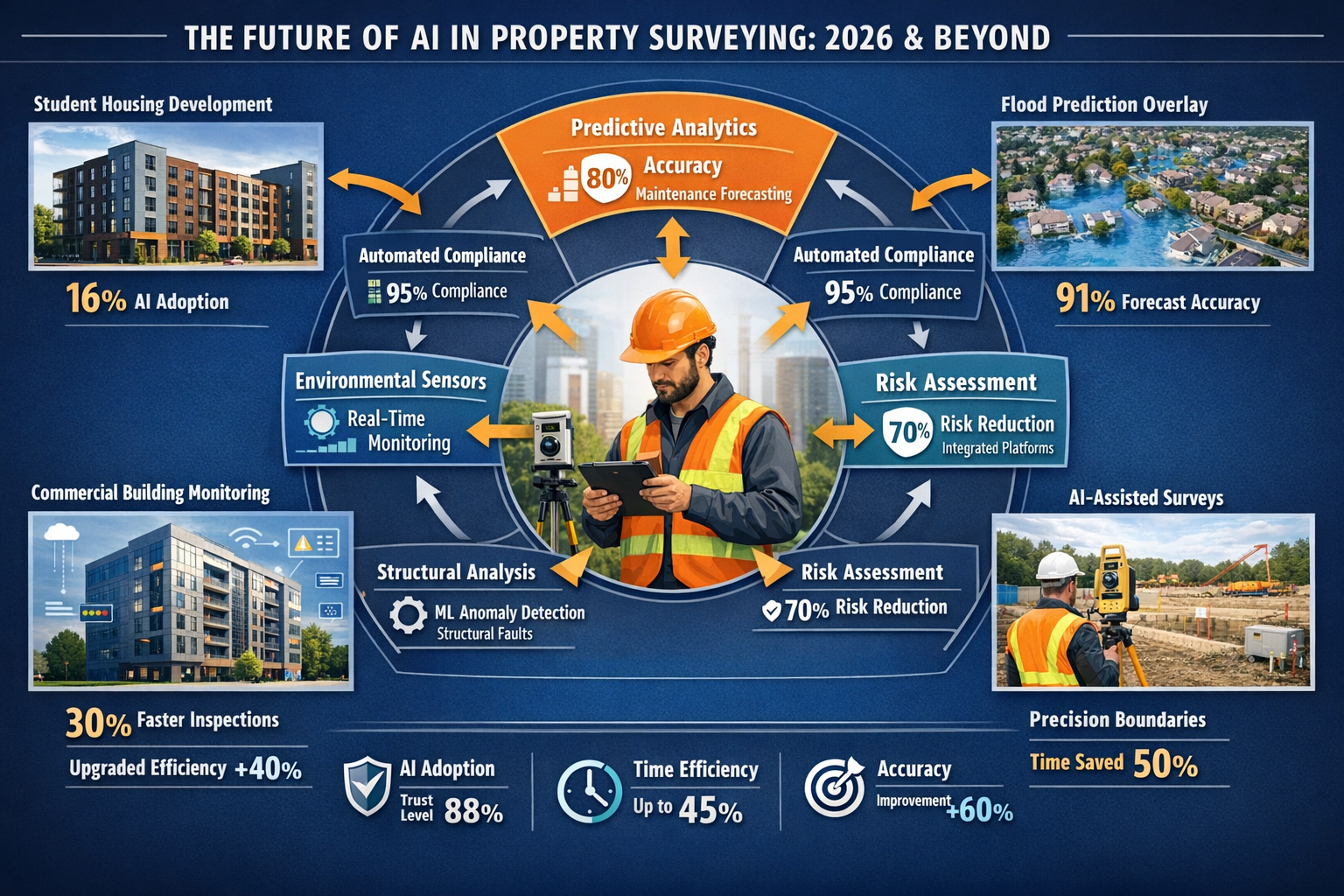
AI and Machine Learning in Property Surveying: Predicting Risks and Automating Analysis represents a transformative force reshaping the surveying profession in 2026. These technologies demonstrate remarkable capabilities—processing massive datasets to detect subtle changes, predicting environmental hazards like floods and landslides before they occur, and streamlining administrative workflows that previously consumed valuable professional time.
Real-world implementations across student housing, commercial properties, and residential sectors prove that AI delivers genuine value when properly deployed. Efficiency gains of 40-60% in document review, automated defect detection with 80%+ accuracy rates, and predictive risk models identifying hazards months in advance showcase technology's potential to enhance surveying practice.
Yet the profession has learned an equally important lesson: AI serves as a powerful tool, not a replacement for professional expertise. Critical gaps in document review, persistent risks of over-reliance on automated systems, and the irreplaceable value of contextual understanding and professional judgment mean that qualified surveyors remain essential to delivering reliable property assessments.[3]
The path forward requires balanced integration—selectively adopting AI for high-value applications while preserving traditional methods where they prove superior. Surveyors must evolve into technology-literate professionals who validate AI outputs, curate data quality, and translate automated findings into actionable client advice. This evolution mirrors transformations across professional services where technology augments rather than replaces human expertise.
Actionable Next Steps
For property owners seeking survey services:
- Request information about AI use in your survey and ensure qualified professional oversight
- Match survey complexity to property needs, recognizing that AI-assisted options may suit straightforward properties
- Verify surveyor credentials and professional indemnity insurance regardless of technology used
- Contact qualified surveyors to discuss your specific property assessment needs
For surveying professionals:
- Evaluate specific AI applications offering clear ROI for your practice
- Invest in team training to develop AI literacy and technical competency
- Start with low-risk implementations like document review before expanding to complex risk prediction
- Maintain rigorous quality standards ensuring AI-assisted work meets professional requirements
For the industry:
- Develop clear standards governing appropriate AI use in different surveying contexts
- Create training programs supporting professional development in AI technologies
- Foster collaboration enabling knowledge sharing about successful implementations
- Build consumer trust through transparency about AI capabilities and limitations
The surveying profession stands at an exciting juncture where technology and expertise combine to deliver unprecedented value. By embracing AI's strengths while preserving the irreplaceable human element, the profession can navigate this transformation successfully—serving clients better while maintaining the professional standards that underpin public trust.
References
[1] Why 2026 Could Be The Year Ai Beats Traditional Real Estate Practices – https://www.aicerts.ai/blog/why-2026-could-be-the-year-ai-beats-traditional-real-estate-practices/
[2] How Ai Is Changing Real Estate In The Usa – https://www.rentana.io/blog/how-ai-is-changing-real-estate-in-the-usa
[3] How Ai Is Changing Building Surveying Opportunities And Limitations – https://www.eddisons.com/insights/how-ai-is-changing-building-surveying-opportunities-and-limitations
[4] Ai In Real Estate Reaches A Turning Point High Adoption Low Trust And A Race Toward Enterprise Scale Nwid 1177 – https://www.realestatebusinessreview.com/news/ai-in-real-estate-reaches-a-turning-point-high-adoption-low-trust-and-a-race-toward-enterprise-scale-nwid-1177.html
[5] How Ai Is Changing The Role Of The Surveyor In Aec – https://www.gim-international.com/content/article/how-ai-is-changing-the-role-of-the-surveyor-in-aec
[6] Doubling Down On Digital – https://amerisurv.com/2026/02/01/doubling-down-on-digital/
[7] Real Estate Ai Success Depends On People – https://www.weforum.org/stories/2026/01/real-estate-ai-success-depends-on-people/