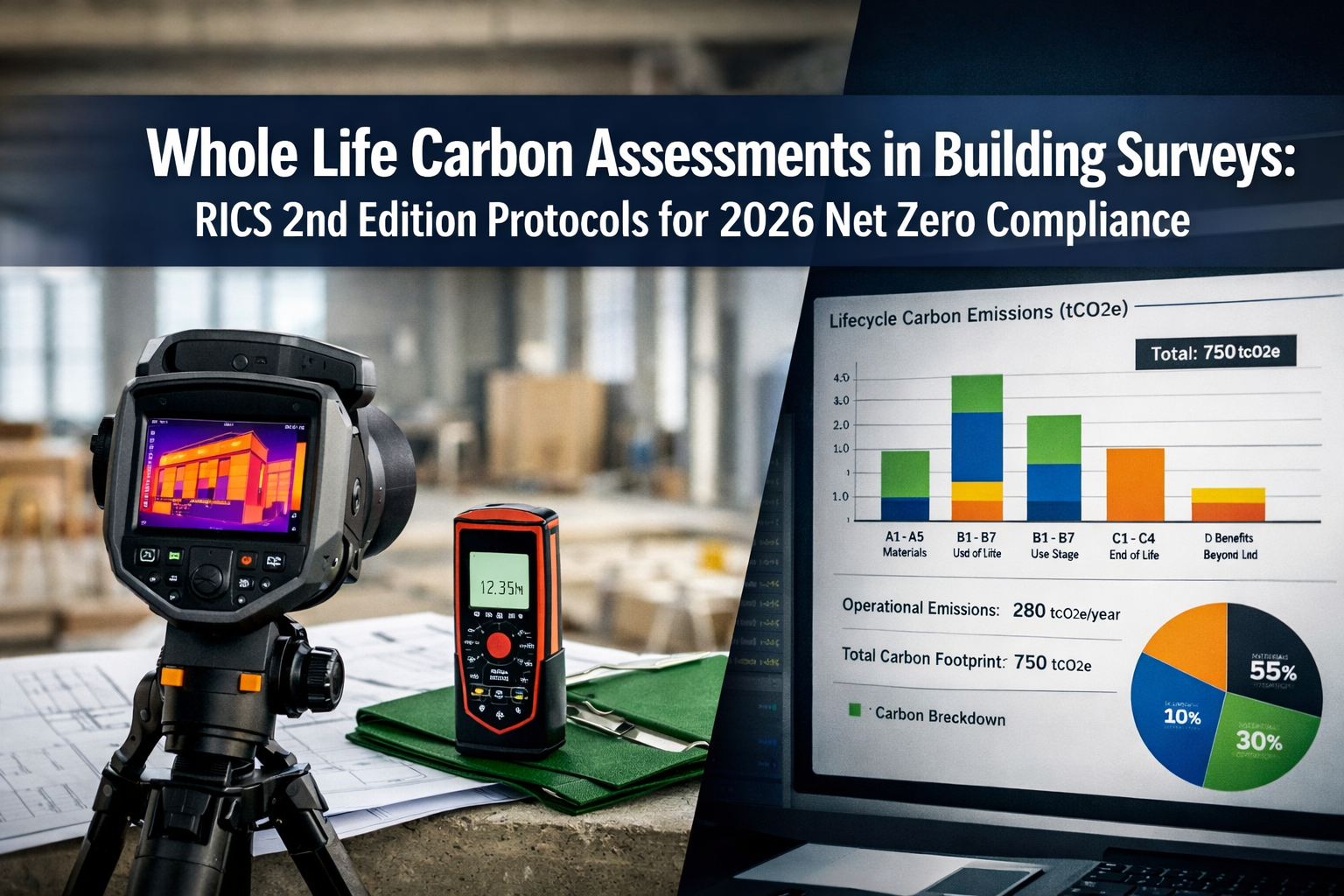
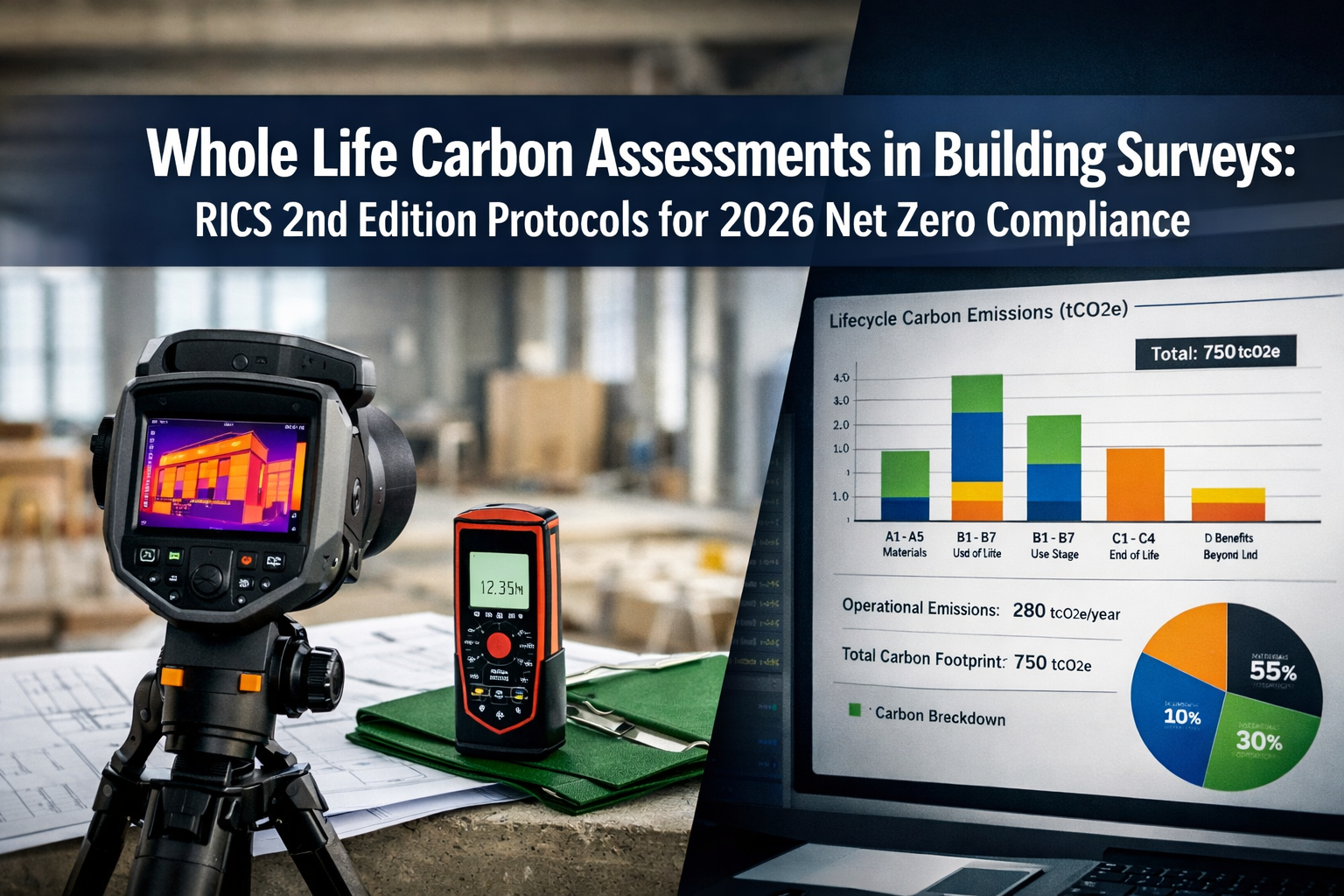
{"cover":"Professional landscape format (1536x1024) hero image featuring bold text overlay 'Whole Life Carbon Assessments in Building Surveys: RICS 2nd Edition Protocols for 2026 Net Zero Compliance' in extra large 70pt white sans-serif font with dark shadow and semi-transparent navy overlay box, positioned in upper third. Background shows split composition: left side displays modern building survey equipment including thermal imaging camera and laser measurement tools on construction site, right side shows digital carbon assessment dashboard with lifecycle stages graph and emissions data. Color scheme: deep green, navy blue, white, with orange accent highlights. High contrast, magazine cover quality, editorial architectural photography style with professional lighting and sharp focus.","content":["Detailed landscape format (1536x1024) editorial photograph showing chartered surveyor conducting Level 3 building survey in partially renovated Victorian property, wearing high-visibility vest, holding tablet displaying RICS WLCA software interface with embodied carbon calculations visible on screen. Foreground shows exposed brick wall with material samples tagged for carbon assessment, background reveals structural timber beams and MEP systems. Natural lighting through large windows, professional architectural photography style with depth of field, annotations overlaying image indicating carbon hotspots in yellow circles, measurement tools and clipboard visible on workbench. Color palette: warm browns, construction orange, digital blue interface glow, professional surveying aesthetic.","Landscape format (1536x1024) technical infographic illustration displaying four-quadrant breakdown of carbon types assessed under RICS 2nd edition: embodied carbon (showing material extraction and manufacturing icons), operational carbon (building with energy meters and HVAC systems), biogenic carbon (timber frame construction with carbon sequestration arrows), and end-of-life carbon (demolition and recycling symbols). Center shows circular lifecycle diagram with stages A1-C4 labeled according to EN 15978 standard. Clean professional design with isometric building cutaway, data visualization elements, percentage breakdowns for each carbon type, color-coded sections in green, blue, orange, and grey. Modern infographic style with clear typography and measurement units in kgCO2e.","Landscape format (1536x1024) professional photograph of modern construction project meeting room with large wall-mounted monitor displaying integrated ICMS 3 cost and carbon assessment dashboard showing parallel columns comparing financial costs versus carbon costs for building elements. Foreground shows conference table with architectural plans, material specification sheets, and RICS professional standards documentation spread out. Three professionals in business attire reviewing data, one pointing at screen showing contingency factors table. Background features window overlooking construction site with sustainable building materials visible. Bright professional lighting, corporate architectural aesthetic, charts showing decarbonization scenarios with 2026 and 2050 net zero targets marked, color scheme: professional grey, green sustainability accents, digital blue screen glow."]}
The built environment accounts for nearly 40% of global carbon emissions, yet until recently, surveyors lacked standardized tools to quantify this impact during property assessments. Since July 1, 2024, all RICS members must comply with the Whole Life Carbon Assessment (WLCA) 2nd edition standard—a mandatory framework that fundamentally transforms how RICS building surveys integrate carbon considerations into professional practice.[1] As 2026 sustainability mandates intensify across the construction sector, understanding how Whole Life Carbon Assessments in Building Surveys: RICS 2nd Edition Protocols for 2026 Net Zero Compliance operate has become essential for chartered surveyors navigating renovation projects and new builds.
This comprehensive guide explores how the RICS 2nd edition protocols integrate into building survey practice, providing surveyors with actionable frameworks to quantify embodied carbon, assess operational emissions, and support clients' net zero ambitions through evidence-based carbon accounting.
Key Takeaways
- Mandatory compliance since July 2024 requires all RICS members to follow the 2nd edition WLCA standard for carbon assessments, regardless of project location or building type
- Four carbon categories are assessed—embodied, operational, biogenic, and end-of-life—covering complete lifecycle stages from material extraction through demolition
- Integration with building surveys enables chartered surveyors to quantify carbon impacts during Level 3 surveys, retrofit assessments, and commercial building surveys
- Validated software tools and contingency methodologies ensure accurate carbon quantification aligned with cost management standards
- 2026 net zero compliance depends on comprehensive WLCA implementation across renovation and new construction projects
Understanding the RICS 2nd Edition WLCA Framework
What Changed from the 2017 Standard
The RICS Whole Life Carbon Assessment 2nd edition, published in 2023, represents a dramatic expansion from its predecessor. While the original 2017 standard focused primarily on office buildings, the current framework encompasses all building types and extensive infrastructure categories including roads, drainage systems, railways, dams, reservoirs, and airports—all using a unified methodology.[1]
This comprehensive professional standard exceeds 200 pages of technical guidance, reflecting the industry's maturation in carbon accounting practices. The development process included a public consultation that received over 1,300 responses, demonstrating substantial industry engagement before finalization.[4]
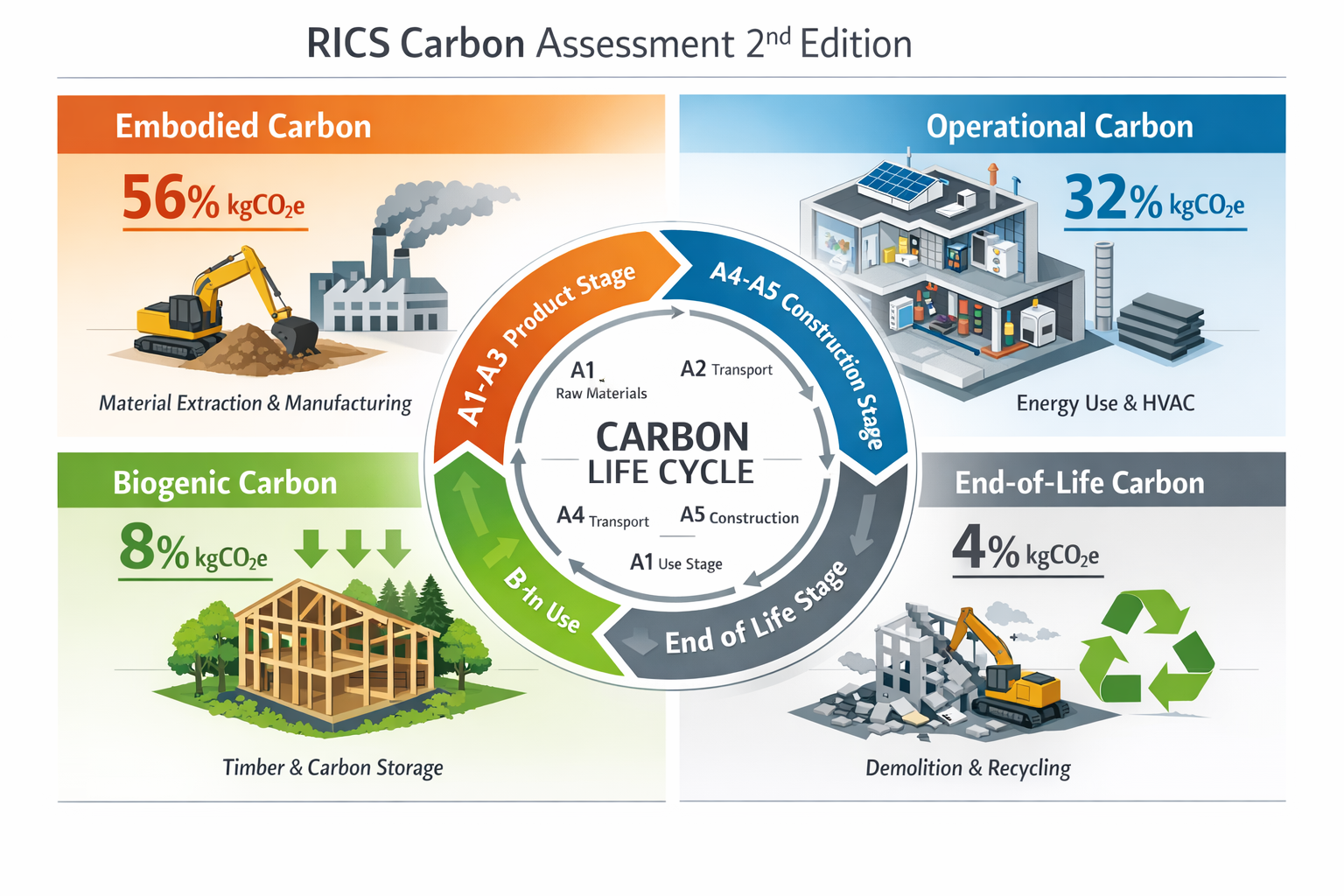
The Four Carbon Types in Building Assessments
The RICS 2nd edition framework comprehensively addresses four distinct carbon categories that surveyors must evaluate during property assessments:
1. Embodied Carbon 🏗️
This encompasses emissions from material extraction, manufacturing, transportation, and construction activities. For building surveys, embodied carbon assessment involves quantifying the carbon footprint of existing structural elements, proposed renovation materials, and new construction components.
2. Operational Carbon ⚡
These are emissions generated during building occupation, primarily from energy consumption for heating, cooling, lighting, and equipment operation. Surveyors must evaluate MEP (mechanical, electrical, plumbing) systems and their projected carbon performance over the building's operational life.
3. Biogenic Carbon 🌳
This category addresses carbon sequestration in biological materials, particularly timber and other bio-based construction materials. The 2nd edition provides enhanced clarity on accounting for carbonation effects and renewable material integration.[4]
4. End-of-Life Carbon ♻️
Emissions from demolition, deconstruction, waste processing, and material recycling fall into this category. The framework supports comprehensive pre-construction modeling, including demolition of existing assets—particularly relevant for retrofit and refurbishment projects.[2]
Integration with International Cost Management Standards
A significant advancement in the RICS 2nd edition is its integration with the International Cost Management Standard (ICMS 3), enabling professionals to assess cost and carbon impacts simultaneously.[3] This parallel framework allows surveyors conducting building surveys to provide clients with comprehensive financial and environmental impact assessments.
The integration means that carbon assessments follow the same elemental breakdown structure as cost plans, facilitating direct comparison and trade-off analysis during design development and renovation planning.
Implementing Whole Life Carbon Assessments in Building Surveys: RICS 2nd Edition Protocols for 2026 Net Zero Compliance
How Surveyors Integrate WLCA into Level 3 Surveys
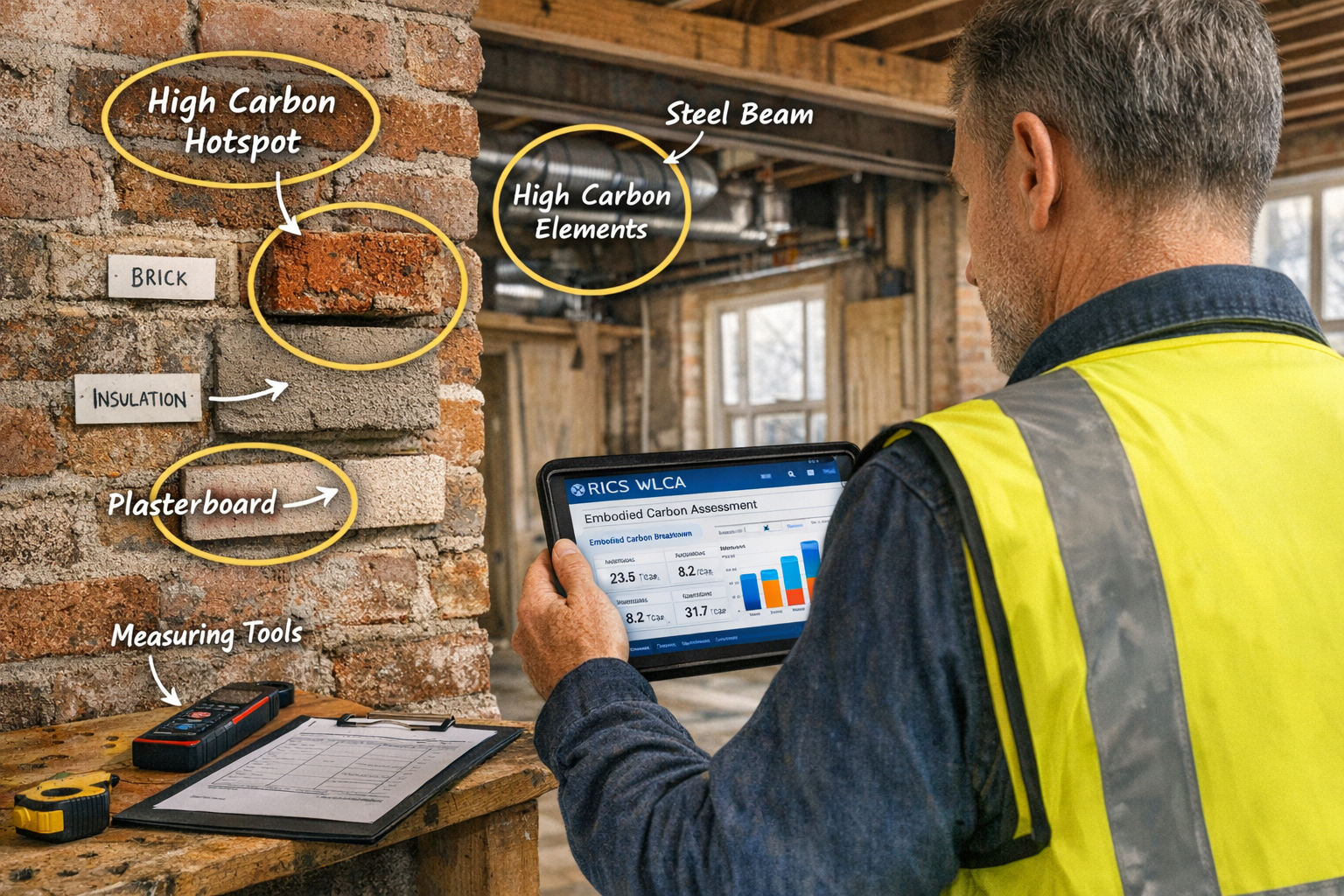
Traditional Level 3 building surveys focus on structural condition, defects, and repair recommendations. The RICS 2nd edition protocols now enable surveyors to extend this assessment to include carbon quantification for existing building elements and proposed interventions.
Practical integration steps include:
- Material Inventory – Document existing building materials, construction methods, and structural systems during the physical survey
- Carbon Database Matching – Match identified materials and systems to validated Environmental Product Declarations (EPDs) and carbon factors
- Lifecycle Stage Allocation – Categorize carbon impacts according to EN 15978 lifecycle stages (A1-C4)
- Scenario Modeling – Assess carbon implications of different repair, renovation, or replacement options
- Contingency Application – Apply appropriate contingency factors based on data reliability and project stage
The Role of Validated Software in Carbon Assessments
RICS implemented a WLCA software validation program to mitigate risks of inaccurate assessments, with One Click LCA being the first validated software under the scheme.[3] This validation program ensures that digital tools used by surveyors comply with the standard's calculation methodologies and reporting requirements.
Validated software platforms enable:
- Automated carbon calculations based on material quantities and specifications
- Simultaneous reporting of decarbonized and non-decarbonized emissions scenarios[2]
- Contingency factor application similar to traditional cost plans, with factors based on project stage, data reliability, and quantity certainty[1]
- Integration with BIM models for new construction projects
- Retrofit scenario comparison for existing buildings undergoing renovation
Contingency Methodology for Carbon Assessments
Similar to traditional cost planning, the RICS 2nd edition introduces contingency factors that account for uncertainty in carbon assessments. These factors vary based on:
| Project Stage | Data Reliability | Quantity Reliability | Typical Contingency Range |
|---|---|---|---|
| Early Design | Low | Low | 40-60% |
| Developed Design | Medium | Medium | 20-40% |
| Technical Design | High | High | 10-20% |
| Construction | Very High | Very High | 5-10% |
Validated software tools automatically apply these contingency factors, ensuring that carbon estimates reflect appropriate uncertainty margins at each project development stage.[1][2]
Carbon Assessment in Renovation and Retrofit Projects
For surveyors conducting assessments on existing buildings, the RICS 2nd edition framework supports comprehensive pre-construction modeling, including demolition of existing assets.[2] This capability is particularly valuable for:
- Heritage building renovations where material retention versus replacement decisions have significant carbon implications
- Commercial retrofit projects requiring specialist defect surveys and carbon impact assessments
- Residential refurbishment where embodied carbon in existing structures may justify repair over replacement
- Mixed-use redevelopment requiring comprehensive lifecycle carbon accounting
When conducting structural engineering assessments alongside carbon evaluations, surveyors can provide clients with evidence-based recommendations that balance structural performance, cost, and carbon impact.
Achieving 2026 Net Zero Compliance Through RICS WLCA Protocols
Decarbonization Scenario Planning
The RICS 2nd edition provides greater clarity on MEP systems, decarbonization scenarios, renewables integration, and carbonation effects.[4] This enhanced guidance enables surveyors to model different pathways to net zero compliance, considering:
Grid Decarbonization Trajectories 📊
Validated software platforms enable simultaneous reporting of emissions under different grid decarbonization assumptions, reflecting government targets for 2026, 2030, and 2050.[2] This allows clients to understand how operational carbon will decrease over time as the electricity grid becomes cleaner.
Renewable Energy Integration ☀️
The standard provides frameworks for accounting for on-site renewable generation, including solar PV, heat pumps, and other low-carbon technologies. Surveyors can quantify the carbon benefit of retrofitting renewable systems during renovation projects.
Material Substitution Strategies 🔄
By comparing carbon factors for different material options, surveyors can identify opportunities to reduce embodied carbon through material substitution—such as replacing concrete with timber in appropriate applications.
Carbon Budgets and Target Setting
The RICS 2nd edition aims to help manage carbon budgets, reduce lifetime emissions, and deliver a net-zero future for the built environment.[4] For surveyors, this means:
- Establishing baseline carbon performance for existing buildings during survey assessments
- Setting reduction targets aligned with client sustainability commitments and regulatory requirements
- Tracking carbon performance through different design iterations and renovation scenarios
- Reporting against benchmarks using industry-standard metrics and comparison frameworks
Regulatory Compliance and Future-Proofing
As 2026 approaches, various jurisdictions are implementing mandatory carbon disclosure requirements for buildings. The RICS WLCA 2nd edition protocols provide a standardized framework that supports compliance with:
- UK Building Regulations Part Z (anticipated carbon disclosure requirements)
- London Plan carbon reduction targets for major developments
- BREEAM and LEED certification carbon assessment requirements
- Corporate ESG reporting obligations for property portfolios
By conducting comprehensive carbon assessments during building surveys, surveyors help clients future-proof their properties against evolving regulatory requirements and market expectations.
Professional Development and Training
RICS offers a Certificate in Whole Life Carbon Assessment training programme to support members in implementing the 2nd edition standard.[5] This structured training covers:
- Technical application of the WLCA methodology
- Software tool utilization and validation
- Integration with existing surveying workflows
- Case study analysis and practical application
- Regulatory compliance and reporting requirements
For surveyors expanding their practice to include carbon assessment capabilities, this professional development pathway provides essential competency building aligned with the mandatory standard.
Practical Challenges and Solutions in WLCA Implementation
Data Availability and Quality
One of the primary challenges surveyors face when implementing WLCA protocols is obtaining reliable carbon data for existing building materials and systems. Many older buildings contain materials for which specific Environmental Product Declarations (EPDs) don't exist.
Solutions include:
- Using generic carbon factors from validated databases when specific EPDs are unavailable
- Applying appropriate contingency factors to reflect data uncertainty
- Conducting material testing and analysis for significant building elements
- Documenting data sources and assumptions transparently in survey reports
Integration with Traditional Survey Workflows
Incorporating carbon assessment into established surveying practices requires workflow adaptation. Surveyors must balance comprehensive carbon analysis with traditional defect identification and condition assessment.
Effective integration strategies:
- Parallel data collection – Gather material specifications and quantities during physical inspections
- Digital documentation – Use tablets and mobile apps to input data directly into WLCA software on-site
- Staged implementation – Begin with simplified carbon assessments and expand detail as experience grows
- Client communication – Clearly explain the value proposition of integrated carbon assessments
Cost and Time Implications
Comprehensive WLCA implementation adds time and cost to building survey projects. However, the value delivered through carbon insights increasingly justifies this investment, particularly as clients face growing sustainability pressures.
Cost management approaches:
- Offer tiered service levels with basic, standard, and comprehensive carbon assessment options
- Leverage validated software tools to improve efficiency and reduce manual calculation time
- Bundle carbon assessment with other specialist surveys to create comprehensive service packages
- Demonstrate ROI through case studies showing how carbon insights influenced decision-making
Case Applications Across Building Types
Residential Property Assessments
For residential surveys, WLCA protocols enable homeowners to understand the carbon footprint of renovation decisions. When conducting assessments on period properties or modern homes, surveyors can quantify:
- Embodied carbon in existing structural elements worth preserving
- Carbon implications of extension and conversion projects
- Operational carbon reduction opportunities through insulation and system upgrades
- End-of-life considerations for materials being replaced
Commercial Building Surveys
Commercial property surveys benefit significantly from WLCA integration, as commercial clients increasingly face ESG reporting requirements and tenant sustainability expectations. Carbon assessments support:
- Portfolio-level carbon benchmarking and target setting
- Tenant improvement carbon accounting
- Major refurbishment planning and scenario comparison
- Green building certification support (BREEAM, LEED, WELL)
Infrastructure and Specialized Projects
The RICS 2nd edition's expanded scope to include infrastructure enables surveyors working on specialized projects to apply consistent carbon assessment methodologies across:
- Transportation infrastructure (roads, railways, airports)
- Water management systems (drainage, dams, reservoirs)
- Industrial facilities and specialized structures
- Mixed-use developments combining multiple building types
The Future of Carbon-Conscious Surveying
Emerging Technologies and Methodologies
The field of whole life carbon assessment continues to evolve rapidly. Emerging developments that will shape future practice include:
Digital Twin Integration 🖥️
Linking WLCA models with digital twins enables real-time operational carbon monitoring and predictive maintenance planning based on carbon performance.
AI-Enhanced Material Recognition 🤖
Machine learning algorithms are being developed to automatically identify building materials from photographs and thermal imaging, accelerating the data collection process during surveys.
Blockchain-Based EPD Verification 🔗
Distributed ledger technology may provide tamper-proof verification of material carbon factors and supply chain transparency.
Industry Collaboration and Standardization
The success of the RICS 2nd edition demonstrates the value of industry-wide standardization. Future developments will likely include:
- Greater harmonization between RICS WLCA and other international carbon assessment frameworks
- Expanded databases of validated EPDs for construction materials
- Industry benchmarking data enabling comparative performance analysis
- Integration with valuation methodologies to reflect carbon performance in property values
Policy and Regulatory Evolution
As governments intensify climate commitments, surveyors should anticipate:
- Mandatory carbon disclosure requirements for property transactions
- Carbon-based taxation or incentive schemes affecting property values
- Stricter building performance standards linked to carbon metrics
- Enhanced professional liability considerations for carbon assessment accuracy
Conclusion
The mandatory implementation of Whole Life Carbon Assessments in Building Surveys: RICS 2nd Edition Protocols for 2026 Net Zero Compliance represents a fundamental evolution in surveying practice. Since July 2024, all RICS members must apply these comprehensive protocols when conducting carbon assessments, integrating embodied, operational, biogenic, and end-of-life carbon considerations into their professional work.[1]
For chartered surveyors, this framework provides the tools to deliver enhanced value to clients navigating the transition to net zero. By quantifying carbon impacts during building surveys, renovation assessments, and new construction projects, surveyors enable evidence-based decision-making that balances structural performance, cost, and environmental impact.
Actionable Next Steps
For Surveyors:
- Complete the RICS Certificate in Whole Life Carbon Assessment training programme[5]
- Evaluate and implement validated WLCA software tools in your practice
- Begin integrating basic carbon assessments into existing survey workflows
- Develop case studies demonstrating carbon assessment value to clients
- Stay informed on evolving regulations and industry best practices
For Property Owners and Developers:
- Request carbon assessments as part of comprehensive building surveys
- Use WLCA insights to inform renovation and development decisions
- Establish carbon reduction targets aligned with 2026 and 2050 net zero goals
- Engage RICS-qualified surveyors experienced in WLCA implementation
- Consider carbon performance in long-term property strategy and portfolio management
The integration of whole life carbon assessment into building survey practice is no longer optional—it's a professional requirement that positions the surveying profession at the forefront of the construction industry's sustainability transformation. By embracing these protocols, surveyors contribute meaningfully to the urgent challenge of decarbonizing the built environment while delivering enhanced professional services that meet evolving client needs and regulatory requirements.
References
[1] Rics Whole Life Carbon Assessment Standard How Does It Support The Industry – https://www.bcis.co.uk/insight/rics-whole-life-carbon-assessment-standard-how-does-it-support-the-industry/
[2] Rics Whole Life Carbon Assessment Wlca 2nd Edition – https://oneclicklca.com/regulations/rics-whole-life-carbon-assessment-wlca-2nd-edition
[3] Rics Whole Life Carbon Assessment V2 Whats Working Whats Next – https://oneclicklca.com/en/resources/articles/rics-whole-life-carbon-assessment-v2-whats-working-whats-next
[4] An Overview Of Rics Second Edition Of The Whole Life Cycle Carbon Assessment Standard – https://www.buildpass.co.uk/blog/an-overview-of-rics-second-edition-of-the-whole-life-cycle-carbon-assessment-standard/
[5] Certificate In Whole Life Carbon Assessment Training Programme – https://www.rics.org/training-events/training-courses/certificate-in-whole-life-carbon-assessment-training-programme
[6] Rics Whole Life Carbon Assessment Wlca Standard – https://netzerocompare.com/policies/rics-whole-life-carbon-assessment-wlca-standard
[7] Watch – https://www.youtube.com/watch?v=d3QnUM16ves
[8] Whole Life Carbon Assessments In 2026 Valuations Rics 2nd Edition Standards For Surveyors – https://nottinghillsurveyors.com/blog/whole-life-carbon-assessments-in-2026-valuations-rics-2nd-edition-standards-for-surveyors
[9] Whole Life Carbon Assessment – https://www.rics.org/profession-standards/rics-standards-and-guidance/sector-standards/construction-standards/whole-life-carbon-assessment