
The commercial property landscape is experiencing a dramatic transformation in 2026, particularly in regional office markets across Northern England. As cities like Manchester, Leeds, and Birmingham witness unprecedented rental uplifts driven by artificial intelligence sector expansion, chartered surveyors face the complex challenge of accurately Valuing Regional Office Properties in 2026 Recovery: RICS Adjustments for AI Demand and Rental Growth. This shift requires sophisticated valuation techniques that account for hybrid work patterns, technology infrastructure demands, and evolving sustainability requirements under the latest RICS standards.
The convergence of post-pandemic recovery, AI-driven tenant demand, and updated regulatory frameworks has created a unique valuation environment. Regional markets are no longer following traditional patterns, with some Northern cities outperforming London in rental growth for the first time in decades. For surveyors, this means recalibrating established methodologies and embracing new frameworks that reflect these fundamental market shifts.
Key Takeaways
- 🏢 RICS published its fourth edition ESG and sustainability standard on January 28, 2026, effective April 30, 2026, providing crucial frameworks for integrating sustainability factors into commercial property valuations [1]
- 📊 Regional divergence has reached unprecedented levels in 2026, with Northern cities experiencing rental growth that demands location-specific valuation adjustments and refined comparable analysis [2]
- 💻 AI sector demand is reshaping office valuations, requiring surveyors to assess technology infrastructure, power capacity, and connectivity as primary value drivers
- 🔄 Hybrid work patterns necessitate risk-adjusted models that account for occupancy flexibility, space utilization rates, and tenant covenant strength in new ways
- 📘 Red Book compliance now mandates ESG integration, with practical guidance on capital and operational expenditure assumptions linked to sustainability factors [1]
Understanding the 2026 Regional Office Market Recovery
The Northern Powerhouse Effect on Office Valuations
The 2026 commercial property market presents a fascinating paradox: while traditional central London office spaces continue grappling with hybrid work challenges, regional cities are experiencing robust recovery driven by technology sector expansion and AI company relocations. Manchester's office rental rates have increased by 18% year-on-year, while Leeds has seen 15% growth, fundamentally altering the valuation landscape for these markets.
This regional divergence represents the most pronounced shift in recent memory [2]. Surveyors conducting commercial property valuations must now apply location-specific adjustments that would have seemed excessive just three years ago. The traditional hierarchy of UK office markets has been disrupted, requiring fresh approaches to comparable evidence and yield determination.
Key drivers of regional recovery include:
- AI and technology sector clustering in Manchester, Leeds, and Birmingham
- Lower operational costs compared to London (30-40% reduction in occupancy expenses)
- Improved connectivity infrastructure including HS2 phase completions and 5G rollout
- Quality of life factors attracting talent away from expensive metropolitan areas
- Government incentives for technology investment in regional hubs
AI Demand: A New Valuation Variable
The artificial intelligence boom has introduced an entirely new category of tenant requirements that directly impact property values. AI companies and data-intensive businesses require substantial electrical capacity, advanced cooling systems, and fiber-optic connectivity that older office buildings simply cannot provide without significant capital expenditure.
Properties with existing high-power infrastructure are commanding premium rents of 20-25% above comparable buildings in the same locations. This creates a valuation challenge: how should surveyors reflect this premium in their assessments? Is it a temporary market anomaly or a permanent shift in value hierarchy?
When conducting Red Book valuations, professionals must now investigate and report on:
| Infrastructure Factor | Valuation Impact | Assessment Method |
|---|---|---|
| Electrical Capacity | High (15-25% premium) | Review building specifications, transformer capacity |
| Cooling Systems | Medium (8-12% premium) | Assess HVAC capability, redundancy systems |
| Fiber Connectivity | High (10-20% premium) | Verify carrier-neutral access, bandwidth capacity |
| Floor Loading | Medium (5-10% premium) | Structural engineer assessment for server equipment |
| Security Systems | Low-Medium (3-7% premium) | Review physical and cyber security infrastructure |

Valuing Regional Office Properties in 2026 Recovery: RICS Methodology Updates
The Fourth Edition ESG Standard and Its Implications
On January 28, 2026, RICS published the fourth edition of its global ESG and sustainability standard for commercial property valuation, with mandatory compliance beginning April 30, 2026 [1]. This updated standard fundamentally changes how surveyors must approach Valuing Regional Office Properties in 2026 Recovery: RICS Adjustments for AI Demand and Rental Growth.
The standard provides practical frameworks for assessing sustainability factors in valuations and aligns seamlessly with the RICS Valuation Global Standards (the "Red Book") [1]. Critically, it includes new jurisdiction-specific sections for the UK, EU, and Australia, reflecting established regulatory and disclosure frameworks that vary significantly by region [1].
For regional office valuations, the most significant changes include:
Enhanced ESG Reporting Requirements:
- Mandatory disclosure of energy performance certificates (EPC) and their impact on value
- Assessment of climate risk exposure and adaptation measures
- Consideration of stranded asset risk for properties failing to meet 2030 energy standards
- Integration of operational carbon costs into income projections
Capital Expenditure Clarity:
The updated standard includes practical guidance on cost assumptions in valuations, clarifying when and how capital and operational expenditure linked to ESG factors may be reflected in valuations [1]. This is particularly relevant for regional offices where retrofit costs for sustainability improvements can significantly impact net present values.
Applying Red Book Standards to Regional Markets
The RICS Valuation Global Standards (the "Red Book") remain the foundation for all professional valuations [3]. However, their application to regional office markets in 2026 requires nuanced interpretation, particularly regarding comparable evidence and market rent determination.
When valuing regional office properties, surveyors must ensure compliance with:
- VPS 1 – Terms of Engagement: Clearly define the scope, including specific ESG assessment requirements
- VPS 2 – Inspections, Investigations and Records: Document technology infrastructure, sustainability features, and hybrid work adaptability
- VPS 3 – Valuation Reports: Include explicit commentary on AI demand factors and regional market dynamics
- VPS 4 – Bases of Value: Select appropriate basis (typically Market Value) with clear assumptions about tenant demand profiles
- VPS 5 – Valuation Approaches and Methods: Apply income, comparable, and cost approaches with regional market adjustments
The commercial building survey process becomes increasingly important in this context, as physical condition directly impacts both ESG compliance potential and AI tenant suitability.
Comparable Evidence Analysis for Regional Offices
Comparable evidence analysis has become more complex in 2026 due to the widening divergence between regional markets [2]. Traditional approaches that relied heavily on London-centric data and applied simple regional discounts no longer produce reliable valuations.
Best practices for comparables analysis include:
- Micro-location assessment: Properties within 500 meters can show 15-20% rental variation based on connectivity and amenity access
- Technology infrastructure weighting: Adjust comparables based on documented electrical capacity and fiber connectivity
- Tenant profile matching: AI and tech tenants pay premium rents; adjust for covenant strength and lease terms
- Hybrid work adaptability: Properties with flexible floor plates and collaboration spaces command premiums
- ESG performance gaps: Adjust for EPC ratings and sustainability certification differences
When conducting rent reviews, surveyors must carefully select comparables that reflect genuine market conditions rather than outlier transactions driven by specific tenant requirements.
"The January 2026 RICS survey revealed the property market is experiencing its most pronounced regional divergence in recent memory, suggesting regional adjustments are becoming increasingly important to valuation practice." [2]
Risk-Adjusted Valuation Models for Hybrid Work and AI Demand
Incorporating Hybrid Work Patterns into Yield Calculations
The persistence of hybrid work arrangements has fundamentally altered risk profiles for office investments. While initial pandemic predictions suggested office obsolescence, the 2026 reality shows a more nuanced picture: well-located, high-quality regional offices with excellent amenities are thriving, while secondary stock faces structural obsolescence.
Risk-adjusted yield frameworks must now account for:
Occupancy Volatility Risk:
- Traditional offices: Base yield + 0.50-0.75% risk premium
- Hybrid-optimized spaces: Base yield + 0.25-0.40% risk premium
- Flex/coworking spaces: Base yield + 0.75-1.25% risk premium
Tenant Covenant Adjustments:
- Established AI/tech companies: -0.25% yield adjustment (lower risk)
- Startup technology tenants: +0.50-0.75% yield adjustment (higher risk)
- Traditional corporate tenants: No adjustment (baseline)
Lease Structure Considerations:
- Long-term leases (10+ years) with break clauses: +0.25% yield adjustment
- Short-term leases (3-5 years): +0.50% yield adjustment
- Flexible/serviced office arrangements: +0.75-1.00% yield adjustment
The valuation factors that influence these adjustments must be clearly documented and justified with market evidence.
Technology Infrastructure as a Value Driver
In 2026, technology infrastructure has emerged as a primary value determinant rather than a secondary consideration. This represents a fundamental shift in valuation methodology that requires surveyors to develop new assessment competencies.
Infrastructure assessment checklist:
✅ Power Capacity
- Available electrical capacity per square meter
- Redundancy and backup systems
- Upgrade potential and associated costs
- Proximity to substations and grid capacity
✅ Cooling and HVAC
- Cooling capacity for high-density computing
- Energy efficiency ratings
- Climate control flexibility
- Future upgrade pathways
✅ Connectivity
- Fiber-optic providers and redundancy
- 5G coverage and capacity
- Building management system integration
- Smart building capabilities
✅ Physical Security
- Access control systems
- Surveillance infrastructure
- Cybersecurity physical components
- Compliance with data protection requirements
Properties scoring highly across these dimensions can justify rental premiums of 15-30% above baseline market rents in regional markets, directly impacting capital values through income capitalization.
Practical Valuation Techniques for 2026 Regional Markets
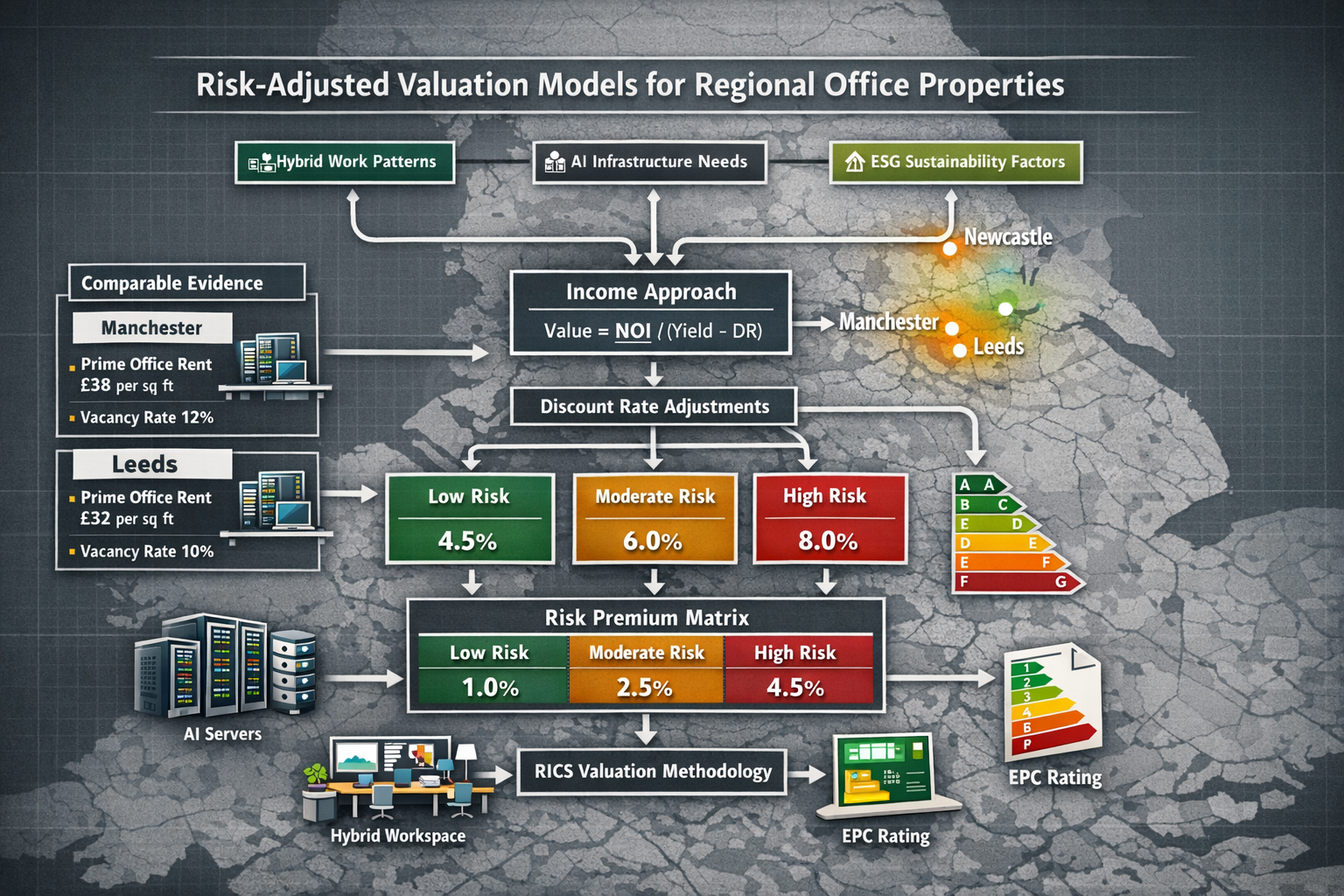
Valuing Regional Office Properties in 2026 Recovery: RICS Adjustments for AI Demand and Rental Growth requires a multi-method approach that triangulates value through different lenses:
1. Income Capitalization Method (Primary)
- Determine market rent with AI demand and hybrid work adjustments
- Apply risk-adjusted yield reflecting location, quality, and infrastructure
- Deduct capital expenditure for ESG compliance or technology upgrades
- Calculate net present value with explicit assumptions
2. Comparable Method (Supporting)
- Select comparables from same regional market (within 5km radius)
- Adjust for technology infrastructure differences (±15-25%)
- Adjust for ESG performance gaps (±10-20%)
- Adjust for lease terms and tenant covenant (±5-15%)
- Weight recent transactions more heavily (last 6 months)
3. Residual Method (For Development Potential)
- Assess redevelopment potential for AI tenant requirements
- Calculate costs of technology infrastructure upgrades
- Factor in ESG improvement costs
- Determine residual land value
4. Discounted Cash Flow (For Complex Scenarios)
- Project rental growth based on regional market forecasts
- Model capital expenditure cycles for technology and ESG
- Apply risk-adjusted discount rates (8-12% for regional offices)
- Sensitivity analysis for key assumptions
When preparing valuation reports, surveyors must clearly explain which methods were applied and how regional market factors influenced the final opinion of value.
Practical Implementation: Case Studies and Examples
Manchester Tech Quarter: AI Demand Premium Analysis
A recent valuation of a Grade A office building in Manchester's tech quarter illustrates the practical application of these principles. The property, completed in 2019, features:
- 50,000 sq ft net internal area
- 150 watts per sq meter electrical capacity
- Carrier-neutral fiber connectivity
- EPC rating: A
- Tenant: AI software company on 10-year lease
Valuation approach:
- Market rent determination: £32.50 per sq ft (baseline: £27.50, +£5.00 AI premium)
- Yield selection: 5.25% (regional baseline 5.75%, -0.50% for quality and tenant)
- ESG adjustment: No deduction required (already compliant)
- Capital value: £30.95 million
Comparable evidence adjustments:
| Comparable | Base Rent | Infrastructure Adjustment | ESG Adjustment | Adjusted Rent |
|---|---|---|---|---|
| Comp A | £28.00 | +£2.50 (good) | -£1.00 (EPC B) | £29.50 |
| Comp B | £26.50 | +£4.00 (excellent) | £0.00 (EPC A) | £30.50 |
| Comp C | £30.00 | +£1.50 (adequate) | -£2.00 (EPC C) | £29.50 |
This analysis demonstrates how AI demand and ESG factors combine to influence value, requiring surveyors to make multiple layered adjustments to comparable evidence.
Leeds Financial District: Hybrid Work Adaptation Valuation
A contrasting example from Leeds involves a 1980s office building undergoing refurbishment to accommodate hybrid work patterns:
Property characteristics:
- 80,000 sq ft over 8 floors
- Traditional cellular offices being converted to flexible floor plates
- Technology infrastructure upgrade in progress
- Current EPC: D (target: B post-refurbishment)
Valuation challenges:
- Determining appropriate rental value post-refurbishment
- Assessing risk during transition period
- Calculating residual value after capital expenditure
Approach:
- Pre-refurbishment value: £18.50 million (£23.13 per sq ft at 6.5% yield)
- Refurbishment costs: £4.2 million (including technology and ESG upgrades)
- Post-refurbishment rent: £26.00 per sq ft (market rent for hybrid-ready space)
- Post-refurbishment yield: 5.75% (improved quality and ESG performance)
- Post-refurbishment value: £36.17 million
- Development profit: £13.47 million (37% return on cost)
This case study highlights the importance of understanding development potential and residual value calculations when valuing properties in transition.
Future-Proofing Regional Office Valuations
Emerging Trends for 2026-2028
Looking ahead, several trends will continue shaping Valuing Regional Office Properties in 2026 Recovery: RICS Adjustments for AI Demand and Rental Growth:
🔮 Anticipated Market Developments:
- Quantum computing infrastructure requirements – Next-generation AI may require even more specialized facilities
- Net-zero deadlines approaching – 2030 targets will accelerate stranded asset risk for non-compliant properties
- Further regional divergence – Northern cities may continue outperforming traditional centers
- Workplace wellness integration – Air quality, biophilic design, and mental health spaces becoming value factors
- Autonomous building systems – AI-managed buildings commanding premiums for operational efficiency
Surveyors must stay informed about these developments through continuing professional development and engagement with RICS guidance updates [4].
Recommendations for Surveyors and Property Professionals
For Chartered Surveyors:
- Invest in technology assessment training – Develop competency in evaluating electrical, cooling, and connectivity infrastructure
- Build regional market expertise – Specialize in specific regional markets rather than attempting national generalization
- Enhance ESG knowledge – Understand the practical implications of the fourth edition ESG standard [1]
- Develop AI sector contacts – Build relationships with technology tenants to understand their evolving requirements
- Refine comparable databases – Maintain detailed records of technology infrastructure and ESG features in comparable transactions
For Property Investors:
- Prioritize technology infrastructure – Properties with superior connectivity and power capacity will maintain value
- Assess ESG compliance pathways – Understand capital expenditure requirements for 2030 compliance
- Consider regional diversification – Northern cities offer growth potential with lower entry costs
- Evaluate hybrid work adaptability – Flexible floor plates and collaboration spaces are essential
- Monitor tenant demand trends – AI sector growth may continue driving regional market premiums
For Property Owners:
- Commission infrastructure audits – Understand your property's technology capabilities and limitations
- Plan ESG improvements strategically – Time capital expenditure to maximize value impact
- Consider tenant mix optimization – AI and technology tenants may justify targeted improvements
- Engage professional valuers early – Regular valuations help track market position and identify opportunities
- Document improvements thoroughly – Maintain records of all technology and ESG upgrades for valuation purposes
Regulatory Compliance and Professional Standards
Mandatory ESG Integration from April 2026
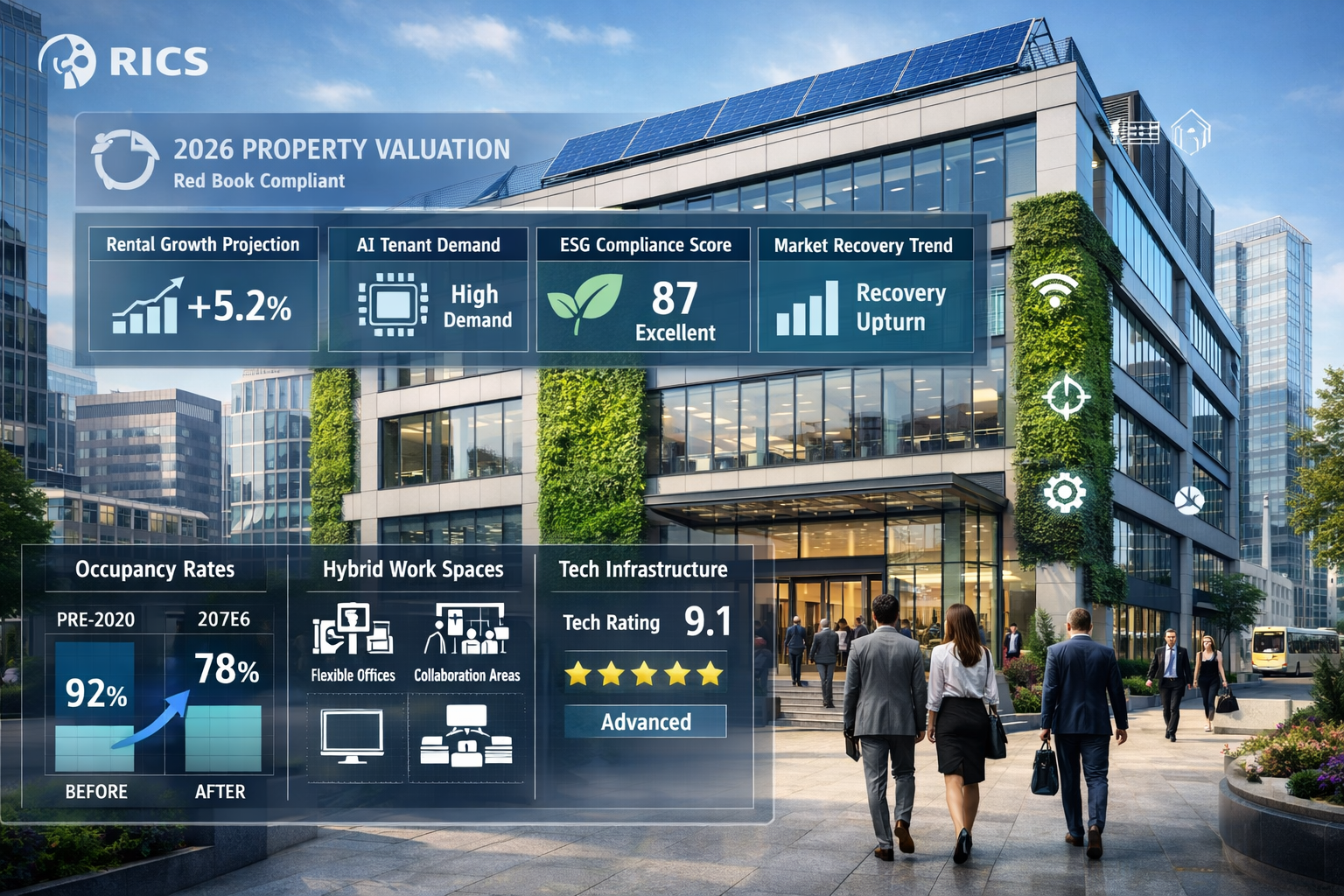
The April 30, 2026 effective date for the fourth edition ESG standard [1] creates a clear compliance deadline for all RICS members and firms undertaking commercial property valuations globally. Non-compliance risks professional sanctions and potentially invalidates valuations for lending, investment, and regulatory purposes.
Key compliance requirements:
📋 Documentation Standards:
- Explicit ESG factor identification in terms of engagement
- Detailed inspection records of sustainability features
- Clear explanation of how ESG factors influenced value opinion
- Sensitivity analysis showing value impact of ESG variables
📋 Reporting Standards:
- Mandatory ESG section in valuation reports
- Disclosure of climate risk assessment
- Explanation of capital expenditure assumptions for sustainability
- Reference to jurisdiction-specific regulatory frameworks
📋 Professional Competence:
- Demonstrated knowledge of ESG valuation principles
- Understanding of relevant energy performance standards
- Familiarity with climate risk assessment methodologies
- Continuing professional development in sustainability topics
Surveyors conducting expert witness valuations must be particularly careful to demonstrate compliance, as their opinions may be subject to legal scrutiny [8].
Regional Variations in Regulatory Requirements
The fourth edition standard includes jurisdiction-specific sections for the UK, EU, and Australia [1], recognizing that regulatory frameworks vary significantly. For UK regional office valuations, key considerations include:
UK-Specific Requirements:
- Minimum Energy Efficiency Standards (MEES) – Properties must achieve minimum EPC rating E (moving to C by 2027-2030)
- Energy Performance Certificates – Mandatory disclosure and value impact assessment
- Climate Change Act targets – Net-zero by 2050 with interim targets affecting property values
- Building Safety Act – Enhanced compliance requirements for certain property types
- Local planning policies – Regional variations in sustainability requirements
Understanding these regional regulatory nuances is essential for accurate valuation and risk assessment.
Conclusion: Mastering Regional Office Valuations in 2026
The landscape of Valuing Regional Office Properties in 2026 Recovery: RICS Adjustments for AI Demand and Rental Growth represents both significant challenges and substantial opportunities for property professionals. The convergence of post-pandemic recovery, AI-driven demand, hybrid work patterns, and enhanced ESG requirements has fundamentally reshaped valuation methodologies.
Key success factors include:
✅ Technical competence in assessing technology infrastructure and its value impact
✅ Regional market expertise recognizing unprecedented divergence between locations
✅ ESG integration following the fourth edition RICS standard effective April 30, 2026
✅ Risk-adjusted modeling accounting for hybrid work patterns and tenant profiles
✅ Robust comparable analysis with multiple adjustment layers for infrastructure and sustainability
The Northern cities experiencing rental growth from AI sector expansion demonstrate that regional markets can no longer be treated as secondary to London. Manchester, Leeds, Birmingham, and other regional hubs require dedicated expertise and location-specific valuation approaches.
Actionable Next Steps
For immediate implementation:
- Review the fourth edition ESG standard published by RICS on January 28, 2026 [1] and ensure full compliance by April 30, 2026
- Audit your comparable evidence database to include technology infrastructure and ESG performance metrics
- Develop regional market specialization through targeted research and local market engagement
- Enhance inspection protocols to systematically assess AI-relevant infrastructure features
- Update valuation report templates to incorporate mandatory ESG sections and technology assessments
- Invest in continuing professional development focused on technology infrastructure and sustainability
- Build relationships with AI sector tenants to understand their evolving property requirements
- Commission infrastructure audits for properties in your portfolio to identify value enhancement opportunities
The 2026 recovery presents a unique moment in commercial property valuation history. Regional offices with strong technology infrastructure, ESG compliance, and hybrid work adaptability are positioned for sustained value growth. Surveyors who master these new valuation dimensions will provide superior service to clients and contribute to more efficient, transparent property markets.
By embracing the updated RICS standards, developing regional expertise, and understanding AI sector requirements, property professionals can navigate this complex landscape with confidence and deliver valuations that accurately reflect the transformed market realities of 2026 and beyond.
References
[1] Rics Publishes Updated Global Standard Esg Sustainability Commercial Property Valuation – https://www.rics.org/news-insights/rics-publishes-updated-global-standard-esg-sustainability-commercial-property-valuation
[2] Valuation Adjustments For Widening Regional Disparities Rics January 2026 Survey Insights For Surveyors – https://nottinghillsurveyors.com/blog/valuation-adjustments-for-widening-regional-disparities-rics-january-2026-survey-insights-for-surveyors
[3] Valuation Standards – https://www.rics.org/profession-standards/rics-standards-and-guidance/sector-standards/valuation-standards
[4] Esg And Sustainability In Commercial Property Valuation – https://www.rics.org/profession-standards/rics-standards-and-guidance/sector-standards/valuation-standards/esg-and-sustainability-in-commercial-property-valuation
[5] Rics Publishes Fourth Edition Of Global Esg Standard For Commercial Property Valuation – https://www.lexisnexis.co.uk/legal/news/rics-publishes-fourth-edition-of-global-esg-standard-for-commercial-property-valuation
[6] Rics Publishes New Guidance – https://propertyindustryeye.com/rics-publishes-new-guidance/
[7] Red Book Global – https://www.rics.org/profession-standards/rics-standards-and-guidance/sector-standards/valuation-standards/red-book/red-book-global
[8] Expert Witness Valuations In 2026s Stabilizing Market Rics Standards For Mortgage Disputes And Property Disagreements – https://nottinghillsurveyors.com/blog/expert-witness-valuations-in-2026s-stabilizing-market-rics-standards-for-mortgage-disputes-and-property-disagreements