

Over 200 million users accessed online AI valuation tools in a single month during 2025, signaling a seismic shift in how the residential property market approaches risk assessment.[6] This unprecedented adoption reflects a fundamental transformation in buyer and seller behavior following years of market volatility, rising interest rates, and transaction fall-throughs that have cost the industry billions in lost deals. Valuing Properties for Greater Transaction Certainty: Surveyor Tools in 2026's Risk-Averse Residential Market has become the defining challenge for surveyors, lenders, and investors seeking to restore confidence in property transactions.
The residential market in 2026 operates under fundamentally different conditions than even three years ago. Buyers demand forensic-level accuracy before committing capital. Lenders require multiple validation layers before approving mortgages. Sellers need defensible valuations to avoid prolonged negotiations. This risk-averse environment has accelerated the integration of advanced data analytics, artificial intelligence, and traditional surveying expertise into a comprehensive valuation ecosystem designed to minimize uncertainty and maximize transaction completion rates.

Key Takeaways
- AI-powered valuation tools now deliver 3-5% accuracy within final sales prices, processing results in under 60 seconds by analyzing 300+ market factors simultaneously.[1][6]
- Propensity scoring algorithms assess foreclosure risk and investment potential with color-coded indicators from Very Low to Very High, enabling rapid risk assessment for buyers and lenders.[2]
- Agentic AI systems autonomously monitor property portfolios, identify valuation anomalies, and assess market trends to provide early insights that reduce delays in complex valuations.[8]
- Hybrid valuation approaches combining traditional chartered surveyor expertise with machine learning models produce the highest transaction certainty and lowest dispute rates.
- Specialized tools for rental analysis, multifamily properties, and short-term rental strategies help investors identify cash flow opportunities with unprecedented precision.[3][5]
The Evolution of Property Valuation in Risk-Averse Markets
The residential property market has undergone a profound transformation in its approach to valuation certainty. Traditional methods relying solely on comparable sales and surveyor judgment no longer satisfy the risk tolerance of today's market participants. The shift toward valuing properties for greater transaction certainty reflects lessons learned from market volatility, where inaccurate valuations contributed to deal collapses, mortgage rejections, and protracted legal disputes.
Traditional Valuation Limitations
Historical valuation methodologies faced several critical limitations that became apparent during recent market turbulence:
- Subjective bias: Human appraisers brought individual perspectives that varied significantly between practitioners
- Limited data scope: Manual analysis could only process a fraction of relevant market factors
- Time delays: Traditional surveys required weeks to complete, during which market conditions could shift
- Geographic inconsistency: Valuation approaches varied dramatically across regions and property types
- Dispute vulnerability: Subjective elements created opportunities for challenges and renegotiations
These limitations translated directly into transaction uncertainty. Buyers questioned valuations that seemed disconnected from market realities. Lenders rejected mortgage applications when internal models contradicted surveyor reports. Sellers faced unexpected price reductions late in the sales process.
The Data Analytics Revolution
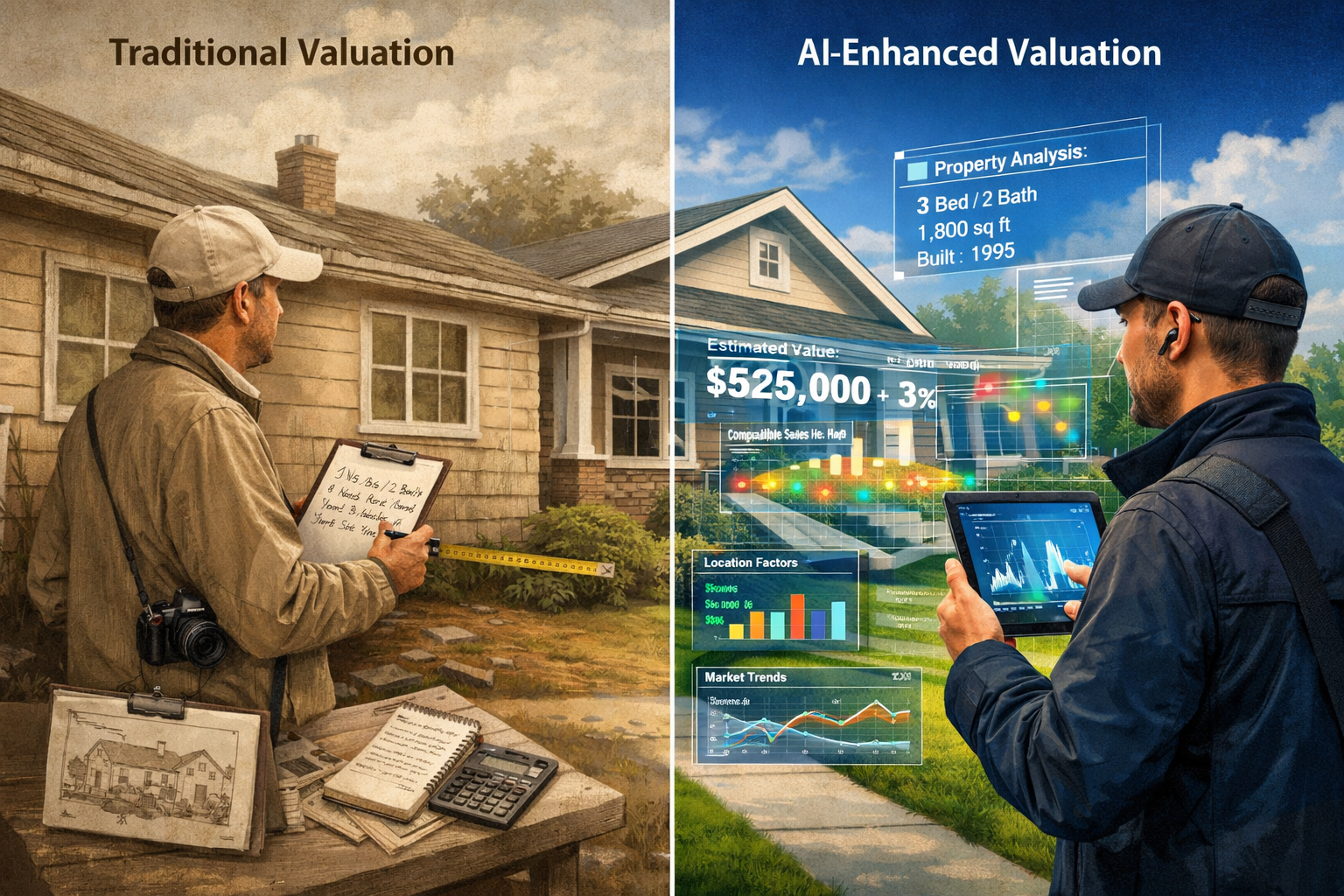
Modern surveyor tools address these limitations through comprehensive data integration and algorithmic analysis. PropLab's automated valuation models (AVM) exemplify this evolution, delivering 3-5% accuracy within final sales prices by processing public records with intelligent weighting for recency and distance factors.[1] The system generates results in under 60 seconds, providing immediate feedback that supports rapid decision-making without sacrificing precision.
The methodology behind these advances relies on hedonic machine learning analysis that evaluates property characteristics, location factors, and market conditions simultaneously.[2] Rather than examining comparables in isolation, modern systems analyze:
- Property-specific attributes (size, age, condition, features)
- Micro-location factors (school quality, transport links, amenities)
- Macro-market conditions (interest rates, supply constraints, demographic trends)
- Temporal patterns (seasonal variations, market cycles, economic indicators)
- Transaction characteristics (buyer motivation, seller circumstances, financing terms)
This comprehensive approach eliminates many sources of valuation error that plagued traditional methods. When chartered surveyors in West London integrate these tools with their local market expertise, they produce valuations with unprecedented reliability.
Adoption Across Market Segments
The embrace of advanced valuation tools spans all residential market segments. Mortgage lenders have begun replacing human appraisers with algorithms for initial property screening, recognizing that machine learning models can identify red flags and valuation outliers faster than manual review processes.[6] Investment firms use these systems to identify undervalued properties before traditional human scouts could locate them.
Single-model AI approaches have proven particularly valuable for transaction certainty because they reduce surprises compared to multi-model systems that produce varying results as different algorithms activate in different geographies.[2] Consistency in methodology translates directly to confidence in outcomes—exactly what risk-averse buyers and sellers demand.
For professionals seeking comprehensive property assessment, understanding the different types of survey comparison helps match valuation tools to specific transaction requirements.
Advanced Surveyor Tools Driving Transaction Certainty in 2026
The surveyor's toolkit in 2026 bears little resemblance to the equipment and methodologies of even five years ago. Valuing Properties for Greater Transaction Certainty: Surveyor Tools in 2026's Risk-Averse Residential Market demands integration of multiple technological platforms, each addressing specific aspects of the valuation and risk assessment process.
AI-Powered Valuation Platforms
Several platforms have emerged as industry standards for residential property valuation:
PropStream employs hedonic machine learning to generate valuations while simultaneously offering predictive AI for foreclosure risk assessment.[2] The platform's Foreclosure Factor uses AI propensity scoring to rank properties from Very Low to Very High likelihood of foreclosure, with wholesale value calculations at 70% of estimated value to help investors identify distressed property opportunities quickly.
This dual functionality—accurate current valuation plus forward-looking risk assessment—addresses the core concern of risk-averse buyers who want to understand not just what a property is worth today, but what factors might affect its value tomorrow.
Zillow's Zestimate and Redfin's AI-powered pricing tools represent established competitive options that have refined their algorithms through billions of data points.[5] These consumer-facing platforms have educated buyers and sellers about data-driven valuation, creating market expectations that professional surveyors must now meet or exceed.
Comprehensive Market Analysis Tools
Beyond basic valuation, modern surveyor tools provide deep market intelligence that supports transaction certainty:
Market Factor Analysis: Contemporary AI valuation tools analyze 300+ market factors including demographics, foot traffic patterns, comparable sales, and real-time market conditions to enhance objectivity and eliminate subjective bias.[6] This comprehensive approach captures nuances that single-factor models miss.
Mashvisor provides market-level analysis specifically for residential investment properties, with visual heat maps that compare long-term rental versus short-term rental (STR) strategies.[3] Investors can scan entire neighborhoods to identify cash flow opportunities, comparing potential returns across different property types and rental strategies.
For investors focused on multifamily properties, Rentana uses AI to deliver accurate rental market analyses and investment insights, offering income data, comparable sales, and return calculations designed for both beginners and experienced investors.[5]
Agentic AI and Portfolio Monitoring
The latest evolution in surveyor tools involves agentic AI systems that autonomously monitor portfolios, identify valuation anomalies, and assess investment risk based on market trends.[8] These systems provide early property insights that reduce delays in complex valuations by flagging issues before they become transaction obstacles.
Agentic AI represents a shift from reactive to proactive valuation management. Rather than waiting for a buyer to request a valuation, these systems continuously assess property values across entire portfolios, alerting owners and surveyors to:
- 📊 Valuation anomalies: Properties whose values diverge from predicted trajectories
- ⚠️ Market risk factors: Emerging conditions that could affect property values
- 📈 Investment opportunities: Properties entering favorable value positions
- 🔍 Due diligence triggers: Factors requiring additional investigation before transactions
When chartered surveyors in Guildford or chartered surveyors in Esher integrate agentic AI into their practice, they can offer clients continuous value monitoring rather than point-in-time assessments.
Specialized Valuation Applications
Different property types and transaction purposes require specialized tools:
| Tool Category | Primary Function | Key Benefit |
|---|---|---|
| Rental Analysis Platforms | Compare long-term vs. short-term rental returns | Optimize investment strategy |
| Foreclosure Risk Scoring | Predict distressed property likelihood | Identify wholesale opportunities |
| Portfolio Monitoring | Track multiple property values continuously | Early risk detection |
| Comparable Sales AI | Identify most relevant comparables automatically | Improve accuracy |
| Market Heat Mapping | Visualize neighborhood value trends | Geographic opportunity identification |
For specialized valuation needs such as lease extension valuation or valuing freehold interests, combining traditional surveyor expertise with these advanced tools produces the most defensible valuations.
Integration with Traditional Survey Methods
The most effective approach to valuing properties for greater transaction certainty combines advanced analytical tools with traditional surveying expertise. RICS building surveys provide the physical inspection and condition assessment that algorithms cannot replicate, while AI tools provide the market context and comparative analysis that human surveyors might miss.
This hybrid approach addresses both the physical and financial dimensions of property value:
- Physical condition: Structural integrity, defects, maintenance requirements
- Market position: Comparative value, price trends, investment potential
- Risk factors: Foreclosure likelihood, market volatility, location risks
- Opportunity assessment: Rental potential, development options, value-add possibilities
Professionals offering building surveys increasingly integrate digital tools into their inspection process, using tablets to access real-time market data while on-site and immediately contextualizing physical findings within market valuations.

Implementing Advanced Valuation Tools for Maximum Transaction Certainty
Understanding the tools available represents only the first step. Effective implementation requires strategic integration of technology with professional expertise, clear communication protocols, and alignment with client risk tolerance.
Selecting the Right Tool Combination
No single platform addresses all valuation needs. Professional surveyors in 2026 typically employ a combination of tools matched to specific transaction types:
For Standard Residential Purchases:
- Primary AVM tool (PropLab, Zillow, Redfin) for initial valuation
- Traditional survey (Level 2 Homebuyer Survey or Level 3 Building Survey)
- Comparable sales verification through multiple data sources
- Local market intelligence from area specialists
For Investment Properties:
- Rental analysis platform (Mashvisor, Rentana) for income potential
- Foreclosure risk scoring (PropStream) for distressed opportunities
- Market heat mapping for neighborhood trend analysis
- Cash flow modeling tools for return projections
For Complex Transactions:
- Agentic AI for continuous monitoring during extended negotiations
- Expert witness surveyor services for dispute resolution
- Multiple valuation methods (methods of valuation) for triangulation
- Specialized assessments for unique property features
Establishing Valuation Confidence Levels
Risk-averse markets demand transparency about valuation certainty. Leading surveyors now provide confidence scores alongside valuations, indicating the reliability of their estimates based on:
- Data availability: Quantity and quality of comparable sales
- Market stability: Volatility in recent transaction prices
- Property uniqueness: How closely comparables match subject property
- Time sensitivity: How recent the comparable data is
A valuation with 95% confidence based on 20 recent comparables within 0.3 miles provides far greater transaction certainty than one with 70% confidence based on 3 comparables from 18 months ago. This transparency allows buyers, sellers, and lenders to make informed decisions about proceeding with transactions.
Communicating Valuation Findings
Advanced tools generate vast amounts of data, but effective communication requires distilling insights into actionable intelligence. Best practices include:
✅ Executive Summary: One-page overview with valuation figure, confidence level, and key factors
✅ Visual Data Presentation: Charts, heat maps, and graphs that illustrate market position
✅ Comparable Analysis: Detailed breakdown of properties used in valuation with adjustment explanations
✅ Risk Assessment: Clear identification of factors that could affect future value
✅ Opportunity Identification: Specific recommendations for value enhancement or risk mitigation
When chartered surveyors in East London or other regions present valuations in this structured format, clients can quickly assess whether to proceed with transactions, negotiate terms, or seek additional information.
Continuous Professional Development
The rapid evolution of valuation tools requires ongoing education. Professional surveyors invest in:
- Platform-specific training for major AI valuation tools
- Data science fundamentals to understand algorithmic approaches
- Market analysis techniques for interpreting AI-generated insights
- Communication skills for explaining technical findings to non-technical clients
Organizations like RICS provide continuing professional development programs that help surveyors stay current with technological advances while maintaining traditional expertise.
Quality Assurance and Validation
Even the most sophisticated AI tools require human oversight. Quality assurance processes include:
- Algorithmic output review: Checking AI valuations against professional judgment
- Comparable verification: Confirming that automated comparable selections are appropriate
- Adjustment validation: Ensuring that algorithmic adjustments for property differences are reasonable
- Market sanity checks: Comparing valuations to recent transaction experience
- Client circumstance consideration: Adjusting for factors algorithms cannot capture
This validation layer ensures that technology enhances rather than replaces professional expertise, providing the highest level of transaction certainty.

Regional Considerations and Local Market Expertise
While AI tools provide powerful analytical capabilities, local market knowledge remains essential for accurate valuation. Property markets vary dramatically across regions, with factors that algorithms struggle to quantify:
London Market Dynamics: Properties in areas served by chartered surveyors in Camden, chartered surveyors in Islington, or chartered surveyors in Richmond experience unique value drivers including proximity to specific tube stations, school catchment areas, and neighborhood character that require local expertise to properly weight.
Suburban Markets: Areas covered by chartered surveyors in Chiswick, chartered surveyors in Weybridge, or chartered surveyors in Epsom balance urban accessibility with suburban amenities, creating valuation considerations that differ from both central urban and rural properties.
County Markets: Properties in Hertfordshire, Berkshire, Sussex, Hampshire, and Oxfordshire require understanding of rural-urban gradients, commuter patterns, and local economic factors.
The most effective valuation approach combines algorithmic analysis of broad market patterns with granular local knowledge that captures neighborhood-specific value drivers.
Future Trends in Property Valuation Technology
The trajectory of valuation technology suggests several developments that will further enhance transaction certainty:
Real-Time Valuation Updates: Rather than point-in-time assessments, continuous monitoring will provide buyers and sellers with daily value updates throughout transaction periods, reducing surprises at completion.
Predictive Market Modeling: Advanced AI will forecast not just current value but projected value ranges over various time horizons, helping buyers assess long-term investment potential.
Integrated Transaction Platforms: Valuation tools will integrate directly with conveyancing, mortgage, and survey platforms, creating seamless transaction workflows that reduce delays and miscommunication.
Blockchain Verification: Distributed ledger technology may provide immutable records of valuations, comparable sales, and property characteristics, increasing trust and reducing disputes.
Augmented Reality Surveys: Surveyors will use AR glasses to overlay property data, comparable information, and valuation factors directly onto their field of view during inspections.
These advances will continue the trend toward greater transaction certainty, but will require surveyors to continuously adapt their skills and methodologies.
Conclusion
Valuing Properties for Greater Transaction Certainty: Surveyor Tools in 2026's Risk-Averse Residential Market represents both a challenge and an opportunity for property professionals. The integration of AI-powered valuation platforms, comprehensive market analysis tools, and agentic monitoring systems with traditional surveying expertise creates unprecedented accuracy and reliability in property assessment.
The residential market's evolution toward risk aversion reflects rational responses to recent volatility, but also creates demand for surveyors who can provide defensible, data-driven valuations that withstand scrutiny from buyers, sellers, lenders, and legal professionals. Tools delivering 3-5% accuracy within final sales prices, analyzing 300+ market factors, and providing continuous portfolio monitoring enable this level of precision.[1][6]
Success in this environment requires strategic tool selection, continuous professional development, quality assurance processes, and effective communication of complex findings. Surveyors who combine technological proficiency with traditional expertise and local market knowledge will deliver the transaction certainty that defines successful property transactions in 2026.
Actionable Next Steps
For property buyers, sellers, and investors seeking maximum transaction certainty:
- Engage qualified surveyors who integrate advanced valuation tools with traditional expertise
- Request confidence scores alongside valuations to understand reliability levels
- Utilize multiple valuation methods to triangulate accurate property values
- Consider continuous monitoring for properties in negotiation or portfolio holdings
- Invest in comprehensive surveys that address both physical condition and market position
- Leverage specialized tools for specific property types (rental, multifamily, investment)
The risk-averse residential market of 2026 rewards thoroughness, transparency, and technological sophistication. By embracing advanced surveyor tools while maintaining professional judgment and local expertise, property transactions can achieve unprecedented certainty and completion rates.
References
[1] Best Real Estate Analysis Tools 2026 Complete Comparison – https://proplab.app/blog/best-real-estate-analysis-tools-2026-complete-comparison
[2] Best Ai Tools For Real Estate – https://www.v7labs.com/blog/best-ai-tools-for-real-estate
[3] Real Estate Investment Analysis Tools – https://batchdata.io/blog/real-estate-investment-analysis-tools
[5] Best Real Estate Market Analysis Tools – https://www.rentana.io/blog/best-real-estate-market-analysis-tools
[6] Ai Property Valuation – https://www.growthfactor.ai/resources/blog/ai-property-valuation
[8] Technology For Early Property Insight In 2026 Building Surveys Reducing Delays In Complex Valuations – https://nottinghillsurveyors.com/blog/technology-for-early-property-insight-in-2026-building-surveys-reducing-delays-in-complex-valuations