

The Northern Ireland property market has emerged as the undisputed champion of UK real estate performance, maintaining its position as the fastest-growing region for three consecutive years. As property values continue their upward trajectory in 2026, understanding how to accurately value Northern Ireland properties through comprehensive surveys has never been more critical for buyers, sellers, and investors seeking to capitalise on this exceptional market momentum.
Valuing Northern Ireland Properties in 2026: Surveys Capitalising on Strongest UK Price Growth requires a sophisticated understanding of local market dynamics, RICS-compliant survey methodologies, and the unique factors driving unprecedented demand in this dynamic region. With prices rising by 9.7% in 2025 according to Nationwide data[4][5], and sustained growth projected into 2026, professional property surveys have become essential tools for securing optimal pricing and identifying value opportunities.
This comprehensive guide explores the intersection of Northern Ireland's remarkable property market performance and the critical role of professional valuation surveys in maximising investment returns and ensuring informed purchasing decisions.
Key Takeaways
- 🏆 Northern Ireland achieved the strongest UK property price growth in 2025 at 9.7%, outperforming all other regions for the third consecutive year[4][5]
- 📊 Average property values vary by methodology, with PropertyPal reporting £235,000 and ONS data showing £193,000, highlighting the importance of professional valuation surveys[1][2]
- 🔍 RICS-compliant surveys are essential for accurate property valuation in Northern Ireland's rapidly appreciating market, ensuring buyers and sellers achieve optimal pricing
- 📈 Transaction volumes remained robust with 5,512 properties going sale agreed in Q4 2025, demonstrating sustained market confidence[1]
- 🎯 Strategic hotspots including Belfast, Bangor, Lisburn, and Newtownards continue to attract premium valuations, making location-specific survey insights critical for investment decisions
Understanding Northern Ireland's Exceptional Property Market Performance
Record-Breaking Growth Across the Region
Northern Ireland's property market has delivered exceptional performance that has captured the attention of investors, homebuyers, and industry professionals throughout the UK. The region's sustained growth trajectory represents not merely a temporary spike but a fundamental shift in market dynamics that demands careful analysis and professional valuation approaches.
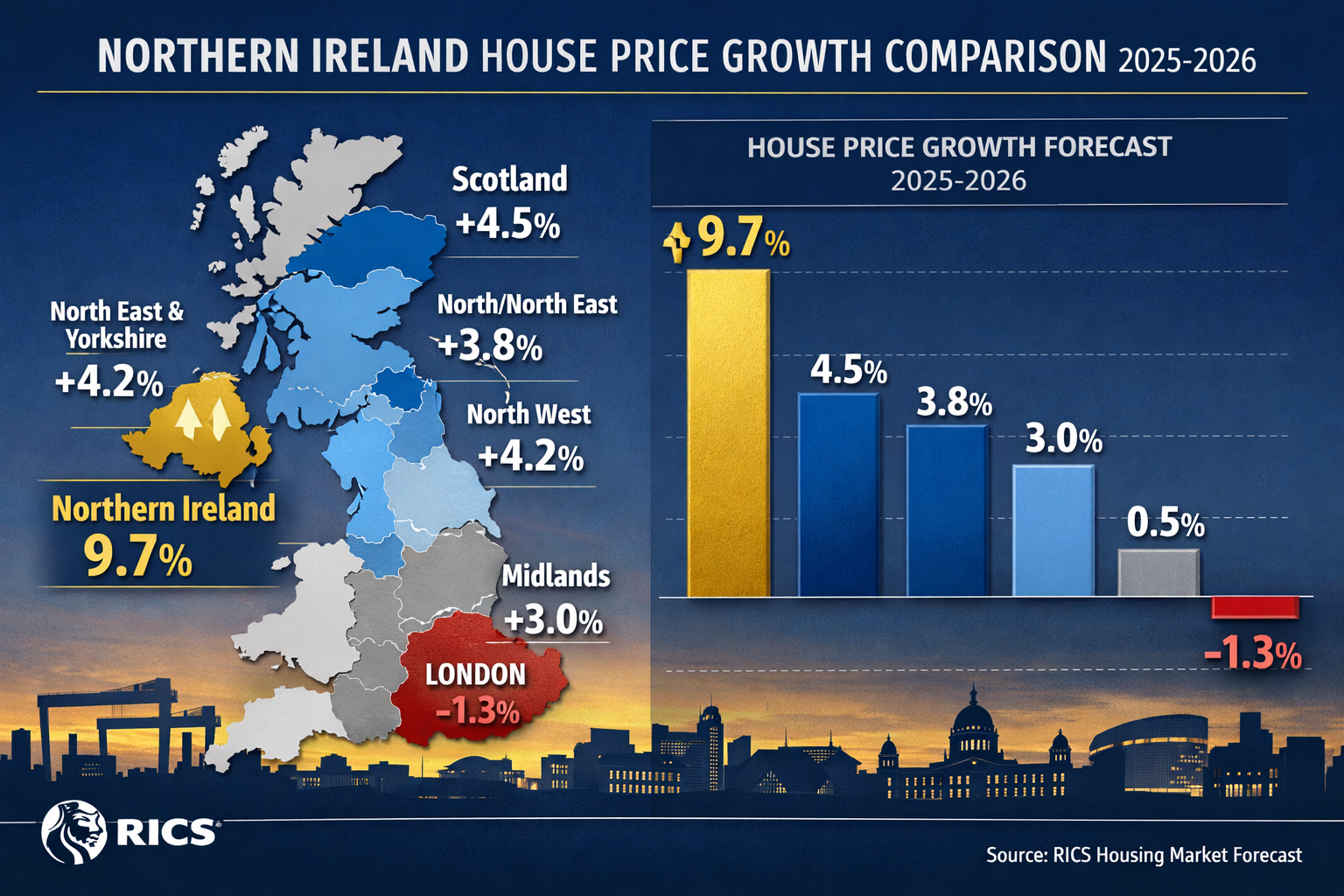
According to Nationwide's comprehensive data, Northern Ireland property prices surged by 9.7% during 2025[4][5], a remarkable achievement that positioned the region significantly ahead of all other UK areas. This performance marked the third consecutive year that Northern Ireland claimed the top position for property price growth, establishing a clear pattern of sustained appreciation that extends into 2026.
Halifax corroborated this strong performance with their own analysis showing a 7.5% annual increase[4], while Lloyds Bank data tracking the period from October 2024 to October 2025 recorded a 5.8% rise, equivalent to £9,302 in absolute terms[5]. These multiple data sources, despite slight methodological variations, consistently confirm Northern Ireland's position as the UK's strongest-performing property market.
Regional Comparison: Northern Ireland's Competitive Advantage
The scale of Northern Ireland's outperformance becomes even more apparent when examined against other UK regions. While Northern Ireland enjoyed nearly double-digit growth, London experienced a 1.3% decline in property values during the same period[4][5]. East Anglia saw prices fall by 0.8%, highlighting the stark regional disparities in the UK property landscape.
Scotland and northern England regions recorded secondary growth positions, but remained substantially behind Northern Ireland's pace. This divergence reflects several critical factors:
- Relative affordability compared to southern England markets
- Strong local economic fundamentals supporting buyer confidence
- Limited housing supply meeting sustained demand
- Quality of life factors attracting both domestic and returning international buyers
- Investment appeal as a value proposition within the broader UK market
For property professionals conducting valuations, understanding these regional dynamics is essential when applying RICS Building Surveys and comparative market analysis methodologies.
Price Variation and the Importance of Accurate Valuation
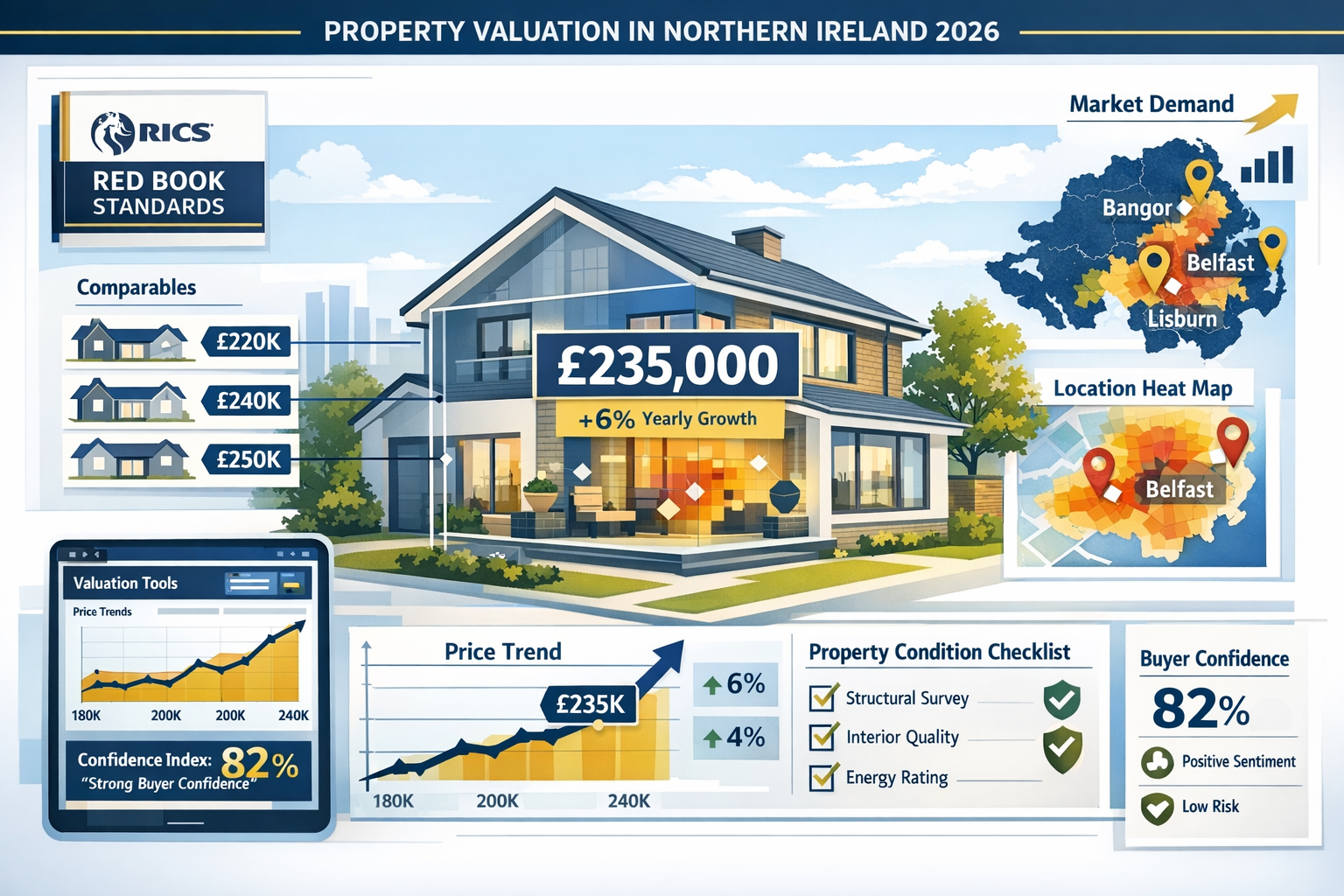
One of the most significant challenges in Valuing Northern Ireland Properties in 2026: Surveys Capitalising on Strongest UK Price Growth stems from the notable variation in reported average prices across different data sources. PropertyPal's Q4 2025 data reports an average house price of £235,000[1], while ONS data from Q3 2025 shows £193,000[2].
This substantial £42,000 difference is not an error but reflects different measurement methodologies:
| Data Source | Average Price | Measurement Period | Methodology |
|---|---|---|---|
| PropertyPal | £235,000 | Q4 2025 | Active listings and sale agreed properties |
| ONS | £193,000 | Q3 2025 | Completed transactions and Land Registry data |
| Nationwide | Growth: 9.7% | Annual 2025 | Mortgage lending data |
| Halifax | Growth: 7.5% | Annual 2025 | Mortgage approvals |
These variations underscore why professional property surveys are absolutely essential for accurate valuation. Relying solely on average market data can lead to significant mispricing, whether you're buying, selling, or refinancing. A comprehensive Level 3 RICS Building Survey provides the detailed property-specific analysis necessary to determine true market value in the context of broader trends.
The Critical Role of Professional Surveys in Property Valuation
Why RICS-Compliant Surveys Matter in a Growing Market
In a rapidly appreciating market like Northern Ireland's, the temptation exists to skip comprehensive surveys or rely on basic valuations. However, this approach carries substantial risks that can undermine investment returns and lead to costly surprises post-purchase.
RICS (Royal Institution of Chartered Surveyors) standards represent the gold standard in property surveying, providing a framework that ensures thorough, impartial, and professionally conducted assessments. When Valuing Northern Ireland Properties in 2026: Surveys Capitalising on Strongest UK Price Growth, RICS-compliant surveys offer several critical advantages:
Accurate Condition Assessment: A rising market can mask underlying property defects. Professional surveys identify structural issues, damp problems, subsidence risks, and other concerns that directly impact true value. Our subsidence surveys and damp surveys provide specialized assessments for these common Northern Ireland property concerns.
Negotiation Leverage: Even in a seller's market, survey findings provide legitimate grounds for price negotiation. Identifying £15,000 worth of necessary repairs on a £235,000 property creates meaningful negotiation opportunities.
Investment Protection: With average prices rising substantially, the absolute value at stake increases proportionally. A 5% valuation error on a £235,000 property represents nearly £12,000—far exceeding the cost of a comprehensive survey.
Mortgage Security: Lenders increasingly require detailed surveys for properties in rapidly appreciating markets to ensure loan-to-value ratios reflect genuine property worth rather than inflated market sentiment.
Types of Surveys for Northern Ireland Properties
Different property types, ages, and conditions require tailored survey approaches. Understanding which survey type best suits your needs is fundamental to effective property valuation:
Level 2 Homebuyer Survey (RICS Home Survey Level 2)
The Level 2 Homebuyer Survey represents the most popular choice for conventional properties in reasonable condition. This survey provides:
- ✅ Visual inspection of accessible areas
- ✅ Assessment of property condition using a traffic light rating system
- ✅ Identification of urgent defects and potential legal issues
- ✅ Market valuation and insurance reinstatement figure
- ✅ Advice on necessary repairs and ongoing maintenance
Ideal for: Modern properties (post-1900), standard construction, properties in apparently good condition, and first-time buyers seeking cost-effective professional assessment.
Level 3 Building Survey (RICS Building Survey)
The comprehensive Building Survey offers the most detailed analysis available, particularly valuable for Northern Ireland's diverse property stock:
- ✅ Detailed inspection of all accessible areas
- ✅ Comprehensive structural analysis
- ✅ Identification of defects with repair cost estimates
- ✅ Assessment of construction quality and materials
- ✅ Advice on maintenance priorities and long-term concerns
- ✅ Detailed photographic evidence
Ideal for: Older properties (pre-1900), non-standard construction, properties requiring renovation, high-value properties, and buyers planning significant alterations.
Specialist Surveys
Northern Ireland's property stock includes numerous buildings with specific concerns requiring specialized assessment:
- Structural Surveys: For properties with visible structural movement, cracking, or settlement
- Damp Surveys: Essential for older properties and those with visible moisture issues
- Subsidence Surveys: Critical for properties on clay soils or with historical movement
Integrating Survey Findings with Market Valuation
The true art of Valuing Northern Ireland Properties in 2026: Surveys Capitalising on Strongest UK Price Growth lies in synthesizing survey findings with market intelligence. A property might command £235,000 based on location and size, but survey discoveries can substantially adjust this figure:
Scenario 1: Premium Condition Property
- Market average: £235,000
- Survey findings: Excellent condition, recent upgrades, no defects
- Adjusted valuation: £245,000-£250,000 (4-6% premium)
Scenario 2: Deferred Maintenance Property
- Market average: £235,000
- Survey findings: £20,000 in necessary repairs, outdated systems
- Adjusted valuation: £210,000-£215,000 (8-11% discount)
Scenario 3: Structural Concerns
- Market average: £235,000
- Survey findings: Subsidence evidence requiring £30,000+ remediation
- Adjusted valuation: £195,000-£205,000 (13-17% discount)
Professional surveyors apply their expertise to translate technical findings into financial implications, ensuring buyers understand the true cost of ownership beyond the purchase price.
Market Dynamics Driving Northern Ireland Property Values in 2026
Transaction Volumes and Market Velocity
Sustained transaction activity provides critical insight into market health and valuation confidence. Northern Ireland demonstrated robust market participation throughout 2025, with 5,512 properties going sale agreed in Q4 alone[1]. This represented only a 3% decline compared to Q4 2024, indicating sustained buyer confidence despite rising prices.
High transaction volumes create several important implications for property valuation:
Comparative Data Availability: More transactions generate richer comparable sales data, enabling more accurate Red Book valuations based on recent, relevant market evidence.
Market Liquidity: Properties in active markets typically achieve valuations closer to asking prices, as buyer competition remains healthy and well-presented homes sell within reasonable timeframes[1].
Valuation Confidence: Sustained activity reduces valuation uncertainty, as recent comparable sales provide reliable benchmarks for current property assessments.
For property professionals, understanding how long a homebuyer survey takes becomes particularly important in fast-moving markets where transaction timelines matter significantly.
Geographic Hotspots and Location-Specific Valuation
Not all Northern Ireland locations experience uniform appreciation. Key demand hotspots have emerged with distinct valuation characteristics:
Belfast: The capital continues to attract substantial buyer interest, with urban regeneration, employment opportunities, and lifestyle amenities driving premium valuations in desirable postcodes. Properties in sought-after Belfast neighborhoods often command 15-25% premiums over regional averages.
Bangor: This coastal town has experienced particularly strong growth, appealing to lifestyle buyers, families, and commuters. Waterfront and period properties achieve significant premiums, while modern developments offer relative value.
Lisburn: Combining commuter convenience with town amenities, Lisburn attracts family buyers seeking value compared to Belfast proper. Well-connected properties near major routes command premium valuations.
Newtownards: Growing as a commuter and lifestyle location, Newtownards offers comparative affordability while benefiting from regional appreciation trends.
When conducting property valuations, location-specific market knowledge is absolutely essential. A three-bedroom semi-detached property might be valued at £180,000 in one location and £240,000 in another, despite similar size and condition. Professional surveyors incorporate granular location analysis into their assessments, examining:
- Recent comparable sales within 0.5-mile radius
- Local amenity quality and accessibility
- School catchment areas and performance data
- Transport links and commute times
- Neighborhood trajectory and development plans
- Environmental factors and flood risk
Property Type Performance Variations
Different property categories within Northern Ireland's market have experienced varied appreciation rates, requiring type-specific valuation approaches:
Apartments: According to PropertyPal data, apartment prices increased by 7% year-on-year[1], slightly below the overall market growth rate. This reflects supply-demand dynamics specific to the apartment sector, with new developments in Belfast and other urban centers adding supply.
New Homes: Average new home prices reached £267,000, representing a 5.2% annual increase[1]. New builds typically command premiums for modern specifications, energy efficiency, and warranty protection, but may appreciate more slowly than established properties in prime locations.
Traditional Terraced Houses: These properties, particularly prevalent in Belfast and other urban areas, have experienced strong appreciation driven by first-time buyer demand and investor interest. Well-maintained Victorian and Edwardian terraces in desirable locations often outperform market averages.
Detached Family Homes: Properties offering space, gardens, and privacy have maintained strong demand, particularly in commuter locations. These properties often achieve premium valuations when combining desirable features with good condition.
Understanding these category-specific trends is essential when applying valuation factors to individual properties.
Rental Market Performance and Investment Valuation
Rental Growth Trends
Northern Ireland's rental market has demonstrated parallel strength to the sales market, with important implications for investment property valuations. Average monthly rents reached £995 in Q4 2025 according to PropertyPal data, representing a 5.6% annual increase[1].
ONS data, measuring advertised new lets, reported slightly lower average rents of £873 in October 2025, up 5.7% from the previous year[2]. The variation reflects different measurement methodologies, with PropertyPal capturing broader market averages while ONS focuses on new tenancy agreements.
Significantly, rental inflation has moderated from its peak of 9.9% in April 2024 to 5.7% by October 2025[2], suggesting the market is finding a more sustainable equilibrium. This moderation is healthy for long-term market stability while still providing attractive returns for property investors.
Investment Property Valuation Considerations
For investors, Valuing Northern Ireland Properties in 2026: Surveys Capitalising on Strongest UK Price Growth requires analyzing both capital appreciation potential and rental yield performance. Professional commercial property valuations apply similar methodologies to residential investment assessments.
Gross Yield Calculation:
- Average property price: £235,000
- Average annual rent: £11,940 (£995 × 12)
- Gross yield: 5.08%
Net Yield Considerations:
After accounting for maintenance (1% of property value), management fees (10% of rent), insurance (£400), and void periods (5% of rent), net yields typically range from 3.5-4.2% for Northern Ireland residential investments.
When combined with capital appreciation of 5-10% annually, total returns become highly attractive compared to many alternative investments. However, accurate property condition assessment through comprehensive surveys is critical for realistic yield projections, as unexpected maintenance costs can significantly erode returns.
Investment-focused surveys should specifically assess:
- Tenant appeal and rental positioning
- Maintenance requirements and lifecycle costs
- Energy efficiency and potential improvement costs
- Compliance with rental property regulations
- Long-term structural soundness
- Potential for value-adding improvements
RICS Standards and Professional Valuation Methodology
Red Book Valuation Framework
The RICS Valuation – Global Standards, commonly known as the "Red Book," establishes the framework for professional property valuations worldwide. When Valuing Northern Ireland Properties in 2026: Surveys Capitalising on Strongest UK Price Growth, adherence to Red Book standards ensures consistency, transparency, and professional credibility.
Red Book valuations require:
Independence and Objectivity: Valuers must maintain professional distance from the transaction, avoiding conflicts of interest that could compromise impartiality.
Competence: Valuers must possess appropriate knowledge of the property type, location, and market conditions. Northern Ireland-specific expertise is essential for accurate local valuations.
Basis of Value: Clear identification of the valuation basis—typically Market Value for residential properties, defined as "the estimated amount for which an asset should exchange on the valuation date between a willing buyer and a willing seller in an arm's length transaction."
Assumptions and Special Assumptions: Explicit statement of any assumptions made, such as property condition, tenure, or planning permissions.
Inspection Requirements: Appropriate level of inspection for the valuation purpose, ranging from external-only inspections to comprehensive internal and external assessments.
Comparable Evidence Analysis
Professional valuations rely heavily on comparable evidence—recent sales of similar properties in similar locations. In Northern Ireland's active market, abundant transaction data enables robust comparable analysis:
Selection Criteria:
- Geographic proximity (typically within 0.5 miles)
- Property type and size similarity
- Comparable condition and specification
- Transaction recency (typically within 6 months)
- Arm's length transaction (excluding family sales or distressed sales)
Adjustment Methodology:
Valuers apply percentage adjustments to comparable sales to account for differences:
- Location variations: ±5-15%
- Size differences: ±2-5% per 10% size variation
- Condition differences: ±5-20%
- Specification upgrades: ±3-10%
- Garden/parking differences: ±3-8%
Example Comparable Analysis:
Subject Property: 3-bed semi-detached, Belfast suburb, 1,100 sq ft, good condition
| Comparable | Sale Price | Date | Size | Condition | Adjusted Value |
|---|---|---|---|---|---|
| Comp 1 | £228,000 | 2 months ago | 1,050 sq ft | Excellent | £235,000 (+3% size, -2% condition) |
| Comp 2 | £245,000 | 1 month ago | 1,200 sq ft | Good | £233,000 (-8% size) |
| Comp 3 | £220,000 | 4 months ago | 1,100 sq ft | Fair | £236,000 (+7% condition, +1% time) |
Indicated Market Value: £234,000-£236,000
This analytical approach, combined with professional judgment and local market knowledge, produces reliable valuations that reflect true market positioning.
Specialist Valuation Services
Beyond standard market valuations, several specialist valuation services apply to Northern Ireland properties:
Probate Valuations: Required for inheritance tax purposes, these valuations establish property value at the date of death, requiring particular attention to HMRC requirements and defensible methodology.
Capital Gains Tax Valuations: Establishing baseline values for CGT calculations on second properties and investment properties, particularly relevant given Northern Ireland's strong appreciation.
Insurance Reinstatement Valuations: Determining rebuild costs for insurance purposes, which often differ substantially from market value—particularly important as property values rise but construction costs may not increase proportionally.
Expert Witness Services: When valuation disputes arise, expert witness testimony from qualified surveyors provides authoritative evidence for legal proceedings.
Practical Guidance for Property Buyers and Sellers
For Buyers: Maximizing Value Through Informed Decisions
When purchasing property in Northern Ireland's competitive market, strategic use of professional surveys provides significant advantages:
Pre-Offer Survey Considerations: While uncommon, commissioning a survey before making an offer (with seller permission) provides maximum negotiation leverage. More typically, buyers include survey contingencies in offers, allowing withdrawal or renegotiation based on findings.
Survey Timing: Understanding the difference between Level 2 and Level 3 surveys helps buyers select appropriate survey types. For older properties or those with visible concerns, investing in comprehensive Level 3 surveys often proves cost-effective by identifying issues before legal commitment.
Negotiation Strategy: Survey findings provide legitimate grounds for price negotiation even in seller's markets. Presenting repair cost estimates from qualified contractors alongside survey reports strengthens negotiation positions.
Budget Planning: Comprehensive surveys enable accurate budget planning by identifying immediate repair needs, short-term maintenance requirements, and long-term considerations. This prevents post-purchase financial stress.
Future Value Protection: Properties with clean survey reports and documented condition maintain stronger resale positions, as subsequent buyers gain confidence from historical documentation.
For Sellers: Achieving Optimal Pricing
Sellers benefit from understanding how professional valuations and surveys impact their properties' market positioning:
Pre-Sale Surveys: Forward-thinking sellers commission surveys before listing, identifying and addressing issues that could derail sales or trigger price reductions. This proactive approach often achieves higher net proceeds despite upfront survey costs.
Accurate Pricing: Professional valuations prevent both under-pricing (leaving money on the table) and over-pricing (resulting in extended marketing periods and eventual price reductions that signal desperation).
Marketing Advantage: Properties with available survey reports attract serious buyers and demonstrate seller transparency, often resulting in faster sales and stronger offers.
Negotiation Preparation: Understanding potential survey findings allows sellers to prepare responses, obtain repair quotes, and make informed decisions about addressing issues versus adjusting prices.
Documentation: Maintaining records of improvements, repairs, and maintenance provides valuable context for surveyors and supports premium valuations.
For Investors: Due Diligence and Return Optimization
Property investors require particularly rigorous valuation approaches, as investment decisions depend on accurate financial projections:
Yield Analysis: Combining market rent data with accurate purchase prices (adjusted for survey findings) enables realistic yield calculations. Optimistic valuations that ignore necessary repairs produce misleading return projections.
Lifecycle Costing: Comprehensive surveys identify upcoming major expenditure items (roof replacement, heating system renewal, etc.), allowing accurate lifecycle cost modeling essential for long-term investment planning.
Value-Add Opportunities: Detailed surveys often identify improvement opportunities that enhance rental income or capital value beyond their cost, creating value-add investment strategies.
Portfolio Risk Management: For investors with multiple properties, systematic survey programs identify portfolio-wide risks and enable prioritized maintenance planning.
Exit Strategy Planning: Understanding property condition and market positioning informs hold-versus-sell decisions, with surveys providing objective data for strategic planning.
2026 Market Outlook and Valuation Implications
Conservative Growth Projections
While Northern Ireland's property market delivered exceptional performance in 2025, forecasts for 2026 suggest more moderate growth. Real estate firm Savills predicts house price increases of approximately 2% for 2026[5], representing a normalization from the previous year's exceptional gains.
This moderation reflects several factors:
Affordability Constraints: Sustained price growth has reduced affordability for first-time buyers, potentially limiting demand growth at current price levels.
Interest Rate Environment: Mortgage costs, while stabilizing, remain elevated compared to the ultra-low rate environment of recent years, affecting buyer purchasing power.
Market Maturity: After three consecutive years of leading UK growth, some price consolidation represents healthy market development rather than weakness.
Economic Uncertainty: Broader economic conditions, including employment trends and consumer confidence, influence property market performance.
For valuation purposes, these projections suggest:
- Increased importance of property-specific factors: In slower markets, individual property condition and presentation matter more than in rising tides that lift all boats
- Greater negotiation scope: Moderate growth environments typically provide more balanced buyer-seller dynamics
- Quality premium expansion: Well-presented, defect-free properties may command increasing premiums over properties requiring work
Emerging Valuation Considerations
Several emerging factors will influence Valuing Northern Ireland Properties in 2026: Surveys Capitalising on Strongest UK Price Growth:
Energy Efficiency: With increasing focus on environmental performance and energy costs, EPC ratings increasingly impact valuations. Properties with poor ratings may experience valuation discounts, while high-efficiency properties command premiums.
Remote Work Impact: Sustained remote and hybrid working patterns continue influencing location preferences, with properties offering home office space and good broadband connectivity achieving premium valuations.
Building Safety: Post-Grenfell building safety regulations increasingly impact apartment valuations, with properties in buildings lacking EWS1 certificates experiencing significant valuation challenges.
Climate Resilience: Flood risk, coastal erosion, and climate adaptation increasingly factor into long-term property valuations, with vulnerable properties potentially experiencing value pressure.
Professional surveys increasingly incorporate these factors, providing forward-looking assessments that consider both current condition and future resilience.
Strategic Timing Considerations
Understanding market cycles informs strategic timing decisions for both buyers and sellers:
Buyer Perspective: The transition from exceptional growth (2025) to moderate growth (2026 forecast) potentially creates favorable buying conditions, as seller expectations adjust while underlying market fundamentals remain sound. Properties requiring renovation may offer particular value as buyers increasingly differentiate between turnkey and project properties.
Seller Perspective: Properties in excellent condition with strong survey reports may achieve optimal pricing in early 2026, capitalizing on residual momentum from 2025's strong performance before broader market moderation fully materializes.
Investor Perspective: Moderate capital growth combined with sustained rental yields (5.6-5.7% annual growth) maintains attractive total return profiles, particularly for investors with long-term hold strategies who can weather short-term market fluctuations.
Conclusion: Maximizing Value Through Professional Survey Integration
Valuing Northern Ireland Properties in 2026: Surveys Capitalising on Strongest UK Price Growth requires sophisticated integration of market intelligence, professional survey findings, and RICS-compliant valuation methodologies. Northern Ireland's position as the UK's strongest-performing property market for three consecutive years creates both opportunities and risks that demand careful professional assessment.
The key principles for successful property valuation in this dynamic market include:
✅ Professional Survey Investment: Comprehensive RICS surveys provide essential due diligence, identifying both risks and opportunities that fundamentally impact property value
✅ Market Context Understanding: Recognizing that average prices vary significantly by source, location, and property type prevents reliance on misleading generalizations
✅ Condition-Adjusted Valuation: Synthesizing survey findings with market comparables produces accurate valuations reflecting true property worth rather than superficial market averages
✅ Forward-Looking Assessment: Considering emerging factors including energy efficiency, climate resilience, and changing lifestyle preferences ensures valuations reflect long-term value drivers
✅ Specialist Expertise: Engaging qualified professionals with Northern Ireland-specific knowledge and RICS accreditation ensures credible, defensible valuations
Actionable Next Steps
For property buyers, sellers, and investors seeking to capitalize on Northern Ireland's exceptional market performance while managing risks effectively:
-
Commission Appropriate Surveys: Select survey types matching property characteristics and transaction risk profiles—Level 2 for standard modern properties, Level 3 for older or complex properties, and specialist surveys for specific concerns
-
Engage RICS-Qualified Professionals: Ensure surveyors hold appropriate RICS qualifications and demonstrate Northern Ireland market expertise
-
Integrate Survey Findings: Use survey reports actively in negotiation, budget planning, and investment analysis rather than treating them as mere formalities
-
Consider Specialist Valuations: For probate, tax, or investment purposes, commission appropriate specialist valuations meeting specific regulatory requirements
-
Plan Strategically: Use professional valuations and market intelligence to inform timing decisions, recognizing that 2026's forecast moderation may create different opportunities than 2025's exceptional growth
-
Document Thoroughly: Maintain comprehensive records of surveys, valuations, improvements, and maintenance to support future transactions and valuation defenses
The Northern Ireland property market's exceptional performance creates genuine wealth-building opportunities for informed participants. However, achieving optimal outcomes requires moving beyond headline growth figures to understand individual property characteristics, condition realities, and location-specific dynamics. Professional surveys and valuations provide the essential intelligence foundation for confident, profitable property decisions in 2026 and beyond.
Whether purchasing your first home, selling a family property, or building an investment portfolio, the integration of professional survey expertise with market knowledge represents the cornerstone of successful property transactions in Northern Ireland's dynamic market environment.
References
[1] Northern Ireland Property Market In 2026 Why Now Is A Good Time To Sell – https://www.reedsrains.co.uk/blog/northern-ireland-property-market-in-2026-why-now-is-a-good-time-to-sell
[2] January2026 – https://www.ons.gov.uk/economy/inflationandpriceindices/bulletins/privaterentandhousepricesuk/january2026
[3] Northern Ireland House Price Index Quarter 1 2026 – https://www.gov.uk/government/statistics/announcements/northern-ireland-house-price-index-quarter-1-2026
[4] Weekly Summary 9th January 2026 – https://builtplace.com/weekly-summary-9th-january-2026/
[5] House Prices – https://moneyweek.com/investments/house-prices/house-prices