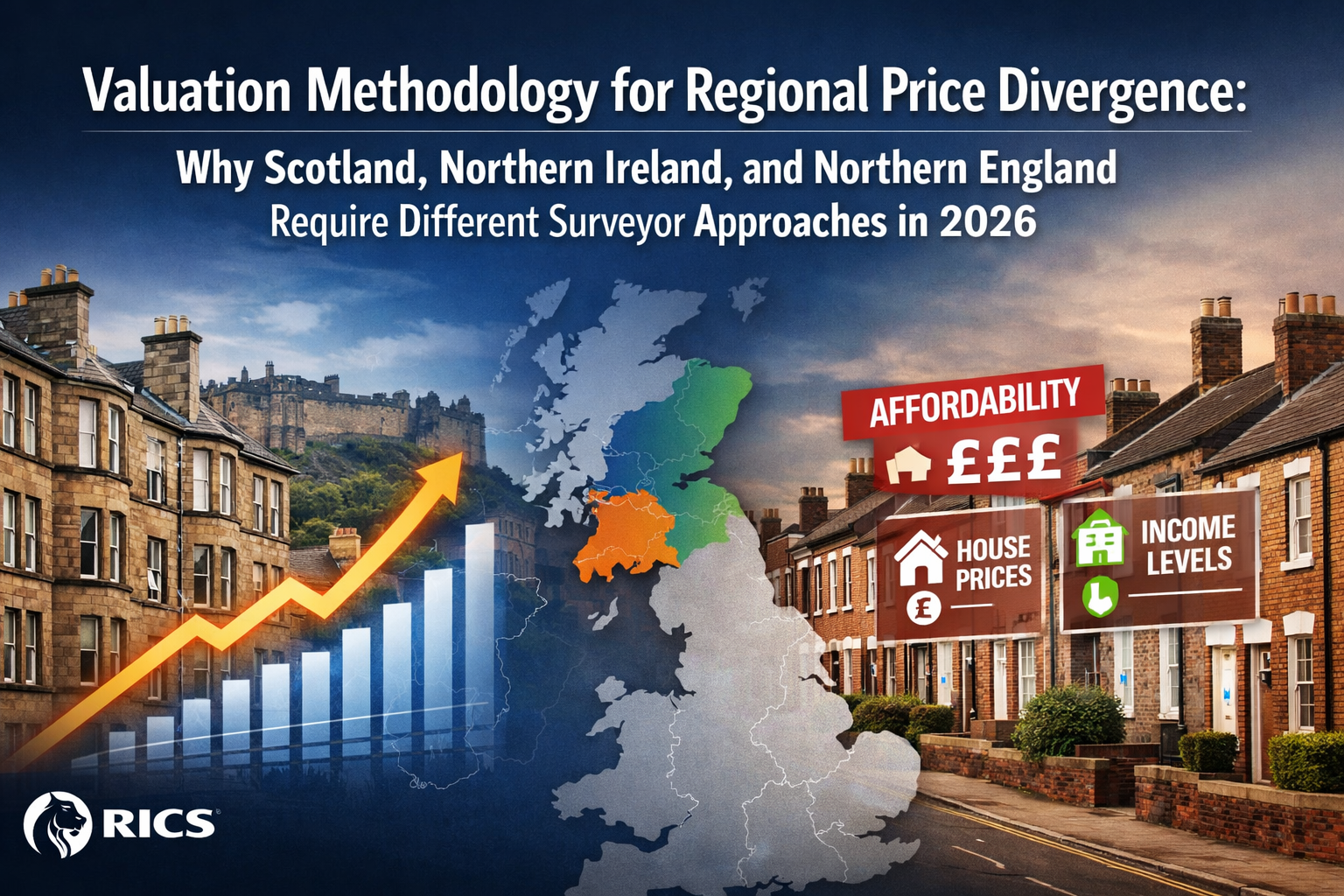

The UK property market in 2026 tells a tale of two nations. While London and the South East grapple with affordability crises and stagnant growth, Scotland, Northern Ireland, and Northern England are experiencing remarkable price appreciation and renewed investor confidence. This stark regional divergence demands that property surveyors fundamentally rethink their valuation methodologies. Understanding the Valuation Methodology for Regional Price Divergence: Why Scotland, Northern Ireland, and Northern England Require Different Surveyor Approaches in 2026 has become essential for accurate property assessments in today's fragmented market.
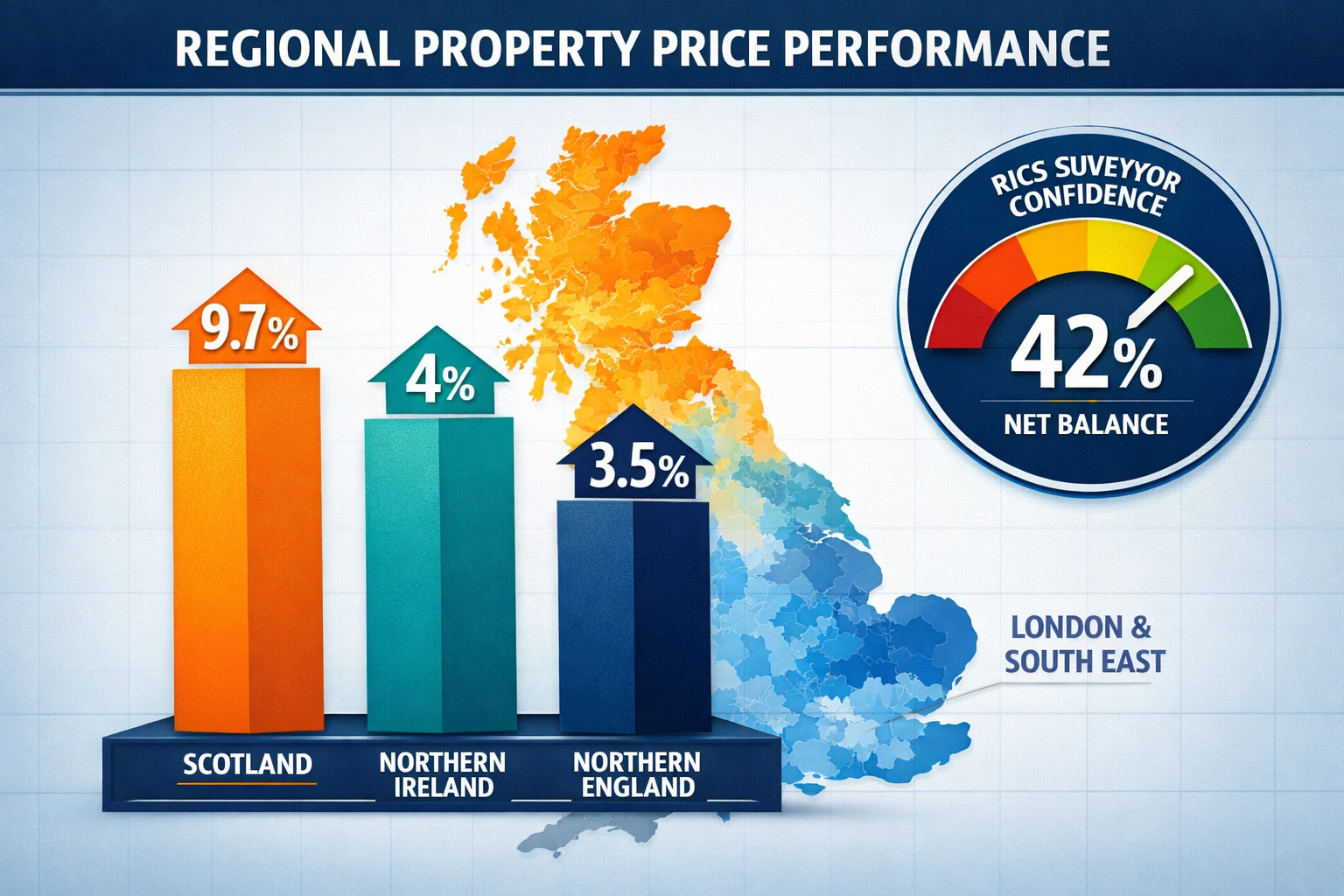
Recent RICS data reveals an extraordinary shift: 42% of surveyors in Scotland reported house prices rising over the past three months—the strongest reading in nearly a year—while many southern regions continue experiencing downward pressure.[5] Northern Ireland recorded an impressive 9.7% price gain in 2025, significantly outpacing the UK average, and the North West saw approximately 3.5% growth.[3] These divergent trends require surveyors to adopt region-specific approaches that account for local affordability pressures, demographic shifts, and unique market drivers.
Key Takeaways
✅ Regional price divergence is accelerating: Scotland shows 42% net surveyor confidence in price rises, while Northern Ireland achieved 9.7% annual growth—dramatically outperforming London and the South East.[3][5]
✅ Affordability drives northern competitiveness: Average flat prices in London (£539,000) are more than double those in Scotland, Northern Ireland, and Northern England, creating fundamentally different valuation contexts.[3]
✅ Rental yield analysis is critical in Northern England: Favorable price-to-rent ratios make rental yield calculations particularly important for accurate property valuations in northern markets.[7]
✅ Business rates revaluation impacts differ regionally: The April 1, 2026 revaluation uses different antecedent valuation dates for Scotland (April 1, 2025) versus England, Wales, and Northern Ireland (April 1, 2024), affecting commercial property assessments.[1]
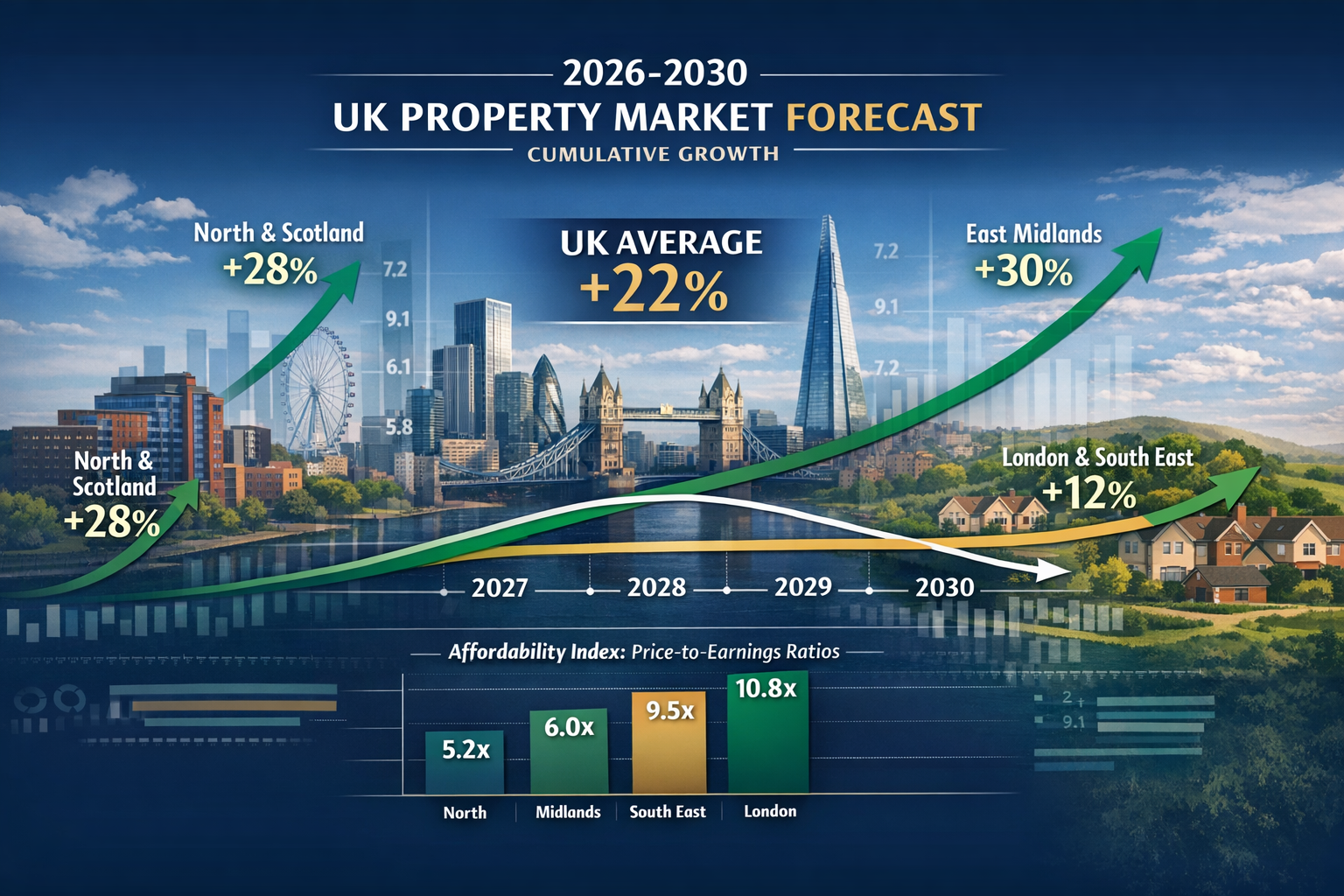
✅ Long-term forecasts favor northern regions: The East Midlands is projected to overtake London in cumulative house price growth since 2010 by 2028, signaling a fundamental market rebalancing.[3]
Understanding Regional Price Divergence in the UK Property Market
The 2026 Regional Performance Gap
The UK property market has fractured into distinct regional ecosystems, each operating under different economic fundamentals. Scotland's housing market demonstrates exceptional resilience, with 23% of surveyors expecting prices to rise over the next three months and an impressive 55% anticipating higher prices over the coming year.[5] This confidence stands in stark contrast to sentiment in southern England, where affordability constraints and economic uncertainty continue to dampen expectations.
Northern Ireland's 9.7% price growth in 2025 represents the strongest regional performance in the UK, driven by a combination of factors including competitive pricing, strong local employment, and limited housing supply.[3] The North West of England, encompassing major cities like Manchester and Liverpool, recorded approximately 3.5% growth, while Scottish markets including Glasgow and Edinburgh experienced 2-4% appreciation.[3]
These figures highlight a fundamental truth: surveyors can no longer apply uniform valuation methodologies across the UK. The economic, demographic, and market conditions in these regions differ so substantially from London and the South East that region-specific approaches are essential for accurate property assessments.
Affordability as the Primary Divergence Driver
Affordability pressures represent the single most important factor driving regional price divergence. London's average flat price of approximately £539,000 is more than double the average in Scotland, Northern Ireland, and Northern England.[3] This dramatic price differential creates entirely different buyer demographics, investment motivations, and market dynamics.
In Northern England, first-time buyers can realistically access the property market with significantly lower deposits and mortgage commitments. This accessibility drives sustained demand and supports price growth even during periods of economic uncertainty. Scotland and Northern Ireland benefit from similar affordability advantages, attracting both domestic buyers priced out of southern markets and investors seeking better rental yields.
For surveyors conducting property valuations, these affordability dynamics must inform comparable selection, adjustment factors, and market trend analysis. A property in Glasgow cannot be accurately valued using the same methodology applied to a comparable property in Chelsea—the buyer pools, financing structures, and investment rationales are fundamentally different.
The Role of Demographic Shifts and Migration Patterns
The UK has witnessed significant internal migration from expensive southern regions to more affordable northern areas. Remote working arrangements, accelerated by pandemic-era changes, have enabled professionals to relocate while maintaining London-based salaries. This demographic shift brings higher purchasing power to northern markets, supporting price growth and changing the composition of local buyer populations.
Scotland, in particular, has benefited from this trend, with Edinburgh and Glasgow attracting skilled professionals seeking better quality of life and housing affordability. Northern Ireland has seen similar patterns, with Belfast emerging as an attractive alternative for both domestic and international buyers. These migration patterns create upward price pressure in receiving regions while potentially dampening demand in expensive southern markets.
Surveyors must account for these demographic shifts when conducting Red Book valuations, particularly when assessing future market trends and sustainability of current price levels. Understanding the composition and motivations of the local buyer pool is essential for accurate valuation in 2026.
Valuation Methodology for Regional Price Divergence: Surveyor Approaches for Scotland
Scotland's Unique Legal and Market Framework
Scotland operates under a distinct legal system for property transactions, fundamentally different from England and Wales. The Scottish property market uses a "offers over" system rather than asking prices, sealed bids are common, and the legal conveyancing process differs substantially. These structural differences impact how surveyors must approach valuations.
The Home Report system in Scotland requires sellers to commission a survey before marketing, creating a different information environment compared to England. Surveyors must understand how Home Reports influence buyer behavior, price negotiations, and market transparency. This pre-listing survey requirement means comparable properties have publicly available condition assessments, providing valuable data for valuation analysis.
Scotland's Land and Buildings Transaction Tax (LBTT) structure also differs from Stamp Duty Land Tax in England, with different thresholds and rates affecting buyer calculations and market dynamics.[8] Surveyors must factor these tax implications into their market analysis and buyer affordability assessments.
Adapting Comparables Analysis for Scottish Markets
When conducting comparables analysis in Scotland, surveyors must recognize that market velocity and transparency differ from southern England. The sealed bid system can create price discovery challenges, as final transaction prices may significantly exceed "offers over" figures. Surveyors need access to actual completion prices rather than listing prices to ensure accurate comparables.
Scottish property types also require specialized knowledge. Traditional tenement flats, common in Glasgow and Edinburgh, have unique characteristics including shared maintenance responsibilities and factoring arrangements. Victorian and Georgian townhouses in Edinburgh's New Town command premium prices based on heritage value and location prestige. Surveyors must understand these property-specific factors when selecting and adjusting comparables.
The regional variation within Scotland is substantial. Aberdeen's market, historically tied to oil and gas industry fortunes, operates differently from Edinburgh's finance and tourism-driven market or Glasgow's diverse economic base. Surveyors must develop region-specific expertise within Scotland itself, not treating the entire country as a homogeneous market.
For registered RICS valuers working in Scotland, maintaining current knowledge of local market conditions, recent transactions, and regional economic trends is essential for accurate valuations in 2026.
Incorporating Scottish Economic and Policy Factors
Scotland's devolved government implements distinct housing policies that impact property values. Affordable housing requirements, planning regulations, and rental market controls differ from England, creating unique supply and demand dynamics. The Scottish Government's budget decisions and tax policies directly influence the property market in ways that don't apply elsewhere in the UK.[8]
Economic performance indicators specific to Scotland must inform surveyor analysis. Employment trends in key Scottish industries, population growth patterns, and infrastructure investment all affect regional property markets. Edinburgh's financial services sector, Glasgow's diversified economy, and Aberdeen's energy industry create distinct local market drivers.
The rental market in Scotland operates under different regulations, including rent pressure zones and enhanced tenant protections. These policies affect buy-to-let investor calculations and rental yield expectations. Surveyors valuing investment properties must account for these regulatory differences when assessing income potential and comparing to English markets.
Valuation Methodology for Regional Price Divergence: Northern Ireland's Distinct Market Characteristics
The Exceptional Growth Story of Northern Ireland
Northern Ireland's 9.7% price growth in 2025 represents the strongest regional performance in the UK, a remarkable achievement that demands surveyor attention.[3] This growth stems from a combination of factors including sustained affordability, limited housing supply, strong local employment, and increased investor interest from both Great Britain and the Republic of Ireland.
Belfast's emergence as a competitive city for business investment, technology sector growth, and tourism has transformed the property market. The city offers significantly lower property prices than Dublin, London, or Edinburgh while providing modern amenities and improving infrastructure. This value proposition attracts both domestic buyers and investors seeking capital appreciation potential.
The cross-border dynamics between Northern Ireland and the Republic of Ireland create unique market influences. Currency fluctuations, economic policy differences, and cross-border worker patterns all affect property demand and pricing. Surveyors must understand these bilateral influences when conducting valuations in Northern Ireland.
Legal and Valuation Framework Differences
Northern Ireland operates under a separate legal jurisdiction with distinct property law, conveyancing processes, and regulatory frameworks. The Land Registry system differs from both Scotland and England/Wales, affecting how surveyors access transaction data and verify ownership information.
Stamp Duty Land Tax in Northern Ireland has different thresholds and rates compared to England, affecting buyer affordability calculations and market entry points. The business rates system, while aligned with England and Wales for the 2026 revaluation antecedent valuation date (April 1, 2024), operates under separate legislation and administrative processes.[1]
Surveyors conducting probate valuations or other specialist assessments in Northern Ireland must ensure compliance with local legal requirements and valuation standards. The regulatory environment differs sufficiently that surveyors accustomed to English practice need specific training and local knowledge.
Market-Specific Valuation Considerations
Property types in Northern Ireland include unique characteristics. Traditional terraced housing in Belfast, rural properties in Counties Down and Antrim, and coastal properties along the Causeway Coast each require specialized valuation knowledge. Building construction methods, local materials, and regional architectural styles differ from other UK regions.
The rental market in Northern Ireland shows strong yields relative to purchase prices, making buy-to-let investment particularly attractive. Surveyors must incorporate detailed rental yield analysis when valuing investment properties, using local rental data and understanding tenant demand patterns specific to Northern Irish markets.
Economic indicators specific to Northern Ireland, including employment data, wage growth, and business investment trends, must inform surveyor market analysis. The region's economic performance has strengthened in recent years, supporting property price growth and justifying optimistic future projections.
Valuation Methodology for Regional Price Divergence: Northern England's Investment Opportunity

The Northern Powerhouse and Property Market Dynamics
Northern England, encompassing regions from the North West to the North East, has experienced sustained investment in infrastructure, business development, and urban regeneration. Cities like Manchester, Liverpool, Leeds, and Newcastle have transformed their economic bases, attracting technology companies, financial services, and creative industries.
The North West's 3.5% price growth demonstrates the region's competitive position in the UK property market.[3] Manchester, in particular, has emerged as a genuine alternative to London for many businesses and professionals, driving residential property demand and supporting price appreciation. Liverpool's regeneration and cultural renaissance have similarly strengthened its property market.
Affordability advantages in Northern England create strong fundamentals for continued growth. First-time buyers can access quality housing at price points impossible in southern England, while investors benefit from attractive rental yields and capital appreciation potential. This combination of affordability and growth potential makes Northern England particularly attractive in 2026.
Rental Yield Focus in Northern England Valuations
Surveyor guidance emphasizes that rental yield analysis is particularly important for property valuations in Northern England due to favorable price-to-rent ratios.[7] The region's combination of affordable purchase prices and strong rental demand creates attractive investment propositions that must be properly reflected in valuations.
When conducting lease extension valuations or investment property assessments in Northern England, surveyors must incorporate detailed rental market analysis. Understanding local rental demand drivers, tenant demographics, and yield expectations is essential for accurate valuations that reflect investment value.
Buy-to-let investors have increasingly focused on Northern England markets, recognizing superior yields compared to southern regions. Surveyors must understand investor motivations, financing structures, and return expectations when valuing properties likely to attract investment buyers. The investment buyer pool represents a significant market segment that influences pricing dynamics.
Regional Variation Within Northern England
Northern England is not a homogeneous market—significant variation exists between the North West, Yorkshire and the Humber, and the North East. Manchester's property market operates differently from Newcastle's, and Leeds differs from Liverpool. Surveyors must develop city-specific and sub-regional expertise.
Urban versus rural dynamics in Northern England also require distinct approaches. While cities like Manchester experience strong price growth driven by economic diversification and population growth, rural areas in Yorkshire or the Lake District operate under different demand drivers including lifestyle appeal and retirement migration.
Post-industrial regeneration areas present unique valuation challenges. Former industrial cities undergoing transformation require surveyors to assess regeneration sustainability, infrastructure investment impact, and changing neighborhood dynamics. Historical transaction data may not accurately predict future performance in rapidly transforming areas.
For surveyors conducting building surveys in Northern England, understanding regional construction methods, common defects in local property types, and climate-related issues specific to northern regions is essential for comprehensive property assessment.
Technical Valuation Adjustments for Regional Markets
Comparables Selection and Regional Adjustment Factors
Selecting appropriate comparables becomes more complex when valuing properties in Scotland, Northern Ireland, and Northern England due to market-specific characteristics. Surveyors must ensure comparables reflect the same legal jurisdiction, local market conditions, and buyer demographics as the subject property.
Regional adjustment factors must account for differences in:
- Local market velocity and transaction volumes
- Buyer financing availability and typical loan-to-value ratios
- Regional economic performance and employment trends
- Local planning policies and development constraints
- Infrastructure investment and connectivity improvements
Surveyors should develop region-specific adjustment matrices that quantify these factors rather than relying on generic national adjustments. A 10% adjustment appropriate for comparing properties within London may be entirely inappropriate for comparing properties in Glasgow or Belfast.
Market Conditions and Timing Adjustments
The timing of comparable transactions requires careful consideration in rapidly appreciating markets like Northern Ireland. A comparable sale from six months ago may significantly understate current values in a market experiencing 9.7% annual growth.[3] Surveyors must apply appropriate time adjustments based on regional price indices and local market data.
Market conditions adjustments should reflect regional economic trends, not just national indicators. Scotland's 42% net balance of surveyors reporting price rises indicates very different market conditions than southern England.[5] Valuations must reflect these regional market conditions through appropriate adjustments to comparable evidence.
Seasonal variations also differ regionally. Scottish markets may experience different seasonal patterns than Northern England due to climate, holiday periods, and local market customs. Surveyors must understand these regional seasonal patterns when selecting comparables and making timing adjustments.
Income Approach Considerations for Investment Properties
When applying income capitalization methods in Northern England, Scotland, or Northern Ireland, surveyors must use region-specific capitalization rates that reflect local investor expectations and risk assessments. Cap rates appropriate for London investment properties do not apply to Manchester or Edinburgh properties.
Rental market data must be locally sourced and current. Regional rental growth rates, void periods, and tenant demand patterns differ substantially across UK regions. Surveyors should maintain databases of local rental transactions and market intelligence specific to their valuation regions.
Operating expense ratios and management costs also vary regionally. Property management fees, maintenance costs, and local authority charges differ across Scotland, Northern Ireland, and Northern England. Accurate income approach valuations require region-specific expense data and assumptions.
For surveyors conducting capital gains tax valuations, understanding regional market trends and price appreciation patterns is essential for accurate retrospective and current valuations.
The 2026 Business Rates Revaluation Impact
Regional Differences in Antecedent Valuation Dates
The April 1, 2026 business rates revaluation introduces important regional differences that surveyors must understand.[1] England, Wales, and Northern Ireland use property values from April 1, 2024 as the antecedent valuation date, while Scotland's antecedent valuation date is set at April 1, 2025.[1]
This one-year difference means Scottish commercial property valuations for rating purposes reflect more recent market conditions than those in other UK regions. In rapidly changing markets, this timing difference can significantly impact rateable values and business rate liabilities.
Surveyors conducting commercial valuations must clearly understand which antecedent valuation date applies to their subject property and ensure their valuation methodology aligns with the appropriate date. Using incorrect market data or timing assumptions can result in inaccurate rateable value assessments.
Commercial Property Valuation Methodology Variations
Commercial property markets in Scotland, Northern Ireland, and Northern England have experienced different trajectories than London and the South East. Office markets in Manchester and Edinburgh have strengthened due to business relocations and expansions, while some London office markets face challenges from remote working trends.
Retail property valuations must account for regional differences in consumer spending, tourism patterns, and local economic strength. Edinburgh's tourism-driven retail market operates differently from Newcastle's local consumer-focused retail, requiring distinct valuation approaches.
Industrial and logistics properties in Northern England benefit from strategic locations for national distribution networks and lower land costs compared to southern regions. Surveyors must understand these competitive advantages when valuing industrial properties and applying capitalization rates.
For those conducting commercial building surveys, understanding regional construction standards, typical building ages, and common defects in different UK regions is essential for accurate condition assessments.
Impact on Investment Property Valuations
The business rates revaluation affects investment property valuations by changing occupancy costs for tenants. Properties facing significant rateable value increases may experience tenant resistance or rental growth constraints, while properties benefiting from rateable value reductions may become more attractive to occupiers.
Surveyors must model the impact of business rate changes on net operating income for investment properties. This requires understanding not just the revaluation mechanics but also how local markets will respond to changed occupancy costs.
Regional economic resilience affects how business rate changes impact property values. Stronger regional economies in Scotland, Northern Ireland, and Northern England may better absorb rate increases than struggling southern markets, creating different valuation implications across regions.
Future-Proofing Regional Valuation Methodologies
Long-Term Regional Growth Forecasts
UK property market forecasts project approximately 22% cumulative house price growth over 2026-2030, though regional variations are substantial.[3] The East Midlands is forecast to overtake London in cumulative house price growth since 2010 by 2028, signaling a fundamental rebalancing of UK property markets.[3]
Scotland's 55% of surveyors anticipating higher prices over the coming year indicates strong medium-term confidence.[5] Northern Ireland's momentum suggests continued outperformance, while Northern England's affordability advantages and economic diversification support sustained growth prospects.
Surveyors must incorporate these long-term trends into their market analysis and valuation assumptions. Properties in regions with strong growth forecasts may justify different capitalization rates, risk assessments, and market condition adjustments than properties in stagnant or declining markets.
Technological Integration in Regional Valuations
Advanced data analytics and property technology tools enable more sophisticated regional market analysis. Surveyors can access real-time transaction data, rental market intelligence, and economic indicators specific to Scotland, Northern Ireland, and Northern England markets.
Automated Valuation Models (AVMs) must be calibrated specifically for regional markets to ensure accuracy. Generic national AVMs often perform poorly in regional markets with distinct characteristics. Surveyors should develop or use region-specific AVMs that account for local market dynamics.
Geographic Information Systems (GIS) and spatial analysis tools help surveyors understand micro-market variations within regions. Neighborhood-level analysis in cities like Glasgow, Belfast, or Manchester reveals price gradients and demand patterns that inform more accurate valuations.
Professional Development and Regional Expertise
Surveyors must invest in continuous professional development focused on regional market knowledge. Understanding Scotland's legal system, Northern Ireland's cross-border dynamics, and Northern England's diverse city markets requires dedicated study and practical experience.
Local market intelligence networks, including relationships with estate agents, developers, and other surveyors in specific regions, provide invaluable insights that complement formal data sources. Surveyors should actively cultivate these professional networks in their practice regions.
RICS guidance and professional standards must be interpreted and applied within regional contexts. While fundamental valuation principles remain consistent, their application must adapt to regional market realities, legal frameworks, and economic conditions.
For those seeking help to buy valuations or other specialist assessments, working with surveyors who have genuine regional expertise ensures accurate valuations that reflect local market conditions.
Practical Implementation for Surveyors
Building Regional Market Databases
Surveyors should develop comprehensive databases of regional transaction data, rental information, and market intelligence specific to Scotland, Northern Ireland, and Northern England. These databases should include:
📊 Transaction data with verified completion prices, property characteristics, and transaction dates
📊 Rental evidence including achieved rents, void periods, and tenant profiles
📊 Economic indicators such as regional employment data, wage growth, and business investment
📊 Development pipelines tracking new housing supply and commercial development
📊 Infrastructure projects that may impact property values and market dynamics
Regular database updates ensure surveyors work with current information reflecting rapidly changing regional markets. Automated data feeds from Land Registry, rental platforms, and economic data sources can streamline this process.
Developing Regional Valuation Templates
Standardized templates adapted for regional markets help ensure consistency while accommodating regional differences. Separate templates for Scotland, Northern Ireland, and Northern England should incorporate:
✅ Region-specific comparable selection criteria
✅ Appropriate adjustment factor ranges for local markets
✅ Regional economic indicator checkpoints
✅ Jurisdiction-specific legal considerations
✅ Local market condition assessment frameworks
These templates should evolve based on market feedback, regulatory changes, and professional experience. Regular review and refinement ensure templates remain relevant and accurate.
Quality Assurance and Peer Review
Regional valuation accuracy benefits from peer review processes involving surveyors with local market expertise. Firms should implement review procedures where valuations in Scotland, Northern Ireland, or Northern England receive scrutiny from surveyors familiar with those specific markets.
Benchmarking exercises comparing valuations against subsequent transaction prices help identify systematic biases or methodology weaknesses. Regional market differences mean that valuation accuracy metrics should be tracked separately for different UK regions.
Continuous improvement processes should incorporate lessons learned from regional market developments, regulatory changes, and professional experience. Surveyors should regularly review and update their regional methodologies based on performance data and market evolution.
Conclusion: Embracing Regional Differentiation in 2026
The Valuation Methodology for Regional Price Divergence: Why Scotland, Northern Ireland, and Northern England Require Different Surveyor Approaches in 2026 reflects fundamental shifts in UK property markets. Regional divergence is not temporary—it represents a structural rebalancing driven by affordability pressures, demographic shifts, and economic diversification.
Scotland's 42% net surveyor confidence in price rises, Northern Ireland's 9.7% annual growth, and Northern England's favorable investment yields create distinct market contexts that demand specialized valuation approaches.[3][5] Surveyors who recognize these differences and adapt their methodologies will deliver more accurate valuations and better serve their clients.
The 2026 business rates revaluation, with its different antecedent valuation dates for Scotland versus other UK regions, further emphasizes the importance of regional expertise.[1] Commercial and residential property markets across Scotland, Northern Ireland, and Northern England operate under different legal frameworks, economic conditions, and market dynamics than London and the South East.
Actionable Next Steps for Property Professionals
For surveyors practicing in regional markets:
- Invest in region-specific professional development and market knowledge
- Build comprehensive local market databases and intelligence networks
- Develop specialized valuation templates adapted to regional characteristics
- Implement peer review processes involving regional market experts
- Track valuation accuracy separately for different regions to identify improvement opportunities
For property investors and buyers:
- Engage surveyors with demonstrated regional expertise and local market knowledge
- Request detailed explanation of regional adjustment factors and methodology
- Verify that valuations incorporate current regional market data and trends
- Consider long-term regional growth forecasts when making investment decisions
- Understand how regional legal and regulatory differences affect property values
For industry stakeholders:
- Support development of region-specific valuation guidance and standards
- Facilitate data sharing and market intelligence networks for regional markets
- Promote professional development opportunities focused on regional expertise
- Advocate for regulatory frameworks that recognize regional market differences
- Encourage research into regional market dynamics and valuation methodology
The UK property market's regional divergence represents both challenge and opportunity. Surveyors who embrace regional differentiation, develop specialized expertise, and adapt their methodologies to local market realities will thrive in this evolving landscape. Those who continue applying uniform national approaches risk delivering inaccurate valuations that fail to reflect regional market dynamics.
As we progress through 2026 and beyond, regional expertise will increasingly differentiate leading surveyors from those struggling to adapt. The time to develop regional specialization and refined methodologies is now—the market's regional divergence shows no signs of reversing, and client expectations for accurate, locally-informed valuations continue rising.
References
[1] Business Rates 2026 Revaluation – https://www.nmrk.com/en-gb/services/business-rates/business-rates-2026-revaluation
[2] Valuation Approach For Properties In Residential Buildings With – https://www.rics.org/profession-standards/rics-standards-and-guidance/sector-standards/valuation-standards/valuation-approach-for-properties-in-residential-buildings-with-
[3] Uk Price Forecasts – https://investropa.com/blogs/news/uk-price-forecasts
[4] February2026 – https://www.ons.gov.uk/economy/inflationandpriceindices/bulletins/privaterentandhousepricesuk/february2026
[5] Scottish Housing Market 2026 Rics Survey – https://www.simpsonmarwick.com/journal/scottish-housing-market-2026-rics-survey
[6] Help With The 2026 Business Rates Revaluation – https://www.gov.uk/guidance/help-with-the-2026-business-rates-revaluation
[7] Valuing Northern England Properties In 2026 Surveyor Tactics For Outpacing Southern Affordability Pressures – https://nottinghillsurveyors.com/blog/valuing-northern-england-properties-in-2026-surveyor-tactics-for-outpacing-southern-affordability-pressures
[8] Pages – https://www.gov.scot/publications/scottish-budget-2026-2027-scottish-tax-ready-reckoners/pages/6/