

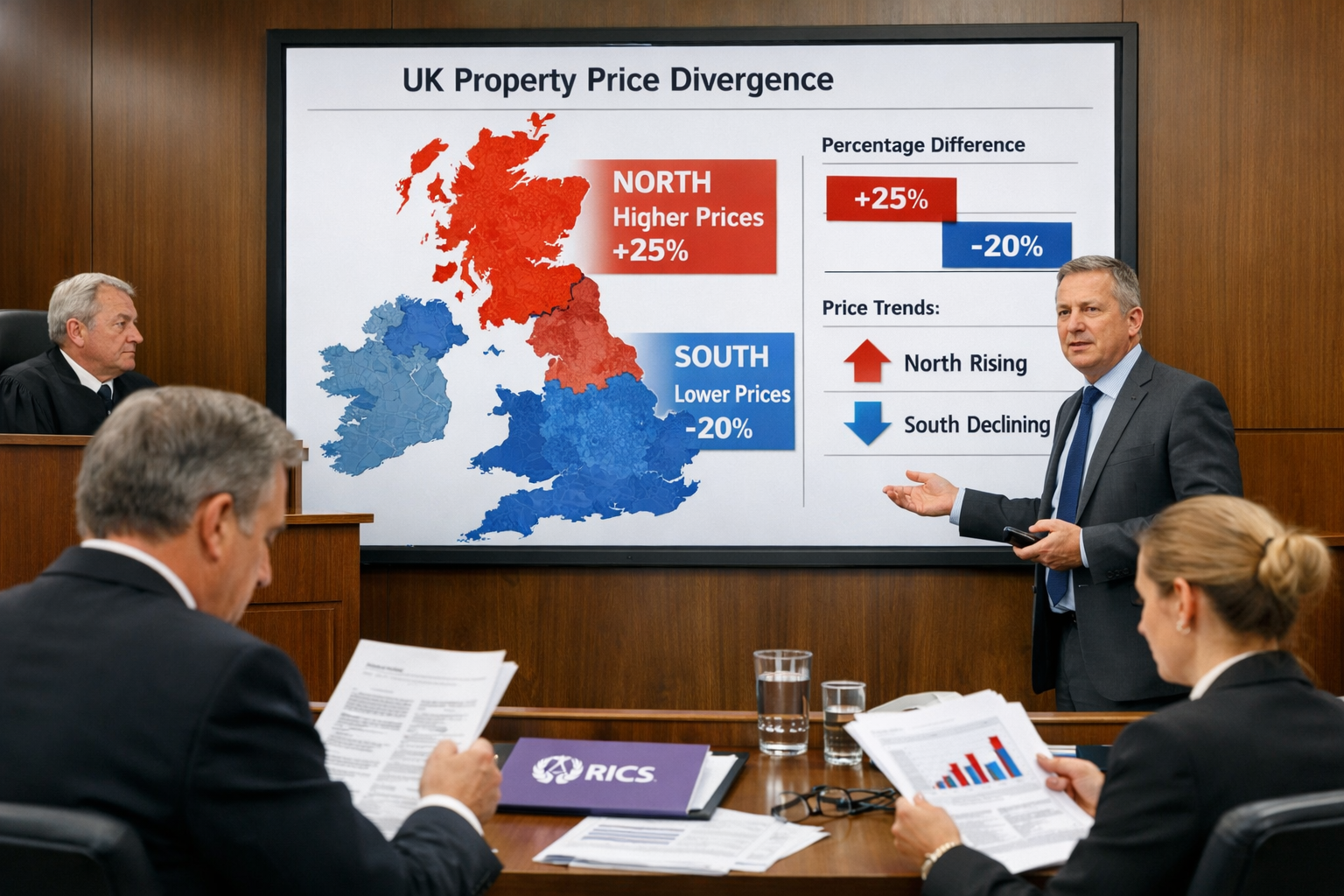
As Scotland, Northern Ireland, and Northern England experience unprecedented property price growth while Southern regions stagnate, expert witnesses face mounting pressure to defend their valuation methodologies in court. The widening North-South property divide represents the most significant geographic split in UK property performance since the post-financial crisis recovery, creating a minefield for surveyors tasked with providing comparable property evidence in litigation[5].
When regional markets move in opposite directions, traditional valuation approaches break down. A three-bedroom semi-detached property in Manchester may appreciate 12% annually while an identical property in parts of Southern England remains flat or declines. This divergence creates fertile ground for valuation disputes where parties challenge expert witness assessments based on regional comparables that no longer align with historical patterns.

Key Takeaways
- 🏘️ Regional price divergence between Northern and Southern UK property markets has reached historic levels in 2026, creating unprecedented challenges for expert witness valuations
- ⚖️ Expert witnesses must develop robust methodologies that account for localized market conditions rather than relying on national trends or outdated comparable data
- 📊 Service-oriented cities are significantly outperforming industrial counterparts, requiring surveyors to adjust valuation approaches based on local economic drivers
- 🔍 Comparable selection strategies must incorporate regional adjustment factors and demonstrate clear rationale for geographic limitations in evidence
- 📝 Documentation standards have become critical as courts scrutinize regional valuation methodologies more rigorously amid widening price gaps
Understanding Regional Price Divergence in 2026
The UK property market has fractured along geographic lines in ways not seen for over a decade. Northern England, Scotland, and Northern Ireland are experiencing robust price appreciation while many Southern markets face stagnation or decline. This phenomenon reflects broader economic shifts where service-oriented cities outperform their industrial counterparts, both within and across countries[2].
The Scale of North-South Divergence
Regional performance gaps have widened dramatically:
| Region | Average Annual Growth (2026) | Key Drivers |
|---|---|---|
| Northern England | +8-12% | Affordability, remote work migration |
| Scotland | +7-10% | Economic resilience, tech sector growth |
| Northern Ireland | +6-9% | Housing shortage, investment inflows |
| South East England | +1-3% | Affordability constraints, outmigration |
| London (outer) | -2-0% | Cost of living pressures, hybrid work |
These divergent trends create immediate challenges for expert witness surveyors who must defend valuation conclusions that may contradict national averages or historical regional relationships.
Economic Underpinnings of Divergence
The 2026 property landscape reflects fundamental economic restructuring. Service-oriented economies continue to thrive while traditional industrial centers face headwinds. This pattern extends beyond the UK—China experiences downward corrections in house prices throughout 2026, contrasting sharply with affordability pressures in Europe and North America[2].
Critical factors driving regional divergence:
- 💼 Employment patterns: Remote work has redistributed demand toward affordable Northern markets
- 🏭 Industrial decline: Traditional manufacturing centers face structural challenges
- 💰 Affordability thresholds: Southern markets have reached price ceilings that constrain further growth
- 🌐 Investment flows: International capital increasingly targets Northern UK growth markets
- 🏛️ Policy interventions: Regional development initiatives favor Northern investment
Valuation Disputes Over Regional Price Divergence: Challenges for Expert Witnesses
When parties dispute property valuations in litigation, expert witnesses must navigate treacherous methodological waters. Traditional approaches that worked in stable, uniform markets fail when regional performance diverges dramatically.
Common Dispute Scenarios in 2026
Matrimonial proceedings represent a particularly contentious arena. When divorcing parties purchased a London property in 2020 expecting continued appreciation, but the asset has declined while comparable properties in Manchester have doubled, valuation disputes become inevitable. Each party's expert may present radically different valuations based on regional comparable selection.
Compulsory purchase and compensation claims create another flashpoint. When government entities acquire property in rapidly appreciating Northern markets, landowners challenge valuations based on outdated assessment dates or Southern-weighted comparable evidence that understates true market value.
Partnership dissolutions and shareholder disputes involving property portfolios face similar challenges. A portfolio spanning multiple regions may show aggregate stability while individual assets experience wildly different performance, creating disputes over fair distribution values.
The Comparable Selection Dilemma
Traditional valuation methodology relies on comparable sales evidence from similar properties in similar locations. But what constitutes "similar" when regional markets diverge?
Key challenges in comparable selection:
-
Geographic radius limitations: How far can an expert reasonably extend the search for comparables before regional differences invalidate the comparison?
-
Temporal adjustments: When markets move at different speeds, how should experts adjust historical sales to reflect current conditions?
-
Property type variations: Does a service-oriented city's premium for certain property types apply equally in industrial centers?
-
Market condition adjustments: What adjustment factors account for fundamentally different regional economic trajectories?
Professional valuation services must address these questions with defensible methodologies that withstand cross-examination.
Cross-Examination Vulnerabilities
Expert witnesses face aggressive cross-examination when regional divergence creates valuation ambiguity. Common attack vectors include:
- ❌ Cherry-picking comparables: Opposing counsel argues the expert selected only favorable regional evidence
- ❌ Insufficient adjustment factors: Challenges to the quantum of regional adjustments applied
- ❌ Outdated market assumptions: Arguments that the expert failed to recognize shifting regional dynamics
- ❌ Inconsistent methodology: Claims that the expert applied different standards to Northern versus Southern comparables
Expert Witness Strategies for Defending Regional Valuations
Successful expert witnesses in 2026 employ sophisticated strategies that acknowledge regional divergence while maintaining methodological rigor. These approaches have emerged from recent case law and professional guidance from RICS and other professional bodies.
Strategy 1: Establish Clear Geographic Boundaries
Define explicit geographic parameters for comparable selection and justify these boundaries with market evidence. Rather than arbitrarily selecting a radius, demonstrate why specific boundaries reflect genuine market areas.
For properties in North West London, an expert might establish that buyers typically search within specific boroughs based on school catchment areas, transport links, and employment centers. This creates defensible boundaries that resist claims of cherry-picking.
Strategy 2: Implement Multi-Tier Comparable Analysis
Develop a hierarchical approach to comparable evidence:
Tier 1: Immediate locality comparables (within 0.5 miles)
Tier 2: Extended local market (1-3 miles with similar characteristics)
Tier 3: Regional comparables (broader area with documented adjustments)
Tier 4: National benchmarks (for context only, not primary valuation basis)
This structure demonstrates comprehensive analysis while prioritizing the most relevant evidence. When defending valuations in South East London versus South West London, this tiered approach shows recognition of micro-market differences even within the same broader region.
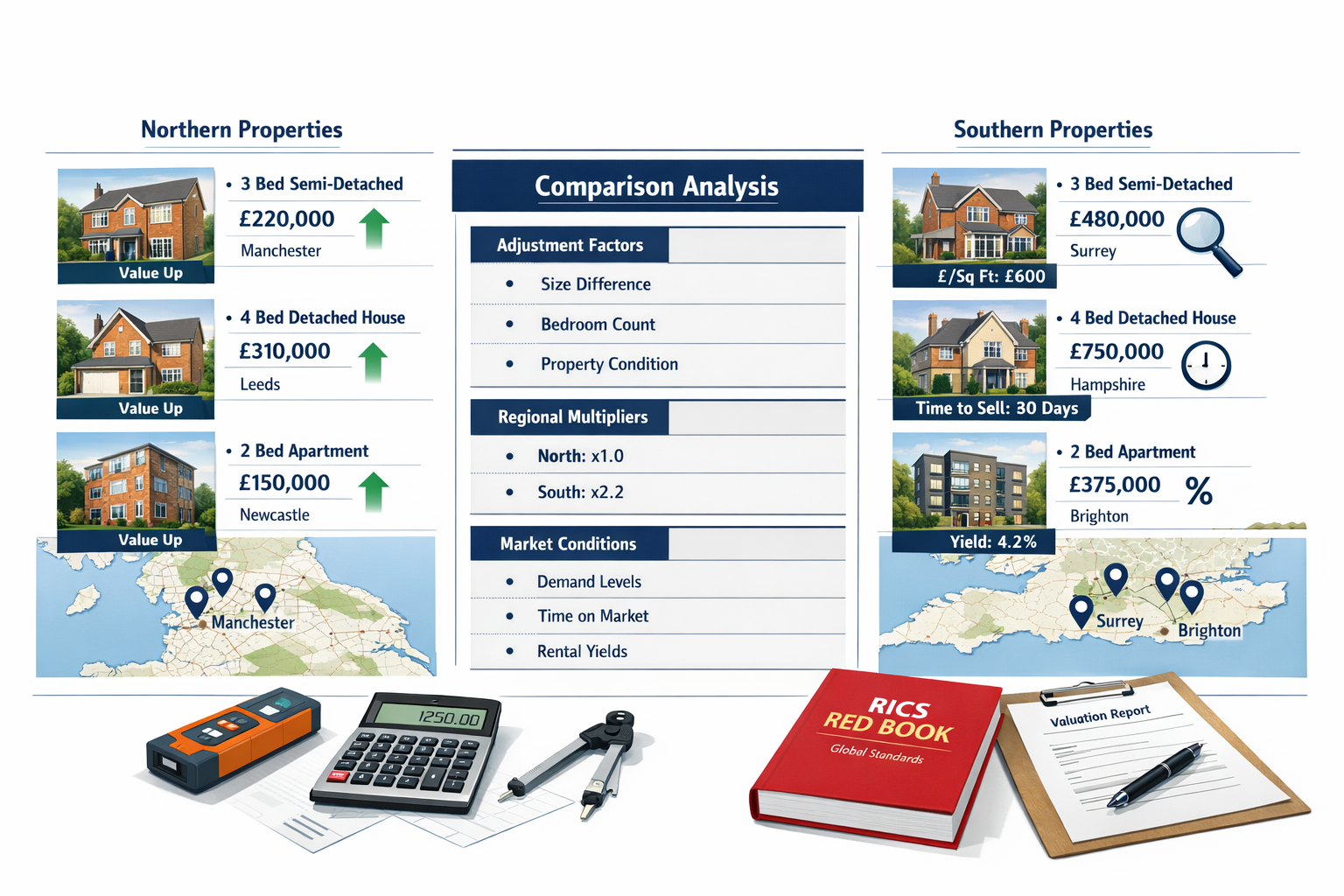
Strategy 3: Quantify Regional Adjustment Factors
Rather than applying subjective adjustments, develop data-driven regional multipliers based on:
- Historical price performance differentials between regions
- Economic indicator correlations (employment rates, wage growth, migration patterns)
- Transaction volume analysis showing demand intensity
- Days on market comparisons indicating market strength
- Rental yield differentials reflecting investment demand
These quantified adjustments withstand scrutiny better than subjective estimates. When explaining why a Northern comparable requires a 15% downward adjustment to reflect Southern market conditions, data-driven evidence proves more persuasive than expert intuition.
Strategy 4: Address Market Condition Timing
Temporal adjustments become critical when markets move at different speeds. Develop explicit methodologies for adjusting historical sales to current valuation dates:
- Calculate monthly appreciation/depreciation rates for specific sub-markets
- Apply these rates to historical comparables to derive current equivalent values
- Document the statistical basis for these rates (regression analysis, index correlations)
- Explain confidence intervals and potential variance in these adjustments
This approach proves particularly valuable for commercial valuations where transaction volumes may be lower and temporal adjustments carry greater weight.
Strategy 5: Incorporate Economic Context Evidence
Expert witnesses strengthen their position by connecting property valuations to broader economic trends. Reference authoritative sources demonstrating:
- Regional employment growth differentials
- Infrastructure investment patterns
- Demographic migration trends
- Commercial real estate performance indicators
For instance, US regional banks face elevated exposure to commercial real estate with total criticized assets well above 2020 levels, signaling deteriorating credit quality[1]. While this relates to US markets, similar patterns in UK regional banking exposure to commercial property can inform residential valuation risk assessments.
Strategy 6: Pre-Empt Alternative Methodologies
Anticipate opposing expert approaches and address them proactively in reports. If an opposing expert might argue for national average adjustments rather than regional specificity, explain why this approach fails to reflect actual market behavior.
Demonstrate awareness of alternative methodologies while explaining why the chosen approach better reflects market reality. This positions the expert as comprehensive and balanced rather than advocate-driven.
Strategy 7: Maintain RICS Compliance Throughout
Strict adherence to RICS Red Book standards provides crucial defensibility. Document compliance with:
- Valuation Practice Statements (VPS)
- UK National Supplement requirements
- Professional Standards (PS) regarding conflicts of interest and ethical behavior
- Technical and Performance Standards (TPS)
When regional divergence creates valuation uncertainty, demonstrating that every step followed professional standards strengthens credibility. Desktop valuations must meet the same standards as physical inspections, with appropriate caveats regarding limitations.
Documentation and Report Writing Best Practices
The written expert report represents the primary defense against challenges to regional valuation methodologies. In 2026's divergent market environment, documentation standards have become more critical than ever.
Essential Report Components
Executive Summary: Clearly state the valuation conclusion and the primary methodology employed, with explicit reference to regional market conditions.
Market Context Section: Dedicate substantial space to explaining the specific regional market dynamics affecting the subject property. Include:
- Regional price trend analysis with supporting data
- Economic drivers specific to the locality
- Comparative performance versus other UK regions
- Forward-looking market indicators
Comparable Selection Rationale: For each comparable, explicitly document:
- Why this property was selected
- How it compares to the subject property
- What adjustments were applied and why
- Geographic relationship to subject property
- Temporal adjustments and their basis
Adjustment Methodology: Provide detailed explanation of every adjustment factor:
- Quantitative basis for adjustment percentages
- Supporting market data
- Alternative approaches considered and rejected
- Sensitivity analysis showing valuation range under different assumptions
Limitations and Assumptions: Clearly state any limitations in the analysis, particularly regarding:
- Geographic boundaries of comparable search
- Temporal constraints on available data
- Market volatility and uncertainty
- Regional divergence impacts on confidence levels
Visual Presentation Techniques
Maps and geographic visualization prove invaluable in regional divergence disputes. Include:
- Heat maps showing price performance across regions
- Comparable location maps with subject property highlighted
- Geographic boundary illustrations showing market areas
- Transportation and amenity proximity mapping
Charts and graphs should demonstrate:
- Historical price trends for subject region versus comparator regions
- Transaction volume trends indicating market strength
- Days on market comparisons
- Price per square foot evolution over time
Anticipating Cross-Examination
Structure reports to pre-empt common cross-examination questions:
- "Why didn't you consider comparables from [different region]?"
- "How do you justify this adjustment percentage?"
- "Isn't your valuation just an average of cherry-picked sales?"
- "What if the market changes direction next month?"
Address these questions within the report itself, demonstrating thorough consideration of alternative approaches and potential criticisms.
Regional Variations: Practical Application Across UK Markets
Different UK regions require tailored approaches reflecting local market characteristics. Expert witnesses must adapt general strategies to specific geographic contexts.
Northern England Markets
Northern England's 2026 price surge creates unique challenges. Properties that were undervalued relative to Southern counterparts for decades now command premium prices in specific submarkets. Expert witnesses must:
- Avoid historical bias: Don't assume Northern properties should trade at historical discounts to Southern equivalents
- Recognize micro-market variations: Manchester city center performs differently than Greater Manchester suburbs
- Account for investment demand: Build-to-rent and institutional investment has transformed some Northern markets
- Consider regeneration impacts: Major infrastructure projects create localized value premiums
London and South East Markets
Stagnant or declining prices in parts of London and the South East require different approaches:
- Acknowledge affordability ceilings: Recognize that some markets have reached price points that constrain further growth
- Consider outmigration impacts: Remote work has reduced demand in some previously premium locations
- Identify resilient submarkets: Not all Southern markets decline uniformly—some maintain strength
- Account for leasehold factors: Lease extension costs and collective enfranchisement considerations disproportionately affect Southern markets with older leasehold stock
Scotland and Northern Ireland
These markets present distinct legal and market frameworks:
- Different legal systems: Scottish property law differs from English law, affecting valuation approaches
- Unique market drivers: Scotland's tech sector growth and Northern Ireland's housing shortage create region-specific dynamics
- Cross-border comparables: When and how to use cross-border comparable evidence requires careful justification
- Currency and economic factors: Post-Brexit economic divergence affects these markets differently
Emerging Trends and Future Considerations
As 2026 progresses, several trends will shape valuation dispute strategies in the context of regional divergence.
Increased Scrutiny of Expert Methodologies
Courts increasingly recognize that regional divergence requires more sophisticated valuation approaches. Judges show less tolerance for simplistic methodologies that ignore local market dynamics. Expert witnesses must demonstrate genuine market expertise rather than mechanical application of formulas.
Technology-Enhanced Evidence
Advanced data analytics and AI-powered valuation tools provide new opportunities and challenges:
- Automated valuation models (AVMs) incorporate regional factors but may lag in recognizing rapid market shifts
- Big data analysis enables more sophisticated comparable selection and adjustment
- Predictive analytics help demonstrate forward-looking market trends
- Blockchain and property data transparency improve comparable verification
Climate and Environmental Factors
Regional divergence increasingly reflects environmental considerations:
- Flood risk differentially affects regions, with Northern properties in certain areas facing increased premiums for flood-resilient locations
- Energy efficiency requirements impact older Southern housing stock more severely
- Green space access commands different premiums across regions
- Climate migration patterns influence long-term regional demand
Geopolitical and Economic Uncertainty
Global economic trends continue to influence regional UK property markets. Geopolitical factors create divergent regional impacts, with some areas benefiting from reshoring of manufacturing while others face continued headwinds[3]. Expert witnesses must incorporate these macro trends into regional analysis while avoiding speculation.
Professional Standards Evolution
RICS and other professional bodies continue refining guidance on regional valuation methodologies. Expert witnesses must stay current with:
- Updated Red Book guidance on regional adjustments
- Case law precedents establishing acceptable methodologies
- Professional development requirements for regional market expertise
- Emerging best practices from peer-reviewed research
Case Study: Defending a Northern Valuation in Matrimonial Proceedings
Background: In a 2026 matrimonial dispute, parties disagreed on the value of a Manchester property portfolio acquired in 2019. The husband's expert valued the portfolio at £2.8 million based on Northern England comparables showing strong appreciation. The wife's expert valued the same portfolio at £2.2 million, applying Southern-weighted national average adjustments.
Challenge: The wife's expert argued that Northern price appreciation was temporary and unsustainable, warranting conservative valuation based on long-term historical relationships between Northern and Southern markets.
Successful Strategy: The husband's expert employed several key tactics:
- Comprehensive market analysis: Presented detailed economic data showing structural shifts favoring Northern markets, not temporary fluctuations
- Tiered comparable evidence: Demonstrated that local Manchester comparables (Tier 1) consistently supported higher valuations, with regional and national data provided for context only
- Quantified adjustments: Developed data-driven adjustment factors based on five years of transaction data, showing clear divergence trends
- Pre-emptive rebuttal: Addressed the "temporary appreciation" argument by referencing employment growth, infrastructure investment, and demographic trends supporting sustained Northern strength
- Professional standards compliance: Documented strict adherence to RICS Red Book requirements throughout
Outcome: The court accepted the higher valuation, finding the husband's expert's methodology more reflective of actual market conditions. The judge specifically noted the importance of regional-specific analysis in the current divergent market environment.
Conclusion
Valuation disputes over regional price divergence present formidable challenges for expert witnesses in 2026. As Northern markets surge while Southern regions stagnate, traditional valuation methodologies that assume uniform national trends no longer suffice. Expert witnesses must develop sophisticated, data-driven approaches that acknowledge and quantify regional differences while maintaining methodological rigor and professional standards compliance.
Key success factors include:
✅ Establishing clear, defensible geographic boundaries for comparable selection
✅ Implementing multi-tier comparable analysis that prioritizes local evidence
✅ Quantifying regional adjustment factors with data-driven methodologies
✅ Incorporating broader economic context to explain regional divergence
✅ Maintaining strict RICS compliance and comprehensive documentation
✅ Pre-empting alternative methodologies through thorough analysis
The widening North-South gap represents both a challenge and an opportunity for expert witnesses. Those who develop robust regional valuation methodologies will establish themselves as authorities in this evolving landscape, while those relying on outdated approaches will face increasing challenges to their credibility.
Actionable Next Steps
For surveyors and expert witnesses navigating regional price divergence:
- Invest in regional market intelligence: Develop deep expertise in specific geographic markets rather than relying on national trends
- Build comprehensive databases: Maintain detailed comparable sales databases with regional segmentation and adjustment factors
- Enhance documentation practices: Elevate report quality to address regional divergence explicitly and thoroughly
- Pursue continuing education: Stay current with RICS guidance, case law, and emerging best practices for regional valuations
- Engage specialist support: Consider partnering with local chartered surveyors who possess deep regional market knowledge
- Review and update methodologies: Regularly assess whether valuation approaches remain appropriate for current market conditions
As regional divergence continues throughout 2026 and beyond, expert witnesses who adapt their methodologies to reflect these realities will provide the most credible and defensible valuations in litigation contexts. The era of one-size-fits-all national valuation approaches has ended—regional expertise now represents the gold standard for expert witness work.
References
[1] 2026 Credit Outlook – https://www.man.com/insights/2026-credit-outlook
[2] Cities Key Themes 2026 Growing Divergence – https://www.oxfordeconomics.com/resource/cities-key-themes-2026-growing-divergence/
[3] Geopolitics And The Geometry Of Global Trade 2026 Update – https://www.mckinsey.com/mgi/our-research/geopolitics-and-the-geometry-of-global-trade-2026-update
[4] Market Outlook 2026 – https://www.statestreet.com/us/en/insights/market-outlook-2026
[5] Valuation Strategies For Northern Englands 2026 Price Surge Rics Techniques Amid Regional Recovery – https://nottinghillsurveyors.com/blog/valuation-strategies-for-northern-englands-2026-price-surge-rics-techniques-amid-regional-recovery